 Stellar
خريطة شبكة شرائح النصاب
Context
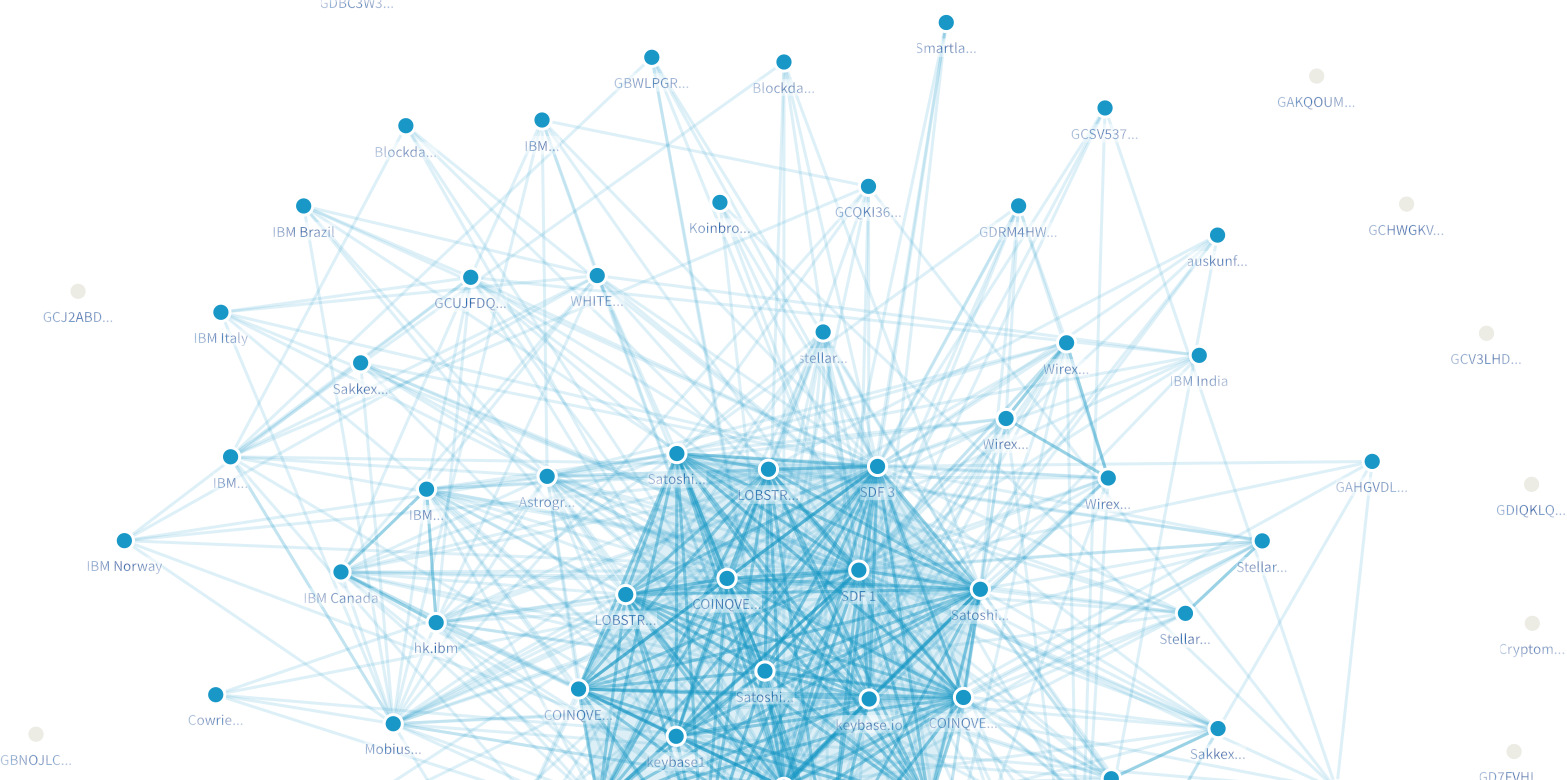
This figure appears in the Evaluation section of the Stellar Consensus Protocol (SCP) paper, which empirically assesses the safety and liveness properties of SCP on realistic network topologies. It presents a concrete depiction of how the federated voting structure actually appears when deployed, using observed quorum slice configurations to illustrate how global consensus emerges from locally chosen trust relationships.
What This Figure Shows
The diagram visualizes the quorum slice topology as a directed graph where each node represents a validator and each edge represents a trust relationship: a node includes the target in its quorum slice, meaning it requires agreement from the target before committing a value. Nodes that mutually include each other form dense clusters — analogous to intra-organizational trust groups — while inter-cluster edges represent cross-organizational trust that enables different institutions' validators to reach agreement. The key property illustrated is quorum intersection: any two quorums share at least one node, which is the necessary condition for safety in federated Byzantine agreement. The figure also reveals a tiered topology where a small set of well-connected core nodes appear in many participants' slices and act as glue stitching together the globally intersecting structure.
Significance
The quorum slice network map is the most intuitive visualization of SCP's core innovation — replacing administrator-imposed global membership with participant-chosen local trust — and demonstrates why federated Byzantine agreement can achieve safety on the open internet without requiring a fixed validator set. It is also practically important as a diagnostic tool: operators can inspect the map to identify weakly connected nodes or potential quorum disjointness before it causes consensus failures.