 XRP
XRP
طوبولوجيا شبكة UNL
Context
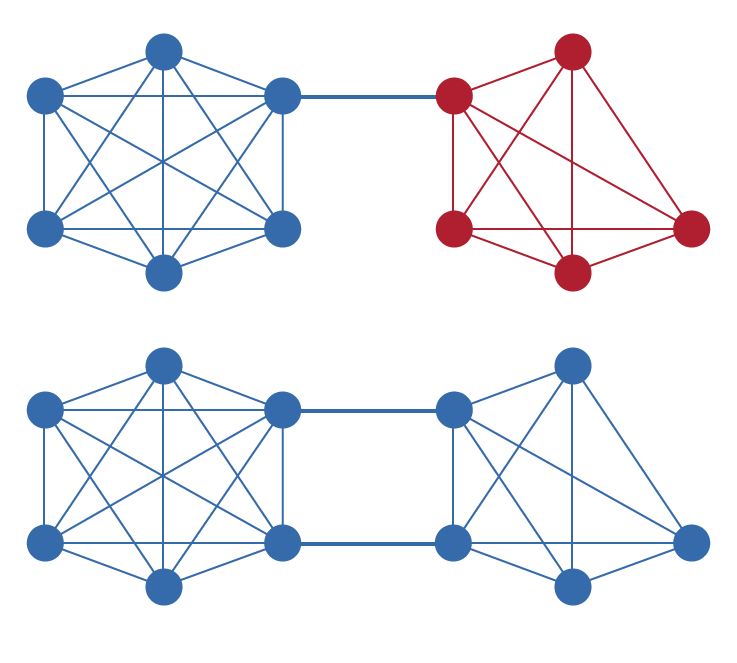
This figure appears in the Unique Node Lists section of the XRP Ledger consensus paper, which establishes the trust model underlying the Ripple Protocol Consensus Algorithm (RPCA). The section argues that global consensus does not require every node to trust every other node, but only requires sufficient overlap between the sets of validators each node trusts.
What This Figure Shows
The diagram depicts two clusters of validator nodes, each representing the Unique Node List (UNL) of a different participant. The overlapping region indicates validators appearing on both UNLs simultaneously. RPCA's safety depends on this overlap: when two nodes reach consensus using their respective UNLs, shared validators act as a bridge forcing both groups to agree on the same ledger state. If the intersection is smaller than 20% of the larger UNL, the network can bifurcate into groups that each achieve internal consensus but disagree with each other, producing a ledger fork. The topology illustrates the minimum connectivity requirement: even nodes with largely disjoint UNLs achieve global consistency as long as overlap exceeds the safety threshold.
Significance
This network topology diagram operationalizes the XRP Ledger's departure from PoW and PoS designs: rather than using economic stakes or computational puzzles, RPCA delegates trust to human-curated validator lists and relies on the structural property of UNL overlap for correctness. The XRP Ledger's safety is a graph-theoretic property of the trust network topology — a fundamentally different security model with significant implications for censorship resistance and validator selection.