 Bitcoin
Privacy Model
Context
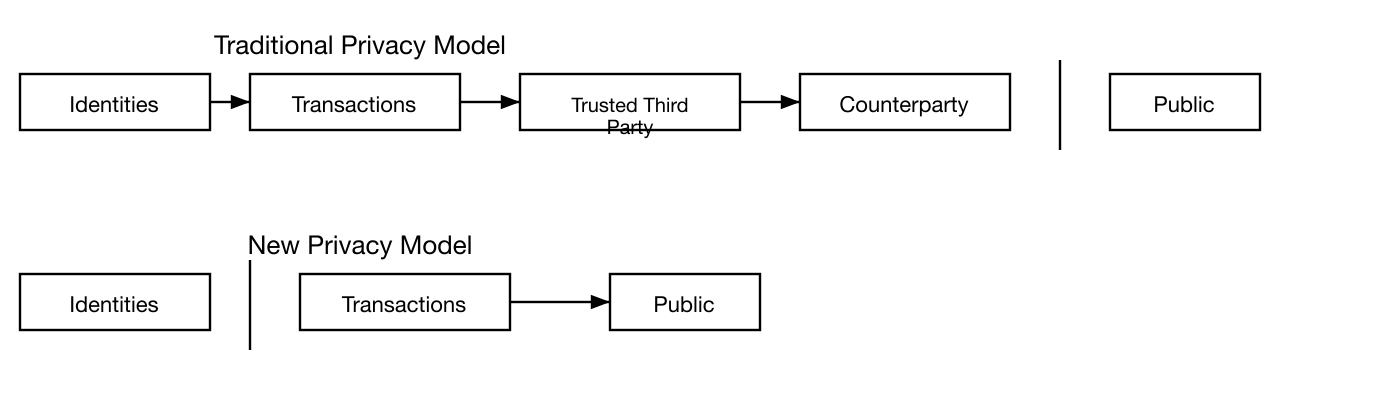
This figure appears in the Privacy section, which acknowledges that Bitcoin's requirement to publicly announce all transactions fundamentally breaks the traditional banking privacy model. The section argues that a new form of privacy can be achieved not by hiding transaction data, but by keeping the identities behind public keys anonymous. It also recommends using a fresh key pair for every transaction as an additional safeguard against linking.
What This Figure Shows
The diagram presents a side-by-side comparison of two privacy models. In the traditional model, a trusted third party such as a bank sits between the identities of transacting parties and the public, filtering what information is disclosed. In Bitcoin's new model, transaction data — amounts, inputs, outputs — is fully public, but the public keys involved are not tied to real-world identities, breaking the link between the financial record and the people behind it. This is analogous to a stock exchange tape, where trade sizes and times are public but the counterparties remain unnamed. The section warns that multi-input transactions necessarily reveal that those inputs share a common owner, creating a residual privacy risk if any one key is ever linked to an identity.
Significance
This figure articulates Bitcoin's pseudonymity model and distinguishes it clearly from both full anonymity and traditional financial privacy. It establishes the theoretical basis for address-reuse avoidance and motivates later privacy research and tooling in the broader cryptocurrency ecosystem, including CoinJoin, stealth addresses, and zero-knowledge proof systems.