Chainlink
Kostenverstärkung für Bestechende
Context
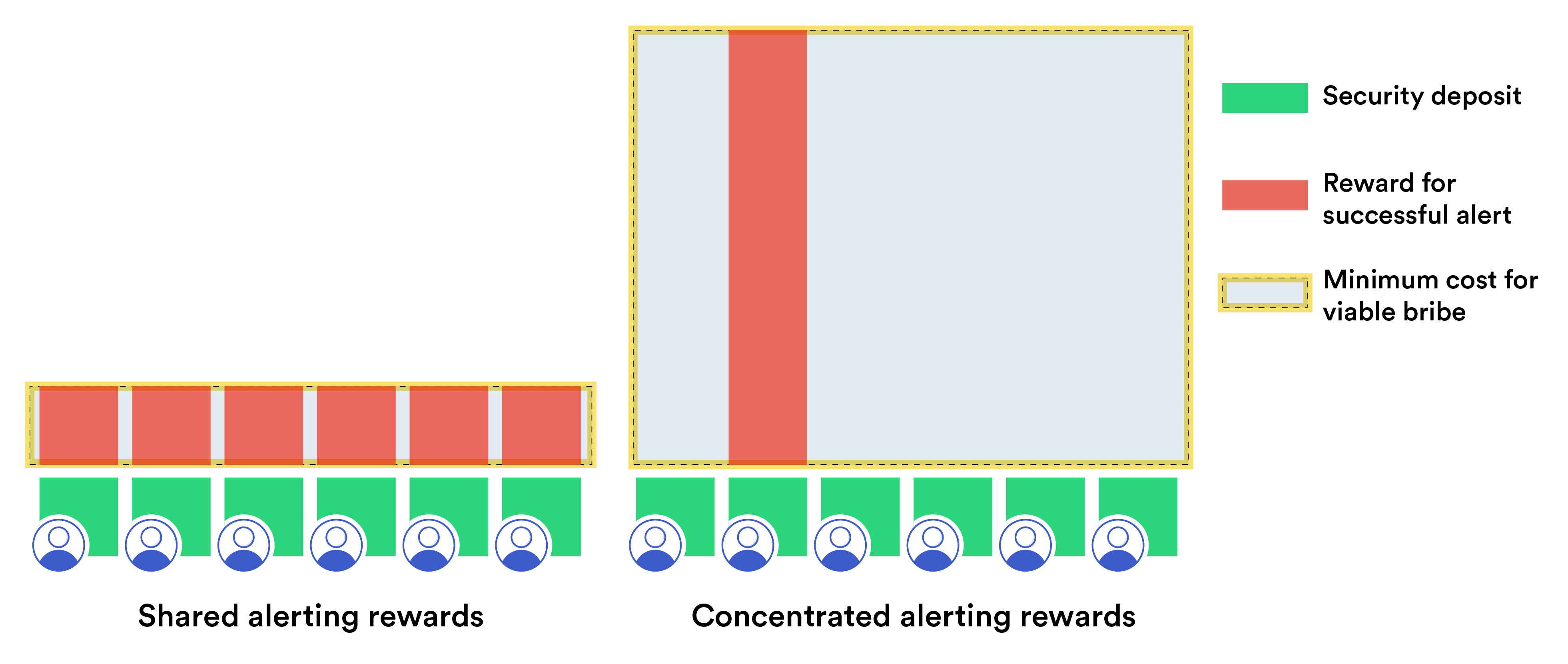
This figure appears in Section 9.4.2 during the explanation of quadratic staking impact. It provides an intuitive graphical comparison of two reward distribution schemes—shared alerting rewards versus concentrated alerting rewards—to show why concentration dramatically increases the cost of bribery. The figure directly supports the mathematical argument that the adversary's required budget scales quadratically rather than linearly.
What This Figure Shows
The figure shows two scenarios side by side. In the shared rewards scenario, alerting rewards are distributed among all potential alerters, so any individual node's expected reward is small (low red bar). A briber knowing this can offer each node only slightly more than this small expected reward, making the total bribery budget scale linearly with the number of nodes. In the concentrated rewards scenario, the full alerting reward goes to a single highest-priority watchdog (tall red bar). Because any node might be this highest-priority watchdog, the adversary must offer every single node a bribe exceeding this large concentrated reward. The gray regions show that the total payout required by the briber is vastly larger with concentrated rewards than with shared rewards.
Significance
This figure provides the clearest intuitive explanation of why watchdog priority and reward concentration produce super-linear staking impact. It shows graphically that a seemingly counterintuitive design choice—concentrating rewards in one node rather than distributing them broadly—dramatically increases the adversary's cost, transforming a linearly scalable attack into a quadratically expensive one.