
Polygon-Whitepaper
Abstract
Abstract
This paper proposes POL, the native token of the revised Polygon protocol architecture, commonly referred to as Polygon 2.0. As the successor of MATIC, POL is envisioned to become an instrumental tool for coordination and growth of the Polygon ecosystem and the main driver of the vision of Polygon as the Value Layer for the Internet. We start by analyzing relevant work, identifying opportunities and threats and, based on that, we establish POL design goals. We propose design, utility and tokenomics of POL that achieve all the design goals. We describe the concept of the Staking Layer, a one-of-a-kind, POL-powered chain coordinator, capable of supporting a practically unlimited number of Polygon chains with arbitrary features and configurations. We believe the introduction of the Staking Layer and the wider Polygon 2.0 architecture can establish Polygon as the third most important and impactful breakthrough in Web3 (the first two being Bitcoin and Ethereum), given the magnitude of innovation and adoption it can facilitate. We introduce the Community Treasury, an in-protocol, community-governed fund designed to provide ongoing economic support for further development and growth of the Polygon ecosystem. We describe the process of migration from MATIC to POL. To analyze the proposed design, we define an economic simulation model and run simulations to confirm the hypothesis of the model, derived from the aforementioned design goals. Based on everything above, we conclude that POL is a novel, next generation asset that provides a solid foundation for the ambitious vision of the Value Layer.
Zusammenfassung
In diesem Artikel wird POL vorgeschlagen, die native token der überarbeiteten Protokollarchitektur Polygon. allgemein als Polygon 2.0 bezeichnet. Als Nachfolger von MATIC soll POL entstehen ein Instrument für die Koordination und das Wachstum des Polygon-Ökosystems und der Haupttreiber der Vision von Polygon als Wertschicht für das Internet. Wir beginnen mit der Analyse relevanter Arbeiten, der Identifizierung von Chancen und Risiken und darauf aufbauend Legen Sie POL-Designziele fest. Wir schlagen Design, Nutzen und tokenomics von POL vor, die alles erreichen die Gestaltungsziele. Wir beschreiben das Konzept des Staking Layers, eines einzigartigen, POL-gestützten Kettenkoordinators. Kann eine praktisch unbegrenzte Anzahl von Polygon-Ketten mit beliebigen Funktionen unterstützen und Konfigurationen. Wir glauben, dass die Einführung des Staking Layers und des umfassenderen Polygon 2.0 Architektur kann Polygon als drittwichtigsten und wirkungsvollsten Durchbruch in etablieren Web3 (die ersten beiden sind Bitcoin und Ethereum), angesichts des Ausmaßes der Innovation und Adoption kann dadurch erleichtert werden. Wir stellen das Community Treasury vor, einen protokollinternen, von der Gemeinschaft verwalteten Fonds, der darauf ausgelegt ist Bereitstellung fortlaufender wirtschaftlicher Unterstützung für die weitere Entwicklung und das Wachstum des Polygon Ökosystem. Wir beschreiben den Prozess der Migration von MATIC zu POL. Um den vorgeschlagenen Entwurf zu analysieren, definieren wir ein wirtschaftliches Simulationsmodell und führen Simulationen durch um die Hypothese des Modells zu bestätigen, die aus den oben genannten Entwurfszielen abgeleitet wurde. Basierend auf dem oben Gesagten kommen wir zu dem Schluss, dass POL ein neuartiger Vermögenswert der nächsten Generation ist bietet eine solide Grundlage für die ehrgeizige Vision des Value Layer.
Vision
Vision
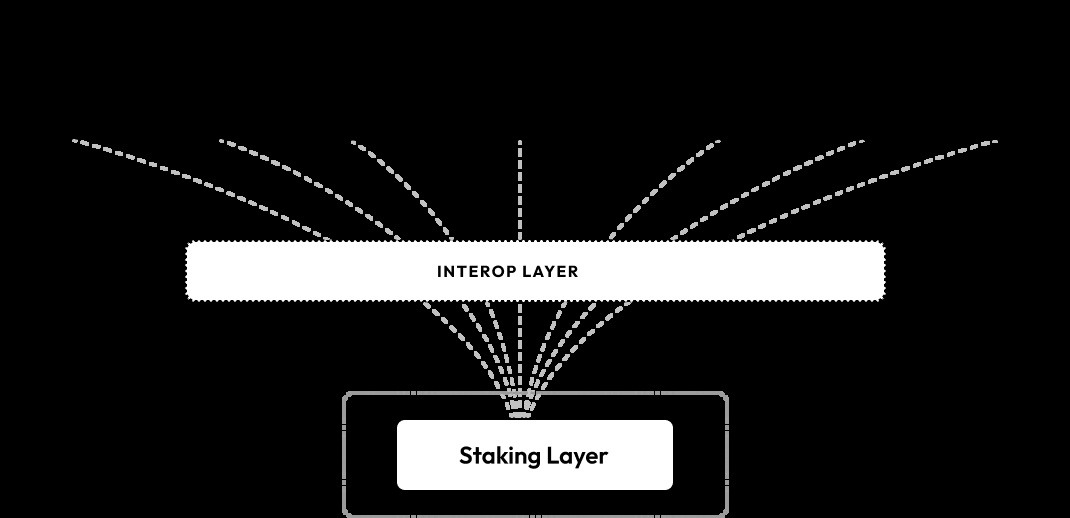
The vision behind Polygon as the Value Layer of the Internet is to usher a world in which value can be created and exchanged freely and globally, similarly to how we create and exchange information today. A world which enables new – fairer, more inclusive and more efficient – forms of human organizations and governance. We strongly believe that realizing this vision can significantly advance our society. In order to make this ambitious vision a reality, Polygon’s infrastructure must improve. Specifically, it must become exponentially more scalable, without sacrificing security and user experience. To address this, a reimagined protocol architecture is being introduced as part of the Polygon 2.0 effort. This radical redesign turns Polygon into a network of ZK-powered L2 chains, unified via a novel cross-chain coordination protocol. The network can support a practically unlimited number of chains, and cross-chain interactions can happen seamlessly and instantly without additional security or trust assumptions. This design fully delivers on the aforementioned requirement – exponential scalability without sacrificing security and user experience. Figure 1. Polygon protocol architecture To coordinate, secure and grow this powerful network, an advanced, well-designed protocol economy and mechanism design are necessary. This inspired the creation of POL.
Vision
Die Vision hinter Polygon als Wertschicht des Internets besteht darin, eine Welt voller Werte zu schaffen können frei und global erstellt und ausgetauscht werden, ähnlich wie wir erstellen und austauschen Informationen heute. Eine Welt, die neue – gerechtere, inklusivere und effizientere – Formen ermöglicht menschlicher Organisationen und Governance. Wir sind fest davon überzeugt, dass die Verwirklichung dieser Vision möglich ist bringen unsere Gesellschaft maßgeblich voran. Um diese ehrgeizige Vision Wirklichkeit werden zu lassen, muss die Infrastruktur von Polygon verbessert werden. Insbesondere muss es exponentiell skalierbarer werden, ohne Einbußen bei Sicherheit und Benutzerfreundlichkeit Erfahrung. Um dieses Problem anzugehen, wird im Rahmen des Polygon eine neu konzipierte Protokollarchitektur eingeführt. 2,0 Aufwand. Diese radikale Neugestaltung verwandelt Polygon in ein Netzwerk von ZK-betriebenen L2-Ketten, vereinheitlicht über ein neuartiges kettenübergreifendes Koordinationsprotokoll. Das Netzwerk kann praktisch unbegrenzt unterstützen Anzahl der Ketten, und kettenübergreifende Interaktionen können nahtlos und sofort ohne erfolgen zusätzliche Sicherheits- oder Vertrauensannahmen. Dieses Design erfüllt das oben Genannte vollständig Anforderung – exponentielle Skalierbarkeit ohne Einbußen bei Sicherheit und Benutzererfahrung. Abbildung 1. Polygon-Protokollarchitektur Um dieses leistungsstarke Netzwerk zu koordinieren, zu sichern und zu erweitern, ist ein fortschrittliches, gut konzipiertes Protokoll erforderlich Wirtschaftlichkeit und Mechanikdesign sind erforderlich. Dies inspirierte die Gründung von POL.
Relevant work
Relevant work
In this chapter we outline relevant native token design examples, the utility they assign to the token as well as notable advantages and disadvantages. 2.1 Bitcoin (BTC) BTC is the native token of the Bitcoin protocol, and it’s the first prominent native token implementation. The utility of BTC is twofold: ● Miner rewards: The protocol emits BTC and distributes it to protocol validators, aka miners; ● Transaction fees: Users pay fees in BTC for every transaction, which prevents spam and provides additional incentives for miners. One advantage of the BTC design is a deterministic, i.e. predictable supply. Normally, tokens with deterministic supply are more attractive to holders and can capture value better than those with non-deterministic supply. We consider BTC a legacy token design and we argue its disadvantages are multifold: ● It is an unproductive asset, it does not give its holders any meaningful role in the protocol nor the incentives to performs such a role; ● It does not leverage the opportunity to require stake in the native token for protocol validators and instead requires them to stake, i.e. invest external resources (mining equipment and electricity), thus making protocol less resilient and self-sustainable; ● It gradually reduces emission for mining rewards until it reaches zero, which introduces sustainability and security concerns (it is unclear if the security can be maintained once the emission rate becomes low or reaches zero); ● It does not introduce any type of economic support to the ecosystem; ● It does not give any governance rights to holders, although it can be argued that Layer 1 protocols such as Bitcoin should not utilize tokens for governance. 2.2 Ethereum (ETH) ETH is the native token of the Ethereum protocol and ecosystem. With its innovative design, it established the next generation of native protocol tokens.
The utility of ETH is multifold: ● Validators staking: Ethereum’s PoS (Proof-of-Stake) protocol requires validators to stake ETH in order to join the validator pool; ● Validator rewards: The protocol emits ETH and distributes it to protocol validators; ● Transaction fees: Users pay fees in ETH for every transaction, which prevents spam and provides additional incentives for validators. The design of ETH has multiple advantages: ● It is a productive asset, its holders can participate in securing the network and they receive incentives for doing that; ● It disincentivizes malicious behavior of validators via in-protocol slashing, i.e. destroying tokens of malicious validators; ● It does not introduce security and sustainability concerns, given that it doesn’t have supply cap like BTC; ● It provides economic support to the ecosystem via a predetermined portion of the initial supply allocated to the stewarding foundation. One potential disadvantage of the ETH design is that it does not have fully predictable supply, given that token emission for validator rewards increases as more tokens get staked. However, this is successfully countered by the built-in mechanism that burns1 a portion of every transaction fee, thus countering the impact of token emission for validator rewards. Another disadvantage is that the aforementioned economic support can not last indefinitely; the initial token allocation to the stewarding foundation will eventually get depleted. Lastly, it does not assign any governance right to token holders, although, as mentioned above, it can be argued that Layer 1 protocols should not utilize tokens for governance. 2.3 Cosmos (ATOM) ATOM is the native token of the Cosmos Hub, the intended central blockchain of the Cosmos multi-chain ecosystem. It has multifold utility, but only within Cosmos Hub: ● Validators staking; ● Validator rewards; ● Transaction fees; 1 https://github.com/ethereum/EIPs/blob/master/EIPS/eip-1559.md
● Governance. The design of ATOM has the following advantages: ● It is a productive asset, its holders can participate in securing Cosmos Hub and receive incentives for doing that; ● It does not introduce security and sustainability concerns, given that it doesn’t have supply cap; ● It provides economic support to the ecosystem via a predetermined allocation to the stewarding foundation; ● It gives its holders governance rights via a comprehensive governance model. The disadvantages of ATOM design: ● It only has utility within Cosmos Hub; it is not used to run and secure other chains in the ecosystem, although there are initiatives to enable this; ● It facilitates a token-only governance model, which excludes other relevant stakeholders of the ecosystem (developers, prominent contributors, applications etc.) from decision making; ● Economic support it facilitates can not last indefinitely, since the token treasury will eventually get depleted. 2.4 Polkadot (DOT) DOT is the native token of the Polkadot multi-chain ecosystem. It has the same utility as ATOM, but generally across the whole Polkadot ecosystem: ● Validators staking; ● Validator rewards; ● Transaction fees; ● Governance. The design of DOT has the following advantages: ● It is a productive asset; ● It does not introduce security and sustainability concerns, given that it doesn’t have supply cap; ● It provides economic support to the ecosystem via a predetermined allocation to the stewarding foundation; ● It gives its holders governance rights via a comprehensive governance model;
● It provides security for the whole ecosystem, i.e. all participating blockchains. The disadvantages are: ● It mandates the usage of DOT as the validator staking token for all participating chains, thus reducing architectural options for developers of Polkadot chains; ● It introduces a significant level of friction for developers of Polkadot blockchains who are required to bid and lock significant amounts of DOT in order for their chains to become part of the ecosystem; ● It facilitates a token-only governance model, which excludes other relevant stakeholders of the ecosystem from decision making; ● Economic support it facilitates can not last indefinitely, since the token treasury will eventually get depleted. 2.5 Aave (Aave) AAVE is the native token of Aave, an on-chain token lending platform. Given that AAVE is not a protocol but an application token, we do not analyze its design, advantages and disadvantages. The relevance of AAVE for POL design is twofold: ● AAVE is the successor of LEND, the initial native token of Aave; the Aave community executed a successful and beneficial migration from LEND to AAVE; ● AAVE provides its holders governance rights via a comprehensive governance model.
Relevante Arbeit
In diesem Kapitel skizzieren wir relevante native token-Designbeispiele und den Nutzen, den sie ihnen zuweisen token sowie nennenswerte Vor- und Nachteile. 2.1 Bitcoin (BTC) BTC ist der native token des Protokolls Bitcoin und der erste prominente native token Umsetzung. Der Nutzen von BTC ist zweifach: ● Miner-Belohnungen: Das Protokoll gibt BTC aus und verteilt es an das Protokoll validators, auch bekannt als Bergleute; ● Transaktionsgebühren: Benutzer zahlen für jede Transaktion Gebühren in BTC, wodurch Spam verhindert wird bietet zusätzliche Anreize für Bergleute. Ein Vorteil des BTC-Designs ist ein deterministisches, also vorhersehbares Angebot. Normalerweise tokens mit deterministischem Angebot sind für Inhaber attraktiver und können einen besseren Wert erzielen als diese mit nichtdeterministischer Versorgung. Wir betrachten BTC als ein veraltetes token-Design und argumentieren, dass es zahlreiche Nachteile hat: ● Es handelt sich um einen unproduktiven Vermögenswert, der seinen Inhabern keine sinnvolle Rolle im Protokoll einräumt noch die Anreize, eine solche Rolle auszuüben; ● Es nutzt nicht die Möglichkeit, eine Beteiligung am nativen token für das Protokoll zu verlangen validators und verlangt stattdessen, dass sie externe Ressourcen einsetzen (Mining). Ausrüstung und Elektrizität), wodurch das Protokoll weniger belastbar und autark wird; ● Es reduziert die Emissionen für Mining-Belohnungen schrittweise, bis sie Null erreichen, was zu einer Einführung führt Nachhaltigkeits- und Sicherheitsbedenken (es ist unklar, ob die Sicherheit einmal aufrechterhalten werden kann). die Emissionsrate wird niedrig oder erreicht Null); ● Es führt keinerlei wirtschaftliche Unterstützung für das Ökosystem ein; ● Es gibt den Inhabern keine Governance-Rechte, obwohl argumentiert werden kann, dass Layer 1 Protokolle wie Bitcoin sollten tokens nicht für die Governance verwenden. 2.2 Ethereum (ETH) ETH ist der native token des Ethereum-Protokolls und Ökosystems. Mit seinem innovativen Design ist es etablierte die nächste Generation des nativen Protokolls tokens.
Der Nutzen der ETH ist vielfältig: ● Validatoren staking: Das PoS-Protokoll (Proof-of-Stake) von Ethereum erfordert das Abstecken von validators ETH, um dem Pool validator beizutreten; ● Validator-Belohnungen: Das Protokoll gibt ETH aus und verteilt es an Protokoll validators; ● Transaktionsgebühren: Benutzer zahlen in der ETH Gebühren für jede Transaktion, was Spam verhindert und bietet zusätzliche Anreize für validators. Das Design der ETH hat mehrere Vorteile: ● Es handelt sich um ein produktives Gut, dessen Inhaber sich an der Sicherung des Netzwerks beteiligen können Anreize dafür erhalten; ● Es verhindert bösartiges Verhalten von validators durch protokollinternes Slashing, d. h. Zerstörung tokens von böswilligen validators; ● Es bringt keine Sicherheits- und Nachhaltigkeitsbedenken mit sich, da dies nicht der Fall ist Angebotsobergrenze wie BTC; ● Es unterstützt das Ökosystem wirtschaftlich über einen vorher festgelegten Teil des Anfangskapitals der Stewarding-Stiftung zugeteilte Versorgung. Ein potenzieller Nachteil des ETH-Designs besteht darin, dass das Angebot nicht vollständig vorhersehbar ist. Angesichts der Tatsache, dass die Emission von token für validator Belohnungen zunimmt, je mehr tokens eingesetzt werden. Allerdings Dem wird durch den eingebauten Mechanismus, der einen Teil davon verbrennt, erfolgreich entgegengewirkt Transaktionsgebühr, wodurch die Auswirkung der Emission von token auf validator Belohnungen ausgeglichen wird. Ein anderer Der Nachteil besteht darin, dass die oben genannte wirtschaftliche Unterstützung nicht unbegrenzt dauern kann; die Initiale token Die Zuweisung an die Stewarding Foundation wird irgendwann aufgebraucht sein. Schließlich ist dies nicht der Fall Weisen Sie den token-Inhabern jegliche Governance-Rechte zu, obwohl dies, wie oben erwähnt, argumentiert werden kann dass Layer 1-Protokolle tokens nicht für die Governance nutzen sollten. 2.3 Cosmos (ATOM) ATOM ist der native token des Cosmos Hubs, der beabsichtigte zentrale blockchain des Cosmos Multi-Chain-Ökosystem. Es hat einen vielfältigen Nutzen, jedoch nur innerhalb des Cosmos-Hubs: ● Validatoren staking; ● Validator-Belohnungen; ● Transaktionsgebühren; 1 https://github.com/ethereum/EIPs/blob/master/EIPS/eip-1559.md● Regierungsführung. Das Design von ATOM bietet folgende Vorteile: ● Es handelt sich um einen produktiven Vermögenswert, dessen Inhaber sich an der Sicherung des Cosmos Hub beteiligen und erhalten können Anreize dafür; ● Es bringt keine Sicherheits- und Nachhaltigkeitsbedenken mit sich, da dies nicht der Fall ist Versorgungsobergrenze; ● Es bietet dem Ökosystem durch eine vorher festgelegte Zuteilung wirtschaftliche Unterstützung Verwaltungsstiftung; ● Es gewährt seinen Inhabern Governance-Rechte über ein umfassendes Governance-Modell. Die Nachteile des ATOM-Designs: ● Es hat nur innerhalb des Cosmos Hubs einen Nutzen; Es dient nicht dazu, andere Ketten in der Anlage zu führen und zu sichern Ökosystem, obwohl es Initiativen gibt, die dies ermöglichen; ● Es ermöglicht ein Governance-Modell, das nur auf token beschränkt ist und andere relevante Interessengruppen ausschließt des Ökosystems (Entwickler, prominente Mitwirkende, Anwendungen usw.) von der Entscheidung machen; ● Die dadurch ermöglichte wirtschaftliche Unterstützung kann nicht unbegrenzt dauern, da die Staatskasse dies tun wird irgendwann erschöpft sein. 2.4 Polkadot (DOT) DOT ist der native token des Multi-Chain-Ökosystems Polkadot. Es hat den gleichen Nutzen wie ATOM, aber im Allgemeinen für das gesamte Polkadot-Ökosystem: ● Validatoren staking; ● Validator-Belohnungen; ● Transaktionsgebühren; ● Regierungsführung. Das Design von DOT hat folgende Vorteile: ● Es ist ein produktives Gut; ● Es bringt keine Sicherheits- und Nachhaltigkeitsbedenken mit sich, da dies nicht der Fall ist Versorgungsobergrenze; ● Es bietet dem Ökosystem durch eine vorher festgelegte Zuteilung wirtschaftliche Unterstützung Verwaltungsstiftung; ● Es gewährt seinen Inhabern Governance-Rechte über ein umfassendes Governance-Modell;
● Es bietet Sicherheit für das gesamte Ökosystem, d. h. alle teilnehmenden blockchains. Die Nachteile sind: ● Es schreibt die Verwendung von DOT als validator staking token für alle teilnehmenden Ketten vor. wodurch die architektonischen Optionen für Entwickler von Polkadot-Ketten reduziert werden; ● Es führt zu einem erheblichen Maß an Reibung für Entwickler von Polkadot blockchains, die dies tun Sie müssen erhebliche Mengen an DOT bieten und sperren, damit ihre Ketten funktionieren Teil des Ökosystems; ● Es ermöglicht ein Governance-Modell, das nur auf token beschränkt ist und andere relevante Interessengruppen ausschließt des Ökosystems aus der Entscheidungsfindung; ● Die dadurch ermöglichte wirtschaftliche Unterstützung kann nicht unbegrenzt dauern, da die Staatskasse dies tun wird irgendwann erschöpft sein. 2,5 Aave (Aave) AAVE ist der native token von Aave, einer On-Chain-Kreditplattform token. Da es sich bei AAVE nicht um ein Protokoll, sondern um eine Anwendung token handelt, analysieren wir das Design nicht. Vor- und Nachteile. Die Relevanz von AAVE für das POL-Design ist zweifach: ● AAVE ist der Nachfolger von LEND, dem ursprünglichen nativen token von Aave; die Aave-Community führte eine erfolgreiche und vorteilhafte Migration von LEND zu AAVE durch; ● AAVE bietet seinen Inhabern Governance-Rechte über ein umfassendes Governance-Modell.
Design goals
Design goals
Based on the analysis of relevant work, several major opportunities for POL to benefit the Polygon ecosystem were identified. These opportunities are brought forward here as POL design goals. 1. Ecosystem security. POL should help establish a highly decentralized pool of validators that can run and secure any Polygon chain. Validators should be incentivized to join and stay in the validator pool and help secure as many chains as possible, and at the same time disincentivized to do anything malicious. 2. Infinite scalability. POL should support exponential growth of the Polygon ecosystem and eventual “hyperblochainization” of the world. Primarily, it should enable the validator pool to scale to support thousands of Polygon chains.
3. Ecosystem support. Being a global network in the making, Polygon will require ongoing economic support for further development and growth. POL should help establish a self-sustaining funding mechanism for those activities. This funding “vehicle” should be governed by the Polygon community. 4. No friction. Blockchain networks often require both users and developers to hold, stake or consume their native tokens in order to use the network. This causes friction and degrades user and developer experience. POL should be designed in a way that does not introduce any such friction. 5. Community ownership. Polygon is envisioned as a decentralized network governed by its community. Assigning governance rights to POL holders can enable creation of effective governance models in which decision makers are directly incentivized to support proposals that are in the best interest of the Polygon ecosystem.
Designziele
Basierend auf der Analyse relevanter Arbeiten ergeben sich für POL mehrere große Chancen, von denen zu profitieren ist Polygon Ökosystem wurden identifiziert. Diese Möglichkeiten werden hier vorgestellt POL Gestaltungsziele. 1. Ökosystemsicherheit. POL soll dabei helfen, einen stark dezentralen Pool aufzubauen validators, die jede Polygon-Kette ausführen und sichern können. Validatoren sollten Anreize erhalten dem validator-Pool beizutreten und dort zu bleiben und dabei zu helfen, so viele Ketten wie möglich zu sichern, und zwar bei Gleichzeitig werden sie nicht dazu angeregt, etwas Bösartiges zu tun. 2. Unendliche Skalierbarkeit. POL sollte das exponentielle Wachstum des Ökosystems Polygon unterstützen und schließlich „Hyperblochainisierung“ der Welt. In erster Linie sollte es die Funktion validator aktivieren. Pool skalierbar, um Tausende von Polygon-Ketten zu unterstützen.
3. Unterstützung des Ökosystems. Da Polygon ein globales Netzwerk im Entstehen ist, ist fortlaufender Bedarf erforderlich wirtschaftliche Unterstützung für weitere Entwicklung und Wachstum. POL soll dabei helfen, eine zu etablieren selbsttragender Finanzierungsmechanismus für diese Aktivitäten. Dieses Finanzierungs-„Vehikel“ sollte es sein wird von der Polygon-Community verwaltet. 4. Keine Reibung. Blockchain-Netzwerke erfordern häufig, dass sowohl Benutzer als auch Entwickler Anteile halten oder ihre nativen tokens verbrauchen, um das Netzwerk zu nutzen. Dies verursacht Reibung und beeinträchtigt die Benutzer- und Entwicklererfahrung. POL sollte so gestaltet sein, dass dies der Fall ist keine solche Reibung hervorrufen. 5. Gemeinschaftseigentum. Polygon ist als dezentrales Netzwerk gedacht, das von verwaltet wird seine Gemeinschaft. Die Zuweisung von Governance-Rechten an POL-Inhaber kann die Erstellung von ermöglichen effektive Governance-Modelle, bei denen Entscheidungsträger direkte Anreize erhalten Unterstützen Sie Vorschläge, die im besten Interesse des Ökosystems Polygon sind.
Utility
Utility
POL is the native token of Polygon, and as such represents the major tool for coordination and incentivization of the whole Polygon ecosystem. It has multi-fold utility, namely: ● Validator staking; ● Validator rewards; ● Community ownership, i.e. governance. 4.1 Validator staking Polygon validators are required to stake POL in order to join the validator pool. Validator staking increases security of the ecosystem by: ● Preventing Sybil attacks; ● Aligning validators with the success of the ecosystem; ● Enabling slashing, i.e. punishment of malicious validators. By staking POL and joining the validator pool, validators become eligible to subscribe to validate any Polygon chain. Validation and its benefits for validators are further explained in § 6.3.
4.2 Validator rewards Decentralization and size of the validator pool is critically important for security, resilience and neutrality of the whole Polygon ecosystem. To incentivize validator onboarding and retention, predefined amounts of POL should be continuously distributed to Polygon validators as protocol rewards. Protocol rewards should be distributed to validators proportionally to the amount of POL they stake. POL emission is described in § 5.2. Protocol rewards provide base incentives for validators and establish a level playing field for the whole validator pool. On top of it, validators can then secure additional incentives by validating individual Polygon chains. Additional validator incentives are described in § 6.3. 4.3 Governance To facilitate efficient, community-run governance of important aspects of the Polygon ecosystem, POL should be technically enabled to hold governance rights, i.e. be utilized in governance frameworks. Describing the Polygon governance framework is out of the scope of this paper.
Nutzen
POL ist das native token von Polygon und stellt als solches das wichtigste Werkzeug für die Koordination dar Anreize für das gesamte Polygon-Ökosystem. Es hat einen mehrfachen Nutzen, nämlich: ● Validator staking; ● Validator-Belohnungen; ● Gemeinschaftseigentum, d. h. Governance. 4.1 Validator staking Polygon validators müssen POL einsetzen, um dem validator-Pool beizutreten. Validator staking erhöht die Sicherheit des Ökosystems durch: ● Verhindern von Sybil-Angriffen; ● Ausrichtung von validators auf den Erfolg des Ökosystems; ● Ermöglicht Slashing, also die Bestrafung böswilliger validators. Durch staking POL und den Beitritt zum validator-Pool werden validators berechtigt, sich zur Validierung anzumelden jede Polygon-Kette. Die Validierung und ihre Vorteile für validators werden in § 6.3 näher erläutert.
4.2 Validator-Belohnungen Dezentralisierung und Größe des validator-Pools sind von entscheidender Bedeutung für Sicherheit, Ausfallsicherheit und Neutralität des gesamten Polygon Ökosystems. Um Anreize für das Onboarding und die Bindung von validator zu schaffen, Vordefinierte Mengen an POL sollten als Protokoll kontinuierlich an Polygon validators verteilt werden Belohnungen. Protokollbelohnungen sollten proportional zur Menge an validators verteilt werden POL sie setzen. Die POL-Emission wird in § 5.2 beschrieben. Protokollprämien bieten grundlegende Anreize für validators und schaffen gleiche Wettbewerbsbedingungen für die gesamter validator Pool. Darüber hinaus können sich validators dann durch Validierung zusätzliche Anreize sichern einzelne Polygon Ketten. Zusätzliche validator Anreize sind in § 6.3 beschrieben. 4.3 Governance Zu erleichtern effizient, von der Gemeinschaft geführt Regierungsführung von wichtige Aspekte des Polygon Ökosystem sollte POL technisch in der Lage sein, Governance-Rechte zu besitzen, d. h. genutzt zu werden Governance-Rahmen. Die Beschreibung des Governance-Frameworks Polygon liegt außerhalb des Rahmens von dieses Papier.
Supply
Supply
Here we cover the initial supply and the emission policy of POL, and describe the rationale behind both. 5.1 Initial supply The initial supply of POL is 10 billion tokens. The entirety of the initial supply should be dedicated for migration, i.e. token swap from MATIC to POL. This migration would need to take place in order for POL to succeed MATIC as the native token of the Polygon ecosystem, and it is discussed in § 8. The initial supply of POL matches the supply of MATIC, which should make the migration quite straightforward. Once the migration is complete, the distribution of POL would essentially match the current distribution of MATIC. MATIC has already gone through an extensive process of token distribution which has resulted in more than 600,000 holder addresses2, and likely even more 2 Source: https://etherscan.io/token/0x7d1afa7b718fb893db30a3abc0cfc608aacfebb0#balances
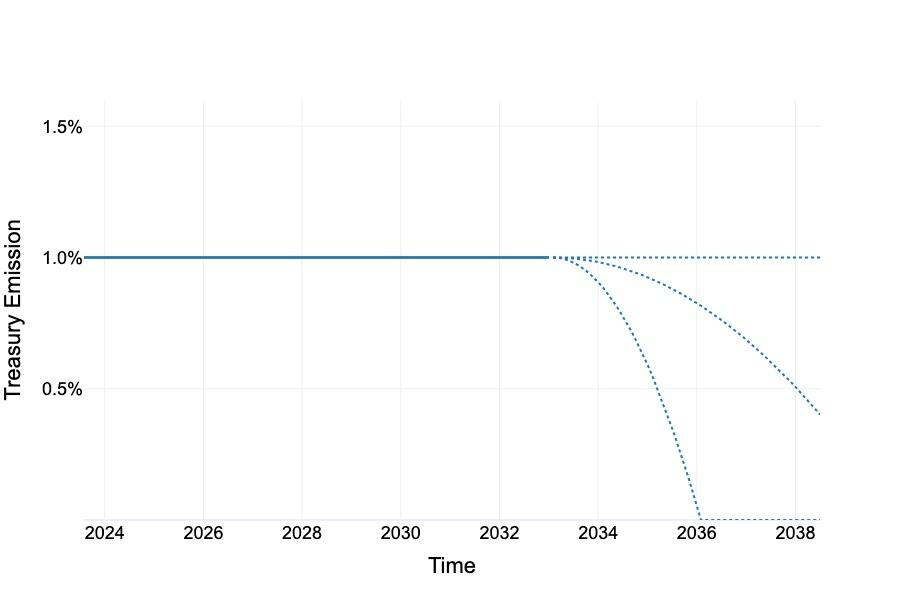
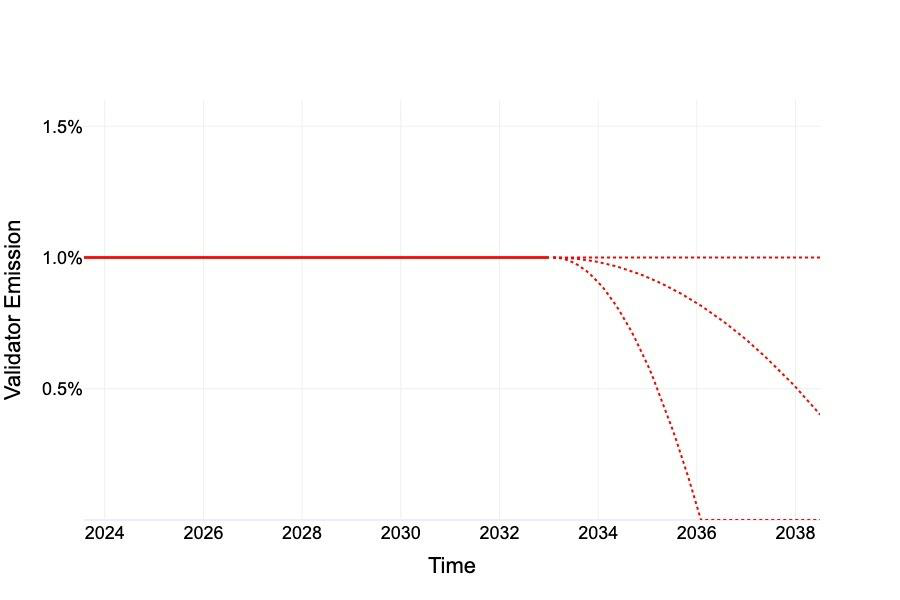
actual holders, given that centralized crypto exchanges’ and DeFi protocols’ addresses represent multiple users. This implies that POL would be widely distributed from day one, which is instrumental for overall decentralization and resilience of the ecosystem. 5.2 Emission POL is emitted at a predefined, deterministic rate for two purposes: 1. Validator rewards. To incentivize validator onboarding and retention, POL should be continuously emitted at a predetermined rate and distributed to validators as the base, protocol reward. We propose a yearly emission rate of 1% of the POL supply for this purpose. The emission rate would not be possible to change for the initial 10 years, and after that period the community can decide to decrease it in an arbitrary way via the governance framework. The emission rate can never be increased beyond 1%. 2. Ecosystem support. To provide ongoing support for further development and growth of the Polygon ecosystem, we propose to introduce the Community Treasury, a community-governed ecosystem fund, described in § 7. We propose a yearly emission rate of 1% of the POL supply for this purpose. Just like the emission for validator rewards, this emission rate can be decreased after 10 years via a governance framework, and it can never be increased beyond 1%. Figure 2. Possible POL emission rate scenarios The rationale for the proposed emission and the emission rates is that the Polygon ecosystem and Web3 in general will need time to mature and reach mainstream adoption. Based on the
historical Internet and computing platforms adoption cycles, the maturity phase could be realistically expected to happen in about 10-15 years. During that period, the ecosystem will need economic support. Once the Polygon ecosystem and Web3 reach maturity, transaction fees and other incentives secured by validating Polygon chains (described in § 6.3) should alone generate sufficient returns for Polygon validators. Once that happens, the community can decide to intervene and reduce or completely discontinue the emission for validator rewards, without impacting security and decentralization of the ecosystem. Similarly, the community can then decide to decrease or discontinue the emission for the Community Treasury as well, given that the ecosystem will not need significant economic support anymore. Obviously, the adoption cycle of Web3 might look slightly or completely different. In case it turns out that reaching mainstream adoption takes more time and the ecosystem still needs support after 10 years, the community can choose not to intervene and the emission will continue to happen for as long as required. We consider the proposed emission policy optimal, as it achieves the equilibrium between: ● Sufficient ecosystem support. Sufficient, future-proof support to the Polygon ecosystem is critically important for security and success of Polygon. To validate the hypothesis that the proposed emission rates are indeed sufficient, we developed an economic model, ran simulations and presented results in § 9. ● Security via scarcity. Scarcity of native tokens is instrumentally important for blockchain networks; high token dilution can dramatically affect security. To estimate POL scarcity, we can compare the proposed emission rate to the emission rate of BTC, which is currently at ≈1.8%3, and has been significantly higher in the past. Also, although gradually declining, BTC emission is guaranteed to happen for more than another century, whilst POL emission could potentially be reduced or discontinued even after 10 years. Given that (i) Bitcoin is considered a highly scarce asset, and (ii) total POL emission rate is comparable to (and potentially more strict than) BTC, we conclude that POL is sufficiently scarce, i.e. its emission does not introduce protocol security concerns. 3 Source: https://charts.woobull.com/bitcoin-inflation/
Lastly, it is important to note that the emission policy we propose has a high degree of predictability. The predetermined emission schedule makes POL supply predictable in the long term, even if the community decides to intervene. As explained, the community can only decrease the rates, thus effectively complementing the predetermined emission policy and potentially increasing scarcity of POL. Predictability and scarcity attract protocol and market participants and provide a sense of reliability. As the Polygon ecosystem continues to grow, this should contribute to establishing POL as an attractive and reliable digital asset, which subsequently could further ignite adoption and reliability, thus creating a virtuous circle.
Angebot
Hier behandeln wir die Erstversorgung und die Emissionspolitik von POL und beschreiben die Gründe hinter beiden. 5.1 Erstausstattung Der anfängliche Bestand an POL beträgt 10 Milliarden tokens. Die gesamte Erstausstattung sollte vorhanden sein dediziert für die Migration, d. h. token Wechsel von MATIC zu POL. Diese Migration müsste dauern Platz, damit POL MATIC als nativer token des Polygon-Ökosystems ablösen kann, und zwar wird in § 8 besprochen. Der anfängliche Vorrat an POL entspricht dem Vorrat an MATIC, was die Migration recht angenehm gestalten sollte unkompliziert. Sobald die Migration abgeschlossen ist, würde die Verteilung von POL im Wesentlichen der aktuellen entsprechen Vertrieb von MATIC. MATIC hat bereits einen umfangreichen Prozess von token durchlaufen Verteilung, die zu mehr als 600.000 Inhaberadressen2 geführt hat, und wahrscheinlich sogar noch mehr 2 Quelle: https://etherscan.io/token/0x7d1afa7b718fb893db30a3abc0cfc608aacfebb0#balances
tatsächliche Inhaber, da die Adressen zentraler Krypto-Börsen und DeFi-Protokolle vorliegen repräsentieren mehrere Benutzer. Dies bedeutet, dass POL vom ersten Tag an weit verbreitet sein würde ist entscheidend für die allgemeine Dezentralisierung und Widerstandsfähigkeit des Ökosystems. 5.2 Emission POL wird zu zwei Zwecken mit einer vordefinierten, deterministischen Rate ausgegeben: 1. Validator-Belohnungen. Um Anreize für das Onboarding und die Bindung von validator zu schaffen, sollte POL vorhanden sein kontinuierlich mit einer vorgegebenen Rate emittiert und an validators als Basis verteilt, Protokollbelohnung. Wir schlagen hierfür eine jährliche Emissionsrate von 1 % des POL-Angebots vor Zweck. Die Emissionsrate wäre in den ersten 10 Jahren nicht veränderbar Nach diesem Zeitraum kann die Community beschließen, den Betrag auf beliebige Weise zu verringern Governance-Rahmen. Die Emissionsrate kann niemals über 1 % erhöht werden. 2. Unterstützung des Ökosystems. Kontinuierliche Unterstützung für die Weiterentwicklung und das Wachstum von die Polygon Ökosystem, wir vorschlagen zu vorstellen die Gemeinschaft Finanzministerium, a Gemeinnütziger Ökosystemfonds, beschrieben in § 7. Wir schlagen eine jährliche Emission vor zu diesem Zweck einen Satz von 1 % des POL-Angebots. Genau wie die Emission für validator Belohnungen kann diese Emissionsrate nach 10 Jahren durch eine Governance gesenkt werden Rahmen und kann nie über 1 % erhöht werden. Abbildung 2. Mögliche Szenarien für die POL-Emissionsrate Der Grund für die vorgeschlagene Emission und die Emissionsraten ist, dass das Ökosystem Polygon ist und Web3 im Allgemeinen wird Zeit brauchen, um zu reifen und die Akzeptanz im Mainstream zu erreichen. Basierend auf derIn den historischen Einführungszyklen von Internet- und Computerplattformen könnte die Reifephase der Fall sein realistisch voraussichtlich in etwa 10-15 Jahren geschehen. Während dieser Zeit wird das Ökosystem brauchen wirtschaftliche Unterstützung. Sobald das Polygon-Ökosystem und Web3 ausgereift sind, fallen Transaktionsgebühren und andere Anreize an Die Sicherung durch die Validierung von Polygon-Ketten (beschrieben in § 6.3) sollte allein ausreichend generieren gibt für Polygon validators zurück. Sobald dies geschieht, kann die Community beschließen, einzugreifen Reduzieren Sie die Emission von validator-Prämien oder stellen Sie sie ganz ein, ohne die Sicherheit zu beeinträchtigen und Dezentralisierung des Ökosystems. Ebenso kann die Community dann entscheiden, die Zahl zu verringern bzw Die Emission wird auch für das Finanzministerium der Gemeinschaft eingestellt, da das Ökosystem dies nicht tun wird brauchen nicht mehr erhebliche wirtschaftliche Unterstützung. Offensichtlich könnte der Einführungszyklus von Web3 etwas oder ganz anders aussehen. Falls es sich dreht Wir stellen fest, dass es mehr Zeit braucht, bis die Akzeptanz im Mainstream erreicht ist, und dass das Ökosystem noch Unterstützung benötigt Nach 10 Jahren kann die Gemeinschaft entscheiden, nicht einzugreifen, und die Emission wird weiterhin stattfinden geschieht so lange wie nötig. Wir halten die vorgeschlagene Emissionspolitik für optimal, da sie das Gleichgewicht zwischen Folgendem erreicht: ● Ausreichend Ökosystem Unterstützung. Ausreichend, zukunftssicher Unterstützung zu die Polygon Ökosystem ist von entscheidender Bedeutung für die Sicherheit und den Erfolg von Polygon. Zur Validierung der Hypothese, dass die vorgeschlagenen Emissionsraten tatsächlich ausreichend sind, haben wir eine entwickelt Wirtschaftsmodell, führte Simulationen durch und präsentierte die Ergebnisse in § 9. ● Sicherheit über Knappheit. Der Mangel an einheimischen tokens ist von entscheidender Bedeutung für blockchain Netzwerke; Eine hohe token Verdünnung kann die Sicherheit dramatisch beeinträchtigen. Zum Schätzen POL-Knappheit, wir können die vorgeschlagene Emissionsrate mit der Emissionsrate von BTC vergleichen, Dieser liegt derzeit bei ≈1,8 %3 und war in der Vergangenheit deutlich höher. Auch wenn Wenn der BTC-Ausstoß allmählich abnimmt, wird er garantiert noch länger anhalten Jahrhundert, während die POL-Emission möglicherweise sogar nach dem 10. Jahrhundert reduziert oder eingestellt werden könnte Jahre. Angesichts der Tatsache, dass (i) Bitcoin als äußerst knappes Gut gilt und (ii) der gesamte POL Die Emissionsrate ist mit der von BTC vergleichbar (und möglicherweise strenger als diese), daraus schließen wir POL ist ausreichend selten, d. h. seine Emission wirft keine Bedenken hinsichtlich der Protokollsicherheit auf. 3 Quelle: https://charts.woobull.com/bitcoin-inflation/
Abschließend ist es wichtig anzumerken, dass die von uns vorgeschlagene Emissionspolitik ein hohes Maß an Nachhaltigkeit aufweist Vorhersehbarkeit. Der vorgegebene Emissionsplan macht die POL-Versorgung auf lange Sicht vorhersehbar selbst wenn die Gemeinschaft beschließt, einzugreifen. Wie erläutert, kann die Community nur Senkung der Sätze und somit wirksame Ergänzung der vorgegebenen Emissionspolitik und potenziell zunehmende Knappheit von POL. Vorhersehbarkeit und Knappheit ziehen Protokoll und Markt an Teilnehmer und vermitteln ein Gefühl der Verlässlichkeit. Da das Polygon-Ökosystem weiter wächst, ist dies der Fall soll dazu beitragen, POL als attraktives und zuverlässiges digitales Asset zu etablieren Anschließend könnten Akzeptanz und Zuverlässigkeit weiter gefördert und so ein positiver Kreislauf geschaffen werden.
Staking Layer
Staking Layer
Realizing the vision of the Value Layer of the Internet will eventually require the Polygon network to host billions of users and millions of Web3 applications. To enable this vast level of activity, hundreds or thousands of Polygon chains will be running in parallel, secured by tens or hundreds of thousands of validators. In order to coordinate all Polygon chains and validators, the redesigned Polygon protocol architecture introduces the Staking Layer. The Staking Layer is a one-of-a-kind programmable multi-chain coordinator protocol. By orchestrating all Polygon validators and chains, it enables: ● Unlimited scalability of the ecosystem; ● Simple, automated access to dedicated Web3 infrastructure to any Web3 project. The Web3 industry was started by Bitcoin, the first successful blockchain with a single application – digital currency. As new applications and use cases were being proposed, they were normally launching their own blockchains, which was slow and complex. This was addressed by the second major breakthrough of Web3 – Ethereum, a programmable blockchain that can support any application or use case. Despite being a huge paradigm shift, the main limitation of Ethereum is that it is not able to scale to support mainstream adoption. To mitigate this limitation, the Ethereum community turned to Layer 2 chains – blockchain architectures that offer higher scalability without sacrificing security. With the introduction of Staking Layer, Polygon becomes capable of supporting a practically unlimited number of Layer 2 chains, each fully programmable both on the application and the configuration level. We believe this can be the third most important breakthrough since the commencement of Web3, given the magnitude of innovation and adoption it enables.
Describing and specifying the Staking Layer in detail is out of the scope of this paper. Instead, and in order to get better understanding of this POL-powered layer and its potential, we provide an overview of its following aspects: ● Design and implementation; ● Polygon chains management; ● Validator management. 6.1 Design and implementation As mentioned above, the Staking Layer is a programmable multi-chain coordinator. It manages two main logical components: 1. Validator registry: Maintains the up-to-date registry of validators, with their corresponding POL stakes and chains they are subscribed to; 2. Chain registry: Maintains the up-to-date registry of Polygon chains, with their corresponding configurations. The main feature the Staking Layer requires is full programmability; it allows it to support and coordinate: ● Arbitrary configurations of Polygon chains; ● All validator-related operations; ● Arbitrary supporting operations and applications, e.g. staking derivatives. The optimal way to achieve programmability is by utilizing EVM (Ethereum Virtual Machine), since it provides a number of benefits: ● Turing-completeness; ● Maturity of the EVM, higher level languages (e.g. Solidity) and tooling; ● Developer base etc. Practically, this means that the Staking Layer will be implemented as a set of EVM smart contracts. These smart contracts can be deployed on any EVM blockchain, likely on Ethereum or Polygon zkEVM rollup, given that both offer a high level of security. 6.2 Polygon chains management The Staking Layer can support a practically unlimited number of Polygon chains, each with arbitrary features and configuration, and provide them the required level of decentralization.
The main service that the Staking Layer provides to Polygon chains is the management of their validator requirements and validator sets established according to those requirements. Validator requirements are specified in a config smart contract that every Polygon chain deploys in order to get initiated. This smart contract can define arbitrary validator requirements, including but not limited to: ● Maximal validator number: Specifies the maximum number of validators the chain accepts in its validator set. ● Minimal validator number: The minimal number of validators required to initiate the chain. ● Slashable offenses: On-chain attributable validation offenses that cause slashing of the stake; ● Validator criteria: The only common criteria for all validators in the Staking Hub is a stake in POL. Arbitrary additional criteria can be specified, such as authorization by a third party, additional stake in other tokens (e.g. native tokens of individual Polygon chains) etc. In addition to the ability to configure validator requirements, Polygon chains can arbitrarily configure all other parameters and features of their architecture. These are not defined on the Staking Layer level, but instead in the client code of Polygon chains. Some notable parameters and features are: ● Native token: Chains can create their native tokens which can be used for various purposes, e.g. transaction fees, user incentivization etc. ● Fee management: Chains can decide how to manage transaction fees. Normally, transaction fees would be passed to validators in their entirety, but other distribution models are possible, e.g. burning a portion of fees and passing the remaining portion to validators. ● Additional rewards: All Polygon validators receive base protocol rewards (as described in § 4.2) and normally transaction fees from Polygon chains they validate. In order to attract more validators, Polygon chain can offer additional rewards on top of these. These rewards will likely often be in native tokens of those chains. ● Block time and size: It is possible to configure the frequency and size, i.e. gas limit of blocks. ● Checkpoint time: Validator sets provide fast, local finality for Polygon chains. In addition to this, all Polygon chains periodically generate and submit zero-knowledge proofs to
Ethereum, thus leveraging its high security. The frequency of these checkpoints can be configured (e.g. every 5 minutes). ● Data availability: The data availability model can also be specified. Chains can decide to leverage Ethereum (rollup model) or their own validator sets or other external data availability service (validium model). With the proposed framework, launching a new Polygon chain practically boils down to writing and deploying the aforementioned config smart contract. Once the contract gets deployed to the Staking Layer, validators can start subscribing to it. When the minimal required number of validators is reached, the chain gets launched. We believe that this simple way of configuring and launching chains can usher a new era of innovation and adoption. The game-changing design decision of Ethereum was to not try to predict what applications and use cases developers will want to build. Instead, it offered a Turing-complete programmable environment that can support any application or use case. With the Staking Layer, Polygon is taking the same approach for launching new chains – it supports practically any chain design, in a programmable manner and without scaling limitations. 6.3 Validator management The Staking Layer can support a practically unlimited number of validators. It manages validators throughout their whole lifecycle and enables them to secure different types of incentives for performing useful work. There are four possible phases, i.e. statuses, in the validator lifecycle: 1. Activation: Validators get initiated as part of the validator pool by depositing POL into the staking contract on the Staking Layer. Once initiated, validators become eligible to receive base protocol rewards (described in § 4.2). 2. Subscription: Once initiated, validators are allowed to subscribe to validate any Polygon chain. 3. Validation: If a validator meets all the criteria of the Polygon chain it subscribed to, it becomes a member of that chain’s validator set. Validators can validate multiple chains, and their POL stake is acknowledged on each of those chains. If a validator gets slashed for a predefined slashable offense on one of the chains, its POL balance gets updated and reflected on all chains it validates. The validation and subscription phases can
overlap; a single validator can be in the subscription phase on one Polygon chain and in the validation phase on another. 4. Retirement: Validators can leave the validator pool at any point. Once the retirement is initiated, a predefined waiting period commences, allowing for potential pending slashing. After the waiting period, validators are able to withdraw their POL stake from the deposit contract. In return for validating Polygon chains, validators can establish at least three incentive streams: 1. Protocol rewards: As described above, every active Polygon validator is receiving base protocol rewards. The total POL emission for validator rewards (described in § 5.2), is distributed to active validators proportionally to their POL stake. 2. Transaction fees: Validators are allowed to validate any number of Polygon chains. In return, these chains will normally award the entirety or a portion of transaction fees to validators. 3. Additional rewards: As mentioned above, some Polygon chains can choose to introduce additional rewards to attract more validators. These rewards can be in any token, including but not limited to POL, stablecoins or native tokens of those Polygon chains. As we describe validator incentives, it is worth noting that the concept of validation in Polygon is broader than the usual, narrow definition. This further improves the value proposition of the validator role – in addition to validating multiple chains, validators can also perform multiple roles on a single chain. The most common roles will likely be: ● Validation in the narrow sense: Accepting user transactions, determining their validity and generating blocks; ● Proving: Producing zero-knowledge proofs of transaction validity; ● Data availability: Providing guarantees that transaction data is published and publicly available.
Absteckschicht
Um die Vision der Wertschicht des Internets zu verwirklichen, ist letztendlich das Netzwerk Polygon erforderlich um Milliarden von Benutzern und Millionen von Web3-Anwendungen zu hosten. Um dieses enorme Maß an Aktivität zu ermöglichen, Hunderte oder Tausende von Polygon-Ketten werden parallel laufen, gesichert durch Dutzende oder Hunderttausende validators. Um alle Polygon-Ketten und validators zu koordinieren, Die neu gestaltete Protokollarchitektur Polygon führt die Staking-Schicht ein. Der Staking Layer ist ein einzigartiges programmierbares Multi-Chain-Koordinatorprotokoll. Von Durch die Orchestrierung aller Polygon validators und Ketten wird Folgendes ermöglicht: ● Unbegrenzte Skalierbarkeit des Ökosystems; ● Einfacher, automatisierter Zugriff auf die dedizierte Web3-Infrastruktur für jedes Web3-Projekt. Die Web3-Branche wurde von Bitcoin ins Leben gerufen, dem ersten erfolgreichen blockchain mit einer einzigen Anwendung – digitale Währung. Als neue Anwendungen und Anwendungsfälle vorgeschlagen wurden, haben sie Normalerweise starteten sie ihre eigenen blockchains, was langsam und komplex war. Das war angesprochen durch den zweiten großen Durchbruch von Web3 – Ethereum, ein programmierbarer blockchain das jede Anwendung oder jeden Anwendungsfall unterstützen kann. Obwohl es sich um einen großen Paradigmenwechsel handelt, ist der wichtigste Die Einschränkung von Ethereum besteht darin, dass es nicht skaliert werden kann, um die Akzeptanz im Mainstream zu unterstützen. Zur Milderung Aufgrund dieser Einschränkung wandte sich die Ethereum-Community an Layer 2-Ketten – blockchain-Architekturen bieten eine höhere Skalierbarkeit ohne Einbußen bei der Sicherheit. Mit der Einführung des Staking Layers Polygon ist in der Lage, jeweils eine praktisch unbegrenzte Anzahl von Layer 2-Ketten zu unterstützen sowohl auf der Anwendungs- als auch auf der Konfigurationsebene vollständig programmierbar. Wir glauben, dass dies möglich ist Angesichts der Größenordnung der drittwichtigste Durchbruch seit der Einführung von Web3 von Innovation und Akzeptanz, die es ermöglicht.
Die detaillierte Beschreibung und Spezifizierung der Absteckschicht würde den Rahmen dieses Dokuments sprengen. Stattdessen und um ein besseres Verständnis dieser POL-gestützten Schicht und ihres Potenzials zu erhalten, stellen wir Folgendes bereit: einen Überblick über die folgenden Aspekte: ● Design und Umsetzung; ● Polygon Kettenmanagement; ● Validatorverwaltung. 6.1 Design und Implementierung Wie oben erwähnt, ist der Staking Layer ein programmierbarer Multi-Chain-Koordinator. Es schafft zwei logische Hauptkomponenten: 1. Validator Registrierung: Pflegt die aktuell Registrierung von validators, mit ihr entsprechende POL-Einsätze und -Ketten, die sie abonniert haben; 2. Kette Registry: Verwaltet die aktuelle Registry der Polygon-Ketten mit ihren entsprechenden Konfigurationen. Das Hauptmerkmal, das der Staking Layer benötigt, ist die vollständige Programmierbarkeit; es ermöglicht es zu unterstützen und Koordinate: ● Beliebige Konfigurationen von Polygon-Ketten; ● Alle validator-bezogenen Vorgänge; ● Beliebige unterstützende Operationen und Anwendungen, z.B. staking Derivate. Der optimale Weg, Programmierbarkeit zu erreichen, ist die Verwendung von EVM (Ethereum Virtual Machine). da es eine Reihe von Vorteilen bietet: ● Turing-Vollständigkeit; ● Reife von EVM, höheren Sprachen (z. B. Solidity) und Tools; ● Entwicklerbasis usw. Praktisch bedeutet dies, dass der Staking Layer als eine Reihe von EVM smart implementiert wird Verträge. Diese smart contracts können auf jedem EVM blockchain bereitgestellt werden, wahrscheinlich auf Ethereum oder Polygon zkEVM rollup, vorausgesetzt, dass beide ein hohes Maß an Sicherheit bieten. 6.2 Polygon Kettenmanagement Die Absteckschicht kann eine praktisch unbegrenzte Anzahl von Polygon-Ketten mit jeweils unterstützen beliebige Funktionen und Konfigurationen ermöglichen und ihnen das erforderliche Maß an Dezentralisierung verleihen.Der Hauptdienst, den die Absteckschicht den Polygon-Ketten bietet, ist die Verwaltung ihrer validator-Anforderungen und validator-Sätze, die gemäß diesen Anforderungen erstellt wurden. Validatoranforderungen werden in einer Konfiguration smart contract angegeben, die jede Polygon-Kette bereitstellt um initiiert zu werden. Dieser smart contract kann beliebige validator Anforderungen definieren, einschließlich aber nicht beschränkt auf: ● Maximale validator-Anzahl: Gibt die maximale Anzahl von validators in der Kette an akzeptiert in seinem validator-Satz. ● Minimale validator-Anzahl: Die minimale Anzahl von validators, die zum Initiieren des erforderlich sind Kette. ● Slashable-Verstöße: On-Chain-zuordenbare Validierungsverstöße, die zu einem Slashing führen Pfahl; ● Validierungskriterien: Das einzige gemeinsame Kriterium für alle validators im Staking Hub ist ein Einsatz in POL. Es können beliebige Zusatzkriterien festgelegt werden, beispielsweise die Autorisierung durch einen Dritten Partei, zusätzliche Beteiligung an anderen tokens (z. B. native tokens einzelner Polygon-Ketten) usw. Zusätzlich zur Möglichkeit, validator-Anforderungen zu konfigurieren, können Polygon-Ketten beliebig konfiguriert werden Konfigurieren Sie alle anderen Parameter und Funktionen ihrer Architektur. Diese sind auf der nicht definiert Absteckebene, aber stattdessen im Client-Code der Polygon-Ketten. Einige bemerkenswerte Parameter und Funktionen sind: ● Native token: Ketten können ihre nativen tokens erstellen, die für verschiedene Zwecke verwendet werden können Zwecke, z.B. Transaktionsgebühren, Benutzeranreize usw. ● Gebührenverwaltung: Ketten können entscheiden, wie sie Transaktionsgebühren verwalten. Normalerweise, Die Transaktionsgebühren würden in vollem Umfang an validators weitergegeben, jedoch mit einer anderen Verteilung Modelle sind möglich, z.B. Einen Teil der Gebühren verbrennen und den Rest an weitergeben validators. ● Zusätzliche Belohnungen: Alle Polygon validators erhalten Basisprotokoll-Belohnungen (wie in beschrieben). § 4.2) und normalerweise Transaktionsgebühren von Polygon-Ketten, die sie validieren. Um anzuziehen Weitere validators, Polygon-Ketten können darüber hinaus zusätzliche Prämien anbieten. Diese Belohnungen werden wahrscheinlich oft in nativen tokens dieser Ketten sein. ● Blockzeit und -größe: Es ist möglich, die Häufigkeit und Größe, d. h. die Gasbegrenzung, zu konfigurieren Blöcke. ● Checkpoint-Zeit: Validator-Sets sorgen für schnelle, lokale Endgültigkeit für Polygon-Ketten. Darüber hinaus Darüber hinaus generieren alle Polygon-Ketten regelmäßig wissensfreie Beweise und übermitteln diese anEthereum und nutzt so seine hohe Sicherheit. Die Häufigkeit dieser Kontrollpunkte kann sein konfiguriert (z. B. alle 5 Minuten). ● Datenverfügbarkeit: Das Datenverfügbarkeitsmodell kann ebenfalls angegeben werden. Ketten können sich dafür entscheiden Nutzen Sie Ethereum (Modell rollup) oder ihre eigenen validator-Sets oder andere externe Daten Verfügbarkeitsdienst (Validium-Modell). Mit dem vorgeschlagenen Framework läuft die Einführung einer neuen Polygon-Kette praktisch auf das Schreiben hinaus und Bereitstellen der oben genannten Konfiguration smart contract. Sobald der Vertrag bereitgestellt wird Absteckschicht, validators können mit dem Abonnieren beginnen. Wenn die minimal erforderliche Anzahl von validators erreicht ist, wird die Kette gestartet. Wir glauben, dass diese einfache Art, Ketten zu konfigurieren und zu starten, eine neue Ära einläuten kann Innovation und Akzeptanz. Die bahnbrechende Designentscheidung von Ethereum bestand darin, es nicht zu versuchen Vorhersagen, welche Anwendungen und Anwendungsfälle Entwickler erstellen möchten. Stattdessen bot es a Turing-vollständig programmierbare Umgebung, die jede Anwendung oder jeden Anwendungsfall unterstützen kann. Mit Der Staking Layer, Polygon, verfolgt den gleichen Ansatz für die Einführung neuer Ketten – er unterstützt praktisch jedes Kettendesign, programmierbar und ohne Skalierungsbeschränkungen. 6.3 Validatorverwaltung Der Staking Layer kann eine praktisch unbegrenzte Anzahl von validators unterstützen. Es schafft validators über ihren gesamten Lebenszyklus hinweg und ermöglicht ihnen die Absicherung verschiedener Arten von Anreize, nützliche Arbeit zu leisten. Es gibt vier mögliche Phasen, d. h. Status, im validator-Lebenszyklus: 1. Aktivierung: Validatoren werden als Teil des validator-Pools initiiert, indem sie POL in den einzahlen staking-Vertrag auf der Absteckebene. Nach der Einführung sind validators berechtigt Basisprotokoll-Belohnungen erhalten (beschrieben in § 4.2). 2. Abonnement: Nach der Initiierung können validators ein Abonnement abschließen, um alle Polygon zu validieren. Kette. 3. Validierung: Wenn ein validator alle Kriterien der Polygon-Kette erfüllt, die er abonniert hat, wird er wird Mitglied des validator-Sets dieser Kette. Validatoren können mehrere Ketten validieren, und ihr POL-Anteil wird in jeder dieser Ketten anerkannt. Wenn ein validator durchgestrichen wird Bei einem vordefinierten, streichbaren Vergehen in einer der Ketten wird dessen POL-Kontostand aktualisiert und spiegelt sich in allen Ketten wider, die es validiert. Die Validierungs- und Abonnementphasen können
Überlappung; Ein einzelner validator kann sich in der Abonnementphase einer Polygon-Kette befinden und in die Validierungsphase auf einer anderen. 4. Ruhestand: Validatoren können den Pool validator jederzeit verlassen. Sobald der Ruhestand ansteht Initiiert wird, beginnt eine vordefinierte Wartezeit, in der mögliche ausstehende Arbeiten berücksichtigt werden Schlitzen. Nach Ablauf der Wartezeit können validators ihren POL-Einsatz abheben der Einlagenvertrag. Als Gegenleistung für die Validierung von Polygon-Ketten können validators mindestens drei Anreizströme einrichten: 1. Protokollbelohnungen: Wie oben beschrieben erhält jeder aktive Polygon validator eine Basis Protokollbelohnungen. Die gesamte POL-Emission für validator Belohnungen (beschrieben in § 5.2) beträgt wird an aktive validators proportional zu ihrem POL-Einsatz verteilt. 2. Transaktionsgebühren: Validatoren dürfen eine beliebige Anzahl von Polygon-Ketten validieren. In Im Gegenzug gewähren diese Ketten normalerweise die gesamten oder einen Teil der Transaktionsgebühren validators. 3. Zusätzliche Belohnungen: Wie oben erwähnt, können sich einige Polygon-Ketten dafür entscheiden Führen Sie zusätzliche Belohnungen ein, um mehr validators anzulocken. Diese Belohnungen können in jedem sein token, einschließlich, aber nicht beschränkt auf POL, Stablecoins oder native tokens davon Polygon Ketten. Bei der Beschreibung der validator-Anreize ist es erwähnenswert, dass das Konzept der Validierung in Polygon so ist weiter gefasst als die übliche, enge Definition. Dies verbessert das Wertversprechen des validator-Rolle – zusätzlich zur Validierung mehrerer Ketten können validators auch mehrere ausführen Rollen in einer einzelnen Kette. Die häufigsten Rollen werden wahrscheinlich sein: ● Validierung im engeren Sinne: Annahme von Benutzertransaktionen und Feststellung ihrer Gültigkeit und Blöcke erzeugen; ● Beweisen: Erstellung von Zero-Knowledge-Beweisen der Transaktionsgültigkeit; ● Datenverfügbarkeit: Bereitstellung von Garantien dafür, dass Transaktionsdaten veröffentlicht und öffentlich sind verfügbar.
Community Treasury
Community Treasury
The Polygon ecosystem and the whole Web3 industry are still in the early adoption and heavy development phase. To remain on the current growth trajectory, the Polygon ecosystem will need ongoing economic support in years to come.
To address the need for ongoing ecosystem support, we propose the Community Treasury, an in-protocol, community-governed ecosystem fund. It introduces at least three major benefits to the Polygon ecosystem: ● Ongoing, self-sustainable economic support for as long as required; ● Increased decentralization by reducing dependency on the Polygon Foundation; ● Achieving the next level of transparency and community inclusion. As described in § 5.2, the Community Treasury is funded by a predetermined emission of POL. The emission rate dedicated to this purpose is 1% per year, or ≈100 million POL in absolute terms, and can not be changed for 10 years. This guarantees strong ecosystem support during this period, critical for development, growth and positioning of Polygon. Once the Polygon ecosystem and Web3 reach maturity, the ecosystem will likely not need significant economic support anymore. At that point, the community should intervene and decrease or discontinue the emission for the Community Treasury. In an optimistic scenario, where maturity is reached before the 10-year period of guaranteed funding expires, the Community Treasury might end up having more funds than the ecosystem realistically needs. In that case, the community should decide how to utilize this excess POL. For example, a decision can be made to burn it. As mentioned, and as the name indicates, the Community Treasury should be governed by the community, via an agreed upon governance process. The governance process and the wider Polygon governance framework are being designed and established as part of the Polygon 2.0 effort, and explaining them in detail is out of the scope of this paper. Instead, we give a brief overview of its two likely concepts: 1. Polygon Funding Proposals (PFPs): Formal proposals for funding or other activities or improvements related to the Community Treasury. PFPs can be submitted by anyone, and should be publicly available and discussed. Similar concepts can be observed in other prominent governance frameworks4,5. 2. Consensus gathering: The process of making a decision on a specific PFP. The decision can be made in a direct manner, where every community member can participate, or via delegates who represent the community. As mentioned in § 4.3, POL should be technically enabled to hold governance rights, so it can potentially be utilized 5 https://docs.aave.com/governance/ 4 https://uniswap.org/governance
as part of the consensus gathering or the delegate election process. POL holders are directly economically incentivized to approve good proposals and reject the bad ones, which makes the decision making process more likely to benefit the ecosystem. We simulated ongoing Community Treasury inflows in § 9.
Gemeindekasse
Das Polygon-Ökosystem und die gesamte Web3-Branche befinden sich noch in der frühen Einführungsphase und sind stark ausgeprägt Entwicklungsphase. Um auf dem aktuellen Wachstumskurs zu bleiben, wird das Ökosystem Polygon dies tun Sie benötigen in den kommenden Jahren kontinuierliche wirtschaftliche Unterstützung.
Um dem Bedarf an fortlaufender Ökosystemunterstützung gerecht zu werden, schlagen wir das Community Treasury vor protokollinterner, von der Gemeinde verwalteter Ökosystemfonds. Es bringt mindestens drei große Vorteile mit sich das Polygon Ökosystem: ● Kontinuierliche, selbsttragende wirtschaftliche Unterstützung so lange wie nötig; ● Stärkere Dezentralisierung durch Verringerung der Abhängigkeit von der Stiftung Polygon; ● Erreichen der nächsten Stufe der Transparenz und Einbindung der Gemeinschaft. Wie in § 5.2 beschrieben, wird die Gemeinschaftskasse durch eine im Voraus festgelegte Emission von POL finanziert. Die diesem Zweck gewidmete Emissionsrate beträgt 1 % pro Jahr oder absolut ≈100 Millionen POL Bedingungen und können 10 Jahre lang nicht geändert werden. Dies garantiert eine starke Unterstützung des Ökosystems während Dieser Zeitraum ist entscheidend für die Entwicklung, das Wachstum und die Positionierung von Polygon. Sobald das Polygon-Ökosystem und Web3 ausgereift sind, wird das Ökosystem wahrscheinlich keinen Bedarf mehr haben erhebliche wirtschaftliche Unterstützung mehr. An diesem Punkt sollte die Gemeinschaft eingreifen und die Emission für die Gemeinschaftskasse verringern oder einstellen. In einem optimistischen Szenario wenn die Fälligkeit erreicht wird, bevor die 10-jährige Laufzeit der garantierten Finanzierung abläuft, die Das Finanzministerium der Gemeinschaft könnte am Ende über mehr Mittel verfügen, als das Ökosystem realistischerweise benötigt. In In diesem Fall sollte die Community entscheiden, wie sie diesen überschüssigen POL nutzt. Zum Beispiel eine Entscheidung kann dazu gebracht werden, es zu verbrennen. Wie bereits erwähnt und wie der Name schon sagt, sollte die Gemeinschaftskasse von der verwaltet werden Gemeinschaft, über einen vereinbarten Governance-Prozess. Der Governance-Prozess und das weitere Polygon Governance-Frameworks werden als Teil von Polygon 2.0 entworfen und etabliert Der Aufwand ist groß und es würde den Rahmen dieses Dokuments sprengen, sie im Detail zu erläutern. Stattdessen geben wir eine kurze Zusammenfassung Überblick über die beiden wahrscheinlichen Konzepte: 1. Polygon Finanzierungsvorschläge (PFPs): Formelle Vorschläge für Finanzierung oder andere Aktivitäten oder Verbesserungen im Zusammenhang mit der Gemeinschaftskasse. PFPs können von jedem eingereicht werden, und sollten öffentlich zugänglich sein und diskutiert werden. Ähnliche Konzepte können in beobachtet werden andere wichtige Governance-Rahmenwerke4,5. 2. Konsensfindung: Der Prozess der Entscheidungsfindung über eine bestimmte PFP. Die Entscheidungen können auf direktem Weg getroffen werden, wo jedes Community-Mitglied dies tun kann teilnehmen, oder über Delegierte, die die Gemeinschaft repräsentieren. Wie in § 4.3 erwähnt, POL sollte technisch in der Lage sein, Governance-Rechte zu besitzen, damit diese potenziell genutzt werden können 5 https://docs.aave.com/governance/ 4 https://uniswap.org/governance
im Rahmen der Konsensfindung oder des Delegiertenwahlprozesses. POL-Inhaber sind einen direkten wirtschaftlichen Anreiz haben, gute Vorschläge zu genehmigen und die schlechten abzulehnen, Dadurch ist es wahrscheinlicher, dass der Entscheidungsprozess dem Ökosystem zugute kommt. In § 9 haben wir die laufenden Zuflüsse aus dem Finanzministerium der Gemeinschaft simuliert.
Migration
Migration
Given that POL is being proposed as the successor of MATIC, the current native token of Polygon, migration from the old to the new token would need to take place. The initial supply of POL proposed in § 5.1 matches the current supply of MATIC and was proposed to simplify the migration process as much as possible. For self-custodying MATIC holders, the migration would require a simple action – swap from MATIC to POL, using the swapping smart contract that should be created for that purpose. The swapping contract should accept MATIC from any address and return the equivalent amount of POL to the same address. For MATIC holders who keep their tokens with centralized crypto exchanges and custodians, the migration would normally be automatic, i.e. would not require any action. Every MATIC holder should be able to swap their tokens for POL, including those who have MATIC “locked” for multiple years in various DeFi or vesting contracts, or the uninformed holders who find out about POL at some point in the future. For this reason, the migration should be allowed to happen during a prolonged period of time (e.g. 4 years), if not indefinitely. The migration should be voluntary, i.e. it cannot be forced. However, if POL is accepted by the majority of the community as the new native token, there will be little to no reason to hold MATIC instead of POL. In this situation, it is reasonable to expect that the migration will practically be fully executed, i.e. the vast majority of MATIC will be migrated.
Migration
Da POL als Nachfolger von MATIC vorgeschlagen wird, ist der aktuelle native token von Polygon müsste eine Migration vom alten zum neuen token stattfinden. Die in § 5.1 vorgeschlagene anfängliche POL-Versorgung entspricht der aktuellen MATIC-Versorgung und war vorgeschlagen, den Migrationsprozess so weit wie möglich zu vereinfachen. Für die Selbstverwaltung von MATIC Für Inhaber wäre für die Migration eine einfache Aktion erforderlich: Wechseln Sie von MATIC zu POL mithilfe von Austausch von smart contract, das zu diesem Zweck erstellt werden sollte. Der Tauschvertrag sollte Akzeptieren Sie MATIC von einer beliebigen Adresse und senden Sie den entsprechenden POL-Betrag an dieselbe Adresse zurück. Für MATIC-Inhaber, die ihre tokens bei zentralisierten Krypto-Börsen und Depotbanken aufbewahren, Die Migration würde normalerweise automatisch erfolgen, d. h. es wäre keine Aktion erforderlich. Jeder MATIC-Inhaber sollte in der Lage sein, seine tokens gegen POL einzutauschen, auch diejenigen, die dies getan haben MATIC war für mehrere Jahre in verschiedenen DeFi- oder Unverfallbarkeitsverträgen „gesperrt“ oder uninformiert Inhaber, die irgendwann in der Zukunft etwas über POL erfahren. Aus diesem Grund ist die Migration sollte über einen längeren Zeitraum (z. B. 4 Jahre), wenn nicht sogar auf unbestimmte Zeit, geschehen können. Die Migration sollte freiwillig erfolgen, d. h. sie kann nicht erzwungen werden. Wenn POL jedoch von der akzeptiert wird Da die Mehrheit der Community der neue Eingeborene token ist, wird es kaum oder gar keinen Grund geben, MATIC abzuhalten statt POL. In dieser Situation ist davon auszugehen, dass die Migration praktisch stattfinden wird vollständig ausgeführt, d. h. der überwiegende Teil von MATIC wird migriert.
Model
Model
Based on the design of POL and the Staking Layer, we propose a model to simulate important performance indicators of the POL-powered ecosystem, provide required inputs and analyze the results of simulations.
9.1 Hypothesis The purpose of the model is to validate the hypothesis that the proposed POL-powered ecosystem can simultaneously meet the following goals, derived from § 3: ● Sufficient ecosystem security: We measure security through POL staking ratio, i.e. percentage of the POL supply staked by validators. The minimal satisfactory ratio is 30-40%, roughly equivalent to the current staking ratio on the Polygon PoS chain6. ● Sufficient validator incentives: To estimate sufficiency of validator incentives, we introduce Return on Work (ROW), the measure of total validator earnings relative to the value of staked POL. The minimal satisfactory return is 4-5%; lower returns are not considered attractive enough, considering the work being performed, the risks and the opportunity costs. ● Sufficient ecosystem support: We measure ecosystem support through yearly inflow to the Community Treasury. The minimal satisfactory inflow is $50-100 million, and it is determined based on the current level of economic support the Polygon ecosystem needs. We explicitly define these indicators (staking ratio, validator returns and treasury inflow) in § 9.3. 9.2 Inputs In this chapter we outline the required model inputs and estimate their respectable values. First, we define three growth scenarios, projecting the abstract number of chains in the Polygon ecosystem during the initial 10-year period. We refer to the number of chains as abstract because it is not necessarily expressing the exact number of Polygon chains (although that might be the case), but more the cumulative level of activity, i.e. transactions in the ecosystem. 6 Source: https://staking.polygon.technology/
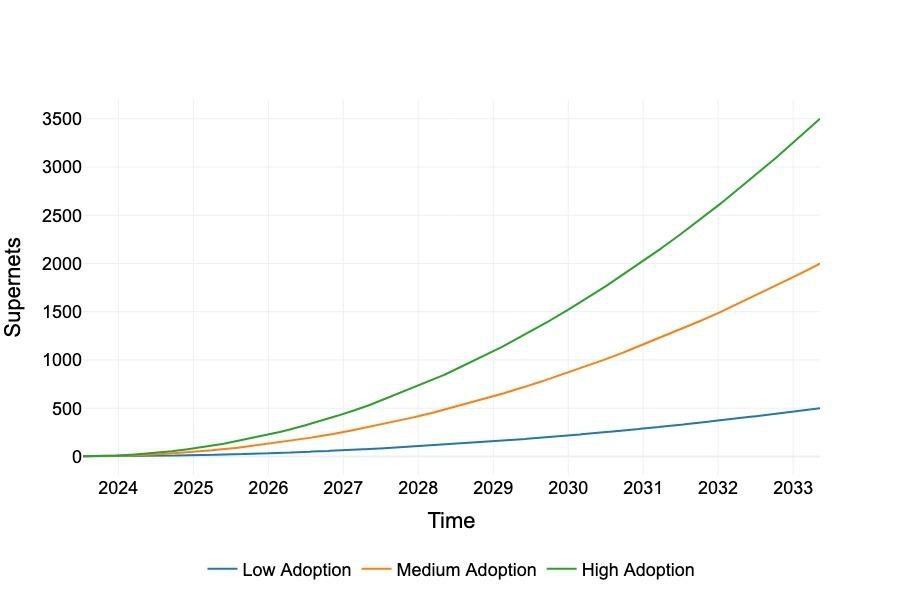
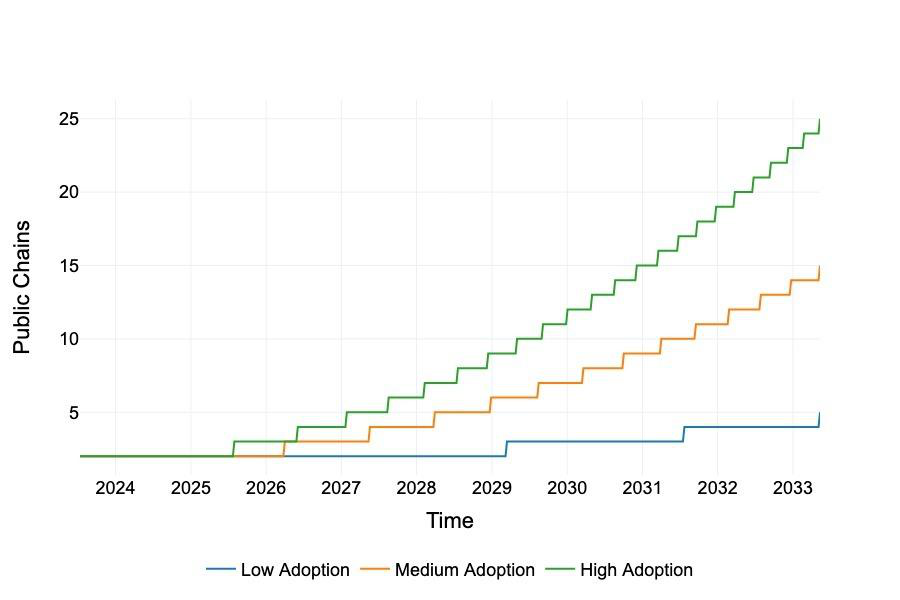
Figure 3. 10-year growth scenarios The rationale for the growth scenarios is based on the following data and observations: ● Current growth trajectory. Since the inception in 2020, the Polygon ecosystem has grown to thousand of applications and 3 million daily transactions7. If this trend even remotely continues, the proposed growth scenarios seem realistic. ● Web2 app marketplaces: The App Store hosts around 1.8 million applications8 and Google Play around 2.7 million9; both were introduced around 14 years ago. It could be reasonable to expect a comparable level of adoption for Web3 in a comparable timeframe. ● Supernets adoption: At the moment of writing this paper, one year since the introduction of Supernets, there are more than 100 Supernets candidate projects, many of them under active development. Based on this, the proposed growth scenarios for Supernets seem realistic, especially given that Supernets’ deployment should become significantly easier once the Staking Layer (described in § 6) is introduced. Additionally, it is noticeable that the trend of interest in Supernets is stronger in relative terms than the one for public chains. For this reason, we are assuming the same for the proposed growth scenarios. To further justify this, a meaningful parallel with Web2 adoption history can be drawn. In the earlier days of Web2, shared application hosting – Web2 equivalent to public chains – was much more common than nowadays. As the industry matured, 9 Source: https://www.appbrain.com/stats/number-of-android-apps 8 Source: https://www.apple.com/newsroom/2022/04/report-finds-third-party-apps-see-global-success-on-the-app-st ore/ 7 Source: https://polygonscan.com/chart/tx
dedicated hosting – Web2 equivalent to Supernets – became the norm for every application with a meaningful user base and level of activity. Again, the number of Polygon chains is an abstract concept in our model; in conjunction with the number of transactions per chain, it should primarily reflect the level of economic activity in the ecosystem. Similarly, the prevalence, i.e. ratio of Supernets compared to public chains, is an abstract, conservative assumption. If it would turn out that public chains are more popular relative to Supernets, the results of the simulation presented in § 9.4 would look similar or better, due to their respective transaction fee levels. To complement the aforementioned growth scenarios, we estimate the following inputs: ● Initial supply of 10 billion POL, as described in § 5.1; ● Yearly emission rate of 1% for validator incentives, as described in § 5.2; ● Yearly emission rate of 1% for the Community Treasury, as described in § 5.2; ● $5 average POL price during the 10-year period; ● 38 transactions/second on average per public chains, comparable to current Polygon PoS chain usage10; ● 19 transactions/second on average per Supernet, an estimate based on the requirements of Supernet projects; ● $0.01 average transaction fee on public chains, an estimate based on current average fees on Polygon PoS chain;11 ● $0.001 average transaction fee on Supernets, conservative estimate given abundant blockspace and a “race to the bottom” that it will likely cause for transaction fees; ● 100 validators on average per public chain, equivalent to the current validator set size of Polygon PoS; ● 15 validators on average per Supernet, based on requirements and realistic needs of Supernet candidates; ● $6,000/year average running costs per validator, equivalent to current Polygon PoS data, gradually decreasing according to a modified version of Moore’s Law (50% decrease in 3 years). It is worth noting that POL price, although one of the required model inputs, directly and significantly affects only the Community Treasury inflow, not the other key performance indicators. Also, transaction fee estimates do not account for the cost of data availability on 11 Source: https://polygonscan.com/chart/gasprice
Modell
Basierend auf dem Design von POL und der Absteckschicht schlagen wir ein Modell zur Simulation wichtiger vor Leistungsindikatoren des POL-basierten Ökosystems, stellen erforderliche Eingaben bereit und analysieren die Ergebnisse von Simulationen.
9.1 Hypothese Der Zweck des Modells besteht darin, die Hypothese zu validieren, dass der vorgeschlagene POL-betrieben ist Ökosystem kann gleichzeitig die folgenden, aus § 3 abgeleiteten Ziele erreichen: ● Ausreichende Ökosystemsicherheit: Wir messen die Sicherheit anhand des POL staking-Verhältnisses, d. h. Prozentsatz des von validators abgesteckten POL-Angebots. Das minimal zufriedenstellende Verhältnis ist 30-40 %, was in etwa dem aktuellen staking-Verhältnis in der Polygon PoS-Kette6 entspricht. ● Ausreichende validator Anreize: Um die ausreichende validator Anreize abzuschätzen, haben wir Führen Sie den Return on Work (ROW) ein, das Maß für das Gesamteinkommen im Verhältnis zum validator Wert des eingesetzten POL. Die minimale zufriedenstellende Rendite beträgt 4-5 %; niedrigere Renditen sind es nicht als attraktiv genug angesehen, wenn man die geleistete Arbeit, die Risiken und die Risiken bedenkt Opportunitätskosten. ● Ausreichende Ökosystemunterstützung: Wir messen die Ökosystemunterstützung anhand des jährlichen Zuflusses an die Gemeinschaftskasse. Der minimale zufriedenstellende Zufluss beträgt 50-100 Millionen US-Dollar, und das ist er auch wird auf der Grundlage des aktuellen Niveaus der wirtschaftlichen Unterstützung des Ökosystems Polygon bestimmt Bedürfnisse. Wir definieren diese Indikatoren (staking-Verhältnis, validator-Erträge und Treasury-Zufluss) explizit in § 9.3. 9.2 Eingaben In diesem Kapitel skizzieren wir die erforderlichen Modelleingaben und schätzen ihre respektablen Werte. Zunächst definieren wir drei Wachstumsszenarien und projizieren die abstrakte Anzahl der Ketten im Polygon Ökosystem während des ersten 10-Jahres-Zeitraums. Wir bezeichnen die Anzahl der Ketten als abstrakt weil es nicht unbedingt die genaue Anzahl der Polygon-Ketten ausdrückt (obwohl das könnte der Fall sein), sondern vielmehr das kumulative Niveau der Aktivität, d. h. der Transaktionen im Ökosystem. 6 Quelle: https://staking.polygon.technology/
Abbildung 3. 10-Jahres-Wachstumsszenarien Die Begründung für die Wachstumsszenarien basiert auf den folgenden Daten und Beobachtungen: ● Aktueller Wachstumskurs. Seit seiner Gründung im Jahr 2020 hat das Ökosystem Polygon auf Tausende von Anwendungen und 3 Millionen Transaktionen pro Tag angewachsen7. Wenn dieser Trend sogar Auch wenn die Entwicklung einigermaßen anhält, erscheinen die vorgeschlagenen Wachstumsszenarien realistisch. ● Web2-App-Marktplätze: Der App Store hostet rund 1,8 Millionen Anwendungen8 und Google Play rund 2,7 Millionen9; beide wurden vor etwa 14 Jahren eingeführt. Es könnte sein Es ist vernünftig, in einem vergleichbaren Ausmaß mit einer vergleichbaren Akzeptanz von Web3 zu rechnen Zeitrahmen. ● Einführung von Supernets: Zum Zeitpunkt der Erstellung dieses Artikels ist ein Jahr vergangen Einführung von Supernets, es gibt mehr als 100 Supernets-Kandidatenprojekte, viele davon befinden sich in aktiver Entwicklung. Darauf aufbauend werden die vorgeschlagenen Wachstumsszenarien für Supernets erscheinen realistisch, insbesondere angesichts der Tatsache, dass der Einsatz von Supernets erfolgen sollte deutlich einfacher, sobald der Staking Layer (beschrieben in § 6) eingeführt wird. Darüber hinaus ist es Auffällig ist, dass der Trend des Interesses an Supernets relativ gesehen stärker ist als der eine für öffentliche Ketten. Aus diesem Grund gehen wir auch für den Vorschlag davon aus Wachstumsszenarien. Um dies weiter zu rechtfertigen, eine sinnvolle Parallele zur Geschichte der Web2-Einführung gezogen werden kann. In den frühen Tagen von Web2 war Shared Application Hosting das Web2-Äquivalent an öffentliche Ketten – war viel häufiger als heute. Als die Branche reifer wurde, 9 Quelle: https://www.appbrain.com/stats/number-of-android-apps 8 Quelle: https://www.apple.com/newsroom/2022/04/report-finds-third-party-apps-see-global-success-on-the-app-st Erz/ 7 Quelle: https://polygonscan.com/chart/txDediziertes Hosting – Web2-Äquivalent zu Supernets – wurde für jeden zur Norm Anwendung mit einer sinnvollen Benutzerbasis und Aktivitätsniveau. Auch hier ist die Anzahl der Polygon-Ketten ein abstraktes Konzept in unserem Modell; in Verbindung mit der Die Anzahl der Transaktionen pro Kette sollte in erster Linie das Niveau der wirtschaftlichen Aktivität in der Kette widerspiegeln Ökosystem. Ebenso ist die Prävalenz, d. h. das Verhältnis von Supernets im Vergleich zu öffentlichen Ketten, ein abstrakte, konservative Annahme. Wenn sich herausstellen würde, dass öffentliche Ketten beliebter sind relativ zu Supernetzen würden die Ergebnisse der in § 9.4 vorgestellten Simulation ähnlich aussehen oder aufgrund der jeweiligen Höhe der Transaktionsgebühren besser. Zur Ergänzung der oben genannten Wachstumsszenarien schätzen wir die folgenden Inputs: ● Erstausstattung von 10 Milliarden POL, wie in § 5.1 beschrieben; ● Jährliche Emissionsrate von 1 % für validator-Anreize, wie in § 5.2 beschrieben; ● Jährliche Emissionsrate von 1 % für die Gemeinschaftskasse, wie in § 5.2 beschrieben; ● 5 $ durchschnittlicher POL-Preis während des 10-Jahres-Zeitraums; ● Durchschnittlich 38 Transaktionen/Sekunde pro öffentliche Kette, vergleichbar mit dem aktuellen Polygon PoS-Kettennutzung10; ● 19 Transaktionen/Sekunde auf Durchschnitt pro Supernet, ein Schätzung basiert auf die Anforderungen an Supernet-Projekte; ● 0,01 $ durchschnittliche Transaktionsgebühr in öffentlichen Ketten, eine Schätzung basierend auf dem aktuellen Durchschnitt Gebühren für die PoS-Kette Polygon;11 ● 0,001 $ durchschnittliche Transaktionsgebühr in Supernets, konservative Schätzung, reichlich vorhanden Blockspace und ein „Wettlauf nach unten“, der wahrscheinlich zu Transaktionsgebühren führen wird; ● Durchschnittlich 100 validators pro öffentlicher Kette, was der aktuellen validator-Satzgröße von entspricht Polygon PoS; ● Durchschnittlich 15 validators pro Supernet, basierend auf den Anforderungen und realistischen Bedürfnissen von Supernet-Kandidaten; ● 6.000 $/Jahr durchschnittliche Betriebskosten pro validator, entsprechend dem aktuellen Polygon PoS Daten, die gemäß einer modifizierten Version des Mooreschen Gesetzes allmählich abnehmen (50 % Rückgang in 3 Jahren). Es ist erwähnenswert, dass der POL-Preis, obwohl einer der erforderlichen Modelleingaben, direkt und direkt ist wirkt sich nur erheblich auf den Zufluss aus dem Finanzministerium der Gemeinschaft aus, nicht jedoch auf die anderen wichtigen Leistungen Indikatoren. Außerdem berücksichtigen Schätzungen der Transaktionsgebühren nicht die Kosten für die Datenverfügbarkeit 11 Quelle: https://polygonscan.com/chart/gasprice
Source: https://polygonscan.com/chart/tx
Source: https://polygonscan.com/chart/tx
Ethereum for Polygon chains that use the rollup model; we ignore this cost because it is passed to Ethereum. 9.3 Methodology We define a simple model to estimate the key performance indicators of the ecosystem, and validate the hypothesis from § 9.1. The key indicators and the methodology to determine them are as follows: ● Staking ratio ( ): The portion of the POL supply staked by validators. 𝑆𝑟 𝑆𝑟= 𝑆𝑠 / 𝑆𝑡 Where is staked supply, i.e. total amount of POL staked by validators, and is total 𝑆𝑠 𝑆𝑡 supply, i.e. current supply of POL. ● Validator emission incentives ( ): Yearly validator incentives that come from POL 𝑉𝑖𝑖 emission. 𝑉𝑖𝑖= 𝑆𝑡 × 𝐼𝑣 × 𝑃 Where is total supply, is yearly emission rate for validator rewards and is POL 𝑆𝑡 𝐼𝑣 𝑃 price. ● Validator fees incentives ( ): Yearly validator incentives that come from gas fees. 𝑉𝑖𝑓 𝑉𝑖𝑓= 𝐶𝑝 × 𝑇𝑝× 𝐹𝑝 + 𝐶𝑠 × 𝑇𝑠× 𝐹𝑠 Where is number of public chains, is number of transactions per public chain, 𝐶𝑝 𝑇𝑝 𝐹𝑝 is average transaction fee per public chain, is number of Supernets, is number of 𝐶𝑠 𝑇𝑠 transactions per Supernet and is average transaction fee per Supernet. 𝐹𝑠 ● Validator running costs ( ): Cumulative yearly running costs of all Polygon validators. 𝑉𝑐 𝑉𝑐= (𝑁𝑝 × 𝐶𝑝+ 𝑁𝑠 × 𝐶𝑠) × 𝑌 Where is number of validators per public chain, is number of public chains, is 𝑁𝑝 𝐶𝑝 𝑁𝑠 number of validators per Supernet, is number of Supernets and are yearly running 𝐶𝑠 𝑌 costs for a single validator. ● Return on Work ( ): Total validator earnings expressed as a percentage of the value 𝑉𝑟 of staked POL. 𝑉𝑟= (𝑉𝑖𝑖 + 𝑉𝑖𝑓 − 𝑉𝑐) / (𝑆𝑠 × 𝑃)
Where are validator issuance incentives, are validator fee incentives, are 𝑉𝑖𝑖 𝑉𝑖𝑓 𝑉𝑐 validator running costs, is staked supply and is POL price. 𝑆𝑠 𝑃 ● Community Treasury inflow ( ): Total yearly inflow to the Community Treasury. 𝑋𝑖 𝑋𝑖= 𝑉𝑖𝑖= 𝑆𝑡 × 𝐼𝑡 × 𝑃 Where is total supply, is yearly emission rate for the Community Treasury and is 𝑆𝑡 𝐼𝑡 𝑃 POL price. 9.4 Results The model accepts the required inputs and processes them using the presented methodology. The results for varying input sets can provide interesting insights into the ecosystem and its dynamics, including but not limited to: ● The attractiveness and sustainability of validator incentives; ● The amount and dynamics of the the Community Treasury inflows; ● The structure of validator incentives and their changes over time; ● The effect of price on all observed indicators; ● The effect of different adoption levels to all observed indicators etc. Here we run the model with the inputs provided in § 9.2 and observe the three indicators required to validate our initial hypothesis: staking ratio ( ), validator incentives ( ) and treasury 𝑆𝑟 𝑉𝑖 inflow ( ). 𝑋𝑖 Based on the model results, we are reasonably confident that the described POL-powered ecosystem can meet all three goals outlined in § 9.1: ● Sufficient ecosystem security: We fixed the staking ratio ( ) at 30% and ran the 𝑆𝑟 model. Given that the remaining two indicators – validator incentives ( ) and treasury 𝑉𝑖 inflow ( ) – are showing expected or higher than expected values, we conclude that the 𝑋𝑖 staking ratio should retain satisfactory or higher than satisfactory levels. ● Sufficient validator incentives: The results show that the targeted Return on Work ( ) 𝑉𝑟 of 4-5% is realistic to expect. Moreover, it reaches ≈7% for medium growth and ≈10% for fast growth scenario. In reality, this would likely cause the staking ratio to increase (thus further increasing security of the ecosystem), until the market determines the equilibrium between staking ratio and returns.
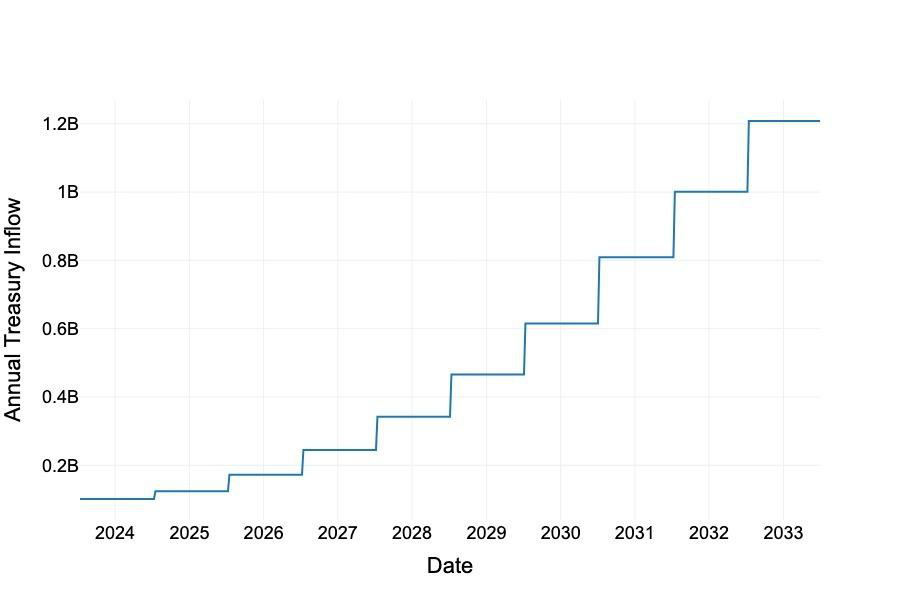
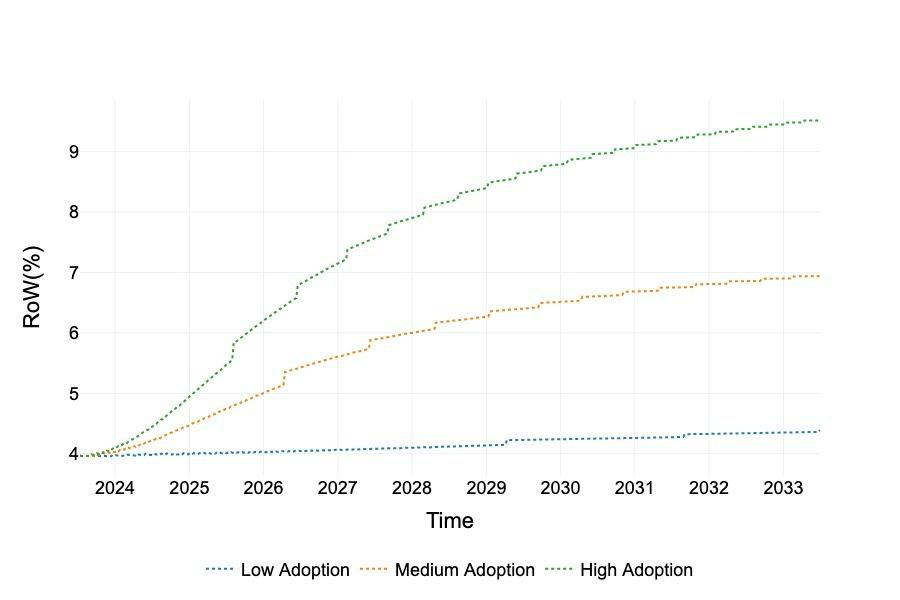
● Sufficient ecosystem support: The results show that the minimal satisfactory level of the Community Treasury inflows ( ) of $50-100 million per year is realistic to expect. 𝑋𝑖 Moreover, it reaches significantly higher levels towards the end of the 10-year period. However, the treasury inflow is directly related to the price of POL, and thus highly speculative. If the treasury ends up having more funds than the ecosystem realistically needs, the community might decide to burn the excess POL, as mentioned in § 7. Figure 4. Return on Work and Community Treasury inflow The full model is open-source and can be accessed on GitHub, and used to produce and analyze results for arbitrary sets of inputs. 10 Conclusion The vision behind Polygon is to build the Value Layer of the Internet. To achieve this vision, the redesigned Polygon protocol architecture introduces a novel, infinitely scalable and seamlessly interconnected network of Layer 2 chains. In this paper, we introduced POL, the proposed native token of Polygon, designed to secure, coordinate and align the Polygon ecosystem and supercharge its growth. The proposed design and tokenomics of POL achieve the rigorous design goals that we defined. We created a model to simulate the key performance indicators of the POL-powered ecosystem, provided required model inputs and analyzed the results of the simulation. The results confirmed the hypothesis of the model, derived from the aforementioned design goals.
Based on everything above, we conclude that POL is a novel, next generation asset that provides a solid foundation for Polygon to achieve its ambitious vision.
Quelle: https://polygonscan.com/chart/tx
Ethereum für Polygon-Ketten, die das Modell rollup verwenden; Wir ignorieren diese Kosten, weil sie weitergegeben werden an Ethereum. 9.3 Methodik Wir definieren ein einfaches Modell zur Schätzung der wichtigsten Leistungsindikatoren des Ökosystems Validieren Sie die Hypothese aus § 9.1. Die Schlüsselindikatoren und die Methodik zu ihrer Bestimmung sind wie folgt: ● Einsatzverhältnis ( ): Der Teil des POL-Angebots, der von validators abgesteckt wird. 𝑆𝑟 𝑆𝑟= 𝑆𝑠 / 𝑆𝑡 Wo ist das abgesteckte Angebot, d. h. die Gesamtmenge an POL, die von validators abgesteckt wird, und ist total 𝑆𝑠 𝑆𝑡 Versorgung, d. h. aktuelle Versorgung mit POL. ● Emissionsanreize für Validatoren ( ): Jährliche validator Anreize, die von POL kommen 𝑉𝑖𝑖 Emission. 𝑉𝑖𝑖= 𝑆𝑡 × 𝐼𝑣 × 𝑃 Wo ist das Gesamtangebot, ist die jährliche Emissionsrate für validator Belohnungen und ist POL 𝑆𝑡 𝐼𝑣 𝑃 Preis. ● Anreize für Validatorgebühren ( ): Jährliche validator Anreize, die sich aus Gasgebühren ergeben. 𝑉𝑖𝑓 𝑉𝑖𝑓 = 𝐶𝑝 × 𝑇𝑝× 𝐹𝑝 + 𝐶𝑠 × 𝑇𝑠× 𝐹𝑠 Wo ist die Anzahl der öffentlichen Ketten, ist die Anzahl der Transaktionen pro öffentlicher Kette, 𝐶𝑝 𝑇𝑝 𝐹𝑝 ist die durchschnittliche Transaktionsgebühr pro öffentlicher Kette, ist die Anzahl der Supernets, ist Anzahl von 𝐶𝑠 𝑇𝑠 Transaktionen pro Supernet und ist die durchschnittliche Transaktionsgebühr pro Supernet. 𝐹𝑠 ● Betriebskosten des Validators ( ): Kumulierte jährliche Betriebskosten aller Polygon validators. 𝑉𝑐 𝑉𝑐= (𝑁𝑝 × 𝐶𝑝+ 𝑁𝑠 × 𝐶𝑠) × 𝑌 Wo ist die Anzahl der validators pro öffentlicher Kette, ist die Anzahl der öffentlichen Ketten, ist 𝑁𝑝 𝐶𝑝 𝑁𝑠 Anzahl der validators pro Supernet, ist die Anzahl der Supernets und finden jährlich statt 𝐶𝑠 𝑌 Kosten für einen einzelnen validator. ● Rückkehr zur Arbeit ( ): Gesamtverdienst validator, ausgedrückt als Prozentsatz des Wertes 𝑉𝑟 abgesteckter POL. 𝑉𝑟= (𝑉𝑖𝑖 + 𝑉𝑖𝑓 − 𝑉𝑐) / (𝑆𝑠 × 𝑃)
Wo sind validator Emissionsanreize, sind validator Gebührenanreize, sind 𝑉𝑖𝑖 𝑉𝑖𝑓 𝑉𝑐 validator laufende Kosten, ist abgesteckt Versorgung und ist der POL-Preis. 𝑆𝑠 𝑃 ● Zufluss aus der Gemeinschaftskasse ( ): Gesamter jährlicher Zufluss zur Gemeinschaftskasse. 𝑋𝑖 𝑋𝑖= 𝑉𝑖𝑖= 𝑆𝑡 × 𝐼𝑡 × 𝑃 Wo ist das Gesamtangebot, ist die jährliche Emissionsrate für das Finanzministerium der Gemeinschaft und ist 𝑆𝑡 𝐼𝑡 𝑃 POL-Preis. 9.4 Ergebnisse Das Modell akzeptiert die erforderlichen Eingaben und verarbeitet sie mithilfe der vorgestellten Methodik. Die Ergebnisse für unterschiedliche Eingabesätze können interessante Einblicke in das Ökosystem und seine Umgebung liefern Dynamik, einschließlich, aber nicht beschränkt auf: ● Die Attraktivität und Nachhaltigkeit von validator Anreizen; ● Die Höhe und Dynamik der Zuflüsse aus dem Finanzministerium der Gemeinschaft; ● Die Struktur von validator Anreizen und ihre Veränderungen im Laufe der Zeit; ● Die Auswirkung des Preises auf alle beobachteten Indikatoren; ● Die Auswirkung unterschiedlicher Akzeptanzniveaus auf alle beobachteten Indikatoren usw. Hier führen wir das Modell mit den in § 9.2 bereitgestellten Eingaben aus und beobachten die drei Indikatoren erforderlich, um unsere ursprüngliche Hypothese zu validieren: staking Verhältnis ( ), validator Anreize ( ) und Schatzkammer 𝑆𝑟 𝑉𝑖 Zufluss ( ). 𝑋𝑖 Basierend auf den Modellergebnissen sind wir ziemlich sicher, dass der beschriebene POL-Antrieb erfolgt Ökosystem kann alle drei in § 9.1 genannten Ziele erreichen: ● Ausreichende Ökosystemsicherheit: Wir haben das Verhältnis staking festgelegt ( ) bei 30 % und lief 𝑆𝑟 Modell. Angesichts der Tatsache, dass die verbleibenden zwei Indikatoren – validator Anreize ( ) und Schatzkammer 𝑉𝑖 Zufluss ( ) – erwartete oder höhere Werte als erwartet anzeigen, schließen wir daraus, dass die 𝑋𝑖 Das staking-Verhältnis sollte ein zufriedenstellendes oder höheres als zufriedenstellendes Niveau beibehalten. ● Ausreichende validator Anreize: Die Ergebnisse zeigen, dass der angestrebte Return on Work ( ) 𝑉𝑟 von 4-5 % ist realistisch zu erwarten. Darüber hinaus erreicht sie ≈7 % für mittleres Wachstum und ≈10 % für schnelles Wachstumsszenario. In der Realität würde dies wahrscheinlich dazu führen, dass das staking-Verhältnis steigt (also die Sicherheit des Ökosystems weiter erhöhen), bis der Markt das Gleichgewicht bestimmt zwischen staking Verhältnis und Rendite.● Ausreichende Ökosystemunterstützung: Die Ergebnisse zeigen, dass das minimale zufriedenstellende Niveau von die Zuflüsse der Gemeinschaftskasse ( ) von 50–100 Millionen US-Dollar pro Jahr ist realistisch zu erwarten. 𝑋𝑖 Darüber hinaus erreicht er gegen Ende des 10-Jahres-Zeitraums deutlich höhere Werte. Der Treasury-Zufluss steht jedoch in direktem Zusammenhang mit dem Preis von POL und ist daher hoch spekulativ. Wenn das Finanzministerium am Ende realistischerweise über mehr Mittel verfügt als das Ökosystem Bei Bedarf könnte die Gemeinde beschließen, den überschüssigen POL zu verbrennen, wie in § 7 erwähnt. Abbildung 4. Arbeitsrendite und Zufluss von Gemeinschaftskassen Das vollständige Modell ist Open Source und kann auf GitHub abgerufen und zum Erstellen von verwendet werden Analysieren Sie Ergebnisse für beliebige Eingabesätze. 10 Fazit Die Vision hinter Polygon besteht darin, die Wertschicht des Internets aufzubauen. Um diese Vision zu verwirklichen, muss die Die neu gestaltete Protokollarchitektur Polygon führt ein neuartiges, unendlich skalierbares und nahtloses Protokoll ein miteinander verbundenes Netzwerk von Layer 2-Ketten. In diesem Dokument haben wir POL vorgestellt, den vorgeschlagenen nativen token von Polygon, der darauf ausgelegt ist, Folgendes zu sichern: Koordinieren und richten Sie das Ökosystem Polygon aus und beschleunigen Sie sein Wachstum. Der vorgeschlagene Entwurf und tokenomics von POL erreichen die strengen Designziele, die wir definiert haben. Wir haben ein Modell erstellt, um die wichtigsten Leistungsindikatoren des POL-basierten Ökosystems zu simulieren. stellte die erforderlichen Modelleingaben bereit und analysierte die Ergebnisse der Simulation. Die Ergebnisse bestätigte die Hypothese des Modells, abgeleitet aus den oben genannten Entwurfszielen.
Basierend auf dem oben Gesagten kommen wir zu dem Schluss, dass POL ein neuartiger Vermögenswert der nächsten Generation ist bietet eine solide Grundlage für Polygon, um seine ehrgeizige Vision zu verwirklichen.