 Internet Computer
Capas del Protocolo IC
Context
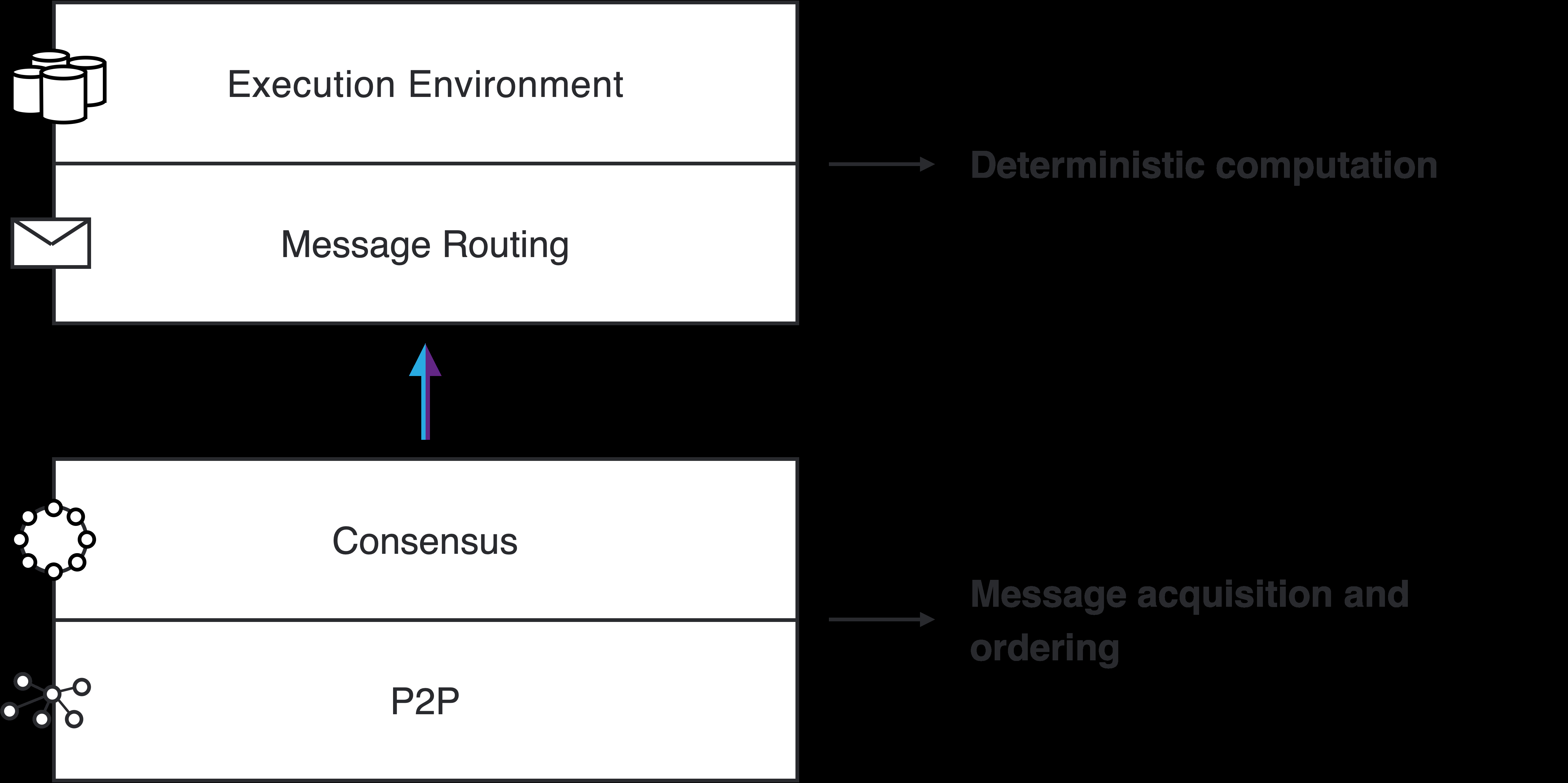
This figure appears in the Protocol Design section of the Internet Computer whitepaper, describing the four-layer architecture that implements a decentralized cloud computer. The section explains how each layer builds on guarantees provided by the layer below, separating concerns such that network connectivity, consensus ordering, message delivery, and deterministic execution are handled by distinct, composable subsystems.
What This Figure Shows
The diagram presents the Internet Computer protocol as a vertical stack of four layers. At the base, the Peer-to-Peer (P2P) layer handles artifact-based broadcast, reliably disseminating messages among nodes within a subnet using a gossip protocol with cryptographic authenticity guarantees. The Consensus layer implements a deterministic, Byzantine-fault-tolerant ordering protocol that produces a linear sequence of finalized blocks. The Message Routing layer translates ordered block payloads into input queues for each canister, routes inter-subnet messages through the XNet protocol, and provides a certified state tree for verification. At the top, the Execution layer deterministically executes WebAssembly canisters against their allocated state, consuming input queues and producing output messages in a fully reproducible way across all subnet replicas.
Significance
The layered protocol architecture allows the Internet Computer to scale horizontally by adding subnets: each subnet independently executes all four layers, and subnets interact only through the well-defined XNet message passing interface. By isolating consensus from execution, the design allows each layer to be upgraded independently through governance proposals without disrupting the others.