 Bitcoin
Reclaiming Disk Space
Context
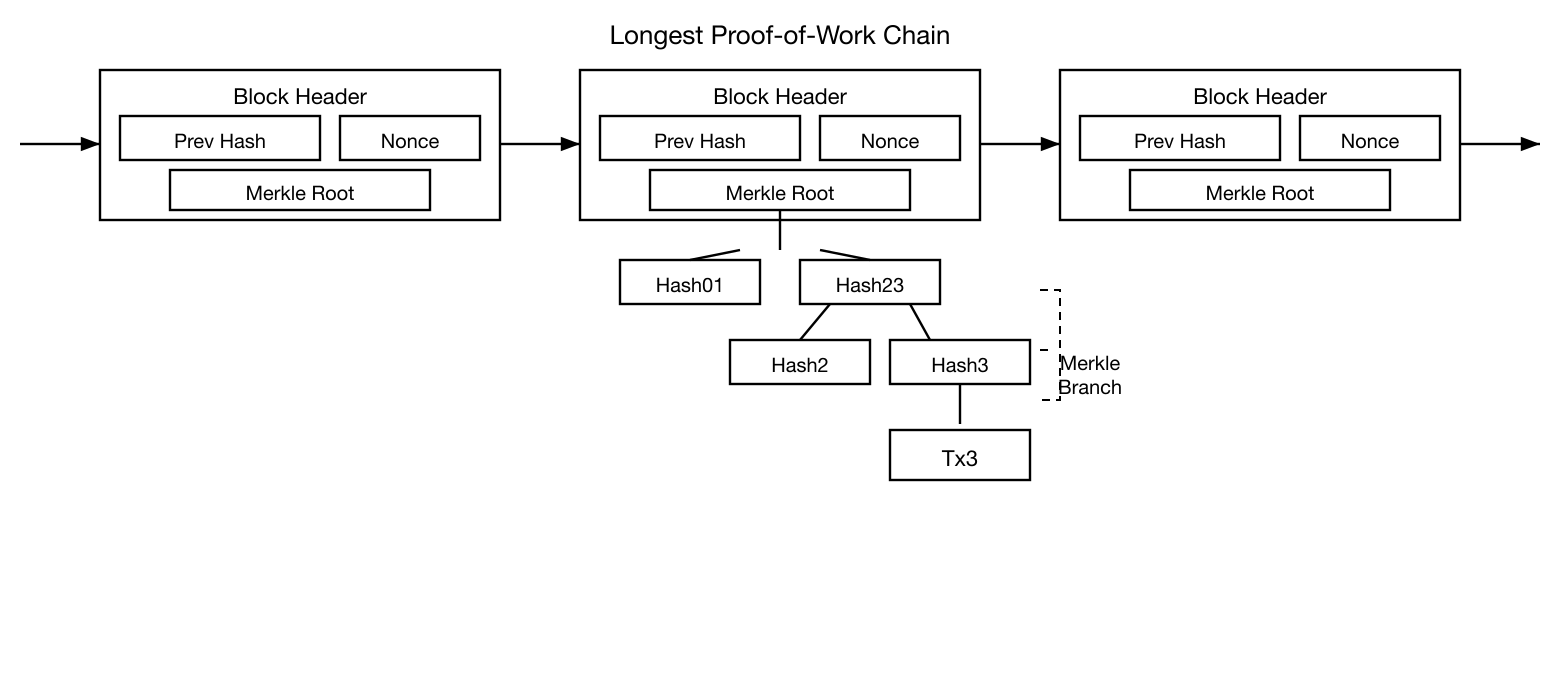
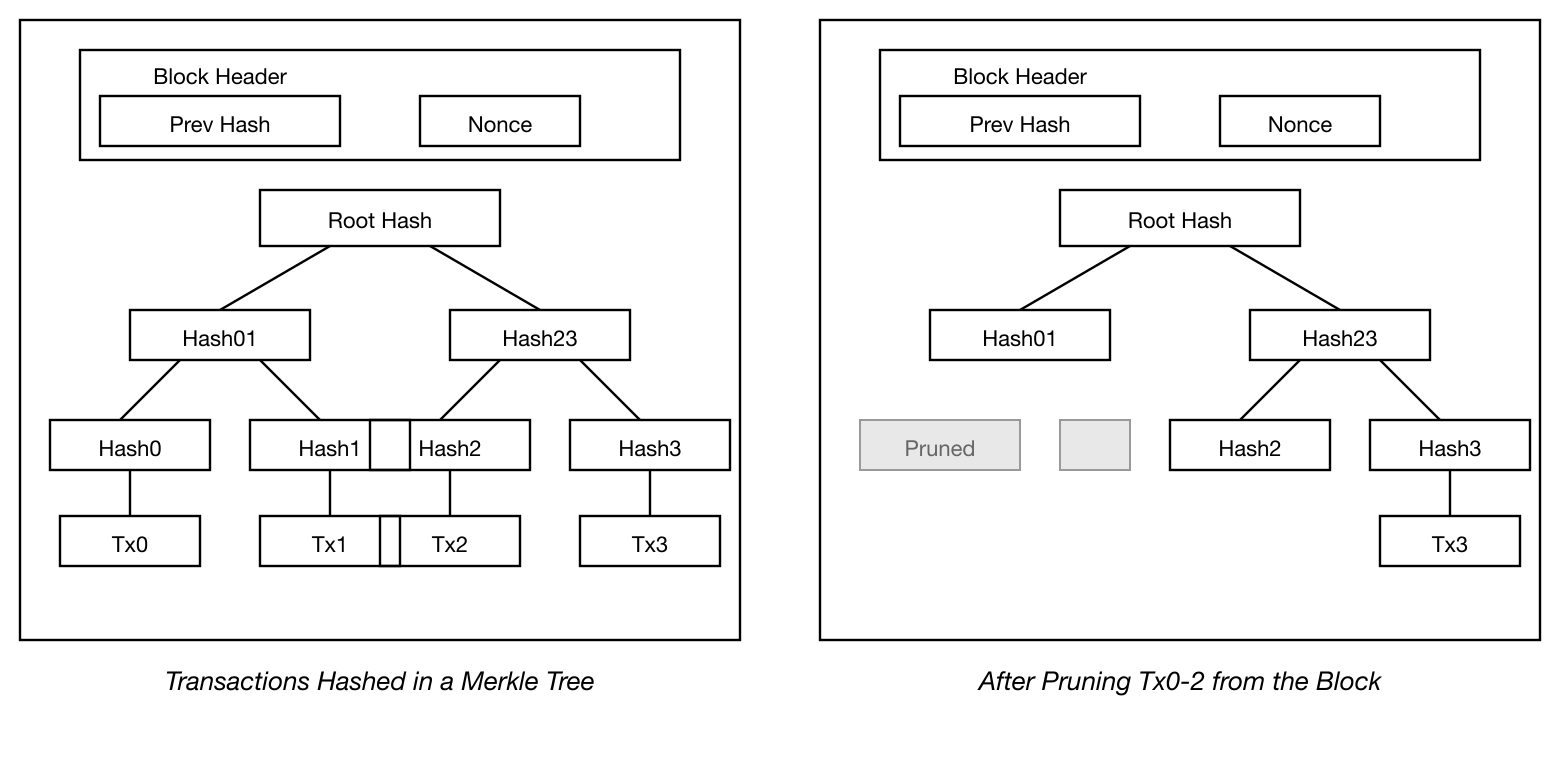
This figure appears in the Reclaiming Disk Space section, which addresses the long-term storage scalability of the Bitcoin blockchain. The section explains that fully spent transaction outputs do not need to be retained forever; once they are buried deep enough in the chain they can be pruned without compromising block integrity. Satoshi calculated that even retaining all block headers indefinitely would consume only about 4.2 MB per year under 2008-era assumptions.
What This Figure Shows
The diagram illustrates how transactions within a block are arranged into a Merkle tree: each transaction is hashed, pairs of hashes are recursively combined, and only the single Merkle root is stored in the block header. Because the root cryptographically commits to every leaf transaction, individual spent transactions and their intermediate hashes can be pruned from the tree without invalidating the block header's hash. The figure shows 'stubbed' branches where old transactions have been discarded, leaving only the root and whatever subtrees are needed to verify remaining unspent outputs. This allows full nodes to shed the bulk of historical data while retaining the ability to verify the chain's integrity through the headers alone.
Significance
This figure demonstrates that Bitcoin's blockchain can scale over decades without requiring every node to store the complete transaction history forever. The Merkle tree structure is the cryptographic primitive that makes selective pruning possible, and this insight is foundational to later concepts like SPV and light-client designs across the entire blockchain ecosystem.