 Monero
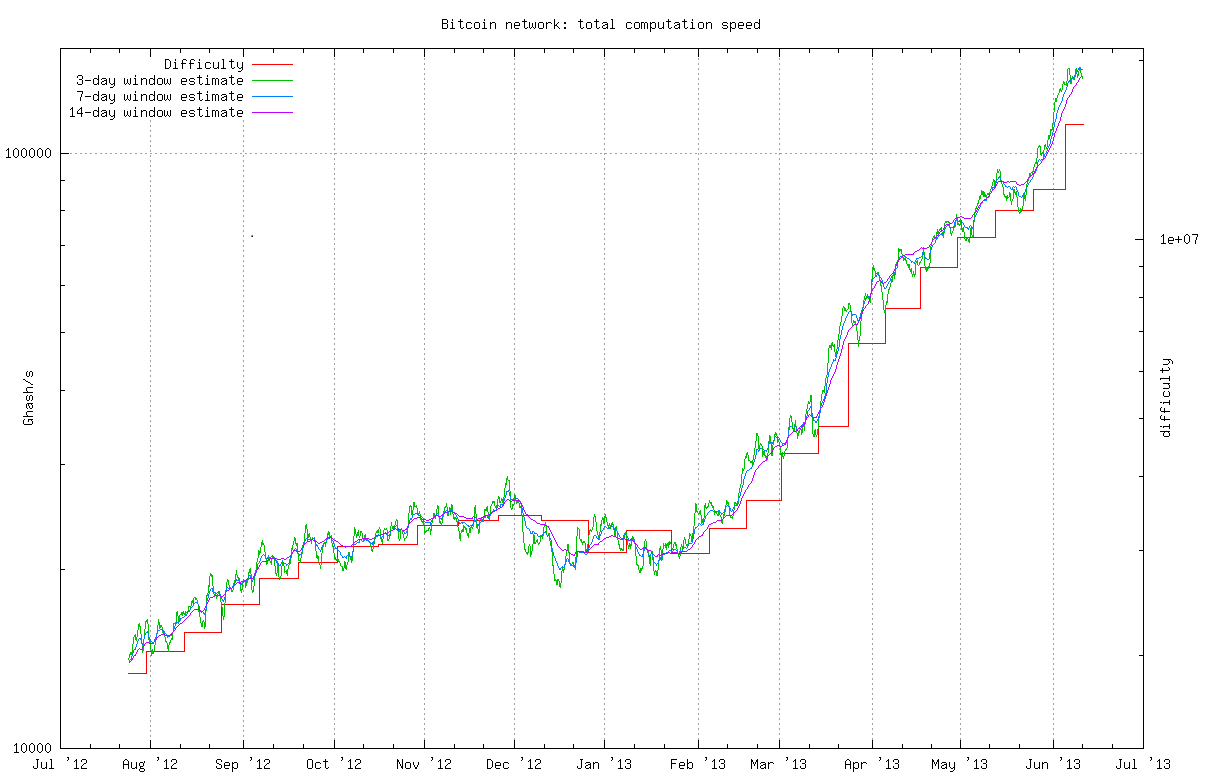
Hashrate du Réseau Bitcoin
Context
This figure appears in the Analysis section of the CryptoNote whitepaper, which critically examines Bitcoin's proof-of-work mining ecosystem before introducing CryptoNote's own egalitarian PoW design. The section argues that ASIC miners created an economically stratified mining landscape, concentrating hash power among a small number of industrial participants and undermining the decentralization premise.
What This Figure Shows
The chart displays the Bitcoin network's total hash rate over time, showing a dramatic exponential growth trajectory as increasingly specialized mining hardware — progressing from CPUs to GPUs to FPGAs and ultimately to ASICs — was deployed. The CryptoNote authors interpret this growth pattern as evidence of hardware arms-race dynamics: each generation of specialized hardware rendered the previous generation unprofitable, continuously concentrating mining power in the hands of those with access to cutting-edge silicon at scale. The whitepaper contrasts this with the behavior expected from a memory-hard PoW function like CryptoNight, where the computational bottleneck is random-access memory bandwidth rather than raw hash computation — a resource that scales uniformly with commodity hardware and cannot easily be optimized by specialized chips.
Significance
This figure is the empirical cornerstone of CryptoNote's egalitarian PoW argument and directly motivates the CryptoNight algorithm that Monero adopted. The mining centralization concern it documents remains one of the most important debates in proof-of-work blockchain design, influencing not only Monero but a generation of ASIC-resistant cryptocurrencies. Monero has since further evolved its PoW to RandomX, specifically designed to favor general-purpose CPU execution.