 Bitcoin
Simplified Payment Verification
Context
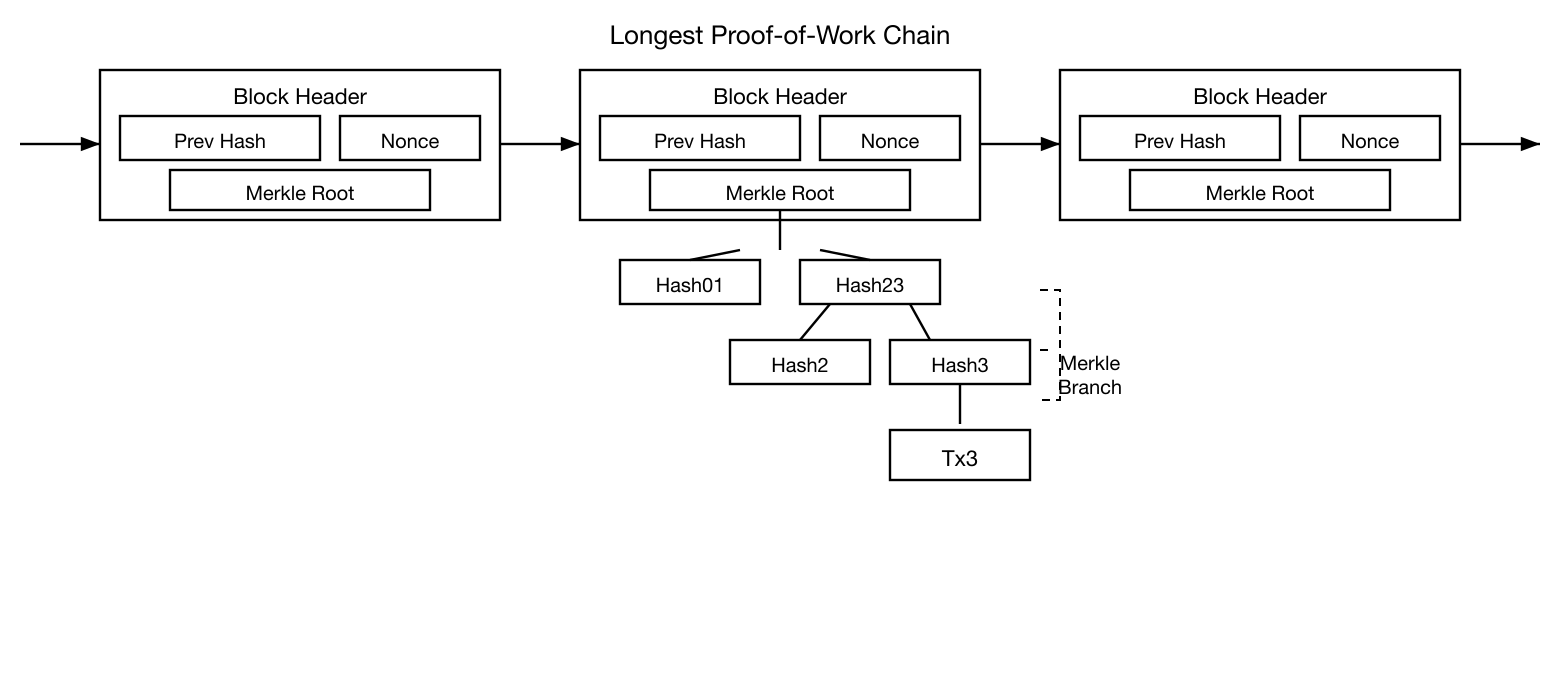
This figure appears in the Simplified Payment Verification section, which describes how a lightweight client can confirm that a transaction has been accepted by the network without downloading and validating the entire blockchain. The section argues that as long as honest nodes control the majority of hash rate, an SPV client tracking only block headers can obtain reliable payment proofs. It also notes the trade-off: SPV clients are more vulnerable than full nodes under adversarial conditions.
What This Figure Shows
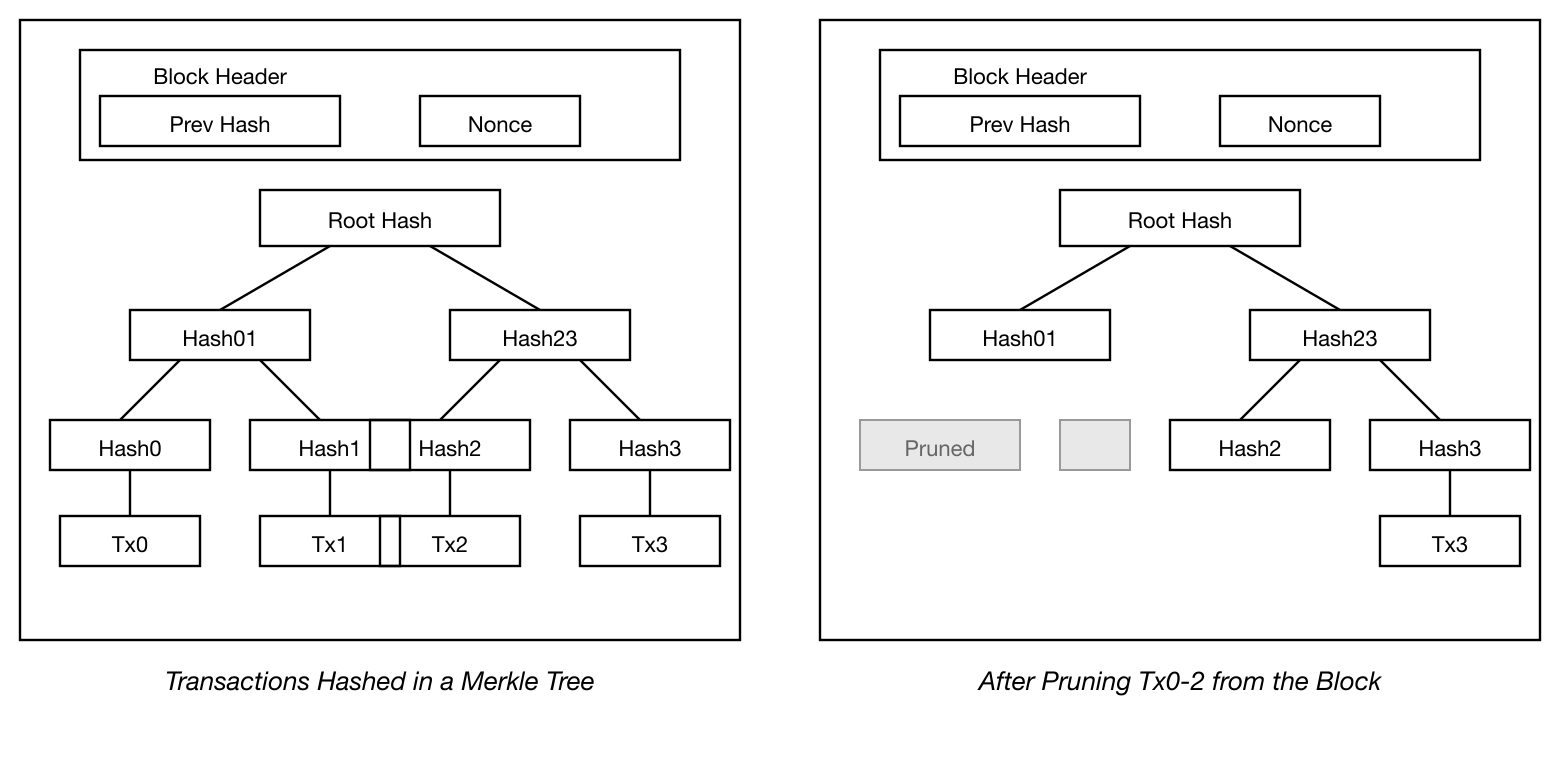
The diagram shows a user holding only the chain of block headers — the longest proof-of-work chain — alongside a Merkle branch that links a specific transaction to the block in which it was included. By verifying that the Merkle branch connects the transaction hash up to the Merkle root stored in the block header, and that this block header is part of the longest chain with substantial proof-of-work behind it, the user can conclude that the network accepted the transaction without having seen the full block. Each additional block added on top further reinforces the confirmation. The SPV approach trades some security for dramatically reduced storage and bandwidth requirements, making payment verification practical on resource-constrained devices.
Significance
This figure introduces the SPV model that underlies the design of lightweight wallets and mobile Bitcoin clients used by the vast majority of everyday users. It shows how the Merkle tree and block header design combine to enable trustless payment verification with minimal data, a key scalability insight that influenced the architecture of virtually every subsequent blockchain platform.