 Bitcoin
टाइमस्टैम्प सर्वर
Context
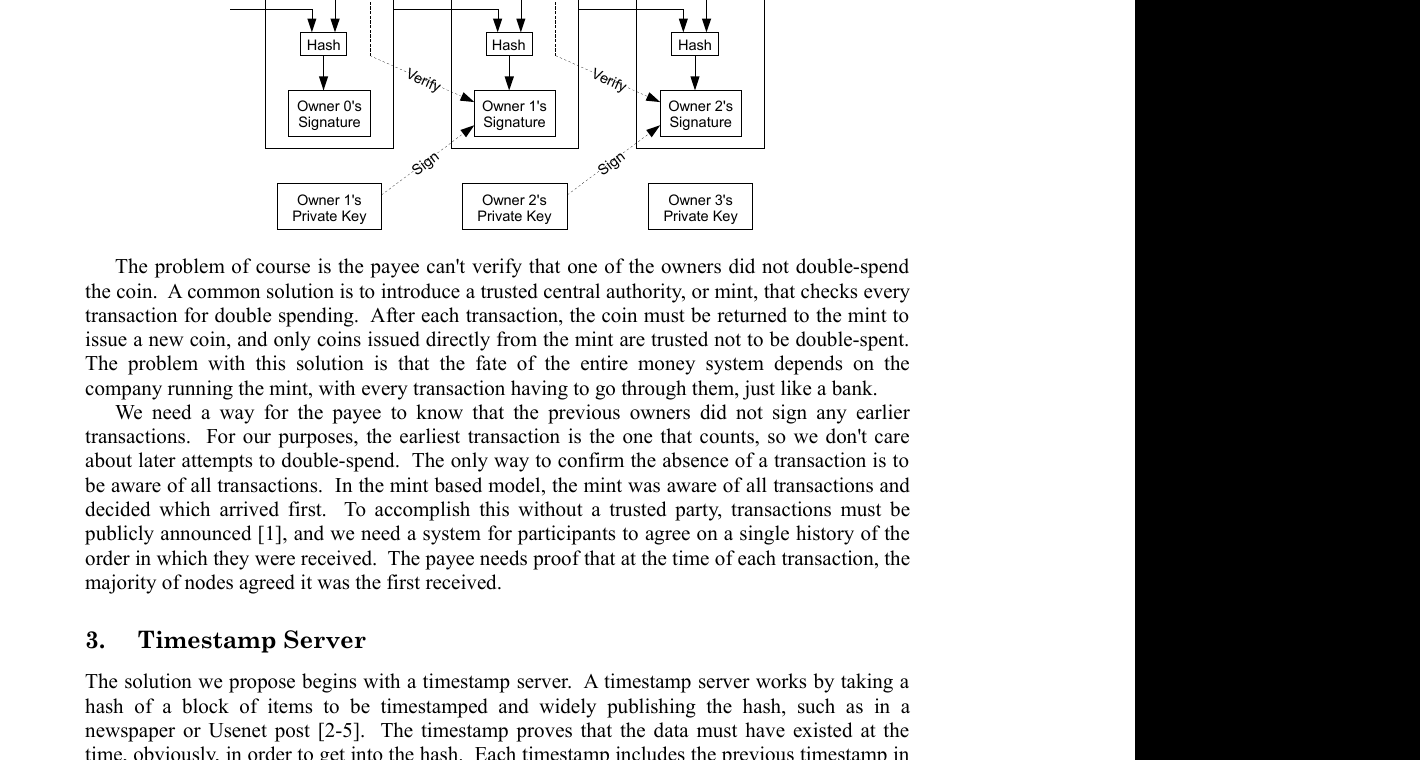
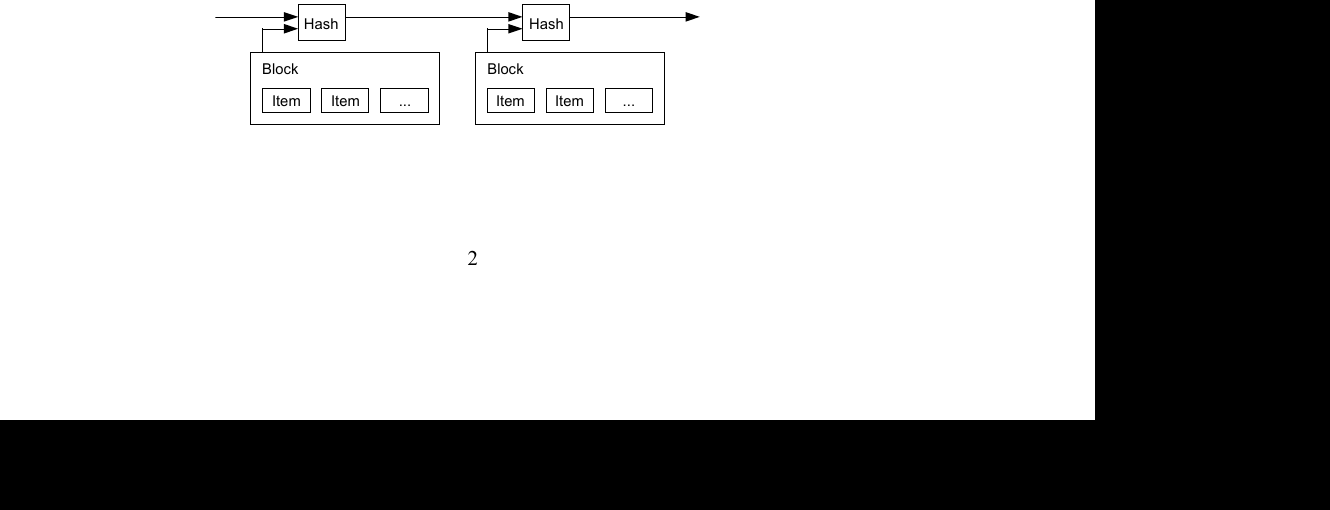
This figure appears in the Timestamp Server section, which proposes the first building block for solving the double-spend problem without a trusted third party. The section draws an analogy to publishing hashes in newspapers or Usenet posts to prove data existed at a given point in time. It introduces the concept of a hash-chained sequence of blocks that forms the structural backbone of the blockchain.
What This Figure Shows
The diagram illustrates a sequence of blocks where each block contains a hash of a set of items and also incorporates the hash of the previous block. This chaining means that the hash of any given block implicitly commits to the entire history of all preceding blocks — altering any earlier block would change its hash, which would invalidate every subsequent block's hash. The timestamp server widely publishes each block hash, making the historical record publicly verifiable. Each new block added to the chain reinforces the integrity of all blocks before it, creating an ever-stronger proof that a sequence of events occurred in a specific order.
Significance
This figure introduces the hash-chain structure that underlies the Bitcoin blockchain, showing how an append-only, tamper-evident ledger can be constructed without central coordination. The insight that each timestamp reinforces all prior ones is the key property that makes rewriting history computationally costly, which is later combined with proof-of-work to achieve security.