 Cosmos
Tendermint Throughput Benchmark
Context
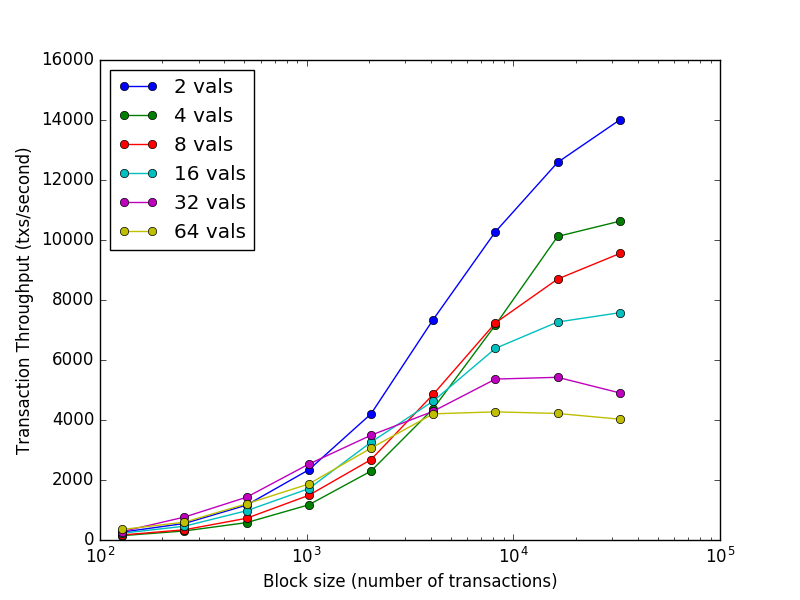
This figure appears in Section 1 (Introduction) of the Cosmos whitepaper, describing the Tendermint Core consensus engine. It follows the qualitative description of Tendermint as a partially synchronous BFT consensus protocol derived from the DLS algorithm. The benchmark used 64 nodes distributed across 7 datacenters on 5 continents.
What This Figure Shows
The chart plots transaction throughput against block size for the Tendermint consensus engine running on a geographically distributed 64-node testnet. Throughput initially increases with block size as larger batches amortize per-block consensus overhead, then plateaus as block propagation and validation time begins to dominate. This is distinct from proof-of-work systems, where block size is tightly constrained to control propagation time and uncle rates; in Tendermint, round-based voting with a known validator set eliminates the need for this trade-off. The benchmark also demonstrates the latency side of the design: because the protocol requires a supermajority (2/3+) of voting power to commit a block, and because commit finality is achieved within a single round under normal conditions, block times are deterministic and short.
Significance
This throughput benchmark is critical evidence in the Cosmos whitepaper's argument that BFT consensus is a viable foundation for production blockchain infrastructure. At the time of the whitepaper, Bitcoin processed ~7 TPS and Ethereum ~15 TPS; Tendermint's thousands of TPS at global scale positioned the Cosmos Hub as a genuinely high-performance layer for cross-chain communication.