 Bitcoin
작업 증명 체인
Context
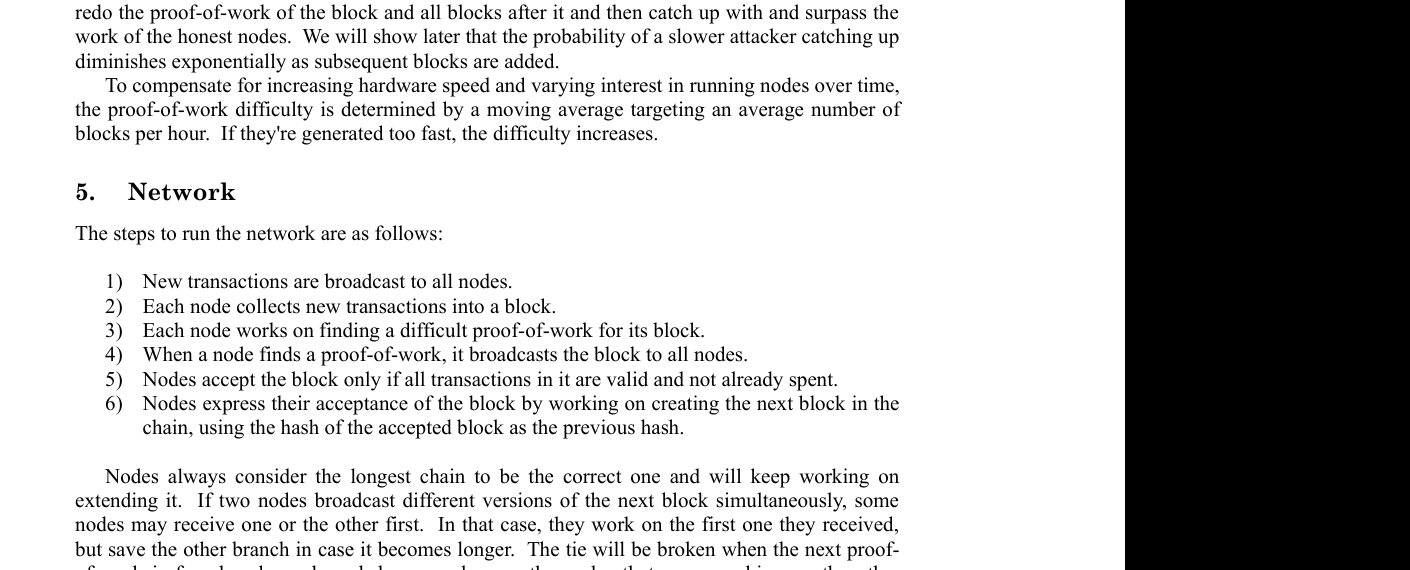
This figure appears in the Proof-of-Work section, which describes how Bitcoin implements a distributed timestamp server using computational puzzles rather than centralized publication. The section explains how miners search for a nonce value that causes the block's hash to meet a specific difficulty target, and how chaining these blocks together makes history immutable. It also introduces the longest-chain rule as the mechanism for distributed consensus.
What This Figure Shows
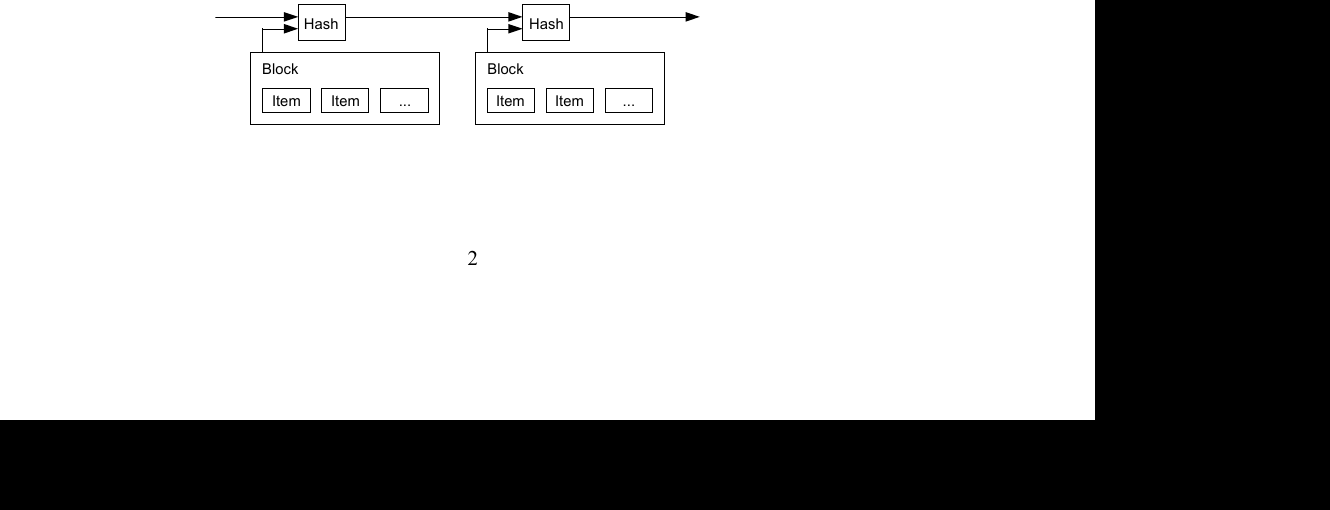
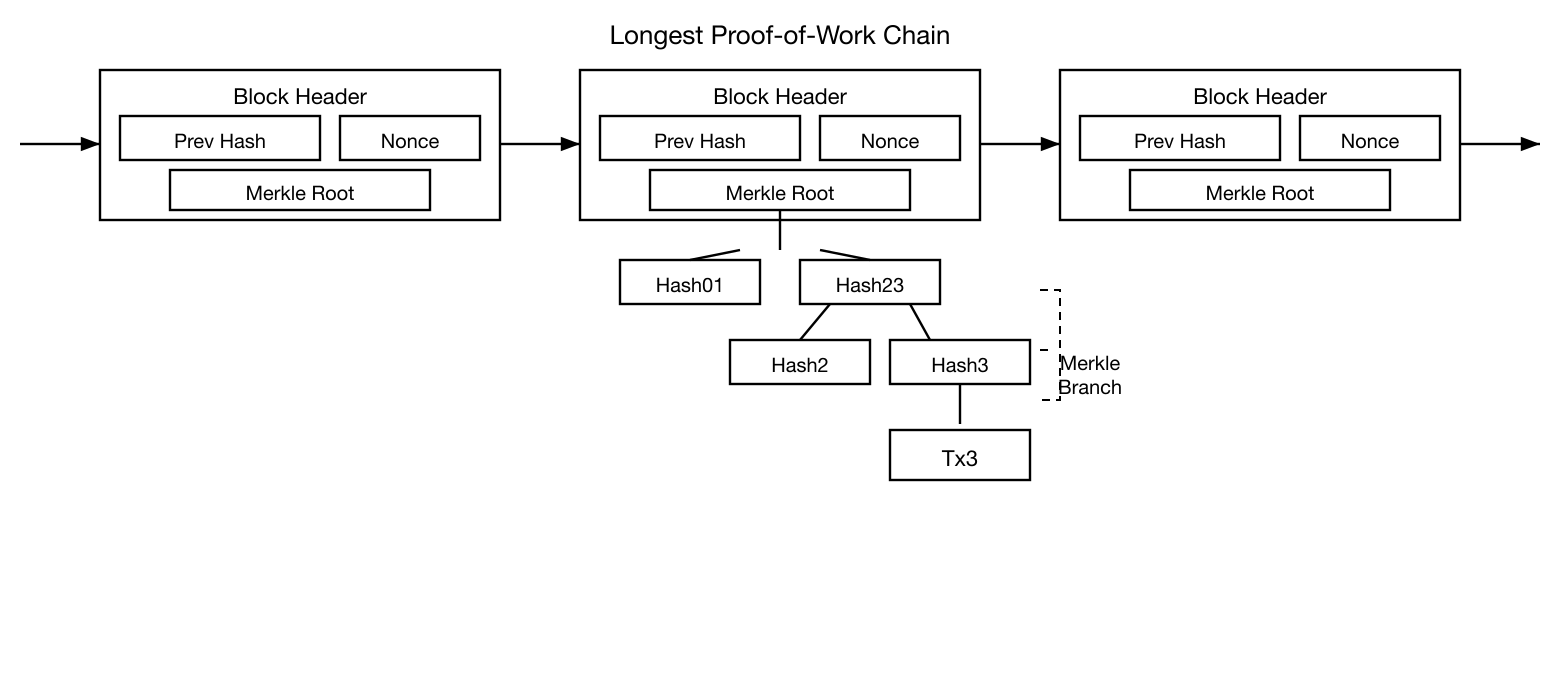
The diagram shows a series of blocks, each containing a set of transactions, a nonce, and a cryptographic reference to the previous block's hash. To add a new block, a miner must find a nonce such that the resulting SHA-256 hash of the block header begins with a required number of zero bits — work that is statistically expensive to perform but trivially cheap to verify. Because each block references the prior block's hash, rewriting any historical block requires redoing the proof-of-work for that block and every block after it, then outpacing the honest network's ongoing work. The chain with the greatest cumulative proof-of-work is treated as canonical truth, incentivizing honest miners to extend the longest chain. The difficulty adjusts over time via a moving average to maintain a target block interval regardless of changes in total hash rate.
Significance
This figure is the centerpiece of the Bitcoin design: it shows how proof-of-work transforms computational effort into an immutable, trustless record of transaction history. The one-CPU-one-vote model it encodes prevents Sybil attacks and ensures that an attacker controlling less than a majority of hash rate cannot rewrite the ledger, providing the security guarantees that make Bitcoin viable as a decentralized currency.