TRON
TRON
Estrutura de Bloco em Árvore Merkle
Context
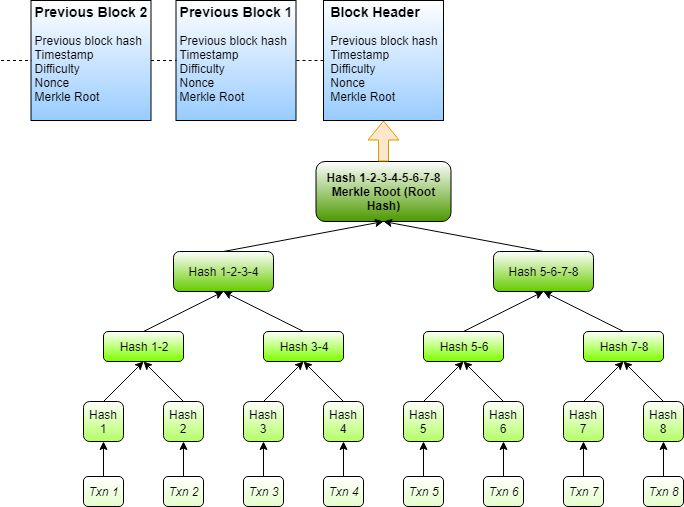
This figure appears in the Block section of the TRON whitepaper, specifying the internal structure of a TRON block. It describes how blocks organize transactions and how the block header commits to that content, establishing the data integrity guarantees that underlie the chain's tamper-evidence properties.
What This Figure Shows
The diagram shows a TRON block divided into the block header and the Merkle tree of transactions. The header contains the parent block hash, timestamp, witness address (the DPoS Super Representative who produced the block), and the Merkle root. Transactions are organized as leaves of a binary Merkle tree: each is hashed, adjacent hashes are combined and hashed recursively, producing a single Merkle root stored in the header. This root cryptographically commits the header to the exact set and ordering of transactions. Any modification to any transaction changes its leaf hash, propagates upward, and produces a different Merkle root, making tampering detectable.
Significance
The Merkle tree structure is directly inherited from Bitcoin's design and serves the same dual purpose: efficient inclusion proofs for light clients (O(log n) verification) and cryptographic binding of the header to the full transaction set. In TRON's DPoS context, this is particularly important because Super Representatives produce blocks on behalf of voters, and the Merkle commitment ensures block producers cannot silently alter transactions after broadcast.