 BNB
BNB
Cross-Chain Mimarisi
Context
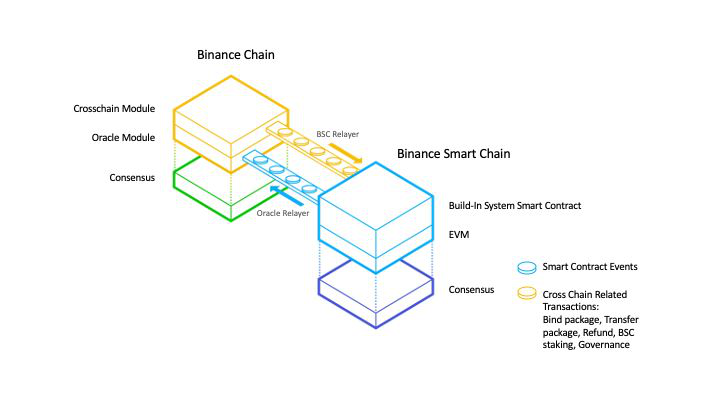
This figure appears at the opening of the Overview section of the BNB Chain whitepaper, after the introduction establishes the rationale for a dual-chain architecture. BNB Beacon Chain was designed for high-speed decentralized exchange but lacked smart contract support, while BNB Smart Chain (BSC) was created to add EVM-compatible smart contract execution. The figure illustrates how these two chains coexist and interoperate.
What This Figure Shows
The diagram depicts a dual-chain structure in which BNB Beacon Chain and BNB Smart Chain run as parallel but distinct blockchains with a native cross-chain bridge connecting them. Beacon Chain handles token issuance, native DEX order matching, and governance voting using a fast, simple consensus optimized for throughput. BNB Smart Chain runs an EVM-compatible execution environment with Proof of Staked Authority (PoSA) consensus, combining delegated proof-of-stake validator selection with Byzantine fault-tolerant block finality. The cross-chain bridge allows tokens to be transferred between chains: a token locked on Beacon Chain triggers minting of a corresponding BEP-20 token on Smart Chain, and vice versa. Smart Chain validators are elected by Beacon Chain governance, creating a tight coupling between the chains' security models.
Significance
This cross-chain architecture is the foundational design choice that differentiates BNB Chain from single-chain platforms. By preserving Beacon Chain's high-performance DEX capabilities while adding a fully EVM-compatible smart contract environment in BSC, the architecture avoids the throughput degradation that would result from running complex DeFi computation on the same chain as a high-frequency order book.