Chainlink
Süper-Doğrusal Staking Etkisi
Context
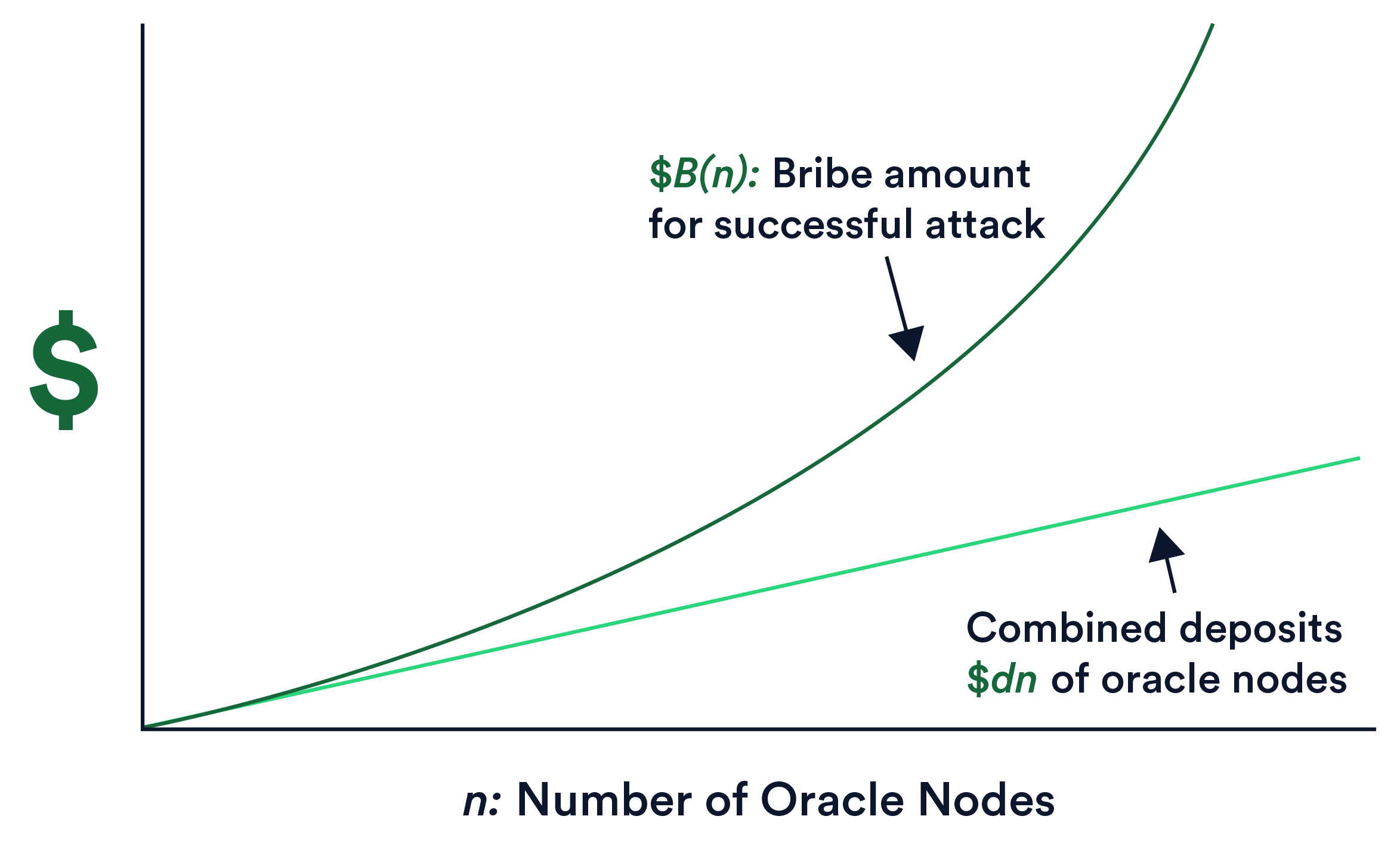
This figure appears in the Introduction during the discussion of incentive-based (cryptoeconomic) security, the seventh key design goal. It conceptually illustrates the super-linear staking impact property that is the centerpiece of Chainlink's novel staking mechanism design. The whitepaper later provides detailed mathematical treatment of this property in Section 9, specifically demonstrating that the mechanism achieves quadratic staking impact.
What This Figure Shows
The figure shows a graph where the bribe required by an adversary ($B(n)) grows faster than the combined deposits of all oracle nodes ($dn) as the number of nodes n increases. While combined deposits grow linearly with n (one line), the adversary's required budget grows super-linearly—specifically quadratically ($dn²/2)—making bribery attacks economically infeasible even for moderately sized networks. For example, with 100 nodes each depositing $20K (total $2M in deposits), the adversary would need over $100M to mount a successful bribe. This property is achieved through the watchdog priority mechanism that concentrates alerting rewards in a single node.
Significance
Super-linear staking impact is the key innovation that distinguishes Chainlink's staking design from existing systems. It allows oracle networks to provide economic security far exceeding their total deposited stake, enabling even moderate-sized networks with moderate deposits to resist well-resourced adversaries. This property underpins the virtuous cycle of economic security described later in the whitepaper.