Filecoin
هياكل بيانات أوامر السوق
Context
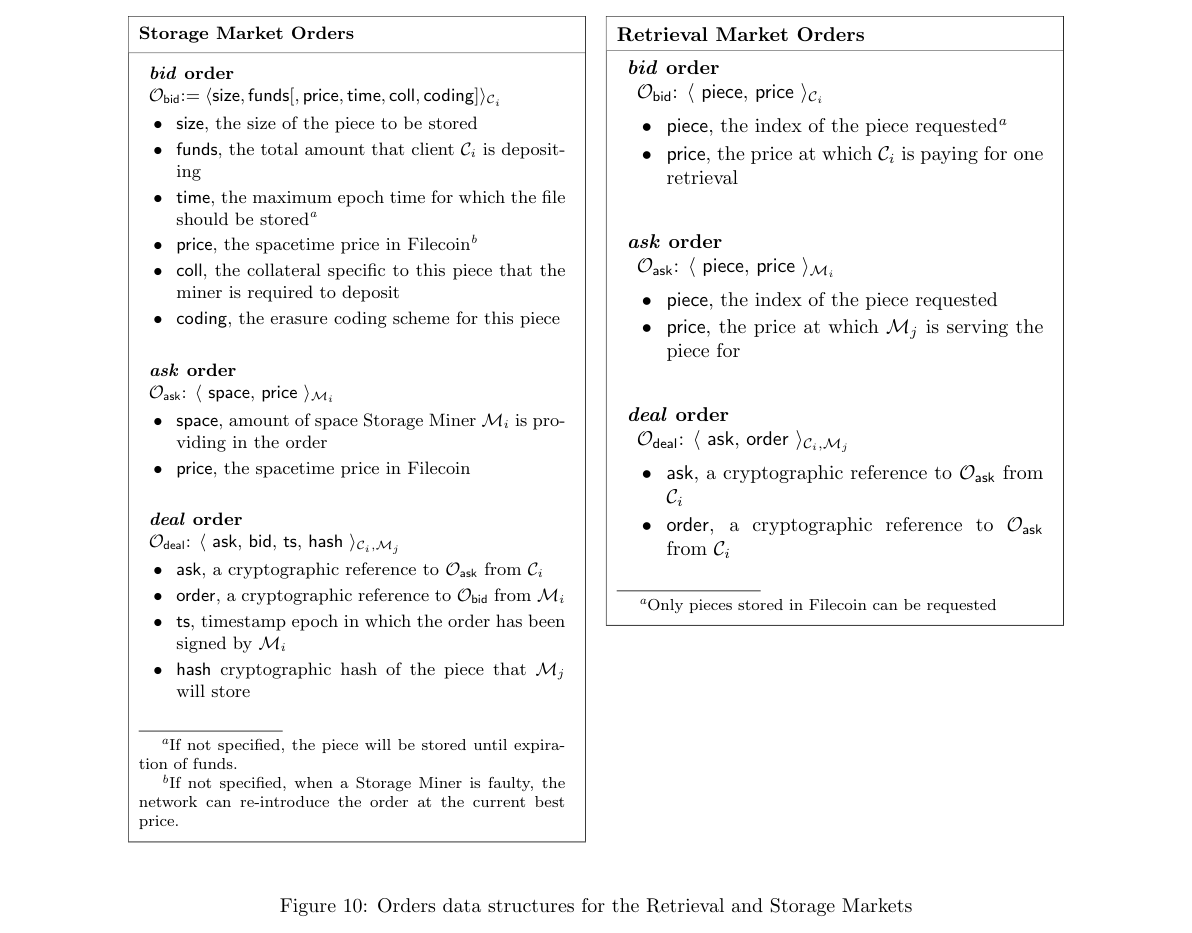
Figure 10 appears in Section 5.2.2 (Storage Market Data Structures) and is also referenced from Section 5.3.2 (Retrieval Market Data Structures). It provides a side-by-side comparison of the order data structures for both markets, showing the concrete fields of bid, ask, and deal orders for the Storage Market on the left and the Retrieval Market on the right.
What This Figure Shows
Storage Market orders: a bid order from client contains size (piece size), funds (total deposit), and optional fields: price (spacetime price in FIL), time (maximum storage epoch), collateral requirement, and coding (erasure coding scheme). An ask order from miner contains space (available storage) and price. A deal order from both parties contains cryptographic references to the matched ask and bid, a timestamp (epoch when miner signed, preventing indefinite lock of committed space), and hash (cryptographic hash of the piece the miner will store). Retrieval Market orders: a bid order from client contains the piece index and price-per-retrieval. An ask order from miner contains the piece index and asking price. A deal order from both parties contains cryptographic references to the matched ask and bid orders.
Significance
The structural differences between Storage and Retrieval Market orders reflect deep architectural choices: Storage bids include funds deposit and collateral requirements because the Network must enforce long-term accountability via on-chain proof verification, while Retrieval orders carry no upfront commitment because payment is handled incrementally via micropayment channels. The timestamp field in storage deal orders is a subtle but important anti-griefing mechanism preventing malicious clients from permanently locking a miner's pledged storage by withholding a signed deal.