Chainlink
Virtuous Cycle of Staking
Context
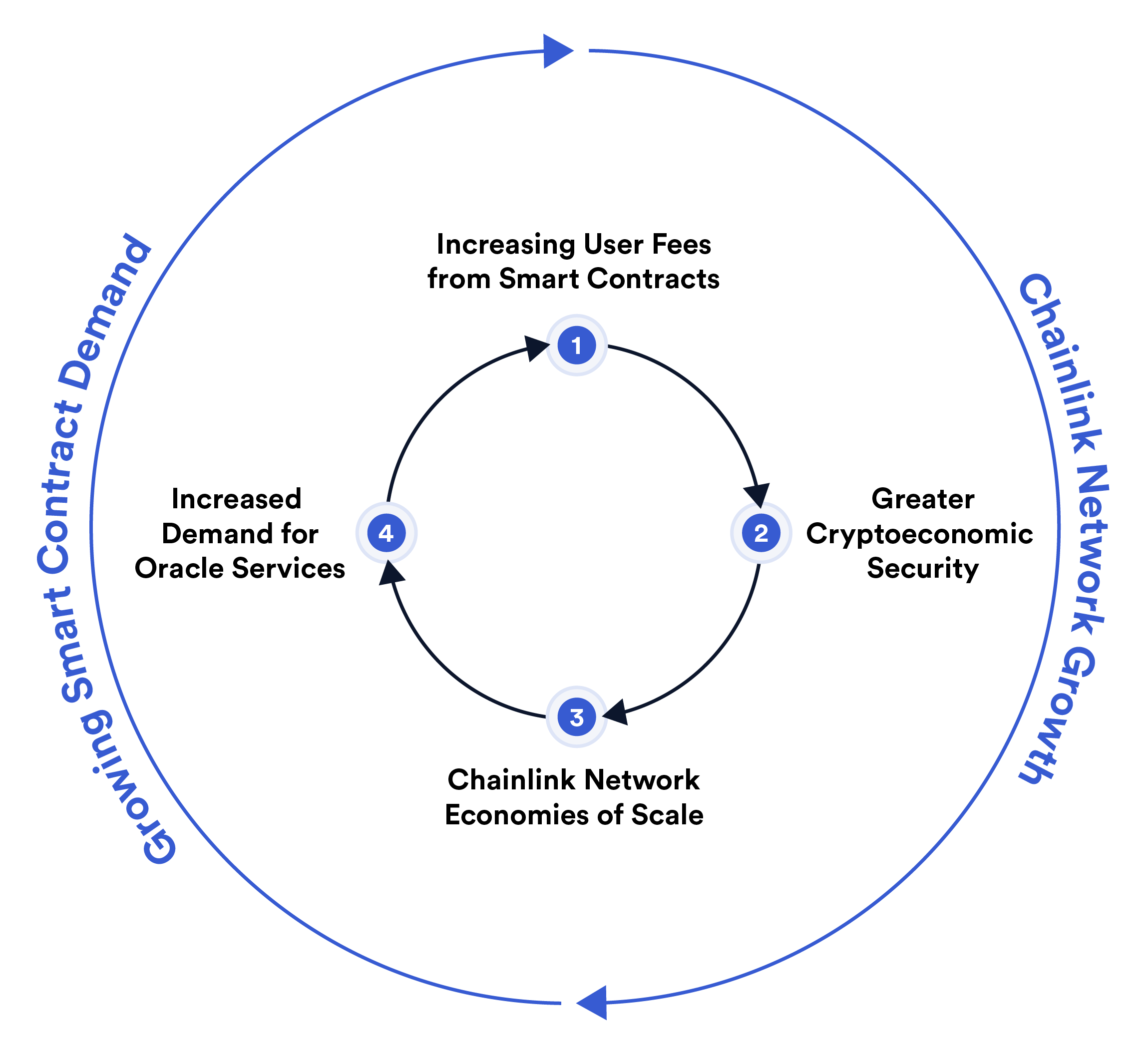
This figure appears in Section 9.8 during the explanation of the virtuous cycle of economic security, which is the culminating argument of the economics section. It illustrates schematically how super-linear staking impact and the IIF together create a self-reinforcing cycle of growth in both network security and user adoption. The figure synthesizes the incentive design argument into a single feedback loop diagram.
What This Figure Shows
The figure shows a four-step virtuous cycle: (1) a rise in user fee payments to an oracle network causes the network to grow by attracting additional nodes; (2) network growth leads to super-linear growth in economic security, specifically scaling as n² under the quadratic staking mechanism; (3) this super-linear growth produces economies of scale—specifically a reduction in the average cost of economic security per dollar, since the same total stake now secures a quadratically larger amount; and (4) lower costs, passed on to users in the form of lower fees, stimulate increased demand for oracle services, generating additional fees and FFO, which restarts the cycle.
Significance
The virtuous cycle is the whitepaper's capstone economic argument: it shows that Chainlink's staking mechanism does not merely provide static security but creates a dynamic positive feedback loop where growth in usage directly increases security, and increased security reduces costs in a way that drives further growth. This addresses the bootstrapping problem for oracle networks and suggests that well-designed DONs should be self-sustaining once established.