 Cosmos
Hub and Zones Architecture
Context
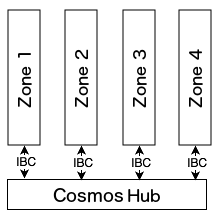
This figure appears in Section 2 (Cosmos Architecture) of the Cosmos whitepaper, defining the Hub-and-Zones topology. It is introduced after the text establishes that the Cosmos Hub is a multi-asset proof-of-stake blockchain and that zones are independent blockchains connecting via the Inter-Blockchain Communication (IBC) protocol. The figure is the visual anchor for the entire Cosmos architectural thesis.
What This Figure Shows
The diagram shows the Cosmos Hub at the center with multiple outgoing connections to several independent zone blockchains. Each zone is an autonomous blockchain with its own consensus, governance, and token economy; zones can be Tendermint-based or bridge non-IBC-native chains via a peg zone adapter. Token transfers between zones route through the Hub, which maintains a ledger of total token supply locked in each connected zone and enforces conservation across the system. The IBC protocol formalizes this: a sending zone produces a Merkle proof of a send packet, the Hub verifies the proof against stored block headers, mints or releases corresponding tokens, and forwards an IBC packet to the receiving zone. Any zone can itself act as a Hub, creating a recursive acyclic graph of interconnected chains.
Significance
This figure encapsulates the entire Cosmos value proposition: a modular internet of blockchains in which each chain retains full independence while achieving trustless communication through the Hub. The hub-and-zones topology was a direct response to the scalability limitations of monolithic smart contract platforms, proposing that different use cases should run on purpose-built chains communicating via a standardized protocol rather than competing for shared blockspace.