Filecoin
Выбор лидера в ожидаемом консенсусе
Context
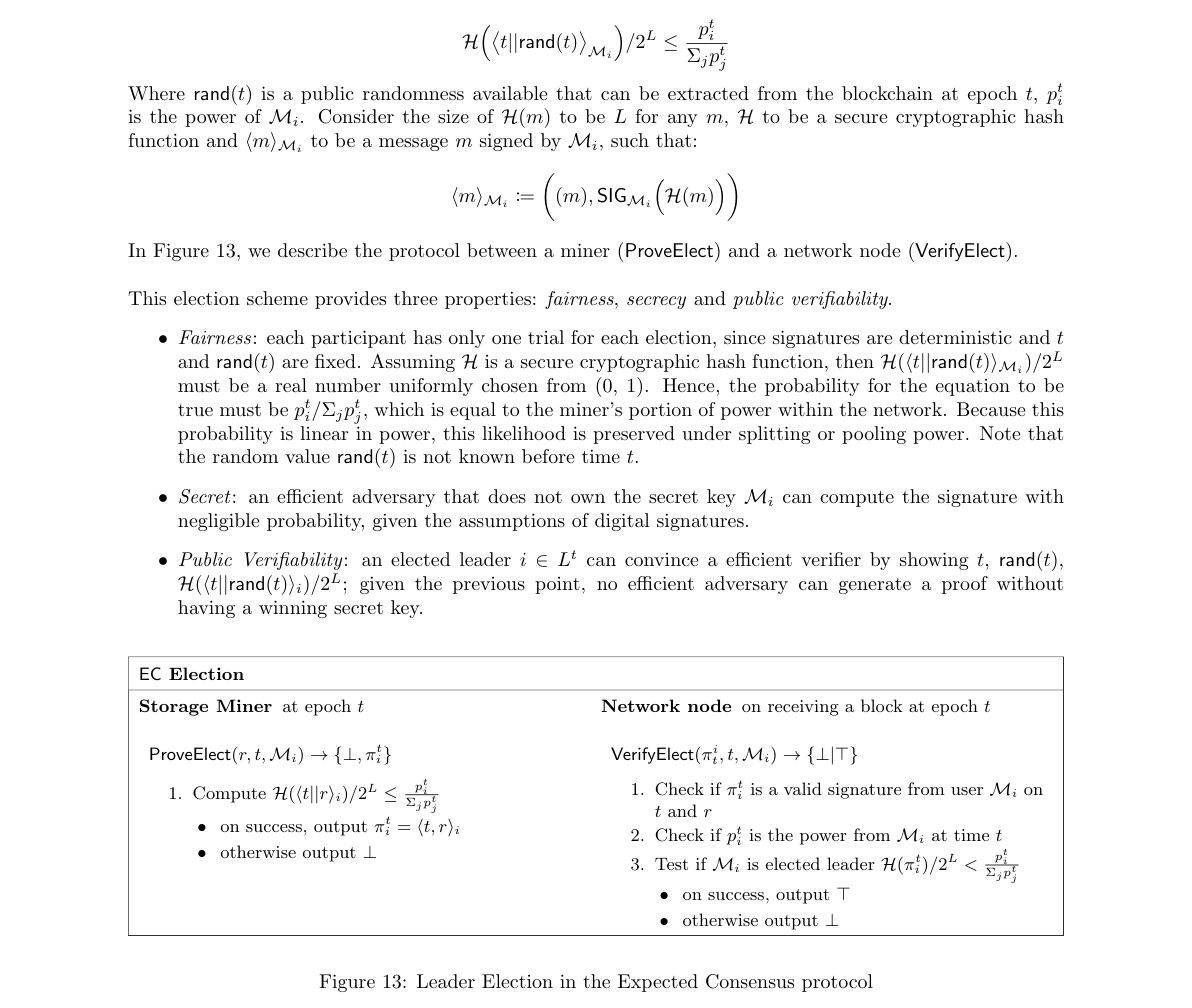
Figure 13 appears in Section 6.2.3 (Using Power to Achieve Consensus) and presents the EC (Expected Consensus) election protocol that determines which miner is eligible to create a new block in each epoch. It is the concrete instantiation of the Filecoin consensus mechanism, showing the ProveElect algorithm run by miners and the VerifyElect algorithm run by network nodes.
What This Figure Shows
The election criterion states that miner M_i is a leader at time t if the hash of the signed timestamp and randomness, divided by 2^L, is less than or equal to M_i's storage power divided by total network power. ProveElect takes randomness, epoch, and miner identity: it computes the hash inequality, and if satisfied outputs a signed proof; otherwise it outputs the empty symbol. VerifyElect takes the proof, epoch, and miner identity: it verifies the signature, looks up the miner's power from the AllocTable at that epoch, and tests whether the hash inequality holds. The scheme provides fairness (each miner gets exactly one trial per epoch due to deterministic signatures), secrecy (only the key holder can compute the winning signature), and public verifiability (anyone can verify the election proof).
Significance
This figure operationalizes Filecoin's 'useful work' consensus: mining power is directly proportional to verified storage rather than wasted hash computations, so miners are economically compelled to provide genuine storage service rather than burning energy on puzzles. The probabilistic election preserves the linear relationship between storage share and block production probability even under power splitting or pooling, making the consensus mechanism Sybil-resistant and aligned with the network's core storage utility.