
بروتوكول إجماع Stellar
Abstract
Abstract
International payments are slow and expensive, in part because of multi-hop payment routing through heterogeneous banking systems. Stellar is a new global payment network that can directly transfer digital money anywhere in the world in seconds. The key innovation is a secure transaction mechanism across untrusted intermediaries, using a new Byzantine agreement protocol called SCP. With SCP, each institution specifies other institutions with which to remain in agreement; through the global interconnectedness of the financial system, the whole network then agrees on atomic transactions spanning arbitrary institutions, with no solvency or exchange-rate risk from intermediary asset issuers or market makers. We present SCP’s model, protocol, and formal verification; describe the Stellar payment network; and finally evaluate Stellar empirically through benchmarks and our experience with several years of production use. CCS Concepts • Security and privacy →Distributed systems security; • Computer systems organization → Peer-to-peer architectures; • Information systems → Electronic funds transfer. Keywords blockchain, BFT, quorums, payments ACM Reference Format: Marta Lokhava, Giuliano Losa, David Mazières, Graydon Hoare, Nicolas Barry, Eli Gafni, Jonathan Jove, Rafał Malinowsky, Jed McCaleb. 2019. Fast and secure global payments with Stellar. In SOSP ’19: Symposium on Operating Systems Principles, October 27–30, 2019, Huntsville, ON, Canada. ACM, New York, NY, USA, 17 pages. https://doi.org/10.1145/3341301.3359636
خلاصة
المدفوعات الدولية بطيئة ومكلفة، ويرجع ذلك جزئيًا إلى توجيه الدفع متعدد القفزات عبر طرق غير متجانسة الأنظمة المصرفية. Stellar هي شبكة دفع عالمية جديدة التي يمكنها تحويل الأموال الرقمية مباشرة إلى أي مكان في العالم العالم في ثواني. الابتكار الرئيسي هو معاملة آمنة آلية عبر وسطاء غير موثوق بهم، وذلك باستخدام جديد بروتوكول الاتفاقية البيزنطية يسمى SCP. مع SCP، لكل منهما تحدد المؤسسة المؤسسات الأخرى التي ستبقى معها في الاتفاق؛ من خلال الترابط العالمي النظام المالي، ثم توافق الشبكة بأكملها على الذرية المعاملات التي تشمل مؤسسات تعسفية، مع عدم وجود مخاطر الملاءة المالية أو سعر الصرف من مصدري الأصول الوسطاء أو صناع السوق. نقدم نموذج SCP وبروتوكوله و التحقق الرسمي؛ وصف شبكة الدفع Stellar؛ وأخيرًا قم بتقييم Stellar تجريبيًا من خلال المعايير وخبرتنا مع عدة سنوات من استخدام الإنتاج. مفاهيم CCS • الأمن والخصوصية →الموزعة أمن الأنظمة؛ • تنظيم أنظمة الكمبيوتر → أبنية نظير إلى نظير؛ • نظم المعلومات → تحويل الأموال إلكترونيا. الكلمات الرئيسية blockchain, BFT, النصاب القانوني, الدفعات التنسيق المرجعي ACM: مارتا لوخافا، جوليانو لوسا، ديفيد مازيير، جرايدون هور، نيكولا باري، إيلي جافني، جوناثان جوف، رافائيل مالينوفسكي، جيد مكالب. 2019. مدفوعات عالمية سريعة وآمنة باستخدام Stellar. في SOSP ’19: ندوة حول مبادئ أنظمة التشغيل، 27-30 أكتوبر 2019، هانتسفيل، أونتاريو، كندا. ACM، نيويورك، نيويورك، الولايات المتحدة الأمريكية، 17 صفحة. https://doi.org/10.1145/3341301.3359636
Introduction
Introduction
International payments are notoriously slow and costly [32]. Consider the impracticality of sending $0.50 from the U.S. to *Galois, Inc. †UCLA Permission to make digital or hard copies of all or part of this work for personal or classroom use is granted without fee provided that copies are not made or distributed for profit or commercial advantage and that copies bear this notice and the full citation on the first page. Copyrights for components of this work owned by others than ACM must be honored. Abstracting with credit is permitted. To copy otherwise, or republish, to post on servers or to redistribute to lists, requires prior specific permission and/or a fee. Request permissions from [email protected]. SOSP ’19, October 27–30, 2019, Huntsville, ON, Canada © 2019 Association for Computing Machinery. ACM ISBN 978-1-4503-6873-5/19/10...$15.00 https://doi.org/10.1145/3341301.3359636 Mexico, two neighboring countries. End users pay nearly $9 for the average such transfer [32], and a bilateral agreement brokered by the countries’ central banks could only reduce the underlying bank cost to $0.67 per item [2]. On top of fees, the latency of international payments is generally counted in days, making it impossible to get money abroad quickly in emergencies. In countries where the banking system doesn’t work or doesn’t serve all citizens, or where fees are intolerable, people resort to sending payments by bus [38], by boat [19], and occasionally now by Bitcoin [55], all of which incur risk, latency, or inconvenience. While there will always be compliance costs, evidence suggests a significant amount is lost to lack of competition [21], which is exacerbated by inefficient technology. Where people can innovate, prices and latencies go down. For instance, remittances from bank accounts in Q2 2019 cost an average of 6.99%, while the figure for mobile money was only 4.88% [13]. An open, global payment network that attracts innovation and competition from non-bank entities could drive down costs and latencies at all layers, including compliance [83]. This paper presents Stellar, a blockchain-based payment network specifically designed to facilitate innovation and competition in international payments. Stellar is the first system to meet all three of the following goals (under a novel but empirically valid “Internet hypothesis”): 1. Open membership – Anyone can issue currency-backed digital tokens that can be exchanged among users. 2. Issuer-enforced finality – A token’s issuer can prevent transactions in the token from being reversed or undone. 3. Cross-issuer atomicity – Users can atomically exchange and trade tokens from multiple issuers. Achieving the first two is easy. Any company can unilaterally offer a product such as Paypal, Venmo, WeChat Pay, or Alipay and ensure the finality of payments in the virtual currencies they have created. Unfortunately, transacting atomically across these currencies is impossible. In fact, despite Paypal having acquired Venmo’s parent company in 2013, it is still impossible for end users to send Venmo dollars to Paypal users [78]. Only recently can merchants even accept both with a single integration. Goals 2 and 3 can be achieved in a closed system. In particular, a number of countries have efficient domestic payment networks, typically overseen by a universally trusted regulatory authority. However, membership is limited to a closed set of chartered banks and the networks are limited to the reach of a country’s regulatory authority.
SOSP ’19, October 27–30, 2019, Huntsville, ON, Canada Lokhava et al. Goals 1 and 3 have been achieved in mined blockchains, most notably in the form of ERC20 tokens on Ethereum [3]. The key idea of these blockchains is to create a new cryptocurrency with which to reward people for making settled transactions hard to revert. Unfortunately, this means token issuers do not control transaction finality. If software errors cause transactions history to be reorganized [26, 73], or when the spoils of defrauding people exceed the cost of reorganizing history [74, 97], issuers may be liable for tokens they have already redeemed for real-world money. The Stellar blockchain has two distinguishing properties. First, it natively supports efficient markets between tokens from different issuers. Specifically, anyone can issue a token, the blockchain provides a built-in orderbook for trade between any pair of tokens, and users can issue path payments that atomically trade across several currency pairs while guaranteeing an end-to-end limit price. Second, Stellar introduces a new Byzantine agreement protocol, SCP (Stellar Consensus Protocol), through which token issuers designate specific validator servers to enforce transaction finality. So long as no one compromises an issuer’s validators (and the underlying digital signatures and cryptographic hashes remain secure), the issuer knows exactly which transactions have occurred and avoids the risk of losses from blockchain history reorganization. SCP’s key idea is that most asset issuers benefit from liquid markets and want to facilitate atomic transactions with other assets. Hence, validator administrators configure their servers to agree with other validators on the exact history of all transactions on all assets. A validator v1 can be configured to agree with v2, or v2 can be configured to agree with v1, or both may be configured to agree with each other; in all cases, neither will commit to a transaction history until it knows the other cannot commit to a different history. By transitivity, if v1 cannot disagree with v2 and v2 cannot disagree with v3 (or vice versa), v1 cannot disagree with v3, whether or not v3 represents assets v1 has even heard of. Under the hypothesis that these agreement relationships transitively connect the whole network, SCP guarantees global agreement, making it a global Byzantine agreement protocol with open membership. We call this new connectedness assumption the Internet hypothesis, and note that it holds of both “the Internet” (which everyone understands to mean the single largest transitively connected IP network) and legacy international payments (which are hop-by-hop non-atomic, but leverage a transitively connected, global network of financial institutions). Stellar has been in production use since September, 2015. To keep the blockchain length manageable, the system runs SCP at 5-second intervals—fast by blockchain standards, but far slower than typical applications of Byzantine agreement. Though the primary use has been payments, Stellar has also proven appealing for non-money fungible tokens that benefit from immediate secondary markets (see Section 7.1). The next section discusses related work. Section 3 presents SCP. Section 4 describes our formal verification of SCP. Section 5 describes Stellar’s payment layer. Section 6 relates some of our deployment experience and lessons learned. Section 7 evaluates the system. Section 8 concludes.
مقدمة
من المعروف أن المدفوعات الدولية بطيئة ومكلفة [32]. خذ بعين الاعتبار عدم جدوى إرسال 0.50 دولار من الولايات المتحدة إلى * شركة جالوا †جامعة كاليفورنيا الإذن بعمل نسخ رقمية أو ورقية من كل هذا العمل أو جزء منه يُمنح الاستخدام الشخصي أو الاستخدام في الفصل الدراسي بدون رسوم بشرط عدم وجود نسخ صنعت أو وزعت لتحقيق الربح أو الميزة التجارية وتحمل تلك النسخ هذا الإشعار والاقتباس الكامل في الصفحة الأولى. حقوق الطبع والنشر للمكونات يجب تكريم هذا العمل المملوك لآخرين غير ACM. التجريد مع الائتمان مسموح به. النسخ بخلاف ذلك، أو إعادة النشر، للنشر على الخوادم أو إلى إعادة التوزيع على القوائم يتطلب الحصول على إذن محدد مسبق و/أو دفع رسوم. طلب الأذونات من [email protected]. SOSP '19، 27-30 أكتوبر 2019، هانتسفيل، أونتاريو، كندا © 2019 جمعية آلات الحوسبة. ACM ISBN 978-1-4503-6873-5/19/10...$15.00 https://doi.org/10.1145/3341301.3359636 المكسيك دولتان متجاورتان. يدفع المستخدمون النهائيون ما يقرب من 9 دولارات لمتوسط هذا النقل [32]، واتفاق ثنائي ولم يكن من الممكن إلا أن تخفض الديون التي توسطت فيها البنوك المركزية في البلدان تبلغ تكلفة البنك الأساسي 0.67 دولارًا أمريكيًا لكل عنصر [2]. على رأس الرسوم، يتم احتساب زمن الوصول للمدفوعات الدولية بشكل عام في أيام، مما يجعل من المستحيل الحصول على الأموال في الخارج بسرعة حالات الطوارئ. في البلدان التي لا يوجد بها نظام مصرفي العمل أو لا يخدم جميع المواطنين، أو عندما تكون الرسوم غير محتملة، يلجأ الناس إلى إرسال المدفوعات بالحافلة [38]، عن طريق القارب [19]، وأحيانًا الآن بواسطة Bitcoin [55]، وكلها تحمل المخاطر أو الكمون أو الإزعاج. على الرغم من أنه ستكون هناك دائمًا تكاليف امتثال، تشير الأدلة إلى ضياع مبلغ كبير بسبب انعدام المنافسة [21]، والتي تتفاقم بسبب التكنولوجيا غير الفعالة. حيث الناس يمكن أن يبتكر، وتنخفض الأسعار وفترات التأخير. على سبيل المثال، بلغت تكلفة التحويلات من الحسابات المصرفية في الربع الثاني من عام 2019 ما متوسطه 6.99%، بينما بلغت نسبة تحويل الأموال عبر الهاتف المحمول 4.88% فقط [13]. شبكة دفع عالمية مفتوحة تجذب الابتكار ومن الممكن أن تؤدي المنافسة من جانب الكيانات غير المصرفية إلى الانخفاض التكاليف وزمن الوصول في جميع الطبقات، بما في ذلك الامتثال [83]. تعرض هذه الورقة Stellar، دفعة مستندة إلى blockchain شبكة مصممة خصيصًا لتسهيل الابتكار و المنافسة في المدفوعات الدولية. Stellar هو الأول نظام لتحقيق الأهداف الثلاثة التالية (تحت أ "فرضية الإنترنت" جديدة ولكنها صالحة تجريبيًا): 1. العضوية المفتوحة – يمكن لأي شخص إصدار عملة مدعومة tokens الرقمية التي يمكن تبادلها بين المستخدمين. 2. النهاية التي يفرضها المُصدر - يمكن لجهة إصدار token أن تمنع المعاملات في token من التراجع أو التراجع. 3. الذرية عبر المُصدر – يمكن للمستخدمين التبادل ذريًا وتداول tokens من جهات إصدار متعددة. إن تحقيق الأولين أمر سهل. يمكن لأي شركة أن تقدم من جانب واحد منتجًا مثل Paypal وVenmo وWeChat الدفع، أو Alipay والتأكد من نهائية المدفوعات في العملات الافتراضية التي قاموا بإنشائها. ولسوء الحظ، فإن التعامل ذريًا عبر هذه العملات أمر مستحيل. في الواقع، على الرغم من استحواذ Paypal على الشركة الأم لشركة Venmo في عام 2013، لا يزال من المستحيل على المستخدمين النهائيين إرسال Venmo دولار لمستخدمي Paypal [78]. في الآونة الأخيرة فقط يمكن للتجار حتى قبول كلاهما بتكامل واحد. يمكن تحقيق الهدفين 2 و 3 في نظام مغلق. وعلى وجه الخصوص، يتمتع عدد من البلدان بمدفوعات محلية تتسم بالكفاءة الشبكات، التي تشرف عليها عادةً هيئة تنظيمية موثوقة عالميًا. ومع ذلك، تقتصر العضوية على مغلقة مجموعة من البنوك المعتمدة والشبكات تقتصر على مدى وصول السلطة التنظيمية في البلاد.SOSP '19، 27-30 أكتوبر 2019، هانتسفيل، أونتاريو، كندا لوخافا وآخرون. تم تحقيق الهدفين 1 و3 في blockchains، وعلى الأخص في شكل ERC20 tokens على Ethereum [3]. الفكرة الرئيسية لهذه blockchain هي إنشاء عملة مشفرة جديدة يمكن من خلالها مكافأة الأشخاص على تسوية الأمر المعاملات من الصعب العودة. لسوء الحظ، هذا يعني أن جهات إصدار token لا تتحكم في نهائية المعاملة. إذا البرمجيات تتسبب الأخطاء في إعادة تنظيم سجل المعاملات [26، 73]، أو عندما تكون غنائم الغشاشين أكثر من تكلفة إعادة تنظيم التاريخ [74، 97]، قد يكون المصدرون مسؤولين عن tokens لقد قاموا بالفعل باستبدال أموال العالم الحقيقي. يحتوي Stellar blockchain على خاصيتين مميزتين. أولاً، يدعم أصلاً الأسواق الفعالة بين tokens من مصدرين مختلفين. على وجه التحديد، يمكن لأي شخص إصدار token، يوفر blockchain سجل طلبات مدمجًا للتداول بين أي زوج من token، ويمكن للمستخدمين إصدار دفعات المسار التي تتداول ذريًا عبر عدة أزواج عملات بينما ضمان سعر الحد الشامل. ثانيًا، يقدم Stellar اتفاقية بيزنطية جديدة البروتوكول SCP (Stellar بروتوكول الإجماع) والذي من خلاله يقوم مصدرو token بتعيين خوادم validator محددة للتنفيذ نهائية المعاملة. طالما لم يقم أحد بالمساس بـ validators الخاصة بجهة الإصدار (والتوقيعات الرقمية الأساسية و التشفير hashes آمن)، يعرف المصدر بالضبط المعاملات التي حدثت ويتجنب المخاطر من الخسائر الناجمة عن blockchain إعادة تنظيم التاريخ. الفكرة الرئيسية لشركة SCP هي أن معظم مصدري الأصول يستفيدون منها الأسواق السائلة وتريد تسهيل المعاملات الذرية مع الأصول الأخرى. ومن ثم، يتم تكوين مسؤولي validator خوادمهم للاتفاق مع validators الأخرى على وجه التحديد تاريخ جميع المعاملات على جميع الأصول. يمكن أن يكون validator v1 يمكن تكوينه للموافقة على الإصدار 2، أو يمكن تكوين الإصدار 2 للموافقة مع الإصدار 1، أو قد يتم تكوين كليهما للاتفاق مع بعضهما البعض؛ وفي جميع الحالات، لن يلتزم أي منهما بسجل المعاملات حتى إنها تعلم أن الآخر لا يمكنه الالتزام بتاريخ مختلف. بواسطة العبور، إذا كان v1 لا يمكن أن يختلف مع v2 وv2 لا يمكن أن يختلف مع v3 (أو العكس)، فإن v1 لا يمكن أن يختلف مع v3 v3، سواء كان v3 يمثل الأصول التي سمعها v1 أم لا من. في ظل فرضية أن هذه العلاقات اتفاق ربط الشبكة بالكامل بشكل عابر، يضمن SCP اتفاقية عالمية، مما جعلها اتفاقية بيزنطية عالمية بروتوكول ذو عضوية مفتوحة. نحن نطلق على افتراض الترابط الجديد هذا اسم فرضية الإنترنت، ونلاحظ ذلك يحمل كلا من "الإنترنت" (الذي يفهمه الجميع يعني أكبر شبكة IP متصلة بشكل عابر) والمدفوعات الدولية القديمة (التي تتم على أساس خطوة تلو الأخرى غير ذرية، ولكنها تستفيد من عالمية متصلة بشكل عابر شبكة المؤسسات المالية). Stellar قيد الاستخدام الإنتاجي منذ سبتمبر 2015. للحفاظ على طول blockchain قابلاً للإدارة، يتم تشغيل النظام SCP على فترات زمنية مدتها 5 ثوانٍ — بسرعة وفقًا لمعايير blockchain، ولكن أبطأ بكثير من التطبيقات النموذجية للاتفاقية البيزنطية. على الرغم من أن الاستخدام الأساسي كان عبارة عن مدفوعات، إلا أن Stellar كان كذلك أيضًا أثبتت جاذبيتها للأشياء القابلة للاستبدال غير المالية token والتي تستفيد منها من الأسواق الثانوية المباشرة (انظر القسم 7.1). ويناقش القسم التالي الأعمال ذات الصلة. يعرض القسم 3 SCP. يصف القسم 4 التحقق الرسمي من SCP. يصف القسم 5 طبقة الدفع الخاصة بـ Stellar. ويتعلق القسم 6 بعض خبراتنا في النشر والدروس المستفادة. القسم 7 يقيم النظام. وينتهي القسم 8.
Stellar consensus protocol
Stellar consensus protocol
The Stellar consensus protocol (SCP) is a quorum-based Byzantine agreement protocol with open membership. Quorums emerge from the combined local configuration decisions of individual nodes. However, nodes only recognize quorums to which they belong themselves, and only after learning the local configurations of all other quorum members. One benefit of this approach is that SCP inherently tolerates heterogeneous views of what nodes exist. Hence, nodes can join and leave unilaterally with no need for a “view change” protocol to coordinate membership. 3.1 Federated Byzantine agreement The traditional Byzantine agreement problem consists of a closed system of N nodes, some of which are faulty and may behave arbitrarily. Nodes receive input values and exchange messages to decide on an output value among the inputs. A Byzantine agreement protocol is safe when no two wellbehaved nodes output different decisions and the unique decision was a valid input (for some definition of valid agreed
SOSP ’19, October 27–30, 2019, Huntsville, ON, Canada Lokhava et al. upon beforehand). A protocol is live when it guarantees that every honest node eventually outputs a decision. Typically, protocols assume N = 3f + 1 for some integer f > 0, then guarantee safety and some form of liveness so long as at most f nodes are faulty. At some stage in these protocols, nodes vote on proposed values and a proposal receiving 2f + 1 votes, called a quorum of votes, becomes the decision. With N = 3f + 1 nodes, any two quorums of size 2f + 1 overlap in at least f + 1 nodes; even if f of these overlapping nodes are faulty, the two quorums share at least one non-faulty node, preventing contradictory decisions. However, this approach only works if all nodes agree on what constitutes a quorum, which is impossible in SCP where two nodes may not even know of each other’s existence. With SCP, each node v unilaterally declares sets of nodes, called its quorum slices, such that (a) v believes that if all members of a slice agree about the state of the system, then they are right, and (b) v believes that at least one of its slices will be available to provide timely information about the state of the system. We call the resulting system, consisting of nodes and their slices, a Federated Byzantine Agreement (FBA) system. As we will see next, a quorum system emerges from nodes’ slices. Informally, an FBA node’s slices express with whom the node requires agreement. E.g., a node may require agreement with 4 specific organizations, each running 3 nodes; to accommodate downtime, it may set its slices to be all sets consisting of 2 nodes from each organization. If this “requires agreement with” relation transitively relates any two nodes, we get global agreement. Otherwise, we can get divergence, but only between organizations neither of which requires agreement with the other. Given the topology of today’s financial system, we hypothesize that widespread convergence will keep producing a singe ledger history people call “the Stellar network,” much as we speak of the Internet. Quorums arise from slices as follows. Every node specifies its quorum slices in every message it sends. Let S be the set of nodes from which a set of messages originated. A node considers the set of messages to have reached quorum threshold when every member of S has a slice included in S. By construction, such a set S, if unanimous, satisfies the agreement requirements of each of its members. A faulty peer may advertise slices crafted to change what well-behaved nodes consider quorums. For the sake of protocol analysis, we define a quorum in FBA to be a non-empty set S of nodes encompassing at least one quorum slice of each non-faulty member. This abstraction is sound, as any set of messages purporting to represent a unanimous quorum actually does (even if it contains messages from faulty nodes), and it is precise when S contains only well-behaved nodes. In this section, we also assume that nodes’ slices do not change. Nevertheless, our results transfer to the changing-slice case because a system in which slices change is no less safe than a fixed-slice system in which a node’s slices consist of all the slices it ever uses in the changing-slices case (see Theorem 13 in [68]). As explained in Section 4, liveness depends on well-behaved nodes eventually removing unreliable nodes from their slices. Because different nodes have different agreement requirements, FBA precludes a global definition of safety. We say non-faulty nodes v1 and v2 are intertwined when every quorum of v1 intersects every quorum of v2 in at least one non-faulty node. An FBA protocol can ensure agreement only between intertwined nodes; since SCP does so, its fault tolerance for safety is optimal. The Internet hypothesis, underlying Stellar’s design, states that the nodes people care about will be intertwined. We say a set of nodes I is intact if I is a uniformly nonfaulty quorum such that every two members of I are intertwined even if every node outside of I is faulty. Intuitively, then, I should remain impervious to the actions of non-intact nodes. SCP guarantees both non-blocking liveness [93] and safety to intact sets, though nodes themselves do not need to know (and may not be able to know) which sets are intact. Furthermore, the union of two intact sets that intersect is an intact set. Therefore, intact sets define a partition of the well-behaved nodes, where each partition is safe and live (under some conditions), but different partitions may output divergent decisions. 3.1.1 Safety vs. Liveness considerations in FBA With limited exceptions [64], most closed Byzantine agreement protocols are tuned to the equilibrium point at which safety and liveness have the same fault tolerance. In FBA, that means configurations in which, regardless of failures, all intertwined sets are also intact. Given that FBA determines quorums in a decentralized way, it is unlikely that individual slice choices will lead to this equilibrium. Moreover, at least in Stellar, equilibrium is not desirable: the consequences of a safety failure (namely double-spent digital money) are far worse than those of a liveness failure (namely delays in payments that anyway took days before Stellar). People therefore should and do select large quorum slices such that their nodes are more likely to remain intertwined than intact. Further tipping the scales, it is easier to recover from typical liveness failures in an FBA system than in a traditional closed one. In closed systems, all messages must be interpreted with respect to the same set of quorums. Hence, adding and removing nodes to recover from failure requires reaching consensus on a reconfiguration event, which is difficult once consensus is no longer live. By contrast, with FBA, any node can unilaterally adjust its quorum slices at any time. In response to an outage at a systemically important organization, node administrators can adjust their slices to work around the problem, a bit like coordinating responses to BGP catastrophes [63] (though without the constraints of routing over physical network links).
Fast and secure global payments with Stellar SOSP ’19, October 27–30, 2019, Huntsville, ON, Canada 3.1.2 The cascade theorem SCP follows the template of the basic round model [42]; nodes progress through a series of numbered ballots, each attempting three tasks: (1) identify a “safe” value not contradicted by any decision in a previous ballot (often termed preparing the ballot), (2) agree on the safe value, and (3) detect that agreement was successful. However, FBA’s open membership stymies several common techniques, making it impossible to “port” traditional closed protocols to the FBA model by simply changing the definition of quorum. One technique employed by many protocols is rotating through leader nodes in round-robin fashion following timeouts. In a closed system, round-robin leader selection ensures that eventually a unique honest leader ends up coordinating agreement on a single value. Unfortunately, round-robin cannot work in an FBA system with unknown membership. Another common technique that fails with FBA is assuming a particular quorum can convince all nodes. For instance, if everyone recognizes any 2f + 1 nodes as a quorum, then 2f + 1 signatures suffice to prove protocol state to all nodes. Similarly, if a node receives a quorum of identical messages through reliable broadcast [24], the node can assume all nonfaulty nodes will also see a quorum. In FBA, by contrast, a quorum means nothing to nodes outside the quorum. Finally, non-federated systems often employ “backwards” reasoning about safety: if f + 1 nodes are faulty, all safety guarantees are lost. Hence, if node v hears f + 1 nodes all state some fact F, v can assume at least one is telling the truth (and hence that F is true) with no loss of safety. Such reasoning fails in FBA because safety is a property of pairs of nodes, so a node that has lost safety to some peers can always lose safety to more nodes by assuming bad facts. FBA can, however, reason backwards about liveness. Define a v-blocking set as a set of nodes that intersects every slice of v. If a v-blocking set B is unanimously faulty, B can deny node v a quorum and cost it liveness. Hence, if B unanimously states fact F, then v knows that either F is true or v is not intact. However, v still needs to see a full quorum to know that intertwined nodes won’t contradict F, which leads to a final round of communication in SCP and other FBA protocols [47] that is not required in analogous closed-membership protocols. The result is that we have three possible levels of confidence in potential facts: indeterminate, safe to assume among intact nodes (which we will term accepted facts), and safe to assume among intertwined nodes (which we will term confirmed facts). Node v can efficiently determine whether a set B is vblocking by checking whether B intersects all its slices. Interestingly, if nodes always announce the statements they accept and a full quorum accepts a statement, it sets off a cascading process by which statements propagate throughout intact sets. We call the key fact underlying this propagation the cascade theorem, which sates the following: If I is an intact set, Q is a quorum of any member of I, and S is any superset of Q, then either \(S \supseteq I\) or there is a member \(v \in I\) such that \(v \notin S\) and \(I \cap S\) is \(v\)-blocking. Intuitively, were this not the case, the complement of S would contain a quorum that intersects I but not Q, violating quorum intersection. Note that if we start with S = Q and repeatedly expand S to include all nodes it blocks, we obtain a cascading effect until, eventually, S encompasses all of I. 3.2 Protocol description SCP is a partially synchronous consensus protocol [42] consisting of a series of attempts to reach consensus called ballots. Ballots employ timeouts of increasing duration. A ballot-synchronization protocol ensures that nodes stay on the same ballot for increasing periods of time until the ballots are effectively synchronous. Termination is not guaranteed until ballots are synchronous, but two synchronous ballots in which faulty members of well-behaved nodes’ slices do not interfere are sufficient for SCP to terminate. A balloting protocol specifies the actions taken during each ballot. A ballot begins with a prepare phase, in which nodes try to determine a value to propose that does not contradict any previous decision. Then, in a commit phase, nodes try to make a decision on the prepared value. Balloting employs an agreement sub-protocol called federated voting, in which nodes vote on abstract statements that may eventually be confirmed or get stuck. Some statements might be designated contradictory, and the safety guarantee of federated voting is that no two members of an intertwined set confirm contradictory statements. Confirmation of a statement is not guaranteed except for an intact set whose members all vote the same way. However, if a member of an intact set does confirm a statement, federated voting guarantees that all members of the intact set eventually confirm that statement. Hence, taking irreversible steps in response to confirming statements preserves liveness for intact nodes. Nodes initially propose values obtained from a nomination protocol that increases the chances of all members of an intact set proposing the same value, and that eventually converges (though with no way to determine convergence is complete). Nomination combines federated voting with leader selection. Because round-robin is impossible in FBA, nomination uses a probabilistic leader-selection scheme. The cascade theorem plays a crucial role both in ballot synchronization and in avoiding blocked states from which termination is no longer possible. 3.2.1 Balloting SCP nodes proceed through a series of numbered ballots, employing federated voting to agree on statements about which values are or are not decided in which ballots. If asynchrony or faulty behavior prevents reaching a decision in ballot n, nodes time out and try again in ballot n + 1.
SOSP ’19, October 27–30, 2019, Huntsville, ON, Canada Lokhava et al. Recall federated voting might not terminate. Hence, some statements about ballots can get stuck in a permanently indeterminate state where nodes can never determine if they are still in progress or stuck. Because nodes cannot rule out the possibility of indeterminate statements later proving true, they must never attempt federated voting on new statements contradicting indeterminate ones. In each ballot n, nodes use federated voting on two types of statement: • prepare ⟨n,x⟩– states that no value other than x was or will ever be decided in any ballot \(\leq n\). • commit \(\langle n, x \rangle\) – states \(x\) is decided in ballot \(n\). Importantly, note that prepare \(\langle n, x \rangle\) contradicts commit \(\langle n', x' \rangle\) when \(n \geq n'\) and \(x \neq x'\). A node starts ballot n by attempting federated voting on a statement prepare ⟨n,x⟩. If any previous prepare statement was successfully confirmed through federated voting, the node chooses x from the confirmed prepare of the highest ballot. Otherwise, the node sets x to the output of the nomination protocol described in the next subsection. If and only if a node successfully confirms prepare ⟨n,x⟩ in ballot n, it attempts federated voting on commit ⟨n,x⟩. If that succeeds, it means SCP has decided, so the node outputs the value from the confirmed commit statement. Consider an intertwined set S. Since at most one value can be confirmed prepared by members of S in a given ballot, no two different values may be confirmed committed by members of S in a given ballot. Moreover, if commit ⟨n,x⟩ is confirmed, then prepare ⟨n,x⟩was confirmed too; since prepare ⟨n,x⟩contradicts any earlier commit for a different value, by the agreement guarantees of federated voting we get that no different value may be decided in an earlier ballot by members of S. By induction on ballot numbers, we therefore get that SCP is safe. For liveness, consider an intact set I and a long enough synchronous ballot n. If faulty nodes appearing in the slices of well-behaved nodes do not interfere in n, then by ballot n + 1 all members of I have confirmed the same set P of prepare statements. If P = ∅and ballot n was long enough, the nomination protocol will have converged on some value x. Otherwise, let x be the value from the prepare with the highest ballot in P. Either way, I will uniformly attempt federated voting on prepare ⟨n + 1,x⟩in the next ballot. Therefore, if n + 1 is also synchronous, a decision for x inevitably follows. 3.2.2 Nomination Nomination entails federated voting on statements: • nominate x – states x is a valid decision candidate. Nodes may vote to nominate multiple values—different nominate statements are not contradictory. However, once a node confirms any nominate statement, it stops voting to nominate new values. Federated voting still allows a node to confirm new nominate statements it didn’t vote for, which vote-or-accept a from quorum accept a from quorum a is valid accept a from blocking set uncommitted voted a accepted a confirmed a voted ¬a Figure 1. Stages of federated voting allows members of an intact set to confirm one another’s nominated values while still withholding new votes. The (evolving) result of nomination is a deterministic combination of all values in confirmed nominate statements. If x represents a set of transactions, nodes can take the union of sets, the largest set, or the one with the highest hash, so long as all nodes do the same. Because nodes withhold new votes after confirming one nominate statement, the set of confirmed statements can contain only finitely many values. The fact that confirmed statements reliably spread through intact sets means intact nodes eventually converge on the same set of nominated values and hence nomination result, though at an unknown point arbitrarily late in the protocol. Nodes employ federated leader selection to reduce the number of different values in nominate statements. Only a leader who has not already voted for a nominate statement may introduce a new x. Other nodes wait to hear from leaders and just copy their leaders’ (valid) nominate votes. To accommodate failure, the set of leaders keeps growing as timeouts occur, though in practice only a few nodes introduce new values of x. 3.2.3 Federated voting Federated voting employs a three-phase protocol shown in Figure 1. Nodes try to agree on abstract statements by first voting, then accepting, and finally confirming statements. A node v may vote for any valid statement a that does not contradict its other outstanding votes and accepted statements. It does so by broadcasting a signed vote message. v then accepts a if a is consistent with other accepted statements and either (case 1)v is a member of a quorum in which each node either votes for a or accepts a, or (case 2) even if v didn’t vote for a, a v-blocking set accepts a. In case 2, v may have previously cast votes contradicting a, which have now been overruled. v is allowed to forget about overruled votes and pretend it never cast them because ifv is intact, it knows overruled votes cannot complete a quorum through case 1. v broadcasts that it accepts a, then confirms a when it is in a quorum that unanimously accepts a. Figure 2 shows the effect of v-blocking sets and the cascade theorem during federated voting. Two intertwined nodes cannot confirm contradictory statements, as the two required quorums would have to share a
Fast and secure global payments with Stellar SOSP ’19, October 27–30, 2019, Huntsville, ON, Canada 3 4 2 1 5 7
Stellar بروتوكول الإجماع
يعتمد بروتوكول الإجماع Stellar (SCP) على النصاب القانوني بروتوكول الاتفاقية البيزنطية ذو العضوية المفتوحة. تنشأ النصاب القانوني من قرارات التكوين المحلي المجمعة للعقد الفردية. ومع ذلك، العقد تعترف فقط النصاب الذي ينتمون إليه أنفسهم، وبعد ذلك فقط التعرف على التكوينات المحلية لجميع أعضاء النصاب القانوني الآخرين. إحدى فوائد هذا النهج هو أن SCP بطبيعته يتسامح مع وجهات النظر غير المتجانسة حول ما هي العقد الموجودة. وبالتالي، يمكن للعقد الانضمام والمغادرة من جانب واحد دون الحاجة إلى بروتوكول "عرض التغيير" لتنسيق العضوية. 3.1 الاتفاقية البيزنطية الفيدرالية تتكون مشكلة الاتفاقية البيزنطية التقليدية من أ نظام مغلق من العقد N، وبعضها معيب وربما التصرف بشكل تعسفي. تتلقى العقد قيم الإدخال والتبادل الرسائل لتحديد قيمة الإخراج بين المدخلات. يكون بروتوكول الاتفاقية البيزنطية آمنًا عندما لا تنتج عقدتان جيدتا التصرف قرارات مختلفة وفريدة من نوعها كان القرار مدخلاً صالحًا (بالنسبة لبعض التعريفات الصالحة المتفق عليهاSOSP '19، 27-30 أكتوبر 2019، هانتسفيل، أونتاريو، كندا لوخافا وآخرون. عليه مسبقًا). يكون البروتوكول حيًا عندما يضمن ذلك كل عقدة صادقة تنتج في النهاية قرارًا. عادةً، تفترض البروتوكولات N = 3f + 1 لبعض الأعداد الصحيحة f > 0، ثم ضمان السلامة وشكل من أشكال الحيوية طالما أن معظم العقد f معيبة. في مرحلة ما في هذه البروتوكولات، والعقد تصوت على القيم المقترحة والاقتراح الحصول على 2f + 1 صوت، وهو ما يسمى نصاب الأصوات، يصبح القرار. مع N = 3f + 1 العقد، أي نصابين من يتداخل الحجم 2f + 1 في العقد f + 1 على الأقل؛ حتى لو و من هذه العقد المتداخلة معيبة، ويشترك النصابان على الأقل عقدة واحدة غير معيبة، مما يمنع اتخاذ قرارات متناقضة. ومع ذلك، فإن هذا النهج لا يعمل إلا إذا اتفقت جميع العقد ما يشكل النصاب القانوني، وهو أمر مستحيل في SCP حيث قد لا تعرف العقدتان وجود بعضهما البعض. مع SCP، كل عقدة v تعلن من جانب واحد عن مجموعات من العقد، تسمى شرائح النصاب القانوني، بحيث (أ) v يعتقد أنه إذا كان كل شيء إذن، يتفق أعضاء الشريحة على حالة النظام إنهم على حق، و(ب) v يعتقد أن شريحة واحدة على الأقل من شرائحه سيكون متاحًا لتقديم المعلومات في الوقت المناسب حول حالة النظام. نحن نسمي النظام الناتج، يتكون العقد وشرائحها، اتفاقية بيزنطية موحدة نظام (FBA). وكما سنرى بعد ذلك، يظهر نظام النصاب القانوني من شرائح العقد. بشكل غير رسمي، تعبر شرائح عقدة FBA عن من معه العقدة تتطلب الاتفاق. على سبيل المثال، قد تتطلب العقدة اتفاقًا مع 4 مؤسسات محددة، تدير كل منها 3 عقد؛ ل لاستيعاب وقت التوقف عن العمل، فقد يقوم بتعيين شرائحه لتكون جميع المجموعات تتكون من عقدتين من كل منظمة. إذا كان هذا "يتطلب الاتفاق مع "العلاقة ترتبط بشكل متعدٍ بأي عقدتين، نحصل على اتفاق عالمي. وإلا فإننا قد نحصل على الاختلاف، ولكن فقط بين المنظمات لا يتطلب أي منهما الاتفاق مع الآخر. بالنظر إلى طوبولوجيا اليوم في النظام المالي، فإننا نفترض أن التقارب واسع النطاق سوف يستمر في إنتاج سجل تاريخي واحد يسميه الناس "شبكة Stellar"، بقدر ما نتحدث عن الإنترنت. النصاب القانوني ينشأ من الشرائح على النحو التالي. تحدد كل عقدة شرائح النصاب القانوني في كل رسالة يرسلها. دع S يكون مجموعة العقد التي نشأت منها مجموعة من الرسائل. أ تعتبر العقدة أن مجموعة الرسائل قد وصلت إلى النصاب القانوني العتبة عندما يكون لدى كل عضو في S شريحة مضمنة في S. من خلال البناء، فإن مثل هذه المجموعة S، إذا تم الإجماع عليها، تلبي متطلبات الاتفاق لكل عضو من أعضائها. قد يعلن النظير المعيب عن شرائح تم تصميمها لتغيير ما العقد حسنة التصرف تأخذ في الاعتبار النصاب القانوني. من أجل تحليل البروتوكول، حددنا النصاب القانوني في FBA ليكون غير فارغ مجموعة S من العقد تشمل شريحة نصاب واحدة على الأقل كل عضو غير معيب. وهذا التجريد سليم، كأي مجموعة من الرسائل التي يزعم أنها تمثل النصاب القانوني بالإجماع في الواقع (حتى لو كان يحتوي على رسائل من عقد معيبة)، ويكون دقيقًا عندما يحتوي S على العقد جيدة التصرف فقط. في في هذا القسم، نفترض أيضًا أن شرائح العقد لا تتغير. ومع ذلك، فإن نتائجنا تنتقل إلى حالة الشريحة المتغيرة لأن النظام الذي يتم فيه تغيير الشرائح لا يقل أمانًا عن نظام شريحة ثابتة تتكون فيه شرائح العقدة من جميع الشرائح التي تستخدمها على الإطلاق في حالة الشرائح المتغيرة (انظر النظرية 13 في [68]). كما هو موضح في القسم 4، تعتمد الحيوية على العقد حسنة التصرف تقوم في النهاية بإزالة العقد غير الموثوقة من شرائحهم. نظرًا لأن العقد المختلفة لها متطلبات اتفاقية مختلفة، فإن FBA يمنع تعريفًا عالميًا للسلامة. نحن نقول تتشابك العقد غير المعيبة v1 وv2 عند كل منهما يتقاطع نصاب v1 مع كل نصاب v2 في واحد على الأقل عقدة غير معيبة. يمكن لبروتوكول FBA ضمان الاتفاق فقط بين العقد المتشابكة؛ منذ SCP يفعل ذلك، خطأه التسامح من أجل السلامة هو الأمثل. فرضية الإنترنت ينص تصميم Stellar الأساسي على أن العقد تهتم بالأشخاص حول سوف تكون متشابكة. نقول إن مجموعة العقد I سليمة إذا كنت نصابًا غير معيب بشكل موحد بحيث يتشابك كل عضوين من I حتى لو كانت كل عقدة خارج I معيبة. بشكل حدسي، إذن، يجب أن أبقى منيعًا أمام تصرفات غير سليمة العقد. يضمن SCP كلاً من الحيوية غير المحظورة [93] و السلامة لمجموعات سليمة، على الرغم من أن العقد نفسها لا تحتاج إليها لمعرفة (وقد لا تكون قادرًا على معرفة) المجموعات السليمة. علاوة على ذلك، فإن اتحاد مجموعتين سليمتين متقاطعتين هو مجموعة سليمة. لذلك، تحدد المجموعات السليمة قسمًا من ملف العقد حسنة التصرف، حيث يكون كل قسم آمنًا وحيويًا (في ظل بعض الشروط)، ولكن قد يتم إخراج أقسام مختلفة قرارات متباينة. 3.1.1 اعتبارات السلامة مقابل الحياة في FBA مع استثناءات محدودة [64]، يتم ضبط معظم بروتوكولات الاتفاقية البيزنطية المغلقة على نقطة التوازن التي عندها السلامة والحيوية لهما نفس التسامح مع الخطأ. في فبا، وهذا يعني التكوينات التي، بغض النظر عن الفشل، كل شيء المجموعات المتشابكة سليمة أيضًا. بالنظر إلى أن FBA يحدد النصاب القانوني بطريقة لا مركزية، فمن غير المرجح أن تؤدي اختيارات الشرائح الفردية إلى هذا التوازن. علاوة على ذلك، في على الأقل في Stellar، التوازن غير مرغوب فيه: العواقب من فشل السلامة (أي الأموال الرقمية التي تم إنفاقها بشكل مزدوج). أسوأ بكثير من فشل الحياة (أي التأخير في الدفعات التي استغرقت على أي حال أيامًا قبل Stellar). الناس ولذلك ينبغي القيام بتحديد شرائح النصاب القانوني الكبيرة من هذا القبيل من المرجح أن تظل عقدها متشابكة أكثر من كونها سليمة. علاوة على ذلك، يصبح التعافي منه أسهل إخفاقات الحيوية النموذجية في نظام FBA مقارنةً بالنظام التقليدي المغلق. في الأنظمة المغلقة، يجب أن تكون كافة الرسائل يتم تفسيرها فيما يتعلق بنفس مجموعة النصاب القانوني. وبالتالي، يتطلب إضافة العقد وإزالتها للتعافي من الفشل التوصل إلى إجماع حول حدث إعادة التشكيل، وهو أمر صعب بمجرد انتهاء الإجماع. على النقيض من ذلك، مع FBA، يمكن لأي عقدة ضبط شرائح النصاب القانوني الخاصة بها من جانب واحد في أي وقت الوقت. ردا على انقطاع التيار الكهربائي في أهمية نظامية المؤسسة، يمكن لمسؤولي العقدة ضبط الشرائح الخاصة بهم وفقًا لذلك التغلب على المشكلة، يشبه إلى حد ما تنسيق الاستجابات لكوارث BGP [63] (على الرغم من عدم وجود قيود التوجيه عبر روابط الشبكة الفعلية).
مدفوعات عالمية سريعة وآمنة باستخدام Stellar SOSP '19، 27-30 أكتوبر 2019، هانتسفيل، أونتاريو، كندا 3.1.2 نظرية التتالي يتبع SCP قالب النموذج الدائري الأساسي [42]؛ تتقدم العقد من خلال سلسلة من بطاقات الاقتراع المرقمة، لكل منها محاولة القيام بثلاث مهام: (1) تحديد قيمة "آمنة" لا تتعارض مع أي قرار تم اتخاذه في الاقتراع السابق (يُطلق عليه غالبًا إعداد الاقتراع)، (2) الاتفاق على القيمة الآمنة، و (3) اكتشاف أن الاتفاق كان ناجحًا. ومع ذلك، FBA مفتوح العضوية تحبط العديد من التقنيات الشائعة، مما يجعلها من المستحيل "نقل" البروتوكولات التقليدية المغلقة إلى FBA النموذج ببساطة عن طريق تغيير تعريف النصاب القانوني. إحدى التقنيات المستخدمة في العديد من البروتوكولات هي التدوير من خلال العقد الرائدة بطريقة دائرية بعد انتهاء المهلات. في النظام المغلق، يتم ضمان اختيار القائد بشكل دائري في نهاية المطاف، ينتهي الأمر بالقائد الصادق الفريد إلى تنسيق الاتفاق على قيمة واحدة. لسوء الحظ، جولة روبن لا يمكن العمل في نظام FBA بعضوية غير معروفة. أسلوب شائع آخر يفشل مع FBA هو افتراض أن نصابًا معينًا يمكنه إقناع جميع العقد. على سبيل المثال، إذا تعرف الجميع على أي عقد 2f + 1 كنصاب قانوني، إذن تكفي توقيعات 2f + 1 لإثبات حالة البروتوكول لجميع العقد. وبالمثل، إذا تلقت العقدة نصابًا من الرسائل المتطابقة من خلال البث الموثوق [24]، يمكن للعقدة أن تفترض أن جميع العقد غير الخاطئة سوف تشهد أيضًا النصاب القانوني. في FBA، على النقيض من ذلك، أ النصاب القانوني لا يعني شيئا للعقد خارج النصاب القانوني. وأخيرا، غالبا ما تستخدم الأنظمة غير الفيدرالية "الرجعية" التفكير في السلامة: إذا كانت العقد f + 1 معيبة، فكل الأمان فقدت الضمانات. وبالتالي، إذا سمعت العقدة v جميع العقد f + 1 اذكر بعض الحقائق F، v يمكن أن تفترض أن واحدًا على الأقل هو الذي يخبر الحقيقة (وبالتالي F صحيحة) دون فقدان الأمان. مثل هذا يفشل المنطق في FBA لأن السلامة هي خاصية للأزواج من العقد، لذلك يمكن للعقدة التي فقدت الأمان لبعض أقرانها تفقد الأمان دائمًا لمزيد من العقد من خلال افتراض حقائق سيئة. ومع ذلك، يمكن لـ FBA التفكير بشكل عكسي فيما يتعلق بالحيوية. حدد مجموعة v-blocking كمجموعة من العقد التي تتقاطع مع كل منها شريحة v. إذا كانت مجموعة حجب v B معيبة بالإجماع، فإن B يمكن رفض العقدة ضد النصاب القانوني وتكلفتها الحيوية. وبالتالي، إذا ينص B بالإجماع على الحقيقة F، ثم يعرف v أن أيًا من F هو صحيح أو v ليس سليما. ومع ذلك، لا يزال v بحاجة لرؤية كامل النصاب القانوني لمعرفة أن العقد المتشابكة لن تتعارض مع F، مما يؤدي إلى الجولة النهائية من الاتصالات في SCP و بروتوكولات FBA الأخرى [47] غير المطلوبة في الأنظمة المشابهة بروتوكولات العضوية المغلقة. والنتيجة هي أن لدينا ثلاثة مستويات محتملة من الثقة في الحقائق المحتملة: غير محددة، وآمنة للافتراض بين العقد السليمة (وهو ما سنفعله). مصطلح حقائق مقبولة)، وآمن الافتراض فيما بينها العقد (والتي سنسميها حقائق مؤكدة). يمكن للعقدة v تحديد ما إذا كانت المجموعة B محظورة بكفاءة عن طريق التحقق مما إذا كانت B تتقاطع مع جميع شرائحها. ومن المثير للاهتمام أنه إذا كانت العقد تعلن دائمًا عن البيانات فإنها قبول والنصاب القانوني الكامل لقبول بيان، فإنه يطلق عملية متتالية يتم من خلالها نشر البيانات في جميع أنحاء مجموعات سليمة. نحن نسمي الحقيقة الأساسية الكامنة وراء هذا الانتشار النظرية المتتالية، التي تنص على ما يلي: إذا كنت مجموعة سليمة، Q هو النصاب القانوني لأي عضو في I، وS هو أي مجموعة شاملة من Q، ثم إما S ⊇I أو هناك عضو v ∈I بحيث يكون v < S و I ∩S بمثابة حجب v. حدسيًا، كان هذا ليس الأمر كذلك، فإن تكملة S سوف تحتوي على النصاب القانوني الذي يتقاطع مع I وليس Q، مما ينتهك تقاطع النصاب القانوني. لاحظ أنه إذا بدأنا بـ S = Q وقمنا بتوسيع S بشكل متكرر إلى بتضمين جميع العقد التي يحظرها، نحصل على تأثير متتالي حتى، في النهاية، S يشمل كل I. 3.2 وصف البروتوكول SCP هو بروتوكول إجماع متزامن جزئيًا [42] يتكون من سلسلة من المحاولات للوصول إلى إجماع يسمى بطاقات الاقتراع. تستخدم بطاقات الاقتراع فترات زمنية أطول. أ يضمن بروتوكول مزامنة الاقتراع بقاء العقد قائمة نفس الاقتراع لفترات زمنية متزايدة حتى الاقتراع متزامنة بشكل فعال. الإنهاء غير مضمون حتى تصبح بطاقات الاقتراع متزامنة، ولكن ورقتين متزامنتين وهو ما يفعله الأعضاء المعيبون في شرائح العقد حسنة التصرف عدم التدخل كافية لإنهاء SCP. ويحدد بروتوكول الاقتراع الإجراءات المتخذة خلال كل منها الاقتراع. يبدأ الاقتراع بمرحلة إعداد، حيث يتم تحديد العقد محاولة تحديد قيمة لاقتراح لا يتعارض أي قرار سابق. ثم، في مرحلة الالتزام، تحاول العقد لاتخاذ قرار بشأن القيمة المعدة. يستخدم الاقتراع بروتوكولًا فرعيًا للاتفاق يسمى التصويت الفيدرالي، أيn التي العقد تصوت على البيانات المجردة والتي قد يتم تأكيدها في النهاية أو تتعثر. قد يتم تصنيف بعض العبارات على أنها متناقضة، والسلامة ضمان التصويت الفيدرالي هو عدم وجود عضوين في أي عضو مجموعة متشابكة تؤكد تصريحات متناقضة. ولا يضمن تأكيد القول إلا سليما تعيين الذي يصوت جميع أعضائه بنفس الطريقة. ومع ذلك، إذا كان أ عضو في مجموعة سليمة يؤكد بيانًا متحدًا يضمن التصويت أن جميع أعضاء المجموعة السليمة يؤكدون هذا البيان في النهاية. وبالتالي اتخاذ خطوات لا رجعة فيها ردا على تأكيد التصريحات يحفظ الحيوية ل العقد سليمة. تقترح العقد في البداية القيم التي تم الحصول عليها من الترشيح البروتوكول الذي يزيد من فرص جميع الأعضاء سليمة مجموعة تقترح نفس القيمة، والتي تتقارب في نهاية المطاف (على الرغم من عدم وجود طريقة لتحديد التقارب الكامل). يجمع الترشيح بين التصويت الفيدرالي واختيار القائد. لأن جولة روبن مستحيلة في FBA، يستخدم الترشيح مخطط احتمالي لاختيار القائد. تلعب نظرية التعاقب دورًا حاسمًا في الاقتراع المزامنة وتجنب الحالات المحظورة منها الإنهاء لم يعد ممكنا. 3.2.1 الاقتراع تستمر عقد SCP عبر سلسلة من بطاقات الاقتراع المرقمة، باستخدام التصويت الفيدرالي للاتفاق على البيانات المتعلقة بها يتم أو لا يتم تحديد القيم في أي بطاقة اقتراع. إذا كان غير متزامن أو السلوك الخاطئ يمنع التوصل إلى قرار في الاقتراع ن، انتهت مهلة العقد وحاول مرة أخرى في الاقتراع n + 1.
SOSP '19، 27-30 أكتوبر 2019، هانتسفيل، أونتاريو، كندا لوخافا وآخرون. تذكر أن التصويت الفيدرالي قد لا ينتهي. وبالتالي بعض يمكن أن تتعثر البيانات المتعلقة بأوراق الاقتراع بشكل دائم حالة غير محددة حيث لا يمكن للعقد أبدًا تحديد ما إذا كانت لا تزال في التقدم أو عالقة. لأن العقد لا يمكن استبعادها إمكانية إثبات صحة البيانات غير المحددة لاحقًا، ويجب عليهم ألا يحاولوا أبدًا التصويت الفيدرالي على البيانات الجديدة يتعارض مع غير المحدد. في كل اقتراع n، تستخدم العقد التصويت الفيدرالي على نوعين من البيان: • تحضير ⟨n,x⟩– ينص على عدم وجود قيمة أخرى غير x تم أو سيتم تحديده في أي اقتراع. • الالتزام ⟨n,x⟩– الدول x يتم تحديدها في الاقتراع n. الأهم من ذلك، لاحظ أن تحضير ⟨n,x⟩تناقضات الالتزام ⟨n',x ′⟩عندما n ≥n' و x , x ′. تبدأ العقدة الاقتراع n من خلال محاولة التصويت الفيدرالي على a بيان تحضير ⟨n,x⟩. إذا كان هناك أي بيان إعداد سابق تم تأكيده بنجاح من خلال التصويت الفيدرالي تختار العقدة x من الإعداد المؤكد لأعلى بطاقة اقتراع. وبخلاف ذلك، تقوم العقدة بتعيين x إلى إخراج الملف بروتوكول الترشيح الموضح في القسم الفرعي التالي. إذا وفقط إذا أكدت العقدة بنجاح التحضير ⟨n,x⟩ في الاقتراع n، يحاول التصويت الفيدرالي على الالتزام ⟨n,x⟩. إذا إذا نجح، فهذا يعني أن SCP قد قرر، وبالتالي يتم إخراج العقدة القيمة من بيان الالتزام المؤكد. النظر في مجموعة متشابكة S. منذ قيمة واحدة على الأكثر يمكن تأكيد إعدادها من قبل أعضاء S في اقتراع معين، ولا يجوز تأكيد الالتزام بقيمتين مختلفتين أعضاء S في اقتراع معين. علاوة على ذلك، إذا ارتكبت ⟨n,x⟩ تم تأكيده، ثم تم تأكيد إعداد ⟨n,x⟩ أيضًا؛ منذ ذلك الحين يعد ⟨n,x⟩يناقض أي التزام سابق بقيمة مختلفة، بموجب اتفاقية ضمانات التصويت الفيدرالي لقد حصلنا على أنه لا يمكن تحديد قيمة مختلفة في وقت سابق الاقتراع من قبل أعضاء S. عن طريق التعريف بأرقام الاقتراع، نحن لذا تأكد من أن SCP آمن. من أجل الحيوية، فكر في مجموعة سليمة وطويلة بما فيه الكفاية اقتراع متزامن إذا ظهرت العقد الخاطئة في الشرائح من العقد حسنة التصرف لا تتدخل في ن، ثم عن طريق الاقتراع n + 1 جميع أعضاء لقد أكدوا نفس المجموعة P من بيانات الإعداد. إذا كانت P = ∅وبطاقة الاقتراع n طويلة بما فيه الكفاية، فإن سيكون بروتوكول الترشيح قد تقارب على بعض القيمة x. بخلاف ذلك، اجعل x هي القيمة من الإعداد بأعلى ورقة اقتراع في P. وفي كلتا الحالتين، سأحاول بشكل موحد التصويت على إعداد ⟨n + 1,x⟩ في الاقتراع التالي. لذلك، إذا n + 1 متزامن أيضًا، ويتبع ذلك حتماً قرار x. 3.2.2 الترشيح يستلزم الترشيح التصويت الموحد على البيانات: • ترشيح x - الدول x هي مرشح صالح للقرار. قد تصوت العقد لترشيح قيم متعددة — مختلفة تصريحات الترشيح ليست متناقضة. ومع ذلك، مرة واحدة تؤكد العقدة أي بيان ترشيح، وتتوقف عن التصويت عليه ترشيح قيم جديدة. لا يزال التصويت الفيدرالي يسمح للعقدة بذلك تأكيد بيانات الترشيح الجديدة التي لم تصوت لها التصويت أو القبول أ من النصاب القانوني قبول أ من النصاب القانوني أ صالح قبول من مجموعة الحظر غير ملتزم صوت أ قبلت أ أكد أ تم التصويت بـ أ الشكل 1. مراحل التصويت الفيدرالي يسمح لأعضاء مجموعة سليمة بتأكيد مجموعة بعضهم البعض القيم المرشحة مع الاستمرار في حجب الأصوات الجديدة. النتيجة (المتطورة) للترشيح هي مزيج حتمي من جميع القيم في بيانات الترشيح المؤكدة. إذا يمثل x مجموعة من المعاملات، ويمكن للعقد أن تأخذ الاتحاد من المجموعات، المجموعة الأكبر، أو المجموعة ذات أعلى hash، لذا طالما أن جميع العقد تفعل الشيء نفسه. لأن العقد حجب جديدة الأصوات بعد تأكيد بيان ترشيح واحد، مجموعة يمكن أن تحتوي البيانات المؤكدة على عدد محدود من القيم فقط. حقيقة أن التصريحات المؤكدة انتشرت بشكل موثوق من خلال المجموعات السليمة تعني أن العقد السليمة تتقارب في النهاية على نفس مجموعة القيم المرشحة وبالتالي نتيجة الترشيح، وإن كان عند نقطة غير معروفة بشكل تعسفي في وقت متأخر من البروتوكول. تستخدم العقد اختيار القائد المتحد لتقليل عدد القيم المختلفة في بيانات الترشيح. فقط يجوز للقائد الذي لم يصوت بالفعل لصالح بيان الترشيح أن يقدم علامة x جديدة. العقد الأخرى تنتظر أن تسمع منها القادة ويقومون فقط بنسخ أصوات ترشيح قادتهم (الصالحة). لاستيعاب الفشل، تستمر مجموعة القادة في النمو تحدث المهلات، على الرغم من أن عددًا قليلاً فقط من العقد تقدم قيمًا جديدة لـ x. 3.2.3 التصويت الفيدرالي يستخدم التصويت الفيدرالي بروتوكولًا ثلاثي المراحل كما هو موضح في الشكل 1. تحاول العقد الاتفاق على البيانات المجردة أولاً التصويت، ثم القبول، وأخيراً تأكيد البيانات. قد تصوت العقدة v لأي بيان صالح لا ينطبق عليه ذلك يناقض غيرهالأصوات المتميزة والبيانات المقبولة. ويتم ذلك عن طريق بث رسالة تصويت موقعة. v ثم يقبل a إذا كان a متوافقًا مع البيانات المقبولة الأخرى وإما (الحالة 1)v هو عضو في النصاب القانوني الذي كل عقدة إما تصوت لـ أو تقبل أو (الحالة 2) حتى لو كانت v لم أصوت لصالح مجموعة v-blocking تقبل a. في الحالة 2، قد سبق أن أدلوا بأصوات تتعارض مع ما حدث الآن تم نقضها. v يُسمح له بنسيان الأصوات الملغاة ويتظاهر بأنه لم يلقيهم أبدًا لأنه إذا كان سليمًا، فهو يعلم لا يمكن للأصوات الملغاة إكمال النصاب القانوني من خلال الحالة 1. v يبث أنه يقبل a، ثم يؤكد a عندما يكون موجودًا نصاب يقبل بالإجماع أ. ويبين الشكل 2 تأثير مجموعات الحجب v ونظرية التتالي خلال التصويت الفيدرالي. لا يمكن لعقدتين متشابكتين تأكيد البيانات المتناقضة، حيث يجب أن يتشارك النصابان المطلوبان في أمدفوعات عالمية سريعة وآمنة باستخدام Stellar SOSP '19، 27-30 أكتوبر 2019، هانتسفيل، أونتاريو، كندا 3 4 2 1 5 7
Vote X
Vote X
Vote Y (a) 3 4 2 1 5 7 6 Vote X Vote X Vote X Vote Y Vote X Vote Y Vote Y (b) 3 4 2 1 5 7 6 Accept X Vote X Accept X Vote Y Accept X Vote Y Vote Y (c) 3 4 2 1 5 7 6 Accept X Accept X Accept X Vote Y Accept X Accept X Vote Y (d) 3 4 2 1 5 7 6 Accept X Vote X Accept X Accept X Accept X Accept X Accept X (e) Figure 2. Cascade effect in federated voting. Each node has one quorum slice indicated by arrows to members of the slice. (a) Contradictory statements X and Y are introduced. (b) Nodes vote for valid statements. (c) Node 1 accepts X after its quorum {1, 2, 3, 4} unanimously votes for X. (d) Nodes 1, 2, 3, and 4 all accept X; set {1} is 5-blocking, so node 5 accepts X, overruling its previous vote for Y. (e) Set {5} is 6- and 7-blocking, so 6 and 7 both accept X. non-faulty node that could not accept contradictory statements. Confirmation of a statement is not guaranteed: in case of a split vote, both statements may be permanently stuck waiting for a quorum in the voting phase. However, if a node in an intact set I confirms a statement, the cascade theorem and accept case 2 ensure that all of I will eventually confirm that statement. 3.2.4 Ballot synchronization If nodes are unable to confirm a commit statement for the current ballot, they give up after a timeout. The timeout gets longer with each ballot so as to adjust to arbitrary bounds on network delay. However, timeouts alone are not sufficient to synchronize ballots of nodes that did not start at the same time or got desynchronized for other reasons. To achieve synchronization, nodes start the timer only once they are part of a quorum that is all at the current (or a later) ballot n. This slows down nodes that started early and ensures that no member of an intact set stays too far ahead of the group. Moreover, if a node v ever notices a v-blocking set at a later ballot, it immediately skips to the lowest ballot such that this is no longer the case, regardless of any timers. The cascade theorem then ensures that all stragglers catch up. The result is that ballots are roughly synchronized throughout an intact set once the system becomes synchronous. 3.2.5 Federated leader selection Leader selection allows each node to pick leaders in such a way that nodes generally only choose one or a small number of leaders. To accommodate leader failure, leader selection proceeds through rounds. If leaders of the current round appear not to be fulfilling their responsibilities, then after a certain timeout period nodes proceed to the next round to expand the set of leaders that they follow. Each round employs two unique cryptographic hash functions, H0 and H1, that output integers in the range [0,hmax). For instance, Stellar uses Hi(m) = SHA256(i∥b∥r ∥m), where b is the overall SCP instance (block or ledger number), r is the leader selection round number, and hmax = 2256. Within a round, we define the priority of node v as: priority(v) = H1(v) One strawman would be for each node to choose as leader the nodev with the highest priority(v). This approach works well with nearly identical quorum slices, but doesn’t properly capture the importance of nodes in imbalanced configurations. For instance, if Europe and China each contribute 3 nodes to every quorum, but China runs 1,000 nodes and Europe 4, then China will have the highest-priority node 99.6% of the time. We therefore introduce a notion of slice weight, where \(\text{weight}(u,v) \in [0, 1]\) is the fraction of node \(u\)'s quorum slices containing node \(v\). When node \(u\) is selecting a new leader, it only considers neighbors, defined as follows:
\[\text{neighbors}(u) = \{ v \mid H_0(v) < h_{\max} \cdot \text{weight}(u,v) \}\]
A node \(u\) then starts with an empty set of leaders, and at each round adds to it the node \(v\) in \(\text{neighbors}(u)\) with the highest \(\text{priority}(v)\). If the neighbors set is empty in any round, \(u\) instead adds the node \(v\) with lowest value of \(H_0(v)/\text{weight}(u,v)\).
التصويت ×
التصويت ي (أ) 3 4 2 1 5 7 6 التصويت X التصويت X التصويت X التصويت ي التصويت X التصويت ي التصويت ي (ب) 3 4 2 1 5 7 6 قبول X التصويت X قبول X التصويت ي قبول X التصويت ي التصويت ي (ج) 3 4 2 1 5 7 6 قبول X قبول X قبول X التصويت ي قبول X قبول X التصويت ي (د) 3 4 2 1 5 7 6 قبول X التصويت X قبول X قبول X قبول X قبول X قبول X (هـ) الشكل 2. تأثير تتالي في التصويت الاتحادي. تحتوي كل عقدة على شريحة نصاب واحدة يُشار إليها بأسهم لأعضاء الشريحة. (أ) تم تقديم بيانات متناقضة X وY. (ب) تصوت العقد على البيانات الصحيحة. (ج) العقدة 1 تقبل X بعد نصابها القانوني {1، 2، 3، 4} يصوتون بالإجماع لصالح X. (د) تقبل جميع العقد 1 و2 و3 و4 X؛ المجموعة {1} عبارة عن 5 حظر، لذا تقبل العقدة 5 X، مما يؤدي إلى إلغاء ذلك تصويتها السابق لصالح Y. (هـ) المجموعة {5} عبارة عن حجب 6 و7، لذا يقبل كل من 6 و7 X. عقدة غير معيبة لا يمكنها قبول البيانات المتناقضة. تأكيد البيان غير مضمون: في وفي حالة انقسام التصويت، يجوز أن يكون كلا البيانين بشكل دائم عالقون في انتظار اكتمال النصاب القانوني في مرحلة التصويت. ومع ذلك، إذا عقدة في مجموعة سليمة تؤكد بيانًا، التتالي النظرية وقبول الحالة 2 تأكد من أنني سأفعل ذلك جميعًا في النهاية تأكيد هذا البيان. 3.2.4 مزامنة الاقتراع إذا كانت العقد غير قادرة على تأكيد بيان الالتزام لـ الاقتراع الحالي، فإنهم يستسلمون بعد مهلة. يحصل المهلة لفترة أطول مع كل اقتراع حتى يتسنى التكيف مع الحدود التعسفية على تأخير الشبكة. ومع ذلك، فإن المهلات وحدها ليست كافية لمزامنة بطاقات الاقتراع الخاصة بالعقد التي لم تبدأ في نفس الوقت أو حصلت على غير متزامنة لأسباب أخرى. لتحقيق التزامن، تبدأ العقد في تشغيل المؤقت فقط عندما تصبح جزءًا من ملف النصاب القانوني الذي يكون موجودًا في الاقتراع الحالي (أو اللاحق) n. هذا يبطئ العقد التي بدأت مبكرًا ويضمن عدم حدوث ذلك يبقى العضو في مجموعة سليمة متقدمًا جدًا على المجموعة. علاوة على ذلك، إذا لاحظت العقدة v تعيين حجب v في وقت لاحق الاقتراع، فإنه يتخطى على الفور إلى أدنى بطاقة اقتراع مثل هذا لم يعد هذا هو الحال، بغض النظر عن أي توقيت. الشلال ثم تضمن النظرية أن جميع المتطرفين يلحقون بالركب. النتيجة هو أن بطاقات الاقتراع تتم مزامنتها تقريبًا في جميع أنحاء سليمة يتم ضبطه بمجرد أن يصبح النظام متزامنًا. 3.2.5 اختيار الزعيم الاتحادي يسمح اختيار القائد لكل عقدة باختيار القادة في مثل هذا الطريقة التي تختار بها العقد عمومًا واحدًا أو عددًا صغيرًا فقط من القادة. لاستيعاب فشل القائد، يتم اختيار القائد العائدات من خلال جولات. إذا كان قادة الجولة الحالية يبدو أنهم لا يقومون بمسؤولياتهم، ثم بعد أ تنتقل عقد معينة في فترة المهلة إلى الجولة التالية توسيع مجموعة القادة الذين يتبعونهم. تستخدم كل جولة وظيفتين تشفيريتين فريدتين hash، H0 وH1، اللتين تنتجان أعدادًا صحيحة في النطاق [0,hmax). على سبيل المثال، Stellar يستخدم Hi(m) = SHA256(i∥b∥r ∥m)، حيث b هو مثيل SCP الإجمالي (رقم الكتلة أو دفتر الأستاذ)، وr هو الرقم الدائري لاختيار القائد، وhmax = 2256. ضمن جولة، نحدد أولوية العقدة v على النحو التالي: الأولوية (ت) = H1(ت) سيكون رجل القش واحدًا لكل عقدة لتختاره كقائد العقدة ذات الأولوية العليا (v). هذا النهج يعمل بشكل جيد مع شرائح النصاب القانوني المتطابقة تقريبًا، ولكن ليس بشكل صحيح التقاط أهمية العقد في التكوينات غير المتوازنة. على سبيل المثال، إذا ساهمت كل من أوروبا والصين بـ 3 عقد لكل نصاب، لكن الصين تدير 1000 عقدة وأوروبا 4، عندها ستحصل الصين على العقدة ذات الأولوية القصوى بنسبة 99.6% من الوقت. لذلك نقدم فكرة وزن الشريحة، حيث الوزن (u,v) ∈[0, 1] هو جزء من شرائح النصاب القانوني للعقدة u تحتوي على العقدة v. عندما تقوم العقدة u باختيار قائد جديد، فإنه يأخذ في الاعتبار الجيران فقط، ويتم تعريفهم على النحو التالي: الجيران (ش) = { ت | H0(v) < hmax · الوزن(u,v) } تبدأ العقدة بعد ذلك بمجموعة فارغة من القادة، وعند كل منهم تضيف إليها العقدة v في الجيران (u) ذات الأعلى الأولوية (ت). إذا كانت مجموعة الجيران فارغة في أي جولة، فبدلاً من ذلك تضيف العقدة ذات القيمة الأقل H0(v)/weight(u,v).
Formal verification of SCP
Formal verification of SCP
To eliminate design errors, we formally verified SCP’s safety and liveness properties (see [65]). Specifically, we verified that intertwined nodes never disagree and that, under conditions discussed below, every member of an intact set eventually decides. Interestingly, verification revealed that the conditions under which SCP guarantees liveness are subtle, and stronger than initially thought [68]: as discussed below, malicious nodes that manipulate timing without otherwise deviating from the protocol may need to be manually evicted from quorum slices.
SOSP ’19, October 27–30, 2019, Huntsville, ON, Canada Lokhava et al. To ensure that the properties proved hold in all possible FBA configurations and executions, we consider an arbitrary number of nodes with arbitrary local configurations. This includes scenarios with disjoint intact sets, as well as potentially infinitely long executions. The drawback is that we face the challenging problem of verifying a parameterized infinite-state system. To keep verification tractable, we modeled SCP in firstorder logic (FOL) using Ivy [69] and the methodology of [82]. The verification process consists of manually providing inductive conjectures that are then automatically checked by Ivy. The FOL model of SCP abstracts over some aspects of FBA systems that are difficult to handle in FOL (e.g., the cascade theorem is taken as an axiom), so we verify the soundness of the abstraction using Isabelle/HOL [75]. After expressing the verification problem in FOL, we verify safety by providing an inductive invariant. The inductive invariant consists of a dozen one-line conjectures for about 150 lines of protocol specification. We then specify SCP’s liveness properties in Ivy’s Linear Temporal Logic and use the liveness to safety reduction of [80, 81] to reduce the liveness verification problem to the problem of finding an inductive invariant. While SCP’s safety is relatively straightforward to prove, SCP’s liveness argument is much more intricate and consists of around 150 single-line invariants. Proving liveness required a precise formalization of the assumptions under which SCP ensures termination. We initially thought an intact set I would always terminate if all members removed faulty nodes from their slices [68]. However, this turned out to be insufficient: a well-behaved (but not intact) node in a quorum of a member of I can, under the influence of faulty nodes, prevent termination by completing a quorum just before the end of a ballot, thereby causing members of I to chose different values of x in the next ballot. We must therefore additionally assume that, informally, each node in a quorum of a member of I eventually either becomes timely or doesn’t send messages at all for a sufficient period. In practice, this means members of I may need to adjust their slices until the condition holds. This issue is not inherent to FBA systems: Losa et al. [47] present a protocol whose liveness depends on the strictly weaker assumptions of just eventual synchrony and eventual leaderelection, without the need to remove faulty nodes from slices.
التحقق الرسمي من SCP
للتخلص من أخطاء التصميم، قمنا بالتحقق رسميًا من سلامة SCP وخصائص الحيوية (انظر [65]). على وجه التحديد، لقد تحققنا وأن العقد المتشابكة لا تختلف أبدًا، وأنه في ظل الظروف الموضحة أدناه، يقرر كل عضو في المجموعة السليمة في النهاية. ومن المثير للاهتمام أن التحقق كشف أن الظروف التي بموجبها تضمن SCP الحيوية تكون دقيقة، وأقوى مما كان يعتقد في البداية [68]: كما هو موضح أدناه، العقد الخبيثة التي تتلاعب بالتوقيت دون غير ذلك قد يحتاج الانحراف عن البروتوكول إلى الإخلاء يدويًا من شرائح النصاب.
SOSP '19، 27-30 أكتوبر 2019، هانتسفيل، أونتاريو، كندا لوخافا وآخرون. للتأكد من أن الخصائص ثبت ثباتها بكل ما هو ممكن تكوينات FBA وعمليات التنفيذ، نعتبرها تعسفية عدد العقد ذات التكوينات المحلية التعسفية. هذا يتضمن سيناريوهات ذات مجموعات سليمة مفككة، بالإضافة إلى عمليات تنفيذ طويلة بلا حدود. العيب هو أننا مواجهة المشكلة الصعبة المتمثلة في التحقق من المعلمات نظام الدولة اللانهائية. لإبقاء التحقق سهلاً، قمنا بتصميم SCP في منطق الدرجة الأولى (FOL) باستخدام Ivy [69] ومنهجية [82]. تتكون عملية التحقق من تقديم تخمينات استقرائية يدويًا، والتي يتم بعد ذلك التحقق منها تلقائيًا اللبلاب. يلخص نموذج FOL لملخصات SCP بعض جوانب أنظمة FBA التي يصعب التعامل معها في FOL (على سبيل المثال، يتم أخذ نظرية التتالي كبديهية)، لذلك نحن نتحقق من سلامة التجريد باستخدام Isabelle/HOL [75]. بعد التعبير عن مشكلة التحقق في FOL، نتحقق من السلامة من خلال توفير ثابت استقرائي. الاستقرائي يتكون الثابت من عشرات التخمينات ذات السطر الواحد لحوالي 150 سطرًا من مواصفات البروتوكول. نقوم بعد ذلك بتحديد خصائص حيوية SCP في المنطق الزمني الخطي لـ Ivy ونستخدم من الحيوية إلى تقليل السلامة [80، 81] لتقليل الحيوية مشكلة التحقق لمشكلة العثور على الاستقرائي ثابت. في حين أن سلامة SCP واضحة نسبيًا أثبت أن حجة حيوية SCP أكثر تعقيدًا و يتكون من حوالي 150 ثابتًا في سطر واحد. يتطلب إثبات الحيوية إضفاء الطابع الرسمي الدقيق على الافتراضات التي بموجبها تضمن SCP الإنهاء. لقد اعتقدنا في البداية أن المجموعة السليمة سوف أقوم بإنهائها دائمًا قام الأعضاء بإزالة العقد المعيبة من شرائحهم [68]. ومع ذلك، فقد تبين أن هذا غير كاف: حسن التصرف (لكن غير سليمة) عقدة في النصاب القانوني لعضو أستطيع، تحت تأثير العقد الخاطئة، ومنع الإنهاء عن طريق استكمال النصاب القانوني قبل نهاية الاقتراع مباشرة، مما يتسبب في ذلك أعضاء I لاختيار قيم مختلفة لـ x في الاقتراع التالي. ولذلك يجب علينا بالإضافة إلى ذلك أن نفترض أنه، بشكل غير رسمي، كل عقدة في النصاب القانوني لعضو من أنا في نهاية المطاف سواء يصبح في الوقت المناسب أو لا يرسل الرسائل على الإطلاق لفترة كافية. في الممارسة العملية، هذا يعني أعضاء يجوز لي بحاجة إلى ضبط شرائحهم حتى يستمر الشرط. هذا المشكلة ليست متأصلة في أنظمة FBA: Losa et al. [47] موجود بروتوكول تعتمد حيويته على الأضعف تمامًا افتراضات التزامن النهائي وانتخاب القائد في نهاية المطاف، دون الحاجة إلى إزالة العقد المعيبة من الشرائح.
Payment network
Payment network
This section describes Stellar’s payment network, implemented as a replicated state machine [88] on top of SCP. 5.1 Ledger model Stellar’s ledger is designed around an account abstraction (in contrast to the more coin-centric unspent transaction output or UTXO model of Bitcoin). The ledger contents consists of a set of ledger entries of four distinct types: accounts, trustlines, offers, and account data. Accounts are the principals that own and issue assets. Each account is named by a public key. By default, the corresponding private key can sign transactions for the account. However, accounts can be reconfigured to add other signers and deauthorize the key that names the account, with a “multisig” option to require multiple signers. Each account also contains: a sequence number (included in transactions to prevent replay), some flags, and a balance in a “native” pre-mined cryptocurrency called XLM, intended to mitigate some denial-of-service attacks and facilitate market making as a neutral currency. Trustlines track the ownership of issued assets, which are named by a pair consisting of the issuing account and a short asset code (e.g., “USD” or “EUR”). Each trustline specifies an account, an asset, the account’s balance in that asset, a limit above which the balance cannot rise, and some flags. An account must explicitly consent to holding an asset by creating a trustline, preventing spammers from saddling accounts with unwanted assets. Know-your-customer (KYC) regulations require many financial institutions to know whose deposits they are holding, for instance by checking photo ID. To comply, issuers can set an optional auth_reqired flag on their accounts, restricting ownership of the assets they issue to authorized accounts. To grant such authorization, the issuer sets an authorized flag on customers’ trustlines. Offers correspond to an account’s willingness to trade up to a certain amount of a particular asset for another at a given price on the order book; they are automatically matched and filled when buy/sell prices cross. Finally, account data consists of account, key, value triples, allowing account holders to publish small metadata values. To prevent ledger spam, there is a minimum XLM balance, called the reserve. An account’s reserve increases with each associated ledger entry and decreases when the ledger entry disappears (e.g., when an order is filled or canceled, or when a trustline is deleted). Currently the reserve grows by 0.5 XLM (∼$0.03) per ledger entry. Regardless of the reserve, it is possible to reclaim the entire value of an account by deleting it with an AccountMerge operation. A ledger header, shown in Figure 3, stores global attributes: a ledger number, parameters such as the reserve balance per ledger entry, a hash of the previous ledger header (actually several hashes forming a skiplist), the SCP output including a hash of new transactions applied at this ledger, a hash of the results of those transactions (e.g., success or failure for each), and a snapshot hash of all ledger entries. Because the snapshot hash includes all ledger contents, validators need not retain history to validate transactions. However, to scale to hundreds of millions of anticipated accounts, we cannot rehash all ledger entry tables on every ledger close. Moreover, it is not practical to transfer a ledger
Fast and secure global payments with Stellar SOSP ’19, October 27–30, 2019, Huntsville, ON, Canada ledger # = 4 H(prev hdr) SCP output H∗(results) H∗(snapshot) ... header ledger # = 5 H(prev hdr) SCP output H∗(results) H∗(snapshot) ... header . . . Figure 3. Ledger contents. H is SHA-256, while H ∗represents hierarchical or recursive application of H. SCP output also depends the previous header hash. CreateAccount Create and fund new account ledger entry AccountMerge Delete account ledger entry SetOptions Change account flags and signers Payment Pay specific quantity of asset to dest. acct. PathPayment Like Payment, but pay in different asset (up to limit); specify up to 5 intermediary assets ManageOffer Create/delete/change offer ledger entry, -PassiveOffer with passive variant to allow zero spread ManageData Create/delete/change acct. data ledger entry ChangeTrust Create/delete/change trustline AllowTrust Set or clear authorized flag on trustline BumpSequence Increase seq. number on account Figure 4. Principal ledger operations of that size every time a node has been disconnected from the network for too long. The snapshot hash is therefore designed to optimize both hashing and state reconciliation. Specifically, the snapshot stratifies ledger entries by time of last modification in a set of exponentially-sized containers called buckets. The collection of buckets is called the bucket list, and bears some similarity to log-structured merge-trees (LSM-trees) [77]. The bucket list is not read during transaction processing (see Section 5.4). Hence, certain design aspects of LSM-trees can be relaxed. In particular, random access by key is not required, and buckets are only ever read sequentially as part of merging levels. Hashing the bucket list is done by hashing each bucket as it is merged and calculating a new cumulative hash of the bucket hashes (a small, fixed index of reference hashes) at each ledger close. Reconciling the bucket list after disconnection requires downloading only buckets that differ. 5.2 Transaction model A transaction consists of a source account, validity criteria, a memo, and a list of one or more operations. Figure 4 lists available operations. Each operation has a source account, which defaults to that of the overall transaction. A transaction must be signed by keys corresponding to every source account in an operation. Multisig accounts can require higher signing weight for some operations (such as SetOptions) and lower for others (such as AllowTrust). Transactions are atomic—if any operation fails, none of them execute. This simplifies multi-way deals. Suppose an issuer creates an asset to represent land deeds, and user A wants to exchange a small land parcel plus $10,000 for a bigger land parcel owned by B. The two users can both sign a single transaction containing three operations: two land payments and one dollar payment. A transaction’s main validity criterion is its sequence number, which must be one greater than that of the transaction’s source account ledger entry. Executing a valid transaction (successfully or not) increments the sequence number, preventing replay. Initial sequence numbers contain the ledger number in the high bits to prevent replay even after deleting and re-creating an account. The other validity criterion is an optional limit on when a transaction can execute. Returning to the land and dollar swap above, if A signs the transaction before B, A may not want B to sit on the transaction for a year before submitting it, and so could place a time limit invalidating the transaction after a few days. Multisig accounts can also be configured to give signing weight to the revelation of a hash pre-image, which, combined with time bounds, permits atomic crosschain trading [1]. A transaction’s source account pays a trivial fee in XLM, 10−5 XLM unless there is congestion. Under congestion, the cost of operations is set by Dutch auction. Validators are not compensated by fees because validators are analogous to Bitcoin full nodes, not miners. Rather than destroy XLM, fees are recycled and distributed proportionally by vote of existing XLM holders, which in retrospect might or might not have been worth the complexity. 5.3 Consensus values For each ledger, Stellar uses SCP to agree on a data structure with three fields: a transaction set hash (including a hash of the previous ledger header), a close time, and upgrades. When multiple values are confirmed nominated, Stellar takes the transaction set with the most operations (breaking ties by total fees, then transaction set hash), the union of all upgrades, and the highest close time. A close time is only valid if it is between the last ledger’s close time and the present, so nodes do not nominate invalid times. Upgrades adjust global parameters such as the reserve balance, minimum operation fee, and protocol version. When combined during nomination, higher fees and protocol version numbers supersede lower ones. Upgrades effect governance through a federated-voting tussle space [34], neither egalitarian nor centralized. Each validator is configured as either governing or non-governing (the default), according to whether its operator wants to participate in governance. Governing validators consider three kinds of upgrade: desired, valid, and invalid (anything the validator does not
SOSP ’19, October 27–30, 2019, Huntsville, ON, Canada Lokhava et al. validator core horizon FS DB DB submit client client other validators Figure 5. Stellar validator architecture know how to implement). Desired upgrades are configured to trigger at a specific time, intended to be coordinated among operators. Governing nodes always vote to nominate desired upgrades, accept but do not vote to nominate valid upgrades (i.e., go along with a blocking quorum), and never vote for or accept invalid upgrades. Non-governing validators echo any vote they see for a valid upgrade, essentially delegating the decision on what upgrades are desired to those who opt for a governance role. 5.4 Implementation Figure 5 shows Stellar’s validator architecture. A daemon called stellar-core (∼92k lines of C++, not counting thirdparty libraries) implements the SCP protocol and the replicated state machine. Producing values for SCP requires reducing large numbers of ledger entries to small cryptographic hashes. By contrast, transaction validation and execution requires looking up account state and order matching at the best price. To serve both functions efficiently, stellar-core keeps two representations of the ledger: an external representation containing the bucket list, stored as binary files that can be efficiently updated and incrementally rehashed, and an internal representation in a SQL database (PostgreSQL for production nodes). Stellar-core creates a write-only history archive containing each transaction set that was confirmed and snapshots of buckets. The archive lets new nodes bootstrap themselves when joining the network. It also provides a record of ledger history—there needs to be some place one can look up a transaction from two years ago. Since history is append-only and accessed infrequently, it can be kept in cheap places such as Amazon Glacier or any service allowing one to store and retrieve flat files. Validator hosts typically do not host their own archives so as to avoid any impact on validation performance from serving history. To keep stellar-core simple, it is not intended to be used directly by applications and exposes only a very narrow interface for the submission of new transactions. To support clients, most validators run a daemon called horizon (∼18k lines of Go) that provides an HTTP interface for submitting and learning of transactions. horizon has read-only access to stellar-core’s SQL database, minimizing the risk of horizon destabilizing stellar-core. Features such as payment path finding are implemented entirely in horizon and can be upgraded unilaterally without coordinating with other validators. Several optional higher-layer daemons are clients to horizon, rounding out the ecosystem. A bridge server facilitates integration of Stellar with existing systems, e.g., posting notifications of all payments received by a specific account. A compliance server provides hooks for financial institutions to exchange and approve of sender and beneficiary information on payments, for compliance with sanctions lists. Finally, a federation server implements a human-readable naming system for accounts. 6 Deployment experience Stellar grew for several years into a state with a moderate number of reasonably-reliable full node operators. However, nodes’ configurations were such that liveness (though not safety) depended on us, the Stellar Development Foundation (SDF); had SDF suddenly disappeared, other node operators would have needed to intervene and manually remove us from quorum slices for the network to continue. While we and many others want to reduce SDF’s systemic importance, this goal received increasing priority after researchers [58] quantified and publicized the network’s centralization without differentiating the risks to safety and liveness. A number of operators reacted with active configuration adjustments, primarily increasing the size of their quorum slices in an effort to dilute SDF’s importance; ironically this only increased the risk to liveness. Two problems exacerbated the situation. First, a popular third-party Stellar monitoring tool [5] was systematically overestimating validator uptime by not actually verifying that stellar-core was running; this lead people to include unreliable nodes in their quorum slices. Second, a bug in stellar-core meant once a validator moved to the next ledger, it didn’t adequately help remaining nodes complete the previous ledger in the event of lost messages. As a result, the network experienced 67 minutes of downtime and required manual coordination by validator administrators to restart. Worse, while attempting to restart the network, simultaneous rushed reconfigurations on multiple nodes resulted in a collective misconfiguration that allowed some nodes to diverge, requiring a manual shutdown of those nodes and resubmission of the transactions accepted during the divergence. Luckily, this divergence was caught and corrected quickly and contained no conflicting transactions, but the risk of the network failing to enjoy quorum intersection— splitting while continuing to accept potentially conflicting transactions, simply due to misconfiguration—was made very concrete by this incident. Reviewing these experiences led to two major conclusions and corresponding corrective actions.
Fast and secure global payments with Stellar SOSP ’19, October 27–30, 2019, Huntsville, ON, Canada Critical, 100% 51% 51% High, 67% 51% Medium, 67% 51% Low, 67% 51% 51% ... ... ... 51% ... 51% Figure 6. Validator quality hierarchy. Highest quality nodes require the highest threshold of 100%, whereas lower qualities are configured to 67% threshold. Nodes within a single organization require a simple 51% majority. 6.1 Configuration complexity and fragility Stellar expresses quorum slices as nested quorum sets consisting of n entries and a threshold k where any set of k entries constitutes a quorum slice. Each of the n entries then is either a validator public key or, recursively, another quorum set. While flexible and compact, we realized nested quorum sets simultaneously afforded node operators too much flexibility and too little guidance: it was easy to write unsafe (or even nonsensical) configurations. The criteria for grouping nodes into sets, for organizing subsets into a hierarchy, and for choosing thresholds were all insufficiently clear and contributed to operational failures. It wasn’t clear whether to treat a “level” in the nested-set hierarchy as a level of trust, or an organization, or both; many configurations in the field mixed these concepts, in addition to specifying dangerous or meaningless thresholds. We therefore added a simpler configuration mechanism that separates two aspects of nested quorum sets: grouping nodes together by organization, and labeling each organization with a simple trust classification (low, medium, high, or critical). Organizations at and above high are required to publish history archives. The new system synthesizes nestedquorum sets in which each organization is represented as a 51% threshold set, and organizations are grouped into sets with 67% or 100% thresholds (depending on group quality). Each group is a single entry in the next (higher quality) group, as illustrated in Figure 6. This simplified model reduces the likelihood of misconfiguration, both in terms of the structure of the synthesized nested sets and the thresholds chosen for each set. 6.2 Proactive detection of misconfiguration Second, we realized that detecting collective misconfiguration by waiting to observe its negative effects is too late. Especially with respect to misconfigurations that can diverge—a more serious failure mode than halting—the network needs to be able to detect misconfiguration immediately so that operators can revert it before any divergence actually hapens. To address this need, we built a mechanism into the validator software that continuously gathers the collective configuration state of all the peers in the node’s transitive closure and detects the potential for divergence—i.e., disjoint quorums—within that collective configuration. 6.2.1 Checking quorum intersection While gathering quorum slices is easy, finding disjoint quorums among them is co-NP-hard [62]. However, we adopted a set of algorithmic heuristics and case-elimination rules proposed by Lachowski [62] that check typical instances of the problem several orders of magnitude faster than the worst-case cost. Practically speaking, the current network’s quorum slice transitive closures are on the order of 20–30 nodes and, with Lachowski’s optimizations, typically check in a matter of seconds on a single CPU. Should the need arise to enhance performance, we may parallelize the search. 6.2.2 Checking risky configurations Detecting that the network admits disjoint quorums is a step in the right direction, but flags the danger uncomfortably late for such a critical issue. Ideally, we want node operators to receive warnings when the network’s collective configuration is merely approaching a risky state. We therefore extended the quorum-intersection checker to detect a condition we call criticality: when the current collective configuration is one misconfiguration away from a state that admits disjoint quorums. To detect criticality, the checker repeatedly replaces each organization’s configuration with a simulated worst-case misconfiguration, then re-runs the inner quorum intersection checker on the result. If any such critical misconfiguration exists one step away from the current state, the software issues a warning and reports the organization posing a misconfiguration risk. These changes give the community of operators two layers of notice and guidance to insulate against the worst forms of collective misconfiguration.
شبكة الدفع
يصف هذا القسم شبكة الدفع الخاصة بـ Stellar، والتي تم تنفيذها كجهاز حالة منسوخ [88] أعلى SCP. 5.1 نموذج دفتر الأستاذ تم تصميم دفتر الأستاذ Stellar حول تجريد الحساب (في على النقيض من مخرجات المعاملات غير المنفقة التي تركز على العملات المعدنية أو UTXO طراز Bitcoin). تتكون محتويات الدفتر من أ مجموعة من إدخالات دفتر الأستاذ من أربعة أنواع متميزة: الحسابات، وخطوط الثقة، العروض وبيانات الحساب. الحسابات هي المديرون الذين يمتلكون الأصول ويصدرونها. كل تتم تسمية الحساب بواسطة مفتاح عام. افتراضيًا، يمكن للمفتاح الخاص المقابل توقيع المعاملات الخاصة بالحساب. ومع ذلك، يمكن إعادة تكوين الحسابات لإضافة موقعين آخرين وإلغاء تخويل المفتاح الذي يُسمي الحساب، باستخدام خيار "multisig" يتطلب عدة موقعين. كل حساب يحتوي أيضًا على: رقم تسلسلي (مدرج في المعاملات لمنع الإعادة)، وبعض الأعلام، ورصيد في “أصلي” عملة مشفرة تم تعدينها مسبقًا تسمى XLM، تهدف إلى التخفيف بعض هجمات حجب الخدمة وتسهيل صناعة السوق كعملة محايدة. تقوم خطوط الثقة بتتبع ملكية الأصول المصدرة، وهي اسمه زوج يتكون من حساب الإصدار وقصير رمز الأصل (على سبيل المثال، "USD" أو "EUR"). يحدد كل خط ثقة حساب، أصل، رصيد الحساب في ذلك الأصل، أ الحد الذي لا يمكن أن يرتفع الميزان فوقه، وبعض الأعلام. يجب أن يوافق الحساب صراحةً على الاحتفاظ بالأصل من خلاله إنشاء خط ثقة، ومنع مرسلي البريد العشوائي من التسلل حسابات ذات أصول غير مرغوب فيها. تتطلب لوائح اعرف عميلك (KYC) من العديد من المؤسسات المالية معرفة الودائع التي تحتفظ بها، على سبيل المثال عن طريق التحقق من بطاقة الهوية التي تحتوي على صورة. للامتثال، يمكن للمصدرين تعيين علامة auth_reqired اختيارية على حساباتهم، مما يقيد ملكية الأصول التي يصدرونها للحسابات المعتمدة. لمنح هذا الترخيص، يقوم المصدر بتعيين معتمد وضع علامة على خطوط ثقة العملاء. تتوافق العروض مع رغبة الحساب في التداول إلى مبلغ معين من أصل معين لآخر في وقت معين السعر في دفتر الطلبات؛ تتم مطابقتها تلقائيًا و يتم ملؤها عندما تتقاطع أسعار الشراء/البيع. وأخيرًا، تتكون بيانات الحساب من الحساب والمفتاح والقيمة الثلاثية، مما يسمح لأصحاب الحساب لنشر قيم البيانات الوصفية الصغيرة. لمنع البريد العشوائي في دفتر الأستاذ، يوجد حد أدنى لرصيد XLM، يسمى الاحتياط. يزداد احتياطي الحساب مع كل منها يرتبط إدخال دفتر الأستاذ ويتناقص عند إدخال دفتر الأستاذ يختفي (على سبيل المثال، عند تنفيذ أمر ما أو إلغاؤه، أو عند أ تم حذف خط الثقة). حاليًا ينمو الاحتياطي بمقدار 0.5 XLM (∼ 0.03 دولار) لكل إدخال في دفتر الأستاذ. بغض النظر عن الاحتياطي، فهو كذلك من الممكن استعادة القيمة الكاملة للحساب عن طريق الحذف مع عملية AccountMerge. يقوم رأس دفتر الأستاذ، الموضح في الشكل 3، بتخزين السمات العامة: رقم دفتر الأستاذ، والمعلمات مثل الرصيد الاحتياطي لكل إدخال دفتر الأستاذ، hash من رأس دفتر الأستاذ السابق (في الواقع عدة hashes تشكل قائمة تخطي)، بما في ذلك إخراج SCP hash من المعاملات الجديدة المطبقة في دفتر الأستاذ هذا، hash من نتائج تلك المعاملات (على سبيل المثال، النجاح أو الفشل ل لكل منهما)، ولقطة hash لجميع إدخالات دفتر الأستاذ. نظرًا لأن اللقطة hash تشتمل على كافة محتويات دفتر الأستاذ، لا يحتاج validators إلى الاحتفاظ بالسجل للتحقق من صحة المعاملات. ومع ذلك، لتوسيع نطاق مئات الملايين من المتوقع الحسابات، لا يمكننا إعادة hash جميع جداول إدخال دفتر الأستاذ في كل منها إغلاق دفتر الأستاذ. علاوة على ذلك، ليس من العملي نقل دفتر الأستاذمدفوعات عالمية سريعة وآمنة باستخدام Stellar SOSP '19، 27-30 أكتوبر 2019، هانتسفيل، أونتاريو، كندا دفتر الأستاذ # = 4 H (نطاق عالي الديناميكية السابق) مخرجات SCP ح∗(النتائج) ح∗(لقطة) ... header دفتر الأستاذ # = 5 H (نطاق عالي الديناميكية السابق) مخرجات SCP ح∗(النتائج) ح∗(لقطة) ... header . . . الشكل 3. محتويات دفتر الأستاذ. H هو SHA-256، بينما H ∗ يمثل التطبيق الهرمي أو التكراري لـ H. مخرجات SCP يعتمد أيضًا على الرأس السابق hash. إنشاء حساب إنشاء وتمويل إدخال دفتر الأستاذ الجديد للحساب دمج الحساب حذف إدخال دفتر الأستاذ الحساب خيارات الضبط تغيير علامات الحساب والموقعين الدفع ادفع كمية محددة من الأصول إلى الوجهة. com.acct. مسار الدفع مثل الدفع، ولكن الدفع في أصول مختلفة (ما يصل للحد)؛ حدد ما يصل إلى 5 أصول وسيطة إدارة العرض إنشاء/حذف/تغيير إدخال دفتر الأستاذ للعرض، -العرض السلبي مع متغير سلبي للسماح بانتشار صفر إدارة البيانات إنشاء/حذف/تغيير الحساب. إدخال دفتر البيانات تغيير الثقة إنشاء/حذف/تغيير خط الثقة السماح بالثقة قم بتعيين أو مسح العلامة المعتمدة على خط الثقة BumpSequence زيادة ما يلي. رقم على الحساب الشكل 4. عمليات دفتر الأستاذ الرئيسي بهذا الحجم في كل مرة يتم فيها قطع اتصال العقدة الشبكة لفترة طويلة جدًا. وبالتالي فإن اللقطة hash هي مصمم لتحسين كل من hashing وتسوية الحالة. على وجه التحديد، تقوم اللقطة بتقسيم إدخالات دفتر الأستاذ حسب الوقت التعديل الأخير في مجموعة من الحاويات ذات الحجم المتضاعف تسمى الدلاء. يسمى جمع الدلاء بالدلو القائمة، وتحمل بعض التشابه مع أشجار الدمج المنظمة بالسجل (أشجار-LSM) [77]. لا تتم قراءة قائمة المجموعة أثناء معالجة المعاملات (انظر القسم 5.4). ومن ثم تصميم معين يمكن تخفيف جوانب أشجار LSM. وعلى وجه الخصوص، عشوائية الوصول عن طريق المفتاح غير مطلوب، ولا تتم قراءة الدلاء إلا على الإطلاق بالتتابع كجزء من دمج المستويات. تجزئة الدلو يتم إجراء القائمة عن طريق hashing كل مجموعة أثناء دمجها وحساب تراكمي جديد hash للمجموعة hashes (صغير، الفهرس المرجعي الثابت hashes) عند كل إغلاق لدفتر الأستاذ. تتطلب تسوية قائمة المجموعة بعد قطع الاتصال التنزيل الدلاء فقط التي تختلف. 5.2 نموذج الصفقة تتكون المعاملة من حساب المصدر ومعايير الصلاحية وأ مذكرة، وقائمة واحدة أو أكثر من العمليات. يسرد الشكل 4 العمليات المتاحة. كل عملية لها حساب مصدر، والذي الافتراضيات لتلك الصفقة الشاملة. لا بد من الصفقة يتم توقيعه بواسطة المفاتيح المقابلة لكل حساب مصدر في عملية. يمكن أن تتطلب حسابات Multisig توقيعًا أعلى الوزن لبعض العمليات (مثل SetOptions) وأقل للآخرين (مثلallowTrust). المعاملات ذرية - إذا فشلت أي عملية، فلن يحدث أي منها ينفذون. وهذا يبسط الصفقات متعددة الاتجاهات. لنفترض أن يقوم المُصدر بإنشاء أصل لتمثيل سندات الأرض، ويقوم المستخدم أ يريد استبدال قطعة أرض صغيرة بالإضافة إلى 10000 دولار مقابل أ قطعة أرض أكبر يملكها B. يمكن لكلا المستخدمين التوقيع معاملة واحدة تحتوي على ثلاث عمليات: أرضان المدفوعات ودفع دولار واحد. معيار صلاحية المعاملة الرئيسي هو رقمها التسلسلي، الذي يجب أن يكون أكبر من الرقم التسلسلي للمعاملة. إدخال دفتر الأستاذ حساب المصدر. تنفيذ معاملة صالحة (بنجاح أم لا) يؤدي إلى زيادة الرقم التسلسلي، مما يمنع إعادة التشغيل. تحتوي أرقام التسلسل الأولية على دفتر الأستاذ عدد البتات العالية لمنع إعادة التشغيل حتى بعد الحذف وإعادة إنشاء الحساب. معيار الصلاحية الآخر هو الحد الاختياري للوقت يمكن تنفيذ الصفقة. العودة إلى الأرض والدولار المبادلة أعلاه، إذا قام A بتوقيع المعاملة قبل B، فلا يجوز لـ A ذلك تريد B أن يجلس على المعاملة لمدة عام قبل تقديمها عليه، وبالتالي يمكن وضع حد زمني لإبطال المعاملة بعد بضعة أيام. يمكن أيضًا تكوين حسابات Multisig لإضفاء وزن التوقيع على الكشف عن الصورة المسبقة hash، والتي، إلى جانب الحدود الزمنية، تسمح بالتداول عبر سلسلة ذرية [1]. يدفع الحساب المصدر للمعاملة رسومًا بسيطة بعملة XLM، 10−5 XLM ما لم يكن هناك ازدحام. في ظل الازدحام يتم تحديد تكلفة العمليات عن طريق المزاد الهولندي. المصادقون هم لا يتم تعويضها بالرسوم لأن validators متشابهة إلى Bitcoin العقد الكاملة، وليس عمال المناجم. بدلاً من تدمير XLM، يتم إعادة تدوير الرسوم وتوزيعها بشكل متناسب عن طريق التصويت حاملي XLM الحاليين، والذي قد يكون أو قد يكون في وقت لاحق لم تكن تستحق التعقيد. 5.3 قيم الإجماع بالنسبة لكل دفتر أستاذ، يستخدم Stellar SCP للموافقة على بنية البيانات مع ثلاثة حقول: مجموعة المعاملات hash (بما في ذلك hash) من رأس دفتر الأستاذ السابق)، في وقت قريب، ود ترقيات. عندما يتم تأكيد ترشيح قيم متعددة، يأخذ Stellar المعاملة التي تم تعيينها بأكبر عدد من العمليات (قطع العلاقات بإجمالي الرسوم، ثم مجموعة المعاملات hash)، اتحاد الكل ترقيات، وأعلى وقت إغلاق. وقت قريب هو فقط صالح إذا كان بين وقت إغلاق دفتر الأستاذ الأخير و موجودة، لذلك لا ترشح العقد أوقاتًا غير صالحة. تقوم الترقيات بضبط المعلمات العالمية مثل الرصيد الاحتياطي والحد الأدنى لرسوم التشغيل وإصدار البروتوكول. متى مجتمعة أثناء الترشيح، تحل الرسوم الأعلى وأرقام إصدار البروتوكول محل الأرقام الأقل. ترقيات تأثير الحكم من خلال مساحة صراع التصويت الفيدرالي [34]، ولا مساواة ولا مركزية. تم تكوين كل validator كـ إما الحاكم أو غير الحاكم (الافتراضي)، وفقا إلى ما إذا كان مشغلها يريد المشاركة في الحكم. تعتبر إدارة validators ثلاثة أنواع من الترقية: مطلوب وصالح وغير صالح (أي شيء لا يفعله validator
SOSP '19، 27-30 أكتوبر 2019، هانتسفيل، أونتاريو، كندا لوخافا وآخرون. validator الأساسية الأفق خ.س ديسيبل ديسيبل إرسال العميل العميل validators أخرى الشكل 5. بنية Stellar validator تعرف كيفية التنفيذ). تم تكوين الترقيات المطلوبة ل الزناد في وقت محدد، والمقصود أن يتم التنسيق فيما بينهم مشغلي. العقد الحاكمة تصوت دائمًا للترشيح المرغوب الترقيات، اقبل ولكن لا تصوت لترشيح ترقيات صالحة (أي، وافق على النصاب القانوني المحظور)، ولا تصوت لصالحه أبدًا أو قبول ترقيات غير صالحة. صدى validators غير الحاكم أي تصويت يرونه لترقية صالحة، هو في الأساس تفويض القرار بشأن الترقيات المطلوبة لأولئك الذين يختارون ذلك لدور الحكم. 5.4 التنفيذ يوضح الشكل 5 بنية Stellar validator. شيطان يُسمى Stellar-core (∼ 92 ألف سطر من C ++، دون احتساب مكتبات الطرف الثالث) ينفذ بروتوكول SCP وجهاز الحالة المنسوخ. يتطلب إنتاج قيم SCP تقليل أعداد كبيرة من إدخالات دفتر الأستاذ إلى عمليات تشفير صغيرة hashes. وعلى النقيض من ذلك، التحقق من صحة المعاملة وتنفيذها يتطلب البحث عن حالة الحساب ومطابقة الطلب في أفضل الأسعار. لخدمة كلتا الوظيفتين بكفاءة، نجمي النواة يحتفظ بتمثيلين لدفتر الأستاذ: تمثيل خارجي يحتوي على قائمة الجرافة، المخزنة كملفات ثنائية يمكن تحديثه بكفاءة وإعادة hashed بشكل تدريجي، و تمثيل داخلي في قاعدة بيانات SQL (PostgreSQL لعقد الإنتاج). Stellar- يقوم النواة بإنشاء أرشيف محفوظات للكتابة فقط يحتوي على كل مجموعة معاملات تم تأكيدها ولقطات منها دلاء. يتيح الأرشيف للعقد الجديدة أن تقوم بتمهيد نفسها عند الانضمام إلى الشبكة. كما يوفر سجلا لدفتر الأستاذ التاريخ - يجب أن يكون هناك مكان ما يمكن للمرء البحث عنه الصفقة منذ عامين. منذ التاريخ هو إلحاق فقط ولا يتم الوصول إليه بشكل متكرر، ويمكن الاحتفاظ به في أماكن رخيصة مثل Amazon Glacier أو أي خدمة تسمح بالتخزين واسترجاع الملفات المسطحة. عادةً لا يستضيف مضيفو أداة التحقق أرشيفاتهم الخاصة لتجنب أي تأثير على التحقق من الصحة الأداء من خدمة التاريخ. لإبقاء النواة النجمية بسيطة، فهي غير مخصصة للاستخدام مباشرة عن طريق التطبيقات ولا يعرض سوى واجهة ضيقة جدًا لتقديم المعاملات الجديدة. لدعم العملاء، يقوم معظم validators بتشغيل برنامج خفي يسمى Horizon (∼18k خطوط Go) التي توفر واجهة HTTP للإرسال وتعلم المعاملات . Horizon لديه حق الوصول للقراءة فقط قاعدة بيانات SQL الخاصة بـ stellar-core، مما يقلل من مخاطر الأفق زعزعة الاستقرار النجمي. يتم تنفيذ ميزات مثل العثور على مسار الدفع بالكامل في الأفق ويمكن ترقيتها من جانب واحد دون التنسيق مع validators الأخرى. العديد من البرامج الاختيارية ذات الطبقة العليا هي عملاء للأفق، مما يكمل النظام البيئي. يسهل خادم الجسر تكامل Stellar مع الأنظمة الحالية، على سبيل المثال، نشر إشعارات بجميع المدفوعات المستلمة بواسطة حساب معين. أ يوفر خادم الامتثال خطافات للمؤسسات المالية تبادل واعتماد معلومات المرسل والمستفيد بشأن المدفوعات، للامتثال لقوائم العقوبات. وأخيرا، ينفذ خادم الاتحاد تسمية يمكن قراءتها بواسطة الإنسان نظام للحسابات. 6 تجربة النشر Stellar نمت لعدة سنوات إلى دولة معتدلة عدد مشغلي العقدة الكاملة الموثوقين بشكل معقول. ومع ذلك، كانت تكوينات العقد بحيث تكون الحيوية (وإن لم تكن كذلك). السلامة) تعتمد علينا، مؤسسة Stellar التنمية (قسد)؛ لو اختفت قوات الدفاع الذاتي فجأة، مشغلي العقدة الآخرين كان سيحتاج إلى التدخل وإزالتنا يدويًا من شرائح النصاب القانوني لاستمرار الشبكة. في حين أننا والعديد من الآخرين نريد تقليل الأهمية النظامية لقوات سوريا الديمقراطية، فقد حظي هذا الهدف بأولوية متزايدة بعد ذلك قام الباحثون [58] بقياس ونشر مركزية الشبكة دون التمييز بين المخاطر على السلامة حيوية. كان رد فعل عدد من المشغلين هو إجراء تعديلات التكوين النشطة، مما أدى في المقام الأول إلى زيادة حجم طائراتهم شرائح النصاب القانوني في محاولة لتخفيف أهمية قوات سوريا الديمقراطية؛ ومن المفارقات أن هذا أدى فقط إلى زيادة المخاطر على الحيوية. مشكلتان أدت إلى تفاقم الوضع. أولا شعبية تم استخدام أداة مراقبة Stellar التابعة لجهة خارجية [5] بشكل منهجي المبالغة في تقدير وقت تشغيل validator من خلال عدم التحقق فعليًا كان ذلك النواة النجمية يعمل؛ هذا يقود الناس إلى تضمين العقد غير الموثوقة في شرائح النصاب القانوني الخاصة بهم. ثانياً: خطأ في يُقصد بالنواة النجمية بمجرد انتقال validator إلى دفتر الأستاذ التالي، لم يساعد العقد المتبقية بشكل كافٍ في إكمال العقد السابقدفتر الأستاذ في حالة فقدان الرسائل. ونتيجة لذلك، شهدت الشبكة 67 دقيقة من التوقف وكانت مطلوبة التنسيق اليدوي بواسطة مسؤولي validator لإعادة التشغيل. والأسوأ من ذلك، أثناء محاولة إعادة تشغيل الشبكة، أدت عمليات إعادة التكوين السريعة المتزامنة على عقد متعددة في تكوين خاطئ جماعي سمح لبعض العقد بذلك تتباعد، مما يتطلب الإغلاق اليدوي لتلك العقد و إعادة تقديم المعاملات المقبولة أثناء الاختلاف. ولحسن الحظ، تم اكتشاف هذا الاختلاف وتصحيحه بسرعة ولم تحتوي على أي معاملات متضاربة، ولكن خطر فشل الشبكة في التمتع بتقاطع النصاب القانوني— الانقسام مع الاستمرار في قبول التضارب المحتمل المعاملات، وذلك ببساطة بسبب التكوين الخاطئ ملموسة جدا من هذا الحادث. أدت مراجعة هذه التجارب إلى استنتاجين رئيسيين والإجراءات التصحيحية المقابلة.مدفوعات عالمية سريعة وآمنة باستخدام Stellar SOSP '19، 27-30 أكتوبر 2019، هانتسفيل، أونتاريو، كندا حرجة 100% 51% 51% عالية 67% 51% متوسطة 67% 51% منخفض، 67% 51% 51% ... ... ... 51% ... 51% الشكل 6. التسلسل الهرمي لجودة المدقق. أعلى جودة العقد تتطلب الحد الأعلى وهو 100%، في حين يتم ضبط الجودة الأدنى على عتبة 67%. العقد داخل واحدة تتطلب المنظمة أغلبية بسيطة بنسبة 51٪. 6.1 تعقيد التكوين وهشاشته Stellar يعبر عن شرائح النصاب كمجموعات نصاب متداخلة تتكون من n إدخالات وعتبة k حيث توجد أي مجموعة من إدخالات k يشكل شريحة النصاب القانوني. كل من الإدخالات n هو إما validator مفتاح عام أو، بشكل متكرر، مجموعة نصاب أخرى. وعلى الرغم من مرونتنا وصغر حجمنا، فقد حققنا النصاب القانوني المتداخل أتاحت المجموعات في الوقت نفسه لمشغلي العقد مرونة كبيرة جدًا وقليلًا جدًا من التوجيه: كان من السهل كتابة ملفات غير آمنة (أو حتى لا معنى لها) التكوينات. معايير التجميع العقد إلى مجموعات، لتنظيم المجموعات الفرعية في تسلسل هرمي، و لاختيار العتبات كلها كانت غير واضحة بما فيه الكفاية وساهمت في الفشل التشغيلي. ولم يكن من الواضح ما إذا كان الأمر كذلك التعامل مع "المستوى" في التسلسل الهرمي المتداخل كمستوى ثقة، أو منظمة، أو كليهما؛ العديد من التكوينات في هذا المجال اختلطت هذه المفاهيم، بالإضافة إلى تحديد الخطورة أو عتبات لا معنى لها. ولذلك أضفنا آلية تكوين أبسط الذي يفصل بين جانبين من مجموعات النصاب المتداخلة: التجميع العقد معًا حسب المؤسسة، وتصنيف كل مؤسسة بتصنيف ثقة بسيط (منخفض، متوسط، مرتفع، أو حرجة). مطلوب من المنظمات ذات المستوى الأعلى وما فوق ذلك نشر أرشيف التاريخ. يقوم النظام الجديد بتجميع مجموعات النصاب المتداخلة التي يتم فيها تمثيل كل مؤسسة كـ تم تحديد عتبة 51%، ويتم تجميع المنظمات في مجموعات بحدود 67% أو 100% (حسب جودة المجموعة). كل مجموعة عبارة عن إدخال واحد في المجموعة التالية (الأعلى جودة)، كما هو موضح في الشكل 6. هذا النموذج المبسط يقلل من احتمالية التكوين الخاطئ، سواء من حيث الهيكل من المجموعات المتداخلة المركبة والعتبات المختارة كل مجموعة. 6.2 الكشف الاستباقي عن التكوين الخاطئ ثانياً، أدركنا أن اكتشاف سوء التشكيل الجماعي من خلال الانتظار لملاحظة آثاره السلبية قد فات الأوان. خاصة فيما يتعلق بالتكوينات الخاطئة التي يمكن أن تتباعد — أ وضع فشل أكثر خطورة من التوقف — احتياجات الشبكة لتكون قادرًا على اكتشاف التكوين الخاطئ على الفور حتى يتمكن المشغلون من التراجع عنه قبل حدوث أي اختلاف فعليًا. لتلبية هذه الحاجة، قمنا ببناء آلية في برنامج validator تعمل بشكل مستمر على جمع حالة التكوين الجماعية لجميع النظراء في الإغلاق المتعدي للعقدة وتكتشف احتمالية الاختلاف، أي الانفصال النصاب القانوني – ضمن هذا التكوين الجماعي. 6.2.1 التحقق من تقاطع النصاب القانوني على الرغم من أن جمع شرائح النصاب أمر سهل، إلا أن العثور على النصاب المنفصل فيما بينها يعد أمرًا صعبًا [62]. ومع ذلك، اعتمدنا مجموعة من الاستدلالات الخوارزمية وقواعد حذف الحالات اقترحه Lachowski [62] للتحقق من الحالات النموذجية من المشكلة عدة أوامر من حيث الحجم أسرع من تكلفة أسوأ الحالات. من الناحية العملية، الشبكة الحالية تكون عمليات الإغلاق الانتقالية لشريحة النصاب في حدود 20-30 العقد، وباستخدام تحسينات Lachowski، يتم التحقق عادةً في غضون ثوان على وحدة المعالجة المركزية واحدة. إذا دعت الحاجة لتعزيز الأداء، يمكننا موازاة البحث. 6.2.2 التحقق من التكوينات الخطرة يعد اكتشاف أن الشبكة تقبل النصاب القانوني المنفصل بمثابة خطوة في الاتجاه الصحيح، لكنه يشير إلى الخطر في وقت متأخر بشكل غير مريح لمثل هذه القضية الحرجة. من الناحية المثالية، نريد أن يتلقى مشغلو العقد تحذيرات عند التكوين الجماعي للشبكة يقترب فقط من حالة محفوفة بالمخاطر. ولذلك قمنا بتوسيع مدقق تقاطع النصاب القانوني للكشف عن حالة نسميها الحرجية: عندما يكون التيار التكوين الجماعي هو تكوين خاطئ واحد بعيدا عن دولة تقبل النصاب القانوني المنفصل. للكشف عن الأهمية، يقوم المدقق باستبدال تكوين كل مؤسسة بشكل متكرر بمحاكاة تكوين خاطئ لأسوأ الحالات إعادة تشغيل مدقق تقاطع النصاب الداخلي على النتيجة. في حالة وجود أي خطأ فادح في التكوين على بعد خطوة واحدة من الحالة الحالية، يصدر البرنامج تحذيرًا و تقارير المنظمة التي تشكل خطر التكوين الخاطئ. تمنح هذه التغييرات مجتمع المشغلين طبقتين من الإشعار والتوجيه للعزل ضد أسوأ الأشكال من سوء التكوين الجماعي
Evaluation
Evaluation
To understand Stellar’s suitablity as a global payment and trading network, we evaluated the state of the public network and ran controlled experiments on a private experimental network. We focused on the following questions: • What does the production network topology look like? How many messages are broadcast on average, and how does SCP experience timeouts? • Do consensus and ledger update latencies remain independent of the number of accounts?
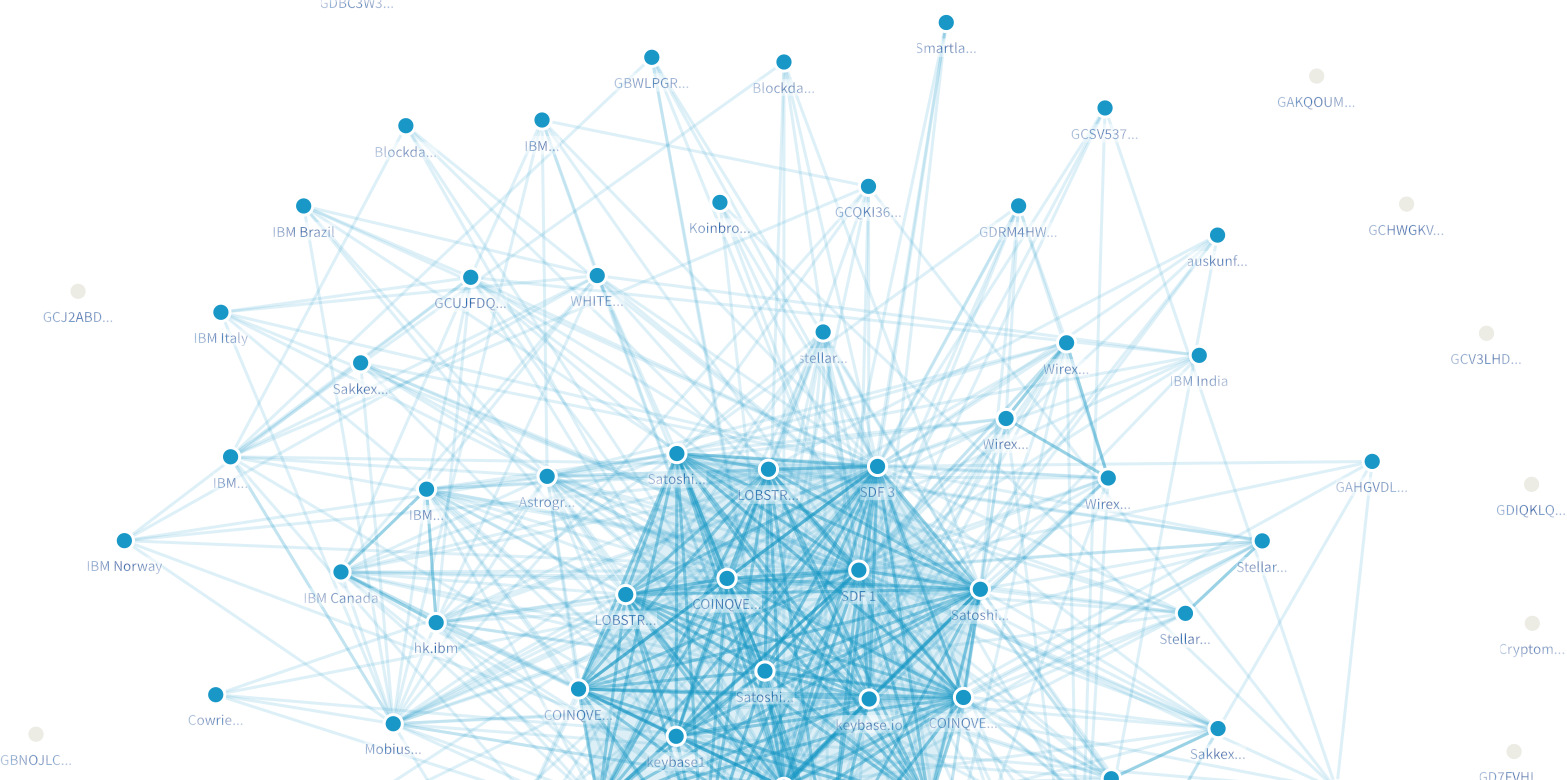
SOSP ’19, October 27–30, 2019, Huntsville, ON, Canada Lokhava et al. • How are latencies affected by increasing (a) transactions per second (and, consequently, transactions per ledger), and (b) the number of validator nodes? • What is the cost of running a node in terms of CPU, memory, and network bandwidth? Payment networks have low transaction rates compared to other types of distributed system. The leading blockchains, Bitcoin and Ethereum, confirm up to 15 transactions/second, less than Stellar. Moreover, these systems take minutes to an hour to confirm a transaction securely, because proof-ofwork requires waiting for several blocks to be mined. The non-blockchain SWIFT network averaged only 420 transactions per second on its peak day [14]. We therefore chose to compare our measurements against the 5-second target ledger interval, a more aggressive target. Our results show that latencies are comfortably below this limit even with several unimplemented optimizations still in the pipeline. 7.1 Anchors The top traded assets by volume include currency (e.g., 3 USD anchors, 2 CNY), a Bitcoin anchor, a real-estate-backed security token [92], and an in-app currency [8]. Different anchors have different policies. For instance, one USD anchor, Stronghold, sets auth_reqired and requires a know-yourcustomer (KYC) process for every account that holds their assets. Another, AnchorUSD, let’s anyone receive and trade their USD (making it literally possible to send $0.50 to Mexico in 5 seconds with a fee of $0.000001). However, AnchorUSD does require KYC and fees to purchase or redeem their USD with conventional wire transfers. In the Philippines, where bank regulations are laxer for incoming payments, coins.ph supports cashing out PHP at any ATM machine [36]. In addition to the aforementioned security token and in-app currency, there’s a range of non-currency tokens ranging from commercial bonds [22] and carbon credits [85, 96] to more esoteric assets such as a token incentivizing collaborative car repossession [35]. 7.2 Public network As of this writing, there are 126 active full nodes, 66 of which participate in consensus by signing vote messages. Figure 7 (generated by [5]) visualizes the network, with a line between two nodes if one appears in the other’s quorum slices and a darker blue line to show bi-directional dependence. At the center is a cluster of 17 de facto “tier-one validators” run by SDF, SatoshiPay, LOBSTR, COINQVEST, and Keybase. Four months ago, before the events of Section 6, there were 15 systemically important nodes: 3 from seemingly tier-one organizations and several random singletons. The graph also looked much less regular. Hence, the new configuration mechanism and/or better operator decisions seem to be contributing to a healthier network topology. Without great financial resources (and corresponding shareholder Figure 7. Quorum slice map obligations), it would have been difficult to recruit 5 tier one organizations from the start, however. This suggests quorum slices play a useful role in network bootstraping: anyone can join with the goal of becoming an important player because there are no gatekeepers to pairwise agreement. There are currently over 3.3M accounts in the ledger. Over a recent 24-hour period, Stellar averaged 4.5 transactions and 15.7 operations per second. Reviewing recent ledgers, most transactions seem to have a single operation, while every few ledgers we see transactions containing many operations that appear to come from market makers managing offers. The mean times to achieve consensus and update the ledger were 1061 ms and 46 ms, respectively. The 99th percentiles were 2252 ms and 142 ms (the former reflecting a 1-second timeout in nomination leader selection). Note SCP’s performance is mostly independent of transactions per second, since SCP agrees on a hash of arbitrarily many transactions. Bottlenecks are more likely to arise from propagating candidate transactions during nomination, executing and validating transactions, and merging buckets. We have not yet needed to parallelize stellar-core’s transaction processing over multiple CPU cores or disk drives. We also evaluated the number of SCP messages broadcast on the production network. In the normal case with a single leader elected to nominate a value, we expect seven logical messages to be broadcast: two messages to vote and accept a nominate statement, two messages to accept and confirm a prepare statement, two message to accept and confirm a commit statement, and finally, an externalize message (sent after committing a new ledger to disk to help stragglers catch up). The implementation combines confirm commit and externalize messages as an optimization, since it is safe to externalize a value after it is committed. We then analyze metrics gathered on a production Stellar validator. Over the course of 68 hours, 1.3 messages/second were emitted, averaging to 6-7 messages per ledger. We note that the total
Fast and secure global payments with Stellar SOSP ’19, October 27–30, 2019, Huntsville, ON, Canada Percentile Number of Timeouts Nomination Balloting 75% 0 0 99% 1 0 Max 4 1 Figure 8. Timeouts per ledger over 68 hours count of messages broadcast by validators is larger, since in addition to federated voting messages, nodes also broadcast any transactions they learn about. Figure 8 shows the timeouts experienced by a production validator over a period of 68 hours. Nomination timeouts are a measure of the (in)effectiveness of the leader election function, while ballot timeouts depend heavily on the network and potential message delays. The timeouts are consistent with the number of messages emitted: six messages in the best case scenario, and at least seven messages if an additional nomination round is needed. 7.3 Controlled experiments We ran controlled experiments in containers packed onto Amazon EC2 c5d.9xlarge instances with 72 GiB of RAM, 900 GB of NVMe SSD, and 36 vCPUs. Each instance was in the same EC2 region and had a fixed bandwidth of 10 Gbps. We used SQLite as a store. (Stellar also supports PostgreSQL, but that has asynchronous tasks that inject noise into measurements.) Stellar provides a built-in runtime query, generateload, that allows generating synthetic load at a specific target transaction/second rate. Although Stellar supports various trading features, such as order book and cross-asset path payments, we focused on simple payments. Confirming transactions consists of multiple steps, so we recorded the measurements for each of the following: • Nomination: time from nomination to first prepare • Balloting: time from first prepare to confirming a ballot committed • Ledger update: time to apply consensus value • Transaction count: confirmed transactions per ledger Each of our experiments was defined by three parameters: the number of account entries in the ledger, the amount of load (in the form of XLM payments) submitted per second, and the number of validators. We configured every validator to know about every other validator (a worst-case scenario for SCP), with quorum slices set to any simple majority of nodes (so as to maximize the number of different quorums). Baseline Our baseline experiment measured Stellar with 100,000 accounts, four validators, and the load generation rate of 100 transactions/second. We observed 507 transactions per ledger on average, with standard deviation of 49 (9.7%). Note that no transactions were dropped; the slight 105 106 107 0 500 1,000 1,500 2,000 Accounts Latency [ms] Ledger update Balloting Nomination Figure 9. Latency as number of accounts increases variance is due to scheduling limitations of the load generator. We observed that the number of transactions per ledger was consistent with our load generation rate, given ledger closing every 5 seconds. Nomination, balloting, and ledger update showed mean latencies of 82.53 ms, 95.96 ms, and 174.08 ms, respectively. We observed that nomination latency 99th percentile is consistently under 61ms, with occasional spikes of roughly 1 second, corresponding to the first step in the timeout function of leader selection. Given the baseline performance, we looked at the effects of varying each of the test setup parameters. Accounts The data in Figure 9 suggests that Stellar scales well as the number of accounts increases. Generation of test accounts became a lengthy process, as bucket creation and merging prevented us from simply populating the database with accounts directly via SQL. Therefore, we conducted our experiments for up to 50,000,000 accounts. While there is minimal impact on consensus and ledger update latencies, we note that increasing accounts creates an overhead of merging buckets, which get larger. Transaction rate Transaction rate impacts the amount of traffic multicast among validators, the number of transactions included in each ledger, and the size of the top level buckets. To understand the effects of increasing transaction load, we ran an experiment with 100,000 accounts and 4 validators. Figure 10 shows slow growth in the consensus latency, while the majority of time was spent updating the ledger. Not surprisingly, as the transaction set increases in size, it takes longer to commit it to the database. We also note that ledger update latency is heavily implementation-dependent, and is affected by the choice of the database. Validator nodes To see how increasing the number of tierone validators impacts performance, we ran experiments with 100,000 accounts, 100 transactions/second, and a varying number of validators from 4 to 43. All validators appeared in all validators’ quorum slices; smaller quorum slices would have a lesser impact on performance.
SOSP ’19, October 27–30, 2019, Huntsville, ON, Canada Lokhava et al. 100 150 200 250 300 350 0 500 1,000 1,500 2,000 Load [transactions/second] Latency [ms] Ledger update Balloting Nomination Figure 10. Latency as transaction load increases 10 20 30 40 0 500 1,000 1,500 2,000 Validators Latency [ms] Ledger update Balloting Nomination Figure 11. Latency as number of nodes increases Changing the number of validating nodes on the network impacts the number of SCP messages exchanged as well as the number of potential values during nomination. Figure 11 shows nomination time growing at a relatively small rate. While the data suggests that balloting is the bottleneck, we believe many scaling issues can be addressed by improving Stellar’s overlay network to optimize network traffic. As expected, ledger update latency remained independent of the number of nodes. Close rate Lastly, we wanted to measure Stellar’s end-toend performance by measuring how often ledgers are confirmed and whether Stellar meets its 5-second target without dropping any transactions. We observed average ledger close times of 5.03 s, 5.10 s, and 5.15 s as we increased account entries, transaction rate, and number of nodes, respectively. The results suggest that Stellar can consistently close ledgers under high load. 7.4 Running a validator One of the important features of Stellar is the low cost of running a validator, as anchors should run (or contract with) validators to enforce finality. SDF runs 3 production validators, all on c5.large AWS instances, which have two cores, 4 GiB of RAM and Intel(R) Xeon(R) Platinum 8124M CPU @ 3.00GHz processors. Inspecting resource usage on one of these machines, we observed the Stellar process using around 7% of CPU and 300 MiB of memory. In terms of network traffic, with 28 connections to peers and a quorum size of 34, the incoming and outgoing rates were 2.78 Mbit/s and 2.56 Mbit/s, respectively. Hardware required to run such a process is inexpensive. In our case, the cost is $0.054/hour or about $40/month. 7.5 Future work These experiments suggest Stellar can easily scale 1–2 orders of magnitude beyond today’s network usage. Because the performance demands have been so modest to date, Stellar leaves room for many straight-forward optimizations using well-known techniques. For example, transactions and SCP messages are broadcast by validators using a naïve flooding protocol, but should ideally use more efficient, structured peer-to-peer multicast [30]. Additionally, database-heavy ledger update time can be improved through standard batching and prefetching techniques.
تقييم
لفهم مدى ملاءمة Stellar كدفعة عالمية و شبكة التداول، قمنا بتقييم حالة الشبكة العامة وأجرى تجارب مضبوطة على تجربة خاصة شبكة. ركزنا على الأسئلة التالية: • كيف تبدو طوبولوجيا شبكة الإنتاج؟ كم عدد الرسائل التي يتم بثها في المتوسط، و كيف يواجه SCP المهلات؟ • هل يظل زمن الاستجابة لتحديث الإجماع ودفتر الأستاذ مستقلاً عن عدد الحسابات؟SOSP '19، 27-30 أكتوبر 2019، هانتسفيل، أونتاريو، كندا لوخافا وآخرون. • كيف تتأثر فترات الاستجابة بزيادة (أ) المعاملات في الثانية (وبالتالي المعاملات في كل ثانية). دفتر الأستاذ)، و(ب) عدد العقد validator؟ • ما هي تكلفة تشغيل العقدة من حيث وحدة المعالجة المركزية، الذاكرة وعرض النطاق الترددي للشبكة؟ تتمتع شبكات الدفع بمعدلات معاملات منخفضة مقارنة إلى أنواع أخرى من النظام الموزع. الرائدة blockchains، Bitcoin وEthereum، تأكيد ما يصل إلى 15 معاملة في الثانية، أقل من Stellar. علاوة على ذلك، تستغرق هذه الأنظمة دقائق ساعة لتأكيد المعاملة بشكل آمن، لأن إثبات العمل يتطلب الانتظار حتى يتم تعدين عدة كتل. ال بلغ متوسط شبكة غير blockchain SWIFT 420 معاملة في الثانية فقط في يوم الذروة [14]. لذلك اخترنا لمقارنة قياساتنا مع هدف الـ 5 ثواني الفاصل الزمني دفتر الأستاذ، وهو هدف أكثر عدوانية. تظهر نتائجنا أن زمن الوصول أقل من هذا الحد بشكل مريح حتى مع العديد من التحسينات غير المنفذة لا تزال قيد التنفيذ. 7.1 المراسي تشمل الأصول الأكثر تداولًا من حيث الحجم العملة (على سبيل المثال، 3 دولارات أمريكية المرساة، 2 يوان صيني)، المرساة Bitcoin، والأمان المدعوم بالعقارات token [92]، والعملة داخل التطبيق [8]. المراسي المختلفة لها سياسات مختلفة. على سبيل المثال، مرساة واحدة بالدولار الأمريكي، Stronghold، يقوم بتعيين auth_reqired ويتطلب عملية معرفة عميلك (KYC) لكل حساب يحتفظ به الأصول. آخر، AnchorUSD، يتيح لأي شخص الاستلام والتداول الدولار الأمريكي (مما يجعل من الممكن حرفيًا إرسال 0.50 دولارًا إلى المكسيك في 5 ثواني برسوم قدرها 0.000001 دولار). ومع ذلك، مرساةUSD يتطلب KYC ورسومًا لشراء أو استرداد الدولار الأمريكي مع التحويلات البرقية التقليدية. في الفلبين حيث تعتبر اللوائح المصرفية أكثر مرونة فيما يتعلق بالمدفوعات الواردة، والعملات المعدنية يدعم صرف PHP من أي ماكينة صراف آلي [36]. بالإضافة إلى الأمان المذكور أعلاه token والعملة داخل التطبيق، هناك مجموعة من العملات غير token تتراوح من السندات التجارية [22] وأرصدة الكربون [85، 96] وأكثر الأصول الباطنية مثل token التحفيز التعاوني استعادة ملكية السيارة [35]. 7.2 شبكة عامة حتى كتابة هذه السطور، هناك 126 عقدة كاملة نشطة، 66 منها المشاركة في الإجماع من خلال التوقيع على رسائل التصويت. الشكل 7 (تم إنشاؤه بواسطة [5]) يصور الشبكة، مع وجود خط بينهما عقدتان إذا ظهرت إحداهما في شرائح النصاب القانوني للأخرى و أ خط أزرق غامق لإظهار الاعتماد ثنائي الاتجاه. في المركز عبارة عن مجموعة من 17 "المستوى الأول validators" بحكم الأمر الواقع يديرها SDF، وSatoshiPay، وLOBSTR، وCOINQVEST، وKeybase. قبل أربعة أشهر، قبل أحداث القسم السادس، هناك كانت هناك 15 عقدة ذات أهمية نظامية: 3 منها على ما يبدو منظمات من المستوى الأول والعديد من المفردات العشوائية. ال بدا الرسم البياني أيضًا أقل انتظامًا. ومن ثم، تظهر آلية التكوين الجديدة و/أو قرارات المشغل الأفضل للمساهمة في طوبولوجيا الشبكة الأكثر صحة. بدون موارد مالية كبيرة (والمساهمين المقابلين الشكل 7. خريطة شريحة النصاب القانوني الالتزامات)، كان من الصعب تعيين 5 الطبقة الأولى لكن المنظمات منذ البداية. وهذا يشير إلى النصاب القانوني تلعب الشرائح دورًا مفيدًا في تمهيد الشبكة: يمكن لأي شخص ذلك انضم بهدف أن تصبح لاعبًا مهمًا بسبب لا يوجد حراس على الاتفاق الزوجي. يوجد حاليًا أكثر من 3.3 مليون حساب في دفتر الأستاذ. انتهى خلال فترة 24 ساعة الأخيرة، بلغ متوسط Stellar 4.5 معاملة و 15.7 عملية في الثانية. مراجعة دفاتر الأستاذ الأخيرة، أكثر يبدو أن المعاملات لديها عملية واحدة، في حين أن كل عدد قليل دفاتر الأستاذ نرى المعاملات التي تحتوي على العديد من العمليات التي يبدو أنها تأتي من صانعي السوق الذين يديرون العروض. ال متوسط الأوقات لتحقيق الإجماع وتحديث دفتر الأستاذ كان 1061 مللي ثانية و 46 مللي ثانية على التوالي. وكانت النسب المئوية 99 2252 مللي ثانية و142 مللي ثانية (يعكس الأول مهلة مدتها ثانية واحدة في اختيار زعيم الترشيح). لاحظ أن أداء SCP هو معظمها مستقلة عن المعاملات في الثانية الواحدة، منذ SCP يوافق على hash من العديد من المعاملات بشكل تعسفي. من المرجح أن تنشأ الاختناقات من نشر المرشح المعاملات أثناء الترشيح والتنفيذ والمصادقة المعاملات، ودمج الدلاء. لم نحتاج بعد لموازاة معالجة المعاملات الخاصة بـ Stellar-core عبر عدة مراكز لوحدة المعالجة المركزية أو محركات الأقراص. قمنا أيضًا بتقييم عدد رسائل SCP التي يتم بثها على شبكة الإنتاج. في الحالة العادية مع واحد الزعيم المنتخب لترشيح قيمة، نتوقع سبعة منطقية الرسائل التي سيتم بثها: رسالتان للتصويت والقبول نوميبيان نيت، رسالتين للقبول والتأكيد بيان إعداد، رسالتين للقبول والتأكيد بيان الالتزام، وأخيرا، رسالة خارجية (تم إرساله بعد الالتزام بدفتر أستاذ جديد على القرص لمساعدة المتطرفين اللحاق). يجمع التنفيذ بين تأكيد الالتزام وإضفاء الطابع الخارجي على الرسائل كتحسين، لأنه كذلك من الآمن إضفاء الطابع الخارجي على القيمة بعد الالتزام بها. نقوم بعد ذلك بتحليل المقاييس المجمعة على الإنتاج Stellar validator. انتهى على مدار 68 ساعة، تم بث 1.3 رسالة في الثانية، بمتوسط 6-7 رسائل لكل دفتر. ونلاحظ أن المجموع
مدفوعات عالمية سريعة وآمنة باستخدام Stellar SOSP '19، 27-30 أكتوبر 2019، هانتسفيل، أونتاريو، كندا المئوي عدد المهلات الترشيح الاقتراع 75% 0 0 99% 1 0 ماكس 4 1 الشكل 8. المهلة لكل دفتر الأستاذ أكثر من 68 ساعة عدد الرسائل التي يتم بثها بواسطة validators أكبر، منذ عام بالإضافة إلى رسائل التصويت الموحد، يتم أيضًا بث العقد أي معاملات يتعلمون عنها. ويبين الشكل 8 المهلات التي يمر بها الإنتاج validator خلال فترة 68 ساعة. مهلة الترشيح هي وهو مقياس لمدى (عدم) فعالية وظيفة انتخاب القائد، في حين أن مهلة الاقتراع تعتمد بشكل كبير على الشبكة والتأخير المحتمل للرسائل. المهلات متسقة مع عدد الرسائل المرسلة: ستة رسائل في أفضل السيناريوهات، وسبع رسائل على الأقل إذا كانت هناك حاجة إلى جولة ترشيح إضافية. 7.3 التجارب الخاضعة للرقابة أجرينا تجارب مضبوطة في حاويات معبأة مثيلات Amazon EC2 c5d.9xlarge مع 72 جيجابايت من ذاكرة الوصول العشوائي، 900 جيجابايت من NVMe SSD و36 وحدة معالجة مركزية افتراضية. كل مثيل كان في نفس منطقة EC2 وكان لها عرض نطاق ترددي ثابت يبلغ 10 جيجابت في الثانية. استخدمنا SQLite كمتجر. (Stellar يدعم أيضًا PostgreSQL، ولكن هذا يحتوي على مهام غير متزامنة تضخ الضوضاء في القياسات.) يوفر Stellar استعلامًا مدمجًا في وقت التشغيل، وإنشاء التحميل، الذي يسمح بتوليد حمل اصطناعي على هدف محدد المعاملة/المعدل الثاني. على الرغم من أن Stellar يدعم العديد من ميزات التداول، مثل دفتر الطلبات ومسار الأصول المشتركة المدفوعات، ركزنا على المدفوعات البسيطة. يتكون تأكيد المعاملات من خطوات متعددة، لذلك نحن سجلت القياسات لكل مما يلي: • الترشيح: الوقت منذ الترشيح وحتى الإعداد الأول • الاقتراع: الوقت من الإعداد الأول إلى التأكيد ارتكبت الاقتراع • تحديث دفتر الأستاذ: حان الوقت لتطبيق القيمة المتفق عليها • عدد المعاملات: المعاملات المؤكدة لكل دفتر الأستاذ تم تعريف كل تجربة من تجاربنا من خلال ثلاث معلمات: عدد إدخالات الحساب في دفتر الأستاذ، ومبلغ التحميل (في شكل دفعات XLM) المقدمة في الثانية، وعدد validators. قمنا بتكوين كل validator لمعرفة المزيد عن كل validator (السيناريو الأسوأ بالنسبة إلى SCP)، مع تعيين شرائح النصاب القانوني على أي أغلبية بسيطة من العقد (بسبب زيادة عدد النصاب القانوني المختلفة). خط الأساس تم قياس تجربتنا الأساسية بـ Stellar بـ 100000 حساب، وأربعة validators، وتوليد التحميل معدل 100 معاملة / ثانية. لقد لاحظنا 507 معاملة لكل دفتر أستاذ في المتوسط، مع انحراف معياري قدره 49 (9.7%). لاحظ أنه لم يتم إسقاط أية معاملات؛ الطفيف 105 106 107 0 500 1000 1500 2000 الحسابات الكمون [مللي ثانية] تحديث دفتر الأستاذ الاقتراع الترشيح الشكل 9. الكمون مع زيادة عدد الحسابات يرجع التباين إلى قيود الجدولة الخاصة بمولد الحمل. لاحظنا أن عدد المعاملات لكل دفتر الأستاذ كان متسقًا مع معدل توليد التحميل لدينا، نظرًا لدفتر الأستاذ إغلاق كل 5 ثواني الترشيح والاقتراع وسجل الأستاذ أظهر التحديث متوسط زمن الوصول 82.53 مللي ثانية، 95.96 مللي ثانية، و 174.08 مللي ثانية، على التوالي. لاحظنا أن الكمون الترشيح النسبة المئوية 99 دائمًا أقل من 61 مللي ثانية، مع بعض الأحيان طفرات مدتها ثانية واحدة تقريبًا، تتوافق مع الخطوة الأولى في وظيفة المهلة لاختيار القائد. وبالنظر إلى الأداء الأساسي، نظرنا إلى التأثيرات من تغيير كل من معلمات إعداد الاختبار. الحسابات تشير البيانات الواردة في الشكل 9 إلى أن المقياس Stellar وكذلك عدد الحسابات يزيد. جيل الاختبار أصبحت الحسابات عملية طويلة، حيث أن إنشاء الدلو و لقد منعنا الدمج من ملء قاعدة البيانات ببساطة مع الحسابات مباشرة عبر SQL. ولذلك، أجرينا لدينا تجارب لما يصل إلى 50,000,000 حساب. في حين أن هناك الحد الأدنى من التأثير على الإجماع وزمن وصول تحديث دفتر الأستاذ، نلاحظ أن زيادة الحسابات تؤدي إلى زيادة في النفقات العامة دمج الدلاء، والتي تصبح أكبر. معدل المعاملة يؤثر معدل المعاملة على المبلغ حركة البث المتعدد بين validators، وعدد المعاملات المضمنة في كل دفتر أستاذ، وحجم المستوى الأعلى دلاء. لفهم آثار زيادة المعاملات التحميل، أجرينا تجربة على 100000 حساب و4 validators. ويبين الشكل 10 النمو البطيء في زمن الوصول المتفق عليه، بينما تم قضاء معظم الوقت في تحديث دفتر الأستاذ. ليس من المستغرب أنه مع زيادة حجم مجموعة المعاملات، فإنه يستغرق وقتًا أطول لربطه بقاعدة البيانات. ونلاحظ ذلك أيضا يعتمد زمن استجابة تحديث دفتر الأستاذ بشكل كبير على التنفيذ، ويتأثر باختيار قاعدة البيانات. عقد التحقق من الصحة لمعرفة كيفية زيادة عدد tierone validatorsيؤثر على الأداء، أجرينا التجارب مع 100000 حساب، و100 معاملة في الثانية، وعدد متفاوت من validators من 4 إلى 43. ظهرت جميع validators في جميع شرائح النصاب القانوني لـ validators؛ سوف شرائح النصاب أصغر لها تأثير أقل على الأداء.SOSP '19، 27-30 أكتوبر 2019، هانتسفيل، أونتاريو، كندا لوخافا وآخرون. 100 150 200 250 300 350 0 500 1000 1500 2000 تحميل [المعاملات/الثانية] الكمون [مللي ثانية] تحديث دفتر الأستاذ الاقتراع الترشيح الشكل 10. زمن الوصول مع زيادة حمل المعاملات 10 20 30 40 0 500 1000 1500 2000 المدققون الكمون [مللي ثانية] تحديث دفتر الأستاذ الاقتراع الترشيح الشكل 11. الكمون مع زيادة عدد العقد تغيير عدد عقد التحقق على الشبكة يؤثر أيضًا على عدد رسائل SCP المتبادلة عدد القيم المحتملة أثناء الترشيح. الشكل 11 يُظهر أن وقت الترشيح ينمو بمعدل صغير نسبيًا. وفي حين تشير البيانات إلى أن الاقتراع هو عنق الزجاجة، فإننا نعتقد أنه يمكن معالجة العديد من مشكلات التوسع من خلال التحسين شبكة Stellar المتراكبة لتحسين حركة مرور الشبكة. كما المتوقع، ظل زمن استجابة تحديث دفتر الأستاذ مستقلاً عن عدد العقد. سعر الإغلاق أخيرًا، أردنا قياس أداء Stellar الشامل من خلال قياس عدد مرات تأكيد دفاتر الأستاذ وما إذا كان Stellar يحقق هدفه البالغ 5 ثوانٍ دون إسقاط أي معاملات. لاحظنا إغلاق دفتر الأستاذ المتوسط مرات 5.03 ثانية و 5.10 ثانية و 5.15 ثانية مع زيادة الحساب الإدخالات ومعدل المعاملات وعدد العقد على التوالي. تشير النتائج إلى أن Stellar يمكنه إغلاق دفاتر الأستاذ باستمرار تحت حمولة عالية. 7.4 تشغيل validator إحدى الميزات المهمة لـ Stellar هي التكلفة المنخفضة تشغيل validator، حيث يجب تشغيل المراسي (أو التعاقد معها) validators لفرض النهاية. يقوم SDF بتشغيل 3 وحدات إنتاج validator، جميعها على مثيلات c5.large AWS، والتي تحتوي على مركزين، 4 غيغابايت من ذاكرة الوصول العشوائي ووحدة المعالجة المركزية Intel (R) Xeon (R) Platinum 8124M معالجات بسرعة 3.00 جيجا هرتز. فحص استخدام الموارد على واحد من هذه الأجهزة، لاحظنا استخدام عملية Stellar حوالي 7% من وحدة المعالجة المركزية و300 ميجابايت من الذاكرة. من حيث حركة مرور الشبكة، مع 28 اتصالاً بالأقران وحجم النصاب القانوني من 34، كانت معدلات الدخول والخروج 2.78 ميجابت/ثانية و 2.56 ميجابت/ثانية، على التوالي. الأجهزة المطلوبة لتشغيل مثل هذا العملية غير مكلفة. في حالتنا، تبلغ التكلفة 0.054 دولارًا في الساعة أو حوالي 40 دولارًا في الشهر. 7.5 العمل المستقبلي تشير هذه التجارب إلى أن Stellar يمكنه بسهولة التوسع في طلب واحد أو أمرين بحجم يتجاوز استخدام الشبكة اليوم. لأن لقد كانت متطلبات الأداء متواضعة جدًا حتى الآن، Stellar يترك مجالًا للعديد من التحسينات المباشرة باستخدام تقنيات معروفة. على سبيل المثال، المعاملات وSCP يتم بث الرسائل بواسطة validators باستخدام فيضان ساذج بروتوكول، ولكن يجب أن يستخدم بشكل مثالي أكثر كفاءة وتنظيما البث المتعدد من نظير إلى نظير [30]. بالإضافة إلى ذلك، قاعدة بيانات ثقيلة يمكن تحسين وقت تحديث دفتر الأستاذ من خلال تقنيات التجميع والجلب المسبق القياسية.
Conclusion
Conclusion
International payments are expensive and take days. Fund custody passes through multiple financial institutions including correspondent banks and money transfer services. Because each hop must be fully trusted, it is difficult for new entrants to gain market share and compete. Stellar shows how to send money around the world cheaply in seconds. The key innovation is a new open-membership Byzantine agreement protocol, SCP, that leverages the peer-to-peer structure of the financial network to achieve global consensus under a novel Internet hypothesis. SCP lets Stellar atomically commit irreversible transactions across arbitrary participants who don’t know about or trust each other. That in turn guarantees new entrants access to the same markets as established players, makes it secure to get the best available exchange rates even from untrusted market makers, and dramatically reduces payment latency. Acknowledgments Stellar would not be where it is today without the early leadership of Joyce Kim or the tremendous contributions of Scott Fleckenstein and Bartek Nowotarski in building and maintaining horizon, the Stellar SDK, and other key pieces of the Stellar ecosystem. We also thank Kolten Bergeron, Henry Corrigan-Gibbs, Candace Kelly, Kapil K. Jain, Boris Reznikov, Jeremy Rubin, Christian Rudder, Eric Saunders, Torsten Stüber, Tomer Weller, the anonymous reviewers, and our shepherd Justine Sherry for their helpful comments on earlier drafts. Disclaimer Professor Mazières’s contribution to this publication was as a paid consultant, and was not part of his Stanford University duties or responsibilities.
Fast and secure global payments with Stellar SOSP ’19, October 27–30, 2019, Huntsville, ON, Canada
خاتمة
المدفوعات الدولية باهظة الثمن وتستغرق أيامًا. الصندوق تمر الحضانة عبر مؤسسات مالية متعددة بما في ذلك البنوك المراسلة وخدمات تحويل الأموال. لأن كل قفزة يجب أن تكون موثوقة تماما، فمن الصعب على الجديد الداخلين للحصول على حصة في السوق والمنافسة. Stellar يظهر كيفية إرسال الأموال حول العالم بسعر رخيص في ثواني. ال الابتكار الرئيسي هو بروتوكول اتفاقية بيزنطية جديد مفتوح العضوية، SCP، الذي يعزز بنية نظير إلى نظير للشبكة المالية لتحقيق توافق عالمي في الآراء بموجب أ فرضية الإنترنت الجديدة. يتيح SCP لـ Stellar الالتزام ذريًا معاملات لا رجعة فيها عبر المشاركين التعسفيين الذين لا يعرفون أو يثقون ببعضهم البعض. وهذا بدوره يضمن للداخلين الجدد الوصول إلى نفس الأسواق القائمة اللاعبين، يجعلها آمنة للحصول على أفضل تبادل متاح أسعار حتى من صناع السوق غير موثوق بهم، وبشكل كبير يقلل من زمن الوصول للدفع. شكر وتقدير Stellar لن يكون حيث هو اليوم دون المبكر قيادة جويس كيم أو المساهمات الهائلة لـ سكوت فليكنشتاين وبارتيك نوفوتارسكي في البناء و الحفاظ على الأفق، وStellar SDK، والأجزاء الرئيسية الأخرى للنظام البيئي Stellar. ونشكر أيضًا كولتن بيرجيرون، هنري كوريجان جيبس، كانديس كيلي، كابيل ك. جاين، بوريس ريزنيكوف، جيريمي روبن، كريستيان رودر، إريك سوندرز، تورستن ستوبر، تومر ويلر، المراجعون المجهولون، و راعيتنا جوستين شيري على تعليقاتها المفيدة المسودات السابقة. إخلاء المسؤولية وكانت مساهمة البروفيسور مازيير في هذا المنشور بمثابة مستشار مدفوع الأجر، ولم تكن جزءًا منه واجبات أو مسؤوليات جامعة ستانفورد.
دفعات عالمية سريعة وآمنة باستخدام Stellar SOSP '19، 27-30 أكتوبر 2019، هانتسفيل، أونتاريو، كندا