 Ethereum
Block Structure
Context
This figure appears in the 'Mining' section, which explains how Bitcoin achieves decentralized consensus by having nodes compete to produce blocks containing ordered batches of transactions. The section describes proof-of-work as the mechanism that makes block production computationally expensive and therefore resistant to manipulation, while the longest-chain rule determines which version of history is canonical. Block rewards and transaction fees incentivize miners to participate honestly.
What This Figure Shows
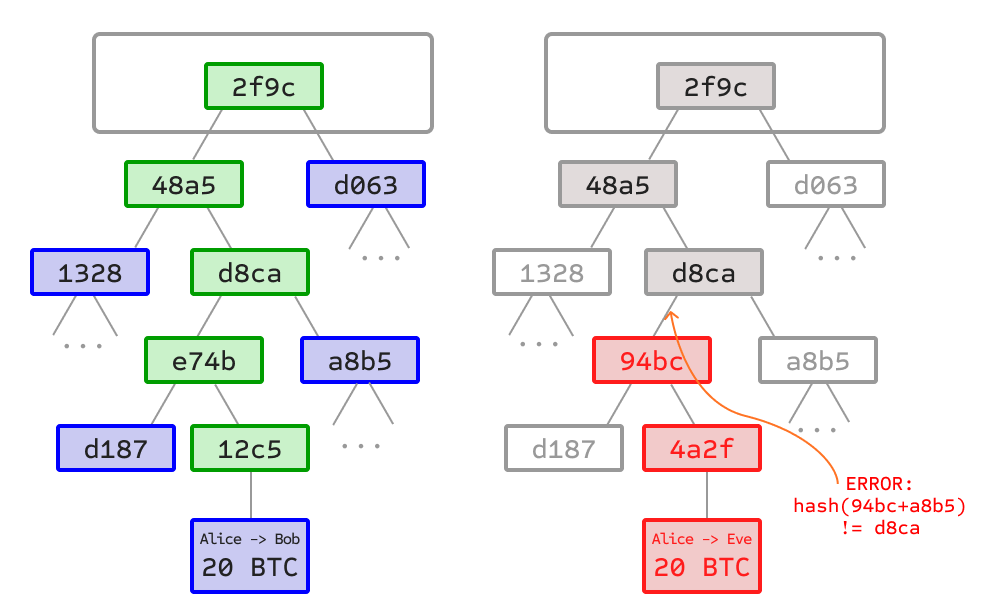
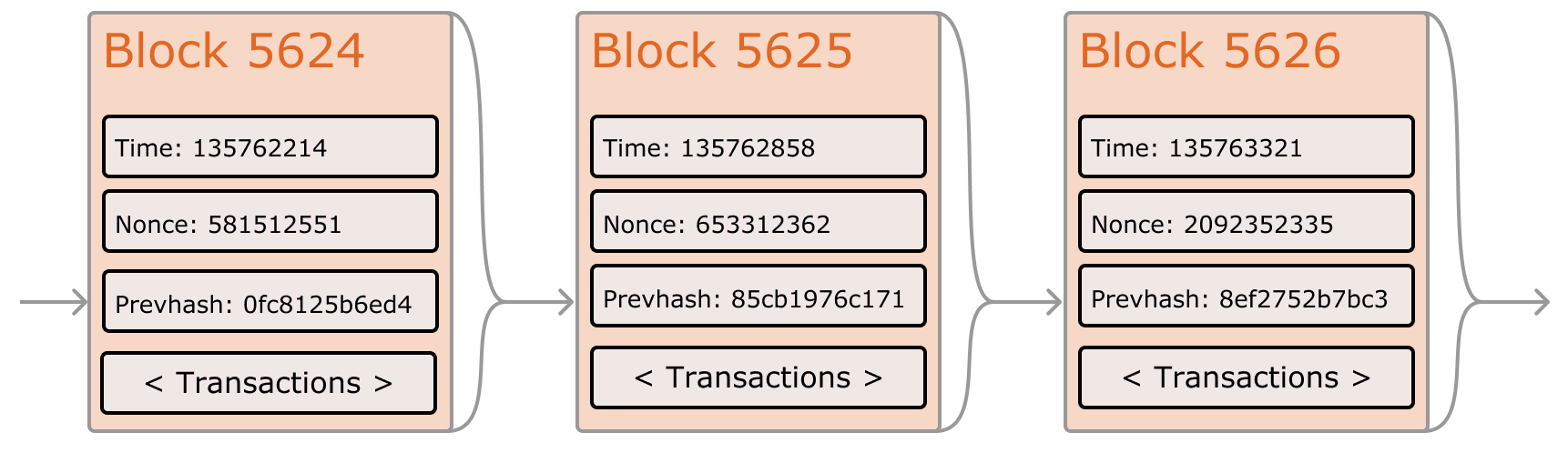
The diagram shows the chain of blocks that constitutes the Bitcoin blockchain, with each block containing a timestamp, a nonce, a cryptographic hash reference to the previous block, and a list of transactions. The hash linkage is the key structural property: altering any data in a historical block changes its hash, which breaks the reference in the next block, cascading forward to invalidate every subsequent block. To rewrite history, an attacker would need to redo the proof-of-work for every block from the target block to the chain tip, requiring more computational power than the rest of the network combined — the so-called 51% attack. The nonce is the value that miners iterate over when searching for a block hash below the difficulty target. The timestamp constrains the block to a valid time window, preventing manipulation of difficulty adjustments.
Significance
This block structure diagram is fundamental to understanding both Bitcoin's security model and Ethereum's evolution of the same structure. Ethereum extends this skeleton by adding state roots, receipt roots, and uncle references, but the core linked-block architecture shown here remains unchanged. The diagram concretely illustrates why the blockchain is tamper-evident and why rewriting history is computationally prohibitive.