
चेनलिंक: एक विकेन्द्रीकृत ओरेकल नेटवर्क
Abstract
Abstract
In this whitepaper, we articulate a vision for the evolution of Chainlink beyond its initial conception in the original Chainlink whitepaper. We foresee an increasingly expansive role for oracle networks, one in which they complement and enhance existing and new blockchains by providing fast, reliable, and confidentiality-preserving universal connectivity and off-chain computation for smart contracts. The foundation of our plan is what we call Decentralized Oracle Networks, or DONs for short. A DON is a network maintained by a committee of Chainlink nodes. It supports any of an unlimited range of oracle functions chosen for deployment by the committee. A DON thus acts as a powerful abstraction layer, offering interfaces for smart contracts to extensive off-chain resources and highly efficient yet decentralized off-chain computing resources within the DON itself. With DONs as a springboard, Chainlink plans to focus on advances in seven key areas: • Hybrid smart contracts: Offering a powerful, general framework for augmenting existing smart contract capabilities by securely composing on-chain and off-chain computing resources into what we call hybrid smart contracts. • Abstracting away complexity: Presenting developers and users with simple functionality eliminates the need for familiarity with complex underlying protocols and system boundaries. • Scaling: Ensuring that oracle services achieve the latencies and throughputs demanded by high-performance decentralized systems. • Confidentiality: Enabling next-generation systems that combine blockchains’ innate transparency with strong new confidentiality protections for sensitive data. • Order-fairness for transactions: Supporting transaction sequencing in ways that are fair for end users and prevent front-running and other attacks by bots and exploitative miners. • Trust-minimization: Creating a highly trustworthy layer of support for smart contracts and other oracle-dependent systems by means of decentralization, strong anchoring in high-security blockchains, cryptographic techniques, and cryptoeconomic guarantees. • Incentive-based (cryptoeconomic) security: Rigorously designing and robustly deploying mechanisms that ensure nodes in DONs have strong economic incentives to behave reliably and correctly, even in the face of wellresourced adversaries. We present preliminary and ongoing innovations by the Chainlink community in each of these areas, providing a picture of the broadening and increasingly powerful capabilities planned for the Chainlink network.
सारांश
इस श्वेतपत्र में, हम मूल Chainlink श्वेतपत्र में इसकी प्रारंभिक अवधारणा से परे Chainlink के विकास के लिए एक दृष्टिकोण व्यक्त करते हैं। हम पूर्वाभास करते हैं oracle नेटवर्क के लिए एक बढ़ती हुई भूमिका, जिसमें वे तेज, विश्वसनीय और प्रदान करके मौजूदा और नए blockchain को पूरक और बढ़ाते हैं। गोपनीयता-संरक्षण सार्वभौमिक कनेक्टिविटी और ओ-चेन गणना smart contracts. हमारी योजना का आधार वह है जिसे हम विकेंद्रीकृत ओरेकल नेटवर्क कहते हैं, या संक्षेप में DONs। DON एक नेटवर्क है जिसका रखरखाव Chainlink की एक समिति द्वारा किया जाता है नोड्स. यह oracle कार्यों की असीमित रेंज के लिए चुने गए किसी भी कार्य का समर्थन करता है समिति द्वारा तैनाती. एक DON इस प्रकार एक शक्तिशाली अमूर्त परत के रूप में कार्य करता है, व्यापक ओ-चेन संसाधनों और अत्यधिक के लिए smart contracts के लिए इंटरफेस की पेशकश DON के भीतर ही कुशल फिर भी विकेन्द्रीकृत ऑफ-चेन कंप्यूटिंग संसाधन। स्प्रिंगबोर्ड के रूप में DONs के साथ, Chainlink सात क्षेत्रों में प्रगति पर ध्यान केंद्रित करने की योजना बना रहा है प्रमुख क्षेत्र: • हाइब्रिड smart contracts: ऑन-चेन को सुरक्षित रूप से कंपोज करके मौजूदा smart contract क्षमताओं को बढ़ाने के लिए एक शक्तिशाली, सामान्य ढांचे की पेशकश और ओff-चेन कंप्यूटिंग संसाधनों को हम हाइब्रिड smart contracts कहते हैं। • जटिलता को दूर करना: डेवलपर्स और उपयोगकर्ताओं को सरलता से प्रस्तुत करना कार्यक्षमता जटिल अंतर्निहित से परिचित होने की आवश्यकता को समाप्त कर देती है प्रोटोकॉल और सिस्टम सीमाएँ। • स्केलिंग: यह सुनिश्चित करना कि oracle सेवाएं विलंबता और थ्रूपुट प्राप्त करें उच्च-प्रदर्शन विकेन्द्रीकृत प्रणालियों द्वारा मांग की गई। • गोपनीयता: अगली पीढ़ी की प्रणालियों को सक्षम करना जो blockchains' को जोड़ती हैं संवेदनशील के लिए मजबूत नई गोपनीयता सुरक्षा के साथ सहज पारदर्शिता डेटा. • लेन-देन के लिए आदेश-निष्पक्षता: तरीकों से लेन-देन अनुक्रमण का समर्थन करना जो अंतिम उपयोगकर्ताओं के लिए उचित हैं और फ्रंट-रनिंग और अन्य हमलों को रोकते हैं बॉट और शोषणकारी खनिक। • विश्वास-न्यूनीकरण: समर्थन की एक अत्यधिक भरोसेमंद परत बनाना विकेंद्रीकरण के माध्यम से smart contracts और अन्य oracle-निर्भर सिस्टम, उच्च-सुरक्षा blockchains में मजबूत एंकरिंग, क्रिप्टोग्राफ़िक तकनीकें, और क्रिप्टोआर्थिक गारंटी। • प्रोत्साहन-आधारित (क्रिप्टोइकोनॉमिक) सुरक्षा: सख्ती से डिजाइन और मजबूती से तैनात करने वाले तंत्र जो यह सुनिश्चित करते हैं कि DONs में नोड्स को विश्वसनीय और सही ढंग से व्यवहार करने के लिए मजबूत आर्थिक प्रोत्साहन मिले, यहां तक कि अच्छी तरह से संसाधन वाले विरोधियों के सामने भी। हम Chainlink समुदाय द्वारा प्रारंभिक और चल रहे नवाचार प्रस्तुत करते हैं इनमें से प्रत्येक क्षेत्र में, विस्तार और उत्तरोत्तर वृद्धि की एक तस्वीर प्रदान की गई है Chainlink नेटवर्क के लिए शक्तिशाली क्षमताओं की योजना बनाई गई।
Introduction
Introduction
Blockchain oracles are often viewed today as decentralized services with one objective: to forward data from off-chain resources onto blockchains. It’s a short step, though, from forwarding data to computing on it, storing it, or transmitting it bidirectionally. This observation justifies a much broader notion of oracles’ functionality. So too do the growing service requirements of smart contracts and increasingly multifaceted technologies that rely on oracle networks. In short, an oracle can and will need to be a general-purpose, bidirectional, compute-enabled interface between and among onchain and off-chain systems. Oracles’ role in the blockchain ecosystem is to enhance the performance, functionality, and interoperability of smart contracts so that they can bring new trust models and transparency to a multiplicity of industries. This transformation will come about through broadening use of hybrid smart contracts, which fuse blockchains’ special properties with the unique capabilities of off-chain systems such as oracle networks and thereby achieve far greater reach and power than on-chain systems in isolation. In this whitepaper, we articulate a vision for what we call Chainlink 2.0, an evolution of Chainlink beyond its initial conception in the original Chainlink whitepaper [98]. We foresee an increasingly expansive role for oracle networks, one in which they complement and enhance existing and new blockchains by providing fast, reliable, and confidentiality-preserving universal connectivity and computation for hybrid smart contracts. We believe that oracle networks will even evolve to become utilities for exporting high-integrity blockchain-grade data to systems beyond the blockchain ecosystem. Today, Chainlink nodes run by a diverse set of entities come together in oracle networks to relay data to smart contracts in what are known as reports. We can view such oracle nodes as a committee similar to that in a classical-consensus blockchain [72], but with the goal of supporting existing blockchains, rather than providing freestanding functionality. With verifiable random functions (VRF) and Off-Chain Reporting (OCR), Chainlink is already evolving toward a general-purpose framework and infrastructure for providing the computational resources that smart contracts require for advanced functionality. The foundation of our plan for Chainlink 2.0 is what we call Decentralized Oracle Networks, or DONs for short. Since we introduced the term “oracle network” in the original Chainlink whitepaper [98], oracles have developed ever richer functionality and breadth of application. In this paper, we offer a fresh definition of the term according to our future vision for the Chainlink ecosystem. In this view, a DON is a network maintained by a committee of Chainlink nodes. Rooted in a consensus protocol, it supports any of an unlimited range of oracle functions chosen for deployment by the committee. A DON thus acts as a blockchain abstraction layer, providing interfaces to off-chain resources for both smart contracts and other systems. It also provides access to highly efficient yet decentralized off-chain computing resources. In general, a DON supports operations on a main chain. Its goal is to enable secure and flexi-
ble hybrid smart contracts, which combine on-chain and off-chain computation with connection to external resources. We emphasize that even with the use of committees in DONs, Chainlink itself remains inherently permissionless. DONs act as the foundation of a permissionless framework in which nodes can come together to implement custom oracle networks with their own regimes for node inclusion, which may be permissioned or permissionless. With DONs as a foundation, we plan to focus in Chainlink 2.0 on advances in seven key areas: hybrid smart contracts, abstracting away complexity, scaling, confidentiality, order-fairness for transactions, trust minimization, and incentive-based (cryptoeconomic) security. In this paper introduction, we present an overview of Decentralized Oracle Networks in Section 1.1 and then our seven key areas of innovation in Section 1.2. We describe the organization of the rest of this paper in Section 1.3. 1.1 Decentralized Oracle Networks Decentralized Oracle Networks are designed to enhance and extend the capabilities of smart contracts on a target blockchain or main chain through functions that are not available natively. They do so by providing the three basic resources found in computing systems: networking, storage, and computation. A DON aims to offer these resources with strong confidentiality, integrity, and availability properties,1 as well as accountability. DONs are formed by committees of oracle nodes that cooperate to fulfill a specific job or choose to establish a long-lived relationship in order to provide persistent services to clients. DONs are designed in a blockchain-agnostic way. They promise to serve as a powerful and flexible tool for application developers to create off-chain support for their smart contracts on any supported main chain. Two types of functionalities realize the capabilities of a DON: executables and adapters. Executables are programs that run continuously and in a decentralized manner on the DON. While they do not directly store main-chain assets, they have important benefits, including high performance and the ability to perform confidential computation. Executables run autonomously on a DON and perform deterministic operations. They work in hand with adapters that link the DON to external resources and may be called by executables. Adapters, as we envision them for DONs, are a generalization of the external adapters in Chainlink today. While existing adapters typically only fetch data from data sources, adapters may operate bidirectionally; in DONs, they may additionally leverage joint computation by DON nodes to achieve additional features, such as encrypting reports for privacy-preserving consumption by an executable. To provide a sense of a DON’s basic operation, Fig. 1 shows conceptually how a DON might be used to send reports to a blockchain and thus achieve traditional, existing oracle functionality. DONs can provide many additional features, however, beyond 1The “CIA triad” of information security [123, p. 26, §2.3.5].
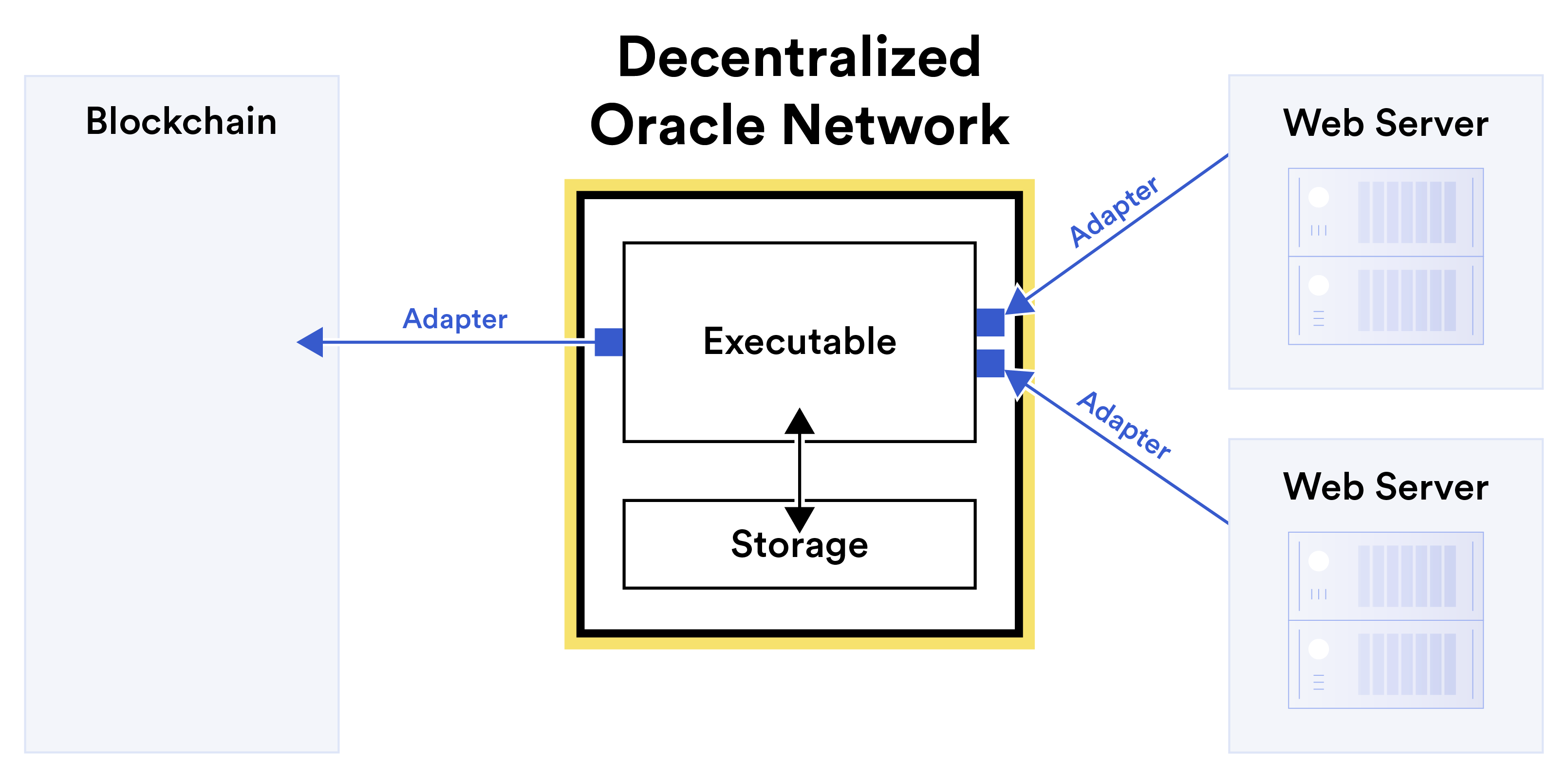
Chainlink’s existing networks. For example, within the general structure of Fig. 1, the executable could record fetched asset-price data on the DON, using such data to compute, e.g., a trailing average for its reports. Figure 1: Conceptual figure showing as an example how a Decentralized Oracle Network can realize basic oracle functionality, i.e., relay off-chain data to a contract. An executable uses adapters to fetch off-chain data, which it computes on, sending output over another adapter to a target blockchain. (Adapters are initiated by code in the DON, represented by small blue boxes; arrows show the direction of data flow for this particular example.) The executable can additionally read and write to local DON storage to keep state and/or communicate with other executables. Flexible networking, computation, and storage in DONs, all represented here, enable a host of novel applications. A major benefit of DONs is their ability to bootstrap new blockchain services. DONs are a vehicle by which existing oracle networks can quickly stand up service applications that would today require the creation of purpose-built networks. We give a number of examples of such applications in Section 4. In Section 3, we provide more details on DONs, describing their capabilities in terms of the interface they present to developers and users. 1.2 Seven Key Design Goals Here we briefly review the seven key focuses enumerated above for the evolution of Chainlink, namely:
Hybrid smart contracts: Central to our vision for Chainlink is the idea of securely combining on-chain and off-chain components in smart contracts. We refer to contracts realizing this idea as hybrid smart contracts or hybrid contracts.2 Blockchains are and will continue to play two critical roles in decentralized-service ecosystems: They are both the loci where cryptocurrency ownership is represented and robust anchors for decentralized services. Smart contracts must therefore be represented or executed on chain, but their on-chain capabilities are severely limited. Purely on-chain contract code is slow, expensive, and insular, unable to benefit from real-world data and a variety of functionalities that are inherently unachievable on chain, including various forms of confidential computation, generation of (pseudo)randomness secure against miner / validator manipulation, etc. For smart contracts to realize their full potential therefore requires smart contracts to be architected with two parts: an on-chain part (which we typically denote by SC) and an off-chain part, an executable running on a DON (which we typically denote by exec). The goal is to achieve a secure composition of on-chain functionality with the multiplicity of off-chain services that DONs aim to provide. Together, the two parts make up a hybrid contract. We present the idea conceptually in Fig. 2. Already today, Chainlink services3 such as data feeds and VRFs are enabling otherwise unachievable smart contract applications, ranging from DeFi to fairly generated NFTs to decentralized insurance, as first steps toward a more general framework. As Chainlink services expand and grow more performant according to our vision in this whitepaper, so too will the power of smart contract systems across all blockchains. Our other six key focuses in this whitepaper may be viewed as acting in the service of the first, overarching one of hybrid contracts. These focuses involve removing visible complexity from hybrid contracts, creating additional off-chain services that enable the construction of ever more capable hybrid contracts, and, in the case of trust minimization, bolstering the security properties achieved by hybrid contracts. We leave the idea of hybrid contracts implicit throughout much of the paper, but any combination of MAINCHAIN logic with a DON may be viewed as a hybrid contract. Abstracting away complexity: DONs are designed to make use of decentralized systems easy for developers and users by abstracting away the often complex machinery behind DONs’ powerful and flexible array of services. Existing Chainlink services already have this feature. For example, data feeds in Chainlink today present onchain interfaces that do not require developers to concern themselves with protocollevel details, such as the means by which OCR enforces consensus reporting among a 2The idea of on-chain / off-chain contract composition has arisen previously in various constrained forms, e.g., layer-2 systems, TEE-based blockchains [80], etc. Our goal is to support and generalize these approaches and ensure that they can encompass off-chain data access and other key oracle services. 3Chainlink services comprise a variety of decentralized services and functionality available through the network. They are offered by the numerous node operators composed into various oracle networks across the ecosystem.
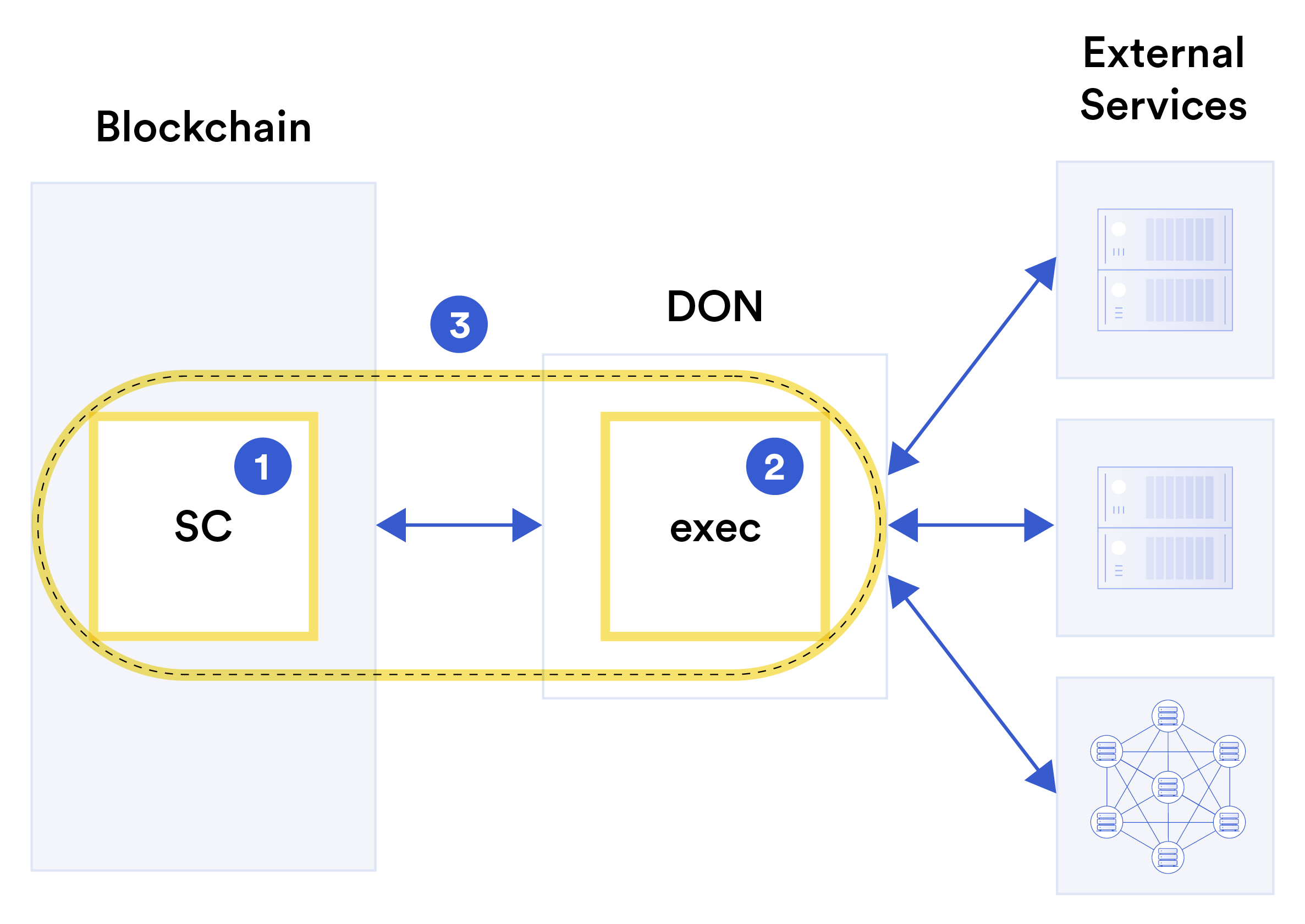
Figure 2: Conceptual figure depicting on-chain / off-chain contract composition. A hybrid smart contract 3⃝consists of two complementary components: an on-chain component SC 1⃝, resident on a blockchain, and an off-chain component exec 2⃝that executes on a DON. The DON serves as a bridge between the two components as well as connecting the hybrid contract with off-chain resources such as web services, other blockchains, decentralized storage, etc. decentralized set of nodes. DONs go a step further in the sense that they expand the range of services for which Chainlink can offer developers an abstraction layer with accompanying streamlined interfaces for high-level services. We present several application examples in Section 4 that highlight this approach. We envision enterprises, for instance, using DONs as a form of secure middleware to connect their legacy systems to blockchains. (See Section 4.2.) This use of DONs abstracts away the complexity of general blockchain dynamics (fees, reorgs, etc.). It also abstracts away the features of specific blockchains, thereby enabling enterprises to connect their existing systems to an ever-broadening array of blockchain systems without a need for specialized expertise in these systems or, more generally, in decentralizedsystems development. Ultimately, our ambition is to push the degree of abstraction achieved by Chainlink to the point of implementing what we refer to as a decentralized metalayer. Such a layer would abstract away the on-chain / off-chain distinction for all classes of developers and users of DApps, allowing seamless creation and use of decentralized services.
To simplify the development process, developers could specify DApp functionality in the metalayer as a virtual application in a unified machine model. They could then use a decentralized-metalayer compiler to instantiate the DApp automatically as a set of interoperating decentralized functionalities spanning blockchains, DONs, and external services. (One of these external services could be an enterprise system, making the metalayer useful for applications involving legacy enterprise systems.) Such compilation is akin to how modern compilers and software-development kits (SDKs) support generalist programmers in using the full potential of heterogeneous hardware architectures consisting of a general-purpose CPU and specialized hardware like GPUs, machine-learning accelerators, or trusted enclaves. Fig. 3 presents this idea at a conceptual level. Hybrid smart contracts are a first step along the way to this vision and to a concept we call meta contracts. Meta contracts are applications coded on a decentralized metalayer and implicitly encompass on-chain logic (smart contracts), as well as offchain computation and connectivity among various blockchains and existing off-chain services. Given the need for language and compiler support, new security models, and conceptual and technical harmonization of disparate technologies, however, realization of a true decentralized metalayer is an ambitious goal to which we aspire over a long time horizon. It is nonetheless a helpful ideal model to keep in mind while reading this paper, not detailed here, but something we plan to focus on in our future work on Chainlink. Scaling: A goal of preeminent importance in our evolving designs is enabling the Chainlink network to meet the growing scaling needs of the blockchain ecosystem. With network congestion becoming a recurring problem in existing permissionless blockchains [86], new and more performant blockchain designs are coming into use, e.g., [103, 120, 203], as well as complementary layer-2 scaling technologies, e.g., [5, 12, 121, 141, 169, 186, 187]. Oracle services must achieve latencies and throughputs that meet the performance demands of these systems while minimizing on-chain fees (e.g., gas costs) for contract operators and ordinary users alike. With DONs, Chainlink functionality aims to go further and deliver performance high enough for purely webbased systems. DONs derive much of their performance gain from their use of fast, committeebased or permissionless consensus protocols, which they combine with the blockchains they support. We expect many DONs with different configurations to run in parallel; different DApps and users can navigate tradeoffs in underlying consensus choices according to their application requirements. DONs may be viewed in effect as layer-2 technologies. We expect that among other services, DONs will support the Transaction Execution Framework (TEF), which facilitates efficient integration of DONs and thus oracles with other high-performance layer-2 systems—e.g., rollups, systems which bundle transactions offchain to achieve performance improvements. We introduce the TEF in Section 6.
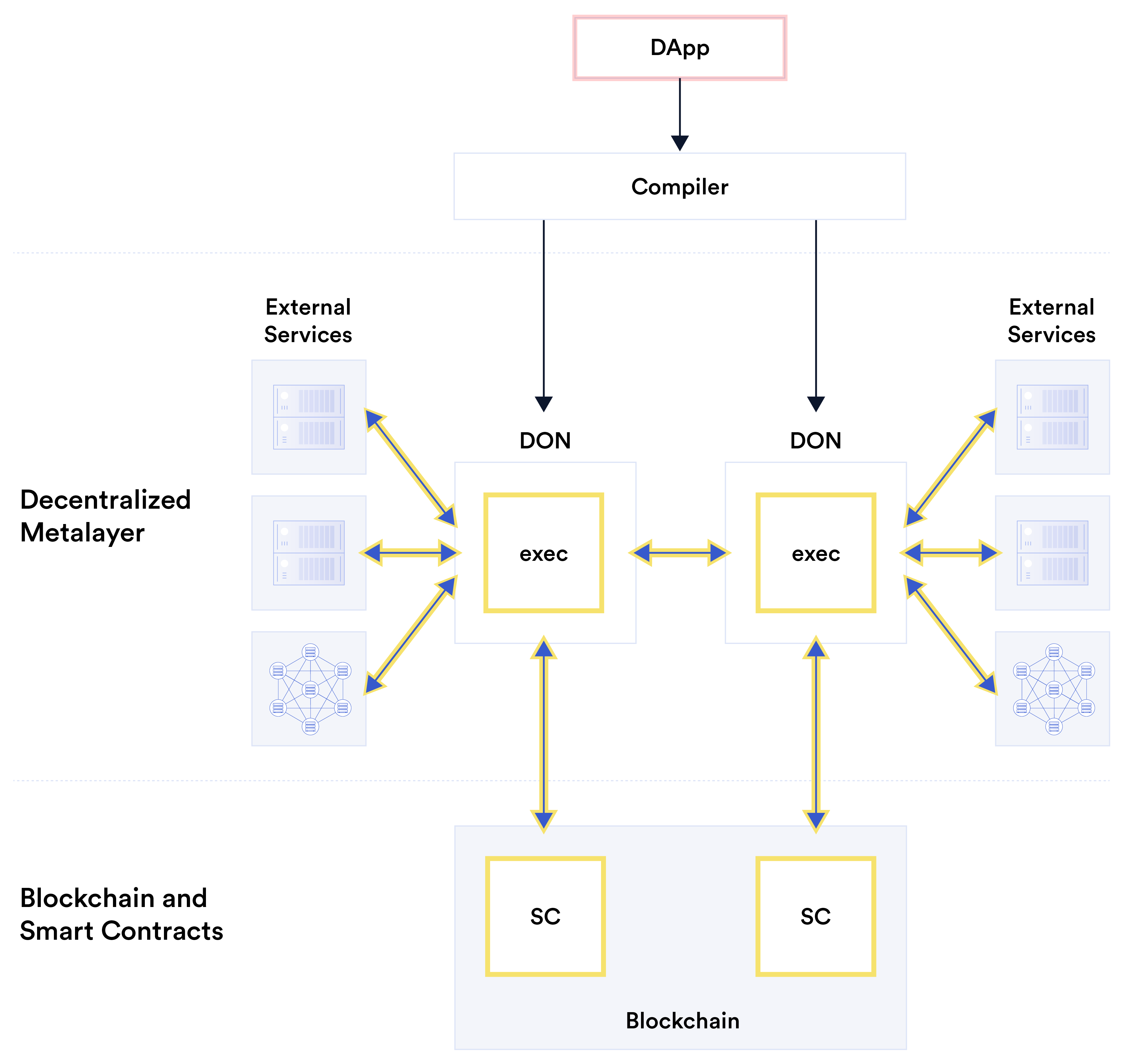
Figure 3: Conceptual figure showing ideal realization of a decentralized metalayer. For ease of development, a developer specifies a DApp, highlighted in pink, as a virtual application in a unified machine model. A decentralized-metalayer compiler automatically generates corresponding interoperating functionalities: smart contracts (denoted by SC), logic (denoted by exec) on DONs, adapters connecting to target external services, and so forth, as indicated in yellow highlight. Fig. 4 shows conceptually how DONs improve blockchain (smart contract) scaling by concentrating transaction and oracle-report processing offchain, rather than on chain. This shift in the main locus of computation reduces transaction latency and fees while boosting transaction throughput. Confidentiality: Blockchains provide unprecedented transparency for smart contracts and the applications they realize. But there is a basic tension between transparency and confidentiality. Today, for example, users’ decentralized exchange trans-
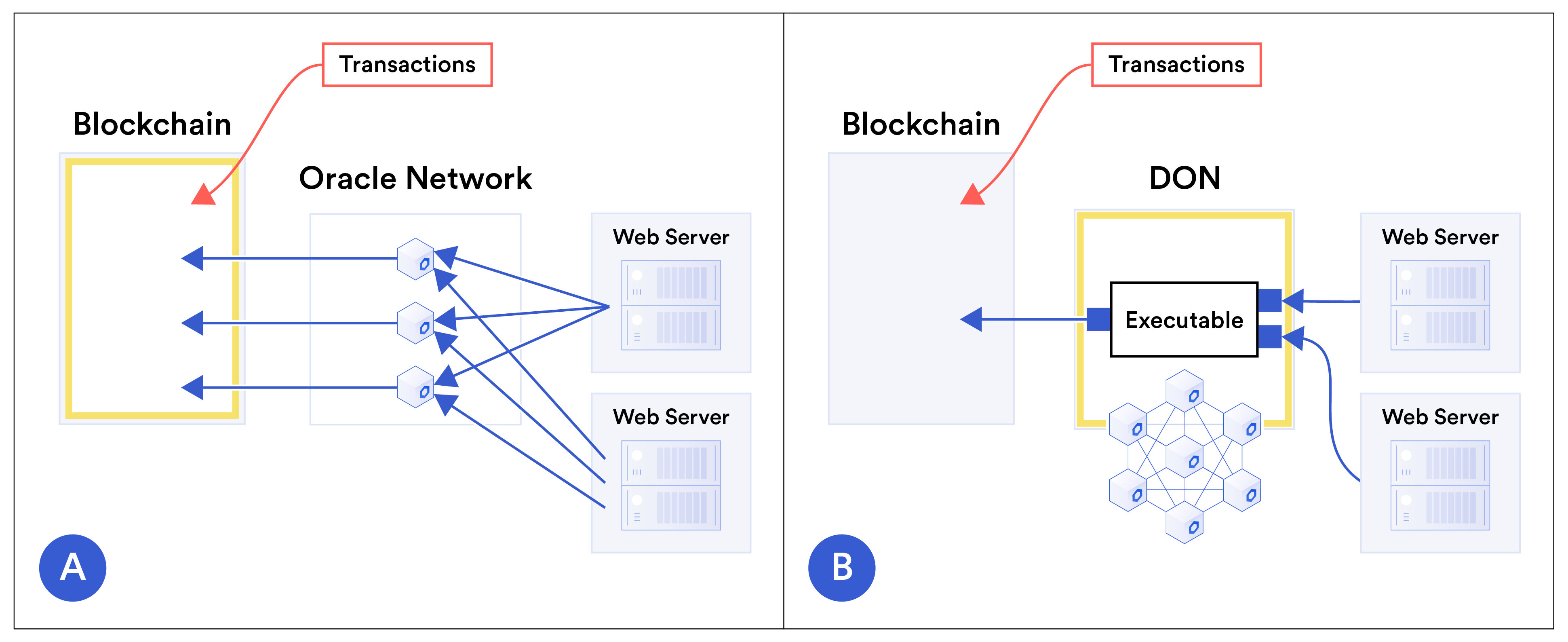
Figure 4: Conceptual figure showing how Decentralized Oracle Networks improve the scaling of blockchain-enabled smart contracts. Figure A ⃝shows a conventional oracle architecture. Transactions are sent directly to the blockchain, as are oracle reports. Thus the blockchain, highlighted in yellow, is the main locus for transaction processing. Figure B⃝shows use of a DON to support contracts on the blockchain. A DON executable processes transactions along with data from external systems and forwards results—e.g., bundled transactions or contract state changes resulting from the transactions’ effects—to the blockchain. The DON, highlighted in yellow, is thus the main locus for transaction processing. actions are recorded on chain, making it easy to monitor exchange behavior, but also making users’ financial transactions publicly visible. Similarly, data relayed to smart contracts remains on chain. This makes such data conveniently auditable, but acts as a disincentive for data providers wishing to furnish smart contracts with sensitive or proprietary data. We believe that oracle networks will play a pivotal role in catalyzing next-generation systems that combine blockchains’ innate transparency with new confidentiality protections. In this paper, we show how they will do so using three main approaches: • Confidentiality-preserving adapters: Two technologies with planned deployment in Chainlink’s networks, DECO [234] and Town Crier [233], enable oracle nodes to retrieve data from off-chain systems in ways that protect user privacy and data confidentiality. They will play a key role in the design of adapters for DONs. (See Section 3.6.2 for details on these two technologies.) • Confidential computation: DONs can simply conceal their computation from relying blockchains. Using secure multi-party computation and/or trusted execution environments, stronger confidentiality is also possible in which DON nodes compute over data into which they themselves do not have visibility.
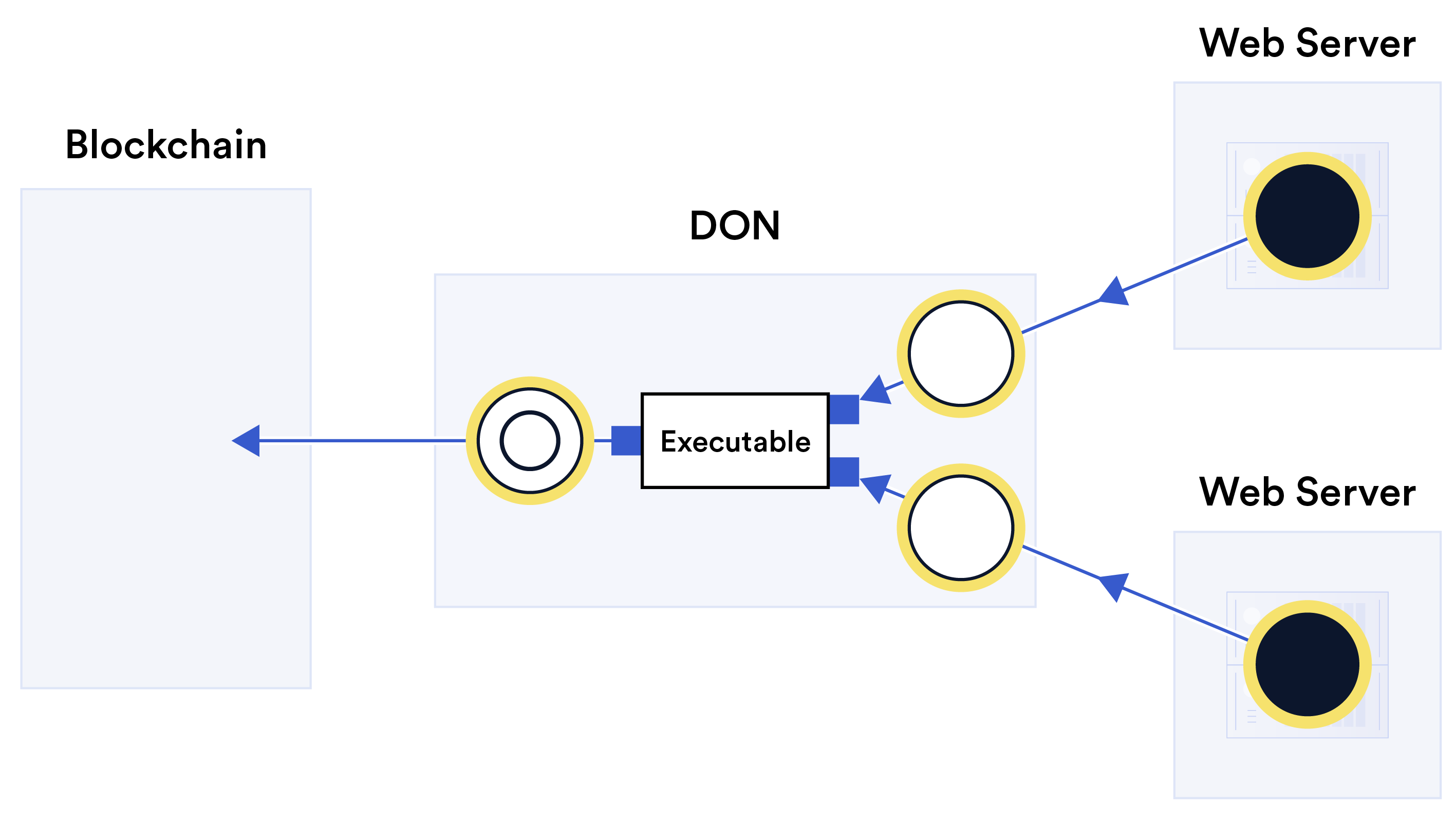
• Support for confidential layer-2 systems: The TEF is designed to support a variety of layer-2 systems, many of which use zero-knowledge proofs to provide various forms of transaction confidentiality. We discuss these approaches in Section 3 (with additional details in Section 6, Appendix B.1, and Appendix B.2). Fig. 5 presents a conceptual view of how sensitive data might flow from external sources to a smart contract by means of confidentiality-preserving adapters and confidential computation in a DON. Figure 5: Conceptual diagram of confidentiality-preserving operations in a DON on sensitive data (highlighted in yellow). Sensitive source data (black circles) in web servers is extracted to the DON using confidentiality-preserving adapters (blue, doublearrowed lines). The DON receives derived data (hollow circles) from these adapters— the result of applying either a function or, e.g., secret-sharing, to the sensitive source data. An executable on the DON may apply confidential computation to derived data to construct a report (double circle), which it sends over an adapter to the blockchain. We believe that powerful tools for handling confidential data will open up a whole range of applications. Among these are private decentralized (and centralized) finance, decentralized identity, credit-based on-chain lending, and more efficient and user-friendly know-your-customer and accreditation protocols, as we discuss in Section 4. Order-fairness for transactions: Today’s blockchain designs have a dirty little open secret: They are ephemerally centralized. Miners and validators can order trans-
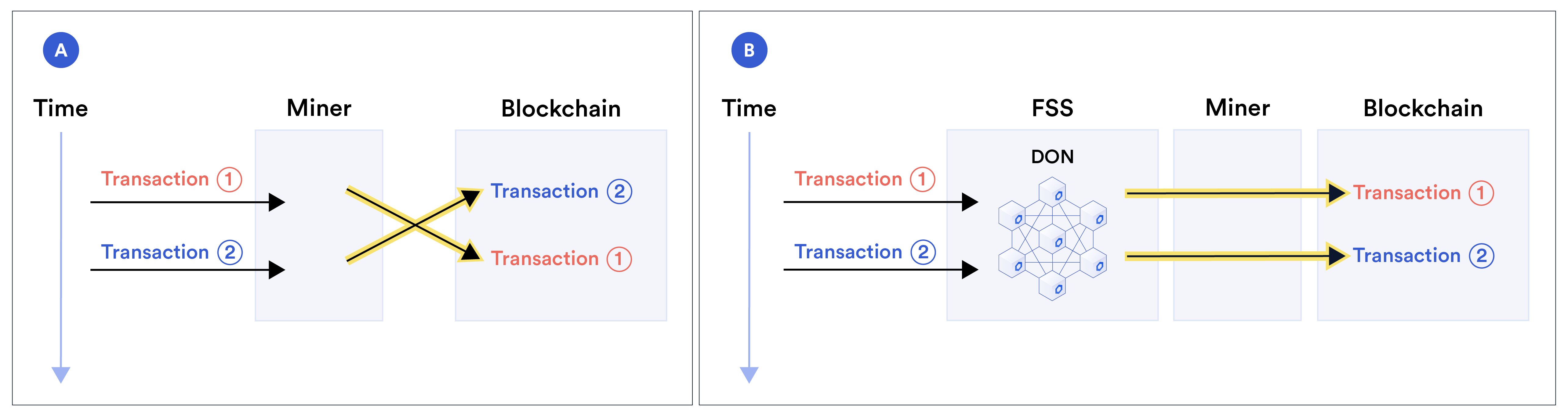
actions however they choose. Transaction order can also be manipulated by users as a function of the network fees they pay (e.g., gas prices in Ethereum) and to some extent by taking advantage of fast network connections. Such manipulation can, for example, take the form of front-running, in which a strategic actor such as a miner observes a user’s transaction and inserts its own exploitative transaction into an earlier position in the same block—effectively stealing money from the user by leveraging advance knowledge of the user’s transaction. For example, a bot may place a buy order before a user’s. It can then take advantage of the asset price increase induced by the user’s trade. Front-running by some bots that harms ordinary users—analogous to high-frequency trading on Wall Street—is already prevalent and well documented [90], as are related attacks such as back-running [159] and automated transaction mimicking [195]. Proposals to systematize order exploitation by miners have even surfaced recently [110]. Layer-2 technologies such as rollups don’t solve the problem, but merely re-centralize ordering, placing it in the hands of the entity that creates a rollup. One of our goals is to introduce into Chainlink a service called Fair Sequencing Services (FSS) [137]. FSS helps smart contract designers ensure fair ordering for their transactions and avoid front-running, back-running, and related attacks on user transactions as well as other types of transactions, such as oracle report transmission. FSS enables a DON to implement ideas such as the rigorous, temporal notion of orderfairness introduced in [144]. As an incidental benefit, FSS can also lower users’ network fees (e.g., gas costs). Briefly, in FSS, transactions pass through the DON, rather than propagating directly to a target smart contract. The DON orders the transactions and then forwards them to the contract. Figure 6: Example of how FSS is beneficial. Fig. A ⃝shows how a miner, exploiting its centralized power to order transactions, may swap a pair of transactions: transaction 1⃝ arrives before 2⃝, but the miner instead sequences it after 2⃝. In contrast, Fig. B⃝shows how a DON decentralizes the ordering process among DON nodes. If a quorum of honest nodes receive 1⃝before 2⃝, the FSS causes 1⃝to appear before 2⃝on chain— preventing miner reordering by attaching contract-enforceable sequence numbers. Fig. 6 compares standard mining with FSS. It shows how in standard mining,
the process of transaction ordering is centralized with the miner and thus subject to manipulation, such as reordering a pair of transactions with respect to their arrival times. In contrast, in FSS, the process is decentralized among DON nodes. Assuming a quorum of honest nodes, FSS helps enforce policies such as temporal ordering of transactions, reducing opportunities for manipulation by miners and other entities. Additionally, since users need not compete for preferential ordering based on gas price, they can pay relatively low gas prices (while transactions from the DON can be batched for gas savings). Trust minimization: Our general aim in the design of DONs is to facilitate a highly trustworthy layer of support for smart contracts and other oracle-dependent systems by means of decentralization, cryptographic tools, and cryptoeconomic guarantees. A DON itself is decentralized, and users can choose from any available DON that supports the main chain on which they wish to operate or spawn additional DONs with committees of nodes they trust. For some applications, however, particularly smart contracts, Chainlink users may favor a trust model that treats the main chain supported by a DON as more trustworthy than the DON itself. For such users, we already have or plan to incorporate into the architecture of the Chainlink network a number of mechanisms that enable contracts on a main chain to strengthen the security assurances provided by DONs, while at the same time also enforcing protections against the possibility of corrupted data sources such as the web servers from which the DON obtains data. We describe these mechanisms in Section 7. They fall under five main headings: • Data-source authentication: Tools that enable data providers to digitally sign their data and thereby strengthen the chain of custody between the origin and relying contract. • DON minority reports: Flags issued by a minority subset of DON nodes that observes majority malfeasance in the DON. • Guard rails: Logic on a main chain that detects anomalous conditions and pauses or halts contract execution (or invokes other remediations). • Trust-minimized governance: Use of gradual-release updates to facilitate community inspection, as well as decentralized emergency interventions for rapid response to system failures. • Decentralized entity authentication: Use of public-key infrastructure (PKI) to identify entities in the Chainlink network. Fig. 7 presents a conceptual schematic of our trust-minimization goals. Incentive-based (cryptoeconomic) security: Decentralization of report generation across oracle nodes helps ensure security even when some nodes are corrupted.
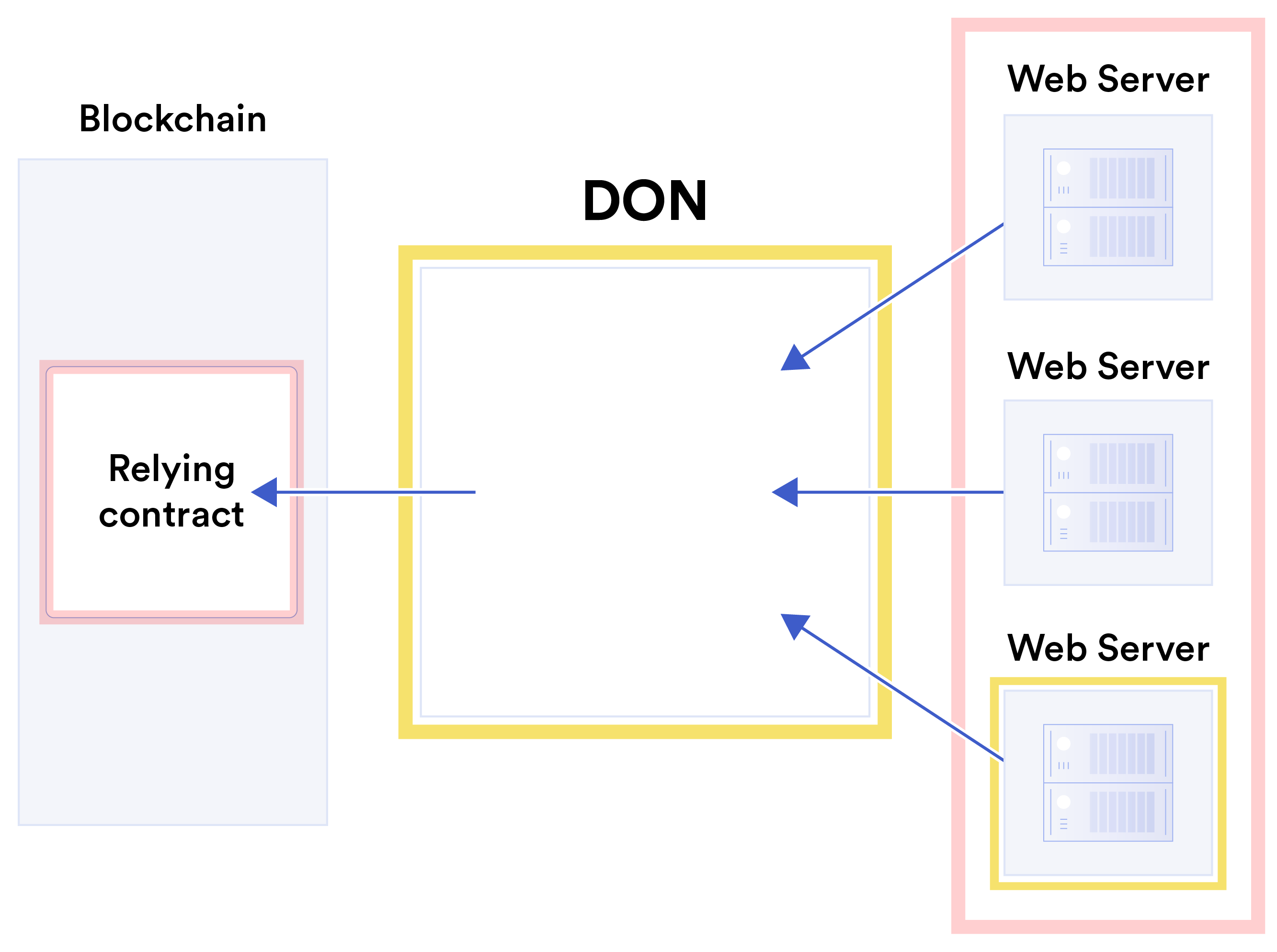
Figure 7: Conceptual depiction of Chainlink’s trust-minimization goal, which is to minimize users’ need for correct behavior of the DON and data sources such as web servers. Yellow highlights in the figure indicate trust-minimization loci: the DON and individual or minority sets of web servers. Pink highlights indicate system components that are highly trustworthy by assumption: contracts on the blockchain and a majority of web servers, i.e., web servers in the aggregate. Equally important, though, is ensuring that nodes have a financial incentive to behave correctly. Staking, i.e., requiring nodes to provide deposits of LINK and slashing (confiscating) these deposits in case of misbehavior, will play a key role in Chainlink. It is an important incentive design already used in a number of blockchains, e.g., [81, 103, 120, 204]. Staking in Chainlink, however, looks very different from staking in standalone blockchains. Staking in blockchains aims to prevent attacks on consensus. It has a different goal in Chainlink: to ensure timely delivery of correct oracle reports. A welldesigned staking system for an oracle network should render attacks such as bribery unprofitable for an adversary, even when the target is a smart contract with high monetary value. In this paper, we present a general approach to staking in Chainlink with three key innovations:
- A powerful adversarial model that encompasses attacks overlooked in existing approaches. One example is what we call prospective bribery. This is a form of bribery that determines which nodes receive bribes on a conditional basis, e.g., offers guaranteed bribes in advance to nodes that a staking mechanism selects at random for particular roles (such as triggering report adjudication).
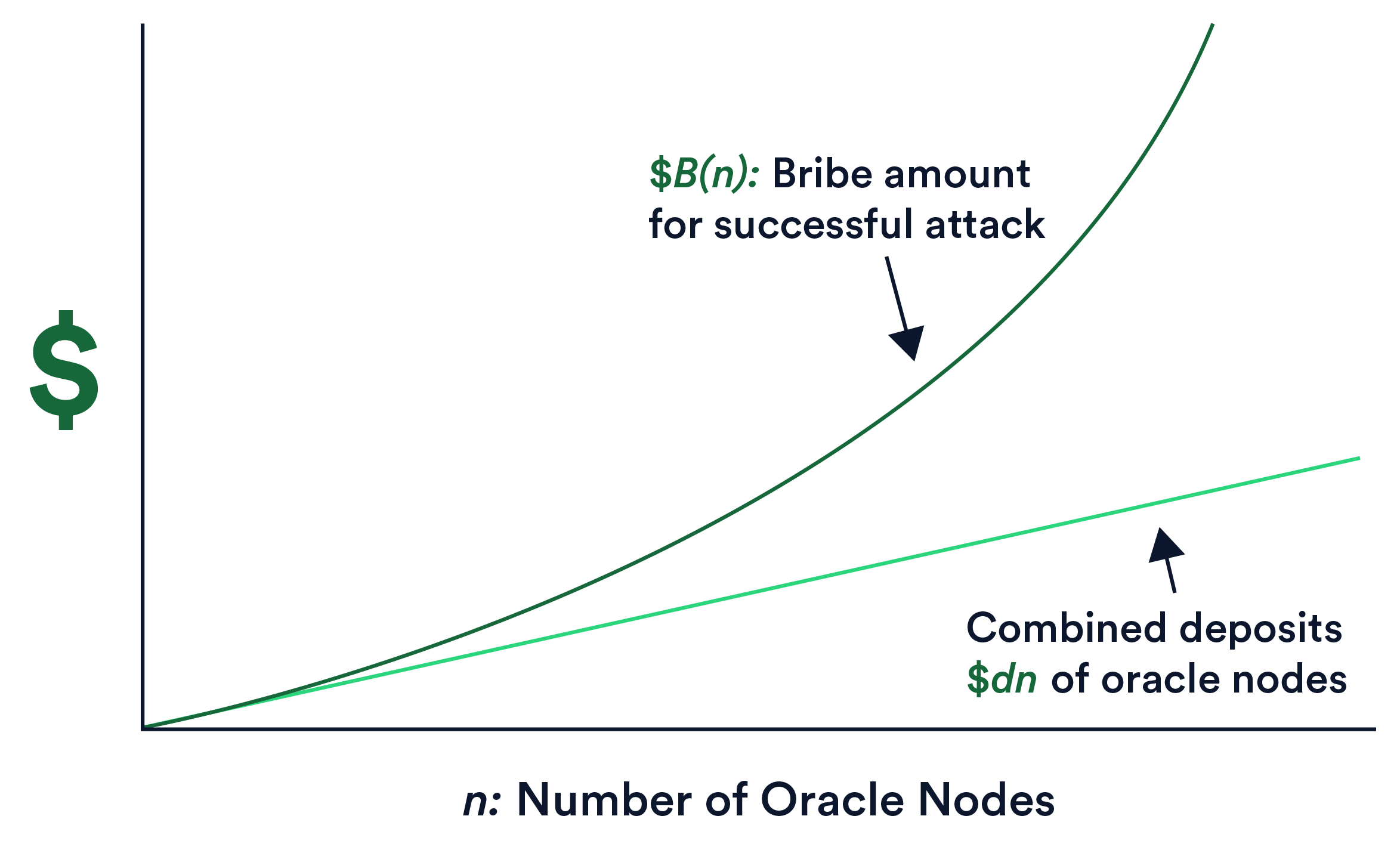
- Super-linear staking impact, meaning informally that to be successful, an adversary must have a budget $B greater than the combined deposits of all oracle nodes. More precisely, we mean that as a function of n, \(B(n) ≫\)dn in a network of n oracle nodes each with a fixed deposit amount $d (more formally, \(B(n) is asymptotically larger in n than \)dn). Fig. 8 gives a conceptual view of this property.
- The Implicit-Incentive Framework (IIF), an incentive model we have devised to encompass empirically measurable incentives beyond explicit deposited staking funds, including nodes’ future fee opportunities. The IIF extends the notion of stake beyond explicit node deposits. Figure 8: Conceptual diagram depicting super-linear scaling in Chainlink staking. The bribe $B(n) required by an adversary grows faster in n than the combined deposits $dn of all oracle nodes. We show how the IIF and super-linear staking impact together induce what we call a virtuous cycle of economic security for oracle networks. When new users enter
the system, increasing potential future earnings from running Chainlink nodes, the marginal cost of economic security drops for current and future users. In a regime of elastic demand, this diminished cost incentivizes additional users to make use of the network, continuously perpetuating adoption in an ongoing virtuous cycle. Note: While this whitepaper outlines important elements of our vision for the evolution of Chainlink, it is informal and includes few detailed technical specifics. We plan to release focused technical papers on additional features and approaches as they evolve. Furthermore, it is important to emphasize that many elements of the vision presented here (scaling improvements, confidentiality technologies, FSS, etc.) can and will be deployed in preliminary form even before advanced DONs become a basic feature of Chainlink. 1.3 Organization of this Paper We present our security model and notation in Section 2 and outline the Decentralized Oracle Network API in Section 3. In Section 4, we present a number of examples of applications for which DONs provide an appealing deployment platform. Readers can learn most of the key concepts of the paper by reading up to this point. The remainder of the paper contains further details. We describe Fair Sequencing Services (FSS) in Section 5 and the Transaction-Execution Framework (TEF) in Section 6. We describe our approach to trust minimization in Section 7. We consider some important DON deployment requirements, namely incremental rollout of features, dynamic ledger membership, and accountability in Section 8. Finally, in Section 9, we give an overview of our developing approach to incentive design. We conclude in Section 10. To help readers who have limited familiarity with the concepts in this paper, we provide a glossary in Appendix A. We present further detail on the DON interface and functionality in Appendix B and present some example adapters in Appendix C. In Appendix D, we describe a cryptographic primitive for trust-minimized data-source authentication called functional signatures and introduce a new variant called discretized functional signatures. We discuss some considerations bearing on committee selection for DONs in Appendix F.
परिचय
ब्लॉकचेन oracle को आज अक्सर एक उद्देश्य के साथ विकेंद्रीकृत सेवाओं के रूप में देखा जाता है: ओ-चेन संसाधनों से डेटा को blockchains पर अग्रेषित करने के लिए। हालाँकि, यह एक छोटा कदम है डेटा को अग्रेषित करने से लेकर उस पर कंप्यूटिंग करने, उसे संग्रहीत करने या उसे दो-दिशात्मक रूप से प्रसारित करने तक। यह अवलोकन oracles की कार्यक्षमता की अधिक व्यापक धारणा को उचित ठहराता है। तो भी smart contracts की बढ़ती सेवा आवश्यकताओं और उत्तरोत्तर बहुआयामी कार्य को पूरा करें प्रौद्योगिकियाँ जो oracle नेटवर्क पर निर्भर करती हैं। संक्षेप में, एक oracle की आवश्यकता हो सकती है और पड़ेगी ऑनचेन और ओff-चेन प्रणालियों के बीच एक सामान्य प्रयोजन, द्विदिशात्मक, गणना-सक्षम इंटरफ़ेस बनें। blockchain पारिस्थितिकी तंत्र में ओरेकल की भूमिका को बढ़ाना है smart contracts का प्रदर्शन, कार्यक्षमता और अंतरसंचालनीयता ताकि वे ऐसा कर सकें अनेक उद्योगों में नए विश्वास मॉडल और पारदर्शिता लाएँ। यह परिवर्तन हाइब्रिड smart contracts के व्यापक उपयोग के माध्यम से आएगा, जो फ्यूज हो जाता है blockchains के विशेष गुण जैसे ओ-चेन सिस्टम की अद्वितीय क्षमताओं के साथ oracle नेटवर्क और इस प्रकार ऑन-चेन सिस्टम की तुलना में कहीं अधिक पहुंच और शक्ति प्राप्त करते हैं अलगाव में. इस श्वेतपत्र में, हम जिसे Chainlink 2.0 कहते हैं, उसके लिए एक दृष्टिकोण व्यक्त करते हैं, जो मूल Chainlink श्वेतपत्र [98] में इसकी प्रारंभिक अवधारणा से परे Chainlink का विकास है। हम oracle नेटवर्क के लिए एक उत्तरोत्तर विस्तृत भूमिका की आशा करते हैं, जिसमें से एक वे हाइब्रिड के लिए तेज, विश्वसनीय और गोपनीयता-संरक्षित सार्वभौमिक कनेक्टिविटी और गणना प्रदान करके मौजूदा और नए blockchain को पूरक और बढ़ाते हैं। smart contracts. हमारा मानना है कि oracle नेटवर्क विकसित होकर उपयोगिताएँ बन जाएंगे blockchain से परे सिस्टम में उच्च-अखंडता blockchain-ग्रेड डेटा निर्यात करने के लिए पारिस्थितिकी तंत्र. आज, संस्थाओं के विविध समूह द्वारा चलाए गए Chainlink नोड oracle नेटवर्क में एक साथ आते हैं और डेटा को smart contract में रिले करते हैं, जिन्हें रिपोर्ट के रूप में जाना जाता है। हम ऐसा देख सकते हैं oracle शास्त्रीय-सर्वसम्मति के समान एक समिति के रूप में नोड्स blockchain [72], लेकिन फ्रीस्टैंडिंग कार्यक्षमता प्रदान करने के बजाय, मौजूदा blockchains का समर्थन करने के लक्ष्य के साथ। सत्यापन योग्य यादृच्छिक फ़ंक्शन (वीआरएफ) और ओ-चेन रिपोर्टिंग के साथ (ओसीआर), Chainlink पहले से ही smart contract के लिए आवश्यक कम्प्यूटेशनल संसाधन प्रदान करने के लिए एक सामान्य प्रयोजन ढांचे और बुनियादी ढांचे की दिशा में विकसित हो रहा है। उन्नत कार्यक्षमता. Chainlink 2.0 के लिए हमारी योजना की नींव को हम विकेंद्रीकृत ओरेकल कहते हैं नेटवर्क, या संक्षेप में DONs। चूंकि हमने "oracle नेटवर्क" शब्द पेश किया है मूल Chainlink श्वेतपत्र [98], oracle ने पहले से कहीं अधिक समृद्ध कार्यक्षमता विकसित की है और आवेदन की चौड़ाई. इस पेपर में, हम तदनुसार शब्द की एक नई परिभाषा प्रदान करते हैं Chainlink पारिस्थितिकी तंत्र के लिए हमारे भविष्य के दृष्टिकोण के लिए। इस दृष्टि से, DON एक नेटवर्क है Chainlink नोड्स की एक समिति द्वारा रखरखाव किया जाता है। यह सर्वसम्मति प्रोटोकॉल में निहित है द्वारा परिनियोजन के लिए चुने गए oracle फ़ंक्शंस की किसी भी असीमित श्रृंखला का समर्थन करता है समिति. एक DON इस प्रकार एक blockchain अमूर्त परत के रूप में कार्य करता है, इंटरफ़ेस प्रदान करता है smart contracts और अन्य प्रणालियों दोनों के लिए ओff-श्रृंखला संसाधनों के लिए। यह भी प्रदान करता है अत्यधिक कुशल लेकिन विकेन्द्रीकृत आधिकारिक श्रृंखला कंप्यूटिंग संसाधनों तक पहुंच। सामान्य तौर पर, DON मुख्य श्रृंखला पर संचालन का समर्थन करता है। इसका लक्ष्य सुरक्षित और लचीलेपन को सक्षम करना है-ब्ली हाइब्रिड smart contracts, जो ऑन-चेन और ओ-चेन गणना को जोड़ती है बाहरी संसाधनों से संबंध. हम इस बात पर जोर देते हैं कि DONs में समितियों के उपयोग के साथ भी, Chainlink ही स्वाभाविक रूप से अनुमति रहित रहता है। DONs अनुमति रहित की नींव के रूप में कार्य करते हैं ढांचा जिसमें नोड्स कस्टम oracle नेटवर्क को लागू करने के लिए एक साथ आ सकते हैं नोड समावेशन के लिए उनकी अपनी व्यवस्थाएँ हैं, जिन्हें अनुमति दी जा सकती है या अनुमति नहीं दी जा सकती है। नींव के रूप में DONs के साथ, हम सात में प्रगति पर Chainlink 2.0 पर ध्यान केंद्रित करने की योजना बना रहे हैं प्रमुख क्षेत्र: हाइब्रिड smart contracts, जटिलता को दूर करना, स्केलिंग, गोपनीयता, लेनदेन के लिए आदेश-निष्पक्षता, विश्वास को कम करना, और प्रोत्साहन-आधारित (क्रिप्टोइकोनॉमिक) सुरक्षा। इस पेपर परिचय में, हम विकेंद्रीकृत का एक सिंहावलोकन प्रस्तुत करते हैं खंड 1.1 में ओरेकल नेटवर्क और फिर खंड 1.2 में नवाचार के हमारे सात प्रमुख क्षेत्र। हम इस पेपर के शेष भाग के संगठन का वर्णन खंड 1.3 में करते हैं। 1.1 विकेंद्रीकृत ओरेकल नेटवर्क विकेंद्रीकृत Oracle नेटवर्क क्षमताओं को बढ़ाने और विस्तारित करने के लिए डिज़ाइन किए गए हैं लक्ष्य blockchain पर smart contracts या फ़ंक्शंस के माध्यम से मुख्य श्रृंखला जो हैं मूल रूप से उपलब्ध नहीं है. वे इसमें पाए जाने वाले तीन बुनियादी संसाधन प्रदान करके ऐसा करते हैं कंप्यूटिंग सिस्टम: नेटवर्किंग, भंडारण और संगणना। एक DON का लक्ष्य प्रदान करना है मजबूत गोपनीयता, अखंडता और उपलब्धता गुणों वाले ये संसाधन,1 जैसे साथ ही जवाबदेही भी. DONs का गठन oracle नोड्स की समितियों द्वारा किया जाता है जो एक विशिष्ट को पूरा करने के लिए सहयोग करते हैं लगातार सेवाएँ प्रदान करने के लिए नौकरी करें या दीर्घकालिक संबंध स्थापित करने का चयन करें ग्राहकों को. DONs को blockchain-अज्ञेयवादी तरीके से डिज़ाइन किया गया है। वे सेवा करने का वादा करते हैं एप्लिकेशन डेवलपर्स के लिए ओ-चेन समर्थन बनाने के लिए एक शक्तिशाली और लचीला उपकरण किसी भी समर्थित मुख्य श्रृंखला पर उनके smart contracts। दो प्रकार की कार्यक्षमताएँ DON की क्षमताओं का एहसास कराती हैं: निष्पादन योग्य और एडेप्टर. निष्पादनयोग्य ऐसे प्रोग्राम हैं जो DON पर लगातार और विकेंद्रीकृत तरीके से चलते हैं। हालाँकि वे मुख्य-श्रृंखला संपत्तियों को सीधे संग्रहीत नहीं करते हैं, लेकिन उनके पास महत्वपूर्ण लाभ हैं, जिनमें उच्च प्रदर्शन और गोपनीय प्रदर्शन करने की क्षमता शामिल है। गणना. निष्पादनयोग्य DON पर स्वायत्त रूप से चलते हैं और नियतात्मक प्रदर्शन करते हैं परिचालन. वे एडॉप्टर के साथ मिलकर काम करते हैं जो DON को बाहरी संसाधनों से जोड़ते हैं और निष्पादनयोग्यों द्वारा बुलाया जा सकता है। एडेप्टर, जैसा कि हम उन्हें DONs के लिए कल्पना करते हैं, एक हैं आज Chainlink में बाहरी एडेप्टर का सामान्यीकरण। जबकि मौजूदा एडाप्टर आम तौर पर केवल डेटा स्रोतों से डेटा प्राप्त होता है, एडेप्टर द्विदिश रूप से काम कर सकते हैं; में DONs, वे अतिरिक्त रूप से प्राप्त करने के लिए DON नोड्स द्वारा संयुक्त गणना का लाभ उठा सकते हैं अतिरिक्त सुविधाएँ, जैसे गोपनीयता-संरक्षण उपभोग के लिए रिपोर्ट एन्क्रिप्ट करना एक निष्पादन योग्य. DON के मूल संचालन की समझ प्रदान करने के लिए, चित्र 1 वैचारिक रूप से दिखाता है कि कैसे DON का उपयोग blockchain को रिपोर्ट भेजने के लिए किया जा सकता है और इस प्रकार पारंपरिक, मौजूदा oracle कार्यक्षमता प्राप्त की जा सकती है। हालाँकि, DONs कई अतिरिक्त सुविधाएँ प्रदान कर सकता है 1सूचना सुरक्षा का "सीआईए त्रय" [123, पृ. 26, §2.3.5]।Chainlink के मौजूदा नेटवर्क। उदाहरण के लिए, चित्र 1 की सामान्य संरचना के भीतर, निष्पादन योग्य ऐसे डेटा का उपयोग करके DON पर प्राप्त संपत्ति-मूल्य डेटा रिकॉर्ड कर सकता है उदाहरण के लिए, इसकी रिपोर्ट के लिए एक अनुगामी औसत की गणना करें। चित्र 1: एक उदाहरण के रूप में दर्शाने वाला वैचारिक चित्र कि कैसे एक विकेन्द्रीकृत ओरेकल नेटवर्क बुनियादी oracle कार्यक्षमता का एहसास कर सकता है, यानी, एक अनुबंध में ऑफ-चेन डेटा को रिले कर सकता है। एक निष्पादन योग्य ओ-चेन डेटा लाने के लिए एडेप्टर का उपयोग करता है, जिस पर वह गणना करता है, आउटपुट भेजता है लक्ष्य blockchain के लिए किसी अन्य एडॉप्टर पर। (एडाप्टर को कोड द्वारा प्रारंभ किया जाता है DON, छोटे नीले बक्सों द्वारा दर्शाया गया; तीर इसके लिए डेटा प्रवाह की दिशा दिखाते हैं विशेष उदाहरण।) निष्पादन योग्य अतिरिक्त रूप से स्थानीय DON को पढ़ और लिख सकता है स्थिति को बनाए रखने और/या अन्य निष्पादनयोग्यों के साथ संचार करने के लिए भंडारण। DONs में लचीली नेटवर्किंग, गणना और भंडारण, सभी यहाँ दर्शाए गए हैं, जो कई नवीनताओं को सक्षम करते हैं अनुप्रयोग. DONs का एक प्रमुख लाभ नई blockchain सेवाओं को बूटस्ट्रैप करने की उनकी क्षमता है। DONs एक ऐसा वाहन है जिसके द्वारा मौजूदा oracle नेटवर्क सेवा अनुप्रयोगों को शीघ्रता से खड़ा कर सकते हैं जिसके लिए आज उद्देश्य-निर्मित नेटवर्क के निर्माण की आवश्यकता होगी। हम संख्या देते हैं धारा 4 में ऐसे अनुप्रयोगों के उदाहरण। अनुभाग 3 में, हम DONs पर अधिक विवरण प्रदान करते हैं, उनकी क्षमताओं का वर्णन करते हुए इंटरफ़ेस की शर्तें जो वे डेवलपर्स और उपयोगकर्ताओं के सामने प्रस्तुत करते हैं। 1.2 सात प्रमुख डिज़ाइन लक्ष्य यहां हम विकास के लिए ऊपर बताए गए सात प्रमुख फोकसों की संक्षेप में समीक्षा करते हैं Chainlink, अर्थात्:हाइब्रिड smart contracts: Chainlink के लिए हमारे दृष्टिकोण का केंद्र सुरक्षित रूप से विचार है smart contracts में ऑन-चेन और ओ-चेन घटकों का संयोजन। हम अनुबंधों का उल्लेख करते हैं इस विचार को हाइब्रिड smart contracts या हाइब्रिड अनुबंध के रूप में साकार करना।2 ब्लॉकचेन विकेंद्रीकृत-सेवा में दो महत्वपूर्ण भूमिकाएँ निभाते हैं और निभाते रहेंगे पारिस्थितिकी तंत्र: वे दोनों लोकी हैं जहां क्रिप्टोकरेंसी स्वामित्व का प्रतिनिधित्व किया जाता है और विकेंद्रीकृत सेवाओं के लिए मजबूत एंकर। इसलिए स्मार्ट अनुबंधों को श्रृंखला पर प्रदर्शित या निष्पादित किया जाना चाहिए, लेकिन उनकी ऑन-चेन क्षमताएं गंभीर रूप से सीमित हैं। विशुद्ध रूप से ऑन-चेन अनुबंध कोड धीमा, महंगा और द्वीपीय है, जो वास्तविक दुनिया से लाभ उठाने में असमर्थ है डेटा और विभिन्न प्रकार की कार्यक्षमताएँ जो श्रृंखला पर स्वाभाविक रूप से अप्राप्य हैं, जिनमें गोपनीय गणना के विभिन्न रूप, सुरक्षित (छद्म) यादृच्छिकता की पीढ़ी शामिल है खनिक के विरुद्ध / validator हेरफेर, आदि। smart contract को अपनी पूरी क्षमता का एहसास करने के लिए smart contract की आवश्यकता होती है दो भागों से निर्मित किया जाना है: एक ऑन-चेन भाग (जिसे हम आम तौर पर एससी द्वारा दर्शाते हैं) और एक ओff-श्रृंखला भाग, DON पर चलने वाला एक निष्पादन योग्य (जिसे हम आम तौर पर इसके द्वारा निरूपित करते हैं) कार्यकारी). लक्ष्य ऑन-चेन कार्यक्षमता की एक सुरक्षित संरचना प्राप्त करना है ओff-श्रृंखला सेवाओं की बहुलता जिसे DONs प्रदान करना चाहता है। एक साथ, दो भाग एक हाइब्रिड अनुबंध बनाएं. हम चित्र 2 में संकल्पनात्मक रूप से विचार प्रस्तुत करते हैं। पहले से ही आज, Chainlink सेवाएँ3 जैसे डेटा फ़ीड और वीआरएफ अन्यथा सक्षम नहीं हैं smart contract अनुप्रयोग, DeFi से लेकर विकेंद्रीकृत बीमा तक काफी हद तक उत्पन्न NFT तक, अधिक सामान्य ढांचे की दिशा में पहले कदम के रूप में। Chainlink सेवाओं के रूप में इस श्वेतपत्र में हमारे दृष्टिकोण के अनुसार विस्तार करें और अधिक प्रदर्शनशील बनें सभी blockchains में smart contract सिस्टम की शक्ति होगी। इस श्वेतपत्र में हमारे अन्य छह प्रमुख फोकस को सेवा में अभिनय के रूप में देखा जा सकता है सबसे पहले, हाइब्रिड अनुबंधों में से एक। इन फोकसों में दृश्य को हटाना शामिल है हाइब्रिड अनुबंधों से जटिलता, अतिरिक्त ओ-चेन सेवाओं का निर्माण जो सक्षम बनाती है अधिक सक्षम हाइब्रिड अनुबंधों का निर्माण, और, विश्वास कम करने के मामले में, हाइब्रिड अनुबंधों द्वारा प्राप्त सुरक्षा गुणों को मजबूत करना। हम विचार छोड़ देते हैं अधिकांश पेपर में हाइब्रिड अनुबंध निहित हैं, लेकिन इनमें से कोई भी संयोजन DON के साथ मेनचेन तर्क को एक हाइब्रिड अनुबंध के रूप में देखा जा सकता है। जटिलता को दूर करना: DONs को विकेंद्रीकृत उपयोग करने के लिए डिज़ाइन किया गया है अक्सर जटिल मशीनरी को हटाकर डेवलपर्स और उपयोगकर्ताओं के लिए सिस्टम आसान हो जाता है DONs की शक्तिशाली और लचीली सेवाओं के पीछे। मौजूदा Chainlink सेवाएँ यह सुविधा पहले से ही है. उदाहरण के लिए, Chainlink में डेटा फ़ीड आज ऑनचेन इंटरफेस पेश करते हैं, जिसके लिए डेवलपर्स को प्रोटोकॉल स्तर के विवरण के बारे में चिंता करने की आवश्यकता नहीं होती है, जैसे कि ओसीआर किस माध्यम से आम सहमति रिपोर्टिंग लागू करता है 2ऑन-चेन/ओ-चेन अनुबंध संरचना का विचार पहले विभिन्न बाधाओं में उत्पन्न हुआ है फॉर्म, उदाहरण के लिए, लेयर-2 सिस्टम, टीईई-आधारित blockchains [80], आदि। हमारा लक्ष्य समर्थन और सामान्यीकरण करना है ये दृष्टिकोण और सुनिश्चित करते हैं कि वे ओ-चेन डेटा एक्सेस और अन्य कुंजी oracle को शामिल कर सकते हैं सेवाएँ। 3Chainlink सेवाओं में विभिन्न प्रकार की विकेन्द्रीकृत सेवाएँ और कार्यक्षमताएँ उपलब्ध हैं नेटवर्क. वे विभिन्न oracle नेटवर्क से बने कई नोड ऑपरेटरों द्वारा पेश किए जाते हैं पूरे पारिस्थितिकी तंत्र में.चित्र 2: ऑन-चेन/ओ-चेन अनुबंध संरचना को दर्शाने वाला वैचारिक चित्र। ए हाइब्रिड smart contract 3⃝दो पूरक घटकों से मिलकर बनता है: एक ऑन-चेन घटक SC 1⃝, blockchain पर निवासी, और एक ओff-श्रृंखला घटक निष्पादन 2⃝वह DON पर निष्पादित होता है। DON दो घटकों के बीच एक पुल के रूप में भी कार्य करता है हाइब्रिड अनुबंध को वेब सेवाओं जैसे ओ-चेन संसाधनों के साथ जोड़ने के रूप में blockchains, विकेन्द्रीकृत भंडारण, आदि। नोड्स का विकेन्द्रीकृत सेट। DONs इस अर्थ में एक कदम आगे जाते हैं कि वे इसका विस्तार करते हैं सेवाओं की श्रेणी जिसके लिए Chainlink डेवलपर्स को एक अमूर्त परत प्रदान कर सकती है उच्च स्तरीय सेवाओं के लिए सुव्यवस्थित इंटरफेस के साथ। हम धारा 4 में कई अनुप्रयोग उदाहरण प्रस्तुत करते हैं जो इस दृष्टिकोण पर प्रकाश डालते हैं। उदाहरण के लिए, हम सुरक्षित मिडलवेयर के रूप में DONs का उपयोग करने वाले उद्यमों की कल्पना करते हैं उनके लीगेसी सिस्टम को blockchains से कनेक्ट करें। (धारा 4.2 देखें।) DONs का यह उपयोग सामान्य blockchain गतिकी (फीस, पुनर्गठन, आदि) की जटिलता को दूर करता है। यह भी विशिष्ट blockchains की विशेषताओं को समाप्त कर देता है, जिससे उद्यमों को अपने मौजूदा सिस्टम को blockchain सिस्टम की निरंतर विस्तृत श्रृंखला के बिना कनेक्ट करने में सक्षम बनाया जा सकता है। इन प्रणालियों में विशेष विशेषज्ञता की आवश्यकता, या अधिक सामान्यतः, विकेंद्रीकृत प्रणालियों के विकास में। अंततः, हमारी महत्वाकांक्षा Chainlink द्वारा प्राप्त अमूर्तता की डिग्री को आगे बढ़ाने की है जिसे हम विकेन्द्रीकृत मेटललेयर के रूप में संदर्भित करते हैं उसे लागू करने के बिंदु तक। ऐसी परत डेवलपर्स के सभी वर्गों के लिए ऑन-चेन/ओ-चेन भेद को दूर कर देगा और डीएपी के उपयोगकर्ता, विकेंद्रीकृत सेवाओं के निर्बाध निर्माण और उपयोग की अनुमति देते हैं।विकास प्रक्रिया को सरल बनाने के लिए, डेवलपर्स एकीकृत मशीन मॉडल में वर्चुअल एप्लिकेशन के रूप में मेटलेयर में डीएपी कार्यक्षमता निर्दिष्ट कर सकते हैं। वे कर सकते थे फिर डीएपी को स्वचालित रूप से चालू करने के लिए एक विकेन्द्रीकृत-मेटललेयर कंपाइलर का उपयोग करें blockchains, DONs, और तक फैले इंटरऑपरेटिंग विकेन्द्रीकृत कार्यात्मकताओं का एक सेट बाहरी सेवाएँ. (इन बाहरी सेवाओं में से एक एंटरप्राइज सिस्टम हो सकता है, जो मेटलेयर को लीगेसी एंटरप्राइज सिस्टम से जुड़े अनुप्रयोगों के लिए उपयोगी बनाता है।) ऐसे संकलन आधुनिक कंपाइलर और सॉफ्टवेयर-डेवलपमेंट किट (एसडीके) के समान है विषम हार्डवेयर की पूरी क्षमता का उपयोग करने में सामान्यवादी प्रोग्रामर का समर्थन करें एक सामान्य प्रयोजन सीपीयू और जीपीयू जैसे विशेष हार्डवेयर से युक्त आर्किटेक्चर, मशीन-लर्निंग एक्सेलेरेटर, या विश्वसनीय एन्क्लेव। चित्र 3 इस विचार को वैचारिक स्तर पर प्रस्तुत करता है। हाइब्रिड smart contracts इस दृष्टि और उस अवधारणा की दिशा में पहला कदम है जिसे हम मेटा कॉन्ट्रैक्ट कहते हैं। मेटा कॉन्ट्रैक्ट विकेंद्रीकृत पर कोडित अनुप्रयोग हैं मेटालेयर और अंतर्निहित रूप से ऑन-चेन लॉजिक (smart contracts), साथ ही विभिन्न blockchains और मौजूदा ओ-चेन के बीच ओ-चेन गणना और कनेक्टिविटी को शामिल करता है। सेवाएँ। भाषा और कंपाइलर समर्थन, नए सुरक्षा मॉडल और की आवश्यकता को देखते हुए असमान प्रौद्योगिकियों का वैचारिक और तकनीकी सामंजस्य, तथापि, प्राप्ति एक सच्चे विकेन्द्रीकृत मेटलेयर का निर्माण एक महत्वाकांक्षी लक्ष्य है जिसकी हम लंबे समय से आकांक्षा कर रहे हैं समय क्षितिज. फिर भी यह पढ़ते समय ध्यान में रखने के लिए एक उपयोगी आदर्श मॉडल है यह पेपर, यहां विस्तृत नहीं है, लेकिन हम अपने भविष्य के काम में जिस पर ध्यान केंद्रित करने की योजना बना रहे हैं Chainlink. स्केलिंग: हमारे विकसित होते डिज़ाइनों में सर्वोपरि महत्व का लक्ष्य सक्षम करना है Chainlink नेटवर्क blockchain पारिस्थितिकी तंत्र की बढ़ती स्केलिंग आवश्यकताओं को पूरा करने के लिए। मौजूदा अनुमति रहित नेटवर्क कंजेशन एक बार-बार होने वाली समस्या बन गई है blockchains [86], नए और अधिक प्रदर्शन करने वाले blockchain डिज़ाइन उपयोग में आ रहे हैं, उदाहरण के लिए, [103, 120, 203], साथ ही पूरक परत-2 स्केलिंग प्रौद्योगिकियां, उदाहरण के लिए, [5, 12, 121, 141, 169, 186, 187]। Oracle सेवाओं को विलंबता और थ्रूपुट प्राप्त करना होगा जो ऑन-चेन शुल्क को कम करते हुए इन प्रणालियों की प्रदर्शन मांगों को पूरा करते हैं (उदाहरण के लिए, गैस लागत) अनुबंध ऑपरेटरों और सामान्य उपयोगकर्ताओं के लिए समान रूप से। DONs के साथ, Chainlink कार्यक्षमता का लक्ष्य आगे बढ़ना और पूरी तरह से वेब आधारित सिस्टम के लिए पर्याप्त उच्च प्रदर्शन प्रदान करना है। DONs को अपने प्रदर्शन में अधिकांश लाभ तेज़, समिति-आधारित या अनुमति रहित सर्वसम्मति प्रोटोकॉल के उपयोग से प्राप्त होता है, जिसे वे blockchains के साथ जोड़ते हैं वे समर्थन करते हैं. हम उम्मीद करते हैं कि विभिन्न कॉन्फ़िगरेशन वाले कई DON समानांतर में चलेंगे; विभिन्न डीएपी और उपयोगकर्ता अंतर्निहित सर्वसम्मति विकल्पों में ट्रेडऑफ़ को नेविगेट कर सकते हैं उनकी आवेदन आवश्यकताओं के अनुसार। DONs को वास्तव में परत-2 प्रौद्योगिकियों के रूप में देखा जा सकता है। हम बीच में यही उम्मीद करते हैं अन्य सेवाएँ, DONs लेनदेन निष्पादन फ्रेमवर्क (TEF) का समर्थन करेंगी, जो DONs और इस प्रकार oracles को अन्य उच्च-प्रदर्शन के साथ कुशल एकीकरण की सुविधा प्रदान करता है परत-2 प्रणालियाँ—उदाहरण के लिए, rollups, प्रणालियाँ जो प्राप्त करने के लिए श्रृंखला के लेनदेन को बंडल करती हैं प्रदर्शन में सुधार. हम धारा 6 में टीईएफ का परिचय देते हैं।
चित्र 3: विकेन्द्रीकृत धातु परत की आदर्श प्राप्ति को दर्शाने वाला वैचारिक चित्र। के लिए विकास में आसानी के लिए, एक डेवलपर गुलाबी रंग में हाइलाइट किए गए DApp को वर्चुअल के रूप में निर्दिष्ट करता है एकीकृत मशीन मॉडल में अनुप्रयोग। एक विकेन्द्रीकृत-मेटललेयर कंपाइलर स्वचालित रूप से संबंधित इंटरऑपरेटिंग कार्यक्षमताएँ उत्पन्न करता है: smart contracts (चिह्नित) एससी द्वारा), DONs पर तर्क (निष्पादन द्वारा चिह्नित), बाहरी सेवाओं को लक्षित करने के लिए कनेक्ट होने वाले एडेप्टर, इत्यादि, जैसा कि पीले हाइलाइट में दर्शाया गया है। चित्र 4 वैचारिक रूप से दिखाता है कि DONs blockchain (smart contract) स्केलिंग में कैसे सुधार करते हैं लेन-देन और oracle-श्रृंखला की रिपोर्ट प्रसंस्करण पर ध्यान केंद्रित करके, बजाय इसके कि श्रृंखला. गणना के मुख्य स्थान में यह बदलाव लेनदेन विलंबता को कम करता है और लेन-देन थ्रूपुट को बढ़ावा देते हुए शुल्क। गोपनीयता: ब्लॉकचेन smart contracts और उनके द्वारा लागू किए जाने वाले अनुप्रयोगों के लिए अभूतपूर्व पारदर्शिता प्रदान करते हैं। लेकिन पारदर्शिता और गोपनीयता के बीच एक बुनियादी तनाव है। आज, उदाहरण के लिए, उपयोगकर्ताओं का विकेन्द्रीकृत विनिमय ट्रांस-चित्र 4: संकल्पनात्मक चित्र दर्शाता है कि विकेंद्रीकृत Oracle नेटवर्क कैसे सुधार करते हैं blockchain-सक्षम smart contracts की स्केलिंग। चित्र ए ⃝एक पारंपरिक oracle दिखाता है वास्तुकला. लेन-देन सीधे blockchain पर भेजे जाते हैं, जैसे oracle रिपोर्टें होती हैं। इस प्रकार, पीले रंग में हाइलाइट किया गया blockchain, लेनदेन प्रसंस्करण के लिए मुख्य स्थान है। चित्र B⃝blockchain पर अनुबंधों का समर्थन करने के लिए DON का उपयोग दिखाता है। ए DON निष्पादन योग्य प्रक्रियाएं बाहरी सिस्टम और फॉरवर्ड से डेटा के साथ लेनदेन करती हैं परिणाम - उदाहरण के लिए, लेनदेन के प्रभाव के परिणामस्वरूप बंडल लेनदेन या अनुबंध स्थिति में परिवर्तन - blockchain तक। इस प्रकार, पीले रंग में हाइलाइट किया गया DON मुख्य है लेनदेन प्रसंस्करण के लिए स्थान. गतिविधियों को श्रृंखला पर रिकॉर्ड किया जाता है, जिससे विनिमय व्यवहार की निगरानी करना भी आसान हो जाता है उपयोगकर्ताओं के वित्तीय लेनदेन को सार्वजनिक रूप से दृश्यमान बनाना। इसी तरह, डेटा स्मार्ट को रिले किया गया अनुबंध श्रृंखला पर बने हुए हैं। यह ऐसे डेटा को आसानी से ऑडिट योग्य बनाता है, लेकिन कार्य करता है संवेदनशील या के साथ smart contracts प्रस्तुत करने के इच्छुक डेटा प्रदाताओं के लिए एक निरुत्साहन मालिकाना डेटा. हमारा मानना है कि oracle नेटवर्क अगली पीढ़ी को उत्प्रेरित करने में महत्वपूर्ण भूमिका निभाएंगे सिस्टम जो blockchains की सहज पारदर्शिता को नई गोपनीयता सुरक्षा के साथ जोड़ते हैं। इस पेपर में, हम दिखाते हैं कि वे तीन मुख्य तरीकों का उपयोग करके ऐसा कैसे करेंगे: • गोपनीयता-संरक्षण एडाप्टर: नियोजित तैनाती के साथ दो प्रौद्योगिकियां Chainlink के नेटवर्क में, DECO [234] और टाउन कैरियर [233], oracle नोड्स को सक्षम करें उपयोगकर्ता की गोपनीयता और डेटा की सुरक्षा करने वाले तरीकों से ओ-चेन सिस्टम से डेटा पुनर्प्राप्त करें गोपनीयता. वे DONs के लिए एडाप्टर के डिज़ाइन में महत्वपूर्ण भूमिका निभाएंगे। (इन दो प्रौद्योगिकियों पर विवरण के लिए धारा 3.6.2 देखें।) • गोपनीय गणना: DONs आसानी से अपनी गणना को blockchains पर निर्भर होने से छिपा सकते हैं। सुरक्षित मल्टी-पार्टी गणना और/या विश्वसनीय निष्पादन वातावरण का उपयोग करके, मजबूत गोपनीयता भी संभव है जिसमें DON नोड्स उन डेटा पर गणना करें जिनकी उन्हें स्वयं दृश्यता नहीं है।
• गोपनीय परत-2 प्रणालियों के लिए समर्थन: टीईएफ को विभिन्न परत-2 प्रणालियों का समर्थन करने के लिए डिज़ाइन किया गया है, जिनमें से कई प्रदान करने के लिए शून्य-ज्ञान प्रमाण का उपयोग करते हैं लेन-देन की गोपनीयता के विभिन्न रूप। हम धारा 3 में इन दृष्टिकोणों पर चर्चा करते हैं (धारा 6, परिशिष्ट बी.1 और परिशिष्ट बी.2 में अतिरिक्त विवरण के साथ)। चित्र 5 एक वैचारिक दृष्टिकोण प्रस्तुत करता है कि गोपनीयता-संरक्षण एडाप्टर के माध्यम से संवेदनशील डेटा बाहरी स्रोतों से smart contract तक कैसे प्रवाहित हो सकता है और DON में गोपनीय गणना। चित्र 5: DON में गोपनीयता-संरक्षण संचालन का वैचारिक आरेख संवेदनशील डेटा (पीले रंग में हाइलाइट किया गया)। वेब में संवेदनशील स्रोत डेटा (काले घेरे)। गोपनीयता-संरक्षण एडेप्टर (नीली, दोहरी तीर वाली रेखाएं) का उपयोग करके सर्वर को DON पर निकाला जाता है। DON इन एडाप्टरों से व्युत्पन्न डेटा (खोखले वृत्त) प्राप्त करता है- किसी फ़ंक्शन को लागू करने का परिणाम या, उदाहरण के लिए, संवेदनशील स्रोत पर गुप्त-साझाकरण डेटा. DON पर एक निष्पादन योग्य व्युत्पन्न डेटा पर गोपनीय गणना लागू कर सकता है एक रिपोर्ट (डबल सर्कल) बनाने के लिए, जिसे यह blockchain पर एक एडाप्टर के माध्यम से भेजता है। हमारा मानना है कि गोपनीय डेटा को संभालने के लिए शक्तिशाली उपकरण पूरी तरह से खुल जाएंगे अनुप्रयोगों की सीमा. इनमें निजी विकेंद्रीकृत (और केंद्रीकृत) वित्त, विकेंद्रीकृत पहचान, क्रेडिट-आधारित ऑन-चेन ऋण, और अधिक कुशल और शामिल हैं। उपयोगकर्ता-अनुकूल अपने ग्राहक को जानें और मान्यता प्रोटोकॉल, जैसा कि हम धारा 4 में चर्चा करते हैं। लेन-देन के लिए आदेश-निष्पक्षता: आज के blockchain डिज़ाइन में थोड़ा गंदापन है खुला रहस्य: वे क्षणिक रूप से केंद्रीकृत हैं। खनिक और validator ट्रांस- ऑर्डर कर सकते हैं-वे जो भी कार्य चुनते हैं। लेन-देन आदेश में उपयोगकर्ताओं द्वारा हेरफेर भी किया जा सकता है उनके द्वारा भुगतान की जाने वाली नेटवर्क फीस का एक कार्य (उदाहरण के लिए, Ethereum में गैस की कीमतें) और कुछ के लिए तेज़ नेटवर्क कनेक्शन का लाभ उठाकर हद तक। इस तरह के हेरफेर, के लिए कर सकते हैं उदाहरण के लिए, फ्रंट-रनिंग का रूप लें, जिसमें एक रणनीतिक अभिनेता जैसे कि खनिक उपयोगकर्ता के लेन-देन का निरीक्षण करता है और अपने स्वयं के शोषणकारी लेन-देन को पहले वाले में सम्मिलित करता है एक ही ब्लॉक में स्थिति—उपयोगकर्ता के लेन-देन की अग्रिम जानकारी का लाभ उठाकर प्रभावी ढंग से उपयोगकर्ता से पैसे चुराना। उदाहरण के लिए, एक बॉट खरीद ऑर्डर दे सकता है किसी उपयोगकर्ता से पहले. इसके बाद यह इससे प्रेरित परिसंपत्ति मूल्य वृद्धि का लाभ उठा सकता है उपयोगकर्ता का व्यापार. कुछ बॉट्स द्वारा फ्रंट-रनिंग जो आम उपयोगकर्ताओं को नुकसान पहुंचाती है - उच्च-आवृत्ति के अनुरूप वॉल स्ट्रीट पर व्यापार पहले से ही प्रचलित है और अच्छी तरह से प्रलेखित है [90], जैसा कि संबंधित है बैक-रनिंग [159] और [195] की नकल करने वाले स्वचालित लेनदेन जैसे हमले। खनिकों द्वारा ऑर्डर शोषण को व्यवस्थित करने के प्रस्ताव हाल ही में सामने आए हैं [110]। परत-2 प्रौद्योगिकियां जैसे rollups समस्या का समाधान नहीं करतीं, बल्कि केवल पुनः केंद्रीकृत करती हैं ऑर्डर देना, इसे उस इकाई के हाथों में देना जो rollup बनाता है। हमारा एक लक्ष्य Chainlink में फेयर सीक्वेंसिंग नामक सेवा शुरू करना है सेवाएँ (FSS) [137]। FSS smart contract डिजाइनरों को उनके लिए उचित ऑर्डर सुनिश्चित करने में मदद करता है लेनदेन और उपयोगकर्ता लेनदेन के साथ-साथ अन्य प्रकार के लेनदेन, जैसे oracle रिपोर्ट ट्रांसमिशन पर फ्रंट-रनिंग, बैक-रनिंग और संबंधित हमलों से बचें। एफएसएस [144] में प्रस्तुत आदेश-निष्पक्षता की कठोर, अस्थायी धारणा जैसे विचारों को लागू करने के लिए DON को सक्षम बनाता है। एक आकस्मिक लाभ के रूप में, एफएसएस उपयोगकर्ताओं के नेटवर्क को भी कम कर सकता है शुल्क (जैसे, गैस लागत)। संक्षेप में, एफएसएस में, लेनदेन सीधे लक्ष्य smart contract तक प्रसारित होने के बजाय DON से होकर गुजरते हैं। DON लेनदेन का आदेश देता है और फिर आगे भेजता है उन्हें अनुबंध के लिए. चित्र 6: एफएसएस कैसे फायदेमंद है इसका उदाहरण। चित्र ए ⃝दिखाता है कि कैसे एक खनिक इसका शोषण करता है लेन-देन का आदेश देने की केंद्रीकृत शक्ति, लेन-देन की एक जोड़ी को स्वैप कर सकती है: लेन-देन 1⃝ 2⃝ से पहले आता है, लेकिन खनिक इसे 2⃝ के बाद अनुक्रमित करता है। इसके विपरीत, चित्र B⃝दिखाता है कैसे DON DON नोड्स के बीच ऑर्डर देने की प्रक्रिया को विकेंद्रीकृत करता है। यदि कोरम का ईमानदार नोड्स को 2⃝ से पहले 1⃝ प्राप्त होता है, FSS श्रृंखला पर 1⃝ को 2⃝ से पहले प्रदर्शित करता है- अनुबंध-प्रवर्तनीय अनुक्रम संख्याओं को संलग्न करके खनिकों को पुनः व्यवस्थित करने से रोकना। चित्र 6 मानक खनन की तुलना एफएसएस से करता है। यह दिखाता है कि मानक खनन में,लेन-देन आदेश देने की प्रक्रिया खनिक के साथ केंद्रीकृत है और इस प्रकार इसके अधीन है हेरफेर, जैसे लेन-देन की एक जोड़ी को उनके आगमन के संबंध में पुन: व्यवस्थित करना बार. इसके विपरीत, FSS में, प्रक्रिया DON नोड्स के बीच विकेंद्रीकृत है। मान लेना ईमानदार नोड्स का एक कोरम, एफएसएस अस्थायी आदेश जैसी नीतियों को लागू करने में मदद करता है लेनदेन, खनिकों और अन्य संस्थाओं द्वारा हेरफेर के अवसरों को कम करना। इसके अतिरिक्त, चूंकि उपयोगकर्ताओं को गैस की कीमत के आधार पर अधिमान्य ऑर्डर के लिए प्रतिस्पर्धा करने की आवश्यकता नहीं है, वे अपेक्षाकृत कम गैस की कीमतों का भुगतान कर सकते हैं (जबकि DON से लेनदेन बैच किया जा सकता है गैस बचत के लिए)। विश्वास न्यूनीकरण: DONs के डिज़ाइन में हमारा सामान्य उद्देश्य अत्यधिक सुविधा प्रदान करना है smart contracts और अन्य oracle-निर्भर प्रणालियों के लिए समर्थन की भरोसेमंद परत विकेंद्रीकरण, क्रिप्टोग्राफ़िक उपकरण और क्रिप्टोआर्थिक गारंटी के माध्यम से। DON स्वयं विकेंद्रीकृत है, और उपयोगकर्ता किसी भी उपलब्ध DON में से चुन सकते हैं मुख्य श्रृंखला का समर्थन करता है जिस पर वे अतिरिक्त DONs को संचालित या उत्पन्न करना चाहते हैं उन नोड्स की समितियों के साथ जिन पर उन्हें भरोसा है। हालाँकि, कुछ अनुप्रयोगों के लिए, विशेष रूप से smart contracts, Chainlink उपयोगकर्ता हो सकते हैं एक ऐसे ट्रस्ट मॉडल का पक्ष लें जो DON द्वारा समर्थित मुख्य श्रृंखला को अधिक भरोसेमंद मानता हो DON से भी अधिक। ऐसे उपयोगकर्ताओं के लिए, हमारे पास पहले से ही है या इसे शामिल करने की योजना है Chainlink नेटवर्क की वास्तुकला में कई तंत्र हैं जो अनुबंधों को सक्षम करते हैं DONs द्वारा प्रदान किए गए सुरक्षा आश्वासनों को मजबूत करने के लिए एक मुख्य श्रृंखला पर, जबकि साथ ही, दूषित डेटा स्रोतों की संभावना के विरुद्ध सुरक्षा भी लागू की जा रही है जैसे कि वेब सर्वर जिनसे DON डेटा प्राप्त करता है। हम धारा 7 में इन तंत्रों का वर्णन करते हैं। वे पांच मुख्य शीर्षकों के अंतर्गत आते हैं: • डेटा-स्रोत प्रमाणीकरण: उपकरण जो डेटा प्रदाताओं को डिजिटल रूप से हस्ताक्षर करने में सक्षम बनाते हैं उनका डेटा और इस प्रकार मूल और के बीच हिरासत की श्रृंखला को मजबूत करता है भरोसा अनुबंध. • DON अल्पसंख्यक रिपोर्ट: DON नोड्स के अल्पसंख्यक उपसमूह द्वारा जारी किए गए झंडे DON में बहुसंख्यक गड़बड़ी देखी गई। • गार्ड रेल्स: मुख्य श्रृंखला पर तर्क जो विषम परिस्थितियों और रुकावटों का पता लगाता है या अनुबंध निष्पादन को रोक देता है (या अन्य सुधारों को लागू करता है)। • विश्वास-न्यूनतम शासन: सामुदायिक निरीक्षण की सुविधा के लिए क्रमिक-रिलीज़ अपडेट का उपयोग, साथ ही तेजी से विकेन्द्रीकृत आपातकालीन हस्तक्षेप सिस्टम विफलताओं पर प्रतिक्रिया. • विकेंद्रीकृत इकाई प्रमाणीकरण: सार्वजनिक-कुंजी अवसंरचना (पीकेआई) का उपयोग Chainlink नेटवर्क में इकाइयों की पहचान करें। चित्र 7 हमारे विश्वास-न्यूनीकरण लक्ष्यों की एक वैचारिक योजना प्रस्तुत करता है। प्रोत्साहन-आधारित (क्रिप्टोइकोनॉमिक) सुरक्षा: oracle नोड्स में रिपोर्ट निर्माण का विकेंद्रीकरण कुछ नोड्स के दूषित होने पर भी सुरक्षा सुनिश्चित करने में मदद करता है।
चित्र 7: Chainlink के विश्वास-न्यूनीकरण लक्ष्य का वैचारिक चित्रण, जो कि है DON और वेब जैसे डेटा स्रोतों के सही व्यवहार के लिए उपयोगकर्ताओं की आवश्यकता को कम करें सर्वर. चित्र में पीली हाइलाइट्स विश्वास-न्यूनीकरण लोकी को दर्शाती हैं: DON और वेब सर्वर के व्यक्तिगत या अल्पसंख्यक सेट। गुलाबी हाइलाइट्स सिस्टम घटकों को दर्शाते हैं जो धारणा के आधार पर अत्यधिक भरोसेमंद हैं: blockchain और बहुमत पर अनुबंध वेब सर्वरों की, यानी समग्र रूप से वेब सर्वर। हालाँकि, यह सुनिश्चित करना भी उतना ही महत्वपूर्ण है कि नोड्स को सही ढंग से व्यवहार करने के लिए वित्तीय प्रोत्साहन मिले। स्टेकिंग, यानी, नोड्स को लिंक और स्लैशिंग की जमा राशि प्रदान करने की आवश्यकता होती है (जब्त करना) दुर्व्यवहार के मामले में ये जमा राशियाँ Chainlink में महत्वपूर्ण भूमिका निभाएंगी। यह एक महत्वपूर्ण प्रोत्साहन डिज़ाइन है जिसका उपयोग पहले से ही कई blockchains में किया जा चुका है। उदाहरण के लिए, [81, 103, 120, 204]। हालाँकि, Chainlink में स्टेकिंग, स्टैंडअलोन में staking से बहुत अलग दिखती है blockchains. blockchains में हिस्सेदारी का उद्देश्य आम सहमति पर हमलों को रोकना है। इसमें एक है Chainlink में अलग लक्ष्य: सही oracle रिपोर्ट की समय पर डिलीवरी सुनिश्चित करना। oracle नेटवर्क के लिए एक अच्छी तरह से डिज़ाइन की गई staking प्रणाली को रिश्वतखोरी जैसे हमलों को प्रस्तुत करना चाहिए किसी प्रतिद्वंद्वी के लिए लाभहीन, तब भी जब लक्ष्य उच्च के साथ smart contract हो मौद्रिक मूल्य. इस पेपर में, हम तीन कुंजी के साथ Chainlink में staking के लिए एक सामान्य दृष्टिकोण प्रस्तुत करते हैं नवाचार:1. एक शक्तिशाली प्रतिकूल मॉडल जो मौजूदा में नजरअंदाज किए गए हमलों को शामिल करता है दृष्टिकोण. एक उदाहरण वह है जिसे हम संभावित रिश्वतखोरी कहते हैं। यह का एक रूप है रिश्वतखोरी जो यह निर्धारित करती है कि कौन से नोड सशर्त आधार पर रिश्वत प्राप्त करते हैं, उदाहरण के लिए, अधिकारी उन नोड्स के लिए अग्रिम रूप से रिश्वत की गारंटी देते हैं जिन्हें staking तंत्र चुनता है विशेष भूमिकाओं के लिए यादृच्छिक (जैसे कि रिपोर्ट निर्णय को ट्रिगर करना)। 2. सुपर-लीनियर staking प्रभाव, जिसका अनौपचारिक अर्थ है कि सफल होने के लिए, एक प्रतिद्वंद्वी के पास सभी oracle की संयुक्त जमा राशि से $B अधिक बजट होना चाहिए। नोड्स. अधिक सटीक रूप से, हमारा मतलब है कि n के एक फ़ंक्शन के रूप में, a में \(B(n) ≫\)dn n oracle नोड्स का नेटवर्क, जिनमें से प्रत्येक की निश्चित जमा राशि $d है (अधिक औपचारिक रूप से, \(B(n) is asymptotically larger in n than \)dn). चित्र 8 एक वैचारिक दृष्टिकोण देता है यह संपत्ति. 3. इम्प्लिसिट-इंसेंटिव फ्रेमवर्क (आईआईएफ), एक प्रोत्साहन मॉडल जिसे हमने तैयार किया है स्पष्ट जमा से परे अनुभवजन्य रूप से मापने योग्य प्रोत्साहन शामिल करें staking नोड्स के भविष्य के शुल्क अवसरों सहित फंड। IIF की धारणा का विस्तार करता है स्पष्ट नोड जमा से परे हिस्सेदारी। चित्र 8: Chainlink staking में सुपर-रैखिक स्केलिंग को दर्शाने वाला वैचारिक आरेख। द एक प्रतिद्वंद्वी द्वारा आवश्यक रिश्वत $B(n) संयुक्त जमा की तुलना में n में तेजी से बढ़ती है सभी oracle नोड्स का $dn। हम दिखाते हैं कि कैसे IIF और सुपर-लीनियर staking प्रभाव मिलकर हमें प्रेरित करते हैं oracle नेटवर्क के लिए आर्थिक सुरक्षा के एक अच्छे चक्र को कॉल करें। जब नए उपयोगकर्ता प्रवेश करते हैं
सिस्टम, Chainlink नोड्स चलाने से संभावित भविष्य की आय में वृद्धि कर रहा है वर्तमान और भविष्य के उपयोगकर्ताओं के लिए आर्थिक सुरक्षा की सीमांत लागत कम हो जाती है। के एक शासन में लोचदार मांग, यह कम लागत अतिरिक्त उपयोगकर्ताओं को इसका उपयोग करने के लिए प्रोत्साहित करती है नेटवर्क, निरंतर चल रहे पुण्य चक्र में गोद लेने को कायम रख रहा है। ध्यान दें: हालाँकि यह श्वेतपत्र Chainlink के विकास के लिए हमारे दृष्टिकोण के महत्वपूर्ण तत्वों को रेखांकित करता है, यह अनौपचारिक है और इसमें कुछ विस्तृत तकनीकी विशिष्टताएँ शामिल हैं। हम योजना बनाते हैं अतिरिक्त सुविधाओं और दृष्टिकोणों के विकसित होने पर उन पर केंद्रित तकनीकी पेपर जारी करें। इसके अलावा, प्रस्तुत दृष्टि के कई तत्वों पर जोर देना महत्वपूर्ण है यहां (स्केलिंग सुधार, गोपनीयता प्रौद्योगिकियां, एफएसएस, आदि) हो सकते हैं और होंगे उन्नत DONs की बुनियादी सुविधा बनने से पहले ही प्रारंभिक रूप में तैनात किया गया Chainlink. 1.3 इस पेपर का संगठन हम अपने सुरक्षा मॉडल और नोटेशन को धारा 2 में प्रस्तुत करते हैं और विकेंद्रीकृत की रूपरेखा तैयार करते हैं धारा 3 में ओरेकल नेटवर्क एपीआई। धारा 4 में, हम कई उदाहरण प्रस्तुत करते हैं ऐसे एप्लिकेशन जिनके लिए DONs एक आकर्षक परिनियोजन प्लेटफ़ॉर्म प्रदान करते हैं। पाठक कर सकते हैं इस बिंदु तक पढ़कर पेपर की अधिकांश प्रमुख अवधारणाओं को सीखें। पेपर के शेष भाग में और विवरण हैं। हम निष्पक्ष अनुक्रमण का वर्णन करते हैं धारा 5 में सेवाएँ (एफएसएस) और धारा 6 में लेनदेन-निष्पादन फ्रेमवर्क (टीईएफ)। हम धारा 7 में विश्वास न्यूनीकरण के लिए अपने दृष्टिकोण का वर्णन करते हैं। हम कुछ पर विचार करते हैं महत्वपूर्ण DON परिनियोजन आवश्यकताएँ, अर्थात् सुविधाओं का वृद्धिशील रोलआउट, गतिशील खाता सदस्यता, और धारा 8 में जवाबदेही। अंत में, धारा 9 में, हम देते हैं प्रोत्साहन डिज़ाइन के प्रति हमारे विकासशील दृष्टिकोण का अवलोकन। हम धारा 10 में निष्कर्ष निकालते हैं। उन पाठकों की मदद करने के लिए जिनकी इस पेपर की अवधारणाओं से सीमित जानकारी है, हम परिशिष्ट A में एक शब्दावली प्रदान करें। हम DON इंटरफ़ेस पर अधिक विवरण प्रस्तुत करते हैं और परिशिष्ट बी में कार्यक्षमता और परिशिष्ट सी में कुछ उदाहरण एडाप्टर प्रस्तुत करते हैं। परिशिष्ट डी में, हम विश्वास-न्यूनतम डेटा-स्रोत के लिए एक क्रिप्टोग्राफ़िक आदिम का वर्णन करते हैं प्रमाणीकरण को कार्यात्मक हस्ताक्षर कहा जाता है और विवेकाधीन कार्यात्मक हस्ताक्षर नामक एक नया संस्करण पेश किया जाता है। हम समिति पर असर डालने वाले कुछ विचारों पर चर्चा करते हैं परिशिष्ट एफ में DONs के लिए चयन।
Security Model and Goals
Security Model and Goals
A Decentralized Oracle Network is a distinct distributed system that we expect will initially be implemented typically—although not necessarily—by a committee-based consensus protocol and run by a set of oracle nodes. A DON is designed primarily to augment the capabilities of a smart contract on a main chain with oracle reports and other services, but it can provide those same supporting services to other nonblockchain systems, and thus need not be associated with a particular main chain.
The model and properties we consider are therefore largely independent of the use of the particular applications of a DON. 2.1 Current Architectural Model It is important to emphasize that Chainlink today is not a monolithic service, but rather a permissionless framework within which it is possible to launch distinct, independent networks of oracle nodes [77]. Networks have heterogeneous sets of node operators and designs. They may also differ in terms of the types of services they provide, which can include, e.g., data feeds, Proof of Reserves, verifiable randomness, and so forth. Other differences can include the degree of decentralization, size of the network in terms of locked value it supports, and various service-level parameters, such as data frequency and accuracy. Chainlink’s permissionless model encourages the growth of an ecosystem in which providers specialize in the services they are best able to furnish to the community. This model is likely to result in lower costs to users and higher service quality than a model that requires all nodes and networks to provide a full range of services, an approach that can easily devolve into system-wide adoption of the services representing the least common denominator of resources available to nodes. As Chainlink evolves toward DON-based designs in Chainlink 2.0, we continue to support the model of a permissionless, open framework, keeping in view the goal of providing users with a range of service choices that globally result in the best match with particular application requirements. 2.2 Consensus Assumptions We use the term Decentralized Oracle Network to encompass the full functionality of the oracle system we describe: both the data structure that oracle nodes maintain and the core API layered on top of it. We use the term ledger (lower case), denoted by L, to mean the underlying data structure maintained by a DON and used to support the particular services it provides. We emphasize that our DON framework does not treat L as a freestanding system like a blockchain: Its purpose is to support blockchains and other systems. Blockchains are, of course, one way of realizing a trustworthy ledger, but there are others. We expect DONs in many cases to realize their underlying ledgers using Byzantine Fault Tolerant (BFT) systems, which considerably predate blockchains such as Bitcoin [174]. We use BFT-type notation and properties throughout the paper for convenience, although we emphasize that DONs can be realized using permissionless consensus protocols. Conceptually, a ledger L is a bulletin board on which data is linearly ordered. We view a ledger generally as having a few key properties commonly ascribed to blockchains [115]. A ledger is: • Append-only: Data, once added, cannot be removed or modified.
• Public: Anyone can read its contents, which are consistent across time in the view of all users.4 • Available: The ledger can always be written to by authorized writers and read by anyone in a timely way. Alternative properties are possible in the ledger for a DON when realized by a committee. For instance, ledger write access might be restricted to certain users, as might read access for some applications, i.e., the ledger need not be public as defined above. Similarly, ledger rules might permit modification or redaction of data. We don’t explicitly consider such variants in this paper, however. The modular design of DONs can support any of a wide variety of modern BFT protocols, e.g., Hotstuff[231]. The exact choice will depend on trust assumptions and network characteristics among the oracle nodes. A DON could in principle alternatively use a highly performant permissionless blockchain for its ledger in its role supporting an equally scalable layer-2 or blockchain system. Similarly, hybridization is also possible: The DON could in principle be composed of nodes that are validators in an existing blockchain, e.g., in Proof-of-Stake systems in which committees are selected to execute transactions, e.g., [8, 81, 120, 146, 204]. This particular mode of operation requires that nodes operate in a dual-use manner, i.e., operate both as blockchain nodes and DON nodes. (See Section 8.2 for a discussion of techniques to ensure continuity in changing committees and Appendix F for some caveats on random committee selection.) In practice, in modern BFT algorithms, nodes digitally sign messages on the ledger. We assume for convenience that L has an associated public key pkL and that its contents are signed by the corresponding private key. This general notation applies even when data on L are signed using threshold signatures.5 Threshold signatures are convenient, as they enable a persistent identity for a DON even with changes of membership in the nodes running it. (See Appendix B.1.3.) We thus assume that \(sk_L\) is secret-shared in a \((k, n)\)-threshold manner for some security parameter \(k\), e.g., \(k = 2f + 1\) and \(n = 3f + 1\), where \(f\) is the number of potentially faulty nodes. (By choosing \(k\) in this way, we ensure that faulty nodes can neither learn \(sk_L\) nor mount a denial-of-service attack preventing its use.) A message on L takes the form M = (m, z), where m is a string and z a unique sequential index number. Where applicable, we write messages in the form m = ⟨MessageType : payload⟩. The message type MessageType is syntactic sugar that indicates the function of a particular message. 4In cases where a blockchain without finality realizes a ledger, inconsistency is typically abstracted away by disregarding insufficiently deep blocks or “pruning” [115]. 5In practice, some code bases, e.g., LibraBFT [205], a variant of Hotstuff, have currently adopted multi-signatures, rather than threshold signatures, trading offreduced communication complexity for simpler engineering. With some added cost, oracle nodes can append threshold signatures to messages written to L even if the consensus protocol used for L doesn’t employ them.
2.3 Notation We denote the set of \(n\) oracle nodes running the ledger by \(O = \{O_i\}_{i=1}^{n}\). Such a set of nodes is often called a committee. For simplicity, we assume that the set of oracles implementing DON functionality, i.e., services on top of L, is identical with that maintaining L, but they can be distinct. We let \(pk_i\) denote the public key of player \(O_i\), and \(sk_i\) the corresponding private key. Most BFT algorithms require at least \(n = 3f + 1\) nodes, where \(f\) is the number of potentially faulty nodes; remaining nodes are honest, in the sense that they follow the protocol exactly as specified. We refer to the committee O as honest if it meets this requirement, i.e., has greater than a \(2/3\)-fraction of honest nodes. Unless otherwise stated, we assume that O is honest (and a static model of corruption). We use \(pk_O\) / \(sk_O\) interchangeably with \(pk_L\) / \(sk_L\), depending on the context. We let \(\sigma = \text{Sig}_{pk}[m]\) denote a signature on message \(m\) with respect to \(pk\), i.e., using corresponding private key \(sk\). Let \(\text{verify}(pk, \sigma, m) \rightarrow \{false, true\}\) denote a corresponding signature verification algorithm. (We leave key generation implicit throughout the paper.) We use the notation \(S\) to denote a data source and \(\mathcal{S}\) to denote the full set of \(n_S\) sources in a given context. We denote by MAINCHAIN a smart-contract enabled blockchain supported by a DON. We use the term relying contract to denote any smart contract on MAINCHAIN that communicates with a DON, and use the notation SC to denote such a contract. We generally assume that a DON supports a single main chain MAINCHAIN, although it can support multiple such chains, as we show in examples in Section 4. A DON can and typically will support multiple relying contracts on MAINCHAIN. (As noted above, a DON can alternatively support non-blockchain services.) 2.4 Note on Trust Models As noted above, DONs may be built atop committee-based consensus protocols, and we expect they will commonly use such protocols. There are many strong arguments that one of the two alternatives, committee-based or permissionless blockchains, provides stronger security than the other. It is important to recognize that the security of committee-based vs. permissionless decentralized systems is incommensurable. Compromising a PoW or a PoS blockchain via 51% attack requires that an adversary obtain majority resources ephemerally and potentially anonymously, for example by renting hash power in a PoW system. Such attacks in practice have already impacted several blockchains [200, 34]. In contrast, compromising a committee-based system means corrupting a threshold number (typically one-third) of its nodes, where the nodes may be publicly known, well resourced, and trustworthy entities. On the other hand, committee-based systems (as well as “hybrid” permissionless systems that support committees) can support more functionality than strictly per-
missionless systems. This includes the ability to maintain persistent secrets, such as signing and/or encryption keys—one possibility in our designs. We emphasize that DONs can in principle be built atop either a committee-based or permissionless consensus protocol and DON deployers may ultimately choose to adopt either approach. Bolstering trust models: A key feature of Chainlink today is the ability of users to select nodes based on decentralized records of their performance histories, as discussed in Section 3.6.4. The staking mechanism and Implicit-Incentive Framework we introduce in Section 9 together constitute a broadly scoped and rigorous mechanism-design framework that will empower users with a greatly expanded ability to gauge the security of DONs. This same framework will also make it possible for DONs themselves to enforce various security requirements on participating nodes and ensure operation within strong trust models. It is also possible using tools described in this paper for DONs to enforce special trust-model requirements, such as compliance with regulatory requirements. For example, using techniques discussed in Section 4.3, nodes can present evidence of node-operator characteristics, e.g., territory of operation, that can be used to help enforce compliance with, e.g., the General Data Protection Regulation (GDPR) Article 3 (“Territorial Scope”) [105]. Such compliance can otherwise be challenging to meet in decentralized systems [45]. Additionally, in Section 7 we discuss plans to strengthen the robustness of DONs through trust-minimization mechanisms on the main chains they support.
सुरक्षा मॉडल और लक्ष्य
विकेंद्रीकृत ओरेकल नेटवर्क एक विशिष्ट वितरित प्रणाली है जिसकी हम अपेक्षा करते हैं शुरुआत में इसे आम तौर पर लागू किया जाएगा - हालांकि जरूरी नहीं - समिति-आधारित द्वारा सर्वसम्मति प्रोटोकॉल और oracle नोड्स के एक सेट द्वारा चलाया जाता है। DON को मुख्य रूप से डिज़ाइन किया गया है oracle रिपोर्ट के साथ मुख्य श्रृंखला पर smart contract की क्षमताओं को बढ़ाने के लिए और अन्य सेवाएँ, लेकिन यह अन्य गैरblockchain प्रणालियों को वही सहायक सेवाएँ प्रदान कर सकता है, और इस प्रकार किसी विशेष मुख्य श्रृंखला से संबद्ध होने की आवश्यकता नहीं है।
इसलिए जिस मॉडल और गुणों पर हम विचार करते हैं वे काफी हद तक उपयोग से स्वतंत्र हैं DON के विशेष अनुप्रयोग। 2.1 वर्तमान वास्तुशिल्प मॉडल इस बात पर ज़ोर देना ज़रूरी है कि Chainlink आज एक अखंड सेवा नहीं है, बल्कि एक अनुमति रहित ढाँचा जिसके अंतर्गत विशिष्ट, स्वतंत्र लॉन्च करना संभव है oracle नोड्स [77] के नेटवर्क। नेटवर्क में नोड ऑपरेटरों के विषम सेट होते हैं और डिज़ाइन. वे प्रदान की जाने वाली सेवाओं के प्रकार के संदर्भ में भी भिन्न हो सकते हैं, जो हो सकता है शामिल हैं, उदाहरण के लिए, डेटा फ़ीड, रिज़र्व का प्रमाण, सत्यापन योग्य यादृच्छिकता, इत्यादि। अन्य अंतरों में विकेंद्रीकरण की डिग्री, नेटवर्क का आकार आदि शामिल हो सकते हैं लॉक किया गया मूल्य जो इसका समर्थन करता है, और विभिन्न सेवा-स्तरीय पैरामीटर, जैसे डेटा आवृत्ति और सटीकता. Chainlink का अनुमति रहित मॉडल एक पारिस्थितिकी तंत्र के विकास को प्रोत्साहित करता है प्रदाता उन सेवाओं में विशेषज्ञ होते हैं जो वे समुदाय को सर्वोत्तम रूप से प्रदान करने में सक्षम होते हैं। यह किसी मॉडल की तुलना में मॉडल के परिणामस्वरूप उपयोगकर्ताओं को कम लागत और उच्च सेवा गुणवत्ता प्राप्त होने की संभावना है इसके लिए सभी नोड्स और नेटवर्क को सेवाओं की एक पूरी श्रृंखला, एक दृष्टिकोण प्रदान करने की आवश्यकता होती है जो कम से कम प्रतिनिधित्व करने वाली सेवाओं को सिस्टम-व्यापी अपनाने में आसानी से विकसित हो सकता है नोड्स के लिए उपलब्ध संसाधनों का सामान्य विभाजक। जैसे-जैसे Chainlink Chainlink 2.0 में DON-आधारित डिज़ाइन की ओर विकसित होता है, हम जारी रखते हैं के लक्ष्य को ध्यान में रखते हुए अनुमति रहित, खुले ढाँचे के मॉडल का समर्थन करें उपयोगकर्ताओं को सेवा विकल्पों की एक श्रृंखला प्रदान करना जिसके परिणामस्वरूप विश्व स्तर पर सर्वोत्तम मेल प्राप्त होता है विशेष अनुप्रयोग आवश्यकताओं के साथ। 2.2 सर्वसम्मत धारणाएँ हम विकेंद्रीकृत Oracle नेटवर्क शब्द का उपयोग इसकी पूर्ण कार्यक्षमता को शामिल करने के लिए करते हैं oracle प्रणाली जिसका हम वर्णन करते हैं: दोनों डेटा संरचना जो oracle नोड्स बनाए रखते हैं और इसके शीर्ष पर कोर एपीआई स्तरित है। हम अंतर्निहित डेटा के अर्थ के लिए, L द्वारा निरूपित, लेज़र (लोअर केस) शब्द का उपयोग करते हैं संरचना का रखरखाव DON द्वारा किया जाता है और इसका उपयोग इसके द्वारा प्रदान की जाने वाली विशेष सेवाओं का समर्थन करने के लिए किया जाता है। हम इस बात पर जोर देते हैं कि हमारा DON ढांचा L को एक फ्रीस्टैंडिंग सिस्टम की तरह नहीं मानता है a blockchain: इसका उद्देश्य blockchains और अन्य प्रणालियों का समर्थन करना है। ब्लॉकचेन हैं, बेशक, एक भरोसेमंद बही-खाता हासिल करने का एक तरीका, लेकिन अन्य भी हैं। हम उम्मीद करते हैं DONs कई मामलों में बीजान्टिन फॉल्ट टॉलरेंट का उपयोग करके अपने अंतर्निहित बहीखातों को साकार करने के लिए (BFT) प्रणालियाँ, जो काफी हद तक blockchain से भी पहले की हैं, जैसे Bitcoin [174]। हम उपयोग करते हैं सुविधा के लिए पूरे पेपर में BFT प्रकार के नोटेशन और गुण, हालाँकि हम इस बात पर ज़ोर दें कि DONs को अनुमति रहित सर्वसम्मति प्रोटोकॉल का उपयोग करके प्राप्त किया जा सकता है। संकल्पनात्मक रूप से, एक लेज़र एल एक बुलेटिन बोर्ड है जिस पर डेटा को रैखिक रूप से क्रमबद्ध किया जाता है। हम आम तौर पर एक बही-खाते को कुछ प्रमुख गुणों से युक्त मानते हैं blockchains [115]। एक बही है: • केवल-जोड़ें: एक बार जोड़ा गया डेटा हटाया या संशोधित नहीं किया जा सकता।• सार्वजनिक: कोई भी इसकी सामग्री पढ़ सकता है, जो समय-समय पर सुसंगत रहती है सभी उपयोगकर्ताओं का दृश्य.4 • उपलब्ध: बही को हमेशा अधिकृत लेखकों द्वारा लिखा और पढ़ा जा सकता है किसी के द्वारा भी समय पर. DON के लिए बहीखाता में वैकल्पिक गुण संभव हैं जब इसे a द्वारा साकार किया जाता है समिति. उदाहरण के लिए, खाता बही लिखने की पहुंच कुछ उपयोगकर्ताओं तक ही सीमित हो सकती है कुछ अनुप्रयोगों के लिए पहुंच को पढ़ सकता है, यानी, खाता बही को परिभाषित के अनुसार सार्वजनिक करने की आवश्यकता नहीं है ऊपर. इसी प्रकार, खाता बही नियम डेटा में संशोधन या संशोधन की अनुमति दे सकते हैं। हम नहीं हालाँकि, इस पेपर में ऐसे वेरिएंट पर स्पष्ट रूप से विचार करें। DONs का मॉड्यूलर डिज़ाइन आधुनिक BFT की विस्तृत विविधता का समर्थन कर सकता है प्रोटोकॉल, जैसे, Hotstuff[231]। सटीक चुनाव विश्वास की धारणाओं पर निर्भर करेगा oracle नोड्स के बीच नेटवर्क विशेषताएँ। एक DON सैद्धांतिक रूप से वैकल्पिक रूप से हो सकता है एक का समर्थन करने वाली भूमिका में इसके बहीखाते के लिए एक उच्च प्रदर्शन अनुमति रहित blockchain का उपयोग करें समान रूप से स्केलेबल परत-2 या blockchain प्रणाली। इसी प्रकार, संकरण भी संभव है: DON सैद्धांतिक रूप से उन नोड्स से बना हो सकता है जो मौजूदा में validator हैं blockchain, उदाहरण के लिए, प्रूफ़-ऑफ़-स्टेक सिस्टम में जिसमें कार्यान्वयन के लिए समितियों का चयन किया जाता है लेनदेन, उदाहरण के लिए, [8, 81, 120, 146, 204]। संचालन के इस विशेष तरीके के लिए इसकी आवश्यकता होती है नोड्स दोहरे उपयोग के तरीके से काम करते हैं, यानी, blockchain नोड्स और DON दोनों के रूप में काम करते हैं नोड्स. (परिवर्तन में निरंतरता सुनिश्चित करने की तकनीकों की चर्चा के लिए धारा 8.2 देखें यादृच्छिक समिति चयन पर कुछ चेतावनियों के लिए समितियाँ और परिशिष्ट एफ।) व्यवहार में, आधुनिक BFT एल्गोरिदम में, नोड्स बहीखाता पर संदेशों पर डिजिटल रूप से हस्ताक्षर करते हैं। हम सुविधा के लिए मानते हैं कि एल के पास एक संबद्ध सार्वजनिक कुंजी पीकेएल है और इसकी सामग्री है संबंधित निजी कुंजी द्वारा हस्ताक्षरित हैं। यह सामान्य संकेतन तब भी लागू होता है जब एल पर डेटा थ्रेशोल्ड हस्ताक्षरों का उपयोग करके हस्ताक्षरित किया जाता है। 5 थ्रेसहोल्ड हस्ताक्षर सुविधाजनक हैं, क्योंकि वे सदस्यता में परिवर्तन के साथ भी DON के लिए एक सतत पहचान सक्षम करते हैं इसे चलाने वाले नोड्स। (परिशिष्ट बी.1.3 देखें।) इस प्रकार हम मानते हैं कि एसकेएल गुप्त-साझा है कुछ सुरक्षा पैरामीटर k के लिए (k, n)-सीमा तरीके से, उदाहरण के लिए, k = 2f + 1 और n = 3f + 1, जहां f संभावित दोषपूर्ण नोड्स की संख्या है। (इसमें k चुनकर वैसे, हम यह सुनिश्चित करते हैं कि दोषपूर्ण नोड्स न तो एसकेएल सीख सकते हैं और न ही सेवा से इनकार कर सकते हैं हमला इसके उपयोग को रोकता है।) L पर एक संदेश M = (m, z) का रूप लेता है, जहां m एक स्ट्रिंग है और z एक अद्वितीय है अनुक्रमिक सूचकांक संख्या. जहां लागू हो, हम संदेश को m = के रूप में लिखते हैं ⟨संदेश प्रकार: पेलोड⟩। संदेश प्रकार MessageType सिंटैक्टिक शुगर है जो किसी विशेष संदेश के कार्य को इंगित करता है। 4ऐसे मामलों में जहां blockchain बिना अंतिमता के एक बही का एहसास कराता है, असंगतता को आम तौर पर समाप्त कर दिया जाता है अपर्याप्त रूप से गहरे ब्लॉकों या "कांट-छांट" [115] की उपेक्षा करके दूर करें। 5व्यवहार में, कुछ कोड आधार, जैसे, लिब्राBFT [205], Hotstuff का एक प्रकार, वर्तमान में अपनाया गया है थ्रेसहोल्ड हस्ताक्षरों के बजाय बहु-हस्ताक्षर, व्यापार ने संचार जटिलता को कम कर दिया सरल इंजीनियरिंग. कुछ अतिरिक्त लागत के साथ, oracle नोड्स संदेशों में थ्रेशोल्ड हस्ताक्षर जोड़ सकते हैं एल को लिखा जाता है, भले ही एल के लिए इस्तेमाल किया गया सर्वसम्मति प्रोटोकॉल उन्हें नियोजित न करता हो।2.3 संकेतन हम लेजर चलाने वाले n oracle नोड्स के सेट को O = {Oi}n द्वारा निरूपित करते हैं मैं=1. ऐसा नोड्स के सेट को अक्सर समिति कहा जाता है। सरलता के लिए, हम मानते हैं कि का सेट oracles DON कार्यक्षमता को लागू कर रहा है, यानी, L के शीर्ष पर सेवाएं, के समान है वह एल को बनाए रखता है, लेकिन वे अलग हो सकते हैं। हमने pki को सार्वजनिक कुंजी को निरूपित करने दिया प्लेयर ओआई, और संबंधित निजी कुंजी स्की करें। अधिकांश BFT एल्गोरिदम को कम से कम n = 3f + 1 नोड्स की आवश्यकता होती है, जहां f की संख्या है संभावित रूप से दोषपूर्ण नोड्स; शेष नोड्स ईमानदार हैं, इस अर्थ में कि वे इसका अनुसरण करते हैं प्रोटोकॉल बिल्कुल निर्दिष्ट के अनुसार। यदि समिति इस पर खरी उतरती है तो हम उसे ईमानदार कहते हैं आवश्यकता, यानी, ईमानदार नोड्स के 2/3-अंश से अधिक है। जब तक अन्यथा न हो कहा गया है, हम मानते हैं कि ओ ईमानदार है (और भ्रष्टाचार का एक स्थिर मॉडल)। हम pkO / का उपयोग करते हैं संदर्भ के आधार पर, skO को pkL/skL के साथ परस्पर बदला जा सकता है। हम σ = Sigpk[m] को pk के संबंध में संदेश m पर एक हस्ताक्षर को दर्शाने देते हैं, अर्थात, इसका उपयोग करते हुए संबंधित निजी कुंजी एसके। आइए सत्यापित करें (पीके, σ, एम) → {झूठा, सच} एक संबंधित हस्ताक्षर सत्यापन एल्गोरिदम को दर्शाता है। (हम मुख्य पीढ़ी को पूरे पेपर में अंतर्निहित छोड़ देते हैं।) हम डेटा स्रोत को दर्शाने के लिए नोटेशन S का उपयोग करते हैं और पूर्ण सेट को दर्शाने के लिए S का उपयोग करते हैं किसी दिए गए संदर्भ में nS स्रोत। हम MAINCHAIN द्वारा एक स्मार्ट-अनुबंध सक्षम को दर्शाते हैं blockchain DON द्वारा समर्थित। हम किसी भी स्मार्ट को दर्शाने के लिए भरोसा अनुबंध शब्द का उपयोग करते हैं मेनचेन पर अनुबंध जो DON के साथ संचार करता है, और नोटेशन SC का उपयोग करता है ऐसे अनुबंध को निरूपित करें। हम आम तौर पर मानते हैं कि DON एकल मुख्य श्रृंखला MAINCHAIN का समर्थन करता है, हालाँकि यह ऐसी कई श्रृंखलाओं का समर्थन कर सकता है, जैसा कि हम धारा 4 में उदाहरणों में दिखाते हैं। DON MAINCHAIN पर कई निर्भर अनुबंधों का समर्थन कर सकता है और आमतौर पर करेगा। (जैसे ऊपर बताया गया है, DON वैकल्पिक रूप से गैर-blockchain सेवाओं का समर्थन कर सकता है।) 2.4 ट्रस्ट मॉडल पर ध्यान दें जैसा कि ऊपर बताया गया है, DONs को समिति-आधारित सर्वसम्मति प्रोटोकॉल के ऊपर बनाया जा सकता है, और हम उम्मीद है कि वे आमतौर पर ऐसे प्रोटोकॉल का उपयोग करेंगे। इसके कई मजबूत तर्क हैं दो विकल्पों में से एक, समिति-आधारित या अनुमति रहित blockchains, प्रदान करता है अन्य की तुलना में अधिक मजबूत सुरक्षा. यह पहचानना महत्वपूर्ण है कि समिति-आधारित बनाम अनुमति-रहित की सुरक्षा विकेन्द्रीकृत व्यवस्था अतुलनीय है। PoW या PoS से समझौता करना blockchain 51% हमले के माध्यम से यह आवश्यक है कि एक प्रतिद्वंद्वी क्षणिक रूप से बहुसंख्यक संसाधन प्राप्त करे संभावित रूप से गुमनाम रूप से, उदाहरण के लिए PoW सिस्टम में hash बिजली किराए पर लेकर। ऐसे व्यवहार में हमलों ने पहले ही कई blockchains [200, 34] को प्रभावित किया है। इसके विपरीत, समिति-आधारित प्रणाली से समझौता करने का अर्थ है इसके नोड्स की एक सीमा संख्या (आमतौर पर एक तिहाई) को भ्रष्ट करना, जहां नोड्स सार्वजनिक रूप से ज्ञात हो सकते हैं, अच्छी तरह से संसाधनयुक्त हो सकते हैं, और भरोसेमंद संस्थाएँ। दूसरी ओर, समिति-आधारित सिस्टम (साथ ही "हाइब्रिड" अनुमति रहित)। सिस्टम जो समितियों का समर्थन करते हैं) सख्ती से प्रति की तुलना में अधिक कार्यक्षमता का समर्थन कर सकते हैं-मिशनहीन प्रणालियाँ. इसमें लगातार रहस्य बनाए रखने की क्षमता शामिल है, जैसे हस्ताक्षर करना और/या एन्क्रिप्शन कुंजियाँ—हमारे डिज़ाइन में एक संभावना। हम इस बात पर जोर देते हैं कि DONs को सैद्धांतिक रूप से समिति-आधारित या शीर्ष पर बनाया जा सकता है अनुमति रहित सर्वसम्मति प्रोटोकॉल और DON तैनातीकर्ता अंततः अपनाने का विकल्प चुन सकते हैं या तो दृष्टिकोण. विश्वास मॉडल को मजबूत करना: आज Chainlink की एक प्रमुख विशेषता उपयोगकर्ताओं की क्षमता है जैसा कि चर्चा की गई है, उनके प्रदर्शन इतिहास के विकेन्द्रीकृत रिकॉर्ड के आधार पर नोड्स का चयन करें धारा 3.6.4 में. staking तंत्र और निहित-प्रोत्साहन फ्रेमवर्क जिसे हम धारा 9 में पेश करते हैं, एक साथ मिलकर एक व्यापक दायरे और कठोर तंत्र-डिज़ाइन का निर्माण करते हैं। ढांचा जो उपयोगकर्ताओं को DONs की सुरक्षा मापने की अत्यधिक विस्तारित क्षमता के साथ सशक्त बनाएगा। यही ढाँचा DONs के लिए भी इसे संभव बनाएगा भाग लेने वाले नोड्स पर विभिन्न सुरक्षा आवश्यकताओं को लागू करना और संचालन सुनिश्चित करना मजबूत विश्वास मॉडल के भीतर। नियामक आवश्यकताओं के अनुपालन जैसी विशेष ट्रस्ट-मॉडल आवश्यकताओं को लागू करने के लिए DONs के लिए इस पेपर में वर्णित टूल का उपयोग करना भी संभव है। के लिए उदाहरण के लिए, धारा 4.3 में चर्चा की गई तकनीकों का उपयोग करके, नोड्स साक्ष्य प्रस्तुत कर सकते हैं नोड-ऑपरेटर विशेषताएँ, उदाहरण के लिए, संचालन का क्षेत्र, जिसका उपयोग मदद के लिए किया जा सकता है उदाहरण के लिए, सामान्य डेटा संरक्षण विनियमन (जीडीपीआर) अनुच्छेद 3 ("प्रादेशिक दायरा") [105] का अनुपालन लागू करें। ऐसा अनुपालन अन्यथा चुनौतीपूर्ण हो सकता है विकेन्द्रीकृत प्रणालियों में मिलते हैं [45]। इसके अतिरिक्त, धारा 7 में हम DONs की मजबूती को मजबूत करने की योजनाओं पर चर्चा करते हैं उनके द्वारा समर्थित मुख्य श्रृंखलाओं पर विश्वास-न्यूनीकरण तंत्र के माध्यम से।
Decentralized Oracle Network Interface and Ca-
Decentralized Oracle Network Interface and Ca-
pabilities Here we briefly sketch the capabilities of DONs in terms of the simple but powerful interface they are designed to realize. Applications on a DON are composed of executables and adapters. An executable is a program whose core logic is a deterministic program, analogous to a smart contract. An executable also has a number of accompanying initiators, programs that call entry points in the executable’s logic when predetermined events occur—e.g., at certain times (like a cron job), when a price crosses a threshold, etc.—much like Keepers (see Section 3.6.3). Adapters provide interfaces to off-chain resources and may be called by either the initiators or core logic in executables. As their behavior may depend on that of external resources, initiators and adapters may behave non-deterministically. We describe the DON developer interface and the functioning of executables and adapters in terms of the three resources typically used to characterize computing systems: networking, compute, and storage. We give a brief overview of each of these resources below and provide more details in Appendix B.
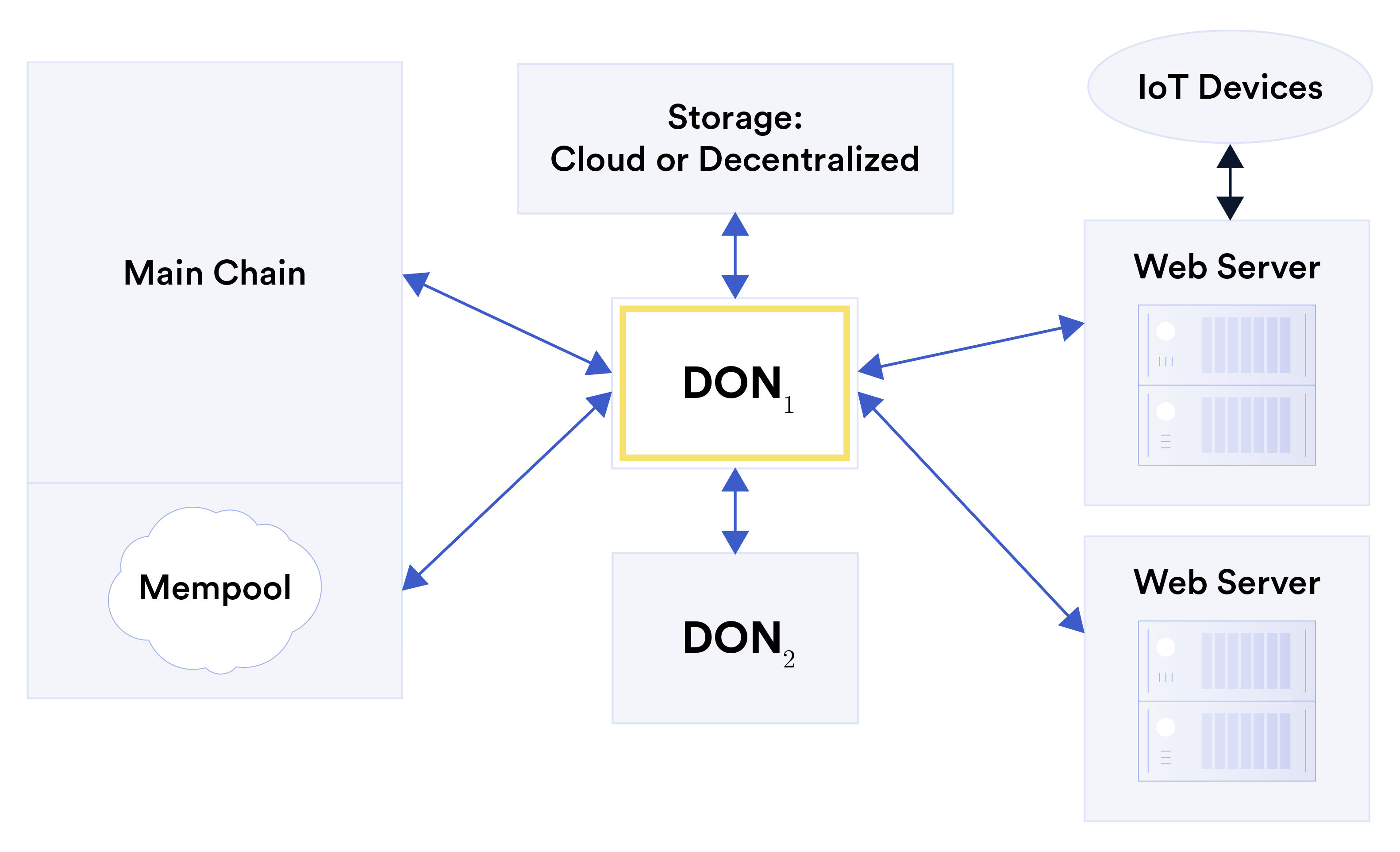
3.1 Networking Adapters are interfaces through which executables running on a DON can send and receive data from off-DON systems. Adapters may be viewed as a generalization of the adapters used in Chainlink today [20]. Adapters may be bidirectional—i.e., they cannot just pull, but push data from a DON to a web server. They may also leverage distributed protocols as well as cryptographic functionality such as secure multi-party computation. Figure 9: Adapters connecting a DON, denoted DON1, with a range of different resources, including another DON, denoted DON2, a blockchain (main chain) and its mempool, external storage, a web server, and IoT devices (via a web server). Examples of external resources for which adapters might be created are shown in Fig. 9. They include: • Blockchains: An adapter can define how to send transactions to a blockchain and how to read blocks, individual transactions, or other state from it. An adapter can also be defined for a blockchain’s mempool. (See Section 3.5.) • Web servers: Adapters can define APIs through which data may be retrieved from web servers, including legacy systems that are not specially adapted for interfacing with DONs. Such adapters can also include APIs to send data to such servers. The web servers to which a DON connects may serve as gateways to additional resources, such as Internet-of-Things (IoT) devices.
• External storage: An adapter can define methods to read and write to storage services outside the DON, such as a decentralized file system [40, 188] or cloud storage. • Other DONs: Adapters can retrieve and transmit data between DONs. We expect that initial deployments of DONs will include a set of building block adapters for such commonly used external resources and will further allow DON-specific adapters to be published by DON nodes. As smart contract developers write adapters today, we expect that they will build even more powerful adapters using this advanced functionality. We expect that ultimately it will be possible for users to create new adapters in a permissionless manner. Some adapters must be constructed in a way that ensures the persistence and availability of external resources controlled by a DON. For example, cloud storage may require maintenance of a cloud services account. Additionally, a DON can perform decentralized management of private keys on behalf of users (as in, e.g., [160]) and/or executables. Consequently, the DON is capable of controlling resources, such as cryptocurrency, that may be used, e.g., for sending transactions on a target blockchain. See Appendix B.1 for further details on DON adapters, as Appendix C for a few example adapters. 3.2 Computation An executable is the basic unit of code on a DON. An executable is a pair exec = (logic, init). Here, logic is a deterministic program with a number of designated entry points (logic1, logic2, . . . , logicℓ) and init is a set of corresponding initiators (init1, init2, . . . , inite). To ensure the full auditability of the DON, an executable’s logic uses the underlying ledger L for all inputs and outputs. Thus, for instance, any adapter data serving as input to an executable must be stored first on L. Initiators: Initiators in Chainlink today cause event-dependent job executions on Chainlink nodes [21]. Initiators in DONs function in much the same way. A DON initiator, however, is specifically associated with an executable. An initiator may depend on an external event or state, on the current time, or on a predicate on DON state. With their dependency on events, initiators may of course behave non-deterministically (as of course may adapters). An initiator can execute within individual DON nodes and so need not rely on an adapter. (See Example 1 below.) Initiators are an important feature distinguishing executables from smart contracts. Because an executable can run in response to an initiator, it can effectively operate autonomously, as of course by extension can a hybrid contract incorporating the executable. One form of initiators today are Chainlink Keepers, which provide transaction
automation services, triggering smart contract execution—such as liquidation of undercollateralized loans and execution of limit-order trades—based on oracle reports. Conveniently, initiators in DONs may also be viewed as a way of specifying the service agreements that apply to an executable, as they define the circumstances under which the DON must call it. The following example illustrates how initiators work within an executable: Example 1 (Deviation-triggered price feed). A smart contract SC may require fresh price-feed data (see Section 3.6.3) whenever there is a substantial change, e.g., 1%, in the exchange rate between a pair of assets, e.g., ETH-USD. Volatility-sensitive price feeds are supported in Chainlink today, but it is instructive to see how they can be realized on a DON by means of an executable execfeed. The executable execfeed maintains the most recent ETH-USD price r on L, in the form of a sequence of ⟨NewPrice : j, r⟩entries, where j is an index incremented with each price update. An initiator init1 causes each node Oi to monitor the current ETH-USD price for deviations of at least 1% from the most recently stored price r with index j. Upon detection of such a deviation, Oi writes its current view ri of the new price to L using an entry of the form ⟨PriceView : i, j + 1, ri⟩. A second initiator init2 fires when at least k such PriceView-entries with new price values for index j + 1 created by distinct nodes have accumulated on L. Then, init2 invokes an entry point logic2 to compute the median \(\rho\) of the first \(k\) fresh, valid priceview values and writes a fresh value ⟨NewPrice : j + 1, ρ⟩to L . (Operationally, nodes may take turns as designated writers.) A third initiator init3 watches for NewPrice entries on L. Whenever a new report ⟨NewPrice : j, r⟩appears there, it invokes an entry point logic3 that pushes (j, r) to SC using an adapter. As we have noted, an executable is similar in its capabilities to a smart contract. Apart from its higher performance, though, it differs from a typical main chain contract in two essential ways: 1. Confidentiality: An executable can perform confidential computation, i.e., a secret program may process cleartext inputs, or a published program may process secret input data, or a combination of both. In a simple model, secret data can be accessed by DON nodes, which conceal intermediate results and disclose only processed and sanitized values to MAINCHAIN. It is also possible to conceal sensitive data from DONs themselves: DONs are meant to support approaches such as multi-party computation, e.g., [42, 157], and trusted execution environments (TEEs) [84, 133, 152, 229] for this purpose.6 6By extension, keeping executables themselves secret with respect to DON nodes is also possible, although this is only practical today for non-trivial executables using TEEs.
- Supporting role: An executable is meant to support smart contracts on a main chain, rather than replace them. An executable has several limitations that a smart contract does not: (a) Trust model: An executable operates within the trust model defined by the DON: Its correct execution relies on the honest behavior of O. (A main chain can, however, provide some guard rails against DON malfeasance, as discussed in Section 7.3.) (b) Asset access: A DON can control an account on a blockchain—and thus control assets on it through an adapter. But a DON cannot authoritatively represent assets created on a main chain, e.g., Ether or ERC20 tokens, since their native chain maintains the authoritative record of their ownership. (c) Lifecycle: DONs may be stood up intentionally with limited lifetimes, as defined by on-chain service level agreements between DONs and the owners of relying contracts. Blockchains, in contrast, are meant to function as permanent archival systems. See Appendix B.2 for further details on DON computation. 3.3 Storage As a committee-based system, a DON can store moderate amounts of data persistently on L at much lower cost than a permissionless blockchain. Additionally, via adapters, DONs can reference external decentralized systems for data storage, e.g., Filecoin [85], and can thereby connect such systems to smart contracts. This option is particularly attractive for bulk data as a means of addressing the pervasive problem of “bloat” in blockchain systems. DONs can thus store data locally or externally for use in their specifically supported services. A DON can additionally make use of such data in a confidential way, computing on data that is: (1) secret-shared across DON nodes or encrypted under a key managed by DON nodes in ways suitable for secure multi-party computation or partial or fully homomorphic encryption; or (2) protected using a trusted execution environment. We expect that DONs will adopt a simple memory-management model common to smart-contract systems: An executable may only write to its own memory. Executables may, however, read from the memory of other executables. See Appendix B.3 for further details on DON storage. 3.4 Transaction-Execution Framework (TEF) DONs are intended to support contracts on a main chain MAINCHAIN (or on multiple main chains). The Transaction-Execution Framework (TEF), discussed in detail
in Section 6, is a general-purpose approach to the efficient execution of a contract SC across MAINCHAIN and a DON. The TEF is intended to support FSS and layer-2 technologies—simultaneously, if desired. Indeed, it is likely to serve as the main vehicle for use of FSS (and for that reason, we do not further discuss FSS in this section). Briefly, in TEF an original target contract SC designed or developed for MAINCHAIN is refactored into a hybrid contract. This refactoring produces the two interoperating pieces of the hybrid contract: a MAINCHAIN contract SCa that we refer to for clarity in the context of TEFs as an anchor contract and an executable execs on a DON. The contract SCa custodies users’ assets, executes authoritative state transitions, and also provides guard rails (see Section 7.3) against failures in the DON. The executable execs sequences transactions and provides associated oracle data for them. It can bundle transactions for SCa in any of a number of ways—e.g., using validity-proof-based or optimistic rollups, confidential execution by the DON, etc. We expect to develop tools that make it easy for developers to partition a contract SC written in a high-level language into pieces of MAINCHAIN and DON logic, SCa and execs respectively, that compose securely and efficiently. Using TEF to integrate high-performance transaction schemes with high-performance oracles is integral to our oracle scaling approach. 3.5 Mempool Services An important application-layer feature that we intend to deploy on DONs in support of FSS and the TEF are Mempool Services (MS). MS may be viewed as an adapter, but one with first-class support. MS provides support for legacy-compatible transaction processing. In this use, MS ingests from a main chain’s mempool those transactions intended for a target contract SC on MAINCHAIN. MS then passes these transactions to an executable on the DON, where they are processed in the desired way. MS data can be used by the DON to compose transactions that can then be passed directly to SC from the DON or to another contract that calls SC. For example, the DON can forward transactions harvested via MS, or it can use MS data to set gas prices for transactions it sends to MAINCHAIN. Because it monitors the mempool, MS can obtain transactions from users interacting directly with SC. Thus users may continue to generate their transactions using legacy software, i.e., applications unaware of the existence of MS and MS-configured contracts. (In this case, SC must be changed to ignore the original transactions and accept only those processed by the MS, so as to avoid double-processing.) For use with a target contract SC, MS can be used with FSS and/or the TEF.
3.6 Stepping Stones: Existing Chainlink Capabilities 3.6.1 Off-Chain Reporting (OCR) Off-Chain Reporting (OCR) [60] is a mechanism in Chainlink for oracle report aggregation and transmission to a relying contract SC. Recently deployed for Chainlink price feed networks, it represents a first step along the path to full DONs. At its core, OCR is a BFT protocol designed to operate in a partially synchronous network. It ensures liveness and correctness in the presence of \(f < n/3\) arbitrarily faulty nodes, guaranteeing the properties of Byzantine reliable broadcast, but it is not a complete BFT consensus protocol. Nodes do not maintain message logs that are consistent in the sense of representing a ledger that is identical in all of their views, and the leader of the protocol may equivocate without violating safety. OCR is currently designed for a particular message type: medianized aggregation of (at least \(2f + 1\)) values reported by participating nodes. It provides a key assurance on the reports it outputs for SC, called attested reports: The median value in an attested report is equal to or lies between values reported by two honest nodes. This property is the key safety condition for OCR. The leader may have some influence on the median value in an attested report, but only subject to this correctness condition. OCR can be extended to message types that aggregate values in different ways. While the Chainlink network’s liveness and correctness goals today do not require OCR to be a full-blown consensus protocol, they do require OCR to provide some additional forms of functionality not present in conventional BFT protocols, most notably: 1. All-or-nothing off-chain report broadcast: OCR ensures that an attested report is made quickly available to all honest nodes or none of them. This is a fairness property that helps ensure that honest nodes have an opportunity to participate in attested report transmission. 2. Reliable transmission: OCR ensures, even in the presence of faulty or malicious nodes, that all OCR reports and messages are transmitted to SC within a certain, pre-defined interval of time. This is a liveness property. 3. Contract-based trust minimization: SC filters out potentially erroneous OCRgenerated reports, e.g., if their reported values deviate significantly from other recently received ones. This is a form of extra-protocol correctness enforcement. All three of these properties will play a natural role in DONs. All-or-nothing offchain (DON) broadcast is an important building block for cryptoeconomic assurances around reliable transmission, which is in turn an essential adapter property. Trust minimization in SC is a type of guard rail, as discussed in Section 7.3. OCR also provides a basis for operational deployment and refinement of BFT protocols in Chainlink’s oracle networks and thus, as noted above, a path to the full functionality of DONs.
3.6.2 DECO and Town Crier DECO [234] and Town Crier [233] are a pair of related technologies currently being developed in Chainlink networks. Most web servers today allow users to connect over a secure channel using a protocol called Transport Layer Security (TLS) [94]. (HTTPS indicates a variant of HTTP that is enabled with TLS, i.e., URLs prefixed with “https” denote use of TLS for security.) Most TLS-enabled servers have a notable limitation, though: They don’t digitally sign data. Consequently, a user or Prover cannot present the data she receives from a server to a third party or Verifier, such as an oracle or smart contract, in a way that ensures the data’s authenticity. Even if a server were to digitally sign data, there remains a problem of confidentiality. A Prover may wish to redact or modify sensitive data before presenting it to a Verifier. Digital signatures are designed specifically to invalidate modified data, however. They thus prevent a Prover from making confidentiality-preserving alterations to data. (See Section 7.1 for more discussion.) DECO and Town Crier are designed to allow a Prover to obtain data from a web server and present it to a Verifier in a way that ensures integrity and confidentiality. The two systems preserve integrity in the sense that they ensure that data presented by the Prover to the Verifier originates authentically from the target server. They support confidentiality in the sense of allowing the Prover to redact or modify data (while still preserving integrity). A key feature of both systems is that they do not require any modifications to a target web server. They can operate with any existing TLS-enabled server. In fact, they are transparent to the server: From the viewpoint of the server, the Prover is establishing an ordinary connection. The two systems have similar goals, but differ in their trust models and implementations as we now briefly explain. DECO makes fundamental use of cryptographic protocols to achieve its integrity and confidentiality properties. While establishing a session with a target server using DECO, the Prover engages at the same time in an interactive protocol with the Verifier. This protocol enables the Prover to prove to the Verifier that it has received a given piece of data D from the server during its current session. The Prover can alternatively present the Verifier with a zero-knowledge proof of some property of D and thus not reveal D directly. In a typical use of DECO, a user or a single node can export data D from a private session with a web server to all of the nodes in a DON. As a result, the full DON can attest to the authenticity of D (or a fact derived from D via a zero-knowledge proof). In addition to the example applications given later in the paper, this capability can be used to amplify high-integrity access to a data source by a DON. Even if only one node has direct access to a data source—due, for instance, to an exclusive arrangement with a data provider—it remains possible for the entire DON to attest to the correctness of
reports emitted by that node. Town Crier relies on the use of a trusted execution environment (TEE) such as Intel SGX. Briefly, a TEE functions as a kind of black box that executes applications in a tamperproof and confidential way. In principle, even the owner of the host on which the TEE is running can neither (undetectably) alter a TEE-protected application nor view the application’s state, which may include secret data. Town Crier can achieve all of the functionality of DECO and more. DECO constrains the Prover to interaction with a single Verifier. In contrast, Town Crier enables a Prover to generate a publicly verifiable proof on data D fetched from a target server, i.e., a proof that anyone, even a smart contract, can verify directly. Town Crier can also securely ingest and make use of secrets (e.g., user credentials). The main limitation of Town Crier is its reliance on TEEs. Production TEEs have recently been shown to have a number of serious vulnerabilities, although the technology is in its infancy and will undoubtedly mature. See Appendices B.2.1 and B.2.2 for further discussion of TEEs. For a few example applications of DECO and Town Crier, see Sections 4.3, 4.5 and 9.4.3 and Appendix C.1. 3.6.3 Existing On-Chain Chainlink Services Chainlink oracle networks provide a number of main services across a multiplicity of blockchains and other decentralized systems today. Further evolution as described in this whitepaper will endow these existing services with additional capabilities and reach. Three examples are: Data feeds: Today, the majority of Chainlink users relying on smart contracts make use of data feeds. These are reports on the current value of key pieces of data according to authoritative off-chain sources. For example, price feeds are feeds reporting the prices of assets—cryptocurrencies, commodities, forex, indexes, equities, etc.—according to exchanges or data-aggregation services. Such feeds today already help secure billions of dollars in on-chain value through their use in DeFi systems such as Aave [147] and Synthetix [208]. Other examples of Chainlink data feeds include weather data for parametric crop insurance [75] and election data [93], among a number of others. The deployment of DONs and other technologies described in this paper will enhance provision of data feeds in Chainlink networks in many ways, including: • Scaling: OCR and subsequently DONs aim to enable Chainlink services to scale dramatically across the many blockchains they support. For example, we expect that DONs will help increase the number of data feeds provided by nodes using Chainlink from 100s to 1000s and beyond. Such scaling will help the Chainlink ecosystem achieve its goal of furnishing data relevant to smart contracts comprehensively and both meeting and anticipating existing and future needs.
• Enhanced security: By storing intermediate reports, DONs will retain records of node behaviors for high-fidelity monitoring and measurement of their performance and accuracy, enabling strong empirical grounding of reputation systems for Chainlink nodes. FSS and the TEF will enable price feeds to be incorporated with transaction data in flexible ways that prevent attacks such as front-running. (Explicit) staking will bolster existing cryptoeconomic protection of the security of data feeds. • Feed agility: As blockchain-agnostic systems (indeed, more broadly, consumeragnostic systems), DONs can facilitate the provision of data feeds to a multiplicity of relying systems. A single DON can push a given feed simultaneously to a set of different blockchains, eliminating the need for per-chain oracle networks and enabling rapid deployment of existing feeds on new blockchains and of additional feeds across currently serviced blockchains. • Confidentiality: The ability to perform generalized computation in a DON enables computations on sensitive data to take place offchain, avoiding on-chain exposure. Additionally, using DECO or Town Crier, it is possible to achieve even stronger confidentiality, allowing report generation based on data that isn’t exposed even to DON nodes. See Section 4.3 and Section 4.5 for examples. Verifiable Random Functions (VRFs): Several types of DApps require a verifiably correct source of randomness to enable verification of their own fair operation. Non-Fungible Tokens (NFTs) are an example. The rarity of NFT features in Aavegotchi [23] and Axie Infinity [35] is determined by Chainlink VRF, as is the distribution of NFTs by means of ticket-based drawings in Ether Cards [102]; the wide variety of gaming DApps whose outcomes are randomized; and unconventional financial instruments, e.g., no-loss savings games such as PoolTogether [89], which allocate funds to random winners. Other blockchain and non-blockchain applications also require secure sources of randomness, including selection of decentralized-system committees and the execution of lotteries. While block hashes can serve as a source of unpredictable randomness, they are vulnerable to manipulation by adversarial miners (and to some extent by users submitting transactions). Chainlink VRF [78] offers a considerably more secure alternative. An oracle has an associated private / public key pair (sk, pk) whose private key is maintained offchain and whose public key pk is published. To output a random value, it applies sk to an unpredictable seed x furnished by a relying contract (e.g., a block hash and DApp-specific parameters) using a function F, yielding y = Fsk(x) along with a proof of correctness. (See [180] for the VRF available on Chainlink.) What makes a VRF verifiable is the fact that with knowledge of pk, it is possible to check the correctness of the proof and therefore of y. The value y is consequently unpredictable to an adversary that cannot predict x or learn sk and infeasible for the service to manipulate.
Chainlink VRF may be viewed as just one of a family of applications that involve custodianship of private keys offchain. More generally, DONs can offer secure, decentralized storage of individual keys for applications and/or users, and combine this capability with generalized computation. The result is a host of applications, of which we give some examples in this paper, including key management for Proof of Reserves (see Section 4.1) and for users’ decentralized credentials (and other digital assets) (see Section 4.3). Keepers: Chainlink Keepers [87] enable developers to write code for decentralized execution of off-chain jobs, generally to trigger execution of relying smart contracts. Before the advent of Keepers, it was common for developers to operate such off-chain logic themselves, creating centralized points of failure (as well as considerable duplicated development effort). Keepers instead provide an easy-to-use framework for decentralized outsourcing of these operations, enabling shorter development cycles and strong assurance of liveness and other security properties. Keepers can support any of a wide variety of triggering goals, including price-dependent liquidation of loans or execution of financial transactions, time-dependent initiation of airdrops or payments in systems with yield harvesting, and so forth. In the DON framework, initiators may be viewed as a generalization of Keepers in several senses. Initiators may make use of adapters, and thus can leverage a modularized library of interfaces to on-chain and off-chain systems, permitting rapid development of secure, sophisticated functionality. Initiators initiate computation in executables, which themselves offer the full versatility of DONs, permitting the wide range of decentralized services we present in this paper for on-chain and off-chain applications. 3.6.4 Node Reputation / Performance History The existing Chainlink ecosystem natively documents the performance histories of contributing nodes on chain. This feature has given rise to a collection of reputationoriented resources that ingest, filter, and visualize performance data on individual node operators and data feeds. Users can reference these resources to make informed decisions in their selection of nodes and to monitor the operation of existing networks. Similar capabilities will help users choose DONs. For example, permissionless marketplaces today such as market.link allow node operators to list their oracle services and attest to their off-chain identities through services such as Keybase [4], which bind the profile of a node in Chainlink to its owner’s existing domain names and social media accounts. Additionally, performance analytics tools, such as those available at market.link and reputation.link, allow users to view statistics on the historical performance of individual nodes, including their average response latency, the deviation of values in their reports from consensus values relayed on chain, revenue generated, jobs fulfilled, and more. These analytics tools also allow users to track the adoption of various oracle networks by other users, a form of
implicit endorsement of the nodes securing such networks. The result is a flat “web of trust” in which, by using particular nodes, high-value decentralized applications create a signal of their trust in those nodes that other users can observe and factor into their own node-selection decisions. With DONs (and initially with OCR) comes a shift in transaction processing and contract activity more generally offchain. A decentralized model for recording node performance remains possible within the DON itself. Indeed, the high performance and data capacity of DONs make it possible to construct records in a fine-grained way and also to perform decentralized computation on these records, yielding trustworthy summaries that can be consumed by reputation services and checkpointed on MAINCHAIN. While it is possible for a DON in principle to misrepresent the behavior of constituent nodes if a large fraction of nodes is corrupted, we note that the collective performance of a DON itself in delivering on-chain data is visible on MAINCHAIN and thus cannot be misrepresented. Additionally, we plan to explore mechanisms that incentivize accurate internal reporting of node behaviors in a DON. For example, by reporting the subset of high-performing nodes that most quickly return data contributing to a report relayed on chain, a DON creates an incentive for nodes to contest incorrect reports: Incorrectly including nodes in this subset means incorrectly excluding nodes that should have been included and therefore invalidly penalizing them. Repeated reporting failures by a DON would also create an incentive for honest nodes to leave the DON. Decentralized compilation of accurate performance histories and the consequent ability of users to identify high-performing nodes and for node operators to build reputations are important distinguishing features of the Chainlink ecosystem. We show in Section 9 how we can reason about them as a key piece of a rigorous and expansive view of the economic security provided by DONs.
विकेंद्रीकृत Oracle नेटवर्क इंटरफ़ेस और Ca-
क्षमताएँ यहां हम सरल लेकिन शक्तिशाली के संदर्भ में DONs की क्षमताओं का संक्षेप में वर्णन करते हैं इंटरफ़ेस को साकार करने के लिए उन्हें डिज़ाइन किया गया है। DON पर एप्लिकेशन निष्पादन योग्य और एडाप्टर से बने होते हैं। एक निष्पादन योग्य है एक प्रोग्राम जिसका मूल तर्क एक नियतात्मक प्रोग्राम है, जो smart contract के अनुरूप है। एक निष्पादन योग्य में कई आरंभकर्ता, प्रोग्राम भी होते हैं जो प्रविष्टि कहते हैं निष्पादन योग्य तर्क में बिंदु तब होते हैं जब पूर्व निर्धारित घटनाएँ घटित होती हैं - उदाहरण के लिए, निश्चित समय पर (क्रॉन जॉब की तरह), जब कोई कीमत एक सीमा को पार कर जाती है, आदि—कीपर्स की तरह (धारा 3.6.3 देखें)। एडेप्टर ओ-चेन संसाधनों के लिए इंटरफेस प्रदान करते हैं और इन्हें कॉल किया जा सकता है निष्पादनयोग्य में या तो आरंभकर्ता या मूल तर्क। चूँकि उनका व्यवहार उस पर निर्भर हो सकता है बाहरी संसाधनों, आरंभकर्ताओं और एडाप्टरों का गैर-नियतात्मक व्यवहार हो सकता है। हम DON डेवलपर इंटरफ़ेस और निष्पादनयोग्यों की कार्यप्रणाली का वर्णन करते हैं तीन संसाधनों के संदर्भ में एडेप्टर आमतौर पर कंप्यूटिंग सिस्टम को चिह्नित करने के लिए उपयोग किए जाते हैं: नेटवर्किंग, कंप्यूट और स्टोरेज। हम इनमें से प्रत्येक का संक्षिप्त विवरण देते हैं नीचे दिए गए संसाधन और परिशिष्ट बी में अधिक विवरण प्रदान करें।
3.1 नेटवर्किंग एडेप्टर इंटरफ़ेस हैं जिनके माध्यम से DON पर चलने वाले निष्पादन योग्य भेज सकते हैं और off-DON सिस्टम से डेटा प्राप्त करें। एडेप्टर को सामान्यीकरण के रूप में देखा जा सकता है आज Chainlink में उपयोग किए जाने वाले एडाप्टर [20] हैं। एडेप्टर द्विदिशात्मक हो सकते हैं - यानी, वे न केवल खींच सकता है, बल्कि DON से डेटा को वेब सर्वर पर भेज सकता है। वे लाभ भी उठा सकते हैं वितरित प्रोटोकॉल के साथ-साथ क्रिप्टोग्राफ़िक कार्यक्षमता जैसे सुरक्षित मल्टी-पार्टी गणना. चित्र 9: DON, जिसे DON1 कहा जाता है, को विभिन्न संसाधनों की एक श्रृंखला के साथ जोड़ने वाले एडेप्टर, जिसमें अन्य DON, DON2, एक blockchain (मुख्य श्रृंखला) और उसके शामिल हैं मेमपूल, बाह्य भंडारण, एक वेब सर्वर, और IoT डिवाइस (एक वेब सर्वर के माध्यम से)। बाहरी संसाधनों के उदाहरण दिखाए गए हैं जिनके लिए एडाप्टर बनाए जा सकते हैं चित्र 9 में। इनमें शामिल हैं: • ब्लॉकचेन: एक एडाप्टर परिभाषित कर सकता है कि blockchain पर लेनदेन कैसे भेजा जाए और इससे ब्लॉक, व्यक्तिगत लेनदेन या अन्य स्थिति को कैसे पढ़ा जाए। एक एडाप्टर blockchain के मेमपूल के लिए भी परिभाषित किया जा सकता है। (धारा 3.5 देखें।) • वेब सर्वर: एडेप्टर एपीआई को परिभाषित कर सकते हैं जिसके माध्यम से डेटा पुनर्प्राप्त किया जा सकता है वेब सर्वर से, जिसमें विरासती प्रणालियाँ भी शामिल हैं जिनके लिए विशेष रूप से अनुकूलित नहीं किया गया है DONs के साथ इंटरफ़ेसिंग। ऐसे एडेप्टर में डेटा भेजने के लिए एपीआई भी शामिल हो सकते हैं ऐसे सर्वर. वे वेब सर्वर जिनसे DON जुड़ता है, गेटवे के रूप में काम कर सकते हैं अतिरिक्त संसाधनों के लिए, जैसे इंटरनेट-ऑफ़-थिंग्स (IoT) डिवाइस।• बाहरी स्टोरेज: एक एडाप्टर स्टोरेज को पढ़ने और लिखने के तरीकों को परिभाषित कर सकता है DON के बाहर की सेवाएँ, जैसे विकेंद्रीकृत फ़ाइल सिस्टम [40, 188] या क्लाउड भण्डारण. • अन्य DONs: एडेप्टर DONs के बीच डेटा पुनर्प्राप्त और संचारित कर सकते हैं। हम उम्मीद करते हैं कि DONs की प्रारंभिक तैनाती में बिल्डिंग ब्लॉक का एक सेट शामिल होगा ऐसे आमतौर पर उपयोग किए जाने वाले बाहरी संसाधनों के लिए एडेप्टर और आगे DON-विशिष्ट की अनुमति देंगे एडेप्टर DON नोड्स द्वारा प्रकाशित किए जाएंगे। जैसे smart contract डेवलपर्स एडाप्टर लिखते हैं आज, हम उम्मीद करते हैं कि वे इस उन्नत का उपयोग करके और भी अधिक शक्तिशाली एडेप्टर बनाएंगे कार्यक्षमता. हम उम्मीद करते हैं कि अंततः उपयोगकर्ताओं के लिए नए एडाप्टर बनाना संभव होगा अनुमति रहित ढंग. कुछ एडेप्टर इस तरह से बनाए जाने चाहिए जो DON द्वारा नियंत्रित बाहरी संसाधनों की दृढ़ता और उपलब्धता सुनिश्चित करें। उदाहरण के लिए, क्लाउड स्टोरेज हो सकता है क्लाउड सेवा खाते के रखरखाव की आवश्यकता है। इसके अतिरिक्त, एक DON कार्य कर सकता है उपयोगकर्ताओं की ओर से निजी कुंजियों का विकेन्द्रीकृत प्रबंधन (जैसे, [160]) और/या निष्पादनयोग्य। नतीजतन, DON क्रिप्टोकरेंसी जैसे संसाधनों को नियंत्रित करने में सक्षम है, जिसका उपयोग किया जा सकता है, उदाहरण के लिए, लक्ष्य blockchain पर लेनदेन भेजने के लिए। DON एडेप्टर पर अधिक जानकारी के लिए परिशिष्ट B.1 देखें, कुछ के लिए परिशिष्ट C के रूप में उदाहरण एडाप्टर. 3.2 गणना निष्पादन योग्य DON पर कोड की मूल इकाई है। एक निष्पादन योग्य एक युग्म exec = है (तर्क, init). यहां, तर्क कई निर्दिष्ट प्रविष्टियों वाला एक नियतात्मक कार्यक्रम है अंक (तर्क1, तर्क2,..., तर्कℓ) और init संबंधित आरंभकर्ताओं का एक समूह है (init1, init2,..., inite)। एक निष्पादन योग्य तर्क, DON की पूर्ण लेखापरीक्षा सुनिश्चित करने के लिए सभी इनपुट और आउटपुट के लिए अंतर्निहित लेज़र एल का उपयोग करता है। इस प्रकार, उदाहरण के लिए, कोई भी एडाप्टर निष्पादन योग्य में इनपुट के रूप में काम करने वाले डेटा को पहले एल पर संग्रहीत किया जाना चाहिए। आरंभकर्ता: Chainlink में आरंभकर्ता आज घटना-निर्भर कार्य निष्पादन का कारण बनते हैं Chainlink नोड्स [21]। DONs में आरंभकर्ता लगभग उसी तरह कार्य करते हैं। हालाँकि, एक DON आरंभकर्ता विशेष रूप से एक निष्पादन योग्य से जुड़ा होता है। एक आरंभकर्ता निर्भर हो सकता है किसी बाहरी घटना या स्थिति पर, वर्तमान समय पर, या DON स्थिति पर किसी विधेय पर। घटनाओं पर अपनी निर्भरता के साथ, आरंभकर्ता निश्चित रूप से गैर-नियतात्मक व्यवहार कर सकते हैं (निश्चित रूप से एडेप्टर हो सकते हैं)। एक आरंभकर्ता व्यक्तिगत DON नोड्स के भीतर निष्पादित कर सकता है और इसलिए एडॉप्टर पर निर्भर रहने की आवश्यकता नहीं है। (नीचे उदाहरण 1 देखें।) आरंभकर्ता एक महत्वपूर्ण विशेषता है जो निष्पादनयोग्य को smart contracts से अलग करती है। क्योंकि एक निष्पादन योग्य एक आरंभकर्ता के जवाब में चल सकता है, यह प्रभावी ढंग से काम कर सकता है स्वायत्त रूप से, निश्चित रूप से विस्तार से निष्पादन योग्य को शामिल करने वाला एक हाइब्रिड अनुबंध हो सकता है। आज आरंभकर्ताओं का एक रूप Chainlink रखवाले हैं, जो लेनदेन प्रदान करते हैंस्वचालन सेवाएं, oracle रिपोर्ट के आधार पर smart contract निष्पादन को ट्रिगर करती हैं - जैसे कि कम संपार्श्विक ऋणों का परिसमापन और सीमा-ऑर्डर ट्रेडों का निष्पादन। सुविधाजनक रूप से, DONs में आरंभकर्ताओं को निर्दिष्ट करने के एक तरीके के रूप में भी देखा जा सकता है सेवा अनुबंध जो निष्पादन योग्य पर लागू होते हैं, क्योंकि वे परिस्थितियों को परिभाषित करते हैं जिसे DON को कॉल करना होगा। निम्नलिखित उदाहरण दिखाता है कि आरंभकर्ता निष्पादन योग्य के भीतर कैसे काम करते हैं: उदाहरण 1 (विचलन-ट्रिगर मूल्य फ़ीड)। smart contract SC को नए सिरे से आवश्यकता हो सकती है मूल्य-फ़ीड डेटा (धारा 3.6.3 देखें) जब भी कोई पर्याप्त परिवर्तन होता है, उदाहरण के लिए, 1%, में परिसंपत्तियों की एक जोड़ी के बीच विनिमय दर, उदाहरण के लिए, ETH-USD। अस्थिरता-संवेदनशील कीमत फ़ीड आज Chainlink में समर्थित हैं, लेकिन यह देखना शिक्षाप्रद है कि वे कैसे हो सकते हैं निष्पादन योग्य निष्पादन फ़ीड के माध्यम से DON पर प्राप्त किया गया। निष्पादन योग्य निष्पादन नवीनतम ETH-USD मूल्य r को L पर बनाए रखता है ⟨NewPrice के अनुक्रम का रूप: j, r⟩entries, जहां j एक सूचकांक है जिसके साथ वृद्धि हुई है प्रत्येक मूल्य अद्यतन। एक आरंभकर्ता init1 प्रत्येक नोड Oi को वर्तमान ETH-USD मूल्य की निगरानी करने के लिए प्रेरित करता है सूचकांक जे के साथ सबसे हाल ही में संग्रहीत मूल्य आर से कम से कम 1% का विचलन। पर इस तरह के विचलन का पता लगाने पर, ओई एल का उपयोग करके नई कीमत का अपना वर्तमान दृश्य आरआई लिखता है फॉर्म की एक प्रविष्टि ⟨PriceView: i, j + 1, ri⟩। एक दूसरा आरंभकर्ता init2 सक्रिय हो जाता है जब कम से कम k ऐसी PriceView-प्रविष्टियाँ नई कीमत के साथ होती हैं अलग-अलग नोड्स द्वारा बनाए गए सूचकांक j + 1 के मान L पर जमा हो गए हैं। फिर, init2 पहले k ताज़ा, वैध मूल्यदृश्य मानों के मध्य ρ की गणना करने के लिए एक प्रवेश बिंदु तर्क 2 को आमंत्रित करता है और एक ताज़ा मान लिखता है ⟨NewPrice: j + 1, ρ⟩to L। (परिचालनात्मक रूप से, नोड्स नामित लेखक के रूप में कार्य कर सकते हैं।) एक तीसरा आरंभकर्ता init3 L पर NewPrice प्रविष्टियों को देखता है। जब भी कोई नई रिपोर्ट आती है ⟨नया मूल्य: j, r⟩वहां दिखाई देता है, यह एक प्रवेश बिंदु तर्क3 को आमंत्रित करता है जो (j, r) को SC की ओर धकेलता है एक एडॉप्टर का उपयोग करना। जैसा कि हमने नोट किया है, एक निष्पादन योग्य अपनी क्षमताओं में smart contract के समान है। हालाँकि, इसके उच्च प्रदर्शन के अलावा, यह एक सामान्य मुख्य श्रृंखला अनुबंध से भिन्न है दो आवश्यक तरीकों से: 1. गोपनीयता: एक निष्पादन योग्य गोपनीय गणना कर सकता है, यानी, एक गुप्त प्रोग्राम क्लियरटेक्स्ट इनपुट को प्रोसेस कर सकता है, या एक प्रकाशित प्रोग्राम प्रोसेस कर सकता है गुप्त इनपुट डेटा, या दोनों का संयोजन। एक साधारण मॉडल में, गुप्त डेटा हो सकता है DON नोड्स द्वारा एक्सेस किया जा सकता है, जो मध्यवर्ती परिणामों को छिपाते हैं और केवल प्रकट करते हैं मेनचेन में संसाधित और स्वच्छ किए गए मान। स्वयं DON से संवेदनशील डेटा छुपाना भी संभव है: DON ऐसे दृष्टिकोणों का समर्थन करने के लिए हैं बहु-पक्षीय संगणना के रूप में, उदाहरण के लिए, [42, 157], और विश्वसनीय निष्पादन वातावरण (टीईई) [84, 133, 152, 229] इस उद्देश्य के लिए।6 6विस्तार से, DON नोड्स के संबंध में निष्पादनयोग्य को गुप्त रखना भी संभव है, हालाँकि यह आज केवल टीईई का उपयोग करने वाले गैर-तुच्छ निष्पादन योग्य के लिए व्यावहारिक है।2. सहायक भूमिका: एक निष्पादन योग्य का उद्देश्य मुख्य पर smart contracts का समर्थन करना है चेन, उन्हें बदलने के बजाय। एक निष्पादन योग्य की कई सीमाएँ होती हैं: a smart contract नहीं करता: (ए) ट्रस्ट मॉडल: एक निष्पादन योग्य ट्रस्ट मॉडल द्वारा परिभाषित के भीतर संचालित होता है DON: इसका सही निष्पादन O के ईमानदार व्यवहार पर निर्भर करता है हालाँकि, चेन DON दुर्भावना के विरुद्ध कुछ सुरक्षा प्रदान कर सकती है, जैसे धारा 7.3 में चर्चा की गई।) (बी) संपत्ति पहुंच: एक DON blockchain पर एक खाते को नियंत्रित कर सकता है—और इस प्रकार एक एडाप्टर के माध्यम से इस पर संपत्तियों को नियंत्रित करें। लेकिन DON आधिकारिक तौर पर नहीं हो सकता मुख्य श्रृंखला पर बनाई गई संपत्तियों का प्रतिनिधित्व करते हैं, उदाहरण के लिए, ईथर या ERC20 tokens, क्योंकि उनकी मूल श्रृंखला उनके स्वामित्व का आधिकारिक रिकॉर्ड बनाए रखती है। (सी) जीवनचक्र: DONs को जानबूझकर सीमित जीवनकाल के साथ खड़ा किया जा सकता है, क्योंकि DONs और मालिकों के बीच ऑन-चेन सेवा स्तर समझौतों द्वारा परिभाषित अनुबंधों पर भरोसा करने का। इसके विपरीत, ब्लॉकचेन का उद्देश्य कार्य करना है स्थायी अभिलेखीय प्रणालियाँ. DON गणना पर अधिक जानकारी के लिए परिशिष्ट B.2 देखें। 3.3 भंडारण समिति-आधारित प्रणाली के रूप में, DON मध्यम मात्रा में डेटा को लगातार संग्रहीत कर सकता है एल पर अनुमति रहित blockchain की तुलना में बहुत कम लागत पर। इसके अतिरिक्त, एडाप्टर के माध्यम से, DONs डेटा भंडारण के लिए बाहरी विकेन्द्रीकृत प्रणालियों का संदर्भ दे सकते हैं, उदाहरण के लिए, Filecoin [85], और इस प्रकार ऐसी प्रणालियों को smart contracts से जोड़ सकता है। यह विकल्प खास है "ब्लोट" की व्यापक समस्या के समाधान के साधन के रूप में थोक डेटा के लिए आकर्षक blockchain सिस्टम. DONs इस प्रकार अपनी विशेष रूप से समर्थित सेवाओं में उपयोग के लिए स्थानीय या बाह्य रूप से डेटा संग्रहीत कर सकते हैं। DON अतिरिक्त रूप से ऐसे डेटा का गोपनीय तरीके से उपयोग कर सकता है, डेटा पर कंप्यूटिंग जो है: (1) DON नोड्स में गुप्त रूप से साझा किया गया या इसके तहत एन्क्रिप्ट किया गया सुरक्षित मल्टी-पार्टी गणना के लिए उपयुक्त तरीकों से DON नोड्स द्वारा प्रबंधित एक कुंजी या आंशिक या पूर्णतः समरूपी एन्क्रिप्शन; या (2) विश्वसनीय निष्पादन का उपयोग करके संरक्षित पर्यावरण. हम उम्मीद करते हैं कि DONs एक सामान्य मेमोरी-प्रबंधन मॉडल अपनाएंगे स्मार्ट-कॉन्ट्रैक्ट सिस्टम: एक निष्पादन योग्य केवल अपनी मेमोरी में ही लिख सकता है। निष्पादनयोग्य हालाँकि, अन्य निष्पादनयोग्यों की स्मृति से पढ़ा जा सकता है। DON भंडारण पर अधिक जानकारी के लिए परिशिष्ट B.3 देखें। 3.4 लेनदेन-निष्पादन ढांचा (टीईएफ) DONs का उद्देश्य मुख्य श्रृंखला MAINCHAIN (या एकाधिक मुख्य श्रृंखलाओं) पर अनुबंधों का समर्थन करना है। लेनदेन-निष्पादन फ्रेमवर्क (टीईएफ) पर विस्तार से चर्चा की गईधारा 6 में, एक अनुबंध के कुशल निष्पादन के लिए एक सामान्य प्रयोजन दृष्टिकोण है मेनचेन के पार SC और एक DON। टीईएफ का उद्देश्य एफएसएस और लेयर-2 का समर्थन करना है प्रौद्योगिकियाँ—एक साथ, यदि वांछित हो। दरअसल, इसके मुख्य वाहन के रूप में काम करने की संभावना है एफएसएस के उपयोग के लिए (और इसी कारण से, हम इस अनुभाग में एफएसएस पर आगे चर्चा नहीं करते हैं)। संक्षेप में, टीईएफ में मेनचेन के लिए एक मूल लक्ष्य अनुबंध एससी डिजाइन या विकसित किया गया है एक हाइब्रिड अनुबंध में पुनः सक्रिय किया गया है। यह रीफैक्टरिंग दो इंटरऑपरेटिंग उत्पन्न करती है हाइब्रिड अनुबंध के टुकड़े: एक मेनचेन अनुबंध एससीए जिसे हम स्पष्टता के लिए संदर्भित करते हैं टीईएफ के संदर्भ में एक एंकर अनुबंध और DON पर निष्पादन योग्य निष्पादन के रूप में। द अनुबंध एससीए उपयोगकर्ताओं की संपत्ति की देखरेख करता है, आधिकारिक राज्य परिवर्तन निष्पादित करता है, और भी DON में विफलताओं के विरुद्ध गार्ड रेल्स (धारा 7.3 देखें) प्रदान करता है। निष्पादन योग्य कार्यकारी लेन-देन को अनुक्रमित करता है और उनके लिए संबद्ध oracle डेटा प्रदान करता है। यह बंडल कर सकता है एससीए के लिए कई तरीकों से लेनदेन - उदाहरण के लिए, वैधता-प्रमाण-आधारित या का उपयोग करना आशावादी rollups, DON द्वारा गोपनीय निष्पादन, आदि। हम ऐसे टूल विकसित करने की उम्मीद करते हैं जो डेवलपर्स के लिए अनुबंध को विभाजित करना आसान बना दे SC को उच्च स्तरीय भाषा में MAINCHAIN और DON तर्क, SCa और के टुकड़ों में लिखा गया है क्रमशः निष्पादन, जो सुरक्षित और कुशलतापूर्वक रचना करते हैं। उच्च-प्रदर्शन लेनदेन योजनाओं को उच्च-प्रदर्शन के साथ एकीकृत करने के लिए टीईएफ का उपयोग करना oracles हमारे oracle स्केलिंग दृष्टिकोण का अभिन्न अंग है। 3.5 मेमपूल सेवाएँ एक महत्वपूर्ण एप्लिकेशन-लेयर सुविधा जिसे हम समर्थन में DONs पर तैनात करने का इरादा रखते हैं एफएसएस और टीईएफ मेमपूल सर्विसेज (एमएस) हैं। MS को एक एडाप्टर के रूप में देखा जा सकता है, लेकिन प्रथम श्रेणी समर्थन वाला। एमएस विरासत-संगत लेनदेन प्रसंस्करण के लिए सहायता प्रदान करता है। इस प्रयोग में, एम.एस मुख्य श्रृंखला के मेमपूल से लक्ष्य अनुबंध के लिए इच्छित लेनदेन को अंतर्ग्रहण करता है मेनचेन पर एस.सी. MS फिर इन लेनदेन को DON पर एक निष्पादन योग्य में भेजता है, जहां उन्हें वांछित तरीके से संसाधित किया जाता है। MS डेटा का उपयोग DON द्वारा किया जा सकता है लेन-देन लिखने के लिए जिसे DON या से सीधे SC को भेजा जा सकता है किसी अन्य अनुबंध के लिए जो SC को कॉल करता है। उदाहरण के लिए, DON लेनदेन को अग्रेषित कर सकता है एमएस के माध्यम से काटा जाता है, या यह भेजे जाने वाले लेनदेन के लिए गैस की कीमतें निर्धारित करने के लिए एमएस डेटा का उपयोग कर सकता है मुख्य श्रृंखला। क्योंकि यह मेमपूल की निगरानी करता है, एमएस सीधे एससी के साथ बातचीत करने वाले उपयोगकर्ताओं से लेनदेन प्राप्त कर सकता है। इस प्रकार उपयोगकर्ता अपने लेनदेन का उपयोग करना जारी रख सकते हैं लीगेसी सॉफ़्टवेयर, यानी, एमएस और एमएस-कॉन्फ़िगर के अस्तित्व से अनजान अनुप्रयोग अनुबंध. (इस मामले में, मूल लेनदेन को अनदेखा करने के लिए एससी को बदला जाना चाहिए केवल एमएस द्वारा संसाधित किए गए को ही स्वीकार करें, ताकि दोहरे प्रसंस्करण से बचा जा सके।) लक्ष्य अनुबंध के साथ उपयोग के लिए एससी, एमएस का उपयोग एफएसएस और/या टीईएफ के साथ किया जा सकता है।3.6 कदम उठाने के पत्थर: मौजूदा Chainlink क्षमताएं 3.6.1 ओff-चेन रिपोर्टिंग (ओसीआर) ओff-चेन रिपोर्टिंग (ओसीआर) [60] oracle रिपोर्ट एकत्रीकरण और एक भरोसेमंद अनुबंध एससी तक ट्रांसमिशन के लिए Chainlink में एक तंत्र है। हाल ही में Chainlink मूल्य पर तैनात किया गया फ़ीड नेटवर्क, यह पूर्ण DONs के पथ पर पहला कदम दर्शाता है। इसके मूल में, OCR एक BFT प्रोटोकॉल है जिसे आंशिक रूप से सिंक्रोनस में संचालित करने के लिए डिज़ाइन किया गया है नेटवर्क. यह मनमाने ढंग से f < n/3 की उपस्थिति में जीवंतता और शुद्धता सुनिश्चित करता है दोषपूर्ण नोड्स, बीजान्टिन विश्वसनीय प्रसारण के गुणों की गारंटी देते हैं, लेकिन ऐसा नहीं है एक संपूर्ण BFT सर्वसम्मति प्रोटोकॉल। नोड्स संदेश लॉग का रखरखाव नहीं करते हैं एक ऐसे बहीखाते का प्रतिनिधित्व करने के अर्थ में सुसंगत जो उनके सभी विचारों में समान है, और प्रोटोकॉल का नेता सुरक्षा का उल्लंघन किए बिना गोलमोल बातें कर सकता है। ओसीआर वर्तमान में एक विशेष संदेश प्रकार के लिए डिज़ाइन किया गया है: मध्यस्थ एकत्रीकरण (कम से कम 2एफ +1) मान भाग लेने वाले नोड्स द्वारा रिपोर्ट किए गए। यह एक महत्वपूर्ण आश्वासन प्रदान करता है यह एससी के लिए जो रिपोर्ट आउटपुट करता है, उसे सत्यापित रिपोर्ट कहा जाता है: प्रमाणित में औसत मूल्य रिपोर्ट दो ईमानदार नोड्स द्वारा रिपोर्ट किए गए मानों के बराबर या उनके बीच स्थित है। यह संपत्ति है ओसीआर के लिए प्रमुख सुरक्षा शर्त। नेता का मध्यस्थ पर कुछ प्रभाव हो सकता है सत्यापित रिपोर्ट में मूल्य, लेकिन केवल इस शुद्धता शर्त के अधीन। ओसीआर कर सकते हैं इसे उन संदेश प्रकारों तक बढ़ाया जा सकता है जो विभिन्न तरीकों से मूल्यों को एकत्रित करते हैं। जबकि Chainlink नेटवर्क की जीवंतता और शुद्धता लक्ष्यों की आज आवश्यकता नहीं है ओसीआर एक पूर्ण विकसित सर्वसम्मति प्रोटोकॉल है, उन्हें पारंपरिक BFT प्रोटोकॉल में मौजूद नहीं होने वाली कार्यक्षमता के कुछ अतिरिक्त रूप प्रदान करने के लिए ओसीआर की आवश्यकता होती है, विशेष रूप से: 1. ऑल-ऑर-नथिंग ऑफ-चेन रिपोर्ट प्रसारण: ओसीआर यह सुनिश्चित करता है कि एक सत्यापित रिपोर्ट सभी ईमानदार नोड्स या उनमें से किसी के लिए भी तुरंत उपलब्ध कराया जाता है। यह एक निष्पक्षता है संपत्ति जो यह सुनिश्चित करने में मदद करती है कि ईमानदार नोड्स को भाग लेने का अवसर मिले सत्यापित रिपोर्ट प्रेषण में. 2. विश्वसनीय ट्रांसमिशन: ओसीआर दोषपूर्ण या दुर्भावनापूर्ण होने पर भी सुनिश्चित करता है नोड्स, कि सभी ओसीआर रिपोर्ट और संदेश एक निश्चित सीमा के भीतर एससी को प्रेषित किए जाते हैं, समय का पूर्व-निर्धारित अंतराल। यह एक सजीव संपत्ति है. 3. अनुबंध-आधारित विश्वास न्यूनतमकरण: एससी संभावित रूप से गलत ओसीआर-जनित रिपोर्टों को फ़िल्टर करता है, उदाहरण के लिए, यदि उनके रिपोर्ट किए गए मान अन्य से महत्वपूर्ण रूप से विचलित होते हैं हाल ही में प्राप्त हुए। यह अतिरिक्त-प्रोटोकॉल शुद्धता प्रवर्तन का एक रूप है। ये तीनों गुण DONs में स्वाभाविक भूमिका निभाएंगे। ऑल-ऑर-नथिंग ऑफ चेन (DON) प्रसारण क्रिप्टोआर्थिक आश्वासन के लिए एक महत्वपूर्ण बिल्डिंग ब्लॉक है विश्वसनीय ट्रांसमिशन के आसपास, जो बदले में एक आवश्यक एडाप्टर गुण है। भरोसा रखें एससी में न्यूनतमकरण एक प्रकार की गार्ड रेल है, जैसा कि धारा 7.3 में चर्चा की गई है। ओसीआर Chainlink के oracle नेटवर्क में BFT प्रोटोकॉल की परिचालन तैनाती और सुधार के लिए एक आधार भी प्रदान करता है और इस प्रकार, जैसा कि ऊपर बताया गया है, पूर्ण पथ DONs की कार्यक्षमता।3.6.2 डेको और टाउन कैरियर DECO [234] और टाउन कैरियर [233] वर्तमान में संबंधित प्रौद्योगिकियों की एक जोड़ी हैं Chainlink नेटवर्क में विकसित। अधिकांश वेब सर्वर आज उपयोगकर्ताओं को एक प्रोटोकॉल का उपयोग करके एक सुरक्षित चैनल से जुड़ने की अनुमति देते हैं ट्रांसपोर्ट लेयर सिक्योरिटी (TLS) [94] कहा जाता है। (HTTPS HTTP के एक प्रकार को इंगित करता है टीएलएस के साथ सक्षम है, यानी, "https" से पहले जुड़े यूआरएल सुरक्षा के लिए टीएलएस के उपयोग को दर्शाते हैं।) हालाँकि, अधिकांश टीएलएस-सक्षम सर्वरों में एक उल्लेखनीय सीमा होती है: वे डिजिटल रूप से हस्ताक्षर नहीं करते हैं डेटा. नतीजतन, कोई उपयोगकर्ता या प्रोवर सर्वर से प्राप्त डेटा प्रस्तुत नहीं कर सकता है किसी तीसरे पक्ष या सत्यापनकर्ता को, जैसे कि oracle या smart contract, एक तरह से जो सुनिश्चित करता है डेटा की प्रामाणिकता. भले ही सर्वर डिजिटल रूप से डेटा पर हस्ताक्षर करता हो, फिर भी गोपनीयता की समस्या बनी रहती है। एक प्रोवर संवेदनशील डेटा को प्रस्तुत करने से पहले उसे संशोधित या संशोधित करना चाह सकता है सत्यापनकर्ता. हालाँकि, डिजिटल हस्ताक्षर विशेष रूप से संशोधित डेटा को अमान्य करने के लिए डिज़ाइन किए गए हैं। इस प्रकार वे एक नीतिवचन को गोपनीयता-संरक्षण परिवर्तन करने से रोकते हैं डेटा के लिए. (अधिक चर्चा के लिए धारा 7.1 देखें।) DECO और टाउन कैरियर को एक प्रोवर को वेब से डेटा प्राप्त करने की अनुमति देने के लिए डिज़ाइन किया गया है सर्वर और इसे सत्यापनकर्ता के समक्ष इस प्रकार प्रस्तुत करें जिससे अखंडता और गोपनीयता सुनिश्चित हो सके। दोनों प्रणालियाँ इस अर्थ में अखंडता को संरक्षित करती हैं कि वे यह सुनिश्चित करती हैं कि डेटा प्रस्तुत किया जाए सत्यापनकर्ता के लिए प्रोवर प्रामाणिक रूप से लक्ष्य सर्वर से उत्पन्न होता है। वे समर्थन करते हैं गोपनीयता नीति को डेटा को संपादित करने या संशोधित करने की अनुमति देने के अर्थ में (जबकि अभी भी)। अखंडता का संरक्षण)। दोनों प्रणालियों की एक प्रमुख विशेषता यह है कि उनमें किसी भी संशोधन की आवश्यकता नहीं है लक्ष्य वेब सर्वर. वे किसी भी मौजूदा टीएलएस-सक्षम सर्वर के साथ काम कर सकते हैं। वास्तव में, वे सर्वर के लिए पारदर्शी हैं: सर्वर के दृष्टिकोण से, प्रोवर है एक सामान्य संबंध स्थापित करना. दोनों प्रणालियों के लक्ष्य समान हैं, लेकिन उनके विश्वास मॉडल और कार्यान्वयन में भिन्न हैं, जैसा कि अब हम संक्षेप में समझाते हैं। DECO अपनी अखंडता प्राप्त करने के लिए क्रिप्टोग्राफ़िक प्रोटोकॉल का मौलिक उपयोग करता है और गोपनीयता गुण। DECO का उपयोग करके लक्ष्य सर्वर के साथ एक सत्र स्थापित करते समय, प्रोवर उसी समय एक इंटरैक्टिव प्रोटोकॉल में संलग्न होता है सत्यापनकर्ता. यह प्रोटोकॉल प्रोवर को सत्यापनकर्ता को यह साबित करने में सक्षम बनाता है कि उसे प्राप्त हुआ है वर्तमान सत्र के दौरान सर्वर से डेटा डी का एक दिया गया टुकड़ा। कहावत कर सकते हैं वैकल्पिक रूप से सत्यापनकर्ता को डी की कुछ संपत्ति के शून्य-ज्ञान प्रमाण के साथ प्रस्तुत करें और इस प्रकार डी को सीधे तौर पर प्रकट नहीं किया जाता है। DECO के सामान्य उपयोग में, एक उपयोगकर्ता या एक नोड एक निजी से डेटा D निर्यात कर सकता है DON में सभी नोड्स के लिए एक वेब सर्वर के साथ सत्र। परिणामस्वरूप, पूर्ण DON हो सकता है डी की प्रामाणिकता को प्रमाणित करें (या शून्य-ज्ञान प्रमाण के माध्यम से डी से प्राप्त तथ्य)। पेपर में बाद में दिए गए उदाहरण अनुप्रयोगों के अतिरिक्त, यह क्षमता हो सकती है DON द्वारा डेटा स्रोत तक उच्च-अखंडता पहुंच को बढ़ाने के लिए उपयोग किया जाता है। भले ही केवल एक नोड डेटा स्रोत तक सीधी पहुंच है - उदाहरण के लिए, एक विशेष व्यवस्था के कारण एक डेटा प्रदाता—संपूर्ण DON के लिए इसकी सत्यता प्रमाणित करना संभव रहता हैउस नोड द्वारा उत्सर्जित रिपोर्ट। टाउन कैरियर इंटेल जैसे विश्वसनीय निष्पादन वातावरण (टीईई) के उपयोग पर निर्भर करता है एसजीएक्स। संक्षेप में, एक टीईई एक प्रकार के ब्लैक बॉक्स के रूप में कार्य करता है जो अनुप्रयोगों को निष्पादित करता है छेड़छाड़रोधी और गोपनीय तरीका। सिद्धांत रूप में, यहां तक कि मेजबान के मालिक भी जिस पर जो टीईई चल रहा है वह न तो (अज्ञात रूप से) टीईई-संरक्षित एप्लिकेशन को बदल सकता है और न ही एप्लिकेशन की स्थिति देखें, जिसमें गुप्त डेटा शामिल हो सकता है। टाउन कैरियर डेको की सभी कार्यक्षमताएं तथा और भी बहुत कुछ हासिल कर सकता है। DECO प्रोवर को एकल सत्यापनकर्ता के साथ बातचीत करने के लिए बाध्य करता है। इसके विपरीत, टाउन कैरियर सक्षम बनाता है लक्ष्य सर्वर से प्राप्त डेटा डी पर सार्वजनिक रूप से सत्यापन योग्य प्रमाण उत्पन्न करने के लिए एक नीति, यानी, एक प्रमाण कि कोई भी, यहां तक कि smart contract भी, सीधे सत्यापित कर सकता है। टाउन कैरियर कर सकते हैं रहस्यों (जैसे, उपयोगकर्ता क्रेडेंशियल्स) को भी सुरक्षित रूप से ग्रहण करें और उनका उपयोग करें। टाउन कैरियर की मुख्य सीमा टीईई पर इसकी निर्भरता है। उत्पादन टीईई के पास है हाल ही में कई गंभीर कमजोरियाँ दिखाई गई हैं, हालाँकि तकनीक अभी प्रारंभिक अवस्था में है और निस्संदेह परिपक्व होगी। इसके लिए परिशिष्ट B.2.1 और B.2.2 देखें टीईई की आगे की चर्चा। DECO और टाउन कैरियर के कुछ उदाहरण अनुप्रयोगों के लिए, अनुभाग 4.3, 4.5 देखें और 9.4.3 और परिशिष्ट सी.1. 3.6.3 मौजूदा ऑन-चेन Chainlink सेवाएँ Chainlink oracle नेटवर्क अनेक प्रकार की मुख्य सेवाएँ प्रदान करते हैं blockchains और आज अन्य विकेन्द्रीकृत प्रणालियाँ। वर्णित के अनुसार आगे का विकास इस श्वेतपत्र में इन मौजूदा सेवाओं को अतिरिक्त क्षमताएं प्रदान की जाएंगी पहुंचें. तीन उदाहरण हैं: डेटा फ़ीड: आज, अधिकांश Chainlink उपयोगकर्ता smart contracts पर निर्भर हैं डेटा फ़ीड का उपयोग. ये डेटा के प्रमुख टुकड़ों के वर्तमान मूल्य पर रिपोर्ट हैं आधिकारिक ओ-चेन स्रोतों के लिए। उदाहरण के लिए, मूल्य फ़ीड कीमतों की रिपोर्ट करने वाले फ़ीड हैं परिसंपत्तियों की - क्रिप्टोकरेंसी, कमोडिटी, विदेशी मुद्रा, सूचकांक, इक्विटी, आदि - के अनुसार एक्सचेंज या डेटा-एकत्रीकरण सेवाएँ। ऐसे फ़ीड आज पहले से ही अरबों डॉलर सुरक्षित करने में मदद करते हैं Aave [147] और जैसे DeFi सिस्टम में उनके उपयोग के माध्यम से ऑन-चेन मूल्य में डॉलर की संख्या सिंथेटिक्स [208]. Chainlink डेटा फ़ीड के अन्य उदाहरणों में मौसम डेटा शामिल है पैरामीट्रिक फसल बीमा [75] और चुनाव डेटा [93], सहित कई अन्य। DONs और इस पेपर में वर्णित अन्य तकनीकों की तैनाती से Chainlink नेटवर्क में डेटा फ़ीड के प्रावधान में कई तरह से वृद्धि होगी, जिनमें शामिल हैं: • स्केलिंग: OCR और बाद में DONs का लक्ष्य Chainlink सेवाओं को स्केल करने में सक्षम बनाना है नाटकीय रूप से वे अनेक blockchains का समर्थन करते हैं। उदाहरण के लिए, हम उम्मीद करते हैं वह DONs का उपयोग करके नोड्स द्वारा प्रदान किए गए डेटा फ़ीड की संख्या बढ़ाने में मदद करेगा Chainlink 100 से 1000 और उससे भी अधिक। इस तरह की स्केलिंग से Chainlink को मदद मिलेगी पारिस्थितिकी तंत्र smart contract से संबंधित डेटा को व्यापक रूप से प्रस्तुत करने और मौजूदा और भविष्य की जरूरतों को पूरा करने और अनुमान लगाने के अपने लक्ष्य को प्राप्त करता है।• उन्नत सुरक्षा: मध्यवर्ती रिपोर्ट संग्रहीत करके, DONs रिकॉर्ड बनाए रखेंगे उच्च-निष्ठा निगरानी और उनके प्रदर्शन और सटीकता के माप के लिए नोड व्यवहार, प्रतिष्ठा प्रणालियों की मजबूत अनुभवजन्य ग्राउंडिंग को सक्षम करना Chainlink नोड्स के लिए। एफएसएस और टीईएफ मूल्य फ़ीड को शामिल करने में सक्षम बनाएंगे लचीले तरीकों से लेनदेन डेटा के साथ जो फ्रंट-रनिंग जैसे हमलों को रोकता है। (स्पष्ट) staking सुरक्षा की मौजूदा क्रिप्टोआर्थिक सुरक्षा को मजबूत करेगा डेटा फ़ीड की. • फ़ीड चपलता: blockchain-अज्ञेयवादी प्रणालियों (वास्तव में, अधिक मोटे तौर पर, उपभोक्ता-अज्ञेयवादी प्रणालियाँ) के रूप में, DONs बहुलता के लिए डेटा फ़ीड के प्रावधान की सुविधा प्रदान कर सकते हैं निर्भर प्रणालियों का. एक DON किसी दिए गए फ़ीड को एक साथ सेट पर भेज सकता है विभिन्न blockchains, प्रति-श्रृंखला oracle नेटवर्क की आवश्यकता को समाप्त करते हैं और नए blockchain और अतिरिक्त पर मौजूदा फ़ीड की तेजी से तैनाती को सक्षम करना वर्तमान में सेवित blockchains पर फ़ीड। • गोपनीयता: DON में सामान्यीकृत गणना करने की क्षमता ऑन-चेन से बचते हुए, संवेदनशील डेटा पर गणना को श्रृंखला से बाहर करने में सक्षम बनाती है। प्रदर्शन. इसके अतिरिक्त, डेको या टाउन कैरियर का उपयोग करके इसे हासिल करना संभव है और भी मजबूत गोपनीयता, जो डेटा के आधार पर रिपोर्ट तैयार करने की अनुमति नहीं देती है DON नोड्स के संपर्क में भी। उदाहरण के लिए धारा 4.3 और धारा 4.5 देखें। सत्यापन योग्य यादृच्छिक कार्य (वीआरएफ): कई प्रकार के डीएपी को अपने स्वयं के निष्पक्ष संचालन के सत्यापन को सक्षम करने के लिए यादृच्छिकता के सत्यापन योग्य सही स्रोत की आवश्यकता होती है। अपूरणीय टोकन (NFTs) एक उदाहरण हैं। Aavegotchi [23] और Axie Infinity [35] में NFT सुविधाओं की दुर्लभता Chainlink VRF द्वारा निर्धारित की जाती है, जैसा कि वितरण है ईथर कार्ड में टिकट-आधारित ड्राइंग के माध्यम से NFTs का [102]; की विस्तृत विविधता गेमिंग डीएपी जिनके परिणाम यादृच्छिक हैं; और अपरंपरागत वित्तीय उपकरण, उदाहरण के लिए, पूलटुगेदर [89] जैसे बिना नुकसान वाले बचत वाले खेल, जो धन आवंटित करते हैं यादृच्छिक विजेता. अन्य blockchain और गैर-blockchain अनुप्रयोगों को भी सुरक्षित की आवश्यकता होती है यादृच्छिकता के स्रोत, जिसमें विकेन्द्रीकृत-प्रणाली समितियों का चयन और शामिल है लॉटरी का निष्पादन. जबकि ब्लॉक hashes अप्रत्याशित यादृच्छिकता के स्रोत के रूप में काम कर सकते हैं, वे प्रतिकूल खनिकों (और कुछ हद तक सबमिट करने वाले उपयोगकर्ताओं द्वारा हेरफेर) के प्रति संवेदनशील हैं। लेन-देन)। Chainlink VRF [78] काफी अधिक सुरक्षित विकल्प प्रदान करता है। एक oracle के पास एक संबद्ध निजी/सार्वजनिक कुंजी जोड़ी (sk, pk) है, जिसकी निजी कुंजी को श्रृंखला में बनाए रखा जाता है और जिसकी सार्वजनिक कुंजी pk प्रकाशित होती है। एक यादृच्छिक मान आउटपुट करने के लिए, यह एक भरोसेमंद अनुबंध द्वारा सुसज्जित अप्रत्याशित बीज x पर sk लागू होता है (उदाहरण के लिए, एक ब्लॉक hash और DApp-विशिष्ट पैरामीटर) एक फ़ंक्शन F का उपयोग करके, y = Fsk(x) के साथ-साथ उत्पन्न करते हैं शुद्धता का प्रमाण. (Chainlink पर उपलब्ध वीआरएफ के लिए [180] देखें।) क्या बनता है वीआरएफ सत्यापन योग्य तथ्य यह है कि पीके के ज्ञान के साथ, प्रमाण की शुद्धता की जांच करना संभव है और इसलिए वाई की। परिणामस्वरूप y का मान a के लिए अप्रत्याशित है विरोधी जो x की भविष्यवाणी नहीं कर सकता या sk नहीं सीख सकता और सेवा में हेरफेर करना संभव नहीं है।Chainlink वीआरएफ को उन अनुप्रयोगों के परिवार में से एक के रूप में देखा जा सकता है जिसमें श्रृंखला की निजी कुंजी की संरक्षकता शामिल है। अधिक सामान्यतः, DONs सुरक्षित प्रदान कर सकते हैं, अनुप्रयोगों और/या उपयोगकर्ताओं के लिए अलग-अलग कुंजियों का विकेन्द्रीकृत भंडारण, और संयोजन सामान्यीकृत गणना के साथ यह क्षमता। परिणाम, अनुप्रयोगों का एक समूह है जिसके प्रमाण के लिए मुख्य प्रबंधन सहित हम इस पेपर में कुछ उदाहरण देते हैं रिज़र्व (धारा 4.1 देखें) और उपयोगकर्ताओं के विकेन्द्रीकृत क्रेडेंशियल्स (और अन्य डिजिटल) के लिए संपत्ति) (धारा 4.3 देखें)। रखवाले: Chainlink रखवाले [87] डेवलपर्स को विकेंद्रीकृत के लिए कोड लिखने में सक्षम बनाते हैं ओ-चेन नौकरियों का निष्पादन, आम तौर पर निर्भर smart contracts के निष्पादन को ट्रिगर करने के लिए। कीपर्स के आगमन से पहले, डेवलपर्स के लिए ऐसी ओ-चेन संचालित करना आम बात थी स्वयं तर्क, विफलता के केंद्रीकृत बिंदु (साथ ही साथ काफी दोहराए गए विकास प्रयास) बनाते हैं। इसके बजाय रखवाले इसके लिए उपयोग में आसान ढांचा प्रदान करते हैं इन परिचालनों की विकेन्द्रीकृत आउटसोर्सिंग, छोटे विकास चक्रों को सक्षम करना और जीवंतता और अन्य सुरक्षा संपत्तियों का मजबूत आश्वासन। रखवाले किसी का भी समर्थन कर सकते हैं ट्रिगरिंग लक्ष्यों की एक विस्तृत विविधता, जिसमें ऋणों का मूल्य-निर्भर परिसमापन या शामिल है वित्तीय लेनदेन का निष्पादन, एयरड्रॉप या भुगतान की समय-निर्भर शुरुआत उपज कटाई वाली प्रणालियों में, इत्यादि। DON ढांचे में, आरंभकर्ताओं को कई अर्थों में रखवाले के सामान्यीकरण के रूप में देखा जा सकता है। आरंभकर्ता एडॉप्टर का उपयोग कर सकते हैं, और इस प्रकार इसका लाभ उठा सकते हैं ऑन-चेन और ओ-चेन सिस्टम के इंटरफेस की मॉड्यूलर लाइब्रेरी, तेजी से अनुमति देती है सुरक्षित, परिष्कृत कार्यक्षमता का विकास। आरंभकर्ता गणना आरंभ करते हैं निष्पादनयोग्य, जो स्वयं DONs की पूर्ण बहुमुखी प्रतिभा प्रदान करते हैं, व्यापक अनुमति देते हैं इस पेपर में हम ऑन-चेन और ओ-चेन अनुप्रयोगों के लिए विकेंद्रीकृत सेवाओं की श्रृंखला प्रस्तुत करते हैं। 3.6.4 नोड प्रतिष्ठा/प्रदर्शन इतिहास मौजूदा Chainlink पारिस्थितिकी तंत्र मूल रूप से प्रदर्शन इतिहास का दस्तावेजीकरण करता है श्रृंखला पर नोड्स का योगदान। इस सुविधा ने प्रतिष्ठित संसाधनों के एक संग्रह को जन्म दिया है जो व्यक्तिगत प्रदर्शन डेटा को ग्रहण, फ़िल्टर और विज़ुअलाइज़ करता है। नोड ऑपरेटर और डेटा फ़ीड। उपयोगकर्ता जानकारी प्राप्त करने के लिए इन संसाधनों का संदर्भ ले सकते हैं उनके नोड्स के चयन और मौजूदा नेटवर्क के संचालन की निगरानी में निर्णय। समान क्षमताएं उपयोगकर्ताओं को DONs चुनने में मदद करेंगी। उदाहरण के लिए, आज अनुमति रहित बाज़ार जैसे कि Market.link नोड को अनुमति देते हैं ऑपरेटरों को अपनी oracle सेवाओं को सूचीबद्ध करना होगा और उनकी ओ-चेन पहचान को सत्यापित करना होगा कीबेस [4] जैसी सेवाएँ, जो Chainlink में एक नोड के प्रोफाइल को उसके साथ जोड़ती हैं स्वामी के मौजूदा डोमेन नाम और सोशल मीडिया खाते। इसके अतिरिक्त, प्रदर्शन मार्केट.लिंक और रेपुटेशन.लिंक पर उपलब्ध एनालिटिक्स टूल इसकी अनुमति देते हैं उपयोगकर्ता अपने सहित व्यक्तिगत नोड्स के ऐतिहासिक प्रदर्शन पर आँकड़े देख सकते हैं औसत प्रतिक्रिया विलंबता, सर्वसम्मति मूल्यों से उनकी रिपोर्ट में मूल्यों का विचलन श्रृंखला पर रिले, राजस्व उत्पन्न, नौकरियाँ पूरी, और भी बहुत कुछ। ये विश्लेषण उपकरण भी उपयोगकर्ताओं को अन्य उपयोगकर्ताओं द्वारा विभिन्न oracle नेटवर्क अपनाने को ट्रैक करने की अनुमति देता है, जो एक प्रकार का हैऐसे नेटवर्क को सुरक्षित करने वाले नोड्स का अंतर्निहित समर्थन। परिणाम एक फ़्लैट "वेब" है ट्रस्ट” जिसमें, विशेष नोड्स का उपयोग करके, उच्च-मूल्य विकेन्द्रीकृत एप्लिकेशन बनाते हैं उन नोड्स पर उनके विश्वास का एक संकेत जिसे अन्य उपयोगकर्ता देख सकते हैं और उन पर विचार कर सकते हैं स्वयं के नोड-चयन निर्णय। DONs के साथ (और शुरुआत में OCR के साथ) लेनदेन प्रसंस्करण में बदलाव आता है अनुबंध गतिविधि अधिक आम तौर पर श्रृंखला की। रिकॉर्डिंग नोड के लिए एक विकेन्द्रीकृत मॉडल प्रदर्शन DON के भीतर ही संभव रहता है। वास्तव में, उच्च प्रदर्शन और DONs की डेटा क्षमता बारीक कणों में रिकॉर्ड बनाना संभव बनाती है इन अभिलेखों पर विकेंद्रीकृत गणना करने का तरीका और विश्वसनीय सारांश प्राप्त करना, जिसका उपयोग प्रतिष्ठा सेवाओं द्वारा किया जा सकता है और चेकपॉइंट पर किया जा सकता है। मुख्य श्रृंखला। यद्यपि DON के लिए सैद्धांतिक रूप से घटक नोड्स के व्यवहार को गलत तरीके से प्रस्तुत करना संभव है यदि नोड्स का एक बड़ा हिस्सा दूषित हो जाता है, हम ध्यान दें कि सामूहिक ऑन-चेन डेटा वितरित करने में DON का प्रदर्शन MAINCHAIN पर दिखाई देता है और इस प्रकार इसे ग़लत ढंग से प्रस्तुत नहीं किया जा सकता। इसके अतिरिक्त, हम ऐसे तंत्रों का पता लगाने की योजना बना रहे हैं DON में नोड व्यवहार की सटीक आंतरिक रिपोर्टिंग को प्रोत्साहित करें। उदाहरण के लिए, उच्च-प्रदर्शन वाले नोड्स के सबसेट की रिपोर्ट करके जो सबसे तेज़ी से योगदान देने वाला डेटा लौटाते हैं श्रृंखला पर रिले की गई एक रिपोर्ट के लिए, एक DON नोड्स को गलत का विरोध करने के लिए एक प्रोत्साहन बनाता है रिपोर्ट: इस सबसेट में गलत तरीके से नोड्स शामिल करने का मतलब गलत तरीके से नोड्स को बाहर करना है इसे शामिल किया जाना चाहिए था और इसलिए उन्हें अवैध रूप से दंडित किया जाना चाहिए था। DON द्वारा बार-बार रिपोर्टिंग विफलताओं से ईमानदार नोड्स को छोड़ने के लिए प्रोत्साहन भी मिलेगा DON. सटीक प्रदर्शन इतिहास और उसके परिणाम का विकेंद्रीकृत संकलन उच्च प्रदर्शन वाले नोड्स की पहचान करने और नोड ऑपरेटरों के निर्माण के लिए उपयोगकर्ताओं की क्षमता प्रतिष्ठा Chainlink पारिस्थितिकी तंत्र की महत्वपूर्ण विशिष्ट विशेषताएं हैं। हम धारा 9 में दिखाएँ कि हम उनके बारे में एक कठोर और महत्वपूर्ण भाग के रूप में कैसे तर्क कर सकते हैं DONs द्वारा प्रदान की गई आर्थिक सुरक्षा का विस्तृत दृश्य।
Decentralized Services Enabled by Decentralized
Decentralized Services Enabled by Decentralized
Oracle Networks To illustrate the versatility of DONs and how they enable a host of new services, we present five examples of DON-based applications in this section and describe the hybrid contracts that realize them: (1) Proof of Reserves, a form of cross-chain service; (2) Interfacing with enterprise / legacy systems, that is, creating a middleware-based abstraction layer that facilitates development of blockchain applications with minimal blockchain-specific code or expertise; (3) Decentralized identity, tools enabling users to obtain and manage their own identity documents and credentials; (4) Priority channels, a service that ensures timely inclusion of critical-infrastructure transactions (e.g., oracle reports) on a blockchain; and (5) Confidentiality-preserving DeFi, that is, financial smart contracts that conceal the sensitive data of participating parties. Here, we
use SC to denote the MAINCHAIN part of a hybrid contract and describe the DON component separately or in terms of an executable exec. 4.1 Proof of Reserves For many applications, it is useful to relay state between or among blockchains. A popular application of such services is cryptocurrency wrapping. Wrapped coins such as WBTC [15] are becoming a popular asset in Decentralized Finance (DeFi). They involve depositing the “wrapped” backing asset on its source blockchain MAINCHAIN(1) and creating a corresponding token on a different, target blockchain MAINCHAIN(2). For example, WBTC is an ERC20 token on the Ethereum blockchain that corresponds to BTC on the Bitcoin blockchain. Because contracts on MAINCHAIN(2) do not have direct visibility into MAINCHAIN(1), they must rely explicitly or implicitly on an oracle to report on deposits of the wrapped asset in a smart contract, producing what is sometimes called a Proof of Reserves. In WBTC [15], for example, custodian BitGo holds BTC and issues WBTC, with the Chainlink network providing Proofs of Reserve [76]. A DON can itself provide a Proof of Reserves. With a DON, however, it is possible to go further. A DON can manage secrets and, through use of appropriate adapters, can transact on any desired blockchain. Consequently, it is possible for the DON to act as one among a number of custodians—or even as a sole, decentralized custodian—for a wrapped asset. DONs can thereby serve as a platform to enhance the security of existing services that use Proofs of Reserves. For example, suppose that MAINCHAIN(1) is Bitcoin and MAINCHAIN(2) is Ethereum. On MAINCHAIN(2), a contract SC issues tokens representing wrapped BTC. The DON controls a BTC address addr(1) DON. To wrap BTC, then, a user U sends X BTC from addr(1) U to addr(1) DON along with a MAINCHAIN(2)-address addr(2) U . The DON monitors addr(1) DON via an adapter to MAINCHAIN(1). On observing U’s deposit, with sufficiently high-probability confirmation, it sends a message to SC via an adapter to MAINCHAIN(2). This message instructs SC to mint X tokens for addr(2) U . For U to release X tokens, the reverse happens. On MAINCHAIN(1), however, addr(1) DON sends X BTC to addr(1) U (or to another address, if thus requested by the user). These protocols can be adapted, of course, to work with exchanges, rather than directly with users. 4.2 Interfacing with Enterprise / Legacy Systems DONs can serve as bridges between and among blockchains, as in the example of Proof of Reserves, but another objective is for them to act as bidirectional bridges between blockchains and legacy systems [176] or blockchain-like systems such as central bank digital currencies [30]. Enterprises face a number of challenges in connecting their existing systems and processes to decentralized systems, including:
• Blockchain agility: Blockchain systems change rapidly. An enterprise may confront the rapid new appearance or rise in popularity of blockchains on which counterparties wish to conduct transactions, but for which the enterprise has no support in its existing infrastructure. In general, blockchains’ dynamism makes it difficult for individual enterprises to remain abreast of the full ecosystem. • Blockchain-specific development resources: For many organizations, hiring or incubating cutting-edge blockchain expertise is difficult, particularly in view of the challenge of agility. • Private-key management: Managing private keys for blockchains or cryptocurrencies requires operational expertise distinct from that of traditional cybersecurity practices and unavailable to many enterprises. • Confidentiality: Enterprises are leery of exposing their sensitive and proprietary data on chain. To address the first three of these difficulties, developers can simply use a DON as a secure middleware layer to enable enterprise systems to read from or write to blockchains. The DON can abstract away detailed technical considerations such as gas dynamics, chain reorganization, and so forth, for both developers and users. By presenting a streamlined blockchain interface to enterprise systems, a DON can thus considerably simplify the development of blockchain-aware enterprise applications, removing the burden from enterprises of acquiring or incubating blockchain-specific development resources. Such use of DONs is especially attractive in that it enables enterprise developers to create smart-contract applications that are largely blockchain agnostic. As a result, the larger the set of blockchains for which a DON is instrumented to act as middleware, the larger the set of blockchains to which enterprise users can gain easy access. Developers can port applications from existing blockchains to new ones with minimal modification to their internally developed applications. To address the additional problem of confidentiality, developers can appeal to the tools we introduce in this paper and expect to deploy in support of DON applications. These include DECO and Town Crier Section 3.6.2 as well as confidentiality-preserving API modifications discussed in Section 7.1.2 and a number of application-specific approaches covered in the remainder of this section. These DON systems can provide high-integrity, on-chain attestations about enterprise system state without revealing sensitive enterprise source data on chain. 4.3 Decentralized Identity Decentralized identity is a general term for the notion that users should be able to obtain and manage their own credentials, rather than relying on third parties to do so. Decentralized credentials are attestations to attributes or assertions of the holder,
which are often called claims. Credentials are digitally signed by entities, often called issuers, that can authoritatively associate claims with users. In most proposed schemes, claims are associated with a Decentralized Identifier (DID), a universal identifier for a given user. Credentials are bound to a public key whose private key the user holds. The user can thus prove possession of a claim using her private key. Visionary as decentralized identity is, existing and proposed schemes, e.g., [14, 92, 129, 216], have three severe limitations: • Lack of legacy compatibility: Existing decentralized identity systems rely on a community of authorities, called issuers, to produce DID credentials. Because existing web services do not generally digitally sign data, issuers must be launched as special-purpose systems. Because there is no incentive to do this without a decentralized-identity ecosystem, a chicken-and-the-egg problem results. In other words, it’s unclear how to bootstrap an issuer ecosystem. • Unworkable key management: Decentralized identity systems require users to manage private keys, something that experience with cryptocurrency has shown to be an unworkable onus. It is estimated that some 4,000,000 Bitcoin have been lost forever because of key management failures [194], and many users store their crypto assets with exchanges [193], thereby undermining decentralization. • Lack of privacy-preserving Sybil resistance: A basic security requirement of applications such as voting, fair allocation of tokens during token sales, etc. is that users be unable to assert multiple identities. Existing decentralized identity proposals require users to reveal their real-world identities in order to achieve such Sybil resistance, thereby undermining important privacy assurances. It is possible to address these problems using a combination of a committee of nodes performing distributed computation within a DON and the use of tools such as DECO or Town Crier, as shown in a system called CanDID [160]. DECO or Town Crier can by design turn existing web services without modification into confidentiality-preserving credential issuers. They enable a DON to export relevant data for this purpose into a credential while concealing sensitive data that should not appear in the credential. In addition, to facilitate key recovery for users, thus addressing the key-management problem, a DON can allow users to store private keys in secret-shared form. Users can recover their keys by proving to the nodes in the DON—similarly, using Town Crier or DECO—an ability to log into accounts with a set of predetermined web providers (e.g., Twitter, Google, Facebook). The benefit of using Town Crier or DECO, as opposed to OAUTH, is user privacy. Those two tools enable a user to avoid revealing to the DON a web provider identifier—from which real-world identities can often be derived. Finally, to provide Sybil resistance, as shown in [160], it is possible for a DON to perform a privacy-preserving transformation of unique real-world identifiers for users (e.g., Social Security Numbers (SSNs)) into on-chain identifiers upon user registration.
The system can thereby detect duplicate registrations without sensitive data such as SSNs being revealed to individual DON nodes.7 A DON can provide any of these services on behalf of external decentralized identity systems on permissionless or permissioned blockchains, e.g., instances of Hyperledger Indy [129]. Example application: KYC: Decentralized identity holds promise as a means to streamline requirements for financial applications on blockchains while improving user privacy. Two challenges it can help address are accreditation and compliance obligations under anti-money-laundering / know-your-customer (AML / KYC) regulations. AML regulations in many countries require financial institutions (and other businesses) to establish and verify the identities of individuals and businesses with which they perform transactions. KYC forms one component of a financial institution’s broader AML policy, which also typically involves monitoring user behaviors and watching fund flows, among other things. KYC typically involves user presentation of identity credentials in some form (e.g., entry into an online web form, holding up an identity document in front of a user’s face in a video session, etc.). Secure creation of and presentation of decentralized credentials could in principle be a beneficial alternative in several respects, namely by: (1) Making the KYC process more efficient for users and financial institutions, because once a credential is obtained, it could be presented seamlessly to any financial institution; (2) Reducing fraud by reducing opportunities for identity theft through compromise of personally identifiable information (PII) and spoofing during video verification; and (3) Reducing the risk of PII compromise in financial institutions, as users retain control of their own data. Given the multi-billion-dollar penalties paid by financial institutions for AML compliance failures, and the many financial institutions spending millions of dollars annually on KYC, improvements could yield considerable savings for financial institutions and, by extension, for consumers [196]. While the traditional financial sector is slow to adopt new compliance tools, DeFi systems are increasingly embracing it [43]. Example application: Under-collateralized loans: Most DeFi applications that support lending today originate only fully collateralized loans. These are loans made to borrowers who deposit cryptocurrency assets of value exceeding that of the loans. Interest has arisen recently in what the DeFi community generally refers to as undercollateralized loans. These, by contrast, are loans for which the corresponding collateral has value that is less than that of the principal of the loan. Under-collateralized loans resemble loans often made by traditional financial institutions. Rather than relying on deposited collateral as a guarantee of loan repayment, they instead base lending decisions on the credit histories of borrowers. 7This transformation relies on a distributed pseudorandom function (PRF).
Under-collateralized loans constitute a nascent but growing part of the DeFi lending market. They rely upon mechanisms like those employed by traditional financial institutions, such as legal contracts [91]. An essential requirement for their growth will be the ability to furnish data on user creditworthiness—a key factor in conventional lending decisions—to DeFi systems in a way that provides strong integrity, i.e., assurance of correct data. A DON-enabled decentralized identity system would enable would-be borrowers to generate high-assurance credentials attesting to their creditworthiness while preserving the confidentiality of sensitive information. Specifically, borrowers can generate these credentials based on records from authoritative online sources while exposing only the data attested to by the DON, without exposing other, potentially sensitive data. For example, a borrower can generate a credential indicating that her credit score with a set of credit bureaus exceeds a particular threshold (e.g., 750), without revealing her precise score or any other data in her records. Additionally, if desired, such credentials can be generated anonymously, i.e., the user’s name can be treated as sensitive data and itself not exposed to oracle nodes or in her decentralized credential. The credential itself can be used on chain or offchain, depending on the application. In summary, a borrower can provide essential information to lenders on their credit histories with strong integrity and without risk of exposure of unnecessary, sensitive data. A borrower can also provide a variety of other confidentiality-preserving credentials helpful in making lending decisions. For example, credentials can attest to a borrower’s possession of (off-chain) assets, as we show in our next example. Example application: Accreditation: Many jurisdictions limit the class of investor to which unregistered securities may be sold. For example, in the U.S., SEC Regulation D stipulates that to be accredited for such investment opportunities, an individual must possess a net worth of $1 million, meet certain minimum income requirements, or have certain professional qualifications [209, 210]. Current accreditation processes are cumbersome and inefficient, often requiring a letter of attestation from an accountant, or similar evidence. A decentralized identity system would enable users to generate credentials from existing online financial services accounts that prove compliance with accreditation regulations, facilitating a more efficient and privacy-preserving KYC process. The privacy-preserving properties of DECO and Town Crier, moreover, would allow these credentials to be generated with a strong assurance of integrity without directly revealing details of a user’s financial status. For example, a user could generate a credential proving that she has a net worth of at least $1 million without revealing any additional information about her financial status. 4.4 Priority Channels Priority channels are a useful new service that is easy to build using a DON. Their
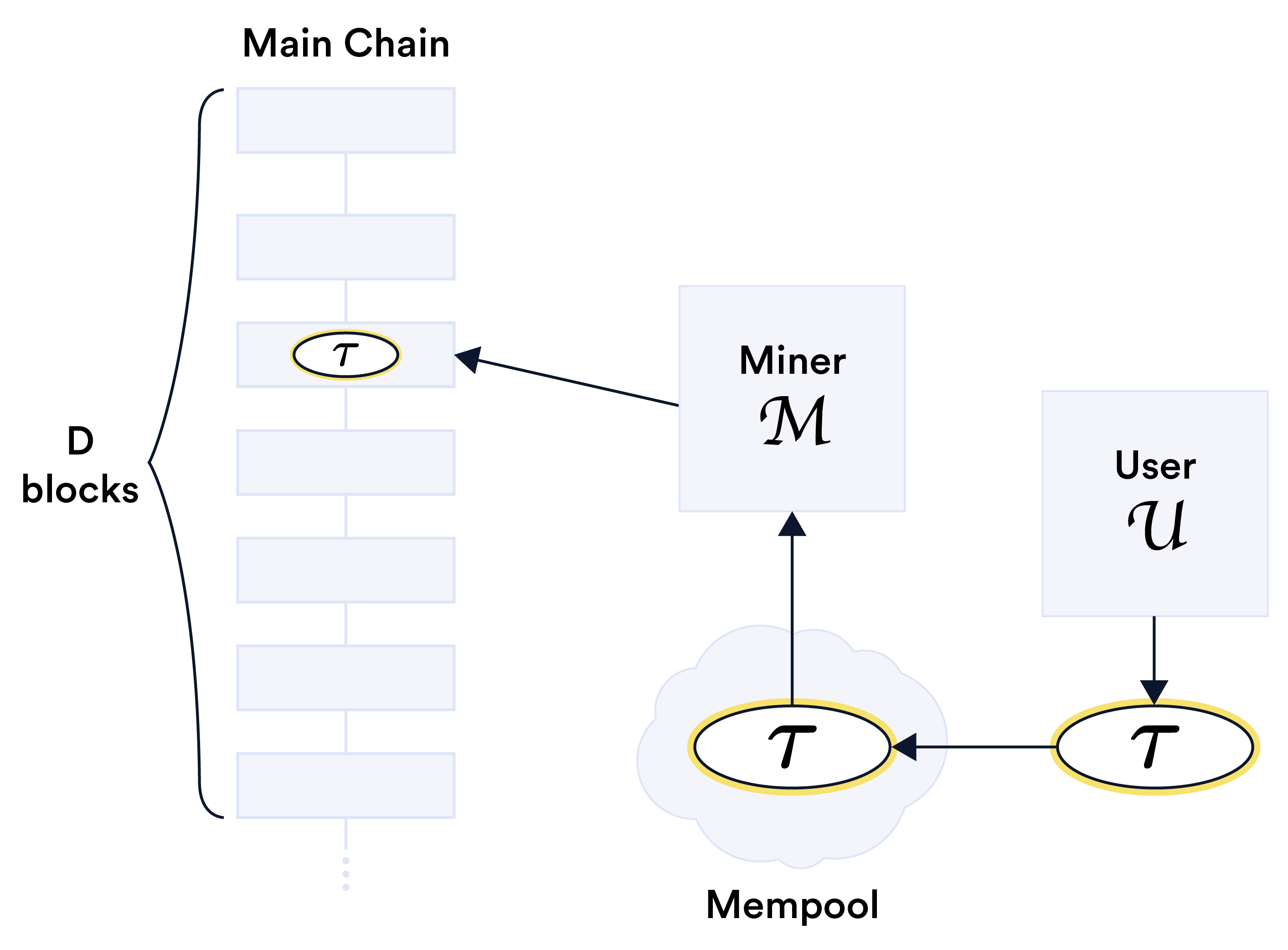
goal is to deliver select, high-priority transactions in a timely way on MAINCHAIN during periods of network congestion. Priority channels may be viewed as a form of futures contract on block space and thus as a cryptocommodity, a term coined as part of Project Chicago [61, 136]. Priority channels are intended specifically for miners to enable infrastructure services, such as oracles, governance functions for contracts, etc.—not for ordinary userlevel activities such as financial transactions. In fact, as designed here, a priority channel implemented by less than 100% of the mining power in the network can only provide loose bounds on delivery times, preventing its use for highly speed-dependent goals such as front-running. Figure 10: A priority channel is a guarantee by a miner M—or, more generally, a set of miners M—to a user U that her transaction \(\tau\) will be mined within D blocks of inclusion in the mempool. A contract SC can use DON monitoring to enforce the service terms of the channel. A priority channel takes the form of an agreement between a miner or set of miners (or mining pools) M that provides the channel and a user U that pays a fee for access. M agrees that when U submits a transaction \(\tau\) to the mempool (with any gas price,
but a pre-agreed-upon gas limit), M will place it on chain within the next D blocks.8 The idea is depicted schematically in Fig. 10. Priority-channel contract description: A priority channel may be realized as a hybrid smart contract roughly as follows. We let SC denote the logic on MAINCHAIN and that on the DON by exec. SC accepts a deposit / stake \(d from M and an advance payment \)p from U. A DON executable exec monitors the mempool, triggering on placement of a transaction by U. It sends a success message to SC if U submits a transaction that M mines in a timely way and a failure message in case of a service failure. SC sends payment $p to M given a success message and sends all remaining funds, including $d, to U if it receives a failure message. Upon successful termination, it releases deposit $d to M. The miner M can of course provide priority channels simultaneously to multiple users and can open a priority channel with U for a pre-agreed-upon number of messages. 4.5 Confidentiality-Preserving DeFi / Mixicles Today, DeFi applications [1] provide little to no confidentiality for users: All transactions are visible on chain. Various zero-knowledge-based approaches, e.g., [149, 217], can provide transaction privacy, and the TEF is general enough to support them. But these approaches are not comprehensive, and do not, for example, typically conceal the asset on which a transaction is based. The broad set of computational tools we ultimately intend to support in DONs will enable privacy in a number of different ways that can plug such gaps, helping complement the privacy assurances of other systems. For example, Mixicles, a confidentialitypreserving DeFi instrument proposed by Chainlink Labs researchers [135], can conceal the asset type backing a financial instrument, and fit very naturally into the DON framework. Mixicles are most easily explained in terms of their use to realize a simple binary option. A binary option is a financial instrument in which two users, which we’ll refer to here for consistency with [135] as players, bet on an event with two possible outcomes, e.g., whether or not an asset exceeds a target price at a predesignated time. The following example illustrates the idea. Example 2. Alice and Bob are parties to a binary option based on the value of an asset called Carol’s Bubble Token (CBT). Alice bets that CBT will have a market price of at least 250 USD at time T = noon on 21 June 2025; Bob bets the reverse. Each player deposits 100 ETH by a prespecified deadline. The player with the winning position receives 200 ETH (i.e., gains 100 ETH). 8D must of course be large enough to ensure that M can comply with high probability. For instance, if M controls 20% of the mining power in the network, it might choose D = 100, ensuring a failure probability of ≈2 × 10⁻¹⁰, i.e., less than one in a billion.
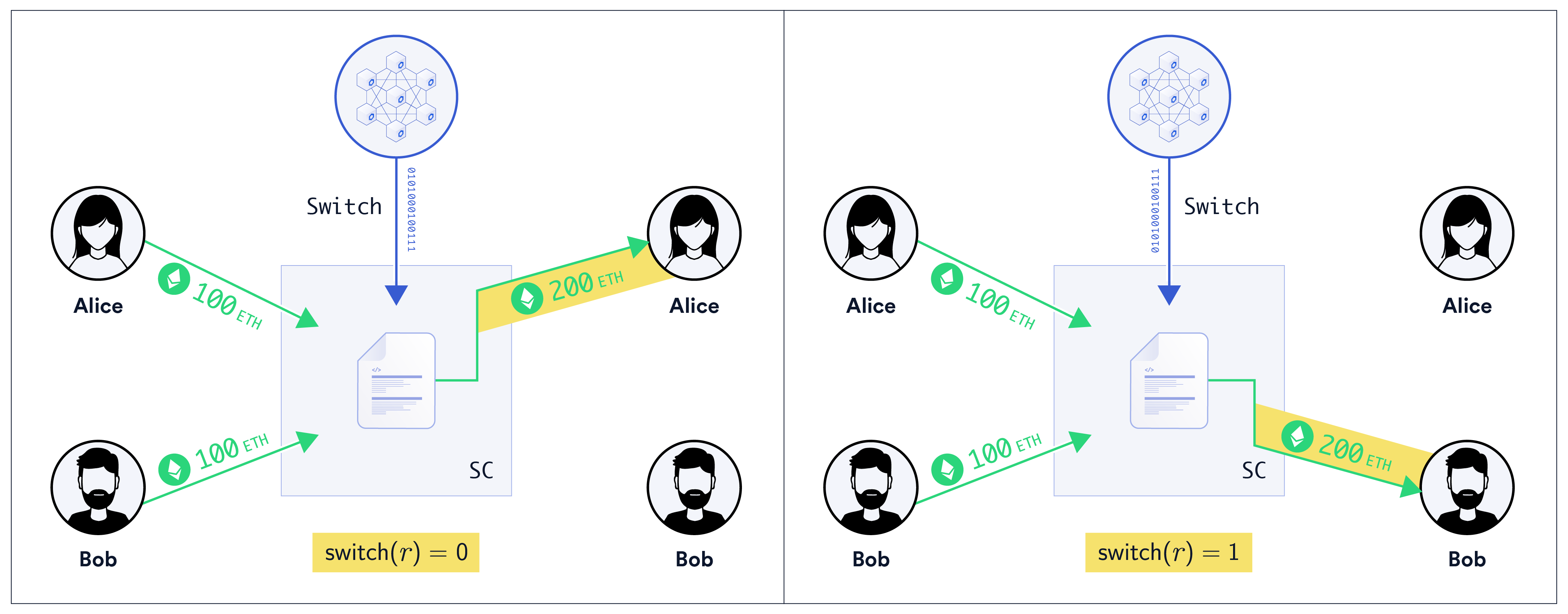
Given an existing Chainlink oracle network O, it is easy to implement a smart contract SC that realizes the agreement in Example 2. The two players each deposit 100 ETH in SC. Sometime after T, a query q is sent to O requesting the price r of CBT at time T. O sends a report r of this price to SC. SC then sends money to Alice if \(r \geq 250\) and Bob if not. This approach, however, reveals \(r\) on chain—making it easy for an observer to deduce the asset underlying the binary option. In the terminology of Mixicles, it is helpful to think conceptually of the outcome of SC in terms of a Switch that transmits a binary value computed as a predicate switch(\(r\)). In our example, switch(\(r\)) = 0 if \(r \geq 250\); given this outcome, Alice wins. Otherwise switch(r) = 1 and Bob wins. A DON can realize a basic Mixicle as a hybrid contract by running an executable exec that computes switch(r) and reports it on chain to SC. We show this construction in Fig. 11. Figure 11: Diagram of basic Mixicle in Example 2. To provide on-chain secrecy for report r, and thus the asset underlying the binary option, the oracle sends to the contract SC via Switch only the binary value switch(r). We specify an adapter ConfSwitch in Appendix C.3 that makes it easy to achieve this goal in a DON. The basic idea behind ConfSwitch is quite simple. Instead of reporting the value r, ConfSwitch reports only the binary switch value switch(r). SC can be designed to make a correct payment based on switch(r) alone, and switch(r) by itself reveals no information about the underlying asset—CBT in our example. Additionally, by placing a ciphertext on (q, r) on the ledger encrypted under pkaud, the public key of an auditor, the adapter ConfSwitch creates a confidentiality-preserving audit trail. The basic Mixicle we’ve chosen for simplicity to describe here conceals only the asset and bet behind the binary option in our example. A full-blown Mixicle [135] can provide two forms of confidentiality. It conceals from observers: (1) What event the players bet on (i.e., q and r) but also (2) Which player won the bet. Since Mixicles are executed on MAINCHAIN, either one player would need to relay switch(r) from the DON to MAINCHAIN, or an executable exec could be created that
is triggered on output by ConfSwitch and calls another adapter to send switch(r) to MAINCHAIN. A third, subtle type of confidentiality is also worth considering. In a basic implementation of ConfSwitch, O is running the adapter on the DON and thus learns the asset—CBT in our example—and thus the nature of the binary option. As discussed in Appendix C.3, however, it is additionally possible to use DECO or Town Crier to conceal even this information from O. In this case, the O learns no more information than a public observer of SC. For further details on Mixicles, we refer readers to [135].
विकेंद्रीकृत सेवाएँ विकेंद्रीकृत द्वारा सक्षम
ओरेकल नेटवर्क DONs की बहुमुखी प्रतिभा को दर्शाने के लिए और वे कैसे नई सेवाओं को सक्षम करते हैं, हम इस अनुभाग में DON-आधारित अनुप्रयोगों के पांच उदाहरण प्रस्तुत करते हैं और उनका वर्णन करते हैं हाइब्रिड अनुबंध जो उन्हें साकार करते हैं: (1) रिज़र्व का प्रमाण, क्रॉस-चेन सेवा का एक रूप; (2) एंटरप्राइज़/लीगेसी सिस्टम के साथ इंटरफेस करना, यानी मिडलवेयर-आधारित बनाना अमूर्त परत जो न्यूनतम के साथ blockchain अनुप्रयोगों के विकास की सुविधा प्रदान करती है blockchain-विशिष्ट कोड या विशेषज्ञता; (3) विकेंद्रीकृत पहचान, उपयोगकर्ताओं को सक्षम करने वाले उपकरण अपने स्वयं के पहचान दस्तावेज़ और क्रेडेंशियल प्राप्त करें और प्रबंधित करें; (4) प्राथमिकता चैनल, एक सेवा जो महत्वपूर्ण-बुनियादी ढांचे के लेनदेन को समय पर शामिल करना सुनिश्चित करती है (उदाहरण के लिए, oracle रिपोर्ट) blockchain पर; और (5) गोपनीयता-संरक्षण DeFi, अर्थात, वित्तीय smart contract जो भाग लेने वाले पक्षों के संवेदनशील डेटा को छिपाते हैं। यहाँ, हम
हाइब्रिड अनुबंध के मेनचेन भाग को दर्शाने के लिए SC का उपयोग करें और DON का वर्णन करें घटक अलग से या निष्पादन योग्य निष्पादन के संदर्भ में। 4.1 आरक्षण का प्रमाण कई अनुप्रयोगों के लिए, blockchains के बीच या उनके बीच स्थिति को रिले करना उपयोगी है। ए ऐसी सेवाओं का लोकप्रिय अनुप्रयोग क्रिप्टोकरेंसी रैपिंग है। ऐसे लिपटे सिक्के क्योंकि WBTC [15] विकेंद्रीकृत वित्त (DeFi) में एक लोकप्रिय संपत्ति बन रही है। वे इसमें "लिपटे हुए" समर्थन परिसंपत्ति को उसके स्रोत blockchain MAINCHAIN(1) पर जमा करना शामिल है और एक अलग, लक्ष्य blockchain MAINCHAIN(2) पर संबंधित token बनाना। उदाहरण के लिए, WBTC Ethereum blockchain पर एक ERC20 token है जो संगत है Bitcoin blockchain पर बीटीसी के लिए। क्योंकि MAINCHAIN(2) पर अनुबंधों की MAINCHAIN(1) में प्रत्यक्ष दृश्यता नहीं है, लपेटे गए जमा पर रिपोर्ट करने के लिए उन्हें स्पष्ट रूप से या परोक्ष रूप से oracle पर भरोसा करना होगा smart contract में परिसंपत्ति, जिसे कभी-कभी आरक्षित निधि का प्रमाण भी कहा जाता है। में WBTC [15], उदाहरण के लिए, कस्टोडियन BitGo BTC रखता है और WBTC जारी करता है, Chainlink नेटवर्क रिज़र्व का प्रमाण प्रदान करता है [76]। DON स्वयं आरक्षण का प्रमाण प्रदान कर सकता है। हालाँकि, DON के साथ, यह संभव है आगे जाने के लिए. एक DON रहस्यों को प्रबंधित कर सकता है और, उपयुक्त एडेप्टर के उपयोग के माध्यम से, किसी भी वांछित blockchain पर लेनदेन कर सकते हैं। परिणामस्वरूप, DON के लिए कार्य करना संभव है कई संरक्षकों में से एक के रूप में - या यहां तक कि एकमात्र, विकेन्द्रीकृत संरक्षक के रूप में - के लिए एक लपेटी हुई संपत्ति. DONs सुरक्षा बढ़ाने के लिए एक मंच के रूप में काम कर सकता है मौजूदा सेवाएँ जो आरक्षण के प्रमाण का उपयोग करती हैं। उदाहरण के लिए, मान लीजिए कि MAINCHAIN(1) Bitcoin है और MAINCHAIN(2) Ethereum है। मेनचेन(2) पर, एक अनुबंध एससी लिपटे हुए बीटीसी का प्रतिनिधित्व करते हुए tokens जारी करता है। DON बीटीसी पता पता नियंत्रित करता है(1) DON. बीटीसी को लपेटने के लिए, उपयोगकर्ता यू से एक्स बीटीसी भेजता है पता(1) यू जोड़ने के लिए(1) DON मेनचेन(2)-पता पता(2) के साथ यू. DON मॉनिटर करता है पता(1) DON मेनचेन(1) के एडाप्टर के माध्यम से। यू की जमा राशि का अवलोकन करने पर, पर्याप्त उच्च-संभावना पुष्टि के साथ, यह एक एडाप्टर के माध्यम से एससी को एक संदेश भेजता है मुख्य श्रृंखला(2). यह संदेश SC को addr(2) के लिए X tokens टकसाल करने का निर्देश देता है यू. U के लिए X tokens जारी करने के लिए, विपरीत होता है। हालाँकि, मेनचेन(1) पर, पता(1) DON पते(1) पर X BTC भेजता है यू (या किसी अन्य पते पर, यदि उपयोगकर्ता द्वारा इस प्रकार अनुरोध किया गया हो)। बेशक, इन प्रोटोकॉल को सीधे के बजाय एक्सचेंजों के साथ काम करने के लिए अनुकूलित किया जा सकता है उपयोगकर्ताओं के साथ. 4.2 एंटरप्राइज़/लीगेसी सिस्टम के साथ इंटरफ़ेसिंग DONs blockchains के बीच और बीच में पुल के रूप में काम कर सकते हैं, जैसा कि प्रूफ़ के उदाहरण में है रिज़र्व का, लेकिन उनका एक अन्य उद्देश्य बीच में द्विदिशात्मक पुल के रूप में कार्य करना है blockchains और विरासत प्रणालियाँ [176] या blockchain-जैसी प्रणालियाँ जैसे केंद्रीय बैंक डिजिटल मुद्राएँ [30]। उद्यमों को अपने मौजूदा सिस्टम को जोड़ने में कई चुनौतियों का सामना करना पड़ता है विकेंद्रीकृत प्रणालियों की प्रक्रियाएँ, जिनमें शामिल हैं:• ब्लॉकचेन चपलता: ब्लॉकचेन सिस्टम तेजी से बदलते हैं। एक उद्यम को blockchains की तेजी से नई उपस्थिति या लोकप्रियता में वृद्धि का सामना करना पड़ सकता है प्रतिपक्ष लेनदेन करना चाहते हैं, लेकिन जिसके लिए उद्यम के पास नहीं है इसके मौजूदा बुनियादी ढांचे में समर्थन। सामान्य तौर पर, blockchains की गतिशीलता बनाती है व्यक्तिगत उद्यमों के लिए संपूर्ण पारिस्थितिकी तंत्र से जुड़े रहना कठिन है। • ब्लॉकचेन-विशिष्ट विकास संसाधन: कई संगठनों के लिए, अत्याधुनिक blockchain विशेषज्ञता को काम पर रखना या विकसित करना कठिन है, विशेष रूप से इसे देखते हुए चपलता की चुनौती. • निजी-कुंजी प्रबंधन: blockchains या क्रिप्टोकरेंसी के लिए निजी कुंजी प्रबंधित करने के लिए पारंपरिक साइबर सुरक्षा से अलग परिचालन विशेषज्ञता की आवश्यकता होती है प्रथाएँ और कई उद्यमों के लिए अनुपलब्ध। • गोपनीयता: उद्यम अपनी संवेदनशील और स्वामित्व को उजागर करने में कतराते हैं श्रृंखला पर डेटा. इनमें से पहली तीन कठिनाइयों का समाधान करने के लिए, डेवलपर्स बस DON का उपयोग कर सकते हैं एंटरप्राइज़ सिस्टम को पढ़ने या लिखने में सक्षम करने के लिए एक सुरक्षित मिडलवेयर परत के रूप में blockchains. DON जैसे विस्तृत तकनीकी विचारों को दूर कर सकता है डेवलपर्स और उपयोगकर्ताओं दोनों के लिए गैस गतिशीलता, श्रृंखला पुनर्गठन, इत्यादि। द्वारा एंटरप्राइज़ सिस्टम के लिए एक सुव्यवस्थित blockchain इंटरफ़ेस प्रस्तुत करते हुए, एक DON इस प्रकार कर सकता है blockchain-जागरूक उद्यम अनुप्रयोगों के विकास को काफी सरल बनाना, उद्यमों से blockchain-विशिष्ट विकास संसाधनों को प्राप्त करने या इनक्यूबेट करने का बोझ हटाना। DONs का ऐसा उपयोग विशेष रूप से आकर्षक है क्योंकि यह एंटरप्राइज़ डेवलपर्स को सक्षम बनाता है स्मार्ट-कॉन्ट्रैक्ट एप्लिकेशन बनाएं जो काफी हद तक blockchain अज्ञेयवादी हों। परिणामस्वरूप, blockchains का बड़ा सेट जिसके लिए DON को मिडलवेयर के रूप में कार्य करने के लिए उपकरण दिया जाता है, blockchains का बड़ा सेट, जिस तक एंटरप्राइज़ उपयोगकर्ता आसान पहुंच प्राप्त कर सकते हैं। डेवलपर्स मौजूदा blockchains से एप्लिकेशन को न्यूनतम संशोधन के साथ नए में पोर्ट कर सकता है उनके आंतरिक रूप से विकसित अनुप्रयोगों के लिए। गोपनीयता की अतिरिक्त समस्या के समाधान के लिए, डेवलपर्स अपील कर सकते हैं उपकरण जो हम इस पेपर में पेश करते हैं और DON अनुप्रयोगों के समर्थन में तैनात करने की उम्मीद करते हैं। इनमें DECO और टाउन कैरियर सेक्शन 3.6.2 के साथ-साथ गोपनीयता-संरक्षण भी शामिल है एपीआई संशोधनों पर धारा 7.1.2 में चर्चा की गई है और इस खंड के शेष भाग में कई एप्लिकेशन-विशिष्ट दृष्टिकोणों को शामिल किया गया है। ये DON सिस्टम प्रदान कर सकते हैं बिना खुलासा किए एंटरप्राइज़ सिस्टम स्थिति के बारे में उच्च-अखंडता, ऑन-चेन सत्यापन श्रृंखला पर संवेदनशील उद्यम स्रोत डेटा। 4.3 विकेंद्रीकृत पहचान विकेंद्रीकृत पहचान इस धारणा के लिए एक सामान्य शब्द है कि उपयोगकर्ताओं को सक्षम होना चाहिए ऐसा करने के लिए तीसरे पक्षों पर निर्भर रहने के बजाय, अपनी स्वयं की साख प्राप्त करें और प्रबंधित करें तो. विकेंद्रीकृत क्रेडेंशियल धारक की विशेषताओं या दावों का सत्यापन है,जिन्हें अक्सर दावे कहा जाता है. क्रेडेंशियल्स को संस्थाओं द्वारा डिजिटल रूप से हस्ताक्षरित किया जाता है, जिन्हें अक्सर कहा जाता है जारीकर्ता, जो उपयोगकर्ताओं के साथ दावों को आधिकारिक रूप से संबद्ध कर सकते हैं। अधिकांश प्रस्तावित योजनाओं में, दावे एक विकेंद्रीकृत पहचानकर्ता (डीआईडी) से जुड़े हैं, जो एक सार्वभौमिक पहचानकर्ता है एक दिया गया उपयोगकर्ता. क्रेडेंशियल एक सार्वजनिक कुंजी से बंधे होते हैं जिसकी निजी कुंजी उपयोगकर्ता के पास होती है। इस प्रकार उपयोगकर्ता अपनी निजी कुंजी का उपयोग करके दावे पर कब्ज़ा साबित कर सकता है। विकेंद्रीकृत पहचान के रूप में दूरदर्शी, मौजूदा और प्रस्तावित योजनाएं हैं, उदाहरण के लिए, [14, 92, 129, 216], की तीन गंभीर सीमाएँ हैं: • विरासत अनुकूलता का अभाव: मौजूदा विकेन्द्रीकृत पहचान प्रणालियाँ किस पर निर्भर हैं? डीआईडी क्रेडेंशियल तैयार करने के लिए अधिकारियों का समुदाय, जिन्हें जारीकर्ता कहा जाता है। क्योंकि मौजूदा वेब सेवाएँ आम तौर पर डेटा पर डिजिटल हस्ताक्षर नहीं करती हैं, जारीकर्ताओं को लॉन्च किया जाना चाहिए विशेष प्रयोजन प्रणालियों के रूप में। क्योंकि इसके बिना ऐसा करने का कोई प्रोत्साहन नहीं है विकेन्द्रीकृत-पहचान पारिस्थितिकी तंत्र, मुर्गी-और-अंडे की समस्या का परिणाम है। दूसरे में शब्दों में, यह स्पष्ट नहीं है कि जारीकर्ता पारिस्थितिकी तंत्र को कैसे बूटस्ट्रैप किया जाए। • अव्यवहारिक कुंजी प्रबंधन: विकेंद्रीकृत पहचान प्रणालियों के लिए उपयोगकर्ताओं को इसकी आवश्यकता होती है निजी कुंजियाँ प्रबंधित करें, कुछ ऐसा जो क्रिप्टोकरेंसी के अनुभव से पता चला है एक अव्यवहारिक दायित्व होना। अनुमान है कि लगभग 4,000,000 Bitcoin हो गए हैं कुंजी प्रबंधन विफलताओं के कारण [194] हमेशा के लिए खो गया, और कई उपयोगकर्ता अपना भंडारण कर लेते हैं एक्सचेंजों के साथ क्रिप्टो संपत्तियां [193], जिससे विकेंद्रीकरण कमजोर हो जाता है। • गोपनीयता-संरक्षण सिबिल प्रतिरोध का अभाव: मतदान, token बिक्री के दौरान token का उचित आवंटन आदि जैसे अनुप्रयोगों की एक बुनियादी सुरक्षा आवश्यकता है उपयोगकर्ता एकाधिक पहचान का दावा करने में असमर्थ होंगे। मौजूदा विकेन्द्रीकृत पहचान प्रस्तावों को ऐसा हासिल करने के लिए उपयोगकर्ताओं को अपनी वास्तविक दुनिया की पहचान प्रकट करने की आवश्यकता होती है सिबिल प्रतिरोध, जिससे महत्वपूर्ण गोपनीयता आश्वासन कमजोर हो जाते हैं। नोड्स की एक समिति के संयोजन का उपयोग करके इन समस्याओं का समाधान करना संभव है DON के भीतर वितरित गणना करना और DECO जैसे उपकरणों का उपयोग करना या टाउन कैरियर, जैसा कि CanDID [160] नामक सिस्टम में दिखाया गया है। DECO या टाउन कैरियर डिज़ाइन द्वारा मौजूदा वेब सेवाओं को बिना किसी संशोधन के चालू कर सकता है गोपनीयता-संरक्षित क्रेडेंशियल जारीकर्ताओं में। वे प्रासंगिक निर्यात करने के लिए DON सक्षम करते हैं इस उद्देश्य के लिए डेटा को एक क्रेडेंशियल में रखें जबकि संवेदनशील डेटा को छुपाया नहीं जाना चाहिए क्रेडेंशियल में दिखाई दें. इसके अलावा, उपयोगकर्ताओं के लिए कुंजी पुनर्प्राप्ति की सुविधा प्रदान करना, इस प्रकार कुंजी-प्रबंधन को संबोधित करना समस्या, एक DON उपयोगकर्ताओं को निजी कुंजी को गुप्त-साझा रूप में संग्रहीत करने की अनुमति दे सकता है। उपयोगकर्ता कर सकते हैं DON में नोड्स को साबित करके उनकी कुंजियाँ पुनर्प्राप्त करें - इसी तरह, टाउन कैरियर का उपयोग करके या DECO—पूर्वनिर्धारित वेब प्रदाताओं के एक सेट के साथ खातों में लॉग इन करने की क्षमता (उदाहरण के लिए, ट्विटर, गूगल, फेसबुक)। इसके विपरीत, टाउन कैरियर या डेको का उपयोग करने का लाभ OAUTH, उपयोगकर्ता की गोपनीयता है. वे दो उपकरण उपयोगकर्ता को DON को प्रकट होने से बचने में सक्षम बनाते हैं एक वेब प्रदाता पहचानकर्ता—जिससे अक्सर वास्तविक दुनिया की पहचान प्राप्त की जा सकती है। अंत में, सिबिल प्रतिरोध प्रदान करने के लिए, जैसा कि [160] में दिखाया गया है, DON के लिए यह संभव है उपयोगकर्ताओं के लिए अद्वितीय वास्तविक-विश्व पहचानकर्ताओं का गोपनीयता-संरक्षण परिवर्तन करें (उदाहरण के लिए, सामाजिक सुरक्षा नंबर (एसएसएन)) उपयोगकर्ता पंजीकरण पर ऑन-चेन पहचानकर्ताओं में।सिस्टम इस प्रकार संवेदनशील डेटा के बिना डुप्लिकेट पंजीकरण का पता लगा सकता है एसएसएन को अलग-अलग DON नोड्स में प्रकट किया जा रहा है।7 एक DON बाहरी विकेंद्रीकृत पहचान की ओर से इनमें से कोई भी सेवा प्रदान कर सकता है अनुमति रहित या अनुमति प्राप्त blockchains पर सिस्टम, उदाहरण के लिए, हाइपरलेजर के उदाहरण इंडी [129]। उदाहरण आवेदन: केवाईसी: विकेंद्रीकृत पहचान एक साधन के रूप में वादा रखती है उपयोगकर्ता में सुधार करते हुए blockchains पर वित्तीय अनुप्रयोगों के लिए आवश्यकताओं को सुव्यवस्थित करें गोपनीयता. यह दो चुनौतियों से निपटने में मदद कर सकता है, वे हैं एंटी-मनी-लॉन्ड्रिंग / नो-योर-कस्टमर (एएमएल / केवाईसी) नियमों के तहत मान्यता और अनुपालन दायित्व। कई देशों में एएमएल विनियमों के लिए वित्तीय संस्थानों (और अन्य व्यवसायों) को उन व्यक्तियों और व्यवसायों की पहचान स्थापित करने और सत्यापित करने की आवश्यकता होती है जिनके साथ वे लेन-देन करते हैं. केवाईसी एक वित्तीय संस्थान का एक घटक है व्यापक एएमएल नीति, जिसमें आम तौर पर अन्य चीजों के अलावा उपयोगकर्ता के व्यवहार की निगरानी करना और फंड प्रवाह पर नजर रखना भी शामिल है। केवाईसी में आम तौर पर किसी न किसी रूप में उपयोगकर्ता की पहचान संबंधी प्रस्तुति शामिल होती है (उदाहरण के लिए, उपयोगकर्ता के चेहरे के सामने एक पहचान दस्तावेज़ रखते हुए, एक ऑनलाइन वेब फॉर्म में प्रवेश करना एक वीडियो सत्र में, आदि)। विकेन्द्रीकृत क्रेडेंशियल्स का सुरक्षित निर्माण और प्रस्तुति सैद्धांतिक रूप से कई मायनों में एक लाभकारी विकल्प हो सकता है, अर्थात्: (1) बनाना केवाईसी प्रक्रिया उपयोगकर्ताओं और वित्तीय संस्थानों के लिए अधिक कुशल है, क्योंकि एक बार क्रेडेंशियल प्राप्त हो जाने पर, इसे किसी भी वित्तीय संस्थान में निर्बाध रूप से प्रस्तुत किया जा सकता है; (2) समझौते के माध्यम से पहचान की चोरी के अवसरों को कम करके धोखाधड़ी को कम करना वीडियो सत्यापन के दौरान व्यक्तिगत पहचान योग्य जानकारी (पीआईआई) और स्पूफिंग; और (3) वित्तीय संस्थानों में पीआईआई समझौते के जोखिम को कम करना, क्योंकि उपयोगकर्ता नियंत्रण बनाए रखते हैं उनके अपने डेटा का. एएमएल अनुपालन विफलताओं के लिए वित्तीय संस्थानों द्वारा भुगतान किए जाने वाले अरबों डॉलर के जुर्माने और कई वित्तीय संस्थानों द्वारा केवाईसी पर सालाना लाखों डॉलर खर्च करने को देखते हुए, सुधार से वित्तीय संस्थानों के लिए काफी बचत हो सकती है। और, विस्तार से, उपभोक्ताओं के लिए [196]। जबकि पारंपरिक वित्तीय क्षेत्र धीमा है नए अनुपालन उपकरणों को अपनाने के लिए, DeFi प्रणालियाँ तेजी से इसे [43] को अपना रही हैं। उदाहरण आवेदन: कम-संपार्श्विक ऋण: अधिकांश DeFi अनुप्रयोग आज समर्थन ऋण केवल पूर्णतः संपार्श्विक ऋणों से ही उत्पन्न होता है। ये किए गए ऋण हैं उन उधारकर्ताओं के लिए जो ऋण से अधिक मूल्य की क्रिप्टोकरेंसी संपत्ति जमा करते हैं। हाल ही में उस चीज़ में रुचि पैदा हुई है जिसे DeFi समुदाय आम तौर पर अंडरकोलैटरलाइज़्ड ऋण के रूप में संदर्भित करता है। इसके विपरीत, ये ऐसे ऋण हैं जिनके लिए संबंधित संपार्श्विक होता है इसका मूल्य ऋण के मूलधन से कम है। कम संपार्श्विक ऋण ये अक्सर पारंपरिक वित्तीय संस्थानों द्वारा दिए गए ऋणों से मिलते जुलते हैं। भरोसा करने के बजाय ऋण चुकौती की गारंटी के रूप में जमा की गई संपार्श्विक पर, वे इसके बजाय ऋण देने को आधार बनाते हैं उधारकर्ताओं के क्रेडिट इतिहास पर निर्णय। 7यह परिवर्तन एक वितरित छद्म आयामी फ़ंक्शन (पीआरएफ) पर निर्भर करता है।अल्प-संपार्श्विक ऋण DeFi उधार बाजार का एक नया लेकिन बढ़ता हुआ हिस्सा है। वे पारंपरिक वित्तीय द्वारा नियोजित तंत्रों जैसे तंत्रों पर भरोसा करते हैं संस्थाएँ, जैसे कानूनी अनुबंध [91]। उनके विकास के लिए एक अनिवार्य आवश्यकता उपयोगकर्ता की साख पर डेटा प्रस्तुत करने की क्षमता होगी - पारंपरिक ऋण निर्णयों में एक महत्वपूर्ण कारक - DeFi सिस्टम को इस तरह से जो मजबूत अखंडता प्रदान करता है, अर्थात, सही डेटा का आश्वासन. एक DON-सक्षम विकेन्द्रीकृत पहचान प्रणाली संभावित उधारकर्ताओं को सक्षम बनाएगी संरक्षित करते समय उनकी साख योग्यता को प्रमाणित करने वाले उच्च-आश्वासन क्रेडेंशियल उत्पन्न करें संवेदनशील जानकारी की गोपनीयता. विशेष रूप से, उधारकर्ता इन्हें उत्पन्न कर सकते हैं केवल उजागर करते समय आधिकारिक ऑनलाइन स्रोतों से रिकॉर्ड पर आधारित क्रेडेंशियल अन्य संभावित संवेदनशील डेटा को उजागर किए बिना, DON द्वारा सत्यापित डेटा। के लिए उदाहरण के लिए, एक उधारकर्ता एक क्रेडेंशियल उत्पन्न कर सकता है जो दर्शाता है कि उसका क्रेडिट स्कोर ए के साथ है क्रेडिट ब्यूरो का सेट एक विशेष सीमा (उदाहरण के लिए, 750) से अधिक है, उसे बताए बिना उसके रिकॉर्ड में सटीक स्कोर या कोई अन्य डेटा। इसके अतिरिक्त, यदि वांछित हो, तो ऐसी साख गुमनाम रूप से उत्पन्न किया जा सकता है, यानी, उपयोगकर्ता के नाम को संवेदनशील डेटा के रूप में माना जा सकता है और स्वयं oracle नोड्स या उसके विकेन्द्रीकृत क्रेडेंशियल के संपर्क में नहीं है। साख अनुप्रयोग के आधार पर इसका उपयोग चेन या ओffचेन पर किया जा सकता है। संक्षेप में, एक उधारकर्ता अपने ऋण पर ऋणदाताओं को आवश्यक जानकारी प्रदान कर सकता है मजबूत अखंडता के साथ इतिहास और अनावश्यक, संवेदनशील के जोखिम के बिना डेटा. एक उधारकर्ता कई अन्य गोपनीयता-संरक्षित क्रेडेंशियल भी प्रदान कर सकता है ऋण देने संबंधी निर्णय लेने में सहायक। उदाहरण के लिए, क्रेडेंशियल्स किसी उधारकर्ता की पुष्टि कर सकते हैं (ओ-चेन) परिसंपत्तियों का कब्ज़ा, जैसा कि हम अपने अगले उदाहरण में दिखाते हैं। उदाहरण आवेदन: प्रत्यायन: कई न्यायक्षेत्र निवेशकों के उस वर्ग को सीमित करते हैं जिन्हें अपंजीकृत प्रतिभूतियाँ बेची जा सकती हैं। उदाहरण के लिए, यू.एस., एसईसी में विनियमन डी यह निर्धारित करता है कि ऐसे निवेश अवसरों के लिए मान्यता प्राप्त होनी चाहिए व्यक्ति के पास $1 मिलियन की कुल संपत्ति होनी चाहिए, कुछ न्यूनतम आय आवश्यकताओं को पूरा करना चाहिए, या कुछ व्यावसायिक योग्यताएँ होनी चाहिए [209, 210]। वर्तमान मान्यता प्रक्रियाएं बोझिल और अप्रभावी हैं, जिनके लिए अक्सर सत्यापन पत्र की आवश्यकता होती है एक एकाउंटेंट, या इसी तरह का सबूत। एक विकेन्द्रीकृत पहचान प्रणाली उपयोगकर्ताओं को क्रेडेंशियल उत्पन्न करने में सक्षम बनाएगी मौजूदा ऑनलाइन वित्तीय सेवा खाते जो मान्यता के अनुपालन को साबित करते हैं विनियम, अधिक कुशल और गोपनीयता-संरक्षित केवाईसी प्रक्रिया की सुविधा प्रदान करते हैं। द इसके अलावा, DECO और टाउन कैरियर की गोपनीयता-संरक्षण संपत्तियाँ इन्हें अनुमति देंगी उपयोगकर्ता की वित्तीय स्थिति का विवरण सीधे प्रकट किए बिना सत्यनिष्ठा के मजबूत आश्वासन के साथ क्रेडेंशियल तैयार किए जाने चाहिए। उदाहरण के लिए, एक उपयोगकर्ता एक क्रेडेंशियल उत्पन्न कर सकता है बिना किसी अतिरिक्त जानकारी के यह साबित करना कि उसकी कुल संपत्ति कम से कम $1 मिलियन है उसकी वित्तीय स्थिति के बारे में जानकारी। 4.4 प्राथमिकता चैनल प्राथमिकता चैनल एक उपयोगी नई सेवा है जिसे DON का उपयोग करके बनाना आसान है। उनके
लक्ष्य मेनचेन पर समय पर चुनिंदा, उच्च-प्राथमिकता वाले लेनदेन वितरित करना है नेटवर्क संकुलन की अवधि के दौरान. प्राथमिकता वाले चैनलों को एक रूप में देखा जा सकता है ब्लॉक स्पेस पर वायदा अनुबंध और इस प्रकार एक क्रिप्टोकमोडिटी के रूप में, एक शब्द को भाग के रूप में गढ़ा गया है प्रोजेक्ट शिकागो का [61, 136]। प्राथमिकता वाले चैनल विशेष रूप से खनिकों के लिए बुनियादी ढांचे की सेवाओं को सक्षम करने के लिए हैं, जैसे oracles, अनुबंधों के लिए शासन कार्य, आदि - वित्तीय लेनदेन जैसी सामान्य उपयोगकर्ता स्तर की गतिविधियों के लिए नहीं। वास्तव में, जैसा कि यहां डिज़ाइन किया गया है, एक प्राथमिकता चैनल केवल नेटवर्क में 100% से कम खनन शक्ति द्वारा कार्यान्वित किया जा सकता है अत्यधिक गति-निर्भरता के लिए इसके उपयोग को रोकते हुए, डिलीवरी समय पर ढीली सीमा प्रदान करें फ्रंट-रनिंग जैसे लक्ष्य। चित्र 10: एक प्राथमिकता चैनल एक खनिक एम-या, अधिक सामान्यतः, ए द्वारा गारंटी है खनिकों का सेट एम-उपयोगकर्ता यू को कि उसका लेनदेन τ डी ब्लॉक के भीतर खनन किया जाएगा मेमपूल में शामिल करने का. एक अनुबंध SC इसे लागू करने के लिए DON निगरानी का उपयोग कर सकता है चैनल की सेवा शर्तें. एक प्राथमिकता चैनल एक खनिक या खनिकों के समूह के बीच एक समझौते का रूप लेता है (या खनन पूल) एम जो चैनल प्रदान करता है और एक उपयोगकर्ता यू जो पहुंच के लिए शुल्क का भुगतान करता है। एम इस बात से सहमत है कि जब यू मेमपूल को लेनदेन τ सबमिट करता है (किसी भी गैस की कीमत के साथ,लेकिन एक पूर्व-सहमत गैस सीमा), एम इसे अगले डी ब्लॉक के भीतर श्रृंखला पर रखेगा।8 इस विचार को चित्र 10 में योजनाबद्ध रूप से दर्शाया गया है। प्राथमिकता-चैनल अनुबंध विवरण: एक प्राथमिकता चैनल के रूप में महसूस किया जा सकता है हाइब्रिड smart contract मोटे तौर पर इस प्रकार है। हमने एससी को मेनचेन पर तर्क बताने दिया और वह DON पर कार्यकारी द्वारा। SC, U. A से जमा/हिस्सेदारी \(d from M and an advance payment \)p स्वीकार करता है DON निष्पादन योग्य निष्पादन मेमपूल की निगरानी करता है, लेनदेन के प्लेसमेंट पर ट्रिगर करता है यू द्वारा। यदि यू कोई लेन-देन सबमिट करता है जिसे एम करता है तो यह एससी को एक सफलता संदेश भेजता है सेवा विफलता के मामले में समय पर तरीका और विफलता संदेश। SC ने सफलता का संदेश देते हुए M को भुगतान $p भेजा और शेष सभी धनराशि भेज दी, यदि इसे विफलता संदेश प्राप्त होता है तो इसमें $d, से लेकर U तक शामिल है। सफल समापन पर, यह एम को जमा $डी जारी करता है। खनिक एम निश्चित रूप से कई लोगों को एक साथ प्राथमिकता चैनल प्रदान कर सकता है उपयोगकर्ता पूर्व-सहमत संदेशों की संख्या के लिए यू के साथ एक प्राथमिकता चैनल खोल सकते हैं। 4.5 गोपनीयता-संरक्षण DeFi / मिश्रण आज, DeFi एप्लिकेशन [1] उपयोगकर्ताओं के लिए बहुत कम या कोई गोपनीयता प्रदान नहीं करते हैं: सभी लेनदेन श्रृंखला पर दिखाई देते हैं। विभिन्न शून्य-ज्ञान-आधारित दृष्टिकोण, जैसे, [149, 217], लेनदेन गोपनीयता प्रदान कर सकता है, और टीईएफ उनका समर्थन करने के लिए पर्याप्त सामान्य है। लेकिन ये दृष्टिकोण व्यापक नहीं हैं, और उदाहरण के लिए, आम तौर पर छिपाते नहीं हैं परिसंपत्ति जिस पर लेनदेन आधारित है। कम्प्यूटेशनल उपकरणों का व्यापक सेट जिसे हम अंततः DONs में समर्थन देने का इरादा रखते हैं कई अलग-अलग तरीकों से गोपनीयता को सक्षम करना जो ऐसी कमियों को दूर कर सकता है, अन्य प्रणालियों की गोपनीयता आश्वासनों को पूरक बनाने में मदद करता है। उदाहरण के लिए, Chainlink लैब्स के शोधकर्ताओं [135] द्वारा प्रस्तावित गोपनीयता को संरक्षित करने वाला DeFi उपकरण मिक्सिकल्स छुपा सकता है एक वित्तीय साधन का समर्थन करने वाली परिसंपत्ति का प्रकार, और बहुत स्वाभाविक रूप से DON में फिट होता है ढांचा. एक सरल बाइनरी को साकार करने के लिए मिक्सिकल्स को उनके उपयोग के संदर्भ में सबसे आसानी से समझाया गया है विकल्प. बाइनरी विकल्प एक वित्तीय साधन है जिसमें दो उपयोगकर्ता होते हैं, जो हम करेंगे खिलाड़ियों के रूप में [135] के साथ निरंतरता के लिए यहां देखें, दो संभावनाओं वाले इवेंट पर दांव लगाएं परिणाम, उदाहरण के लिए, चाहे कोई परिसंपत्ति पूर्वनिर्धारित समय पर लक्ष्य मूल्य से अधिक हो या नहीं। निम्नलिखित उदाहरण इस विचार को दर्शाता है. उदाहरण 2. ऐलिस और बॉब किसी परिसंपत्ति के मूल्य के आधार पर द्विआधारी विकल्प के पक्षकार हैं कैरोल का बबल टोकन (सीबीटी) कहा जाता है। ऐलिस ने शर्त लगाई कि सीबीटी का बाजार मूल्य होगा 21 जून 2025 को समय टी = दोपहर में कम से कम 250 अमरीकी डालर; बॉब ने उलटा दांव लगाया। प्रत्येक खिलाड़ी एक निर्धारित समय सीमा तक 100 ईटीएच जमा करें। विजेता स्थिति वाला खिलाड़ी 200 ETH प्राप्त करता है (अर्थात, 100 ETH प्राप्त करता है)। 8D निश्चित रूप से इतना बड़ा होना चाहिए कि यह सुनिश्चित हो सके कि M उच्च संभावना का अनुपालन कर सके। के लिए उदाहरण के लिए, यदि एम नेटवर्क में 20% खनन शक्ति को नियंत्रित करता है, तो यह सुनिश्चित करते हुए डी = 100 चुन सकता है विफलता की संभावना ≈2 × 10⁻¹⁰, यानी, एक अरब में एक से भी कम।मौजूदा Chainlink oracle नेटवर्क O को देखते हुए, स्मार्ट को कार्यान्वित करना आसान है अनुबंध एससी जो उदाहरण 2 में समझौते का एहसास करता है। दो खिलाड़ी प्रत्येक जमा करते हैं एससी में 100 ईटीएच। T के कुछ समय बाद, O को एक क्वेरी q भेजी जाती है जिसमें r की कीमत का अनुरोध किया जाता है समय टी पर सीबीटी। ओ इस कीमत की एक रिपोर्ट आर एससी को भेजता है। SC फिर ऐलिस को पैसे भेजता है यदि r ≥250 और बॉब यदि नहीं। हालाँकि, यह दृष्टिकोण श्रृंखला पर r को प्रकट करता है - जिससे यह आसान हो जाता है एक पर्यवेक्षक के लिए बाइनरी विकल्प में अंतर्निहित परिसंपत्ति का अनुमान लगाना। मिक्सिकल्स की शब्दावली में, परिणाम के बारे में वैचारिक रूप से सोचना सहायक होता है एक स्विच के संदर्भ में एससी का जो एक विधेय के रूप में गणना की गई बाइनरी मान को प्रसारित करता है स्विच(आर). हमारे उदाहरण में, स्विच(आर) = 0 यदि आर ≥250; इस परिणाम को देखते हुए, ऐलिस जीत जाती है। अन्यथा स्विच(आर) = 1 और बॉब जीत जाता है। एक DON एक निष्पादन योग्य चलाकर एक हाइब्रिड अनुबंध के रूप में एक बुनियादी मिक्सिकल का एहसास कर सकता है कार्यकारी जो स्विच (आर) की गणना करता है और इसे एससी को श्रृंखला पर रिपोर्ट करता है। हम यह निर्माण दिखाते हैं चित्र 11 में. चित्र 11: उदाहरण 2 में मूल मिश्रण का आरेख। ऑन-चेन गोपनीयता प्रदान करने के लिए रिपोर्ट आर, और इस प्रकार बाइनरी विकल्प में अंतर्निहित परिसंपत्ति, oracle को भेजती है केवल बाइनरी वैल्यू स्विच (आर) स्विच के माध्यम से एससी को अनुबंधित करें। हम परिशिष्ट C.3 में एक एडाप्टर कॉन्फस्विच निर्दिष्ट करते हैं जो इसे प्राप्त करना आसान बनाता है DON में लक्ष्य। कॉन्फस्विच के पीछे का मूल विचार काफी सरल है। रिपोर्ट करने के बजाय मान r, कॉन्फ़स्विच केवल बाइनरी स्विच मान स्विच(r) की रिपोर्ट करता है। एससी हो सकता है अकेले स्विच(आर) और अकेले स्विच(आर) के आधार पर सही भुगतान करने के लिए डिज़ाइन किया गया है हमारे उदाहरण में अंतर्निहित परिसंपत्ति-सीबीटी के बारे में कोई जानकारी नहीं मिलती है। इसके अतिरिक्त, pkaud के अंतर्गत एन्क्रिप्टेड लेजर पर (q, r) पर एक सिफरटेक्स्ट रखकर, सार्वजनिक कुंजी एक ऑडिटर, एडॉप्टर कॉन्फस्विच एक गोपनीयता-संरक्षण ऑडिट ट्रेल बनाता है। यहां वर्णन करने के लिए सरलता के लिए हमने जो मूल मिक्सिकल चुना है, वह केवल छुपाता है हमारे उदाहरण में बाइनरी विकल्प के पीछे परिसंपत्ति और दांव। एक पूर्ण विकसित मिक्सिकल [135] कैन गोपनीयता के दो रूप प्रदान करें। यह पर्यवेक्षकों से छुपाता है: (1) कौन सी घटना खिलाड़ियों ने (अर्थात, क्यू और आर) पर दांव लगाया लेकिन साथ ही (2) किस खिलाड़ी ने दांव जीता। चूंकि मिक्सिकल्स को मेनचेन पर निष्पादित किया जाता है, इसलिए किसी एक खिलाड़ी को रिले करने की आवश्यकता होगी DON से MAINCHAIN पर स्विच(r), या एक निष्पादन योग्य निष्पादन बनाया जा सकता है
कॉन्फस्विच द्वारा आउटपुट पर ट्रिगर किया जाता है और स्विच (आर) भेजने के लिए दूसरे एडाप्टर को कॉल करता है मुख्य श्रृंखला। एक तीसरी, सूक्ष्म प्रकार की गोपनीयता भी विचार करने योग्य है। कॉन्फस्विच के बुनियादी कार्यान्वयन में, O DON पर एडाप्टर चला रहा है और इस प्रकार सीखता है परिसंपत्ति-हमारे उदाहरण में सीबीटी-और इस प्रकार द्विआधारी विकल्प की प्रकृति। जैसी कि चर्चा है हालाँकि, परिशिष्ट C.3 में, DECO या टाउन कैरियर का उपयोग करना अतिरिक्त रूप से संभव है यह जानकारी भी O से छुपाएं। इस मामले में, O को और कोई जानकारी नहीं मिलती SC के एक सार्वजनिक पर्यवेक्षक की तुलना में। मिक्सिकल्स पर अधिक जानकारी के लिए, हम पाठकों को [135] पर भेजते हैं।
Fair Sequencing Services
Fair Sequencing Services
One important service that we expect DONs will offer that leverages their networking, computation, and storage capabilities is called Fair Sequencing Services (FSS). Although FSS may be viewed simply as an application realized within the DON framework, we highlight it as a service that we believe will be in high demand across blockchains, and which we expect the Chainlink network to support actively. When executed on public blockchain networks, many of today’s DeFi applications reveal information that can be exploited by users to their own benefit, analogous to the kind of insider leaks and manipulation opportunities that are pervasive in existing markets [64, 155]. FSS instead paves the way toward a fair DeFi ecosystem. FSS helps developers to build DeFi contracts that are protected from market manipulation resulting from information leakage. Given the problems we highlight below, FSS is especially attractive for layer-2 services and fits within the framework for such services that we discuss in Section 6. The challenge: In existing permissionless systems, transactions are ordered entirely at the discretion of miners. In permissioned networks, the validator nodes may exert the same power. This is a form of largely unrecognized ephemeral centralization in otherwise decentralized systems. A miner can (temporarily) censor transactions for its own benefit [171] or reorder them to maximize its own gain, a notion called minerextractable value (MEV) [90]. The term MEV is slightly deceptive: It does not refer only to value that miners can capture: Some MEV can be captured by ordinary users. Because miners have more power than ordinary users, however, MEV represents an upper bound on the amount of value any entity can obtain through adversarial reordering and complementary transaction insertion. Even when miners order transactions simply based on fees (gas), without manipulation, users themselves can manipulate gas prices to advantage their transactions over those of less sophistication. Daian et al. [90] document and quantify ways in which bots (not miners) take advantage of gas dynamics in a way that harms users of DeFi systems today and how MEV even threatens the stability of the underlying consensus layer in a blockchain. Other examples of transaction-order manipulation surface regularly, e.g., [50, 154].
New transaction-processing methods such as rollups are a very promising approach to the scaling problems of high-throughput blockchains. They do not, however, address the problem of MEV. Instead, they shift it to the entity that generates the rollup. That entity, whether the operator of a smart contract or a user furnishing a (zk-)rollup with a validity proof, has the power to order and insert transactions. In other words, rollups swap MEV for REV: Rollup-Extractable Value. MEV affects upcoming transactions that have been submitted to the mempool but are not yet committed on chain. Information about such transactions is broadly available in the network. Miners, validators, and ordinary network participants can therefore exploit this knowledge and create dependent transactions. In addition, miners and validators may influence the order of those transactions that they commit themselves and exploit this to their advantage. The problem of undue influence by leaders on transaction ordering in consensus protocols has been known in the literature since the 1990s [71, 190], but no satisfying solutions have been realized in practice so far [97]. The main reason is that proposed solutions—at least until very recently—cannot readily be integrated with public blockchains, as they rely on the content of transactions remaining secret until after their ordering has been determined. Fair Sequencing Services (FSS) overview: DONs will provide tools to decentralize transaction ordering and implement it according to a policy specified by a relying contract creator, ideally one that is fair, and not advantaging actors who wish to manipulate transaction ordering. Collectively, these tools constitute FSS. FSS includes three components. The first is monitoring of transactions. In FSS, oracle nodes in O both monitor the mempool of MAINCHAIN and (if desired) permit off-chain submission of transactions through a specialized channel. The second is sequencing of transactions. The nodes in O order transactions for a relying contract according to a policy defined for that contract. The third is posting of transactions. After the transactions are ordered, the nodes in O jointly send the transactions to the main chain. The potential benefits of FSS include: • Order-fairness: FSS includes tools to help developers ensure that transactions input to a particular contract are ordered in a way that does not give an unfair advantage to well-resourced and/or technically savvy users. Ordering policies can be specified for this purpose. • Reduction or elimination of information leaks: By ensuring that network participants cannot exploit knowledge about upcoming transactions, FSS can abate or eliminate attacks like front-running that are based on information available in the network before transactions are committed. Preventing exploitation of such leakage ensures that adversarial transactions which depend on original pending transactions cannot enter the ledger before the original transactions are committed.
• Reduced transaction cost: By eliminating players’ need for speed in submitting their transactions to a smart contract, FSS can greatly reduce the cost of transaction processing. • Priority ordering: FSS can automatically give critical transactions special priority ordering. For example, in order to prevent front-running attacks against oracle reports, e.g., [79], FSS can insert an oracle report into a stream of transactions retroactively. An overarching goal of the FSS in DONs is to empower DeFi creators to realize fair financial systems, that is, systems that don’t advantage particular users (or miners) over others on the basis of speed, insider knowledge, or ability to perform technical manipulation. While a crisp, general notion of fairness is elusive, and perfect fairness in any reasonable sense is unachievable, FSS aims to provide developers with a powerful set of tools so that they can enforce policies that help meet their design goals for DeFi. We note that while the main goal of FSS is to act as a fair sequencing service for the MAINCHAIN that DONs target, some of the same fairness desiderata that FSS guarantees can also be appropriate for (decentralized) protocols that are run among DON parties. Thus, FSS can be viewed more broadly as a service provided by a subset of DON nodes to fairly sequence not only transactions sent by users of MAINCHAIN but also transactions (i.e., messages) shared among other DON nodes. In this section, we will focus primarily on the goal of sequencing MAINCHAIN transactions. Section organization: In Section 5.1, we describe two high-level applications that motivate the design of FSS: preventing front-running of oracle reports and preventing front-running of user transactions. We then provide more details on the design of FSS in Section 5.2. Section 5.3 describes examples of fair ordering guarantees and means to achieve them. Finally, Section 5.4 and Section 5.5 discuss network-level threats to such policies and means to address them, respectively for network flooding and Sybil attacks. 5.1 The Front-Running Problem To explain the goals and design of FSS, we describe two general forms of front-running attacks and the limitations of existing solutions. Front-running exemplifies a class of transaction-ordering attacks: There are a number of related attacks such as backrunning and sandwiching (front-running plus back-running) [237] that we don’t cover here, but which FSS also helps address. 5.1.1 Oracle Front-Running In their traditional role of providing off-chain data to blockchain applications, oracles become a natural target for front-running attacks.
Consider the common design pattern of using an oracle to supply various price feeds to an on-chain exchange: periodically (say every hour), the oracle collects price data for different assets and sends these to an exchange contract. These price-data transactions present obvious arbitrage opportunities: For example, if the newest oracle report lists a much higher price for some asset, an adversary could front-run the oracle report to buy up assets and immediately resell them once the oracle’s report is processed. Speed bumps and retroactive pricing: A natural solution to the oracle frontrunning problem is to give oracle reports special priority over other transactions. For example, oracle reports could be sent with high fees to encourage miners to process them first. But this will not prevent front-running if the arbitrage opportunity is high, nor can it prevent arbitrage by the miners themselves. Some exchanges have thus resorted to implementing more heavyweight “speedbumps,” such as queuing user transactions for a number of blocks before processing them, or retroactively adjusting prices when a new oracle report arrives. The disadvantages of these solutions are that they add complexity to the exchange implementation, increase storage requirements and thus transaction costs, and disrupt the user experience as asset exchanges are only confirmed after a significant time period. Piggybacking: Before moving on to FSS, we discuss piggybacking, a quite simple and elegant solution to the oracle front-running problem. It is not applicable to address front-running in other scenarios, however. In short, instead of periodically sending reports to the on-chain contract, oracles publish signed reports that users append to their transactions when buying or selling on-chain assets. The exchange then simply checks that the report is valid and fresh (e.g., the oracle can sign a range of blocks for which the report is valid), and extracts the relevant price feed from it. This simple approach has a number of advantages over the above “speed bump” approach: (1) The exchange contract need not keep state of price feeds, which should lead to lower transaction costs; (2) As oracle reports are posted on chain on a byneed basis, oracles can generate more frequent updates (e.g., every minute), thereby minimizing arbitrage opportunities from front-running a report9; (3) Transactions can be validated immediately, as they always include a fresh price feed. The approach is not perfect, however. First, this piggybacking solution puts the onus on the exchange’s users to fetch up-to-date oracle reports and attach them to their transactions. Second, while piggybacking minimizes arbitrage opportunities, it cannot fully prevent them without affecting the liveness of the on-chain contract. Indeed, if an oracle report is valid until some block number n, then a transaction submitted to block n + 1 would require a new valid report. Due to inherent delays in the propagation of reports from oracles to users, the new report that is valid for block n + 1 would have 9Arbitrage is only worthwhile if the exploitable difference in asset prices exceeds the extraneous fees required to buy and sell the assets, e.g., those collected by miners and the exchange.
to be publicized some period before block n + 1 is mined, say at block n −k, thereby creating a sequence of k blocks where a short-lived arbitrage opportunity exists. We now describe how FSS gets around these limitations. Prioritizing oracle reports with FSS: FSS can address the oracle front-running problem by building upon the above piggybacking solution, but pushing the additional work of augmenting transactions with oracle reports to the Decentralized Oracle Network. At a high level, oracle nodes collect transactions destined for an on-chain exchange, agree on a real-time price feed, and post the price feed along with the collected transactions to the main-chain contract. Conceptually, one can think of this approach as a “data-augmented transaction batching”, where the oracle ensures that an up-to-date price feed is always added to transactions. FSS solutions can be implemented transparently to the exchange’s users, and with minimal changes to contract logic, as we describe in more detail in Section 5.2. Ensuring that fresh oracle reports are always prioritized over user transactions is just one example of an ordering policy that FSS can adopt and enforce. Policies of FSS for ensuring order fairness are described more generally in Section 5.3. 5.1.2 Front-Running User Transactions We now turn to front-running in generic applications, where the defense method above does not work. The problem can be captured broadly through the following scenario: An adversary sees some user transaction tx1 sent into the P2P network and injects its own adversarial transaction tx2, so that tx2 is processed before tx1 (e.g., by paying a higher transaction fee). For instance, this kind of front-running is common among bots that exploit arbitrage opportunities in DeFi systems [90] and has affected users of various decentralized applications [101]. Imposing a fair order among the transactions processed on the blockchain addresses this problem. More fundamentally, seeing the details of tx1 is sometimes not even necessary and knowledge of its mere existence may allow an adversary to front-run tx1 through its own tx2 and defraud the innocent user that created tx1. For example, the user might be known to trade a particular asset at regular times. Preventing such attacks requires mitigations that avoid leakage of metadata as well [62]. Some solutions for this problem exist, but they introduce delays and usability concerns. From network-order to finalized-order with FSS: Opportunities for front-running arise because existing systems have no mechanisms to ensure that the order in which transactions appear on chain respects the order of events and the information flow outside the network. This represents a problem arising from deficiencies in the implementation of applications (e.g., trading platforms) on a blockchain. Ideally, one would ensure that transactions are committed on the blockchain in the same order as they were created and sent to the blockchain’s P2P network. But since the blockchain network
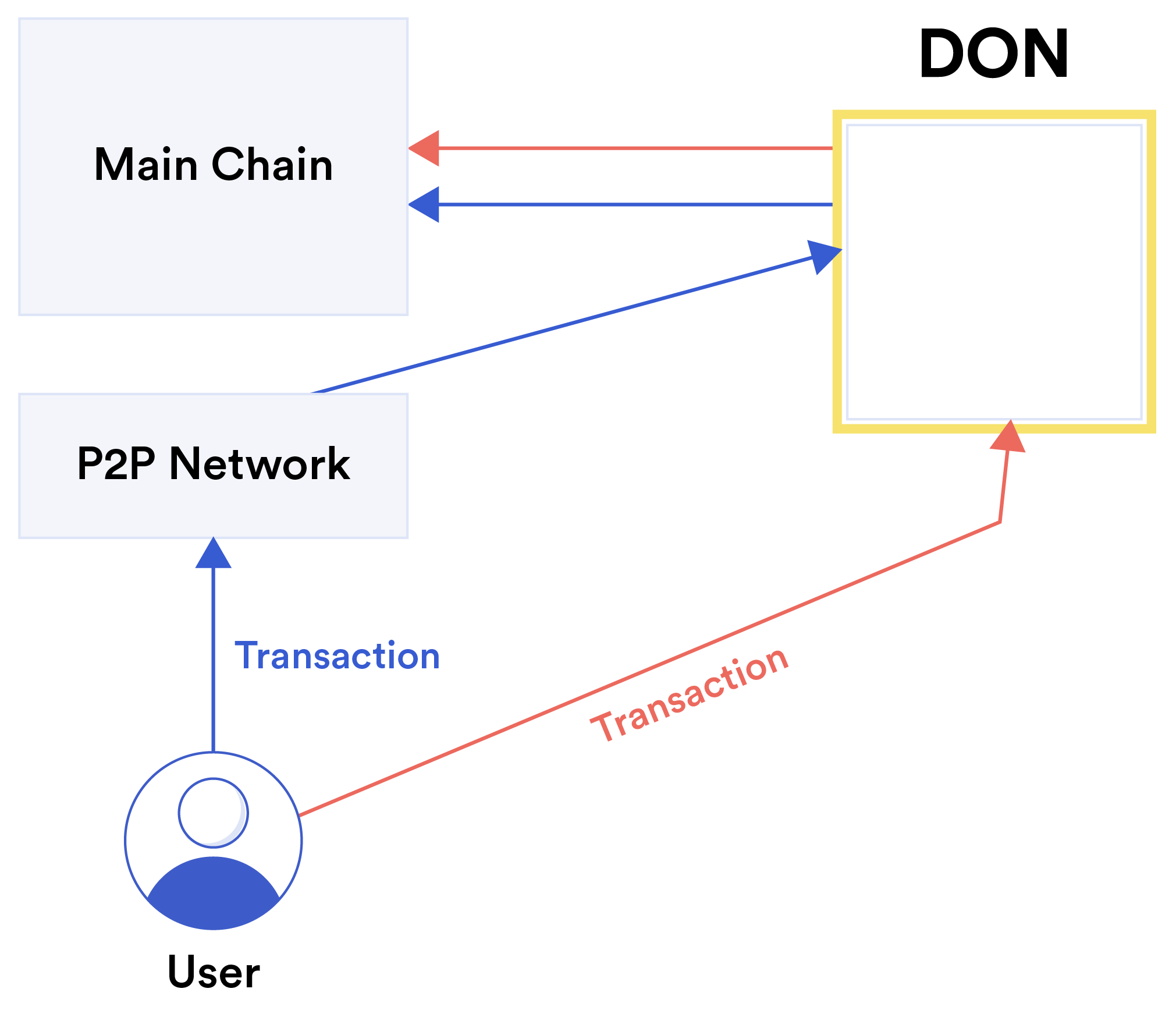
is distributed, no such order can be captured. FSS therefore introduces mechanisms to safeguard against violations of fairness, which arise only because of the distributed nature of the blockchain network. 5.2 FSS Details Figure 12: Order-fair mempool with two different transaction paths: direct and mempool-based. Fig. 12 shows a general schematic of the FSS. For ensuring fairness, the DON providing FSS must interfere with the flow of transactions as they enter MAINCHAIN. Adjustments to clients, to smart contracts on MAINCHAIN, or to both may be necessary. At a high level, processing of transactions by FSS can be decomposed into three phases, described below: (1) Transaction monitoring; (2) Transaction sequencing; and (3) Transaction posting. Depending on the ordering method used for transaction sequencing, additional protocol steps are needed, as described in the next section. 5.2.1 Transaction Processing Transaction monitoring: We envision two different approaches for FSS to monitor user transactions destined for a specific smart contract, direct and mempool-based: • Direct: The direct approach is conceptually simplest, but requires changes to user clients so that transactions are sent directly to the Decentralized Oracle
Network nodes, rather than to the nodes of the main chain. The DON collects user transactions destined to a specific smart contract SC and orders them based on some ordering policy. The DON then sends the ordered transactions to the smart contract on the main chain. Some ordering mechanisms also require the direct approach because the user that creates a transaction must cryptographically protect it before sending it to FSS. • Mempool-based: To facilitate the integration of FSS with legacy clients, the DON can use Mempool Services (MS) to monitor the main chain’s mempool and collect transactions. Direct transmission is likely to be the preferred implementation for many contracts, and we believe it should be fairly practical in many cases. We briefly discuss how existing DApps could be minimally modified to support direct transmission while preserving a good user experience. We describe approaches using Ethereum and MetaMask [6] since these are the most popular choices today, but the mentioned techniques should extend to other chains and wallets. A recent Ethereum Improvement Proposal, “EIP-3085: Wallet add Ethereum chain RPC method” [100], will make it easy to target custom Ethereum chains (using a different CHAIN ID than that of MAINCHAIN to prevent replay attacks) from MetaMask and other browserbased wallets. After implementation of this proposal, a DApp seeking to use a DON would simply add a single method call to their front-end to be able to directly transmit transactions to any DON exposing an Ethereum-compatible API. In the meantime, “EIP-712: Ethereum typed structured data hashing and signing” [49] provides a slightly more involved but already widely deployed alternative, where a DApp user can use MetaMask to sign structured data specifying a DON transaction. The DApp can send this signed structured data to the DON. Finally, we note that hybrid approaches are also possible. For example, legacy clients can continue to send transactions into the main chain’s mempool, but critical transactions (e.g., oracle reports) are sent to DON nodes directly (in particular, the set of nodes providing oracle reports such as price-feed updates and the set of nodes providing FSS may overlap or be identical). Transaction sequencing: The main purpose of FSS is to guarantee that user transactions are ordered according to a pre-defined policy. The nature of this policy will depend on the application’s needs and the types of unfair transaction orderings that it aims to prevent. Since FSS on the DON is capable of processing data and maintaining local state, they may impose an arbitrary sequencing policy based on the information that is available at the oracles. The particular ordering policies and their implementation are discussed subsequently in Section 5.3.
Transaction posting: After collecting and ordering user transactions, received either directly from users or collected from the mempool, the DON sends these transactions to the main chain. As such, a DON’s interactions with the main chain remain subject to (potentially unfair) transaction ordering governed by the main chain’s miners. To harness the benefits of decentralized transaction ordering, the target smart contract SC thus has to be designed to treat the DON as a “first-class” citizen. We distinguish two approaches: • DON-only contracts: The simplest design option is to have the main chain smart contract SC only accept transactions that have been processed by the DON. This ensures that the smart contract processes transactions in the order proposed by the DON, but de-facto restricts the smart contract to operating in a committeebased system (i.e., the DON committee now has ongoing power to determine the ordering and inclusion of transactions). • Dual-class contracts: A preferred, more granular design has the main chain smart contract SC accept transactions originating both from the DON and from legacy users,10 but places traditional “speed bumps” on transactions that were not processed by the DON. For example, transactions from the DON may be processed immediately, whereas legacy transactions get “buffered” by the smart contract for a fixed period of time. Other standard mechanisms for preventing front-running such as commit-reveal schemes or VDFs [53] could also be applied to legacy transactions. This ensures that DON-ordered transactions do get processed in the order agreed upon, without giving the DON the unwanted power to censor transactions. As the imposition of transaction ordering by FSS requires that transactions are aggregated “off-chain,” this solution is naturally combined with other aggregation techniques that aim to reduce on-chain processing costs. For example, after collecting and ordering transactions, the DON may send these transactions to the main chain as a single “batched transaction” (e.g., a rollup), thereby reducing the aggregate transaction fee. Enforcing the transaction order: Whether in a DON-only or dual-class design, the main chain smart contract SC and the DON have to be co-designed so as to guarantee that the DON’s transaction ordering is upheld. Here also, we envision different design options: • Sequence numbers: The DON can append a sequence number to each transaction, and send these transactions into the main chain’s mempool. The main 10If the DON’s transaction monitoring is based on the mempool, legacy transactions must be distinguishable from DON transactions so that they are not collected by the DON, e.g., via a special tag embedded in the transaction or by specifying a particular gas price, e.g. DON transactions have gas prices below a certain threshold.
chain smart contract SC ignores transactions that arrive “out-of-sequence.” We note that in this setting, the main-chain miners can decide to ignore the DON’s transaction ordering, thereby causing transactions to fail. It is possible by keeping (expensive) state for SC to enforce correct transaction ordering, somewhat analogously to how TCP buffers out-of-order packets until missing packets are received. • Transaction nonces: For many blockchains, and in particular for Ethereum, the above sequence-numbering approach can leverage built-in transaction nonces to enforce that the main-chain smart contract SC processes transactions in sequence. Here, the DON nodes send transactions to the main chain through a single mainchain account, protected with a key shared among the DON nodes. The account’s transaction nonce ensures that transactions are mined and processed in the correct order. • Aggregate transactions: The DON can aggregate multiple transactions in a rollup (or in a bundle similar to a rollup). The main-chain smart contract needs to be designed to handle such aggregate transactions. • Aggregate transactions with a main chain proxy: Here, the DON similarly bundles transactions into one “meta-transaction” for the main chain, but relies on a custom proxy smart contract to unpack the transactions and relay them to the target contract SC. This technique can be useful for legacy compatibility. Metatransactions act like rollups but differ in that they consist of an uncompressed list of transactions posted once to the main chain. The last design has the advantage of seamlessly supporting user transactions that are themselves proxied through a main chain contract before reaching the DON’s target contract SC. For example, consider a user who sends a transaction to some wallet contract, which in turn sends an internal transaction to SC. Assigning a sequence number to such a transaction would be tricky, unless the user’s wallet contract is specially designed to forward the sequence number with every internal transaction to SC. Similarly, such internal transactions cannot be easily aggregated into a metatransaction that is sent directly to SC. We discuss further design considerations for such proxied transactions below. 5.2.2 Transaction Atomicity Our discussion thus far has implicitly assumed that transactions interact with a single on-chain smart contract (e.g., a user sends a buy request to an exchange). Yet, in systems such as Ethereum, a single transaction can consist of multiple internal transactions, e.g., one smart contract calling a function in another contract. Below, we describe two high-level strategies for sequencing “multi-contract” transactions, while preserving the atomicity of the transaction (i.e., the sequence of actions prescribed by the transaction are all executed in the correct order, or not at all).
Strong atomicity: The simplest solution is to apply FSS, as described above, directly to entire “multi-contract” transactions. That is, users send their transactions into the network and FSS monitors, sequences, and posts these transactions to the main chain. This approach is technically simple, but has one potential limitation: If a user transaction interacts with two contracts SC1 and SC2 that both want to leverage fair sequencing services, then the sequencing policy of these two contracts has to be consistent. That is, given two different transactions tx1 and tx2 that each interacts with both SC1 and SC2, it must not be the case that the policy of SC1 orders tx1 before tx2 whereas the policy of SC2 prescribes the opposite order. For the vast majority of scenarios of interest, we envision that the sequencing policies adopted by different contracts will be consistent. For example, both SC1 and SC2 may want transactions to be ordered by their approximate arrival time in the mempool, and SC1 may further want certain oracle reports to always be delivered first. As the latter oracle report transactions do not interact with SC2, the policies are consistent. Weak atomicity: In its full generality, FSS could be applied at the level of individual internal transactions. Consider transactions of the form tx = { ˜txpre, ˜txSC, ˜txpost}, consisting of some initial transaction(s) ˜txpre, which results in an internal transaction ˜txSC to SC, which in turn issues internal transaction(s) ˜txpost. The sequencing policy of SC might determine how the internal transaction ˜txSC has to be ordered with respect to other transactions sent to SC, but leave open the sequencing order for ˜txpre and ˜txpost. Given the intrinsics of transaction processing in systems such as Ethereum, developing a sequencing service that targets specific internal transactions is not straightforward. With a specially designed contract SC, this may be realizable as follows: 1. The transaction tx is sent into the network and mined (without any sequencing performed by FSS). The initial ˜txpre is executed, and calls ˜txSC. 2. SC does not execute ˜txSC and returns. 3. FSS monitors internal transactions to SC, sequences them, and posts them back to SC (i.e., by sending transactions ˜txSC directly to SC). 4. SC processes the transactions ˜txSC received from FSS, and issues internal transactions ˜txpost that result from ˜txSC. With this approach, transactions are not executed fully atomically (i.e., the original transaction tx gets broken up into multiple on-chain transactions), but the ordering of internal transactions is preserved. This solution entails a number of design constraints. For example, ˜txpre cannot assume that ˜txSC and ˜txpost will be executed. Moreover, SC should be designed so as to execute transactions ˜txSC and ˜txpost on behalf of a certain user, even though they were
sent by FSS. For these reasons, the more coarse-grained “Strong Atomicity” solution above is likely preferable in practice. For respecting more complex dependencies, involving multiple transactions and their respective internal transactions, the transaction scheduler of FSS may contain elaborate functions that resemble those found in transaction managers of relational database managers. 5.3 Fair Transaction Sequencing Here we discuss two notions of fairness for transaction sequencing and the corresponding implementations, which may be realized by FSS: order-fairness based on a policy imposed by FSS and secure causality preservation, which requires additional cryptographic methods in FSS. Order-fairness: Order-fairness is a notion of temporal fairness in consensus protocols that has first been introduced formally by Kelkar et al. [144]. Kelkar et al. aim to achieve a form of natural policy in which transactions are ordered based on the time they are first received by the DON (or the P2P network, in the case of a mempool-based FSS). In a decentralized system, however, different nodes may see transactions arrive in a different order. Establishing a total order on all transactions is the very problem solved by the consensus protocol underlying MAINCHAIN. Kelkar et al. [144] therefore introduce a weaker notion that can be achieved with the help of a Decentralized Oracle Network, called “block-order fairness.” It groups the transactions that the DON has received during a time interval into a “block” and inserts all transactions of the block concurrently and at the same position (i.e., height) into MAINCHAIN. They are thus ordered together and must be executable in parallel, without creating any conflicts among them. Roughly speaking, orderfairness then states that if a large fraction of nodes see transaction \(\tau_1\) before \(\tau_2\), then \(\tau_1\) will be sequenced before or in the same block as \(\tau_2\). By imposing such a coarse granularity on transaction order, the opportunities for front-running and other orderrelated attacks are greatly reduced. Kelkar et al. propose a family of protocols called Aequitas [144], which address different deployment models, including synchronous, partially synchronous, and asynchronous network settings. Aequitas protocols impose significant communication overhead relative to basic BFT consensus and are therefore not ideal for practical use. We believe, however, that practical variants of Aequitas will emerge that can be used for transaction sequencing in FSS and other applications. Some related schemes have already been proposed that have less accompanying formalism and weaker properties, e.g., [36, 151, 236], but better practical performance. These schemes can be supported in FSS as well. It is also worth noting that the term “fairness” appears elsewhere in the blockchain literature with a different meaning, namely fairness in the sense of opportunity for
miners proportional to their committed resources [106, 181] or for validators in terms of equal opportunity [153]. Secure causality preservation: The most widely known approach to prevent frontrunning and other ordering violations in distributed platforms relies on cryptographic techniques. Their common feature is to hide the transaction data itself, waiting until the order at the consensus layer has been established, and to reveal the transaction data later for processing. This preserves the causal order among the transactions that are executed by the blockchain. The relevant security notions and cryptographic protocols have been developed considerably before the advent of blockchains [71, 190]. The security conditions of “input causality” [190] and “secure causality preservation” [71, 97] require formally that no information about a transaction becomes known before the position of this transaction in the global order has been determined. An adversary must not be able to infer any information until that time, in a cryptographically strong sense. One can distinguish four cryptographic techniques to preserve causality: • Commit-reveal protocols [29, 142, 145]: Instead of a transaction being announced in the clear, only a cryptographic commitment to the transaction is broadcast. After all committed but hidden transactions have been ordered (in early blockchain systems on MAINCHAIN itself, but here by FSS), the sender must open the commitment and reveal the transaction data within a predetermined time interval. The network then verifies that the opening satisfies the earlier commitment. The origins of this method date prior to the advent of blockchains. Although it is particularly simple, the approach introduces considerable drawbacks and is not easy to employ for two reasons. First, since only the commitment exists at the level of the ordering protocol, the semantics of the transaction cannot be validated during consensus. An additional round-trip to the client is required. More severely, though, weighs the possibility that no opening may ever arrive, which could amount to a denial-of-service attack. Furthermore, it is difficult to determine whether the opening is valid in a consistent, distributed manner because all participants must agree on whether the opening arrived in time. • Commit-reveal protocols with delayed recovery [145]: One challenge with the commit-reveal approach is that a client may commit to a transaction speculatively and reveal it later only if subsequent transactions make it profitable. A recent variant of the commit-reveal approach improves the resilience against this kind of misbehavior. In particular, the TEX protocol [145] addresses this problem using a clever approach in which encrypted transactions include a decryption key obtainable by computing a verifiable delay function (VDF) [53, 221]. If a client fails to decrypt her transaction in a timely way, others in the system will decrypt it on her behalf by solving a moderately hard cryptographic puzzle.
• Threshold encryption [71, 190]: This method exploits that the DON may perform threshold-cryptographic operations. Assume FSS maintains an encryption public key pkO and the oracles share the corresponding private key among themselves. Clients then encrypt transactions under pkO and send them to FSS. FSS orders transactions on the DON, then decrypts them, and finally injects them into MAINCHAIN in the fixed order. Encryption therefore ensures that ordering is not based on the transaction content, but that the data itself is available when needed. This method was originally proposed by Reiter and Birman [190] and later refined by Cachin et al. [71], where it was integrated with a permissioned consensus protocol. More recent work has explored the use of threshold cryptography as a consensus-level mechanism for generic messages [33, 97] and for general computations with shared data [41]. Compared to commit-reveal protocols, threshold encryption prevents simple denialof-service attacks (although care is required given the computational cost of decryption). It lets the DON proceed autonomously, at its own speed and without waiting for further client actions. Transactions may be validated immediately after they have been decrypted. Moreover, clients encrypt all transactions with one key for the DON and the communication pattern remains the same as with other transactions. Managing the threshold key securely and with changing nodes in O, however, may pose additional difficulties. • Committed secret sharing [97]: Instead of encrypting the transaction data under a key held by the DON, the client may also secret-share it for the nodes in O. Using a hybrid, computationally secure secret sharing scheme, the transaction is encrypted first using a symmetric cipher with a random key. Only the corresponding symmetric key is shared and the ciphertext is submitted to the DON. The client must send one key share to each node in O using a separately encrypted message. The remaining protocol steps are the same as with threshold encryption, except that the transaction data is decrypted with the symmetric algorithm after reconstructing the per-transaction key from its shares. This method does not require setup or management of a public-key cryptosystem associated with the DON. However, the clients must be aware of the nodes in O and communicate in a secure context with each one of them, which places additional burden on the clients. Although the cryptographic methods offer complete protection against information leaking from submitted transactions to the network, they do not conceal metadata. For example, an IP address or an Ethereum address of the sender could still be used by an adversary to perform front-running and other attacks. Various privacy-enhancing techniques deployed at the network layer, e.g., [52, 95, 107], or the transaction layer, e.g., [13, 65], would be needed to accomplish this goal. The impact of a particular piece of metadata, namely to which contract a transaction is sent, can be (partially) concealed
through multiplexing many contracts on the same DON. Cryptographic concealment of transactions per se also doesn’t prevent prioritization of transactions by corrupted DON nodes in collusion with transaction senders. Secure causality as guaranteed by cryptographic protocols complement the orderfairness guarantees for any policy, and we intend to explore a combination of the two methods, where this is possible. If an adversary cannot gain significant advantage from observing metadata, the secure causality-preservation protocols could be used alongside a na¨ıve ordering approach as well. For example, oracle nodes can write transactions to L as soon as they receive them, without duplication. Transactions would then be ordered according to their appearance on L and subsequently decrypted. We also plan to consider the use of TEEs as a way to help enforce fair ordering; for example, Tesseract [44] may be viewed as achieving a form of causal ordering, but one strengthened by the ability of the TEE to process transactions in explicit form while retaining their confidentiality. 5.4 Network-Layer Considerations So far, our description of FSS has mainly focused on the problem of enforcing that the finalized order of transactions matches their observed order in the network. Hereafter, we consider fairness issues that could arise at the network layer itself. High-frequency traders in conventional electronic marketplaces invest considerable resources to obtain superior network speed [64], and traders in cryptocurrency exchanges exhibit similar behavior [90]. Network speed confers an advantage both in observing the transactions of other parties and in submitting competing transactions. One remedy deployed in practice and popularized in the book Flash Boys [155] is the “speed bump” introduced initially in the IEX exchange [128] and later in other exchanges [179] (with mixed results [19]). This mechanism imposes a delay (350 microseconds in IEX) on access to the market, with the aim of neutralizing advantages in speed. Empirical evidence, e.g. [128], supports its efficacy in decreasing certain trading costs for ordinary investors. FSS can be used simply to implement an asymmetrical speed bump—one that delays incoming transactions. Budish, Cramton, and Shim [64] argue that exploitation of advantages in speed is inescapable in continuous-time markets, and argue for a structural remedy in the form of batch-auction-based markets. But this approach has not taken hold broadly in existing trading platforms. Conventional trading systems are centralized, typically receiving transactions through a single network connection. In a decentralized system, by contrast, it is possible to observe transaction propagation from multiple vantage points. Consequently, it is possible to observe behaviors such as network flooding in a P2P network. We intend to explore network-layer approaches to FSS that help developers to specify policies prohibiting such undesirable network behaviors.
5.5 Entity-Level Fairness Policies Order-fairness and secure causality aim at enforcing an ordering on transactions that respects the time when they were created and first submitted to the network. A limitation of this notion of fairness is that it does not prevent attacks in which an adversary gains an advantage by flooding a system with many transactions, a strategy observed in the wild as a way to perform effective transaction sniping in token sales [159] and to create congestion resulting in liquidation of collateralized debt positions (CDPs) [48]. In other words, order-fairness enforces fairness with respect to transactions, not players. As shown in the CanDID system [160], it is possible to use oracle tools such as DECO or Town Crier in conjunction with a committee of nodes (such as a DON) to achieve various forms of Sybil-resistance while protecting privacy. Users can register identities and provide evidence of their uniqueness without disclosing the identities themselves. Sybil-resistant credentials offer a possible approach to enriching transaction-ordering policies in a way that would limit opportunities for flooding attacks. For example, a token sale might permit only one transaction per registered user, where registration requires a proof of uniqueness of a national identifier, such as a Social Security Number. Such an approach isn’t foolproof, but may prove a useful policy to mitigate transactionflooding attacks.
निष्पक्ष अनुक्रमण सेवाएँ
एक महत्वपूर्ण सेवा जिसकी हमें उम्मीद है कि DONs उनकी नेटवर्किंग, गणना और भंडारण क्षमताओं का लाभ उठाएगी, उसे फेयर सीक्वेंसिंग सर्विसेज (एफएसएस) कहा जाता है। हालाँकि FSS को केवल DON ढांचे के भीतर साकार किए गए एक एप्लिकेशन के रूप में देखा जा सकता है, हम इसे एक ऐसी सेवा के रूप में उजागर करते हैं जिसके बारे में हमारा मानना है कि इसकी उच्च मांग होगी blockchains, और हम उम्मीद करते हैं कि Chainlink नेटवर्क सक्रिय रूप से समर्थन करेगा। जब सार्वजनिक blockchain नेटवर्क पर निष्पादित किया जाता है, तो आज के कई DeFi एप्लिकेशन ऐसी जानकारी प्रकट करें जिसका उपयोग उपयोगकर्ताओं द्वारा अपने लाभ के लिए किया जा सके अंदरूनी सूत्रों की लीक और हेराफेरी के ऐसे अवसर जो मौजूदा समय में व्यापक हैं बाज़ार [64,155]। इसके बजाय FSS एक निष्पक्ष DeFi पारिस्थितिकी तंत्र की ओर मार्ग प्रशस्त करता है। एफएसएस डेवलपर्स को DeFi अनुबंध बनाने में मदद करता है जो बाजार में हेरफेर से सुरक्षित हैं सूचना रिसाव के परिणामस्वरूप। जिन समस्याओं पर हम नीचे प्रकाश डाल रहे हैं, उन्हें देखते हुए एफएसएस है परत-2 सेवाओं के लिए विशेष रूप से आकर्षक और ऐसी सेवाओं के ढांचे के भीतर फिट बैठता है जिस पर हम धारा 6 में चर्चा करते हैं। चुनौती: मौजूदा अनुमति रहित प्रणालियों में, लेनदेन पूरी तरह से ऑर्डर किए जाते हैं खनिकों के विवेक पर. अनुमति प्राप्त नेटवर्क में, validator नोड्स लागू हो सकते हैं वही शक्ति. यह बड़े पैमाने पर गैर-मान्यता प्राप्त क्षणिक केंद्रीकरण का एक रूप है अन्यथा विकेन्द्रीकृत प्रणालियाँ। एक खनिक इसके लिए लेनदेन को (अस्थायी रूप से) सेंसर कर सकता है स्वयं का लाभ [171] या अपने स्वयं के लाभ को अधिकतम करने के लिए उन्हें पुन: व्यवस्थित करें, एक धारणा जिसे माइनएक्सट्रैक्टेबल वैल्यू (एमईवी) [90] कहा जाता है। एमईवी शब्द थोड़ा भ्रामक है: इसका संदर्भ नहीं है केवल उस मूल्य के लिए जिसे खनिक पकड़ सकते हैं: कुछ एमईवी को सामान्य उपयोगकर्ताओं द्वारा पकड़ा जा सकता है। चूँकि खनिकों के पास सामान्य उपयोगकर्ताओं की तुलना में अधिक शक्ति होती है, तथापि, एमईवी उस मूल्य की ऊपरी सीमा का प्रतिनिधित्व करता है जिसे कोई भी इकाई प्रतिकूल पुनर्क्रमण के माध्यम से प्राप्त कर सकती है। और पूरक लेनदेन प्रविष्टि। यहां तक कि जब खनिक आसानी से लेनदेन का आदेश देते हैं शुल्क (गैस) के आधार पर, बिना किसी हेरफेर के, उपयोगकर्ता स्वयं गैस की कीमतों में हेरफेर कर सकते हैं कम परिष्कार वाले लेन-देन की तुलना में अपने लेन-देन को बेहतर बनाने के लिए। डायन एट अल. [90] दस्तावेज़ और उन तरीकों की मात्रा निर्धारित करें जिनसे बॉट (खनिक नहीं) लेते हैं गैस गतिकी का लाभ इस तरह से जो आज DeFi सिस्टम के उपयोगकर्ताओं को नुकसान पहुँचाता है और कैसे MEV blockchain में अंतर्निहित सर्वसम्मति परत की स्थिरता को भी खतरे में डालता है। लेन-देन-आदेश हेरफेर के अन्य उदाहरण नियमित रूप से सामने आते हैं, उदाहरण के लिए, [50, 154]।नई लेन-देन-प्रसंस्करण विधियाँ जैसे rollups एक बहुत ही आशाजनक दृष्टिकोण हैं उच्च-थ्रूपुट blockchains की स्केलिंग समस्याओं के लिए। हालाँकि, वे संबोधित नहीं करते हैं एमईवी की समस्या. इसके बजाय, वे इसे उस इकाई में स्थानांतरित कर देते हैं जो rollup उत्पन्न करती है। वह इकाई, चाहे smart contract का संचालक हो या (zk-)rollup प्रस्तुत करने वाला उपयोगकर्ता हो एक वैधता प्रमाण, लेनदेन को ऑर्डर करने और सम्मिलित करने की शक्ति है। दूसरे शब्दों में, rollups आरईवी के लिए एमईवी को स्वैप करें: रोलअप-एक्सट्रैक्टेबल वैल्यू। एमईवी आगामी लेनदेन को प्रभावित करता है जो मेमपूल को सबमिट किए गए हैं लेकिन अभी तक श्रृंखला पर प्रतिबद्ध नहीं हैं। ऐसे लेन-देन की जानकारी मोटे तौर पर होती है नेटवर्क में उपलब्ध है. खनिक, validators, और सामान्य नेटवर्क प्रतिभागी ऐसा कर सकते हैं इसलिए इस ज्ञान का उपयोग करें और आश्रित लेनदेन बनाएं। इसके अलावा, खनिक और validators उन लेनदेन के क्रम को प्रभावित कर सकते हैं जो वे करते हैं स्वयं और अपने लाभ के लिए इसका फायदा उठाते हैं। सर्वसम्मति से लेनदेन के आदेश पर नेताओं द्वारा अनुचित प्रभाव की समस्या प्रोटोकॉल को साहित्य में 1990 के दशक से जाना जाता है [71, 190], लेकिन कोई संतोषजनक नहीं अब तक समाधान [97] व्यवहार में साकार हो चुके हैं। मुख्य कारण यह है कि प्रस्तावित समाधान - कम से कम हाल तक - जनता के साथ आसानी से एकीकृत नहीं किए जा सकते blockchains, क्योंकि वे लेन-देन की सामग्री को बाद तक गुप्त रहने पर निर्भर करते हैं उनका क्रम निर्धारित कर दिया गया है. फेयर सीक्वेंसिंग सर्विसेज (एफएसएस) सिंहावलोकन: DONs लेन-देन के आदेश को विकेंद्रीकृत करने और एक भरोसेमंद व्यक्ति द्वारा निर्दिष्ट नीति के अनुसार इसे लागू करने के लिए उपकरण प्रदान करेगा। अनुबंध निर्माता, आदर्श रूप से वह जो निष्पक्ष है, और जो अभिनेता ऐसा करना चाहते हैं उन्हें लाभ नहीं पहुंचाता है लेन-देन के क्रम में हेरफेर करें। सामूहिक रूप से, ये उपकरण एफएसएस का गठन करते हैं। एफएसएस में तीन घटक शामिल हैं। पहला है लेन-देन की निगरानी। एफएसएस में, O में oracle नोड्स दोनों MAINCHAIN के मेमपूल की निगरानी करते हैं और (यदि वांछित हो) अनुमति देते हैं एक विशेष चैनल के माध्यम से लेनदेन की ओ-चेन प्रस्तुति। दूसरा है लेन-देन का क्रम। ओ में नोड्स एक भरोसेमंद अनुबंध के लिए लेनदेन का आदेश देते हैं उस अनुबंध के लिए निर्धारित नीति के अनुसार। तीसरा लेनदेन की पोस्टिंग है। लेन-देन का आदेश दिए जाने के बाद, O में नोड्स संयुक्त रूप से लेन-देन भेजते हैं मुख्य श्रृंखला. एफएसएस के संभावित लाभों में शामिल हैं: • ऑर्डर-निष्पक्षता: एफएसएस में डेवलपर्स को लेनदेन सुनिश्चित करने में मदद करने के लिए उपकरण शामिल हैं किसी विशेष अनुबंध में इनपुट को इस तरह से ऑर्डर किया जाता है कि कोई अनुचित परिणाम न मिले अच्छी तरह से साधन-संपन्न और/या तकनीकी रूप से समझदार उपयोगकर्ताओं को लाभ। आदेश देने की नीतियां इस प्रयोजन के लिए निर्दिष्ट किया जा सकता है। • सूचना लीक को कम करना या समाप्त करना: यह सुनिश्चित करके कि नेटवर्क प्रतिभागी आगामी लेनदेन के बारे में ज्ञान का शोषण नहीं कर सकते, एफएसएस कम कर सकता है या फ्रंट-रनिंग जैसे हमलों को खत्म करें जो उपलब्ध जानकारी पर आधारित हैं लेन-देन करने से पहले नेटवर्क। ऐसे शोषण को रोकना रिसाव यह सुनिश्चित करता है कि प्रतिकूल लेनदेन जो मूल लंबित पर निर्भर हैं मूल लेन-देन किए जाने से पहले लेन-देन बही में दर्ज नहीं किया जा सकता।• कम लेनदेन लागत: सबमिट करने में खिलाड़ियों की गति की आवश्यकता को समाप्त करके smart contract पर उनका लेनदेन, FSS लेनदेन प्रसंस्करण की लागत को काफी कम कर सकता है। • प्राथमिकता क्रम: एफएसएस स्वचालित रूप से महत्वपूर्ण लेनदेन को विशेष प्राथमिकता दे सकता है आदेश देना उदाहरण के लिए, oracle के विरुद्ध सामने से चल रहे हमलों को रोकने के लिए रिपोर्ट, उदाहरण के लिए, [79], FSS लेन-देन की स्ट्रीम में oracle रिपोर्ट डाल सकता है पूर्वव्यापी रूप से। DONs में FSS का एक व्यापक लक्ष्य DeFi रचनाकारों को निष्पक्षता का एहसास करने के लिए सशक्त बनाना है वित्तीय प्रणालियाँ, अर्थात्, ऐसी प्रणालियाँ जो विशेष उपयोगकर्ताओं (या खनिकों) को लाभ नहीं पहुँचाती हैं गति, अंदरूनी ज्ञान या तकनीकी प्रदर्शन करने की क्षमता के आधार पर दूसरों से आगे हेराफेरी. जबकि निष्पक्षता की एक स्पष्ट, सामान्य धारणा मायावी है, और पूर्ण निष्पक्षता इसमें है कोई भी उचित अर्थ अप्राप्य है, एफएसएस का लक्ष्य डेवलपर्स को एक शक्तिशाली सुविधा प्रदान करना है उपकरणों का सेट ताकि वे उन नीतियों को लागू कर सकें जो DeFi के लिए उनके डिज़ाइन लक्ष्यों को पूरा करने में मदद करती हैं। हम ध्यान दें कि एफएसएस का मुख्य लक्ष्य एक निष्पक्ष अनुक्रमण सेवा के रूप में कार्य करना है मेनचेन जो DONs का लक्ष्य है, कुछ वही निष्पक्षता वांछनीय है जो FSS गारंटी (विकेंद्रीकृत) प्रोटोकॉल के लिए भी उपयुक्त हो सकती है जो बीच में चलाए जाते हैं DON पार्टियाँ। इस प्रकार, एफएसएस को अधिक व्यापक रूप से एक उपसमूह द्वारा प्रदान की गई सेवा के रूप में देखा जा सकता है DON नोड्स को उचित अनुक्रम में न केवल MAINCHAIN के उपयोगकर्ताओं द्वारा भेजे गए लेनदेन बल्कि अन्य DON नोड्स के बीच साझा किए गए लेनदेन (यानी, संदेश) भी। इस अनुभाग में, हम मुख्य रूप से मेनचेन लेनदेन को अनुक्रमित करने के लक्ष्य पर ध्यान केंद्रित करेंगे। अनुभाग संगठन: अनुभाग 5.1 में, हम दो उच्च-स्तरीय अनुप्रयोगों का वर्णन करते हैं जो एफएसएस के डिजाइन को प्रेरित करते हैं: oracle रिपोर्ट को सामने से चलने से रोकना और उपयोगकर्ता लेनदेन का फ्रंट-रनिंग। फिर हम एफएसएस के डिज़ाइन पर अधिक विवरण प्रदान करते हैं धारा 5.2 में. धारा 5.3 निष्पक्ष आदेश की गारंटी और साधनों के उदाहरणों का वर्णन करती है उन्हें हासिल करने के लिए. अंत में, धारा 5.4 और धारा 5.5 नेटवर्क-स्तरीय खतरों पर चर्चा करते हैं नेटवर्क फ्लडिंग और सिबिल के लिए क्रमशः ऐसी नीतियां और उन्हें संबोधित करने के साधन आक्रमण. 5.1 सामने चल रही समस्या एफएसएस के लक्ष्यों और डिज़ाइन को समझाने के लिए, हम फ्रंट-रनिंग के दो सामान्य रूपों का वर्णन करते हैं हमले और मौजूदा समाधानों की सीमाएँ। फ्रंट-रनिंग एक क्लास का उदाहरण है लेन-देन-आदेश देने वाले हमले: कई संबंधित हमले हैं जैसे कि बैकरनिंग और सैंडविचिंग (फ्रंट-रनिंग प्लस बैक-रनिंग) [237] जिन्हें हम कवर नहीं करते हैं यहां, लेकिन कौन सा एफएसएस भी पता लगाने में मदद करता है। 5.1.1 ओरेकल फ्रंट-रनिंग blockchain अनुप्रयोगों को ओ-चेन डेटा प्रदान करने की अपनी पारंपरिक भूमिका में, oracles सामने चल रहे हमलों के लिए स्वाभाविक लक्ष्य बनें।विभिन्न मूल्य फ़ीड की आपूर्ति के लिए oracle का उपयोग करने के सामान्य डिज़ाइन पैटर्न पर विचार करें ऑन-चेन एक्सचेंज के लिए: समय-समय पर (हर घंटे कहें), oracle मूल्य डेटा एकत्र करता है विभिन्न परिसंपत्तियाँ और इन्हें एक विनिमय अनुबंध में भेजता है। ये मूल्य-डेटा लेनदेन स्पष्ट मध्यस्थता अवसर प्रस्तुत करें: उदाहरण के लिए, यदि नवीनतम oracle रिपोर्ट सूचीबद्ध करती है किसी संपत्ति के लिए बहुत अधिक कीमत, एक प्रतिद्वंद्वी oracle रिपोर्ट को आगे बढ़ा सकता है संपत्ति खरीदें और oracle की रिपोर्ट संसाधित होने के बाद तुरंत उन्हें दोबारा बेचें। स्पीड बम्प और पूर्वव्यापी मूल्य निर्धारण: oracle अग्रणी समस्या का स्वाभाविक समाधान oracle रिपोर्ट को अन्य लेनदेन पर विशेष प्राथमिकता देना है। के लिए उदाहरण के लिए, खनिकों को प्रक्रिया के लिए प्रोत्साहित करने के लिए oracle रिपोर्ट उच्च शुल्क के साथ भेजी जा सकती है उन्हें पहले. लेकिन यदि मध्यस्थता का अवसर अधिक है तो यह आगे बढ़ने से नहीं रोकेगा, न ही यह स्वयं खनिकों द्वारा मध्यस्थता को रोक सकता है। इस प्रकार कुछ एक्सचेंजों ने अधिक हेवीवेट "स्पीडबंप्स" को लागू करने का सहारा लिया है, जैसे प्रसंस्करण से पहले कई ब्लॉकों के लिए उपयोगकर्ता लेनदेन को कतारबद्ध करना उन्हें, या नई oracle रिपोर्ट आने पर कीमतों को पूर्वव्यापी रूप से समायोजित करना। इन समाधानों का नुकसान यह है कि वे विनिमय कार्यान्वयन में जटिलता जोड़ते हैं, भंडारण आवश्यकताओं में वृद्धि और इस प्रकार लेनदेन लागत, और उपयोगकर्ता अनुभव को बाधित करती है क्योंकि परिसंपत्ति विनिमय की पुष्टि एक महत्वपूर्ण समय अवधि के बाद ही की जाती है। गुल्लक पालना: एफएसएस पर आगे बढ़ने से पहले, हम पिग्गीबैकिंग पर चर्चा करते हैं, जो काफी सरल है oracle सामने चल रही समस्या का सुंदर समाधान। यह पते पर लागू नहीं है हालाँकि, अन्य परिदृश्यों में आगे चल रहा है। संक्षेप में, समय-समय पर ऑन-चेन अनुबंध पर रिपोर्ट भेजने के बजाय, oracles हस्ताक्षरित रिपोर्ट प्रकाशित करें जिसे उपयोगकर्ता खरीदते या बेचते समय अपने लेनदेन में जोड़ते हैं ऑन-चेन संपत्तियां। इसके बाद एक्सचेंज केवल यह जांचता है कि रिपोर्ट वैध और ताज़ा है (उदाहरण के लिए, oracle उन ब्लॉकों की श्रृंखला पर हस्ताक्षर कर सकता है जिनके लिए रिपोर्ट मान्य है), और उद्धरण इससे संबंधित मूल्य फ़ीड। उपरोक्त "स्पीड बम्प" की तुलना में इस सरल दृष्टिकोण के कई फायदे हैं दृष्टिकोण: (1) विनिमय अनुबंध को मूल्य फ़ीड की स्थिति रखने की आवश्यकता नहीं है, जो होनी चाहिए लेनदेन लागत कम हो जाएगी; (2) चूंकि oracle रिपोर्ट आवश्यकता के आधार पर श्रृंखला पर पोस्ट की जाती हैं, oracle अधिक लगातार अपडेट (उदाहरण के लिए, हर मिनट) उत्पन्न कर सकते हैं, जिससे रिपोर्ट9 को सामने से चलाने से मध्यस्थता के अवसरों को कम करना; (3) लेन-देन कर सकते हैं तुरंत मान्य किया जाए, क्योंकि उनमें हमेशा ताज़ा मूल्य फ़ीड शामिल होती है। हालाँकि, दृष्टिकोण सही नहीं है। सबसे पहले, यह पिग्गीबैकिंग समाधान डालता है एक्सचेंज के उपयोगकर्ताओं पर नवीनतम oracle रिपोर्ट लाने और उन्हें अपने साथ संलग्न करने का दायित्व है लेन-देन. दूसरा, जबकि गुल्लक मध्यस्थता के अवसरों को कम करती है, ऐसा नहीं हो सकता ऑन-चेन अनुबंध की जीवंतता को प्रभावित किए बिना उन्हें पूरी तरह से रोकें। वास्तव में, यदि कोई oracle रिपोर्ट कुछ ब्लॉक नंबर n तक मान्य है, फिर ब्लॉक में सबमिट किया गया लेनदेन n + 1 के लिए एक नई वैध रिपोर्ट की आवश्यकता होगी। के प्रसार में अंतर्निहित देरी के कारण oracles से उपयोगकर्ताओं को रिपोर्ट, नई रिपोर्ट जो ब्लॉक n + 1 के लिए मान्य है 9मध्यस्थता केवल तभी सार्थक है यदि परिसंपत्ति की कीमतों में शोषक अंतर बाहरी से अधिक हो परिसंपत्तियों को खरीदने और बेचने के लिए आवश्यक शुल्क, उदाहरण के लिए, खनिकों और एक्सचेंज द्वारा एकत्र की गई फीस।ब्लॉक n + 1 के खनन से कुछ समय पहले प्रचारित किया जाना चाहिए, जैसे कि ब्लॉक n −k पर, जिससे के ब्लॉक का एक क्रम बनाना जहां अल्पकालिक मध्यस्थता का अवसर मौजूद है। हम अब वर्णन करें कि एफएसएस इन सीमाओं से कैसे पार पाता है। FSS के साथ oracle रिपोर्ट को प्राथमिकता देना: FSS oracle फ्रंट-रनिंग को संबोधित कर सकता है उपरोक्त पिग्गीबैकिंग समाधान पर निर्माण करके, लेकिन अतिरिक्त को आगे बढ़ाकर समस्या विकेंद्रीकृत Oracle नेटवर्क को oracle रिपोर्ट के साथ लेनदेन बढ़ाने का कार्य। उच्च स्तर पर, oracle नोड्स ऑन-चेन एक्सचेंज के लिए नियत लेनदेन एकत्र करते हैं, वास्तविक समय मूल्य फ़ीड पर सहमत हों, और एकत्रित लेनदेन के साथ मूल्य फ़ीड को मुख्य-श्रृंखला अनुबंध पर पोस्ट करें। वैचारिक रूप से, कोई इस दृष्टिकोण के बारे में सोच सकता है "डेटा-संवर्धित लेनदेन बैचिंग", जहां oracle यह सुनिश्चित करता है कि अद्यतित मूल्य फ़ीड हमेशा लेनदेन में जोड़ा जाता है। एफएसएस समाधानों को एक्सचेंज के उपयोगकर्ताओं के लिए पारदर्शी रूप से लागू किया जा सकता है अनुबंध तर्क में न्यूनतम परिवर्तन, जैसा कि हम धारा 5.2 में अधिक विस्तार से वर्णन करते हैं। सुनिश्चित करना ताजा oracle रिपोर्ट को हमेशा उपयोगकर्ता लेनदेन पर प्राथमिकता दी जाती है, यह सिर्फ एक उदाहरण है एक आदेश देने की नीति जिसे एफएसएस अपना सकता है और लागू कर सकता है। व्यवस्था सुनिश्चित करने के लिए एफएसएस की नीतियां निष्पक्षता का अधिक सामान्यतः वर्णन धारा 5.3 में किया गया है। 5.1.2 फ्रंट-रनिंग उपयोगकर्ता लेनदेन अब हम सामान्य अनुप्रयोगों में फ्रंट-रनिंग की ओर मुड़ते हैं, जहां रक्षा पद्धति ऊपर दी गई है काम नहीं करता. समस्या को निम्नलिखित परिदृश्य के माध्यम से मोटे तौर पर समझा जा सकता है: एक प्रतिद्वंद्वी पी2पी नेटवर्क में भेजे गए कुछ उपयोगकर्ता लेनदेन टीएक्स1 को देखता है और इंजेक्ट करता है इसका अपना प्रतिकूल लेनदेन tx2 है, ताकि tx2 को tx1 से पहले संसाधित किया जा सके (उदाहरण के लिए, भुगतान करके) एक उच्च लेनदेन शुल्क)। उदाहरण के लिए, इस तरह की फ्रंट-रनिंग आम बात है बॉट जो DeFi सिस्टम [90] में मध्यस्थता के अवसरों का फायदा उठाते हैं और इसके उपयोगकर्ताओं को प्रभावित करते हैं विभिन्न विकेन्द्रीकृत अनुप्रयोग [101]। लेन-देन के बीच उचित आदेश लागू करना blockchain पर संसाधित इस समस्या का समाधान करता है। अधिक मौलिक रूप से, tx1 का विवरण देखना कभी-कभी आवश्यक भी नहीं होता है इसके अस्तित्व का ज्ञान ही किसी विरोधी को इसके माध्यम से tx1 को आगे बढ़ाने की अनुमति दे सकता है tx2 का स्वामी बनें और tx1 बनाने वाले निर्दोष उपयोगकर्ता को धोखा दें। उदाहरण के लिए, उपयोगकर्ता हो सकता है नियमित समय पर किसी विशेष परिसंपत्ति का व्यापार करने के लिए जाना जाता है। ऐसे हमलों को रोकने की जरूरत है शमन जो मेटाडेटा के रिसाव को भी रोकते हैं [62]। इस समस्या के कुछ समाधान मौजूद हैं, लेकिन वे देरी और प्रयोज्य संबंधी चिंताएं पेश करते हैं। एफएसएस के साथ नेटवर्क-ऑर्डर से अंतिम-ऑर्डर तक: आगे बढ़ने के अवसर उत्पन्न होता है क्योंकि मौजूदा प्रणालियों में यह सुनिश्चित करने के लिए कोई तंत्र नहीं है कि किस क्रम में लेनदेन घटनाओं के क्रम और सूचना प्रवाह का सम्मान करते हुए श्रृंखला पर दिखाई देते हैं नेटवर्क के बाहर. यह blockchain पर अनुप्रयोगों (उदाहरण के लिए, ट्रेडिंग प्लेटफॉर्म) के कार्यान्वयन में कमियों से उत्पन्न होने वाली समस्या का प्रतिनिधित्व करता है। आदर्श रूप से, कोई ऐसा करेगा सुनिश्चित करें कि लेनदेन blockchain पर उसी क्रम में किए गए हैं जैसे वे थे बनाया और blockchain के P2P नेटवर्क पर भेजा गया। लेकिन blockchain नेटवर्क के बाद से
वितरित किया गया है, ऐसे किसी भी आदेश पर कब्जा नहीं किया जा सकता है। इसलिए एफएसएस तंत्र का परिचय देता है
निष्पक्षता के उल्लंघन से सुरक्षा के लिए, जो केवल वितरित होने के कारण उत्पन्न होते हैं
blockchain नेटवर्क की प्रकृति।
5.2
एफएसएस विवरण
चित्र 12:
दो अलग-अलग लेनदेन पथों के साथ ऑर्डर-फेयर मेमपूल:
प्रत्यक्ष और
मेमपूल-आधारित।
चित्र 12 एफएसएस की एक सामान्य योजना दिखाता है। निष्पक्षता सुनिश्चित करने के लिए, FSS प्रदान करने वाले DON को मेनचेन में प्रवेश करते ही लेनदेन के प्रवाह में हस्तक्षेप करना चाहिए।
ग्राहकों के लिए, MAINCHAIN पर smart contracts, या दोनों के लिए समायोजन आवश्यक हो सकता है। उच्च स्तर पर, एफएसएस द्वारा लेनदेन के प्रसंस्करण को तीन में विघटित किया जा सकता है
चरण, नीचे वर्णित: (1) लेन-देन की निगरानी; (2) लेनदेन अनुक्रमण; और
(3) लेनदेन पोस्टिंग। लेन-देन अनुक्रमण के लिए उपयोग की जाने वाली ऑर्डरिंग विधि के आधार पर, अतिरिक्त प्रोटोकॉल चरणों की आवश्यकता होती है, जैसा कि अगले भाग में वर्णित है।
5.2.1
लेन-देन प्रसंस्करण
लेन-देन की निगरानी:
हम एफएसएस की निगरानी के लिए दो अलग-अलग तरीकों की कल्पना करते हैं
विशिष्ट smart contract के लिए नियत उपयोगकर्ता लेनदेन, प्रत्यक्ष और मेमपूल-आधारित:
• प्रत्यक्ष: प्रत्यक्ष दृष्टिकोण वैचारिक रूप से सबसे सरल है, लेकिन इसमें बदलाव की आवश्यकता है
उपयोगकर्ता क्लाइंट ताकि लेनदेन सीधे विकेंद्रीकृत ओरेकल को भेजा जा सकेमुख्य श्रृंखला के नोड्स के बजाय नेटवर्क नोड्स। DON एकत्रित होता है
उपयोगकर्ता लेनदेन एक विशिष्ट smart contract SC के लिए नियत होते हैं और उनके आधार पर आदेश देते हैं
कुछ आदेश नीति पर. DON फिर ऑर्डर किए गए लेनदेन को भेजता है
मुख्य श्रृंखला पर smart contract। कुछ ऑर्डरिंग तंत्रों को भी प्रत्यक्ष दृष्टिकोण की आवश्यकता होती है क्योंकि जो उपयोगकर्ता लेनदेन बनाता है उसे क्रिप्टोग्राफ़िक रूप से करना होगा
एफएसएस को भेजने से पहले इसे सुरक्षित रखें।
• मेमपूल-आधारित: पुराने ग्राहकों के साथ एफएसएस के एकीकरण की सुविधा के लिए, DON
मुख्य श्रृंखला के मेमपूल की निगरानी और संग्रहण के लिए मेमपूल सर्विसेज (एमएस) का उपयोग कर सकते हैं
लेन-देन.
कई अनुबंधों के लिए प्रत्यक्ष प्रसारण पसंदीदा कार्यान्वयन होने की संभावना है,
और हमारा मानना है कि यह कई मामलों में काफी व्यावहारिक होना चाहिए।
हम संक्षेप में चर्चा करते हैं कि कैसे मौजूदा डीएपी को समर्थन के लिए न्यूनतम रूप से संशोधित किया जा सकता है
एक अच्छा उपयोगकर्ता अनुभव बनाए रखते हुए सीधा प्रसारण। हम दृष्टिकोण का वर्णन करते हैं
Ethereum और मेटामास्क [6] का उपयोग करना क्योंकि ये आज सबसे लोकप्रिय विकल्प हैं, लेकिन
उल्लिखित तकनीकों का विस्तार अन्य श्रृंखलाओं और वॉलेटों तक होना चाहिए। हाल ही का Ethereum
सुधार प्रस्ताव, "ईआईपी-3085: वॉलेट ऐड Ethereum चेन आरपीसी विधि" [100],
इससे कस्टम Ethereum श्रृंखलाओं को लक्षित करना आसान हो जाएगा (इसकी तुलना में भिन्न CHAIN ID का उपयोग करके)
मेटामास्क और अन्य ब्राउज़र आधारित वॉलेट से रीप्ले हमलों को रोकने के लिए मेनचेन की। इस प्रस्ताव के कार्यान्वयन के बाद, एक डीएपी DON का उपयोग करना चाहता है
सीधे संचारित करने में सक्षम होने के लिए बस अपने फ्रंट-एंड पर एक एकल विधि कॉल जोड़ देगा
किसी भी DON पर लेनदेन एक Ethereum-संगत एपीआई को उजागर करता है। इस बीच,
"EIP-712: Ethereum टाइप किया गया संरचित डेटा hashइंग और हस्ताक्षर करना" [49] थोड़ा सा प्रदान करता है
अधिक शामिल लेकिन पहले से ही व्यापक रूप से तैनात विकल्प, जहां एक डीएपी उपयोगकर्ता उपयोग कर सकता है
DON लेनदेन निर्दिष्ट करने वाले संरचित डेटा पर हस्ताक्षर करने के लिए मेटामास्क। डीएपी भेज सकता है
यह संरचित डेटा DON पर हस्ताक्षरित है।
अंत में, हम ध्यान दें कि संकर दृष्टिकोण भी संभव हैं।
उदाहरण के लिए, विरासत
ग्राहक मुख्य श्रृंखला के मेमपूल में लेनदेन भेजना जारी रख सकते हैं, लेकिन महत्वपूर्ण
लेन-देन (उदाहरण के लिए, oracle रिपोर्ट) सीधे DON नोड्स पर भेजे जाते हैं (विशेष रूप से,
नोड्स का सेट जो oracle रिपोर्ट प्रदान करता है जैसे मूल्य-फ़ीड अपडेट और नोड्स का सेट
एफएसएस प्रदान करना ओवरलैप हो सकता है या समान हो सकता है)।
लेन-देन अनुक्रमण:
एफएसएस का मुख्य उद्देश्य यह गारंटी देना है कि उपयोगकर्ता लेनदेन पूर्व-निर्धारित नीति के अनुसार ऑर्डर किए जाते हैं। इस नीति का स्वरूप होगा
यह एप्लिकेशन की ज़रूरतों और उसके द्वारा दिए जाने वाले अनुचित लेनदेन आदेशों के प्रकारों पर निर्भर करता है
रोकने का लक्ष्य है।
चूँकि DON पर FSS डेटा को संसाधित करने और स्थानीय स्थिति को बनाए रखने में सक्षम है,
वे उस जानकारी के आधार पर एक मनमाना अनुक्रमण नीति लागू कर सकते हैं
oracles पर उपलब्ध है।
विशेष आदेश देने वाली नीतियों और उनके कार्यान्वयन पर बाद में धारा 5.3 में चर्चा की गई है।लेन-देन पोस्टिंग:
उपयोगकर्ता लेनदेन को इकट्ठा करने और ऑर्डर करने के बाद, या तो सीधे उपयोगकर्ताओं से प्राप्त किया जाता है या मेमपूल से एकत्र किया जाता है, DON इन लेनदेन को मुख्य श्रृंखला में भेजता है। इस प्रकार, मुख्य श्रृंखला के साथ DON की सहभागिता बनी रहती है
मुख्य श्रृंखला के खनिकों द्वारा शासित (संभावित रूप से अनुचित) लेनदेन आदेश के अधीन। विकेंद्रीकृत लेनदेन आदेश के लाभों का दोहन करने के लिए, लक्ष्य स्मार्ट
इस प्रकार अनुबंध SC को DON को "प्रथम श्रेणी" नागरिक के रूप में मानने के लिए डिज़ाइन किया जाना चाहिए। हम
दो दृष्टिकोणों को अलग करें:
• DON-केवल अनुबंध: सबसे सरल डिज़ाइन विकल्प मुख्य श्रृंखला को स्मार्ट बनाना है
अनुबंध एससी केवल उन लेनदेन को स्वीकार करता है जिन्हें DON द्वारा संसाधित किया गया है। यह
यह सुनिश्चित करता है कि smart contract लेनदेन को प्रस्तावित क्रम में संसाधित करता है
DON, लेकिन वास्तव में smart contract को समिति आधारित प्रणाली में संचालन करने के लिए प्रतिबंधित करता है (यानी, DON समिति के पास अब यह निर्धारित करने की शक्ति है
लेनदेन का आदेश देना और शामिल करना)।
• दोहरे श्रेणी के अनुबंध: एक पसंदीदा, अधिक बारीक डिज़ाइन में मुख्य श्रृंखला स्मार्ट होती है
अनुबंध एससी DON और विरासत दोनों से उत्पन्न होने वाले लेनदेन को स्वीकार करता है
उपयोगकर्ता,10 लेकिन उन लेनदेन पर पारंपरिक "स्पीड बम्प" लगाते हैं जो DON द्वारा संसाधित नहीं किए गए थे। उदाहरण के लिए, DON से लेनदेन संसाधित किया जा सकता है
तुरंत, जबकि लीगेसी लेनदेन को smart contract द्वारा "बफ़र" किया जाता है
समय की एक निश्चित अवधि. फ्रंट-रनिंग को रोकने के लिए अन्य मानक तंत्र
जैसे कि प्रतिबद्ध-प्रकटीकरण योजनाएं या वीडीएफ [53] को विरासत पर भी लागू किया जा सकता है
लेन-देन. यह सुनिश्चित करता है कि DON-आदेशित लेनदेन संसाधित हो जाएं
DON को सेंसर करने की अवांछित शक्ति दिए बिना, आदेश पर सहमति हुई
लेन-देन.
चूंकि एफएसएस द्वारा लेनदेन आदेश लागू करने के लिए आवश्यक है कि लेनदेन को "ओ-चेन" में एकत्रित किया जाए, यह समाधान स्वाभाविक रूप से अन्य एकत्रीकरण तकनीकों के साथ संयुक्त है जिसका उद्देश्य ऑन-चेन प्रसंस्करण लागत को कम करना है। उदाहरण के लिए, संग्रह करने के बाद और
लेन-देन का आदेश देते समय, DON इन लेन-देन को मुख्य श्रृंखला में भेज सकता है
एकल "बैच लेनदेन" (जैसे, एक rollup), जिससे कुल लेनदेन कम हो जाता है
शुल्क.
लेन-देन आदेश लागू करना:
चाहे DON-केवल या दोहरे-श्रेणी डिज़ाइन में हो,
मुख्य श्रृंखला smart contract SC और DON को सह-डिज़ाइन किया जाना चाहिए ताकि यह गारंटी दी जा सके कि DON का लेनदेन ऑर्डर बरकरार रखा गया है। यहां भी, हम अलग-अलग कल्पना करते हैं
डिज़ाइन विकल्प:
• अनुक्रम संख्या: DON प्रत्येक लेनदेन में एक अनुक्रम संख्या जोड़ सकता है, और इन लेनदेन को मुख्य श्रृंखला के मेमपूल में भेज सकता है।
मुख्य
10यदि DON की लेनदेन निगरानी मेमपूल पर आधारित है, तो विरासत लेनदेन को DON लेनदेन से अलग किया जाना चाहिए ताकि उन्हें DON द्वारा एकत्र न किया जाए, उदाहरण के लिए, एक विशेष टैग के माध्यम से
लेन-देन में अंतर्निहित या किसी विशेष गैस मूल्य को निर्दिष्ट करके, उदाहरण के लिए। DON लेनदेन में गैस है
कीमतें एक निश्चित सीमा से नीचे।श्रृंखला smart contract SC "अनुक्रम से बाहर" आने वाले लेन-देन पर ध्यान नहीं देता है। हम
ध्यान दें कि इस सेटिंग में, मुख्य-श्रृंखला खनिक DON को अनदेखा करने का निर्णय ले सकते हैं
लेन-देन का आदेश देना, जिससे लेन-देन विफल हो जाता है। एससी के लिए कुछ हद तक सही लेनदेन आदेश को लागू करने के लिए (महंगी) स्थिति रखना संभव है
इसी तरह टीसीपी बफ़र्स आउट-ऑफ़-ऑर्डर पैकेटों को तब तक जारी रखता है जब तक कि पैकेट गायब न हो जाएं
प्राप्त.
• लेनदेन nonces: कई blockchains के लिए, और विशेष रूप से Ethereum के लिए,
उपरोक्त अनुक्रम-संख्यांकन दृष्टिकोण अंतर्निहित लेनदेन nonces का लाभ उठा सकता है
लागू करें कि मुख्य-श्रृंखला smart contract SC लेनदेन को अनुक्रम में संसाधित करती है।
यहां, DON नोड्स एकल मुख्य श्रृंखला खाते के माध्यम से मुख्य श्रृंखला में लेनदेन भेजते हैं, जो DON नोड्स के बीच साझा की गई कुंजी से सुरक्षित होता है। अकाउंट का
लेन-देन nonce यह सुनिश्चित करता है कि लेन-देन सही क्रम में खनन और संसाधित किया गया है।
• समग्र लेनदेन: DON एक rollup में एकाधिक लेनदेन को एकत्रित कर सकता है
(या rollup के समान बंडल में)। मुख्य श्रृंखला smart contract होनी चाहिए
ऐसे समग्र लेनदेन को संभालने के लिए डिज़ाइन किया गया है।
• मुख्य श्रृंखला प्रॉक्सी के साथ समग्र लेनदेन: यहां, DON मुख्य श्रृंखला के लिए लेनदेन को एक "मेटा-लेनदेन" में बंडल करता है, लेकिन एक पर निर्भर करता है
लेनदेन को अनपैक करने और उन्हें रिले करने के लिए कस्टम प्रॉक्सी smart contract
लक्ष्य अनुबंध एस.सी. यह तकनीक विरासत अनुकूलता के लिए उपयोगी हो सकती है। मेटाट्रांज़ैक्शन rollups की तरह कार्य करते हैं लेकिन इसमें भिन्नता है कि उनमें एक असंपीड़ित होता है
लेन-देन की सूची एक बार मुख्य श्रृंखला पर पोस्ट की गई।
अंतिम डिज़ाइन में उपयोगकर्ता लेनदेन का निर्बाध रूप से समर्थन करने का लाभ है
DON के लक्ष्य तक पहुंचने से पहले स्वयं को एक मुख्य श्रृंखला अनुबंध के माध्यम से प्रॉक्सी किया जाता है
अनुबंध एस.सी. उदाहरण के लिए, एक उपयोगकर्ता पर विचार करें जो किसी वॉलेट में लेनदेन भेजता है
अनुबंध, जो बदले में एससी को एक आंतरिक लेनदेन भेजता है। एक क्रम निर्दिष्ट करना
ऐसे लेन-देन के लिए नंबर देना मुश्किल होगा, जब तक कि उपयोगकर्ता का वॉलेट अनुबंध न हो
प्रत्येक आंतरिक लेनदेन के साथ क्रम संख्या को अग्रेषित करने के लिए विशेष रूप से डिज़ाइन किया गया
एससी.
इसी तरह, ऐसे आंतरिक लेनदेन को आसानी से मेटाट्रांसएक्शन में एकत्रित नहीं किया जा सकता है जो सीधे एससी को भेजा जाता है। हम आगे के डिज़ाइन संबंधी विचारों पर चर्चा करते हैं
ऐसे प्रॉक्सी लेनदेन नीचे दिए गए हैं।
5.2.2
लेन-देन परमाणुता
अब तक की हमारी चर्चा ने स्पष्ट रूप से यह मान लिया है कि लेन-देन किसी एक के साथ अंतःक्रिया करता है
ऑन-चेन smart contract (उदाहरण के लिए, एक उपयोगकर्ता किसी एक्सचेंज को खरीद अनुरोध भेजता है)। फिर भी, में
सिस्टम जैसे Ethereum, एक एकल लेनदेन में कई आंतरिक लेनदेन शामिल हो सकते हैं, उदाहरण के लिए, एक smart contract किसी फ़ंक्शन को दूसरे अनुबंध में कॉल करता है। नीचे, हम
जबकि, "बहु-अनुबंध" लेनदेन को अनुक्रमित करने के लिए दो उच्च-स्तरीय रणनीतियों का वर्णन करें
लेन-देन की परमाणुता को संरक्षित करना (अर्थात्, द्वारा निर्धारित क्रियाओं का क्रम)।
सभी लेन-देन सही क्रम में निष्पादित किए गए हैं, या बिल्कुल नहीं)।मजबूत परमाणुता:
सबसे सरल समाधान एफएसएस को लागू करना है, जैसा कि ऊपर वर्णित है, सीधे संपूर्ण "बहु-अनुबंध" लेनदेन पर। यानी यूजर्स अपना ट्रांजेक्शन भेजते हैं
नेटवर्क में और FSS इन लेनदेन की निगरानी, अनुक्रम और पोस्ट करता है
मुख्य श्रृंखला.
यह दृष्टिकोण तकनीकी रूप से सरल है, लेकिन इसकी एक संभावित सीमा है: यदि कोई उपयोगकर्ता
लेन-देन दो अनुबंधों SC1 और SC2 के साथ इंटरैक्ट करता है जिनका दोनों निष्पक्ष लाभ उठाना चाहते हैं
अनुक्रमण सेवाएँ, तो इन दोनों अनुबंधों की अनुक्रमण नीति सुसंगत होनी चाहिए। अर्थात्, दो अलग-अलग लेनदेन tx1 और tx2 दिए गए हैं जिनके साथ प्रत्येक इंटरैक्ट करता है
SC1 और SC2 दोनों, ऐसा नहीं होना चाहिए कि SC1 की नीति tx2 से पहले tx1 का आदेश दे
जबकि SC2 की नीति विपरीत क्रम निर्धारित करती है।
रुचि के अधिकांश परिदृश्यों के लिए, हम कल्पना करते हैं कि विभिन्न अनुबंधों द्वारा अपनाई गई अनुक्रमण नीतियां सुसंगत होंगी। उदाहरण के लिए, SC1 और SC2 दोनों
हो सकता है कि लेनदेन को मेमपूल में उनके अनुमानित आगमन समय के अनुसार ऑर्डर किया जाए,
और SC1 यह भी चाह सकता है कि कुछ oracle रिपोर्ट हमेशा पहले वितरित की जाएं। के रूप में
उत्तरार्द्ध oracle रिपोर्ट लेनदेन SC2 के साथ इंटरैक्ट नहीं करते हैं, नीतियां सुसंगत हैं।
कमजोर परमाणुता:
अपनी पूर्ण व्यापकता में, एफएसएस को व्यक्ति के स्तर पर लागू किया जा सकता है
आंतरिक लेनदेन.
फॉर्म tx = { ˜txpre, ˜txSC, ˜txpost} के लेनदेन पर विचार करें, जिसमें कुछ प्रारंभिक शामिल हैं
लेन-देन ˜txpre, जिसके परिणामस्वरूप आंतरिक लेन-देन ˜txSC से SC होता है, जो बदले में
आंतरिक लेन-देन जारी करता है ˜txpost। SC की अनुक्रमण नीति यह निर्धारित कर सकती है कि कैसे
आंतरिक लेनदेन ˜txSC को भेजे गए अन्य लेनदेन के संबंध में आदेश दिया जाना चाहिए
SC के लिए, लेकिन ˜txpre और ˜txpost के लिए अनुक्रमण आदेश खुला छोड़ दें।
Ethereum जैसी प्रणालियों में लेनदेन प्रसंस्करण की आंतरिक विशेषताओं को देखते हुए, एक अनुक्रमण सेवा विकसित करना जो विशिष्ट आंतरिक लेनदेन को लक्षित करता है, सीधा नहीं है। विशेष रूप से डिज़ाइन किए गए अनुबंध एससी के साथ, इसे निम्नानुसार साकार किया जा सकता है:
1. लेनदेन टीएक्स को नेटवर्क में भेजा जाता है और खनन किया जाता है (बिना किसी अनुक्रम के
एफएसएस द्वारा किया गया)। आरंभिक ˜txpre निष्पादित होता है, और ˜txSC को कॉल करता है।
2. SC ˜txSC निष्पादित नहीं करता और रिटर्न नहीं देता।
3. एफएसएस एससी को आंतरिक लेनदेन की निगरानी करता है, उन्हें अनुक्रमित करता है, और उन्हें वापस पोस्ट करता है
SC को (अर्थात, लेनदेन ˜txSC को सीधे SC को भेजकर)।
4. एससी एफएसएस से प्राप्त लेनदेन txSC' को संसाधित करता है, औरtxSC' से उत्पन्न आंतरिक लेनदेन `txpost जारी करता है।
इस दृष्टिकोण के साथ, लेनदेन पूरी तरह से परमाणु रूप से निष्पादित नहीं होते हैं (यानी, मूल
लेन-देन tx कई ऑन-चेन लेन-देन में टूट जाता है), लेकिन का क्रम
आंतरिक लेन-देन संरक्षित है.
इस समाधान में कई डिज़ाइन बाधाएँ शामिल हैं। उदाहरण के लिए, ˜txpre नहीं कर सकता
मान लें कि ˜txSC और ˜txpost निष्पादित किए जाएंगे। इसके अलावा, एससी को इस प्रकार डिज़ाइन किया जाना चाहिए
किसी निश्चित उपयोगकर्ता की ओर से लेनदेन ˜txSC और ˜txpost निष्पादित करें, भले ही वे थेएफएसएस द्वारा भेजा गया. इन कारणों से, अधिक मोटे दाने वाला "मजबूत परमाणु" समाधान
व्यवहार में उपरोक्त संभवतः बेहतर है।
अधिक जटिल निर्भरताओं का सम्मान करने के लिए, जिसमें कई लेनदेन शामिल हैं और
उनके संबंधित आंतरिक लेनदेन, एफएसएस के लेनदेन अनुसूचक में शामिल हो सकते हैं
विस्तृत फ़ंक्शन जो रिलेशनल के लेनदेन प्रबंधकों में पाए जाने वाले कार्यों से मिलते जुलते हैं
डेटाबेस प्रबंधक.
5.3
उचित लेनदेन अनुक्रमण
यहां हम लेन-देन अनुक्रमण और संबंधित कार्यान्वयन के लिए निष्पक्षता की दो धारणाओं पर चर्चा करते हैं, जिन्हें एफएसएस द्वारा महसूस किया जा सकता है: एक नीति के आधार पर आदेश-निष्पक्षता
एफएसएस द्वारा लगाया गया और सुरक्षित कार्य-कारण संरक्षण, जिसके लिए एफएसएस में अतिरिक्त क्रिप्टोग्राफ़िक तरीकों की आवश्यकता होती है।
आदेश-निष्पक्षता:
आदेश-निष्पक्षता सर्वसम्मति प्रोटोकॉल में अस्थायी निष्पक्षता की एक धारणा है
इसे सबसे पहले केलकर एट अल द्वारा औपचारिक रूप से पेश किया गया है। [144].
केलकर एट अल. इसका उद्देश्य प्राकृतिक नीति का एक ऐसा रूप प्राप्त करना है जिसमें लेन-देन हो
DON (या P2P नेटवर्क) द्वारा पहली बार प्राप्त होने के समय के आधार पर ऑर्डर किया गया,
मेमपूल-आधारित एफएसएस के मामले में)। हालाँकि, एक विकेन्द्रीकृत प्रणाली में, भिन्न
नोड्स लेनदेन को एक अलग क्रम में आते हुए देख सकते हैं।
कुल व्यवस्था स्थापित करना
सभी लेन-देन पर सर्वसम्मति प्रोटोकॉल द्वारा हल की गई समस्या ही अंतर्निहित है
मुख्य श्रृंखला।
केलकर एट अल. [144] इसलिए एक कमजोर धारणा प्रस्तुत करें जो हो सकती है
विकेंद्रीकृत ओरेकल नेटवर्क की मदद से हासिल किया गया, जिसे "ब्लॉक-ऑर्डर निष्पक्षता" कहा जाता है।
यह उन लेनदेन को समूहित करता है जो DON को एक समय अंतराल के दौरान प्राप्त हुए हैं
"ब्लॉक" और ब्लॉक के सभी लेनदेन को एक साथ और एक ही स्थिति में सम्मिलित करता है
(यानी, ऊंचाई) मेनचेन में। इस प्रकार उन्हें एक साथ आदेश दिया गया है और उन्हें निष्पादन योग्य होना चाहिए
समानांतर रूप से, उनके बीच कोई टकराव पैदा किए बिना।
मोटे तौर पर कहें तो, ऑर्डरफेयरनेस बताती है कि यदि नोड्स का एक बड़ा हिस्सा τ2 से पहले लेनदेन τ1 देखता है, तो
τ1 को τ2 से पहले या उसी ब्लॉक में अनुक्रमित किया जाएगा। इतना मोटा थोप कर
लेन-देन ऑर्डर पर ग्रैन्युलैरिटी, फ्रंट-रनिंग और अन्य ऑर्डर-संबंधी हमलों के अवसर बहुत कम हो जाते हैं।
केलकर एट अल. एक्विटास [144] नामक प्रोटोकॉल के एक परिवार का प्रस्ताव करें, जो पता है
सिंक्रोनस, आंशिक रूप से सिंक्रोनस और एसिंक्रोनस नेटवर्क सेटिंग्स सहित विभिन्न परिनियोजन मॉडल। एक्विटास प्रोटोकॉल बुनियादी BFT सर्वसम्मति के सापेक्ष महत्वपूर्ण संचार ओवरहेड लगाते हैं और इसलिए व्यावहारिक उपयोग के लिए आदर्श नहीं हैं।
हालाँकि, हमारा मानना है कि एक्विटास के व्यावहारिक संस्करण सामने आएंगे जिनका उपयोग किया जा सकता है
एफएसएस और अन्य अनुप्रयोगों में लेनदेन अनुक्रमण के लिए। कुछ संबंधित योजनाएं हैं
पहले से ही प्रस्तावित किया गया है कि इसमें कम औपचारिकता और कमजोर गुण हैं,
उदाहरण के लिए, [36, 151, 236], लेकिन बेहतर व्यावहारिक प्रदर्शन। इन योजनाओं का समर्थन किया जा सकता है
एफएसएस में भी.
यह भी ध्यान देने योग्य है कि शब्द "निष्पक्षता" blockchain में कहीं और दिखाई देता है
एक अलग अर्थ वाला साहित्य, अर्थात् अवसर के अर्थ में निष्पक्षताखनिक अपने प्रतिबद्ध संसाधनों के अनुपात में [106, 181] या validator के संदर्भ में
समान अवसर का [153]।
सुरक्षित कार्य-कारण संरक्षण:
वितरित प्लेटफ़ॉर्म में फ्रंटरनिंग और अन्य ऑर्डरिंग उल्लंघनों को रोकने के लिए सबसे व्यापक रूप से ज्ञात दृष्टिकोण क्रिप्टोग्राफ़िक पर निर्भर करता है
तकनीकें. उनकी सामान्य विशेषता लेनदेन डेटा को स्वयं छिपाना है, तब तक प्रतीक्षा करना
सर्वसम्मति स्तर पर आदेश स्थापित किया गया है, और लेनदेन डेटा प्रकट करने के लिए
बाद में प्रसंस्करण के लिए. यह होने वाले लेन-देन के बीच कारण क्रम को सुरक्षित रखता है
blockchain द्वारा निष्पादित। प्रासंगिक सुरक्षा धारणाएँ और क्रिप्टोग्राफ़िक प्रोटोकॉल
blockchains [71, 190] के आगमन से पहले काफी विकसित किया गया है।
"इनपुट कारणता" [190] और "सुरक्षित कारणता संरक्षण" [71, 97] की सुरक्षा शर्तों के लिए औपचारिक रूप से आवश्यक है कि लेनदेन के बारे में कोई जानकारी ज्ञात न हो
वैश्विक क्रम में इस लेनदेन की स्थिति निर्धारित होने से पहले। किसी प्रतिद्वंद्वी को क्रिप्टोग्राफ़िक रूप से उस समय तक किसी भी जानकारी का अनुमान लगाने में सक्षम नहीं होना चाहिए
मजबूत भावना.
कार्य-कारण को संरक्षित करने के लिए चार क्रिप्टोग्राफ़िक तकनीकों में अंतर किया जा सकता है:
• प्रतिबद्ध-प्रकटीकरण प्रोटोकॉल [29, 142, 145]: लेनदेन की घोषणा के बजाय
स्पष्ट रूप से, लेन-देन के लिए केवल एक क्रिप्टोग्राफ़िक प्रतिबद्धता प्रसारित की जाती है। आख़िरकार सभी प्रतिबद्ध लेकिन छिपे हुए लेन-देन का आदेश दे दिया गया है (शुरुआती blockchain में)
मेनचेन पर ही सिस्टम, लेकिन यहां एफएसएस द्वारा), प्रेषक को प्रतिबद्धता खोलनी होगी और पूर्व निर्धारित समय अंतराल के भीतर लेनदेन डेटा प्रकट करना होगा।
नेटवर्क तब सत्यापित करता है कि उद्घाटन पिछली प्रतिबद्धता को पूरा करता है। द
इस पद्धति की उत्पत्ति blockchains के आगमन से पहले की है।
यद्यपि यह विशेष रूप से सरल है, यह दृष्टिकोण काफी कमियां पेश करता है और दो कारणों से इसे नियोजित करना आसान नहीं है। सबसे पहले, चूंकि ऑर्डरिंग प्रोटोकॉल के स्तर पर केवल प्रतिबद्धता मौजूद है, लेनदेन का शब्दार्थ
सर्वसम्मति के दौरान मान्य नहीं किया जा सकता। ग्राहक के लिए एक अतिरिक्त राउंड-ट्रिप
आवश्यक है. हालाँकि, अधिक गंभीर रूप से, इस संभावना को तौला जाता है कि कोई उद्घाटन नहीं हो सकता है
कभी भी पहुंचें, जो सेवा से इनकार करने वाले हमले के बराबर हो सकता है। इसके अलावा, यह
यह निर्धारित करना कठिन है कि क्या उद्घाटन सुसंगत, वितरित में वैध है
तरीके से क्योंकि सभी प्रतिभागियों को इस बात पर सहमत होना चाहिए कि उद्घाटन हुआ या नहीं
समय.
• विलंबित पुनर्प्राप्ति के साथ प्रतिबद्ध-प्रकटीकरण प्रोटोकॉल [145]: इसके साथ एक चुनौती
प्रतिबद्ध-प्रकटीकरण दृष्टिकोण यह है कि एक ग्राहक किसी लेन-देन के लिए सट्टेबाजी कर सकता है और इसे बाद में तभी प्रकट कर सकता है जब बाद के लेन-देन इसे लाभदायक बनाते हैं। ए
प्रतिबद्ध-प्रकटीकरण दृष्टिकोण का हालिया संस्करण इसके विरुद्ध लचीलेपन में सुधार करता है
एक प्रकार का दुर्व्यवहार. विशेष रूप से, TEX प्रोटोकॉल [145] इस समस्या का समाधान करता है
एक चतुर दृष्टिकोण का उपयोग करना जिसमें एन्क्रिप्टेड लेनदेन में एक डिक्रिप्शन कुंजी शामिल होती है
सत्यापन योग्य विलंब फ़ंक्शन (वीडीएफ) [53, 221] की गणना करके प्राप्त किया जा सकता है। यदि कोई ग्राहक
यदि कोई व्यक्ति अपने लेनदेन को समय पर डिक्रिप्ट करने में विफल रहता है, तो सिस्टम में अन्य लोग डिक्रिप्ट कर देंगे
यह उसकी ओर से एक मामूली कठिन क्रिप्टोग्राफ़िक पहेली को हल करके किया गया है।• थ्रेसहोल्ड एन्क्रिप्शन [71, 190]: यह विधि यह फायदा उठाती है कि DON प्रदर्शन कर सकता है
थ्रेशोल्ड-क्रिप्टोग्राफ़िक संचालन। मान लें कि एफएसएस एक एन्क्रिप्शन सार्वजनिक बनाए रखता है
कुंजी pkO और oracles संबंधित निजी कुंजी को आपस में साझा करते हैं।
ग्राहक फिर पीकेओ के तहत लेनदेन को एन्क्रिप्ट करते हैं और उन्हें एफएसएस को भेजते हैं। एफएसएस आदेश
DON पर लेनदेन, फिर उन्हें डिक्रिप्ट करता है, और अंत में उन्हें इंजेक्ट करता है
निश्चित क्रम में मेनचेन। इसलिए एन्क्रिप्शन यह सुनिश्चित करता है कि ऑर्डर करना है
लेन-देन की सामग्री पर आधारित नहीं, बल्कि यह कि डेटा स्वयं कब उपलब्ध है
जरुरत.
यह विधि मूल रूप से रेइटर और बिरमन [190] द्वारा प्रस्तावित की गई थी और बाद में कैचिन एट अल द्वारा परिष्कृत की गई थी। [71], जहां इसे एक अनुमति प्राप्त सर्वसम्मति के साथ एकीकृत किया गया था
प्रोटोकॉल. हाल के कार्यों में थ्रेशोल्ड क्रिप्टोग्राफी के उपयोग का पता लगाया गया है
सामान्य संदेशों के लिए सर्वसम्मति-स्तरीय तंत्र [33, 97] और साझा डेटा के साथ सामान्य गणना के लिए [41]।
कमिट-रिवील प्रोटोकॉल की तुलना में, थ्रेशोल्ड एन्क्रिप्शन सरल इनकार-सेवा हमलों को रोकता है (हालांकि डिक्रिप्शन की कम्प्यूटेशनल लागत को देखते हुए देखभाल की आवश्यकता होती है)। यह DON को अपनी गति से और उसके बिना भी स्वायत्त रूप से आगे बढ़ने देता है
ग्राहक की आगे की कार्रवाइयों की प्रतीक्षा की जा रही है। डिक्रिप्ट होने के तुरंत बाद लेनदेन को मान्य किया जा सकता है। इसके अलावा, ग्राहक सभी लेनदेन को एक के साथ एन्क्रिप्ट करते हैं
DON के लिए कुंजी और संचार पैटर्न अन्य के समान ही रहता है
लेन-देन. थ्रेशोल्ड कुंजी को सुरक्षित रूप से और बदलते नोड्स के साथ प्रबंधित करना
हालाँकि, O अतिरिक्त कठिनाइयाँ पैदा कर सकता है।
• प्रतिबद्ध गुप्त साझाकरण [97]: इसके अंतर्गत लेनदेन डेटा को एन्क्रिप्ट करने के बजाय
DON के पास मौजूद कुंजी, ग्राहक इसे O में नोड्स के लिए गुप्त रूप से साझा भी कर सकता है।
हाइब्रिड, कम्प्यूटेशनल रूप से सुरक्षित गुप्त साझाकरण योजना, लेनदेन का उपयोग करना
पहले एक यादृच्छिक कुंजी के साथ एक सममित सिफर का उपयोग करके एन्क्रिप्ट किया जाता है। केवल संबंधित सममित कुंजी साझा की जाती है और सिफरटेक्स्ट DON पर सबमिट किया जाता है।
क्लाइंट को अलग से एन्क्रिप्टेड संदेश का उपयोग करके O में प्रत्येक नोड को एक कुंजी शेयर भेजना होगा। शेष प्रोटोकॉल चरण थ्रेशोल्ड के समान हैं
एन्क्रिप्शन, सिवाय इसके कि लेनदेन डेटा सममित के साथ डिक्रिप्ट किया गया है
अपने शेयरों से प्रति-लेन-देन कुंजी के पुनर्निर्माण के बाद एल्गोरिदम।
इस पद्धति के लिए सार्वजनिक-कुंजी क्रिप्टोसिस्टम के सेटअप या प्रबंधन की आवश्यकता नहीं है
DON से संबद्ध। हालाँकि, ग्राहकों को नोड्स के बारे में पता होना चाहिए
ओ और उनमें से हर एक के साथ एक सुरक्षित संदर्भ में संवाद करें, जो स्थान रखता है
ग्राहकों पर अतिरिक्त बोझ
हालाँकि क्रिप्टोग्राफ़िक विधियाँ सूचना के विरुद्ध पूर्ण सुरक्षा प्रदान करती हैं
सबमिट किए गए लेनदेन से नेटवर्क पर लीक होने के कारण, वे मेटाडेटा छिपाते नहीं हैं। के लिए
उदाहरण के लिए, प्रेषक का IP पता या Ethereum पता अभी भी उपयोग किया जा सकता है
अग्रिम मोर्चे पर और अन्य हमले करने के लिए एक प्रतिद्वंद्वी। विभिन्न गोपनीयता बढ़ाने वाले
नेटवर्क परत पर तैनात तकनीकें, उदाहरण के लिए, [52, 95, 107], या लेनदेन परत,
उदाहरण के लिए, [13, 65], इस लक्ष्य को पूरा करने के लिए आवश्यक होगा। किसी विशेष अंश का प्रभाव
मेटाडेटा का, अर्थात् जिस अनुबंध पर लेनदेन भेजा जाता है, उसे (आंशिक रूप से) छुपाया जा सकता हैएक ही DON पर कई अनुबंधों को मल्टीप्लेक्सिंग के माध्यम से। क्रिप्टोग्राफ़िक छिपाव
लेन-देन की संख्या भी भ्रष्ट द्वारा लेन-देन की प्राथमिकता को नहीं रोकती है
लेनदेन प्रेषकों के साथ मिलीभगत में DON नोड्स।
क्रिप्टोग्राफ़िक प्रोटोकॉल द्वारा गारंटीकृत सुरक्षित कार्य-कारण किसी भी नीति के लिए ऑर्डरफेयरनेस गारंटी का पूरक है, और हम दोनों के संयोजन का पता लगाने का इरादा रखते हैं
विधियाँ, जहाँ यह संभव है। यदि कोई विरोधी महत्वपूर्ण लाभ प्राप्त नहीं कर सकता है
मेटाडेटा का अवलोकन करते हुए, सुरक्षित कार्य-कारण-संरक्षण प्रोटोकॉल का उपयोग साथ में किया जा सकता है
एक भोला-भाला आदेश देने का दृष्टिकोण भी। उदाहरण के लिए, oracle नोड लेनदेन लिख सकते हैं
जैसे ही वे उन्हें प्राप्त करते हैं, बिना दोहराव के एल को। तब लेन-देन होगा
एल पर उनकी उपस्थिति के अनुसार आदेश दिया गया और बाद में डिक्रिप्ट किया गया।
हम निष्पक्ष आदेश लागू करने में मदद के लिए टीईई के उपयोग पर भी विचार करने की योजना बना रहे हैं; के लिए
उदाहरण के लिए, Tesseract [44] को कारणात्मक क्रम के एक रूप को प्राप्त करने के रूप में देखा जा सकता है, लेकिन एक
लेनदेन को स्पष्ट रूप में संसाधित करने की टीईई की क्षमता से मजबूत हुई
उनकी गोपनीयता बनाए रखना.
5.4
नेटवर्क-परत संबंधी विचार
अब तक, एफएसएस का हमारा विवरण मुख्य रूप से इसे लागू करने की समस्या पर केंद्रित है
लेन-देन का अंतिम क्रम नेटवर्क में उनके देखे गए क्रम से मेल खाता है। इसके बाद,
हम निष्पक्षता के मुद्दों पर विचार करते हैं जो नेटवर्क स्तर पर ही उत्पन्न हो सकते हैं।
पारंपरिक इलेक्ट्रॉनिक बाज़ारों में उच्च आवृत्ति वाले व्यापारी काफी निवेश करते हैं
बेहतर नेटवर्क गति प्राप्त करने के लिए संसाधन [64], और क्रिप्टोकरेंसी एक्सचेंजों में व्यापारी समान व्यवहार [90] प्रदर्शित करते हैं। नेटवर्क स्पीड दोनों में लाभ प्रदान करती है
अन्य पार्टियों के लेनदेन का अवलोकन करना और प्रतिस्पर्धी लेनदेन प्रस्तुत करना।
व्यवहार में लागू किया गया और फ्लैश बॉयज़ [155] पुस्तक में लोकप्रिय हुआ एक उपाय है
"स्पीड बम्प" शुरू में IEX एक्सचेंज [128] और बाद में अन्य में पेश किया गया
एक्सचेंज [179] (मिश्रित परिणामों के साथ [19])। यह तंत्र बाजार में लाभ को बेअसर करने के उद्देश्य से बाजार तक पहुंच में देरी (IEX में 350 माइक्रोसेकंड) लगाता है।
गति. अनुभवजन्य साक्ष्य, उदा. [128], कुछ व्यापार को कम करने में इसकी प्रभावशीलता का समर्थन करता है
आम निवेशकों के लिए लागत. एफएसएस का उपयोग केवल एक असममित कार्यान्वयन के लिए किया जा सकता है
स्पीड बम्प-वह जो आने वाले लेनदेन में देरी करता है।
बुडिश, क्रैमटन और शिम [64] का तर्क है कि गति में लाभ का दोहन किया जाता है
निरंतर समय के बाज़ारों में अपरिहार्य है, और इसमें एक संरचनात्मक उपाय के लिए तर्क दिया गया है
बैच-नीलामी-आधारित बाज़ारों का स्वरूप। लेकिन यह दृष्टिकोण व्यापक रूप से प्रभावी नहीं हो पाया है
मौजूदा ट्रेडिंग प्लेटफॉर्म में।
पारंपरिक व्यापार प्रणालियाँ केंद्रीकृत होती हैं, आमतौर पर लेनदेन प्राप्त करती हैं
एकल नेटवर्क कनेक्शन. इसके विपरीत, एक विकेन्द्रीकृत प्रणाली में, यह संभव है
अनेक सुविधाजनक बिंदुओं से लेन-देन के प्रसार का निरीक्षण करें। नतीजतन, पी2पी नेटवर्क में नेटवर्क फ्लडिंग जैसे व्यवहार का निरीक्षण करना संभव है।
हमारा इरादा है
एफएसएस के लिए नेटवर्क-लेयर दृष्टिकोण का पता लगाना जो डेवलपर्स को नीतियां निर्दिष्ट करने में मदद करता है
ऐसे अवांछनीय नेटवर्क व्यवहार पर रोक लगाना।5.5
इकाई-स्तरीय निष्पक्षता नीतियाँ
आदेश-निष्पक्षता और सुरक्षित कार्य-कारण का उद्देश्य लेनदेन पर एक आदेश लागू करना है
उस समय का सम्मान करता है जब वे बनाए गए थे और पहली बार नेटवर्क पर सबमिट किए गए थे। निष्पक्षता की इस धारणा की एक सीमा यह है कि यह किसी विरोधी के हमलों को नहीं रोकती है
एक रणनीति के अनुसार, सिस्टम में कई लेन-देन भरकर लाभ प्राप्त किया जाता है
token बिक्री [159] और में प्रभावी लेनदेन स्निपिंग करने के तरीके के रूप में जंगली में
संकुलन पैदा करें जिसके परिणामस्वरूप संपार्श्विक ऋण स्थिति (सीडीपी) [48] का परिसमापन होगा।
दूसरे शब्दों में, ऑर्डर-निष्पक्षता लेनदेन के संबंध में निष्पक्षता लागू करती है, खिलाड़ियों के संबंध में नहीं।
जैसा कि CanDID सिस्टम [160] में दिखाया गया है, DECO जैसे oracle टूल का उपयोग करना संभव है
या टाउन कैरियर को प्राप्त करने के लिए नोड्स की एक समिति (जैसे DON) के साथ मिलकर
गोपनीयता की रक्षा करते हुए सिबिल-प्रतिरोध के विभिन्न रूप। उपयोगकर्ता पहचान पंजीकृत कर सकते हैं
और स्वयं की पहचान उजागर किए बिना उनकी विशिष्टता का प्रमाण प्रदान करते हैं।
सिबिल-प्रतिरोधी क्रेडेंशियल लेनदेन-आदेश को समृद्ध करने के लिए एक संभावित दृष्टिकोण प्रदान करते हैं
ऐसी नीतियां जो बाढ़ के हमलों के अवसरों को सीमित कर देंगी। उदाहरण के लिए, ए
token बिक्री प्रति पंजीकृत उपयोगकर्ता केवल एक लेनदेन की अनुमति दे सकती है, जहां पंजीकरण
किसी राष्ट्रीय पहचानकर्ता की विशिष्टता के प्रमाण की आवश्यकता होती है, जैसे कि सामाजिक सुरक्षा संख्या।
ऐसा दृष्टिकोण मूर्खतापूर्ण नहीं है, लेकिन लेनदेन में बाढ़ के हमलों को कम करने के लिए एक उपयोगी नीति साबित हो सकती है।
The DON Transaction-Execution Framework
The DON Transaction-Execution Framework
(DON-TEF) DONs will provide oracle and decentralized-resource support for layer-2 solutions within what we call the Decentralized Oracle Network Transaction-Execution Framework (DONTEF) or TEF for short. Today, the frequency of updates to DeFi contracts is limited by main chain latencies, e.g., the 10-15 second average block interval in Ethereum [104]—as well as the cost of pushing large amounts of data on chain and limited computational/tx throughput— motivating scaling approaches such as sharding [148, 158, 232] and layer-2 execution [5, 12, 121, 141, 169, 186, 187]. Even blockchains with much faster transaction times, e.g., [120], have proposed scaling strategies that involve off-chain computation [168]. TEF is meant to act as a layer-2 resource for any such layer-1 / MAINCHAIN systems. Using TEF, DONs can support faster updates in a MAINCHAIN contract while retaining the key trust assurances provided by the main chain. TEF can support any of a number of layer-2 execution techniques and paradigms, including rollups,11 optimistic rollups, Validium, etc., as well as a threshold trust model in which DON nodes execute transactions. The TEF is complementary to FSS and intended to support it. In other words, any application running in the TEF can use FSS. 11Often called “zk-rollups,” a misnomer, as they do not necessarily need zero-knowledge proofs.
6.1 TEF Overview The TEF is a design pattern for the construction and execution of a performant hybrid smart contract SC. In accordance with the main idea behind hybrid smart contracts, TEF involves a decomposition of SC into two pieces: (1) What we call in the TEF context an anchor contract SCa on MAINCHAIN and (2) DON logic exect that we call the TEF executable. We use SC here to denote the logical contract implemented by the combination of SCa and exect. (As noted above, we expect to develop compiler tools to decompose a contract SC automatically into these components.) The TEF executable exect is the engine that processes users’ transactions in SC. It can execute in a performant way, as it runs on the DON. It has several functions: • Transaction ingestion: exect receives or fetches users’ transactions. It can do so directly, i.e., through transaction submission on the DON, or via the MAINCHAIN mempool using MS. • Fast transaction execution: exect processes transactions involving assets within SC. It does so locally, i.e., on the DON. • Fast and low-cost oracle / adapter access: exect has native access to oracle reports and other adapter data leading to, e.g., faster, cheaper, and more accurate asset pricing than MAINCHAIN execution. Moreover, off-chain oracle access reduces the oracle’s operational cost, hence the cost of using the system, by avoiding expensive on-chain storage. • Syncing: exect periodically pushes updates from DON onto MAINCHAIN, updating SCa. The anchor contract is the MAINCHAIN front end of SC. As the higher-trust component of SC, it serves several purposes: • Asset custody: Users’ funds are deposited into, held in, and withdrawn from SCa. • Syncing verification: SCa may verify the correctness of state updates when exect syncs, e.g., SNARKs attached to rollups. • Guard rails: SCa may include provisions to protect against corruption or failures in exect. (See Section 7 for more details.) In TEF, users’ funds are custodied on MAINCHAIN, meaning the DON is itself noncustodial. Depending on the choice of syncing mechanism (see below), users may need to trust the DON only for accurate oracle reports and timely syncing with MAINCHAIN. The resulting trust model is very similar to that for order-book-based DEXes, e.g., [2], which today generally include an off-chain component for order matching and an onchain component for clearing and settlement.
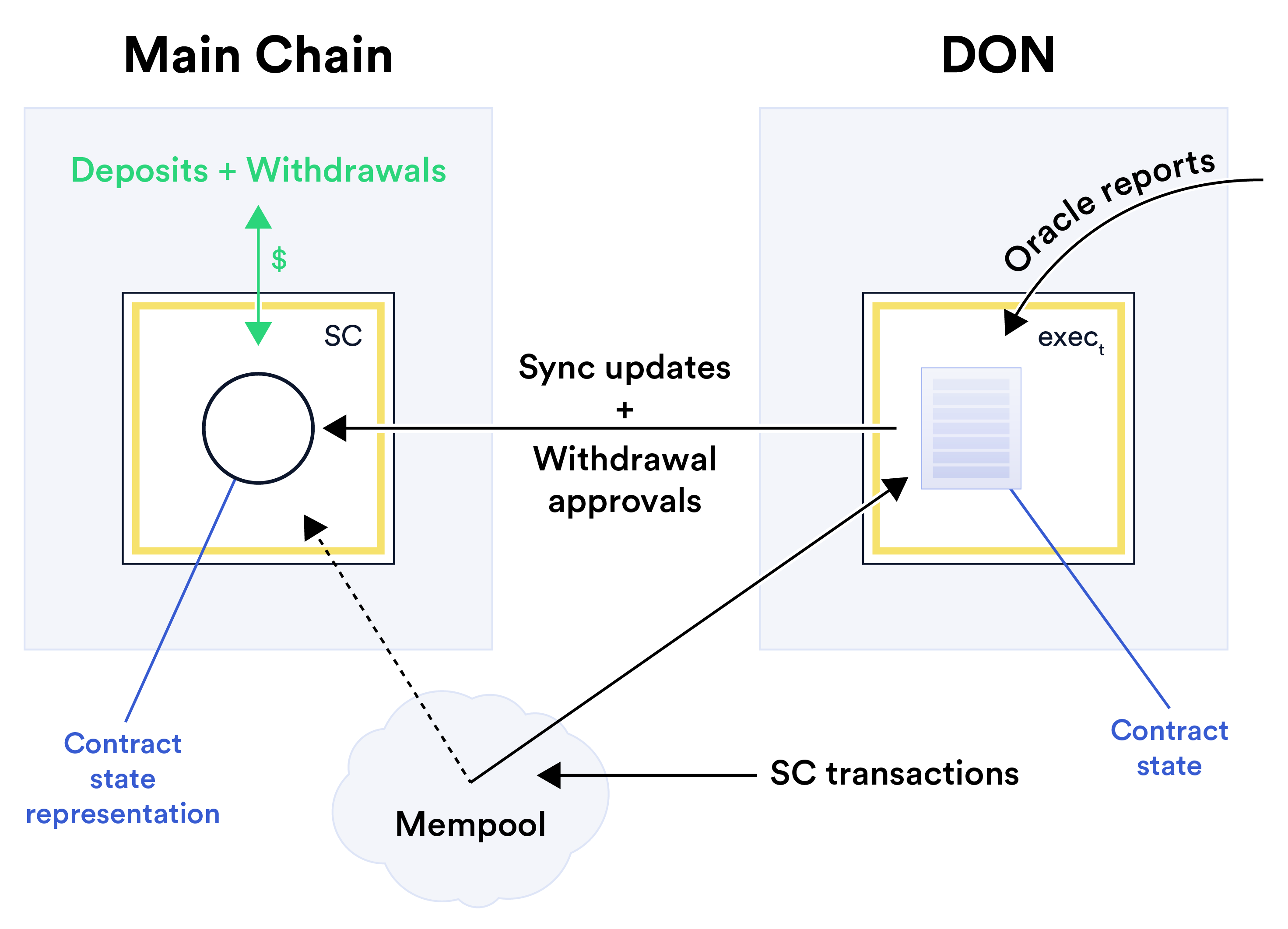
To use the vocabulary of payment systems, one may think of exect as the component of SC responsible for clearing, while SCa handles settlement. See Fig. 13 for a schematic depiction of TEF. Figure 13: TEF schematic. In this example, transactions pass through the mempool of MAINCHAIN via MS to the DON. TEF benefits: TEF carries three main benefits: • High performance: SC inherits the DON’s much higher throughput than MAINCHAIN for both transactions and oracle reports. Additionally, exect can process transactions faster and respond to oracle reports in a more timely way than an implementation on MAINCHAIN alone. • Lower fees: The process of syncing is less time-sensitive than transaction processing, and transactions can be sent from the DON to MAINCHAIN in batches. Consequently, the per-transaction on-chain fees (e.g., gas costs) with this approach are much lower than for a contract that runs only on MAINCHAIN. • Confidentiality: The confidentiality mechanisms of the DON can be brought to bear on SC.
TEF limitations: One limitation of TEF is that it does not support instantaneous withdrawals, as they occur only on MAINCHAIN: Upon sending a withdrawal request to SCa, a user may need to wait for exect to perform a state update that includes the withdrawal transaction before it can be approved. We discuss some partial remedies, however, in Section 6.2. Another limitation of TEF is that it does not support atomic composition of DeFi contracts on MAINCHAIN, specifically the ability to route assets through multiple DeFi contracts in a single transaction. TEF can, however, support such atomicity among DeFi contracts running on the same DON. We also discuss some ways to address this problem in Section 6.2. 6.2 Transaction Routing Transactions for SC can be sent by users directly to the DON or can be routed through the mempool in MAINCHAIN (via FSS). There are four distinct transaction types, each of which requires different handling: Within-contract transactions: Because it sidesteps the complications of gas dynamics, TEF provides SC more flexibility in its handling of transactions than would be available in a layer-1 contract. For example, while a mempool transaction in Ethereum can be overwritten by a fresh transaction with a higher gas price, SC can treat a transaction that operates on assets within SC as authoritative as soon as it becomes visible in the mempool. Consequently, SC need not wait for a transaction to be confirmed within a block, resulting in considerably reduced latency. Proxying: A user may wish to send a transaction \(\tau\) to SC via a wallet contract or other contract on MAINCHAIN. It is possible for the DON to simulate execution of \(\tau\) on MAINCHAIN to determine whether it results in a follow-on transaction to SC. If so, \(\tau\) can be sequenced with other transactions for SC that do. There are a few possibilities for how the DON identifies such transactions: (1) The DON can simulate all transactions in the mempool (an expensive approach); (2) Certain contracts or contract types, e.g., wallets, can be listed for monitoring by the DON; or (3) Users can annotate transactions for DON inspection. Matters become more complicated when a single transaction interacts with two contracts, SC1 and SC2, both of which use Fair Sequencing Services and have incompatible ordering policies. The DON might, for example, sequence \(\tau\) at the latest time that is compatible with both. Deposits: A transaction depositing a MAINCHAIN asset into SC needs to be confirmed in a block before SC can treat it as valid. When it detects the mining of a transaction that sends assets (e.g., Ether) into SCa, exect can instantly confirm the
deposit. For example, it can apply a current oracle-reported price on the DON to the asset. Withdrawals: As noted above, a limitation of TEF is that withdrawals cannot always be executed instantaneously. In a rollup-type execution model, the withdrawal request must be sequenced with other transactions, i.e., rolled up, in order to be safely processed. There are, however, some partial remedies to this limitation. If the DON can quickly compute a rollup validity proof up to the withdrawal transaction, then observing a user's transaction \(\tau\) in the mempool exect can send a stateupdate transaction \(\tau'\) for \(\tau\) at a higher gas price, a kind of beneficial front-running. Provided that \(\tau\) isn't mined before \(\tau'\) reaches the mempool, \(\tau'\) will precede \(\tau\), and \(\tau\) will effect an approved withdrawal. In a TEF variant where the DON is relied upon to compute state updates (see the threshold signing variant below), the DON can alternatively determine off-chain whether \(\tau\) ought to be approved given the state of SC upon its execution. The DON can then send a transaction \(\tau'\) that approves withdrawal \(\tau\)—without effecting a full state update. If this approach isn’t possible, or in cases where it doesn’t succeed, a DON-initiated transaction \(\tau'\) can send funds to the user in response to \(\tau\) so that the user need not initiate an additional transaction. 6.3 Syncing The TEF executable exect periodically pushes updates from DON to MAINCHAIN, updating the state of SCa in a process we refer to as syncing. Syncing may be thought of as propagation of layer-2 transactions to layer-1, so TEF can draw on any of a number of existing techniques for this purpose, including rollups [5, 12, 16, 69], optimistic rollups [10, 11, 141], Validium [201], or basic threshold signing, e.g., threshold BLS, Schnorr, or ECDSA [24, 54, 116, 202]. In principle, trusted execution environments can also attest to the correctness of state changes, offering a much more performant alternative to rollups, but with a hardware-dependent trust model. (See, e.g., [80].) Below we compare these syncing options with respect to three key properties in TEF: • Data availability: Where is the state of SC stored? At least three options are available in TEF: on the MAINCHAIN, on a DON, or by some third-party storage providers such as IPFS. They achieve different security guarantees, availability levels, and performance profiles. Briefly, storing state on the MAINCHAIN enables on-chain auditability and eliminates reliance on any party for state availability; on the other hand, storing state off-chain can reduce storage cost and improve throughput, at the cost of trusting storage providers (DON or third parties) for data availability. Of course, flexible models that combine these options are also possible. We indicate the required form of data availability in Table 1.
• Correctness guarantees: How does SCa ascertain the correctness of the updates pushed by exect? This affects the computational load on exect and SCa and the syncing latency (see below). • Latency: Syncing latency has three contributing factors: (1) The time taken for exect to generate a syncing transaction \(\tau_{\text{sync}}\); (2) The time taken for \(\tau_{\text{sync}}\) to be confirmed on MAINCHAIN; and (3) The time for \(\tau_{\text{sync}}\) to take effect on SCa. In TEF, latency is particularly important for withdrawals (but less so for within-contract transactions) because withdrawals necessarily require an (at least partial) state sync. Syncing options Data availability Correctness guarantees Latency Rollup [5, 12, 16, 69] On-chain Validity proofs Time taken to generate validity proofs (e.g., minutes in current systems) Validium [201] Off-chain Validity proofs Same as above Optimistic rollup [10, 11, 141] On-chain Fraud proofs Length of the challenge period (e.g., days or weeks) Threshold signing [24, 54, 116, 202] Flexible Threshold signatures by DON Instantaneous Trusted execution environments [80] Flexible Hardware-based attestations Instantaneous Table 1: Various syncing options in TEF and their properties. Table 1 summarizes these properties in the five main syncing options in TEF. (Note that we do not intend to compare these technologies as standalone layer-2 scaling solutions. For that we refer readers to e.g., [121].) Now we discuss each syncing option. Rollups: A rollup [69] is a protocol in which the state transition effected by a batch of transactions is computed off-chain. The state change is then propagated onto MAINCHAIN. To implement rollups, the anchor smart contract SCa stores a compact representation Rstate (e.g., a Merkle root) of the actual state. To sync, exect sends \(\tau_{\text{sync}}\) = (T, R′ state) to SCa where T is the set of the transactions it processed since the last
sync and R′ state is the compact representation of the new state calculated by applying transactions in T to the previous state Rstate. There are two popular variants that differ in how SCa verifies state updates in \(\tau_{\text{sync}}\). The first, (zk-)rollups, attach a succinct argument of correctness, sometimes called a validity proof, for the transition Rstate →R′ state. To implement this variant, exect computes and submits the validity proof (e.g., a zk-SNARK proof) along with \(\tau_{\text{sync}}\), proving that R′ state is the result of applying T to the current state of SCa. The anchor contract accepts the state update only after it has verified the proof. Optimistic rollups do not include arguments of correctness, but have staking and challenge procedures that facilitate distributed verification of state transitions. For this rollup variant, SCa tentatively accepts \(\tau_{\text{sync}}\) assuming it is correct (hence the optimism) but \(\tau_{\text{sync}}\) does not take effect until after a challenge period, during which any party monitoring MAINCHAIN can identify erroneous state updates and inform SCa to take necessary actions (e.g., to rollback the state and inflict a penalty on exect.) Both rollup variants achieve on-chain data availability, as transactions are posted on-chain, from which the full state can be constructed. The latency of zk-rollups is dominated by the time needed to generate validity proofs, which typically is on the order of minutes in existing systems [16] and will likely see improvements over time. Optimistic rollups, on the other hand, have a higher latency (e.g., days or weeks) because the challenge period needs to be long enough for fraud proofs to work. The implication of slow confirmation is subtle and sometimes specific to the scheme, so that a thorough analysis is out of scope. For instance, certain schemes consider payment transactions as “trustless final” [109] before the state update is confirmed, since a regular user could verify a rollup much more quickly than the MAINCHAIN. Validium: Validium is a form of (zk-)rollup that makes data available off-chain only and does not maintain all data on MAINCHAIN. Specifically, exect sends only the new state and the proof but not transactions to SCa. With Validium-style syncing, exect and the DON that executes it are the only parties that store the complete state and that execute transactions. As with zk-rollups, syncing latency is dominated by validity proof generation time. Unlike zk-rollups, however, Validium style syncing reduces the storage cost and increases the throughput. Threshold signing by DON: Assuming a threshold of DON nodes is honest, a simple and fast syncing option is to have DON nodes collectively sign the new state. This approach can support both on-chain and off-chain data availability. Note that if users trust DON for oracle updates, they do not need to trust it more for accepting state updates, as they are already in a threshold trust model. Another benefit of threshold signing is low latency. Support for new transaction signature formats as proposed in EIP-2938 [70] and known as account abstraction would make threshold signing considerably easier to implement, as it would eliminate the need for threshold ECDSA, which involves considerably more complex protocols (e.g., [116, 117, 118])
than alternatives such as threshold Schnorr [202] or BLS [55] signatures. Trusted Execution Environments (TEEs): TEEs are isolated execution environments (usually realized by hardware) that aim to provide strong security protections for programs running inside. Some TEEs (e.g., Intel SGX [84]) can produce proofs, known as attestations, that an output is correctly computed by a specific program for a particular input12. A TEE-based variant of TEF syncing can be implemented by replacing proofs in (zk-)rollups or Validium with TEE attestations using techniques from [80]. Compared to zero-knowledge proofs used in rollups and Validium, TEEs are much more performant. Compared to threshold signing, TEEs remove the complexity of generating threshold ECDSA signatures as there need in principle be only one TEE involved. Using TEEs does, however, introduce extra hardware-dependent trust assumptions. One can also combine TEEs with threshold signing to create resilience against compromise of a fraction of TEE instances, although this protective measure reintroduces the complexity of generating threshold ECDSA signatures. Additional flexibility: These syncing options can be refined to provide more flexibility in the following ways. • Flexible triggering: TEF application can determine the conditions under which syncing is triggered. For example, syncing can be batch-based, e.g., occur after every N transactions, time-based, e.g., every 10 blocks, or event-based, e.g., occur whenever target asset prices move significantly. • Partial syncing: It is possible and in some cases desirable (e.g., with rollups, partial syncing can reduce latency) for exect to provide fast syncing of small amounts of state, performing full syncing perhaps only periodically. For example, exect can approve a withdrawal request by updating a user’s balance in SCa without otherwise updating MAINCHAIN state. 6.4 Reorgs Blockchain reorganizations resulting from network instability or even from 51%-attacks can pose a threat to the integrity of a main chain. In practice, adversaries have used them to mount double-spending attacks [34]. While such attacks on major chains are challenging to mount, they remain feasible for some chains [88]. Because it operates independently of MAINCHAIN, a DON offers the interesting possibility of observing and providing some protections against reorgs associated with attacks. For example, a DON can report to a relying contract SC on MAINCHAIN the existence of a competing fork of some threshold length \(\tau\). The DON can additionally 12Supplementary details can be found in Appendix B.2.1. They are not required for understanding.
provide proof—in either a PoW or PoS setting—of the existence of such a fork. The contract SC can implement suitable defensive actions, such as suspending further transaction execution for a period of time (e.g., to allow exchanges to blacklist double-spent assets). Note that although an adversary mounting a 51%-attack can seek to censor reports from a DON, a countermeasure in SC is to require periodic reports from the DON in order to process transactions (i.e., a heartbeat) or to require a fresh report to validate a high-value transaction. While such forking alerts are in principle a general service the DON can provide for any of a number of purposes, our plan is to incorporate them with the TEF.
DON लेनदेन-निष्पादन ढांचा
(DON-TEF) DONs oracle और परत-2 समाधानों के लिए विकेन्द्रीकृत-संसाधन सहायता प्रदान करेगा जिसे हम विकेंद्रीकृत Oracle नेटवर्क लेनदेन-निष्पादन फ्रेमवर्क (DONTEF) या संक्षेप में TEF कहते हैं। आज, DeFi अनुबंधों के अपडेट की आवृत्ति मुख्य श्रृंखला विलंबता द्वारा सीमित है, उदाहरण के लिए, Ethereum [104] में 10-15 सेकंड का औसत ब्लॉक अंतराल-साथ ही इसकी लागत भी श्रृंखला पर बड़ी मात्रा में डेटा भेजना और सीमित कम्प्यूटेशनल/टीएक्स थ्रूपुट- शार्डिंग [148, 158, 232] और लेयर-2 निष्पादन [5, जैसे प्रेरक स्केलिंग दृष्टिकोण 12, 121, 141, 169, 186, 187]। यहां तक कि बहुत तेज़ लेनदेन समय के साथ blockchains, उदाहरण के लिए, [120] ने स्केलिंग रणनीतियों का प्रस्ताव दिया है जिसमें ओ-चेन गणना [168] शामिल है। टीईएफ का उद्देश्य ऐसे किसी भी लेयर-1/मेनचेन सिस्टम के लिए लेयर-2 संसाधन के रूप में कार्य करना है। TEF का उपयोग करते हुए, DONs MAINCHAIN अनुबंध में तेज़ अपडेट का समर्थन कर सकते हैं मुख्य श्रृंखला द्वारा प्रदान किए गए प्रमुख विश्वास आश्वासनों को बनाए रखना। टीईएफ समर्थन कर सकता है rollups,11 सहित कई परत-2 निष्पादन तकनीकों और प्रतिमानों में से कोई भी आशावादी rollups, वैलिडियम, आदि, साथ ही एक थ्रेसहोल्ड ट्रस्ट मॉडल जिसमें DON नोड्स लेनदेन निष्पादित करते हैं। टीईएफ एफएसएस का पूरक है और इसका समर्थन करने का इरादा है। दूसरे शब्दों में, कोई भी टीईएफ में चल रहा एप्लिकेशन एफएसएस का उपयोग कर सकता है। 11 को अक्सर "zk-rollups" कहा जाता है, जो एक मिथ्या नाम है, क्योंकि उन्हें शून्य-ज्ञान प्रमाण की आवश्यकता नहीं होती है।
6.1 टीईएफ अवलोकन टीईएफ एक परफॉर्मेंट हाइब्रिड के निर्माण और निष्पादन के लिए एक डिज़ाइन पैटर्न है smart contract एससी. हाइब्रिड smart contracts के पीछे मुख्य विचार के अनुसार, TEF में शामिल है एससी को दो टुकड़ों में विघटित करना: (1) जिसे हम टीईएफ संदर्भ में एंकर कहते हैं MAINCHAIN पर अनुबंध SCa और (2) DON तर्क का अनुमान है कि हम TEF निष्पादन योग्य कहते हैं। एससीए के संयोजन द्वारा कार्यान्वित तार्किक अनुबंध को दर्शाने के लिए हम यहां एससी का उपयोग करते हैं और उम्मीद है. (जैसा कि ऊपर उल्लेख किया गया है, हम विघटित करने के लिए कंपाइलर टूल विकसित करने की उम्मीद करते हैं इन घटकों में एससी को स्वचालित रूप से अनुबंधित करें।) टीईएफ निष्पादन योग्य इंजन वह इंजन है जो एससी में उपयोगकर्ताओं के लेनदेन को संसाधित करता है। यह निष्पादन योग्य तरीके से निष्पादित कर सकता है, क्योंकि यह DON पर चलता है। इसके कई कार्य हैं: • लेनदेन अंतर्ग्रहण: exect उपयोगकर्ताओं के लेनदेन को प्राप्त करता है या प्राप्त करता है। यह ऐसा कर सकता है सीधे, यानी, DON पर लेनदेन सबमिशन के माध्यम से, या मेनचेन के माध्यम से एमएस का उपयोग कर मेमपूल। • तेजी से लेनदेन निष्पादन: सटीक प्रक्रियाओं लेनदेन के भीतर संपत्ति शामिल है एससी. यह स्थानीय स्तर पर, यानी DON पर ऐसा करता है। • तेज़ और कम लागत वाली oracle / एडाप्टर एक्सेस: Exect के पास oracle रिपोर्ट तक मूल पहुंच है और अन्य एडॉप्टर डेटा, उदाहरण के लिए, तेज़, सस्ता और अधिक सटीक संपत्ति की ओर ले जाता है मेनचेन निष्पादन की तुलना में मूल्य निर्धारण। इसके अलावा, ओff-चेन oracle पहुंच कम हो जाती है oracle की परिचालन लागत, इसलिए सिस्टम का उपयोग करने की लागत से बचकर महँगा ऑन-चेन भंडारण। • सिंकिंग: एक्जेक्ट समय-समय पर एससीए को अपडेट करते हुए DON से मेनचेन पर अपडेट पुश करता है। एंकर अनुबंध एससी का मेनचेन फ्रंट एंड है। SC के उच्च-भरोसेमंद घटक के रूप में, यह कई उद्देश्यों को पूरा करता है: • परिसंपत्ति अभिरक्षा: उपयोगकर्ताओं के धन को एससीए में जमा किया जाता है, रखा जाता है और निकाला जाता है। • सिंकिंग सत्यापन: एससीए अपेक्षित होने पर राज्य अपडेट की शुद्धता को सत्यापित कर सकता है सिंक, उदाहरण के लिए, SNARKs rollups से जुड़े हुए हैं। • गार्ड रेल्स: एससीए में भ्रष्टाचार या विफलताओं से बचाने के प्रावधान शामिल हो सकते हैं बिल्कुल सही. (अधिक जानकारी के लिए धारा 7 देखें।) टीईएफ में, उपयोगकर्ताओं के फंड को MAINCHAIN पर संरक्षित किया जाता है, जिसका अर्थ है कि DON स्वयं गैर-अभिरक्षक है। सिंकिंग तंत्र की पसंद के आधार पर (नीचे देखें), उपयोगकर्ताओं को इसकी आवश्यकता हो सकती है सटीक oracle रिपोर्ट और MAINCHAIN के साथ समय पर समन्वयन के लिए केवल DON पर भरोसा करें। परिणामी ट्रस्ट मॉडल ऑर्डर-बुक-आधारित DEXes के समान है, उदाहरण के लिए, [2], जिसमें आज आम तौर पर ऑर्डर मिलान के लिए एक ओ-चेन घटक और समाशोधन और निपटान के लिए एक ऑन-चेन घटक शामिल है।भुगतान प्रणालियों की शब्दावली का उपयोग करने के लिए, कोई व्यक्ति expec को घटक के रूप में सोच सकता है एससीए समाशोधन के लिए जिम्मेदार है, जबकि एससीए निपटान संभालता है। योजनाबद्ध रूप के लिए चित्र 13 देखें टीईएफ का चित्रण. चित्र 13: टीईएफ योजनाबद्ध। इस उदाहरण में, लेन-देन मेमपूल से होकर गुजरता है एमएस के माध्यम से मेनचेन का DON तक। टीईएफ लाभ: टीईएफ के तीन मुख्य लाभ हैं: • उच्च प्रदर्शन: SC को मेनचेन की तुलना में DON का बहुत अधिक थ्रूपुट विरासत में मिला है लेनदेन और oracle रिपोर्ट दोनों के लिए। इसके अतिरिक्त, Exect लेनदेन को तेजी से संसाधित कर सकता है और अकेले MAINCHAIN पर कार्यान्वयन की तुलना में अधिक समय पर oracle रिपोर्ट का जवाब दे सकता है। • कम शुल्क: लेनदेन प्रसंस्करण की तुलना में सिंकिंग की प्रक्रिया कम समय-संवेदनशील है, और लेनदेन को बैचों में DON से MAINCHAIN पर भेजा जा सकता है। नतीजतन, इस दृष्टिकोण के साथ प्रति-लेन-देन ऑन-चेन शुल्क (उदाहरण के लिए, गैस लागत) केवल मेनचेन पर चलने वाले अनुबंध की तुलना में बहुत कम है। • गोपनीयता: DON की गोपनीयता तंत्र को यहां लाया जा सकता है SC पर सहन करो.
टीईएफ सीमाएँ: टीईएफ की एक सीमा यह है कि यह तात्कालिक का समर्थन नहीं करता है निकासी, क्योंकि वे केवल मेनचेन पर होती हैं: निकासी अनुरोध भेजने पर एससीए के लिए, उपयोगकर्ता को राज्य अद्यतन करने के लिए अपेक्षित प्रतीक्षा करने की आवश्यकता हो सकती है जिसमें शामिल है स्वीकृत होने से पहले निकासी लेनदेन। हम कुछ आंशिक उपायों पर चर्चा करते हैं, हालाँकि, धारा 6.2 में। TEF की एक और सीमा यह है कि यह DeFi की परमाणु संरचना का समर्थन नहीं करता है मेनचेन पर अनुबंध, विशेष रूप से एकाधिक DeFi के माध्यम से परिसंपत्तियों को रूट करने की क्षमता एक ही लेन-देन में अनुबंध. हालाँकि, TEF ऐसी परमाणुता का समर्थन कर सकता है DeFi अनुबंध समान DON पर चल रहे हैं। हम इसे संबोधित करने के कुछ तरीकों पर भी चर्चा करते हैं धारा 6.2 में समस्या। 6.2 लेन-देन रूटिंग SC के लिए लेनदेन उपयोगकर्ताओं द्वारा सीधे DON पर भेजा जा सकता है या इसके माध्यम से रूट किया जा सकता है मेनचेन में मेमपूल (एफएसएस के माध्यम से)। प्रत्येक लेनदेन के चार अलग-अलग प्रकार हैं जिनमें से अलग-अलग प्रबंधन की आवश्यकता है: अनुबंध के भीतर लेनदेन: क्योंकि यह गैस गतिशीलता की जटिलताओं को दरकिनार कर देता है, टीईएफ एससी को लेनदेन के संचालन में पहले की तुलना में अधिक लचीलापन प्रदान करता है। लेयर-1 अनुबंध में उपलब्ध है। उदाहरण के लिए, Ethereum में एक मेमपूल लेनदेन के दौरान उच्च गैस मूल्य के साथ एक नए लेनदेन द्वारा अधिलेखित किया जा सकता है, एससी ऐसे लेनदेन को मान सकता है जो एससी के भीतर परिसंपत्तियों पर संचालित होता है जैसे ही यह दृश्यमान हो जाता है मेमपूल में. परिणामस्वरूप, SC को लेन-देन की पुष्टि होने तक प्रतीक्षा करने की आवश्यकता नहीं है एक ब्लॉक के भीतर, जिसके परिणामस्वरूप विलंबता काफी कम हो गई। प्रॉक्सीइंग: कोई उपयोगकर्ता वॉलेट अनुबंध के माध्यम से एससी को लेनदेन τ भेजना चाह सकता है मेनचेन पर अन्य अनुबंध। DON के लिए निष्पादन का अनुकरण करना संभव है यह निर्धारित करने के लिए मेनचेन पर τ कि क्या इसका परिणाम एससी के लिए अनुवर्ती लेनदेन है। यदि ऐसा है, तो τ को एससी के लिए अन्य लेनदेन के साथ अनुक्रमित किया जा सकता है। कुछ हैं DON ऐसे लेनदेन की पहचान कैसे करता है इसकी संभावनाएं: (1) DON अनुकरण कर सकता है मेमपूल में सभी लेनदेन (एक महंगा तरीका); (2) कुछ अनुबंध या अनुबंध प्रकार, जैसे, वॉलेट, को DON द्वारा निगरानी के लिए सूचीबद्ध किया जा सकता है; या (3) उपयोगकर्ता कर सकते हैं DON निरीक्षण के लिए लेनदेन को एनोटेट करें। जब एक ही लेन-देन दो लेन-देन के साथ इंटरैक्ट करता है तो मामला और अधिक जटिल हो जाता है अनुबंध, SC1 और SC2, दोनों ही निष्पक्ष अनुक्रमण सेवाओं का उपयोग करते हैं और असंगत ऑर्डरिंग नीतियां हैं। उदाहरण के लिए, DON नवीनतम समय में अनुक्रम τ हो सकता है जो दोनों के अनुकूल है। जमा: एससी में मेनचेन परिसंपत्ति जमा करने वाले लेनदेन को एससी द्वारा वैध मानने से पहले एक ब्लॉक में इसकी पुष्टि की जानी चाहिए। जब यह किसी के खनन का पता लगाता है लेनदेन जो परिसंपत्तियों (उदाहरण के लिए, ईथर) को एससीए में भेजता है, तुरंत इसकी पुष्टि कर सकता हैजमा करना। उदाहरण के लिए, यह DON पर वर्तमान oracle-रिपोर्ट की गई कीमत लागू कर सकता है संपत्ति. निकासी: जैसा कि ऊपर उल्लेख किया गया है, टीईएफ की एक सीमा यह है कि निकासी हमेशा तुरंत निष्पादित नहीं की जा सकती है। rollup प्रकार के निष्पादन मॉडल में, निकासी सुरक्षित होने के लिए अनुरोध को अन्य लेन-देन के साथ अनुक्रमित किया जाना चाहिए, यानी रोल अप किया जाना चाहिए संसाधित. हालाँकि, इस सीमा के कुछ आंशिक उपाय हैं। यदि DON निकासी लेनदेन तक rollup वैधता प्रमाण की तुरंत गणना कर सकता है, तो मेमपूल में उपयोगकर्ता के लेनदेन τ को देखकर उच्च गैस मूल्य पर τ के लिए एक स्टेटअपडेट लेनदेन τ ′ भेजा जा सकता है, जो एक प्रकार का लाभकारी फ्रंट-रनिंग है। बशर्ते कि τ को मेमपूल तक पहुंचने से पहले खनन नहीं किया जाता है, τ ′ τ से पहले होगा, और τ एक अनुमोदित वापसी प्रभावी होगी। टीईएफ संस्करण में जहां राज्य अपडेट की गणना करने के लिए DON पर भरोसा किया जाता है (देखें) नीचे थ्रेशोल्ड साइनिंग वेरिएंट), DON वैकल्पिक रूप से ओff-चेन निर्धारित कर सकता है क्या τ को इसके निष्पादन पर SC की स्थिति को देखते हुए अनुमोदित किया जाना चाहिए। DON फिर एक लेन-देन τ 'भेज सकता है जो निकासी को मंजूरी देता है τ—बिना पूरा प्रभाव डाले राज्य अद्यतन. यदि यह दृष्टिकोण संभव नहीं है, या ऐसे मामलों में जहां यह सफल नहीं होता है, तो DON-आरंभ किया जाता है लेनदेन τ ′ उपयोगकर्ता को τ के जवाब में धनराशि भेज सकता है ताकि उपयोगकर्ता को इसकी आवश्यकता न पड़े एक अतिरिक्त लेन-देन आरंभ करें. 6.3 सिंक हो रहा है TEF निष्पादन योग्य समय-समय पर अपडेट को DON से MAINCHAIN पर भेजता है, एससीए की स्थिति को उस प्रक्रिया में अद्यतन करना जिसे हम सिंकिंग कहते हैं। समन्वयन के बारे में सोचा जा सकता है परत-2 लेनदेन को परत-1 तक प्रसारित करने के लिए, इसलिए टीईएफ किसी भी संख्या को आकर्षित कर सकता है इस उद्देश्य के लिए मौजूदा तकनीकें, जिनमें rollups [5, 12, 16, 69] शामिल हैं, आशावादी हैं rollups [10, 11, 141], वैलिडियम [201], या बुनियादी सीमा पर हस्ताक्षर, उदाहरण के लिए, सीमा बीएलएस, श्नोरर, या ईसीडीएसए [24, 54, 116, 202]। सिद्धांत रूप में, विश्वसनीय निष्पादन वातावरण यह राज्य परिवर्तनों की शुद्धता को भी प्रमाणित कर सकता है, और अधिक प्रदर्शन प्रदान कर सकता है rollups का विकल्प, लेकिन हार्डवेयर-निर्भर ट्रस्ट मॉडल के साथ। (देखें, उदाहरण के लिए, [80]।) नीचे हम तीन प्रमुख गुणों के संबंध में इन सिंकिंग विकल्पों की तुलना करते हैं टीईएफ: • डेटा उपलब्धता: एससी की स्थिति कहाँ संग्रहीत है? कम से कम तीन विकल्प हैं TEF में उपलब्ध: मेनचेन पर, DON पर, या किसी तृतीय-पक्ष संग्रहण द्वारा आईपीएफएस जैसे प्रदाता। वे विभिन्न सुरक्षा गारंटी, उपलब्धता प्राप्त करते हैं स्तर, और प्रदर्शन प्रोफ़ाइल। संक्षेप में, मेनचेन पर स्थिति को संग्रहीत करना सक्षम बनाता है ऑन-चेन ऑडिटेबिलिटी और राज्य की उपलब्धता के लिए किसी भी पार्टी पर निर्भरता को समाप्त करता है; दूसरी ओर, राज्य-श्रृंखला को संग्रहीत करने से भंडारण लागत कम हो सकती है और सुधार हो सकता है थ्रूपुट, भंडारण प्रदाताओं (DON या तृतीय पक्षों) पर भरोसा करने की कीमत पर डेटा उपलब्धता. बेशक, इन विकल्पों को संयोजित करने वाले लचीले मॉडल भी हैं संभव. हम तालिका 1 में डेटा उपलब्धता के आवश्यक रूप को दर्शाते हैं।• शुद्धता की गारंटी: एससीए अपडेट की शुद्धता का पता कैसे लगाता है अपेक्षा से प्रेरित? यह उम्मीद और एससीए पर कम्प्यूटेशनल लोड को प्रभावित करता है समन्वयन विलंबता (नीचे देखें)। • विलंबता: सिंकिंग विलंबता में तीन योगदान कारक होते हैं: (1) लगने वाला समय एक सिंकिंग लेनदेन उत्पन्न करने की उम्मीद के लिए τsync; (2) τsync के लिए लिया गया समय मेनचेन पर पुष्टि की जानी है; और (3) τsync के प्रभावी होने का समय एससीए. टीईएफ में, विलंबता निकासी के लिए विशेष रूप से महत्वपूर्ण है (लेकिन इसके लिए कम)। अनुबंध के भीतर लेनदेन) क्योंकि निकासी के लिए आवश्यक रूप से (कम से कम) की आवश्यकता होती है आंशिक) राज्य सिंक। सिंक हो रहा है विकल्प डेटा उपलब्धता शुद्धता गारंटी देता है विलंबता रोलअप [5, 12, 16, 69] ऑन-चेन वैधता प्रमाण उत्पन्न करने में लगा समय वैधता प्रमाण (जैसे, वर्तमान प्रणालियों में मिनट) वैलिडियम [201] ओff-श्रृंखला वैधता प्रमाण ऊपर जैसा ही आशावादी rollup [10, 11, 141] ऑन-चेन धोखाधड़ी के सबूत चुनौती की लंबाई अवधि (उदा., दिन या सप्ताह) दहलीज पर हस्ताक्षर [24, 54, 116, 202] लचीला DON द्वारा थ्रेसहोल्ड हस्ताक्षर तात्कालिक विश्वसनीय निष्पादन वातावरण [80] लचीला हार्डवेयर आधारित सत्यापन तात्कालिक तालिका 1: टीईएफ और उनकी संपत्तियों में विभिन्न सिंकिंग विकल्प। तालिका 1 टीईएफ में पांच मुख्य सिंकिंग विकल्पों में इन गुणों का सारांश प्रस्तुत करती है। (नोट हमारा इरादा इन तकनीकों की तुलना स्टैंडअलोन लेयर-2 स्केलिंग से करने का नहीं है समाधान. इसके लिए हम पाठकों को उदाहरण के लिए, [121] का संदर्भ देते हैं।) अब हम प्रत्येक सिंकिंग विकल्प पर चर्चा करते हैं। रोलअप: rollup [69] एक प्रोटोकॉल है जिसमें राज्य परिवर्तन एक द्वारा प्रभावित होता है लेन-देन के बैच की गणना ऑफ-चेन की जाती है। तब राज्य परिवर्तन का प्रचार किया जाता है मेनचेन पर। rollups को लागू करने के लिए, एंकर smart contract SCa वास्तविक स्थिति का एक कॉम्पैक्ट प्रतिनिधित्व Rstate (उदाहरण के लिए, एक मर्कल रूट) संग्रहीत करता है। सिंक करने के लिए, exect τsync = भेजता है (टी, आर' राज्य) से एससीए तक जहां टी पिछले से संसाधित लेनदेन का सेट हैसिंक और आर' राज्य नए राज्य का संक्षिप्त प्रतिनिधित्व है जिसे लागू करके गणना की जाती है पिछली स्थिति Rstate में T में लेनदेन। दो लोकप्रिय प्रकार हैं जो इस बात में भिन्न हैं कि एससीए τsync में राज्य अपडेट को कैसे सत्यापित करता है। पहला, (zk-)rollups, शुद्धता का एक संक्षिप्त तर्क संलग्न करता है, जिसे कभी-कभी कहा जाता है संक्रमण Rstate →R′ के लिए एक वैधता प्रमाण राज्य. इस संस्करण को लागू करने के लिए, अपेक्षा करें τsync के साथ वैधता प्रमाण (उदाहरण के लिए, एक zk-SNARK प्रमाण) की गणना और सबमिट करता है, यह सिद्ध करना कि R′ राज्य एससीए की वर्तमान स्थिति में टी लागू करने का परिणाम है। एंकर प्रमाण सत्यापित होने के बाद ही अनुबंध राज्य अद्यतन को स्वीकार करता है। आशावादी rollup में शुद्धता के तर्क शामिल नहीं हैं, लेकिन staking और हैं चुनौती प्रक्रियाएं जो राज्य परिवर्तनों के वितरित सत्यापन की सुविधा प्रदान करती हैं। इसके लिए rollup वैरिएंट, SCa अस्थायी रूप से τsync को यह मानते हुए स्वीकार करता है कि यह सही है (इसलिए आशावाद) लेकिन τsync एक चुनौती अवधि के बाद तक प्रभावी नहीं होता है, जिसके दौरान कोई भी पार्टी मेनचेन की निगरानी गलत स्थिति अपडेट की पहचान कर सकती है और एससीए को लेने के लिए सूचित कर सकती है आवश्यक कार्रवाइयां (उदाहरण के लिए, राज्य को वापस लेना और अपेक्षा पर जुर्माना लगाना।) लेनदेन पोस्ट होते ही दोनों rollup वेरिएंट ऑन-चेन डेटा उपलब्धता हासिल कर लेते हैं ऑन-चेन, जिससे पूर्ण राज्य का निर्माण किया जा सकता है। zk-rollups की विलंबता है वैधता प्रमाण उत्पन्न करने के लिए आवश्यक समय पर हावी है, जो आम तौर पर होता है मौजूदा सिस्टम में मिनटों का क्रम [16] और समय के साथ इसमें सुधार देखने की संभावना है। दूसरी ओर, आशावादी rollups में उच्च विलंबता होती है (जैसे, दिन या सप्ताह) क्योंकि धोखाधड़ी के सबूतों के काम करने के लिए चुनौती की अवधि काफी लंबी होनी चाहिए। द धीमी पुष्टि का निहितार्थ सूक्ष्म है और कभी-कभी योजना के लिए विशिष्ट होता है, इसलिए संपूर्ण विश्लेषण दायरे से बाहर है। उदाहरण के लिए, कुछ योजनाएं भुगतान पर विचार करती हैं राज्य अद्यतन की पुष्टि होने से पहले लेन-देन "भरोसेमंद अंतिम" [109] के रूप में, चूंकि a नियमित उपयोगकर्ता MAINCHAIN की तुलना में rollup को अधिक तेज़ी से सत्यापित कर सकता है। वैलिडियम: वैलिडियम (zk-)rollup का एक रूप है जो डेटा को केवल ओff-चेन पर उपलब्ध कराता है और MAINCHAIN पर सभी डेटा का रखरखाव नहीं करता है। विशेष रूप से, exect केवल नया भेजता है राज्य और सबूत लेकिन एससीए को लेनदेन नहीं। वैलिडियम-शैली समन्वयन के साथ, अपेक्षा करें और DON जो इसे निष्पादित करता है, एकमात्र पक्ष है जो संपूर्ण स्थिति को संग्रहीत करता है जो लेनदेन निष्पादित करता है। Zk-rollups की तरह, सिंकिंग विलंबता पर वैधता हावी होती है प्रमाण पीढ़ी का समय. हालाँकि, zk-rollups के विपरीत, वैलिडियम स्टाइल सिंकिंग कम कर देता है भंडारण लागत और थ्रूपुट बढ़ जाता है। DON द्वारा दहलीज पर हस्ताक्षर: DON नोड्स की सीमा मान लेना ईमानदार है, a सरल और तेज़ सिंकिंग विकल्प यह है कि DON नोड्स सामूहिक रूप से नई स्थिति पर हस्ताक्षर करें। यह दृष्टिकोण ऑन-चेन और ऑफ-चेन डेटा उपलब्धता दोनों का समर्थन कर सकता है। ध्यान दें कि यदि उपयोगकर्ता oracle अपडेट के लिए DON पर भरोसा करते हैं, स्वीकार करने के लिए उन्हें इस पर अधिक भरोसा करने की आवश्यकता नहीं है राज्य अद्यतन, क्योंकि वे पहले से ही थ्रेशोल्ड ट्रस्ट मॉडल में हैं। का एक और फायदा थ्रेसहोल्ड हस्ताक्षर कम विलंबता है। नए लेनदेन हस्ताक्षर प्रारूपों के लिए समर्थन EIP-2938 [70] में प्रस्तावित और खाता अमूर्तन के रूप में जाना जाता है जो सीमा बना देगा हस्ताक्षर को लागू करना काफी आसान है, क्योंकि इससे सीमा की आवश्यकता समाप्त हो जाएगी ईसीडीएसए, जिसमें काफी अधिक जटिल प्रोटोकॉल शामिल हैं (उदाहरण के लिए, [116, 117, 118])थ्रेसहोल्ड Schnorr [202] या BLS [55] हस्ताक्षर जैसे विकल्पों की तुलना में। विश्वसनीय निष्पादन वातावरण (टीईई): टीईई पृथक निष्पादन वातावरण हैं (आमतौर पर हार्डवेयर द्वारा महसूस किए जाते हैं) जिनका उद्देश्य मजबूत सुरक्षा सुरक्षा प्रदान करना है अंदर चल रहे प्रोग्रामों के लिए. कुछ टीईई (उदाहरण के लिए, इंटेल एसजीएक्स [84]) सबूत पेश कर सकते हैं, सत्यापन के रूप में जाना जाता है, कि एक आउटपुट की गणना एक विशिष्ट प्रोग्राम द्वारा सही ढंग से की जाती है एक विशेष इनपुट12. टीईएफ सिंकिंग का एक टीईई-आधारित संस्करण किसके द्वारा कार्यान्वित किया जा सकता है तकनीकों का उपयोग करके (zk-)rollups या Validium में प्रमाणों को TEE सत्यापन से बदलना [80] से. rollups और Validium में प्रयुक्त शून्य-ज्ञान प्रमाणों की तुलना में, TEE बहुत अधिक हैं अधिक प्रदर्शन करनेवाला. थ्रेशोल्ड साइनिंग की तुलना में, टीईई की जटिलता दूर हो जाती है थ्रेशोल्ड ईसीडीएसए हस्ताक्षर उत्पन्न करना क्योंकि सैद्धांतिक रूप से केवल एक टीईई की आवश्यकता होती है सम्मिलित। हालाँकि, टीईई का उपयोग अतिरिक्त हार्डवेयर-निर्भर विश्वास धारणाओं को प्रस्तुत करता है। लचीलापन बनाने के लिए कोई टीईई को थ्रेशोल्ड साइनिंग के साथ भी जोड़ सकता है टीईई उदाहरणों के एक अंश से समझौता करने के विरुद्ध, हालांकि यह सुरक्षात्मक उपाय है थ्रेशोल्ड ECDSA हस्ताक्षर उत्पन्न करने की जटिलता को पुनः प्रस्तुत करता है। अतिरिक्त लचीलापन: इन सिंकिंग विकल्पों को निम्नलिखित तरीकों से अधिक लचीलापन प्रदान करने के लिए परिष्कृत किया जा सकता है। • लचीली ट्रिगरिंग: टीईएफ एप्लिकेशन उन स्थितियों को निर्धारित कर सकता है जिनके तहत समन्वयन चालू हो गया है. उदाहरण के लिए, सिंकिंग बैच-आधारित हो सकती है, उदाहरण के लिए, बाद में होती है प्रत्येक एन लेनदेन, समय-आधारित, उदाहरण के लिए, प्रत्येक 10 ब्लॉक, या घटना-आधारित, उदाहरण के लिए, घटित होता है जब भी लक्ष्य परिसंपत्ति की कीमतें महत्वपूर्ण रूप से बढ़ती हैं। • आंशिक समन्वयन: यह संभव है और कुछ मामलों में वांछनीय है (उदाहरण के लिए, rollups के साथ, आंशिक सिंकिंग विलंबता को कम कर सकती है) छोटे की तेजी से सिंकिंग प्रदान करने के लिए राज्य की मात्राएँ, शायद समय-समय पर ही पूर्ण समन्वयन निष्पादित करती हैं। उदाहरण के लिए, एससीए में उपयोगकर्ता के शेष को अपडेट करके exect निकासी अनुरोध को मंजूरी दे सकता है अन्यथा मेनचेन स्थिति को अद्यतन किए बिना। 6.4 रिओर्ग्स ब्लॉकचेन पुनर्गठन नेटवर्क अस्थिरता या यहां तक कि 51%-हमलों के परिणामस्वरूप होता है मुख्य श्रृंखला की अखंडता के लिए खतरा पैदा हो सकता है। व्यवहार में विरोधियों ने प्रयोग किया है उन पर दोहरे खर्च वाले हमले शुरू करने के लिए [34]। जबकि प्रमुख शृंखलाओं पर ऐसे हमले होते हैं माउंट करना चुनौतीपूर्ण है, वे कुछ श्रृंखलाओं [88] के लिए व्यवहार्य रहते हैं। क्योंकि यह मेनचेन से स्वतंत्र रूप से संचालित होता है, DON दिलचस्प सुविधा प्रदान करता है इससे जुड़े पुनर्वर्गों के अवलोकन और कुछ सुरक्षा प्रदान करने की संभावना आक्रमण. उदाहरण के लिए, एक DON मेनचेन पर एक भरोसेमंद अनुबंध SC को कुछ थ्रेशोल्ड लंबाई τ के प्रतिस्पर्धी कांटे के अस्तित्व की रिपोर्ट कर सकता है। DON अतिरिक्त रूप से कर सकता है 12पूरक विवरण परिशिष्ट B.2.1 में पाया जा सकता है। समझने के लिए इनकी आवश्यकता नहीं है।
ऐसे किसी कांटे के अस्तित्व का प्रमाण - या तो PoW या PoS सेटिंग में - प्रदान करें। द अनुबंध एससी उपयुक्त रक्षात्मक कार्रवाइयों को लागू कर सकता है, जैसे कि कुछ समय के लिए आगे के लेनदेन निष्पादन को निलंबित करना (उदाहरण के लिए, एक्सचेंजों को दोहरे खर्च को ब्लैकलिस्ट करने की अनुमति देना) संपत्ति) ध्यान दें कि यद्यपि 51%-हमला करने वाला एक प्रतिद्वंद्वी सेंसर करने की मांग कर सकता है DON से रिपोर्ट, SC में एक जवाबी उपाय के लिए आवधिक रिपोर्ट की आवश्यकता होती है DON लेनदेन को संसाधित करने के लिए (यानी, दिल की धड़कन) या एक नई रिपोर्ट की आवश्यकता है उच्च-मूल्य वाले लेनदेन को मान्य करें। जबकि ऐसे फोर्किंग अलर्ट सैद्धांतिक रूप से एक सामान्य सेवा है जो DON प्रदान कर सकता है कई उद्देश्यों में से किसी एक के लिए, हमारी योजना उन्हें टीईएफ के साथ शामिल करने की है।
Trust Minimization
Trust Minimization
As a decentralized system with participation from a heterogeneous set of entities, the Chainlink network provides strong protection against failures in both liveness (availability) and safety (report integrity). Most decentralized systems, however, vary in the degree to which their constituent components are themselves decentralized. This is true even of large systems, where limited decentralization among miners [32] and intermediaries [51] has long been present. The goal of any decentralization effort is trust minimization: We seek to reduce the adverse effects of systemic corruption or failure within the Chainlink network, even that due to a malicious DON. Our guiding principle is the Principle of Least Privilege [197]. System components and actors within the system should have privileges strictly scoped to allow only for the successful completion of their assigned roles. Here we lay out several concrete mechanisms for Chainlink to adopt in its drive toward ever-greater trust minimization. We characterize these mechanisms in terms of the loci, i.e., system components, in which they are rooted, shown in Fig. 14. We address each locus in a respective subsection. 7.1 Data-Source Authentication Current operating models for oracles are constrained by the fact that few data sources digitally sign the data they omit, in large part because TLS does not natively sign data. TLS does make use of digital signatures in its “handshake” protocol (to establish a shared key between a server and client). HTTPS-enabled servers thus have certificates on public keys that can in principle serve to sign data, but they do not generally use these certificates to support data signing. Consequently, the security of a DON, as in today’s oracle networks, relies on oracle nodes faithfully relaying data from a data source to a contract. An important long-term component of our vision for trust minimization in Chainlink involves stronger data-source authentication through support of tools and standards for data signing. Data signing can help enforce end-to-end integrity guarantees. In principle, if a contract accepts as input a piece of data D signed directly by a data
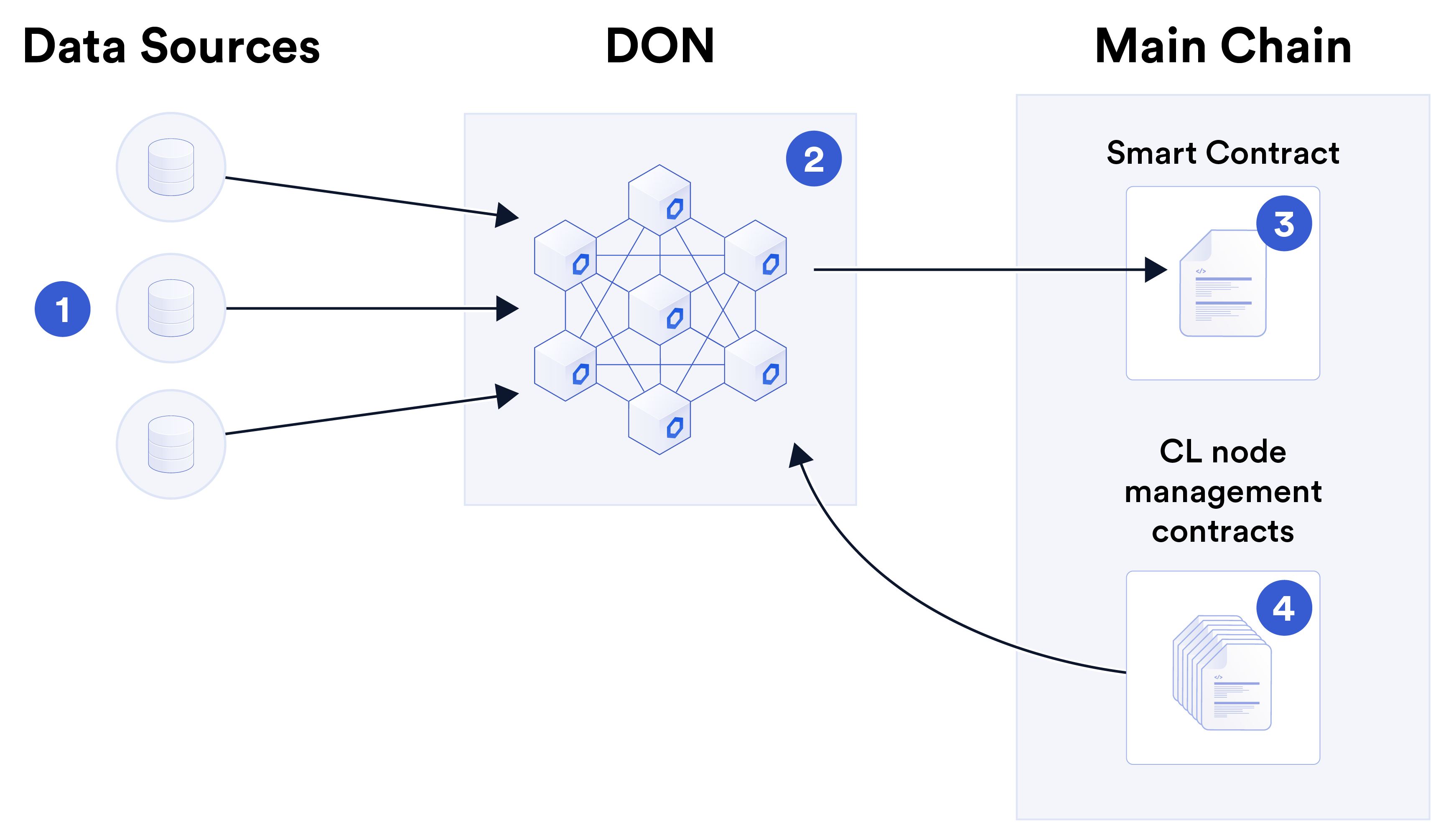
Figure 14: Loci of trust-minimizing mechanisms discussed in this section. 1⃝Data sources provide data to the 2⃝DON, which relays a function of the data to a dependent 3⃝smart contract. Additionally, the DON or the oracle network includes 4⃝node management smart contracts on MAINCHAIN for, e.g., compensating nodes, guard rails, and so forth. source, then the oracle network cannot feasibly tamper with D. Various encouraging efforts to enable such signing of data have emerged, including OpenID Connect, which is designed primarily for user authentication [9], TLS-N, an academic project aiming to extend TLS [191] by repurposing TLS certificates, and TLS Evidence Extensions [63]. While OpenID Connect has seen some adoption, however, TLS Evidence Extensions and TLS-N have yet to see adoption. Another potential avenue of data-source authentication is to use publishers’ own Signed HTTP Exchanges (SXG) [230], which they can cache on content-delivery networks as part of the Accelerated Mobile Pages (AMP) protocol [225]. The Chrome mobile browser displays the content from AMP-cached SXGs as if they were served from their publishers’ own network domains instead of the cache-server domain. This branding incentive, coupled with the relative ease of enabling it using services like CloudFlare’s Real URL [83] and Google’s amppackager [124], may lead to widespread adoption of SXGs in cached news content, which would enable a simple, tamper-resistant way for Chainlink oracles to trigger on newsworthy events reported in valid SXGs. While AMP-cached SXGs from news publishers would not be useful for high-tempo applications like reports on trading data, they could be a secure source for custom contracts pertaining to real-world events like extreme weather or election outcomes. We believe that simple deployment, mature tools, and flexibility will be vital to accelerating data-source signing. Enabling data providers to use Chainlink nodes as an authenticated API front end seems a promising approach. We intend to create an
option for nodes to function in this mode, with or without participation in the network as a full-blown oracle. We refer to this capability as authenticated data origination (ADO). By using Chainlink nodes with ADO, data sources will be able to benefit from the experience and tools developed by the Chainlink community in adding digital signing capabilities to their existing suite of off-chain APIs. Should they choose to run their nodes as oracles, they can additionally open up potential new revenue streams under the same model as existing data providers, e.g., Kraken [28], Kaiko [140], and others, that run Chainlink nodes to sell API data on chain. 7.1.1 The Limitations of Authenticated Data Origination Digital signing by data sources, while it can help strengthen authentication, isn’t sufficient per se to accomplish all of the natural security or operational goals of an oracle network. To begin with, a given piece of data D must still be relayed in a robust and timely way from a data source to smart contract or other data consumer. That is, even in an ideal setting in which all data is signed using keys pre-programmed into dependent contracts, a DON would still be needed to communicate the data reliably from sources to contracts. Additionally, there are a number of cases in which contracts or other oracle-data consumers want access to authenticated output of various functions computed over source data for two main reasons: • Confidentiality: A data source API may provide sensitive or proprietary data that needs to be redacted or sanitized before it is made publicly visible on chain. Any modification to signed data, however, invalidated the signature. Put another way, na¨ıve ADO and data sanitization are incompatible. We show in Example 3 how the two can be reconciled through an enhanced form of ADO. • Data source faults: Both errors and failures can affect data sources, and digital signatures address neither problem. From its inception [98], Chainlink has already included a mechanism to remediate such faults: redundancy. The reports issued by oracle networks typically represent the combined data of multiple sources. We now discuss schemes we are exploring in the ADO setting to enhance the confidentiality of source data and to combine data from multiple sources securely. 7.1.2 Confidentiality Data sources may not anticipate and make available the full gamut of APIs desired by users. Specifically, users may wish to access pre-processed data to help ensure confidentiality. The following example illustrates the problem.
Example 3. Alice wishes to obtain a decentralized identity (DID) credential stating that she is over 18 years of age (and thus can, for instance, take out a loan). To do so, she needs to prove this fact about her age to a DID credential issuer. Alice hopes to use data from her state’s Department of Motor Vehicles (DMV) website for the purpose. The DMV has a record of her birthdate and will emit a digitally signed attestation A on it of the following form: A = {Name: Alice, DoB: 02/16/1999}. In this example, the attestation A may be sufficient for Alice to prove to the DID credential issuer that she’s over 18. But it needlessly leaks sensitive information: Alice’s exact DoB. Ideally, what Alice would like from the DMV instead is a signature on a simple statement A′ that “Alice is over 18 years of age.” In other words, she wants the output of a function G on her birthdate X, where (informally), A′ = G(X) = True if CurrentDate −X ≥18 years; otherwise, G(X) = False. To generalize, Alice would like to be able to request from the data source a signed attestation A′ of the form: A′ = {Name: Alice, Func:G(X), Result: True}, where G(X) denotes a specification of a function G and its input(s) X. We envision that a user should be able to provide a desired G(X) as input with her request for a corresponding attestation A′. Note that the data source’s attestation A′ must include the specification G(X) to ensure that A′ is correctly interpreted. In the above example, G(X) defines the meaning of the Boolean value in A′ and thus that True signifies the subject of the attestation is over 18 years of age. We refer to flexible queries in which a user can specify G(X) as functional queries. In order to support use cases like that in Example 3, as well as those involving queries directly from contracts, we intend to include support for functional queries involving simple functions G as part of ADO. 7.1.3 Combining Source Data To reduce on-chain costs, contracts are generally designed to consume combined data from multiple sources, as illustrated in the following example. Example 4 (Medianizing price data). To provide a price feed, i.e., the value of one asset (e.g., ETH) with respect to another (e.g., USD), an oracle network will generally obtain current prices from a number of sources, such as exchanges. The oracle network typically sends to a dependent contract SC the median of these values. In an environment with data signing, a correctly functioning oracle network obtains from data sources \(S = \{S_1, \ldots, S_{n_S}\}\) a sequence of values \(V = \{v_1, v_2, \ldots, v_{n_S}\}\) from \(n_S\) sources with accompanying source-specific signatures \(\Sigma = \{\sigma_1, \sigma_2, \ldots, \sigma_{n_S}\}\). Upon verifying the signatures, it transmits the price \(v = \text{median}(V)\) to SC.
Unfortunately, there is no simple way for an oracle network to transmit the median value \(v\) in Example 4 to SC along with a succinct proof \(\sigma^*\) that \(v\) was correctly computed over signed inputs. A na¨ıve approach would be to encode in SC the public keys of all \(n_S\) data sources. The oracle network would then relay \((V, \Sigma)\) and allow SC to compute the median of \(V\). This, however, would result in a proof \(\sigma\) of size \(O(n_S)\)—i.e., \(\sigma^*\) would not be succinct. It would also incur high gas costs for SC, which would need to verify all signatures in \(\Sigma\). Use of SNARKs, in contrast, enables a succinct proof of correctly combined authenticated source values. It may be workable in practice, but imposes fairly high computational costs on the prover, and somewhat high gas costs on chain. Use of Town Crier is also a possibility, but requires the use of TEEs, which does not suit all users’ trust models. A helpful concept in which to frame solutions to the general problem of signing combined data from sources is a cryptographic tool known as functional signatures [59, 132]. Briefly, functional signatures allow a signer to delegate signing capability, such that the delegatee can only sign messages in the range of a function F chosen by the signer. We show in Appendix D how this functional constraint can serve to bound the range of report values emitted by a DON as a function of the values signed by data sources. We also introduce a new primitive, called a discretized functional signature, that includes a relaxed requirement for accuracy, but is potentially much more performant than approaches such as SNARKs. The problem of combining data sources in a way that includes source authentication of outputs also applies to data aggregators, e.g., CoinCap, CoinMarketCap, CoinGecko, CryptoCompare, etc., which obtain data from a multiplicity of exchanges, which they weight based on volumes, using methodologies that they in some cases make public and are in other cases proprietary. An aggregator that wishes to publish a value with source authentication faces the same challenge as a collection of nodes aggregating source data. 7.1.4 Processing Source Data Sophisticated smart contracts are likely to depend on custom aggregate statistics over primary data sources, such as volatility in recent price history over many assets, or text and photographs from news about pertinent events. Because computation and bandwidth are relatively cheap in a DON, these statistics— even complex machine-learning models with many inputs—can be processed economically, as long as any output value destined for a blockchain is sufficiently concise. For computationally intensive jobs where DON participants may have differing views on complex inputs, extra rounds of communication between the DON participants may be required to establish consensus on the inputs before computing the result. As long as the final value is fully determined by the inputs, once input consensus is established each participant can simply compute the value and broadcast it to the other
participants with their partial signature, or send it to an aggregator. 7.2 DON Trust Minimization We envision two main ways of minimizing the trust placed in components of the DON: failover clients and minority reports. 7.2.1 Failover Clients Adversarial models in the cryptography and distributed systems literature typically consider an adversary capable of corrupting (i.e., compromising) a subset of nodes, e.g., fewer than one-third for many BFT protocols. It is commonly observed, however, that if all nodes run identical software, an adversary that identifies a fatal exploit could in principle compromise all nodes more or less simultaneously. This setting is often referred to as a software monoculture [47]. Various proposals for automatically diversifying software and software configurations have been put forth to address the problem, e.g., [47, 113]. As noted in [47], however, software diversity is a complex issue and requires careful consideration. Software diversification, for example, can result in worse security than a monoculture if it increases a system’s attack surface and thus its possible vectors of attack in excess of the security benefits it offers. We believe that support for robust failover clients—i.e., clients to which nodes can switch in the face of a catastrophic event—is an especially attractive form of software diversification. Failover clients do not increase the number of potential vectors of attack, as they are not deployed as mainline software. They offer clear benefits, however, as a second line of defense. We intend to support failover clients in DONs as a key means of reducing their dependence for security on a single client. Chainlink already has in place a robust system of failover clients. Our approach involves maintaining previous, battle-tested client versions. Today, for example, Chainlink nodes with Off-Chain Reporting (OCR) as their primary client include support for Chainlink’s previous FluxMonitor system if needed. Having been in use for some time, FluxMonitor has received security audits and field testing. It provides the same functionality as OCR, just at higher cost—a cost only incurred on an as-needed basis. 7.2.2 Minority Reports Given a sufficiently large minority set \(O_{\text{minority}}\)—a fraction of honest nodes that observe malfeasance by the majority—it can be helpful for them to generate a minority report. This is a parallel report or flag, relayed to a dependent contract SC on-chain by \(O_{\text{minority}}\). SC can make use of this flag according to its own contract-specific policy. For example, for a contract in which safety is more important than liveness or responsiveness, a minority report might cause the contract to request supplementary reports from another DON, or trigger a circuit breaker (see the next section).
Minority reports can play an important role even when the majority is honest, because any report-aggregation scheme, even if it uses functional signatures, must operate in a threshold manner, to ensure resilience against oracle or data failure. In other words, it must be possible to produce a valid report based on the inputs of \(k_S < n_S\) oracles, for some threshold \(k_S\). This means a corrupted DON has some latitude in manipulating report values by selecting its preferred \(k_S\) values among the \(n_S\) reported in \(V\) by the full set of oracles, even if all sources are honest. For example, suppose that nS = 10 and kS = 7 in a system that uses a functional signature to authenticate computation of median over V for the USD price of ETH. Suppose that five sources report a price of \(500, while the other five report \)1000. Then by medianizing the lowest 7 reports, the DON can output a valid value v = $500, and by medianizing the highest, it can output v = $1000. By enhancing the DON protocol so that all nodes are aware of which data was available, and which data was used to construct a report, nodes could detect and flag statistically significant tendencies to favor one set of reports over another, and produce a minority report as a result. 7.3 Guard Rails Our trust model for DONs treats MAINCHAIN as a higher-security, higher-privilege system than DONs. (While this trust model may not always hold true, it is easier to adapt the resulting mechanism to situations where the DON is the higher security platform than vice versa.) A natural trust minimization strategy thus involves the implementation of monitoring and failsafe mechanisms in smart contracts—either in a MAINCHAIN front end for a DON or directly in a dependent contract SC. We refer to these mechanisms as guard rails, and enumerate some of the most important here: • Circuit breakers: SC may pause or halt state updates as a function either of characteristics of the state updates themselves (e.g., large variance across sequential reports) or based on other inputs. For example, a circuit breaker might trip in cases where oracle reports vary implausibly over time. A circuit breaker might also be tripped by a minority report. Thus, circuit breakers can prevent DONs from making grossly erroneous reports. Circuit breakers can provide time for additional interventions to be considered or exercised. One such intervention is escape hatches. • Escape hatches: Under adverse circumstances, as identified by a set of custodians, community token holders, or other bodies of trustees, a contract may invoke an emergency facility sometimes called an escape hatch [163]. An escape hatch causes SC to shut down in some manner and/or terminates pending and possibly future transactions. For example, it may return custodied funds to users [17]),
may terminate contract terms [162], or may cancel pending and/or future transactions [173]. Escape hatches can be deployed in any type of contract, not just one that relies on a DON, but they are of interest as a potential buffer against DON malfeasance. • Failover: In systems where SC relies on the DON for essential services, it is possible for SC to provide failover mechanisms that ensure service continuation even in the case of DON failure or misbehavior. For example, in the TEF (Section 6), the anchor contract SCa may provide dual interfaces where both on-chain and off-chain execution interfaces are supported for certain critical operations (e.g., withdrawal), or for ordinary transactions, with a suitable delay to prevent frontrunning of DON transactions. In cases where data sources sign data, users could also furnish reports to SCa when the DON fails to do so. Fraud proofs, as proposed for various forms of optimistic rollup (see Section 6.3), are similar in flavor and complementary to the mechanisms we enumerate above. They too provide a form of on-chain monitoring and protection against potential failures in off-chain system components. 7.4 Trust-Minimized Governance Like all decentralized systems, the Chainlink network requires governance mechanisms to adjust parameters over time, respond to emergencies, and guide its evolution. Some of these mechanisms currently reside on MAINCHAIN, and may continue to do so even with the deployment of DONs. One example is the payment mechanism for oracle node providers (DON nodes). DON front end contracts on MAINCHAIN contain additional mechanisms, such as guard rails, that may be subject to periodic modification. We foresee two classes of governance mechanisms: evolutionary and emergency. Evolutionary governance: Many modifications to the Chainlink ecosystem are such that their implementation is not a matter of urgency: Performance improvements, feature enhancements, (non-urgent) security upgrades, and so forth. As Chainlink progressively moves toward even more participants in its governance, we expect many or most such changes to be ratified by the community of a specific DON affected by those changes. In the interim, and perhaps ultimately as a parallel mechanism, we believe that a notion of temporal least privilege can be a useful means of implementing evolutionary governance. Very simply, the idea is for changes to deploy gradually, ensuring the community an opportunity to respond to them. For example, migration to a new MAINCHAIN contract can be constrained so that the new contract must be deployed at least thirty days before activation.
Emergency governance: Exploitable or exploited vulnerabilities in MAINCHAIN contracts or other forms of liveness or safety failures may require immediate intervention to ensure against catastrophic outcomes. Our intention is to support a multisig intervention mechanism in which, to ensure against malfeasance by any organization, signers will be dispersed across organizations. Ensuring consistent availability of signers and timely access to appropriate chains of command for authorization of emergency changes will clearly require careful operational planning and regular review. These challenges are similar to those involved in testing other cybersecurity incident-response capabilities [134], with a similar need to combat common problems like vigilance decrement [223]. The governance of DONs differs from that of many decentralized systems in its potential degree of heterogeneity. Each DON may have distinct data sources, executables, service-level requirements such as uptime, and users. The Chainlink network’s governance mechanisms must be flexible enough to accommodate such variations in operational goals and parameters. We are actively exploring design ideas and plan to publish research on this topic in the future. 7.5 Public-Key Infrastructure With progressive decentralization will come the need for a robust identification of network participants, including DON nodes. In particular, Chainlink requires a strong Public-Key Infrastructure (PKI). A PKI is a system that binds keys to identities. For example, a PKI undergirds the Internet’s system of secure connections (TLS): When you connect to a website via HTTPS (e.g., https://www.chainlinklabs.com) and a lock appears in your browser, that means that the public key of the domain owner has been bound to that owner by an authority—specifically, through a digital signature in a so-called certificate. A hierarchical system of certificate authorities (CAs), whose toplevel root authorities are hardwired into popular browsers, helps ensure that certificates are issued only to the legitimate owners of domains. We expect that Chainlink will eventually make use of decentralized name services, initially the Ethereum Name Service (ENS) [22], as the foundation for our PKI. As its name suggests, ENS is analogous to DNS, the Domain Name System that maps (human-readable) domain names to IP addresses on the internet. ENS, however, instead maps human-readable Ethereum names to blockchain addresses. Because ENS operates on the Ethereum blockchain, barring key compromise, tampering with its namespace is in principle as difficult as tampering with the contract administering it and/or the underlying blockchain. (DNS, in contrast, has historically been vulnerable to spoofing, hijacking, and other attacks.) We have registered data.eth with ENS on the Ethereum mainnet, and intend to establish it as a root namespace under which the identities of oracle data services and other Chainlink network entities reside. Domains in ENS are hierarchical, meaning that each domain may contain references to other names under it. Subdomains in ENS can serve as a way to organize and
delegate trust. The main role of data.eth will be to serve as an on-chain directory service for data feeds. Traditionally, developers and users of oracles have used off-chain sources (e.g., websites like docs.chain.link or data.chain.link, or social networks such as Twitter) to publish and obtain oracle data feed addresses (such as the ETH-USD price feed). With a highly trustworthy root namespace such as data.eth, it is possible instead to establish a mapping of eth-usd.data.eth to, e.g., the smart contract address of an on-chain oracle network aggregator for the ETH-USD price feed. This would create a secure path for anyone to refer to the blockchain as the source of truth for that data feed of that price/name pair (ETH-USD). Consequently, such use of ENS realizes two benefits unavailable in off-chain data sources: • Strong security: All changes and updates to the domain are recorded immutably and secured cryptographically, as opposed to text addresses on a website, which enjoy neither of these two security properties. • Automated on-chain propagation: Updates to the underlying address of a datafeed’s smart contract can trigger notifications that propagate to dependent smart contracts and can, for example, automatically update dependent contracts with the new addresses.13 Namespaces like ENS, however, do not automatically validate legitimate ownership of asserted names. Thus, for example, if the namespace includes the entry ⟨“Acme Oracle Node Co.”, addr⟩, then a user obtains the assurance that addr belongs to the claimant of the name Acme Oracle Node Co. Without additional mechanisms around namespace administration, however, she does not obtain assurance that the name belongs to an entity legitimately called Acme Oracle Node Co. in a meaningful real world sense. Our approach to validation of names, i.e., ensuring their ownership by corresponding, legitimate real-world entities, relies on several components. Today, Chainlink Labs effectively acts as a CA for the Chainlink network. While Chainlink Labs will continue to validate names, our PKI will evolve into a more decentralized model in two ways: • Web-of-trust model: The decentralized counterpart of a hierarchical PKI is often referred to as a web-of-trust.14 Variants have been proposed since the 1990s, e.g., [98], and a number of researchers have observed that blockchains can facilitate use of the idea, e.g., [227] by recording certificates in a globally consistent ledger. We are exploring variants of this model to validate the identities of entities in the Chainlink network in a more decentralized way. 13A dependent contract can optionally include a predetermined delay to allow for manual inspection and intervention by dependent-contract administrators. 14A term coined by Phil Zimmermann for PGP [238].
• Linkage to validating data: Today, a substantial amount of oracle node performance data is visible on-chain, and thus archivally bound to node addresses. Such data may be viewed as enriching an identity in the PKI by providing historical evidence of its (reliable) participation in the network. Additionally, tools for decentralized identity based on DECO and Town Crier [160] enable nodes to accumulate credentials derived from real-world data. As just one example, a node operator can attach a credential to its PKI identity that proves possession of a Dun and Bradstreet rating. These supplementary forms of validation can supplement staking in creating assurance of the security of the network. An oracle node with an established real-world identity may be viewed as having stake in a system deriving from its reputation. (See Section 4.3 and Section 9.6.3.) A final requirement for the Chainlink PKI is secure bootstrapping, i.e., securely publishing the root name for the Chainlink network, currently data.eth (analogously to hardwiring of top-level domains in browsers). In other words, how do Chainlink users determine that data.eth is indeed the top-level domain associated with the Chainlink project? The solution to this problem for the Chainlink network is multi-pronged and may involve: • Adding a TXT record [224] to our domain record for chain.link that specifies data.eth as the root domain for the Chainlink ecosystem. (Chainlink thus implicitly leverages the PKI for internet domains to validate its root ENS domain.) • Linking to data.eth from Chainlink’s existing website, e.g., from https://docs.chain.link. (Another implicit use of the PKI for internet domains.) • Making the use of data.eth known via various documents, including this whitepaper. • Posting data.eth publicly on our social-media channels, such as Twitter, and the Chainlink blog [18]. • Placing a large quantity of LINK under the control of the same registrant address as data.eth.
विश्वास न्यूनीकरण
विभिन्न संस्थाओं की भागीदारी के साथ एक विकेन्द्रीकृत प्रणाली के रूप में, Chainlink नेटवर्क जीवंतता (उपलब्धता) और सुरक्षा (रिपोर्ट अखंडता) दोनों में विफलताओं के खिलाफ मजबूत सुरक्षा प्रदान करता है। हालाँकि, अधिकांश विकेंद्रीकृत प्रणालियाँ भिन्न-भिन्न होती हैं वह डिग्री जिस तक उनके घटक घटक स्वयं विकेंद्रीकृत हैं। यह यह बड़ी प्रणालियों के लिए भी सच है, जहां खनिकों के बीच सीमित विकेंद्रीकरण [32] और मध्यस्थ [51] लंबे समय से मौजूद हैं। किसी भी विकेंद्रीकरण प्रयास का लक्ष्य विश्वास को कम करना है: हम इसे कम करना चाहते हैं Chainlink नेटवर्क के भीतर प्रणालीगत भ्रष्टाचार या विफलता के प्रतिकूल प्रभाव, यहां तक कि दुर्भावनापूर्ण DON के कारण। हमारा मार्गदर्शक सिद्धांत न्यूनतम विशेषाधिकार का सिद्धांत [197] है। सिस्टम घटकों और सिस्टम के भीतर के कलाकारों को विशेषाधिकारों का कड़ाई से दायरा होना चाहिए केवल उनकी सौंपी गई भूमिकाओं को सफलतापूर्वक पूरा करने की अनुमति देना। यहां हमने Chainlink को इसके अभियान में अपनाने के लिए कई ठोस तंत्र प्रस्तुत किए हैं विश्वास को और भी अधिक कम करने की ओर। हम इन तंत्रों को शब्दों में वर्णित करते हैं लोकी का, यानी, सिस्टम घटक, जिसमें वे निहित हैं, चित्र 14 में दिखाया गया है। हम प्रत्येक स्थान को संबंधित उपधारा में संबोधित करें। 7.1 डेटा-स्रोत प्रमाणीकरण oracles के लिए वर्तमान ऑपरेटिंग मॉडल इस तथ्य से बाधित हैं कि कुछ डेटा स्रोत हैं वे जो डेटा छोड़ देते हैं उस पर बड़े पैमाने पर डिजिटल हस्ताक्षर करते हैं क्योंकि टीएलएस मूल रूप से हस्ताक्षर नहीं करता है डेटा. टीएलएस अपने "हैंडशेक" प्रोटोकॉल में डिजिटल हस्ताक्षर का उपयोग करता है (स्थापित करने के लिए)। सर्वर और क्लाइंट के बीच एक साझा कुंजी)। HTTPS-सक्षम सर्वरों के पास प्रमाणपत्र होते हैं सार्वजनिक कुंजियों पर जो सैद्धांतिक रूप से डेटा पर हस्ताक्षर करने के लिए काम कर सकती हैं, लेकिन वे आम तौर पर उपयोग नहीं करती हैं ये प्रमाणपत्र डेटा हस्ताक्षर का समर्थन करने के लिए हैं। नतीजतन, DON की सुरक्षा, जैसे आज के oracle नेटवर्क में, डेटा से डेटा को ईमानदारी से रिले करने वाले oracle नोड्स पर निर्भर करता है एक अनुबंध का स्रोत. Chainlink में विश्वास को कम करने के हमारे दृष्टिकोण के एक महत्वपूर्ण दीर्घकालिक घटक में डेटा हस्ताक्षर के लिए टूल और मानकों के समर्थन के माध्यम से मजबूत डेटा-स्रोत प्रमाणीकरण शामिल है। डेटा साइनिंग से एंड-टू-एंड अखंडता गारंटी लागू करने में मदद मिल सकती है। सिद्धांत रूप में, यदि कोई अनुबंध इनपुट के रूप में डेटा डी के एक टुकड़े को सीधे डेटा द्वारा हस्ताक्षरित स्वीकार करता है
चित्र 14: इस अनुभाग में विश्वास-न्यूनीकरण तंत्र की चर्चा की गई है। 1⃝डेटा स्रोत 2⃝DON को डेटा प्रदान करते हैं, जो डेटा के एक फ़ंक्शन को आश्रित को रिले करता है 3⃝smart contract. इसके अतिरिक्त, DON या oracle नेटवर्क में 4⃝नोड शामिल हैं मेनचेन पर smart contracts का प्रबंधन, उदाहरण के लिए, क्षतिपूर्ति नोड्स, गार्ड रेल, इत्यादि। स्रोत, तो oracle नेटवर्क संभवतः डी के साथ छेड़छाड़ नहीं कर सकता। विभिन्न उत्साहवर्धक डेटा पर ऐसे हस्ताक्षर करने को सक्षम करने के प्रयास सामने आए हैं, जिनमें ओपनआईडी कनेक्ट भी शामिल है मुख्य रूप से उपयोगकर्ता प्रमाणीकरण [9], TLS-N के लिए डिज़ाइन किया गया है, जिसका लक्ष्य एक शैक्षणिक परियोजना है टीएलएस प्रमाणपत्रों और टीएलएस साक्ष्य एक्सटेंशन [63] को पुन: उपयोग करके टीएलएस [191] का विस्तार करें। हालाँकि, ओपनआईडी कनेक्ट ने टीएलएस साक्ष्य एक्सटेंशन को कुछ हद तक अपनाया है और टीएलएस-एन को अभी तक अपनाया जाना बाकी है। डेटा-स्रोत प्रमाणीकरण का एक अन्य संभावित तरीका प्रकाशकों का उपयोग करना है हस्ताक्षरित HTTP एक्सचेंज (SXG) [230], जिसे वे एक्सेलरेटेड मोबाइल पेज (AMP) प्रोटोकॉल [225] के हिस्से के रूप में सामग्री-वितरण नेटवर्क पर कैश कर सकते हैं। क्रोम मोबाइल ब्राउज़र एएमपी-कैश्ड एसएक्सजी से सामग्री को ऐसे प्रदर्शित करता है जैसे कि उन्हें यहीं से परोसा गया हो कैश-सर्वर डोमेन के बजाय उनके प्रकाशकों के स्वयं के नेटवर्क डोमेन। यह ब्रांडिंग प्रोत्साहन, CloudFlare के रियल URL [83] और Google के amppackager [124] जैसी सेवाओं का उपयोग करके इसे सक्षम करने की सापेक्ष आसानी के साथ मिलकर, कैश्ड समाचार सामग्री में SXG को व्यापक रूप से अपनाने का कारण बन सकता है, जो एक सरल, छेड़छाड़-प्रतिरोधी को सक्षम करेगा। वैध एसएक्सजी में रिपोर्ट की गई समाचारयोग्य घटनाओं को ट्रिगर करने के लिए Chainlink oracles का तरीका। जबकि समाचार प्रकाशकों के एएमपी-कैश्ड एसएक्सजी हाई-टेम्पो के लिए उपयोगी नहीं होंगे ट्रेडिंग डेटा पर रिपोर्ट जैसे एप्लिकेशन, वे कस्टम के लिए एक सुरक्षित स्रोत हो सकते हैं चरम मौसम या चुनाव परिणामों जैसी वास्तविक दुनिया की घटनाओं से संबंधित अनुबंध। हमारा मानना है कि सरल तैनाती, परिपक्व उपकरण और लचीलापन इसके लिए महत्वपूर्ण होंगे डेटा-स्रोत हस्ताक्षर में तेजी लाना। डेटा प्रदाताओं को Chainlink नोड्स का उपयोग करने में सक्षम बनाना एक प्रमाणित एपीआई फ्रंट एंड एक आशाजनक दृष्टिकोण प्रतीत होता है। हम एक बनाने का इरादा रखते हैंनोड्स के लिए इस मोड में नेटवर्क में भागीदारी के साथ या उसके बिना कार्य करने का विकल्प पूर्ण विकसित oracle के रूप में। हम इस क्षमता को प्रमाणित डेटा उत्पत्ति के रूप में संदर्भित करते हैं (एडीओ)। ADO के साथ Chainlink नोड्स का उपयोग करके, डेटा स्रोत लाभान्वित हो सकेंगे डिजिटल जोड़ने में Chainlink समुदाय द्वारा विकसित अनुभव और उपकरणों से ओ-चेन एपीआई के अपने मौजूदा सूट पर हस्ताक्षर करने की क्षमता। क्या उन्हें दौड़ने का विकल्प चुनना चाहिए उनके नोड्स oracles के रूप में, वे अतिरिक्त रूप से संभावित नई राजस्व धाराएँ खोल सकते हैं मौजूदा डेटा प्रदाताओं के समान मॉडल के तहत, उदाहरण के लिए, क्रैकन [28], काइको [140], और अन्य, जो श्रृंखला पर एपीआई डेटा बेचने के लिए Chainlink नोड्स चलाते हैं। 7.1.1 प्रमाणित डेटा उत्पत्ति की सीमाएँ डेटा स्रोतों द्वारा डिजिटल हस्ताक्षर, हालांकि यह प्रमाणीकरण को मजबूत करने में मदद कर सकता है, oracle के सभी प्राकृतिक सुरक्षा या परिचालन लक्ष्यों को पूरा करने के लिए पर्याप्त नहीं है। नेटवर्क. आरंभ करने के लिए, डेटा डी का एक दिया हुआ टुकड़ा अभी भी मजबूत और समय पर रिले किया जाना चाहिए डेटा स्रोत से smart contract या अन्य डेटा उपभोक्ता तक का रास्ता। यानी यहां तक कि अंदर भी एक आदर्श सेटिंग जिसमें सभी डेटा को आश्रित में पूर्व-प्रोग्राम की गई कुंजियों का उपयोग करके हस्ताक्षरित किया जाता है अनुबंधों के अनुसार, स्रोतों से डेटा को विश्वसनीय रूप से संप्रेषित करने के लिए DON की अभी भी आवश्यकता होगी अनुबंधों के लिए. इसके अतिरिक्त, ऐसे कई मामले हैं जिनमें अनुबंध या अन्य oracle-डेटा उपभोक्ता गणना किए गए विभिन्न कार्यों के प्रमाणित आउटपुट तक पहुंच चाहते हैं दो मुख्य कारणों से स्रोत डेटा: • गोपनीयता: एक डेटा स्रोत एपीआई संवेदनशील या मालिकाना डेटा प्रदान कर सकता है इसे श्रृंखला पर सार्वजनिक रूप से प्रदर्शित करने से पहले संशोधित या स्वच्छ करने की आवश्यकता है। हालाँकि, हस्ताक्षरित डेटा में किसी भी संशोधन ने हस्ताक्षर को अमान्य कर दिया। दूसरा लगाओ वैसे, भोले एडीओ और डेटा सैनिटाइजेशन असंगत हैं। हम उदाहरण 3 में दिखाते हैं एडीओ के उन्नत रूप के माध्यम से दोनों में कैसे सामंजस्य बिठाया जा सकता है। • डेटा स्रोत दोष: त्रुटियां और विफलताएं दोनों डेटा स्रोतों को प्रभावित कर सकती हैं, और डिजिटल हस्ताक्षर किसी भी समस्या का समाधान नहीं करते हैं। अपनी स्थापना से [98], Chainlink है ऐसे दोषों को दूर करने के लिए पहले से ही एक तंत्र शामिल है: अतिरेक। oracle नेटवर्क द्वारा जारी की गई रिपोर्टें आम तौर पर एकाधिक के संयुक्त डेटा का प्रतिनिधित्व करती हैं स्रोत. अब हम उन योजनाओं पर चर्चा करते हैं जिन्हें हम स्रोत डेटा की गोपनीयता बढ़ाने और कई स्रोतों से डेटा को सुरक्षित रूप से संयोजित करने के लिए एडीओ सेटिंग में तलाश रहे हैं। 7.1.2 गोपनीयता डेटा स्रोत वांछित एपीआई की पूरी श्रृंखला का अनुमान नहीं लगा सकते हैं और उपलब्ध नहीं करा सकते हैं उपयोगकर्ताओं द्वारा. विशेष रूप से, उपयोगकर्ता यह सुनिश्चित करने में सहायता के लिए पूर्व-संसाधित डेटा तक पहुंच प्राप्त करना चाह सकते हैं गोपनीयता. निम्नलिखित उदाहरण समस्या को दर्शाता है.उदाहरण 3. ऐलिस एक विकेन्द्रीकृत पहचान (डीआईडी) क्रेडेंशियल स्टेटमेंट प्राप्त करना चाहती है कि उसकी उम्र 18 वर्ष से अधिक है (और इस प्रकार, उदाहरण के लिए, वह ऋण ले सकती है)। करना इसलिए, उसे डीआईडी क्रेडेंशियल जारीकर्ता को अपनी उम्र के बारे में यह तथ्य साबित करना होगा। ऐलिस को अपने राज्य के मोटर वाहन विभाग (डीएमवी) से डेटा का उपयोग करने की उम्मीद है इस उद्देश्य के लिए वेबसाइट. डीएमवी के पास उसकी जन्मतिथि का रिकॉर्ड है और वह इसे जारी करेगा निम्नलिखित प्रपत्र पर डिजिटल रूप से हस्ताक्षरित सत्यापन ए: ए = {नाम: ऐलिस, जन्मतिथि: 02/16/1999}। इस उदाहरण में, ऐलिस के लिए डीआईडी साबित करने के लिए सत्यापन ए पर्याप्त हो सकता है क्रेडेंशियल जारीकर्ता कि उसकी उम्र 18 वर्ष से अधिक है। लेकिन यह अनावश्यक रूप से संवेदनशील जानकारी लीक करता है: ऐलिस सटीक जन्मतिथि. आदर्श रूप से, ऐलिस डीएमवी से जो चाहती है वह एक पर हस्ताक्षर है सरल कथन A′ कि "ऐलिस की आयु 18 वर्ष से अधिक है।" दूसरे शब्दों में, वह चाहती है उसकी जन्मतिथि X पर एक फ़ंक्शन G का आउटपुट, जहां (अनौपचारिक रूप से), A′ = G(X) = सत्य है यदि वर्तमान दिनांक −X ≥18 वर्ष; अन्यथा, G(X) = ग़लत। सामान्यीकरण के लिए, ऐलिस डेटा स्रोत से हस्ताक्षरित अनुरोध करने में सक्षम होना चाहेगी प्रपत्र का सत्यापन A′: A′ = {नाम: ऐलिस, Func:G(X), परिणाम: सत्य}, जहां G(X) एक फ़ंक्शन G और उसके इनपुट(ओं) X के विनिर्देशन को दर्शाता है। हम कल्पना करते हैं उपयोगकर्ता को अपने अनुरोध के साथ इनपुट के रूप में वांछित G(X) प्रदान करने में सक्षम होना चाहिए संगत सत्यापन A'। ध्यान दें कि डेटा स्रोत के सत्यापन A' में विनिर्देश G(X) शामिल होना चाहिए सुनिश्चित करें कि A' की सही व्याख्या की गई है। उपरोक्त उदाहरण में, G(X) अर्थ को परिभाषित करता है ए' में बूलियन मान का और इस प्रकार सत्य सत्यापन के विषय को दर्शाता है 18 वर्ष से अधिक आयु है. हम लचीले प्रश्नों का उल्लेख करते हैं जिसमें उपयोगकर्ता G(X) को कार्यात्मक प्रश्नों के रूप में निर्दिष्ट कर सकता है। उदाहरण 3 में दिए गए उपयोग के मामलों के साथ-साथ प्रश्नों से जुड़े मामलों का समर्थन करने के लिए सीधे अनुबंधों से, हम इसमें शामिल कार्यात्मक प्रश्नों के लिए समर्थन शामिल करना चाहते हैं एडीओ के भाग के रूप में सरल कार्य जी। 7.1.3 स्रोत डेटा का संयोजन ऑन-चेन लागत को कम करने के लिए, अनुबंध आम तौर पर संयुक्त डेटा का उपभोग करने के लिए डिज़ाइन किए जाते हैं अनेक स्रोतों से, जैसा कि निम्नलिखित उदाहरण में दिखाया गया है। उदाहरण 4 (मूल्य डेटा का औसतीकरण)। एक मूल्य फ़ीड, यानी, एक का मूल्य प्रदान करना परिसंपत्ति (जैसे, ETH) दूसरे (जैसे, USD) के संबंध में, एक oracle नेटवर्क आम तौर पर होगा एक्सचेंज जैसे कई स्रोतों से मौजूदा कीमतें प्राप्त करें। oracle नेटवर्क आम तौर पर इन मानों का माध्य एक आश्रित अनुबंध एससी को भेजता है। डेटा हस्ताक्षर वाले वातावरण में, एक सही ढंग से कार्य करने वाला oracle नेटवर्क प्राप्त होता है डेटा स्रोतों से S = {S1, . . . , SnS} मानों का एक क्रम V = {v1, v2, . . . , वीएनएस} से स्रोत-विशिष्ट हस्ताक्षरों के साथ nS स्रोत Σ = {σ1, σ2,। . . , σnS}. पर हस्ताक्षरों को सत्यापित करते हुए, यह मूल्य v = माध्यिका(V) को SC तक पहुंचाता है।दुर्भाग्य से, oracle नेटवर्क के लिए माध्यिका संचारित करने का कोई आसान तरीका नहीं है उदाहरण 4 में एससी के लिए एक संक्षिप्त प्रमाण के साथ मूल्य v σ∗ कि v की गणना सही ढंग से की गई थी अति हस्ताक्षरित इनपुट. सभी एनएस डेटा स्रोतों की सार्वजनिक कुंजी को एससी में एनकोड करना एक सरल तरीका होगा। oracle नेटवर्क तब (V, Σ) रिले करेगा और SC को V के माध्यिका की गणना करने की अनुमति देगा। हालाँकि, इसका परिणाम σ आकार O(nS) का प्रमाण होगा - यानी, σ∗संक्षिप्त नहीं होगा। इससे एससी के लिए उच्च गैस लागत भी आएगी, जिसमें सभी हस्ताक्षरों को सत्यापित करने की आवश्यकता होगी Σ. इसके विपरीत, SNARKs का उपयोग, सही ढंग से संयुक्त प्रमाणित स्रोत मूल्यों का एक संक्षिप्त प्रमाण सक्षम करता है। यह व्यवहार में व्यावहारिक हो सकता है, लेकिन काफी अधिक प्रभाव डालता है कहावत पर कम्प्यूटेशनल लागत, और श्रृंखला पर कुछ हद तक उच्च गैस लागत। का उपयोग टाउन कैरियर भी एक संभावना है, लेकिन इसके लिए टीईई के उपयोग की आवश्यकता होती है, जो सभी के लिए उपयुक्त नहीं है उपयोगकर्ताओं का विश्वास मॉडल। स्रोतों से संयुक्त डेटा पर हस्ताक्षर करने की सामान्य समस्या का समाधान तैयार करने में एक सहायक अवधारणा एक क्रिप्टोग्राफ़िक उपकरण है जिसे कार्यात्मक हस्ताक्षर [59, 132] के रूप में जाना जाता है। संक्षेप में, कार्यात्मक हस्ताक्षर एक हस्ताक्षरकर्ता को हस्ताक्षर करने की क्षमता सौंपने की अनुमति देते हैं, जैसे कि प्रतिनिधि केवल हस्ताक्षरकर्ता द्वारा चुने गए फ़ंक्शन F की सीमा में संदेशों पर हस्ताक्षर कर सकता है। हम परिशिष्ट डी में दिखाते हैं कि यह कार्यात्मक बाधा सीमा को कैसे सीमित कर सकती है डेटा स्रोतों द्वारा हस्ताक्षरित मानों के एक फ़ंक्शन के रूप में DON द्वारा उत्सर्जित रिपोर्ट मानों की संख्या। हम एक नया आदिम भी पेश करते हैं, जिसे विवेकाधीन कार्यात्मक हस्ताक्षर कहा जाता है, जिसमें सटीकता के लिए एक आरामदायक आवश्यकता शामिल है, लेकिन संभावित रूप से बहुत अधिक प्रदर्शन करने वाला है SNARKs जैसे दृष्टिकोणों की तुलना में। डेटा स्रोतों को इस तरह से संयोजित करने की समस्या जिसमें स्रोत प्रमाणीकरण शामिल हो आउटपुट की संख्या डेटा एग्रीगेटर्स पर भी लागू होती है, उदाहरण के लिए, कॉइनकैप, कॉइनमार्केटकैप, कॉइनगेको, क्रिप्टोकंपेयर, आदि, जो कई एक्सचेंजों से डेटा प्राप्त करते हैं, जो वे मात्राओं के आधार पर वजन, उन पद्धतियों का उपयोग करते हुए जिन्हें वे कुछ मामलों में सार्वजनिक करते हैं और अन्य मामलों में स्वामित्व हैं। एक एग्रीगेटर जो एक मूल्य प्रकाशित करना चाहता है स्रोत प्रमाणीकरण को नोड्स के संग्रह के समान ही चुनौती का सामना करना पड़ता है स्रोत डेटा. 7.1.4 स्रोत डेटा का प्रसंस्करण परिष्कृत smart contracts कस्टम समग्र आंकड़ों पर निर्भर होने की संभावना है प्राथमिक डेटा स्रोत, जैसे कई परिसंपत्तियों पर हाल के मूल्य इतिहास में अस्थिरता, या प्रासंगिक घटनाओं के बारे में समाचारों से पाठ और तस्वीरें। क्योंकि DON में गणना और बैंडविड्थ अपेक्षाकृत सस्ते हैं, ये आँकड़े- यहां तक कि कई इनपुट वाले जटिल मशीन-लर्निंग मॉडल को भी आर्थिक रूप से संसाधित किया जा सकता है, जब तक कि blockchain के लिए निर्धारित कोई भी आउटपुट मान पर्याप्त रूप से संक्षिप्त हो। कम्प्यूटेशनल रूप से गहन नौकरियों के लिए जहां DON प्रतिभागियों में भिन्नता हो सकती है जटिल इनपुट पर विचार, परिणाम की गणना करने से पहले इनपुट पर आम सहमति स्थापित करने के लिए DON प्रतिभागियों के बीच संचार के अतिरिक्त दौर की आवश्यकता हो सकती है। जब तक अंतिम मूल्य पूरी तरह से इनपुट द्वारा निर्धारित किया जाता है, एक बार इनपुट सर्वसम्मति स्थापित हो जाने पर प्रत्येक भागीदार बस मूल्य की गणना कर सकता है और इसे दूसरे को प्रसारित कर सकता है।प्रतिभागी अपने आंशिक हस्ताक्षर के साथ, या इसे एग्रीगेटर को भेजें। 7.2 DON विश्वास न्यूनतमकरण हम DON के घटकों में रखे गए भरोसे को कम करने के दो मुख्य तरीकों की कल्पना करते हैं: फेलओवर क्लाइंट और अल्पसंख्यक रिपोर्ट। 7.2.1 फेलओवर ग्राहक क्रिप्टोग्राफी और वितरित सिस्टम साहित्य में आमतौर पर प्रतिकूल मॉडल नोड्स के एक उपसमूह को भ्रष्ट करने (यानी, समझौता करने) में सक्षम एक प्रतिद्वंद्वी पर विचार करें, उदाहरण के लिए, कई BFT प्रोटोकॉल के लिए एक तिहाई से भी कम। हालाँकि, यह आमतौर पर देखा जाता है, यदि सभी नोड्स समान सॉफ़्टवेयर चलाते हैं, तो एक प्रतिद्वंद्वी जो पहचानता है वह एक घातक शोषण कर सकता है सिद्धांत रूप में सभी नोड्स को कमोबेश एक साथ समझौता करें। यह सेटिंग अक्सर होती है सॉफ़्टवेयर मोनोकल्चर [47] के रूप में जाना जाता है। समस्या के समाधान के लिए सॉफ़्टवेयर और सॉफ़्टवेयर कॉन्फ़िगरेशन में स्वचालित रूप से विविधता लाने के लिए विभिन्न प्रस्ताव सामने रखे गए हैं, उदाहरण के लिए, [47, 113]। जैसा कि [47] में बताया गया है, हालाँकि, सॉफ़्टवेयर विविधता एक जटिल मुद्दा है और इस पर सावधानीपूर्वक विचार करने की आवश्यकता है। उदाहरण के लिए, सॉफ़्टवेयर विविधीकरण के परिणामस्वरूप मोनोकल्चर की तुलना में बदतर सुरक्षा हो सकती है एक सिस्टम की हमले की सतह को बढ़ाता है और इस प्रकार इसके हमले के संभावित वैक्टर अधिक हो जाते हैं यह सुरक्षा लाभ प्रदान करता है। हमारा मानना है कि मजबूत फेलओवर क्लाइंट्स के लिए समर्थन - यानी, कौन से नोड्स के क्लाइंट किसी विनाशकारी घटना की स्थिति में स्विच कर सकते हैं—का एक विशेष रूप से आकर्षक रूप है सॉफ्टवेयर विविधीकरण. फ़ेलओवर क्लाइंट संभावित वैक्टर की संख्या में वृद्धि नहीं करते हैं हमले का, क्योंकि उन्हें मेनलाइन सॉफ़्टवेयर के रूप में तैनात नहीं किया गया है। वे स्पष्ट लाभ प्रदान करते हैं, हालाँकि, रक्षा की दूसरी पंक्ति के रूप में। हम DONs में फेलओवर ग्राहकों का समर्थन करने का इरादा रखते हैं किसी एक ग्राहक पर सुरक्षा के लिए उनकी निर्भरता को कम करने का एक प्रमुख साधन। Chainlink में पहले से ही फेलओवर क्लाइंट की एक मजबूत प्रणाली मौजूद है। हमारा दृष्टिकोण इसमें पिछले, युद्ध-परीक्षित क्लाइंट संस्करणों को बनाए रखना शामिल है। आज, उदाहरण के लिए, ओff-चेन रिपोर्टिंग (ओसीआर) वाले Chainlink नोड्स में उनके प्राथमिक ग्राहक के रूप में समर्थन शामिल है यदि आवश्यक हो तो Chainlink के पिछले फ्लक्स मॉनिटर सिस्टम के लिए। कुछ के लिए उपयोग में रहा है समय के साथ, फ्लक्समॉनिटर को सुरक्षा ऑडिट और फ़ील्ड परीक्षण प्राप्त हुआ है। यह वही प्रदान करता है ओसीआर के रूप में कार्यक्षमता, केवल उच्च लागत पर - एक लागत जो केवल आवश्यकतानुसार खर्च की जाती है। 7.2.2 अल्पसंख्यक रिपोर्ट पर्याप्त रूप से बड़े अल्पसंख्यक सेट ओमिनोरिटी को देखते हुए - ईमानदार नोड्स का एक अंश जो बहुमत द्वारा कदाचार का निरीक्षण करता है - यह उनके लिए अल्पसंख्यक उत्पन्न करने में सहायक हो सकता है रिपोर्ट. यह एक समानांतर रिपोर्ट या फ़्लैग है, जो एक आश्रित अनुबंध एससी ऑन-चेन से संबंधित है ओमिनोरिटी द्वारा. SC इस ध्वज का उपयोग अपनी अनुबंध-विशिष्ट नीति के अनुसार कर सकता है। उदाहरण के लिए, एक ऐसे अनुबंध के लिए जिसमें सुरक्षा जीवंतता या जवाबदेही से अधिक महत्वपूर्ण है, अल्पसंख्यक रिपोर्ट के कारण अनुबंध को पूरक रिपोर्ट का अनुरोध करना पड़ सकता है किसी अन्य DON से, या सर्किट ब्रेकर को ट्रिगर करें (अगला भाग देखें)।अल्पसंख्यक रिपोर्ट तब भी महत्वपूर्ण भूमिका निभा सकती है जब बहुमत ईमानदार हो, क्योंकि कोई भी रिपोर्ट-एकत्रीकरण योजना, भले ही वह कार्यात्मक हस्ताक्षरों का उपयोग करती हो, अवश्य होनी चाहिए oracle या डेटा विफलता के विरुद्ध लचीलापन सुनिश्चित करने के लिए, एक सीमाबद्ध तरीके से काम करें। में दूसरे शब्दों में, इनपुट के आधार पर एक वैध रिपोर्ट तैयार करना संभव होना चाहिए kS < nS oracles, कुछ सीमा kS के लिए। इसका मतलब है कि दूषित DON में कुछ है के बीच अपने पसंदीदा केएस मूल्यों का चयन करके रिपोर्ट मूल्यों में हेरफेर करने में अक्षांश nS को V में oracles के पूर्ण सेट द्वारा रिपोर्ट किया गया है, भले ही सभी स्रोत ईमानदार हों। उदाहरण के लिए, मान लीजिए कि एक सिस्टम में nS = 10 और kS = 7 है जो एक फ़ंक्शनल का उपयोग करता है ETH के USD मूल्य के लिए V से अधिक माध्यिका की गणना को प्रमाणित करने के लिए हस्ताक्षर। मान लीजिए कि पांच स्रोत \(500, while the other five report \)1000 की कीमत की रिपोर्ट करते हैं। फिर सबसे कम 7 रिपोर्टों को मध्यस्थ करके, DON एक वैध मान v = $500 आउटपुट कर सकता है, और उच्चतम माध्यीकरण करके, यह v = $1000 आउटपुट कर सकता है। DON प्रोटोकॉल को बढ़ाकर ताकि सभी नोड्स को पता चले कि कौन सा डेटा था उपलब्ध है, और रिपोर्ट बनाने के लिए किस डेटा का उपयोग किया गया था, नोड्स पता लगा सकते हैं और चिह्नित कर सकते हैं रिपोर्टों के एक सेट को दूसरे सेट की तुलना में पसंद करने और उत्पादन करने की सांख्यिकीय रूप से महत्वपूर्ण प्रवृत्तियाँ परिणामस्वरूप एक अल्पसंख्यक रिपोर्ट। 7.3 गार्ड रेल्स DONs के लिए हमारा ट्रस्ट मॉडल मेनचेन को उच्च-सुरक्षा, उच्च-विशेषाधिकार प्राप्त मानता है DONs से अधिक सिस्टम। (हालांकि यह विश्वास मॉडल हमेशा सच नहीं हो सकता है, यह आसान है परिणामी तंत्र को उन स्थितियों के अनुकूल बनाना जहां DON उच्च सुरक्षा है इसके विपरीत की तुलना में मंच।) इस प्रकार एक प्राकृतिक विश्वास न्यूनीकरण रणनीति में smart contracts में निगरानी और फेलसेफ तंत्र का कार्यान्वयन शामिल है - या तो मेनचेन फ्रंट एंड में DON के लिए या सीधे आश्रित अनुबंध SC में। हम इन तंत्रों का उल्लेख इस प्रकार करते हैं गार्ड रेल्स, और यहां कुछ सबसे महत्वपूर्ण गिनाएं: • सर्किट ब्रेकर: एससी राज्य की विशेषताओं के आधार पर राज्य अपडेट को रोक या रोक सकता है (उदाहरण के लिए, अनुक्रमिक में बड़े अंतर)। रिपोर्ट) या अन्य इनपुट के आधार पर। उदाहरण के लिए, एक सर्किट ब्रेकर ट्रिप हो सकता है ऐसे मामले जहां oracle रिपोर्ट समय के साथ अविश्वसनीय रूप से भिन्न होती हैं। एक सर्किट ब्रेकर हो सकता है एक अल्पसंख्यक रिपोर्ट द्वारा भी फँसाया जा सकता है। इस प्रकार, सर्किट ब्रेकर DONs को रोक सकते हैं घोर ग़लत रिपोर्ट बनाने से। सर्किट ब्रेकर अतिरिक्त हस्तक्षेपों पर विचार करने के लिए समय प्रदान कर सकते हैं या व्यायाम किया. ऐसा ही एक हस्तक्षेप एस्केप हैच है। • भागने के रास्ते: विपरीत परिस्थितियों में, जैसा कि संरक्षकों, समुदाय token धारकों, या ट्रस्टियों के अन्य निकायों द्वारा पहचाना जाता है, एक अनुबंध लागू हो सकता है एक आपातकालीन सुविधा जिसे कभी-कभी एस्केप हैच [163] कहा जाता है। भागने का रास्ता एससी को किसी तरह से बंद करने का कारण बनता है और/या लंबित और संभवतः समाप्त कर देता है भविष्य के लेनदेन. उदाहरण के लिए, यह [17] उपयोगकर्ताओं को संरक्षित धनराशि लौटा सकता है),अनुबंध की शर्तों [162] को समाप्त कर सकता है, या लंबित और/या भविष्य के लेनदेन को रद्द कर सकता है [173]। एस्केप हैच को न केवल किसी भी प्रकार के अनुबंध में तैनात किया जा सकता है वह जो DON पर निर्भर है, लेकिन वे संभावित बफर के रूप में रुचि रखते हैं DON दुर्भावना। • विफलता: उन प्रणालियों में जहां SC आवश्यक सेवाओं के लिए DON पर निर्भर करता है, SC के लिए फेलओवर तंत्र प्रदान करना संभव है जो सेवा निरंतरता सुनिश्चित करता है DON विफलता या दुर्व्यवहार के मामले में। उदाहरण के लिए, टीईएफ (धारा 6) में, एंकर अनुबंध एससीए दोहरे इंटरफेस प्रदान कर सकता है जहां ऑन-चेन और दोनों ओff-श्रृंखला निष्पादन इंटरफ़ेस कुछ महत्वपूर्ण परिचालनों के लिए समर्थित हैं (उदाहरण के लिए, निकासी), या सामान्य लेनदेन के लिए, DON लेनदेन को आगे बढ़ने से रोकने के लिए उपयुक्त देरी के साथ। ऐसे मामलों में जहां डेटा स्रोत डेटा पर हस्ताक्षर करते हैं, उपयोगकर्ता ऐसा कर सकते हैं जब DON ऐसा करने में विफल रहता है तो एससीए को रिपोर्ट भी प्रस्तुत करें। धोखाधड़ी के सबूत, जैसा कि आशावादी rollup के विभिन्न रूपों के लिए प्रस्तावित है (धारा 6.3 देखें), स्वाद में समान हैं और हमारे द्वारा ऊपर बताए गए तंत्र के पूरक हैं। वे संभावित विफलताओं के विरुद्ध ऑन-चेन निगरानी और सुरक्षा का एक रूप भी प्रदान करता है ओff-श्रृंखला प्रणाली घटक। 7.4 विश्वास-न्यूनतम शासन सभी विकेंद्रीकृत प्रणालियों की तरह, Chainlink नेटवर्क को शासन तंत्र की आवश्यकता होती है समय के साथ मापदंडों को समायोजित करने, आपात स्थिति पर प्रतिक्रिया देने और इसके विकास का मार्गदर्शन करने के लिए। इनमें से कुछ तंत्र वर्तमान में मेनचेन पर मौजूद हैं, और आगे भी बने रह सकते हैं DONs की तैनाती के साथ भी ऐसा करें। एक उदाहरण भुगतान तंत्र है oracle नोड प्रदाताओं (DON नोड्स) के लिए। DON मेनचेन पर फ्रंट एंड अनुबंध इसमें अतिरिक्त तंत्र शामिल हैं, जैसे कि गार्ड रेल, जो समय-समय पर अधीन हो सकते हैं संशोधन. हम शासन तंत्र के दो वर्ग देखते हैं: विकासवादी और आपातकालीन। विकासवादी शासन: Chainlink पारिस्थितिकी तंत्र में कई संशोधन हैं ऐसा कि उनका कार्यान्वयन तात्कालिकता का विषय नहीं है: प्रदर्शन में सुधार, सुविधा संवर्द्धन, (गैर-अत्यावश्यक) सुरक्षा उन्नयन, इत्यादि। जैसे-जैसे Chainlink अपने शासन में और भी अधिक प्रतिभागियों की ओर बढ़ता है, हम उम्मीद करते हैं कि कई या ऐसे अधिकांश परिवर्तनों को उनसे प्रभावित एक विशिष्ट DON के समुदाय द्वारा अनुमोदित किया जाना है परिवर्तन. अंतरिम रूप से, और शायद अंततः एक समानांतर तंत्र के रूप में, हम मानते हैं अस्थायी न्यूनतम विशेषाधिकार की धारणा विकासवादी शासन को लागू करने का एक उपयोगी साधन हो सकती है। बहुत सरलता से, विचार यह है कि परिवर्तनों को सुनिश्चित करते हुए धीरे-धीरे लागू किया जाए समुदाय को उन्हें जवाब देने का अवसर मिलता है। उदाहरण के लिए, किसी नए स्थान पर प्रवासन मेनचेन अनुबंध को बाधित किया जा सकता है ताकि नया अनुबंध तैनात किया जा सके सक्रियण से कम से कम तीस दिन पहले.आपातकालीन शासन: मेनचेन में शोषित या शोषित कमजोरियाँ अनुबंधों या अन्य प्रकार की जीवंतता या सुरक्षा विफलताओं के लिए विनाशकारी परिणामों को सुनिश्चित करने के लिए तत्काल हस्तक्षेप की आवश्यकता हो सकती है। हमारा इरादा एक मल्टीसिग का समर्थन करना है हस्तक्षेप तंत्र जिसमें, किसी भी संगठन द्वारा कदाचार के विरुद्ध सुनिश्चित करना, हस्ताक्षरकर्ताओं को विभिन्न संगठनों में फैलाया जाएगा। हस्ताक्षरकर्ताओं की निरंतर उपलब्धता सुनिश्चित करना और आपातकाल के प्राधिकरण के लिए कमांड की उचित श्रृंखला तक समय पर पहुंच परिवर्तनों के लिए स्पष्ट रूप से सावधानीपूर्वक परिचालन योजना और नियमित समीक्षा की आवश्यकता होगी। ये चुनौतियाँ अन्य साइबर सुरक्षा घटना-प्रतिक्रिया के परीक्षण में शामिल चुनौतियों के समान हैं क्षमताएं [134], सतर्कता में कमी [223] जैसी सामान्य समस्याओं से निपटने के लिए समान आवश्यकता के साथ। DONs का शासन कई विकेन्द्रीकृत प्रणालियों से भिन्न है विविधता की संभावित डिग्री. प्रत्येक DON में अलग-अलग डेटा स्रोत, निष्पादन योग्य, सेवा-स्तर की आवश्यकताएं जैसे अपटाइम और उपयोगकर्ता हो सकते हैं। Chainlink नेटवर्क इस तरह की विविधताओं को समायोजित करने के लिए शासन तंत्र पर्याप्त लचीला होना चाहिए परिचालन लक्ष्य और पैरामीटर। हम सक्रिय रूप से डिजाइन विचारों की खोज कर रहे हैं और योजना बना रहे हैं भविष्य में इस विषय पर शोध प्रकाशित करें। 7.5 सार्वजनिक-कुंजी अवसंरचना प्रगतिशील विकेंद्रीकरण के साथ एक मजबूत पहचान की आवश्यकता आएगी नेटवर्क प्रतिभागी, जिनमें DON नोड शामिल हैं। विशेष रूप से, Chainlink को एक मजबूत की आवश्यकता होती है सार्वजनिक-कुंजी अवसंरचना (पीकेआई)। PKI एक ऐसी प्रणाली है जो कुंजियों को पहचान से जोड़ती है। के लिए उदाहरण के लिए, एक पीकेआई इंटरनेट की सुरक्षित कनेक्शन प्रणाली (टीएलएस) को रेखांकित करता है: कब आप HTTPS (उदा., https://www.chainlinklabs.com) के माध्यम से एक वेबसाइट से जुड़ते हैं और a आपके ब्राउज़र में लॉक दिखाई देता है, इसका मतलब है कि डोमेन स्वामी के पास सार्वजनिक कुंजी है किसी प्राधिकारी द्वारा उस मालिक से बंधा हुआ है - विशेष रूप से, डिजिटल हस्ताक्षर के माध्यम से एक तथाकथित प्रमाणपत्र. प्रमाणपत्र प्राधिकारियों (सीए) की एक पदानुक्रमित प्रणाली, जिसके शीर्ष स्तर के रूट प्राधिकारी लोकप्रिय ब्राउज़रों में हार्डवायर्ड हैं, यह सुनिश्चित करने में मदद करते हैं कि प्रमाणपत्र केवल डोमेन के वैध स्वामियों को जारी किए जाते हैं। हम उम्मीद करते हैं कि Chainlink अंततः विकेंद्रीकृत नाम सेवाओं का उपयोग करेगा, प्रारंभ में Ethereum नाम सेवा (ENS) [22], हमारे PKI की नींव के रूप में। जैसे इसके नाम से पता चलता है, ईएनएस डीएनएस के समान है, डोमेन नाम प्रणाली जो मैप करती है (मानव-पठनीय) डोमेन नाम से लेकर इंटरनेट पर आईपी पते तक। हालाँकि, ENS, मानव-पठनीय Ethereum नामों को blockchain पतों पर मैप करता है। क्योंकि ईएनएस कुंजी समझौता, इसके साथ छेड़छाड़ को छोड़कर, Ethereum blockchain पर संचालित होता है नेमस्पेस सैद्धांतिक रूप से उतना ही कठिन है जितना इसे प्रशासित करने वाले अनुबंध के साथ छेड़छाड़ करना और/या अंतर्निहित blockchain। (इसके विपरीत, डीएनएस ऐतिहासिक रूप से असुरक्षित रहा है स्पूफिंग, अपहरण और अन्य हमलों के लिए।) हमने Ethereum मेननेट पर ENS के साथ data.eth पंजीकृत किया है, और करने का इरादा रखते हैं इसे एक रूट नेमस्पेस के रूप में स्थापित करें जिसके अंतर्गत oracle डेटा सेवाओं की पहचान और अन्य Chainlink नेटवर्क इकाइयाँ निवास करती हैं। ईएनएस में डोमेन पदानुक्रमित हैं, जिसका अर्थ है कि प्रत्येक डोमेन में संदर्भ हो सकते हैं इसके अंतर्गत अन्य नामों के लिए. ईएनएस में उपडोमेन व्यवस्थित करने के एक तरीके के रूप में काम कर सकते हैंप्रतिनिधि विश्वास. data.eth की मुख्य भूमिका ऑन-चेन निर्देशिका सेवा के रूप में कार्य करना होगा डेटा फ़ीड. परंपरागत रूप से, oracles के डेवलपर्स और उपयोगकर्ताओं ने ऑफ-चेन स्रोतों का उपयोग किया है (उदाहरण के लिए, docs.चेन.लिंक या डेटा.चेन.लिंक जैसी वेबसाइटें, या सोशल नेटवर्क जैसे ट्विटर) oracle डेटा फ़ीड पते (जैसे ETH-USD मूल्य) प्रकाशित करने और प्राप्त करने के लिए चारा). data.eth जैसे अत्यधिक भरोसेमंद रूट नेमस्पेस के साथ, इसके बजाय eth-usd.data.eth की मैपिंग स्थापित करना संभव है, उदाहरण के लिए, smart contract पता ETH-USD मूल्य फ़ीड के लिए ऑन-चेन oracle नेटवर्क एग्रीगेटर का। ये होगा किसी के लिए भी सत्य के स्रोत के रूप में blockchain को संदर्भित करने के लिए एक सुरक्षित पथ बनाएं उस मूल्य/नाम जोड़ी (ईटीएच-यूएसडी) का डेटा फ़ीड। नतीजतन, ईएनएस का ऐसा उपयोग ऑफ-चेन डेटा स्रोतों में अनुपलब्ध दो लाभों का एहसास: • मजबूत सुरक्षा: डोमेन में सभी परिवर्तन और अपडेट अपरिवर्तनीय रूप से रिकॉर्ड किए जाते हैं और किसी वेबसाइट पर टेक्स्ट पते के विपरीत, क्रिप्टोग्राफ़िक रूप से सुरक्षित किया जाता है इन दोनों सुरक्षा संपत्तियों में से किसी का भी आनंद न लें। • स्वचालित ऑन-चेन प्रसार: डेटाफ़ीड के smart contract के अंतर्निहित पते पर अपडेट सूचनाओं को ट्रिगर कर सकता है जो निर्भर स्मार्ट तक फैलती हैं अनुबंध और, उदाहरण के लिए, आश्रित अनुबंधों को स्वचालित रूप से अद्यतन कर सकते हैं नये पते.13 हालाँकि, ENS जैसे नामस्थान स्वचालित रूप से वैध स्वामित्व को मान्य नहीं करते हैं घोषित नामों का. इस प्रकार, उदाहरण के लिए, यदि नामस्थान में प्रविष्टि शामिल है ⟨"एक्मे ओरेकल नोड कंपनी", पता⟩, तब उपयोगकर्ता को यह आश्वासन मिलता है कि पता एक्मे नाम के दावेदार का है ओरेकल नोड कंपनी नेमस्पेस प्रशासन के आसपास अतिरिक्त तंत्र के बिना, हालाँकि, उसे यह आश्वासन नहीं मिलता है कि नाम वैध रूप से किसी इकाई का है वास्तविक दुनिया के सार्थक अर्थ में इसे एक्मे ओरेकल नोड कंपनी कहा जाता है। नामों के सत्यापन के लिए हमारा दृष्टिकोण, यानी, संबंधित, वैध वास्तविक दुनिया की संस्थाओं द्वारा उनका स्वामित्व सुनिश्चित करना, कई घटकों पर निर्भर करता है। आज, Chainlink लैब्स प्रभावी रूप से Chainlink नेटवर्क के लिए CA के रूप में कार्य करता है। जबकि Chainlink लैब्स जारी रहेंगी नामों को मान्य करने के लिए, हमारा PKI दो तरीकों से अधिक विकेन्द्रीकृत मॉडल के रूप में विकसित होगा: • वेब-ऑफ-ट्रस्ट मॉडल: एक पदानुक्रमित पीकेआई के विकेन्द्रीकृत समकक्ष को अक्सर वेब-ऑफ-ट्रस्ट के रूप में जाना जाता है। 1990 के दशक से 14 वेरिएंट प्रस्तावित किए गए हैं। उदाहरण के लिए, [98], और कई शोधकर्ताओं ने देखा है कि blockchain विश्व स्तर पर सुसंगत रूप से प्रमाणपत्र रिकॉर्ड करके विचार के उपयोग की सुविधा प्रदान कर सकते हैं, उदाहरण के लिए, [227] बही. हम संस्थाओं की पहचान को मान्य करने के लिए इस मॉडल के वेरिएंट की खोज कर रहे हैं Chainlink नेटवर्क में अधिक विकेंद्रीकृत तरीके से। 13एक आश्रित अनुबंध में मैन्युअल निरीक्षण की अनुमति देने के लिए वैकल्पिक रूप से पूर्व निर्धारित विलंब शामिल हो सकता है और आश्रित-अनुबंध प्रशासकों द्वारा हस्तक्षेप। 14PGP [238] के लिए फिल ज़िम्मरमैन द्वारा गढ़ा गया एक शब्द।• मान्य डेटा से जुड़ाव: आज, oracle नोड प्रदर्शन डेटा की एक बड़ी मात्रा श्रृंखला पर दिखाई देती है, और इस प्रकार संग्रहित रूप से नोड पते से बंधी होती है। इस तरह के डेटा को नेटवर्क में इसकी (विश्वसनीय) भागीदारी के ऐतिहासिक साक्ष्य प्रदान करके पीकेआई में एक पहचान को समृद्ध करने के रूप में देखा जा सकता है। इसके अतिरिक्त, उपकरण DECO और टाउन कैरियर [160] सक्षम नोड्स के आधार पर विकेंद्रीकृत पहचान के लिए वास्तविक दुनिया के डेटा से प्राप्त प्रमाण-पत्रों को संचित करना। केवल एक उदाहरण के रूप में, ए नोड ऑपरेटर अपनी पीकेआई पहचान के साथ एक क्रेडेंशियल संलग्न कर सकता है जो कब्जे को साबित करता है डन और ब्रैडस्ट्रीट रेटिंग का। सत्यापन के ये पूरक रूप हो सकते हैं नेटवर्क की सुरक्षा का आश्वासन बनाने में staking को पूरक करें। स्थापित वास्तविक दुनिया की पहचान वाले oracle नोड को हिस्सेदारी के रूप में देखा जा सकता है अपनी प्रतिष्ठा से प्राप्त प्रणाली में। (धारा 4.3 और धारा 9.6.3 देखें।) Chainlink PKI के लिए अंतिम आवश्यकता सुरक्षित बूटस्ट्रैपिंग है, अर्थात, सुरक्षित रूप से Chainlink नेटवर्क के लिए रूट नाम प्रकाशित करना, वर्तमान में data.eth (समान रूप से)। ब्राउज़रों में शीर्ष-स्तरीय डोमेन की हार्डवायरिंग के लिए)। दूसरे शब्दों में, Chainlink उपयोगकर्ता कैसे हैं निर्धारित करें कि data.eth वास्तव में Chainlink से संबद्ध शीर्ष-स्तरीय डोमेन है प्रोजेक्ट? Chainlink नेटवर्क के लिए इस समस्या का समाधान बहुआयामी है इसमें शामिल हो सकते हैं: • चेन.लिंक के लिए हमारे डोमेन रिकॉर्ड में एक TXT रिकॉर्ड [224] जोड़ना जो निर्दिष्ट करता है data.eth Chainlink पारिस्थितिकी तंत्र के लिए मूल डोमेन के रूप में। (Chainlink इस प्रकार अपने रूट ईएनएस डोमेन को मान्य करने के लिए इंटरनेट डोमेन के लिए PKI का अप्रत्यक्ष रूप से लाभ उठाता है।) • Chainlink की मौजूदा वेबसाइट से data.eth से लिंक करना, उदाहरण के लिए, से https://docs.chain.link. (इंटरनेट डोमेन के लिए PKI का एक और अंतर्निहित उपयोग।) • इस श्वेतपत्र सहित विभिन्न दस्तावेज़ों के माध्यम से data.eth के उपयोग की जानकारी देना। • हमारे सोशल-मीडिया चैनलों, जैसे ट्विटर, आदि पर सार्वजनिक रूप से data.eth पोस्ट करना Chainlink ब्लॉग [18]। • एक ही पंजीकरणकर्ता के पते के नियंत्रण में बड़ी मात्रा में लिंक रखना data.eth के रूप में।
DON Deployment Considerations
DON Deployment Considerations
While not a part of our core design, there are several important technical considerations in the realization of DONs that deserve treatment here.
8.1 Rollout Approach This paper lays out an ambitious vision of advanced Chainlink functionality whose realization will require solutions to many challenges along the way. This whitepaper identifies some challenges, but unanticipated ones are sure to arise. We plan to implement elements of this vision in an incremental fashion over an extended period of time. Our expectation is that DONs will initially launch with support for specific pre-built components built collaboratively by teams within the Chainlink community. The intention is that broader uses of DONs, e.g., the ability to launch arbitrary executables, will see support at a later time. One reason for such caution is that composition of smart contracts can have complex, unintended, and dangerous side effects, as recent flash-loan-based attacks have for instance shown [127, 189]. Similarly, composition of smart contracts, adapters, and executables will require extreme care. In our initial deployment of DONs, we plan to include only a pre-built set of templatized executables and adapters. This will enable study of the compositional security of these functionalities using formal methods [46, 170] and other approaches. It will also simplify pricing: Functionality pricing can be established by DON nodes on a perfunctionality basis, rather than through generalized metering, an approach adopted in, e.g., [156]. We also expect the Chainlink community to take part in the creation of additional templates, combining various adapters and executables into increasingly useful decentralized services that can be run by hundreds, if not thousands of individual DONs. Additionally, this approach can help prevent state bloat, i.e., the need for DON nodes to retain an unworkable amount of state in working memory. This problem is already arising in permissionless blockchains, motivating approaches such as “stateless clients” (see, e.g., [206]). It can be more acute in higher throughput systems, motivating an approach in which a DON deploys only state-size-optimized executables. As DONs evolve and mature and include robust guard rails, as discussed in Section 7, cryptoeconomic and reputation-based security mechanisms as discussed in Section 9, and other features that provide a high degree of assurance for DON users, we also expect to develop a framework and tools to facilitate broader launch and use of DONs by the community. Ideally, these tools will enable a collection of node operators to come together as an oracle network and launch their own DONs in a permissionless or self-service manner, meaning that they can do so unilaterally. 8.2 Dynamic DON Membership The set of nodes running a given DON may change over time. There are two approaches to key management for skL given dynamic membership in O. The first is to update shares of skL held by the nodes upon changes in membership, while keeping pkL unchanged. This approach, explored in [41, 161, 198], has the merit of not requiring that relying parties update pkL.
The classical technique of share resharing, introduced in [122], provides a simple and efficient way of realizing such share updates. It enables a secret to be transferred between one set of nodes O(1) and a second, possibly intersecting one O(2). In this approach, each node O(1) i performs a (k(2), n(2)) secret sharing of its secret share across nodes in O(2) for n(2) = |O(2)| and desired (possibly new) threshold k(2). Various verifiable secret sharing (VSS) schemes [108] can provide security against an adversary that actively corrupts nodes, i.e., introduces malicious behavior into the protocol. Techniques in [161] aim to do so while reducing communication complexity and providing resilience against failures in cryptographic hardness assumptions. A second approach is to update the ledger key pkL. This has the benefit of forward security: Compromise of old shares of pkL (i.e., former committee nodes) would not result in compromise of the current key. Updates to pkL, however, carry two drawbacks: (1) Data encrypted under pkL needs to be re-encrypted during a key refresh and (2) Key updates need to be propagated to relying parties. We intend to explore both approaches, as well as hybridizations of the two. 8.3 DON Accountability As with existing Chainlink oracle networks, DONs will include mechanisms for accountability, i.e., recording, monitoring, and enforcing correct node behavior. DONs will have much more substantial data capacity than many existing permissionless blockchains, particularly given their ability to connect to external decentralized storage. Consequently, they will be able to record nodes’ performance history in detail, allowing for more fine-grained accountability mechanisms. For example, off-chain computation of asset prices may involve inputs that are discarded before a median result is sent on chain. In a DON, these intermediate results could be recorded. Misbehavior or performance lapses by individual nodes in a DON can thus be remedied or penalized on the DON in a fine-grained way. We have additionally discussed approaches to building guard rails in Section 7.3 that address the contract-specific impact of systemic failures. It is also important, however, to have failsafe mechanisms for DONs themselves, i.e., protections against systemic, potentially catastrophic DON failures, specifically forking / equivocation and service-level agreement (SLA) failures, as we now explain. Forking / equivocation: Given sufficiently many faulty nodes, a DON can fork or equivocate, producing two distinct, inconsistent blocks or sequences of blocks in L. Because a DON digitally signs the contents of L, however, it is possible to leverage a main chain MAINCHAIN to prevent and/or penalize equivocation. The DON can periodically checkpoint state from L in an audit contract on MAINCHAIN. If its future state deviates from a checkpointed state, a user / auditor can present proof of this misbehavior to the audit contract. Such proof can be used to generate an alert or penalize DON nodes via slashing in the contract. This latter approach introduces an incentive design problem similar to that for specific oracle feeds, and can build on our work outlined in Section 9.
Enforcing service-level agreements: While DONs are not necessarily meant to run indefinitely, it is important that they adhere to service level agreements (SLAs) with their users. Basic SLA enforcement is possible on a main chain. For example, DON nodes might commit to maintaining the DON until a certain date, or to providing advance notice of service termination (e.g., three months’ notice). A contract on MAINCHAIN can provide basic cryptoeconomic SLA enforcement. For example, the SLA contract can slash DON-deposited funds if checkpoints are not provided at required intervals. A user can deposit funds and challenge the DON to prove that a checkpoint correctly represents a sequence of valid blocks (in a manner analogous to, e.g. [141]). Of course, block production does not equate with transaction processing, but the SLA contract can also serve to enforce the latter. For example, in the legacy-compatible version of FSS in which transactions are fetched from the mempool (see Section 5.2), transactions are eventually mined and placed on chain. A user can prove DON malfeasance by furnishing the SLA contract with a transaction that was mined but wasn’t transmitted by the DON for processing by the target contract within the appropriate interval of time.15 It is also possible to prove the existence of and penalize more fine-grained SLA failures, including errors in computation using executables (via, e.g., the mechanisms for proving correct off-chain state transactions outlined in Section 6.3) or failure to run executables based on initiators visible on a DON, failure to relay data on the DON to MAINCHAIN in a timely way, and so forth.
DON परिनियोजन संबंधी विचार
हालाँकि यह हमारे मूल डिज़ाइन का हिस्सा नहीं है, फिर भी इसमें कई महत्वपूर्ण तकनीकी विचार हैं DON की प्राप्ति में जो यहां उपचार के योग्य हैं।
8.1 रोलआउट दृष्टिकोण यह पेपर उन्नत Chainlink कार्यक्षमता की एक महत्वाकांक्षी दृष्टि प्रस्तुत करता है इस प्राप्ति के लिए रास्ते में कई चुनौतियों के समाधान की आवश्यकता होगी। यह श्वेतपत्र कुछ चुनौतियों की पहचान करता है, लेकिन अप्रत्याशित चुनौतियाँ निश्चित रूप से उत्पन्न होंगी। हम इस दृष्टिकोण के तत्वों को क्रमिक रूप से लागू करने की योजना बना रहे हैं समय की विस्तारित अवधि. हमारी उम्मीद है कि शुरुआत में DONs लॉन्च होंगे के भीतर टीमों द्वारा सहयोगात्मक रूप से निर्मित विशिष्ट पूर्व-निर्मित घटकों के लिए समर्थन Chainlink समुदाय. इरादा यह है कि DONs का व्यापक उपयोग, उदाहरण के लिए, करने की क्षमता मनमाना निष्पादनयोग्य लॉन्च करें, बाद में समर्थन मिलेगा। ऐसी सावधानी का एक कारण यह है कि smart contract की संरचना में जटिल, अनपेक्षित और खतरनाक दुष्प्रभाव हो सकते हैं, जैसा कि हाल ही में फ्लैश-ऋण-आधारित हमलों से हुआ है उदाहरण के लिए दिखाया गया है [127,189]। इसी प्रकार, smart contracts, एडेप्टर, और की संरचना निष्पादनयोग्यों को अत्यधिक देखभाल की आवश्यकता होगी। DONs की हमारी प्रारंभिक तैनाती में, हम केवल टेम्प्लेटाइज़्ड निष्पादन योग्य और एडेप्टर के पूर्व-निर्मित सेट को शामिल करने की योजना बना रहे हैं। इससे संरचनागत सुरक्षा का अध्ययन किया जा सकेगा औपचारिक तरीकों [46, 170] और अन्य दृष्टिकोणों का उपयोग करके इन कार्यात्मकताओं का। यह होगा मूल्य निर्धारण को भी सरल बनाएं: कार्यात्मकता मूल्य निर्धारण को सामान्यीकृत पैमाइश के बजाय पूर्ण कार्यक्षमता के आधार पर DON नोड्स द्वारा स्थापित किया जा सकता है, एक दृष्टिकोण अपनाया गया है में, उदाहरण के लिए, [156]। हम Chainlink समुदाय से भी निर्माण में भाग लेने की अपेक्षा करते हैं अतिरिक्त टेम्प्लेट, विभिन्न एडेप्टर और निष्पादन योग्य को तेजी से संयोजित करना उपयोगी विकेन्द्रीकृत सेवाएँ जिन्हें हजारों नहीं तो सैकड़ों लोग चला सकते हैं DONs. इसके अतिरिक्त, यह दृष्टिकोण राज्य में सूजन को रोकने में मदद कर सकता है, यानी, DON की आवश्यकता कार्यशील मेमोरी में स्थिति की अव्यवहार्य मात्रा को बनाए रखने के लिए नोड्स। यह समस्या है पहले से ही अनुमति रहित blockchains में उत्पन्न हो रहा है, "स्टेटलेस" जैसे प्रेरक दृष्टिकोण ग्राहक” (देखें, उदाहरण के लिए, [206])। यह उच्च थ्रूपुट प्रणालियों में अधिक तीव्र, प्रेरक हो सकता है एक दृष्टिकोण जिसमें DON केवल राज्य-आकार-अनुकूलित निष्पादन योग्य को तैनात करता है। जैसे-जैसे DON विकसित और परिपक्व होते हैं और इसमें मजबूत गार्ड रेल शामिल होती है, जैसा कि धारा 7 में चर्चा की गई है, क्रिप्टोइकोनॉमिक और प्रतिष्ठा-आधारित सुरक्षा तंत्र, जैसा कि धारा 9 में चर्चा की गई है, और अन्य विशेषताएं जो DON उपयोगकर्ताओं के लिए उच्च स्तर का आश्वासन प्रदान करती हैं, हम व्यापक लॉन्च और उपयोग की सुविधा के लिए एक रूपरेखा और उपकरण विकसित करने की भी उम्मीद है समुदाय द्वारा DONs। आदर्श रूप से, ये उपकरण नोड ऑपरेटरों के संग्रह को सक्षम करेंगे एक oracle नेटवर्क के रूप में एक साथ आना और बिना अनुमति के अपना स्वयं का DON लॉन्च करना या स्व-सेवा तरीके से, जिसका अर्थ है कि वे एकतरफा ऐसा कर सकते हैं। 8.2 गतिशील DON सदस्यता किसी दिए गए DON पर चलने वाले नोड्स का सेट समय के साथ बदल सकता है। दो दृष्टिकोण हैं एसकेएल के लिए मुख्य प्रबंधन को ओ में गतिशील सदस्यता दी गई। सबसे पहले सदस्यता में परिवर्तन होने पर नोड्स द्वारा रखे गए एसकेएल के शेयरों को अद्यतन करना है, जबकि पीकेएल को अपरिवर्तित रखा गया है। [41,161,198] में खोजे गए इस दृष्टिकोण में योग्यता है यह आवश्यक नहीं है कि भरोसेमंद पक्ष पीकेएल को अपडेट करें।शेयर पुनः साझा करने की शास्त्रीय तकनीक, [122] में शुरू की गई, एक सरलता प्रदान करती है और ऐसे शेयर अपडेट को साकार करने का कुशल तरीका। यह किसी रहस्य को स्थानांतरित करने में सक्षम बनाता है नोड्स के एक सेट O(1) और दूसरे के बीच, संभवतः एक O(2) को प्रतिच्छेद करता है। इसमें दृष्टिकोण, प्रत्येक नोड O(1) मैं अपने गुप्त हिस्से का (k(2), n(2)) गुप्त साझाकरण करता है n(2) = |O(2)| के लिए O(2) में नोड्स और वांछित (संभवतः नई) सीमा k(2)। विभिन्न सत्यापन योग्य गुप्त साझाकरण (वीएसएस) योजनाएं [108] किसी प्रतिद्वंद्वी के खिलाफ सुरक्षा प्रदान कर सकती हैं सक्रिय रूप से नोड्स को दूषित करता है, यानी, प्रोटोकॉल में दुर्भावनापूर्ण व्यवहार पेश करता है। [161] में तकनीकों का लक्ष्य संचार जटिलता को कम करते हुए और प्रदान करना है क्रिप्टोग्राफ़िक कठोरता मान्यताओं में विफलताओं के विरुद्ध लचीलापन। दूसरा तरीका लेजर कुंजी पीकेएल को अद्यतन करना है। इससे आगे बढ़ने का फायदा है सुरक्षा: पीकेएल के पुराने शेयरों (यानी, पूर्व समिति नोड्स) से समझौता नहीं होगा परिणामस्वरूप वर्तमान कुंजी से समझौता हो जाता है। हालाँकि, पीकेएल के अपडेट में दो कमियाँ हैं: (1) पीकेएल के तहत एन्क्रिप्ट किए गए डेटा को कुंजी रिफ्रेश के दौरान फिर से एन्क्रिप्ट करने की आवश्यकता होती है और (2) प्रमुख अद्यतनों को भरोसेमंद पार्टियों तक प्रचारित करने की आवश्यकता है। हम दोनों दृष्टिकोणों के साथ-साथ दोनों के संकरण का पता लगाने का इरादा रखते हैं। 8.3 DON जवाबदेही मौजूदा Chainlink oracle नेटवर्क की तरह, DON में जवाबदेही के लिए तंत्र शामिल होंगे, यानी, रिकॉर्डिंग, निगरानी और सही नोड व्यवहार लागू करना। DONs के पास होगा कई मौजूदा अनुमति रहित blockchains की तुलना में कहीं अधिक पर्याप्त डेटा क्षमता, विशेष रूप से बाहरी विकेंद्रीकृत भंडारण से जुड़ने की उनकी क्षमता को देखते हुए। नतीजतन, वे नोड्स के प्रदर्शन इतिहास को विस्तार से रिकॉर्ड करने में सक्षम होंगे, जिससे इसकी अनुमति मिलेगी अधिक सूक्ष्म जवाबदेही तंत्र। उदाहरण के लिए, ओff-श्रृंखला गणना परिसंपत्ति की कीमतों में ऐसे इनपुट शामिल हो सकते हैं जिन्हें औसत परिणाम भेजे जाने से पहले हटा दिया जाता है श्रृंखला. DON में, इन मध्यवर्ती परिणामों को रिकॉर्ड किया जा सकता है। DON में अलग-अलग नोड्स द्वारा किए गए दुर्व्यवहार या प्रदर्शन संबंधी खामियों को इस प्रकार सुधारा जा सकता है या दंडित किया जा सकता है DON बारीक-बारीक तरीके से। हमने निर्माण के दृष्टिकोण पर अतिरिक्त चर्चा की है धारा 7.3 में गार्ड रेल्स जो प्रणालीगत विफलताओं के अनुबंध-विशिष्ट प्रभाव को संबोधित करती हैं। हालाँकि, DONs के लिए विफल-सुरक्षित तंत्र का होना भी महत्वपूर्ण है, यानी, प्रणालीगत, संभावित विनाशकारी DON विफलताओं के खिलाफ सुरक्षा, विशेष रूप से फोर्किंग/इक्विवोकेशन और सर्विस-लेवल एग्रीमेंट (एसएलए) विफलताएं, जैसा कि अब हम समझाते हैं। फोर्किंग / इक्विवोकेशन: पर्याप्त रूप से कई दोषपूर्ण नोड्स को देखते हुए, एक DON फोर्क कर सकता है या एल में दो अलग-अलग, असंगत ब्लॉकों या ब्लॉकों के अनुक्रम का निर्माण करते हुए, गोलमोल करें। चूँकि DON डिजिटल रूप से L की सामग्री पर हस्ताक्षर करता है, हालाँकि, इसका लाभ उठाना संभव है गोलमाल को रोकने और/या दंडित करने के लिए मुख्य श्रृंखला MAINCHAIN। DON MAINCHAIN पर ऑडिट अनुबंध में L से समय-समय पर चेकपॉइंट स्थिति बता सकता है। यदि इसकी भविष्य की स्थिति चेकपॉइंट स्थिति से भटकती है, तो उपयोगकर्ता/लेखा परीक्षक प्रमाण प्रस्तुत कर सकता है लेखापरीक्षा अनुबंध के प्रति इस दुर्व्यवहार का। ऐसे प्रमाण का उपयोग अलर्ट उत्पन्न करने के लिए किया जा सकता है या अनुबंध में कटौती के माध्यम से DON नोड्स को दंडित करें। यह बाद वाला दृष्टिकोण परिचय देता है विशिष्ट oracle फ़ीड के समान एक प्रोत्साहन डिज़ाइन समस्या, और इसे आगे बढ़ाया जा सकता है हमारा कार्य धारा 9 में उल्लिखित है।सेवा-स्तरीय समझौते लागू करना: जबकि DON आवश्यक रूप से इसके लिए नहीं हैं अनिश्चित काल तक चलने के लिए, यह महत्वपूर्ण है कि वे सेवा स्तर समझौतों (एसएलए) का पालन करें अपने उपयोगकर्ताओं के साथ. मुख्य श्रृंखला पर बुनियादी एसएलए प्रवर्तन संभव है। उदाहरण के लिए, DON नोड्स एक निश्चित तिथि तक DON को बनाए रखने, या सेवा समाप्ति की अग्रिम सूचना (उदाहरण के लिए, तीन महीने का नोटिस) प्रदान करने के लिए प्रतिबद्ध हो सकते हैं। पर एक अनुबंध मेनचेन बुनियादी क्रिप्टोइकोनॉमिक एसएलए प्रवर्तन प्रदान कर सकता है। उदाहरण के लिए, यदि चेकपॉइंट्स हैं तो SLA अनुबंध DON-जमा की गई धनराशि को कम कर सकता है आवश्यक अंतराल पर उपलब्ध नहीं कराया गया। एक उपयोगकर्ता धनराशि जमा कर सकता है और DON को चुनौती दे सकता है यह साबित करने के लिए कि एक चेकपॉइंट वैध ब्लॉकों के अनुक्रम का सही ढंग से प्रतिनिधित्व करता है (एक तरीके से)। के अनुरूप, उदा. [141]). बेशक, ब्लॉक उत्पादन लेनदेन के बराबर नहीं है प्रसंस्करण, लेकिन एसएलए अनुबंध बाद वाले को लागू करने के लिए भी काम कर सकता है। उदाहरण के लिए, में एफएसएस का विरासत-संगत संस्करण जिसमें लेनदेन को मेमपूल से प्राप्त किया जाता है (धारा 5.2 देखें), लेनदेन को अंततः खनन किया जाता है और श्रृंखला पर रखा जाता है। एक उपयोगकर्ता एक लेनदेन के साथ SLA अनुबंध प्रस्तुत करके DON कदाचार साबित कर सकता है खनन किया गया था लेकिन लक्ष्य अनुबंध द्वारा प्रसंस्करण के लिए DON द्वारा प्रेषित नहीं किया गया था समय के उचित अंतराल के भीतर.15 अधिक सूक्ष्म एसएलए के अस्तित्व को साबित करना और दंडित करना भी संभव है विफलताएं, जिनमें निष्पादनयोग्यों (उदाहरण के लिए, तंत्र के माध्यम से) का उपयोग करके गणना में त्रुटियां शामिल हैं धारा 6.3 में उल्लिखित सही ऑफ-चेन स्थिति लेनदेन साबित करने या चलाने में विफलता के लिए आरंभकर्ताओं पर आधारित निष्पादनयोग्य DON पर दिखाई देते हैं, DON पर डेटा रिले करने में विफलता समय पर मेनचेन, इत्यादि।
Economics and Cryptoeconomics
Economics and Cryptoeconomics
For the Chainlink network to achieve strong security within a decentralized trust model, it is essential that nodes collectively exhibit correct behavior, meaning that they adhere a majority of the time exactly to DON protocols. In this section, we discuss approaches to helping enforce such behavior by means of economic incentives, a.k.a. cryptoeconomic incentives. These incentives fall into two categories: explicit and implicit, realized respectively through staking and future fee opportunity (FFO). Staking: Staking in Chainlink, as in other blockchain systems, involves network participants, i.e., oracle nodes, depositing locked funds in the form of LINK tokens. These funds, which we also refer to as stake or explicit stake are an explicit incentive. They are subject to forfeiture upon node failure or malfeasance. In the blockchain context, this procedure is often called slashing. Staking by oracle nodes in Chainlink, however, differs fundamentally from staking by validators in permissionless blockchains. Validators can misbehave by equivocating or adversarially ordering transactions. The underlying consensus protocol in a 15As users can replace transactions in the mempool, care is required to ensure a correct correspondence between the mined and DON-submitted transactions.
permissionless blockchain, though, uses hard-and-fast block-validation rules and cryptographic primitives to prevent validators from generating invalid blocks. In contrast, programmatic protections cannot prevent a cheating oracle network from generating invalid reports. The reason is a key difference between the two types of system: transaction validation in blockchains is a property of internal consistency, while the correctness of oracle reports on a blockchain is a property of external, i.e., off-chain data. We have designed a preliminary staking mechanism for the Chainlink network based on an interactive protocol among oracle nodes that may make use of external data. This mechanism creates financial incentives for correct behavior using explicit rewards and penalties (slashing). As the mechanism is economic, it is designed to prevent node corruption by an adversary that uses financial resources to corrupt nodes by means of bribery. (Such an adversary is very general, and extends, e.g., to nodes cooperating to extract value from their collective misbehavior.) The Chainlink staking mechanism we have designed has some powerful and novel features.16 The main such feature is super-linear staking impact (specifically, quadratic). An adversary must have resources considerably in excess of nodes’ deposited funds in order to subvert the mechanism. Our staking mechanism additionally provides protection against a stronger adversary than previously considered in similar systems, namely an adversary that can create bribes conditioning on nodes’ future behavior. Additionally, we discuss how Chainlink tools such as DECO can help strengthen our staking mechanism by facilitating correct adjudication in the case of faulty node behavior. Future fee opportunity (FFO): Permissionless blockchains—of both the PoW and PoS variety—today rely critically on what we call implicit incentives. These are economic incentives for honest behavior that derive not from explicit rewards, but from platform participation itself. For example, the Bitcoin miner community is incentivized against mounting a 51% attack by the risk of undermining confidence in Bitcoin, depressing its value, and consequently eroding the value of their collective capital investments in mining infrastructure [150]. The Chainlink network benefits from a similar implicit incentive that we refer to as future fee opportunity (FFO). Oracle nodes with strong performance histories or reputations attract fees from users. Misbehavior by an oracle node jeopardizes future fee payments and thus penalizes the node with an opportunity cost in terms of potential revenue earned through participation in the network. By analogy with explicit stake, FFO may be viewed as a form of implicit stake, an incentive for honest behavior that derives from the shared benefit of maintaining confidence in the platform on which node operators’ business depends, i.e., the positive performance and reputation of the network. This incentive is inherent in but not explicitly expressed in Chainlink network protocols. In Bitcoin, maintaining the value of mining operations as mentioned above 16The staking mechanism we describe here currently aims only to enforce delivery of correct reports by oracle networks. We expect in future work to extend it to ensure correct execution of the many other functionalities DONs will provide.
may similarly be viewed as a form of implicit stake. We emphasize that FFO already exists in Chainlink and helps secure the network today. Our main contribution in the further development of Chainlink will be a principled, empirically driven approach to evaluating implicit incentives such as FFO through what we call the Implicit-Incentive Framework (IIF). To estimate quantities such as the future fee opportunity of nodes, the IIF will draw continuously on the comprehensive performance and payment data amassed by the Chainlink network. Such estimates will enable IIF-based parameterization of staking systems that reflects node incentives with greater accuracy than current heuristic and/or static models. To summarize, then, the two main economic incentives for correct oracle node behavior in the developing Chainlink network will be: • Staking (deposited stake) o Explicit incentive • Future fee opportunity (FFO) o Implicit incentive These two forms of incentive are complementary. Oracle nodes can simultaneously participate in the Chainlink staking protocol, enjoy an ongoing revenue stream from users, and collectively benefit from their continued good behavior. Thus both incentives contribute to the cryptoeconomic security provided by an oracle network. Additionally, the two incentives can reinforce and/or be traded offagainst one another. For example, a new oracle operator without a performance history and revenue stream can stake a large quantity of LINK as a guarantee of honest behavior, thereby attracting users and fees. Conversely, an established oracle operator with a long, relatively fault-free performance history can charge substantial fees from a large user base and thus rely more heavily on its FFO as a form of implicit incentive. In general, the approach we consider here aims for a given amount of oracle-network resource to create the greatest possible economic incentives in Chainlink for rational agents—i.e., nodes maximizing their financial utility—to behave honestly. Put another way, the goal is to maximize the financial resources required for an adversary to attack the network successfully. By formulating a staking protocol with mathematically well defined economic security and also using the IIF, we aim to measure the strength of Chainlink’s incentives as accurately as possible. The creators of relying contracts will then be able to determine with strong confidence whether an oracle network meets their required levels of cryptoeconomic security. The virtuous cycle of economic security: The incentives we discuss in this section, staking and FFO, have an impact beyond their reinforcement of the security of DONs. They promise to induce what we call a virtuous cycle of economic security. Super-linear staking impact (and other economies of scale) result in lower operational cost as a DON’s security grows. Lower cost attracts additional users to the DON,
boosting fee payments. A rise in fee payments continues to incentivize growth of the network, which perpetuates the virtuous cycle. We believe that the virtuous cycle of economic security is just one example of an economy of scale and network effect among others that we discuss later in this section. Section organization: Staking presents notable technical and conceptual challenges for which we have designed a mechanism with novel features. Staking will therefore be our main focus in this section. We give an overview of the staking approach we introduce in this paper in Section 9.1, followed by detailed discussion in Sections 9.2 to 9.5. We present the IFF in Section 9.6. We present a summary view of Chainlink network incentives in Section 9.7. In Section 9.8, we discuss the virtuous cycle of economic security our proposed staking approach can bring to oracle networks. Finally, we briefly describe other potential effects propelling growth of the Chainlink network in Section 9.9. 9.1 Staking Overview The staking mechanism design we introduce here, as noted above, involves an interactive protocol among oracle nodes allowing for resolution of inconsistencies in the reporting of external data. Staking aims to ensure honest behavior from rational oracle nodes. We can therefore model an adversary attacking a staking protocol as a briber: The adversary’s strategy is to corrupt oracle nodes using financial incentives. The adversary may derive financial resources prospectively from successfully tampering with an oracle report, e.g., offer to share the resulting profit with corrupted nodes. We aim in our staking mechanism design simultaneously at two ambitious goals: 1. Resisting a powerful adversary: The staking mechanism is designed to protect oracle networks against a broad class of adversaries that are capable of complex, conditional bribing strategies, including prospective bribery, which offers bribes to oracles whose identities are determined after the fact (e.g., offers bribes to oracles randomly selected for high-priority alerting). While other oracle designs have considered a narrow set of attacks without the full capabilities of a realistic adversary, to the best of our knowledge the adversarial mechanism we introduce here is the first to explicitly address a broad set of bribing strategies and show resistance in this model. Our model assumes that nodes besides the attacker are economically rational (as opposed to honest), and we assume the existence of a source of truth that is prohibitively expensive for typical usage but is available in case of disagreement (discussed further below). 2. Achieving super-linear staking impact: Our aim is to ensure that an oracle network composed of rational agents reports truthfully even in the presence of an attacker with a budget that is super-linear
in the total stake deposited by the entire network. In existing staking systems, if each of n nodes stakes $d, an attacker can issue a credible bribe which requests that nodes behave dishonestly in exchange for a payment of slightly more than \(d to each node, using a total budget of about \)dn. This is already a high bar as the attacker has to have a liquid budget on the order of the combined deposits of all stakers in the network. Our goal is a still stronger degree of economic security than this already substantial hurdle. We aim to design the first staking system that can achieve security for a general attacker with a budget super-linear in n. While practical considerations may achieve a lower impact, as we discuss below, our preliminary design achieves an adversarial budget requirement greater than $dn2/2, i.e., scaling quadratic in n, rendering bribery largely impractical even when nodes stake only moderate amounts. Reaching these two goals requires an innovative combination of incentive design and cryptography. Key ideas: Our staking approach hinges on an idea we call watchdog priority. A report generated by a Chainlink oracle network and sent to a relying contract (e.g., on an asset price) is aggregated from individual reports contributed by participating nodes (e.g., by taking the median). Typically a service-level agreement (SLA) specifies acceptable bounds of deviation for reports, i.e., how far a node’s report can deviate from the aggregate report and how far the aggregate should be permitted to deviate from the true value to be considered correct. In our staking system, for a given reporting round, each oracle node can act as a watchdog to raise an alert if it believes the aggregate report is incorrect. In each reporting round, each oracle node is assigned a public priority that determines the order in which its alert (if any) will be processed. Our mechanism aims at reward concentration, meaning that the highest-priority watchdog to raise an alert earns the entire reward yielded by confiscating the deposits of faulty nodes. Our staking system designs involve two tiers: the first, default tier, and the second, backstop tier. The first tier is the oracle network itself, a set of n nodes. (For simplicity, we assume n is odd.) If a majority of nodes report incorrect values, a watchdog in the first tier is strongly incentivized to raise an alert. If an alert is raised, the reporting decision of the network is then escalated to a second tier—a high-cost, maximumreliability system that can be user-specified in the network service-level agreement. This could be a system which, for example, is composed only of nodes with strong historical reliability scores, or one that has an order of magnitude more oracles than the first tier. Additionally, as discussed in Section 9.4.3, DECO or Town Crier can serve as powerful tools to help ensure efficient and conclusive adjudication in the second tier. For simplicity we thus assume that this second-tier system arrives at a correct report value. While it might seem attractive just to rely on the second tier to generate all reports, the benefit of our design is that it consistently achieves the security properties of the
second-tier system while only paying the operating cost, in the typical case, of the first-tier system. Watchdog priority results in super-linear staking impact in the following way: if the first-tier oracle network outputs an incorrect result and a number of watchdog nodes alert, the staking incentive mechanism rewards the highest-priority watchdog with more than $dn/2 drawn from the deposits of the (majority) misbehaving nodes. The total reward is thus concentrated in the hands of this single watchdog, which therefore determines the minimum that an adversary must promise a potential watchdog to incentivize it not to alert. Since our mechanism ensures that every oracle gets the chance to act as watchdog if the higher-priority watchdogs have accepted their bribes (and chosen not to alert), the adversary must therefore offer a bribe of more than $dn/2 to every node to prevent any alert being raised. Since there are n nodes, the adversary’s requisite budget for a successful bribe amounts to more than $dn2/2, which is quadratic in the number n of nodes in the network. 9.2 Background Our approach to staking draws on research in the fields of game theory and mechanism design (MD) (for a textbook reference, see [177]). Game theory is the mathematically formalized study of strategic interaction. In this context, a game is a model of such an interaction, typically in the real world, that codifies sets of actions available to participants in the game, known as players. A game also specifies the payoffs obtained by the individual players—rewards that depend on a player’s chosen actions and the actions of the other players. Perhaps the best known example of a game studied in game theory is the Prisoners’ Dilemma [178]. Game theorists generally aim to understand the equilibrium or equilibria (if any) represented in a given game. An equilibrium is a set of strategies (one for each player) such that no one player can obtain a higher payoffby unilaterally deviating from its strategy. Mechanism design, meanwhile, is the science of designing incentives such that the equilibrium of an interaction (and its associated game) has some desirable property. MD may be viewed as the inverse of game theory: The canonical question in game theory is, “given the incentives and model, what will the equilibrium be?” In MD, the question is instead, “what incentives will result in a game with a desirable equilibrium?” A typical goal of a mechanism designer is to create an ‘incentive compatible’ mechanism, meaning that participants in the mechanism (e.g., an auction or other information elicitation system [228]) are incentivized to report the truth on some matter (e.g., how much they value a particular item). The Vickrey (second-price) auction is perhaps the best known incentive compatible mechanism, in which participants submit sealed bids for an item and the highest bidder wins the item but pays the second-highest price [214]. Cryptoeconomics is a domain-specific form of MD that leverages cryptographic techniques to create desirable equilibria within decentralized systems. Bribery and collusion create significant challenges throughout the field of MD. Almost all mechanisms break in the presence of collusion, defined as side contracts be-
tween the parties participating in a mechanism [125, 130]. Bribery, in which an external party introduces novel incentives into the game, presents an even tougher problem than does collusion; collusion may be viewed as a special case of bribery among game participants. Blockchain systems can often be conceptualized as games with monetary (cryptocurrencybased) payoffs. A simple example is Proof-of-Work mining: miners have an action space in which they can choose the hashrate with which to mine for blocks. The payoffof mining is a guaranteed negative reward (cost of electricity and equipment) plus a stochastic positive reward (mining subsidy) that depends on the number of other active miners [106, 172] and transaction fees. Crowdsourced oracles like SchellingCoin [68] are another example: the action space is the set of possible reports an oracle may send, while the payoffis the reward specified by the oracle mechanism, e.g., payment might depend on how close an oracle’s report is to the median of the other reports [26, 68, 119, 185]. Blockchain games offer ripe opportunities for collusion and bribery attacks; indeed, smart contracts can even facilitate such attacks [96, 165]. Perhaps the best known bribery attack on crowdsourced oracles is the p-plus-epsilon attack [67]. This attack arises in the context of a SchellingCoin-like mechanism in which players submit booleanvalued reports (i.e., false or true) and are rewarded with p if they agree with the majority submission. In a p-plus-epsilon attack, the attacker credibly promises to, e.g., pay users $p + ϵ for voting false if and only if the majority submission is true. The result is an equilibrium, in which all players are incentivized to report false irrespective of what other players do; consequently, the briber can induce the nodes through its promised bribe to report false without actually paying the bribe (!). Exploration of other briber strategies in the context of oracles, however—and particularly oracles that are not crowdsourced—has been limited to fairly weak adversarial models. For example, in the PoW setting, researchers have studied outcome-contingent bribes, i.e., bribes paid only if a target message is successfully censored and does not appear in a block, irrespective of an individual miner’s action [96, 165]. In the case of oracles, however, other than the p-plus-epsilon attack, we are aware only of work in a strictly limited model of bribery in which a briber sends a bribe conditioned on an individual player’s action, not on the resulting outcome. Here we sketch designs of information-elicitation mechanisms that remain incentive compatible even in a strong adversarial model, as described in the next subsection. 9.3 Modeling Assumptions In this subsection, we explain how we model the behavior and capabilities of players in our system, specifically first-tier oracle nodes, nodes in the second-tier (adjudication) layer, and adversaries.
9.3.1 First-Tier Incentive Model: Rational Actors Many blockchain systems rely for security on the assumption of some number of honest participating nodes. Nodes are defined to be honest if they follow the protocol even when it is not in their financial interest to do so. Proof-of-Work systems typically require the majority of hash power to be honest, Proof-of-Stake systems typically require \(2/3\) or more of all participating stake to be honest, and even layer-2 systems like Arbitrum [141] require at least a single honest participant. In modeling for our staking mechanism, we make a much weaker assumption. (To be clear, weaker assumptions mean stronger security properties and are therefore preferable.) We assume that the adversary has corrupted, i.e., controls, some (minority) fraction of first-tier oracle nodes. We model the remaining nodes not as honest agents, but as rational expected-utility maximizers. These nodes act entirely according to selfinterested financial incentives, choosing actions that result in an expected financial gain. For example, if a node is offered a bribe larger than the reward resulting from honest behavior, it will accept the bribe. Note on adversarial nodes: In accordance with the trust modeling common for decentralized systems, we assume that all nodes are rational, i.e., seeking to maximize net revenue, rather than controlled by a malicious adversary. Our claims, however— specifically super-linear or quadratic staking impact—hold asymptotically provided that the set of adversarially controlled nodes is at most \((1/2 - c)n\), for some positive constant \(c\). 9.3.2 Second-Tier Adjudication Model: Correctness by Assumption Recall that a critical feature of our staking mechanism that helps achieve security against rational nodes is its second-tier system. In our proposed staking mechanism, any oracle may raise an alert indicating that it believes the output of the mechanism is incorrect. An alert results in a high-trust second-tier system activating and reporting the correct result. Thus, a key modeling requirement for our approach is correct adjudication, i.e., correct reporting by the second-tier system. Our staking model assumes a second-tier system that acts as an incorruptible, maximally reliable source of truth. Such a system is likely to be expensive and slow, and thus inappropriate for use for the typical case. In the equilibrium case, however, i.e., when the first-tier system functions correctly, the second-tier system will not be invoked. Instead, its existence boosts the security of the whole oracle system by providing a high-assurance backstop. The use of a high-trust, high-cost adjudication layer resembles the appeals process at the heart of most judicial systems. It is also already common in the design of oracle systems, e.g., [119, 185]. We briefly discuss approaches to realization of the second tier in our mechanism in Section 9.4.3.
Our staking protocol uses the assumed correct adjudication of the second-tier system as a credible threat to enforce correct reporting by oracle nodes. The protocol confiscates part or all of the stake of oracle nodes that generate reports identified by the second-tier system as incorrect. Oracle nodes are thus deterred from misbehaving by the resulting financial penalty. This approach is similar in flavor to that used in optimistic rollups, e.g., [141, 10]. 9.3.3 Adversarial Model Our staking mechanism is designed to elicit truthful information while achieving security against a broad, well-defined class of adversaries. It improves upon prior works, which either omit an explicit adversarial model or focus on narrow sub-classes of adversaries, e.g., the p-plus-epsilon adversary discussed above. Our goal is to design a staking mechanism with formally proven security against the full spectrum of adversaries likely to be encountered in practice. We model our adversary as having a fixed (parameterizable) budget, denoted by $B. The adversary can communicate individually and confidentially with each oracle in the network, and can secretly offer any individual oracle guaranteed payment of a bribe contingent on publicly observable outcomes of the mechanism. Outcomes determining bribes can include, for example, the value reported by the oracle, any public messages sent by any oracle to the mechanism (e.g., an alert), the values reported by other oracles, and the value output by the mechanism. No mechanism can secure against an attacker with unlimited capabilities. We therefore consider some behaviors as unrealistic or out-of-scope. We assume our attacker cannot break standard cryptographic primitives, and, as noted above, has a fixed (if potentially large) budget $B. We further assume that the adversary does not control communication in the oracle network, specifically that it cannot substantially delay traffic between first-tier and/or second-tier nodes. (Whether the adversary can observe such communication depends on the particular mechanism, as we explain below.) Informally, however, as noted above, we assume that the adversary can: (1) Corrupt a fraction of oracle nodes (\((1/2 - c)\)-fraction for some constant \(c\)), i.e., fully control them, and (2) Offer bribes to any desired nodes, with guaranteed payment contingent on outcomes specified by the adversary, as described above. While we don’t offer a formal model or complete taxonomy of the adversary’s full range of bribing capabilities in this whitepaper, here are examples of the kinds of bribers encompassed by our model. For simplicity, we assume that oracles emit Boolean reports whose correct value (w.l.o.g.) is true, and that a final outcome is computed as an aggregate of these reports to be used by a consuming smart contract. The briber’s aim is for the final outcome to be incorrect, i.e., false. • Unconditional briber: Briber offers bribe $b to any oracle that reports false. • Probabilistic briber: Briber offers bribe $b with some probability q to any oracle that reports false.
• false-outcome conditioned briber: Briber offers bribe $b to any oracle that reports false provided that the final outcome is false. • No-alert-conditioned briber: Briber offers bribe $b to any oracle that reports false as long as no alert is raised. • p-plus-epsilon Briber: Briber offers bribe $b to any oracle that reports false as long as the majority of oracles do not report false. • Prospective briber: Briber offers bribe $b in advance to whichever oracle is selected for a randomized role and reports false. In our proposed staking protocol, all nodes act as potential watchdogs, and we are able to show that randomization of watchdog priorities does not lend itself to prospective bribery. Many proofof-work, proof-of-stake, and permissioned systems are susceptible to prospective bribery, however, which shows the importance of considering it in our adversarial model and ensuring that our staking protocols are resilient to it. See Appendix E for more details. 9.3.4 How Much Cryptoeconomic Security Is Enough? A rational adversary will only spend money to attack a system if it can obtain a profit larger than its expenditure. Thus for our adversarial model and proposed staking mechanism, $B may be viewed as a measure of the potential profit an adversary is able to extract from relying smart contracts by corrupting an oracle network and causing it to generate an incorrect report or set of reports. In deciding whether an oracle network offers a sufficient degree of cryptoeconomic security for their purposes, a user should assess the network from this perspective. For plausible adversaries in practical settings, we expect that $B will generally be substantially smaller than the total assets in relying smart contracts. In most cases, it is infeasible for an adversary to extract these assets in their totality. 9.4 Staking Mechanism: Sketch Here we present the main ideas and general structure of the staking mechanism we are currently considering. For ease of presentation, we describe a simple but slow (multi-round) protocol in this subsection. We note, however, that this scheme is quite practical. Given the economic assurances provided by the mechanism, i.e., the penalization of and consequent incentive against faulty nodes, many users may be willing to accept reports optimistically. In other words, such users may accept reports prior to potential adjudication by the second tier. Users unwilling to accept reports optimistically can choose to wait until the protocol execution terminates, i.e., until any potential escalation to the second tier occurs. This, however, can substantially slow the confirmation time for reports. We therefore briefly
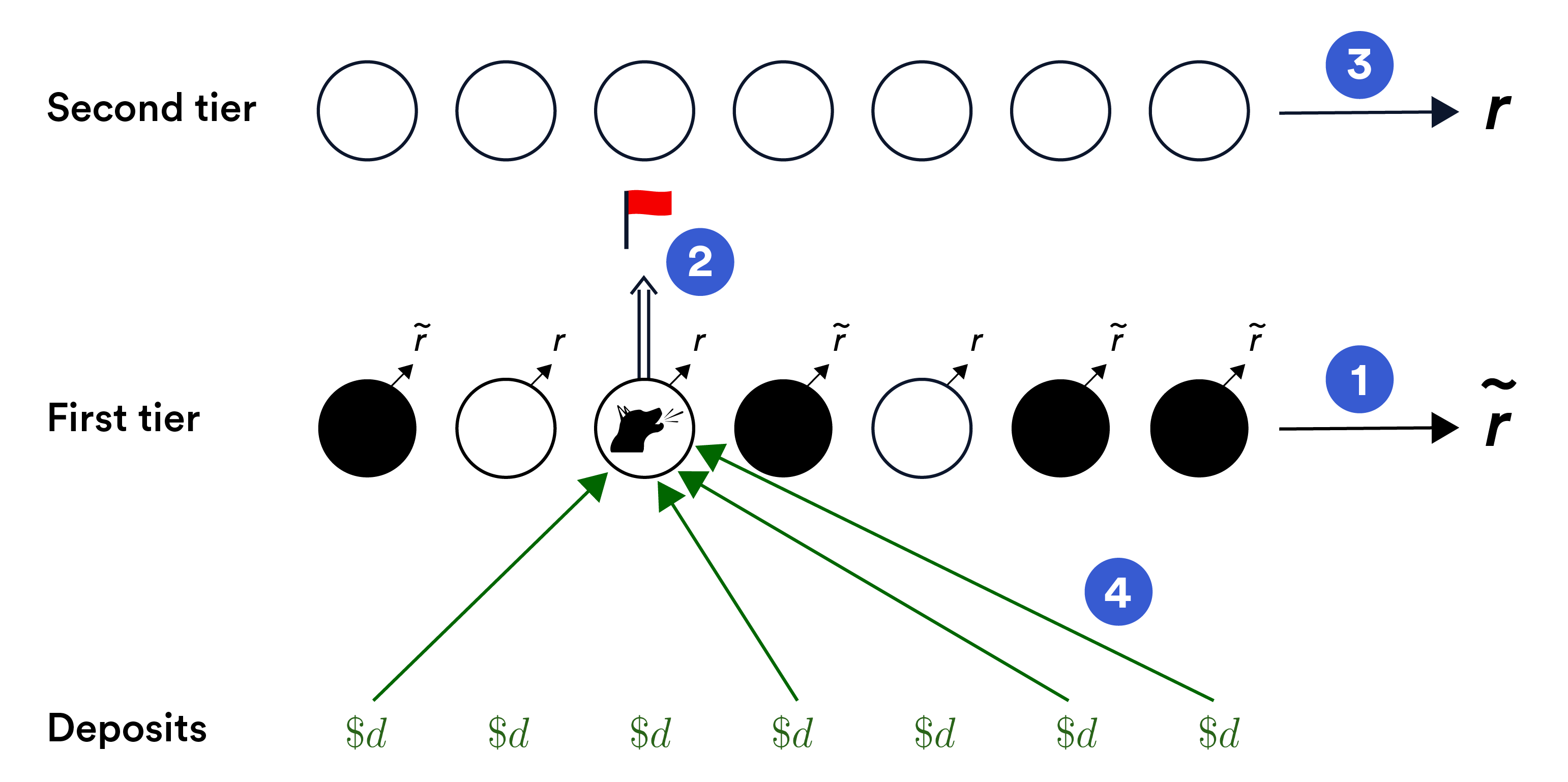
Figure 15: Schematic of staking scheme with alerting. In this example, 1⃝a majority of nodes are corrupted / bribed and emit an incorrect value ˜r, rather than the correct report value r. The watchdog node 2⃝sends an alert to the second-tier committee, which 3⃝determines and emits the correct report value r, resulting in corrupted nodes forfeiting their deposits—each $d to the watchdog node 4⃝. outline some optimizations that result in a faster (single-round) if somewhat more complex design in Section 9.5. Recall that the first tier in our staking mechanism consists of the basic oracle network itself. The main structure of our mechanism, as described above, is that in each round, each node can act as a “watchdog” with some priority, and it thus has the ability to raise an alert if the mechanism arrives at an incorrect output ˜r, rather than a correct one r. This alert causes second-tier resolution, which we assume arrives at a correct report. Nodes with incorrect reports are punished, in the sense that their stakes are slashed and awarded to watchdogs. This basic structure is common in oracle systems, as in, e.g., [119, 185]. The key innovation in our design, mentioned briefly above, is that every node is assigned a distinct priority in the ordering of potential watchdogs. That is, watchdogs are given opportunities to alert in priority sequence. Recall that if a node has the highest priority to raise an alert, it receives the slashed deposit $d of every misbehaving node, for a total of more than \(dn/2 = \)d × n/2, as an incorrect report implies a majority of bad nodes. Consequently, the adversary must pay at least this reward to bribe an arbitrary node. Thus, to bribe a majority of nodes, the adversary must pay a large bribe to a majority of nodes, namely, strictly more than $dn2/2. We show schematically how alerting and watchdog escalation works in Fig. 15.
9.4.1 Further Mechanism Details The bribery-resistant system we now describe in further detail is a simplified sketch of the two-tiered construction we intend to build. Most of our focus will be on describing the first-tier network (henceforth simply “network” where clear from context) along with its incentive mechanism and the procedure for escalation to the second tier. Consider a Chainlink network composed of n oracle nodes that are responsible for regularly (e.g., once a minute) reporting a boolean value (e.g., whether the market capitalization of BTC exceeds that of ETH). As part of the staking mechanism, nodes must provide two deposits: a deposit $d subject to slashing in the event of disagreement with the majority and a watchdog deposit $dw subject to slashing in the event of a faulty escalation. We assume that the nodes cannot copy the submissions of other nodes, e.g., through a commit-reveal scheme as discussed in Section 5.3. In each round, nodes first commit to their report, and once all nodes have committed (or a timeout has expired), nodes reveal their reports. For each report to be generated, every node is also given a watchdog priority between 1 and n chosen at random, with 1 being top priority. This priority enables the concentration of reward in the hands of one watchdog. After all reports are public, an alerting phase ensues. Over a sequence of n (synchronous) rounds, the node with priority i has the opportunity to alert in round i. Let us consider the possible outcomes for the mechanism after nodes have revealed their reports. Again assuming a binary report, suppose the correct value is true and the incorrect one is false. Suppose also that the first-tier mechanism outputs the majority value output by nodes as the final report r. There are three possible outcomes in the mechanism: • Complete agreement: In the best case, nodes are in complete agreement: all nodes are available and have provided a timely report of the same value r (either true or false). In this case, the network need only forward r to relying contracts and reward each node with a fixed per-round payment $p, which is much smaller than $d. • Partial agreement: It is possible that some nodes are offline or there is disagreement about which value is correct, but most nodes report true and only a minority reports false. This case is also straightforward. The majority value (true) is computed, resulting in a correct report r. All nodes that reported r are rewarded with $p while the oracles that reported incorrectly have their deposits slashed modestly, e.g., by $10p. • Alert: In the event that a watchdog believes the output of the network is incorrect, it publicly triggers an alert, escalating the mechanism to the second-tier network. There are then two possible results: – Correct alert: If the second-tier network confirms that the output of the
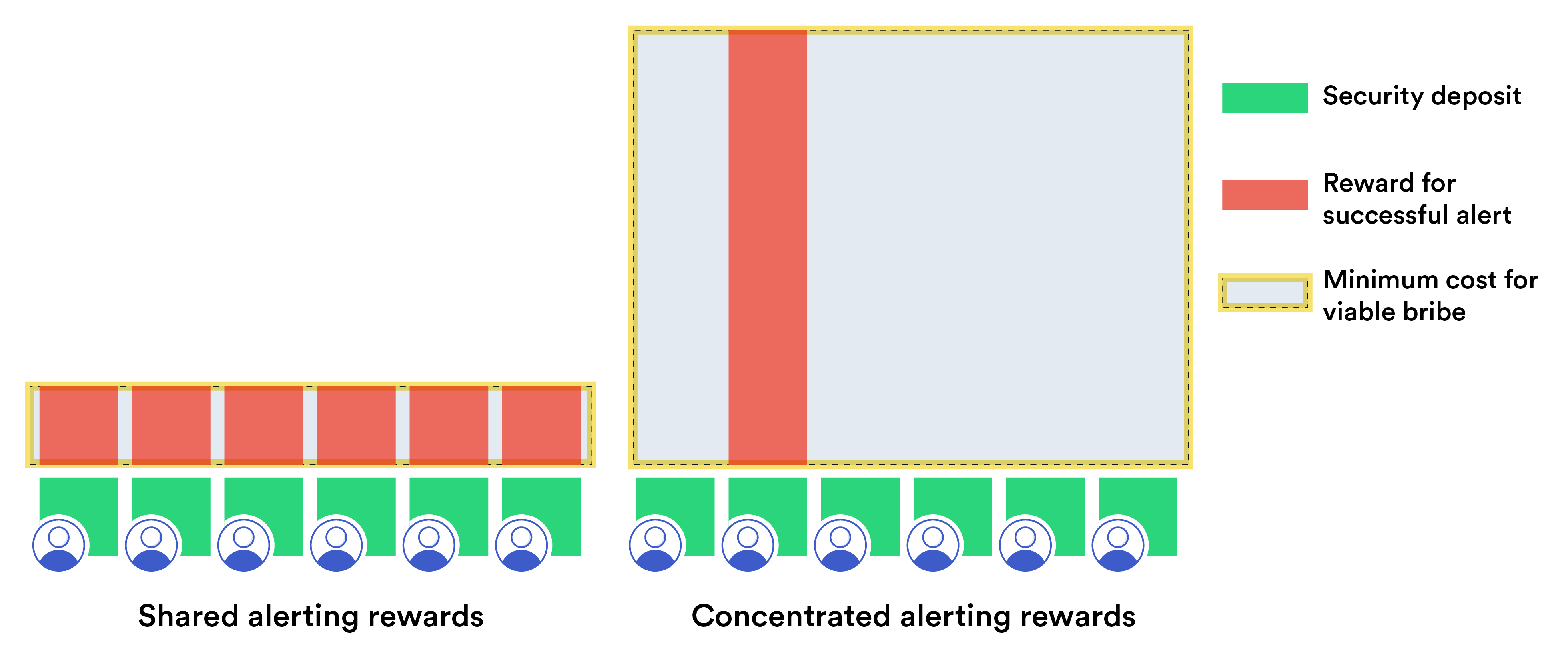
Figure 16: Amplifying briber’s cost through concentrated alerting rewards. A bribing adversary must bribe each node with more than the reward it stands to gain by alerting (shown as a red bar). If alerting rewards are shared, then this reward may be relatively small. Concentrated alerting rewards increase the reward that any single node may obtain (tall red bar). Consequently the total payout by the adversary for a viable bribe (gray regions) is much larger with concentrated than shared alerting rewards. first-tier network was incorrect, the alerting watchdog node receives a reward consisting of all slashed deposits, and thus more than $dn/2. – Faulty alert: If the second-tier and first-tier oracles agree, the escalation is deemed faulty and the alerting node loses its $dw deposit. In the case of optimistic acceptance of reports, watchdog alerts do not cause any change in execution of relying contracts. For contracts designed to await potential arbitration by the second-tier committee, watchdog alerts delay but do not freeze contract execution. It is also possible for contracts to designate a failover DON for periods of adjudication. 9.4.2 Quadratic Staking Impact The ability for every node to act as a watchdog, combined with strict node priority ensuring concentrated rewards, enables the mechanism to achieve quadratic staking impact for each kind of bribing attacker described in Section 9.3.3. Recall that this means specifically in our setting that, for a network with n nodes each with deposit $d, a successful briber (of any of the kinds above) must have a budget of bigger than $dn2/2. To be precise, the briber must corrupt at least (n+1)/2 nodes, since the briber must corrupt a majority of n nodes (for odd n, by assumption). Thus, a watchdog stands to earn a reward of $d(n + 1)/2. The briber consequently must pay this amount to every
node to ensure that none acts as a watchdog. We are working to show formally that if the briber has a budget of at most $d(n2 + n)/2, then the subgame perfect equilibrium of the game between the bribers and the oracles—in other words, the equilibrium at any point during the play of the game—is for the briber not to issue the bribe and for each oracle to report its true values honestly. We have explained above how it is possible that a successful briber could require a budget significantly larger than that of the sum of the node deposits. To illustrate this intuitive result, Fig. 16 shows the impact of concentrated alert rewards graphically. As we see there, if the reward for watchdog alerting—namely the deposits of bribed nodes reporting false)—were split among all potential alerting, the total amount that any individual alerting node could expect would be relatively small, on the order of $d. A briber, knowing that a payout of larger than $d was improbable, could use a false-outcome conditional bribe to bribe each of n nodes with slightly more than $d + ϵ. Counterintuitively, Fig. 16 shows that a system that distributes a reward broadly among nodes signaling an alert is far weaker than one that concentrates the reward in the hands of a single watchdog. Example parameters: Consider a (first-tier) network with n = 100 nodes, each depositing \(d = \)20K. This network would have a total of $2M deposited but would be protected against a briber with budget \(100M = \)dn2/2. Increasing the number of oracles is more effective than increasing $d, of course, and can have a dramatic effect: a network with n = 300 nodes and deposits \(d = \)20K would be protected against a briber with budget up to $900M. Note that a staking system can in many cases protect smart contracts representing more value than the offered level of bribery protection. This is because an adversary attacking these contracts cannot extract the full value in many cases. For example, a Chainlink-powered contract securing $1B in value may only require security against a briber with $100M in resource because such an adversary can feasibly extract a profit of only 10% of the value of the contract. Note: The idea that the value of a network can grow quadratically is expressed in the well known Metcalfe’s Law [167, 235], which states that the value of a network grows quadratically in the number of connected entities. Metcalfe’s Law, however, arises from growth in the number of potential pairwise network connections, a different phenomenon than that underlying quadratic staking impact in our incentive mechanism. 9.4.3 Realization of Second Tier Two operational features facilitate realization of a high-reliability second tier: (1) Second-tier adjudication should be a rare event in oracle networks and therefore can be significantly more costly than normal operation of the first tier and (2) Assuming
optimistically accepted reports—or contracts whose execution can await arbitration— the second tier need not execute in real time. These features result in a range of configuration options for the second tier to meet the requirements of particular DONs. As an example approach, a second tier committee can consist of nodes selected by a DON (i.e., first tier) from the longest-serving and most reliable nodes in the Chainlink network. In addition to considerable relevant operational experience, the operators of such nodes have a considerable implicit incentive in FFO that motivates a desire to ensure that the Chainlink network remains highly reliable. They also have publicly available performance histories that provide transparency into their reliability. Secondtier nodes, it is worth noting, need not be participants in the first-tier network, and may adjudicate faults across multiple first-tier networks. Nodes in a given DON can pre-designate and publicly commit to a set of n′ such nodes as constituting the second-tier committee for that DON. Additionally, DON nodes publish a parameter k′ ≤n′ that determines the number of second-tier votes required to penalize a first-tier node. When an alert is generated for a given report, the members of the second tier vote on the correctness of the values provided by each of the first-tier nodes. Any first-tier node that receives k′ negative votes forfeits its deposits to the watchdog node. Because of the rareness of adjudication and opportunity for extended-time execution noted above, in contrast to the first tier, nodes in the second tier can: 1. Be highly compensated for conducting adjudication. 2. Draw on additional data sources, beyond even the diverse set used by the firsttier. 3. Rely on manual and/or expert inspection and intervention, e.g., to identify and reconcile errors in source data and distinguish between an honest node relaying faulty data and a misbehaving node. We emphasize that the approach we have just described for selection of secondtier nodes and policy governing adjudication represents just a point within a large design space of possible realizations of the second tier. Our incentive mechanism offers complete flexibility as to how the second tier is realized. Individual DONs can thus constitute and set rules for their second tiers that meet the particular requirements and expectations of participating nodes and users. DECO and Town Crier as adjudication tools: It is essential for the second tier in our mechanism to be able to distinguish between adversarial first-tier nodes that intentionally produce incorrect reports and honest first-tier nodes that unintentionally relay data that is incorrect at the source. Only then can the second tier implement slashing to disincentivize cheating, the goal of our mechanism. DECO and Town Crier are powerful tools that can enable second-tier nodes to make this critical distinction reliably.
Second-tier nodes may in some cases be able to directly query the data source used by a first-tier node or use ADO Section 7.1 in order to check whether an incorrect report resulted from a faulty data source. In other cases, however, second tier nodes may lack direct access to a first-tier node’s data source. In such cases, correct adjudication would appear to be infeasible or require a reliance on subjective judgment. Previous oracle dispute systems have relied upon inefficient, escalating rounds of voting to address such challenges. Using DECO or Town Crier, however, a first tier node can prove correct behavior to second-tier nodes. (See Section 3.6.2 for details on the two systems.) Specifically, if the second tier node identifies a first-tier node as having output a faulty report value ˜r, the first-tier node can use DECO or Town Crier to generate tamperproof evidence for second-tier nodes that it is correctly relaying ˜r correctly from a (TLS-enabled) source recognized as authoritative by the DON. Critically, the first-tier node can do this without second-tier nodes requiring direct access to the data source.17 Consequently, correct adjudication is feasible in Chainlink for any desired data source. 9.4.4 Misreporting Insurance The strong bribery resistance achieved by our staking mechanism relies fundamentally on slashed funds being awarded to alerters. Without a monetary reward, alerters would have no direct incentive to reject bribes. As a result, however, slashed funds are not available to compensate users harmed by incorrect reports, e.g., users that lose money when incorrect price data is relayed to a smart contract. By assumption, incorrect reports don’t pose a problem if reports are accepted by a contract only after potential adjudication, i.e., action by the second tier. As explained above, though, to achieve the best possible performance, contracts may instead rely optimistically on the mechanism to enforce correct reporting, meaning that they accept reports before potential second-tier adjudication. Indeed, such optimistic behavior is safe in our model assuming rational adversaries whose budgets do not exceed the staking impact of the mechanism. Users concerned about the improbable event of a mechanism failure resulting from, e.g., adversaries with overwhelming financial resources, may wish to employ an additional layer of economic security in the form of misreporting insurance. We know of multiple insurers already intending to offer smart-contract-backed policies of this kind for Chainlink-secured protocols in the near future, including through innovative mechanisms such as DAOs, e.g., [7]. The existence of performance history for Chainlink nodes and other data about nodes such as their stake amounts provides an exceptionally strong basis for actuarial assessments of risk, making it possible to price policies in ways that are inexpensive for policyholders yet sustainable for insurers. 17With Town Crier, it is additionally possible for first-tier nodes to locally generate attestations of correctness for the reports they output and provide these attestations to second-tier nodes on an as-needed basis.
Basic forms of misreporting insurance can be implemented in a trustworthy and efficient manner using smart contracts. As a simple example, a parametric insurance contract SCins can compensate policyholders automatically if our incentive mechanism’s second tier identifies an error in a report generated in the first tier. A user U that wishes to purchase an insurance policy, e.g., the creator of a target contract SC, can submit a request to a decentralized insurer for an policy amount $M on the contract. On approving U, the insurer can set an ongoing (e.g., monthly) premium of $P in SCins. While U pays the premium, her policy remains active. If a reporting failure occurs in SC, the result will be the emission of a pair (r1, r2) of conflicting reports for SC, where r1 is signed by the first tier in our mechanism and r2, the corresponding corrected report, is signed by the second tier. If the U furnishes such a valid pair (r1, r2) to SCins, the contract automatically pays her $M, provided her premium payments are up-to-date. 9.5 Single-Round Variant The protocol described in the previous subsection requires that the second-tier committee wait n rounds to determine whether a watchdog has raised an alert. This requirement holds even in the optimistic case, i.e., when the first tier is functioning correctly. For users unwilling to accept reports optimistically, i.e., prior to potential adjudication, the delay associated with that approach would be unworkable. For this reason, we are also exploring alternative protocols that require just one round. In this approach, all oracle nodes submit secret bits indicating whether or not they wish to raise an alert. The second-tier committee then checks these values in priority order. To provide a rough sketch, such a scheme might involve the following steps: 1. Watchdog bit submission: Each node Oi secret-shares a one-bit watchdog value wi ∈{no alert, alert} among nodes in the second tier for every report it generates. 2. Anonymous tips: Any oracle node can submit an anonymous tip α to the secondtier committee in the same round that watchdog bits are submitted. This tip α is a message indicating that an alert has been raised for the current report. 3. Watchdog bit checking: The second-tier committee reveals oracle nodes’ watchdog bits in priority order. Note that nodes must send no alert watchdog bits when they don’t alert: otherwise, traffic analysis reveals all nodes’ bits. The protocol does reveal the no alert watchdog bits of nodes with higher priority than the highest-priority alerting watchdog. Observe that what is revealed is identical with that of our n-round protocol. Rewards are also distributed identically with that scheme, i.e., the first identified watchdog receives the slashed deposits of nodes that have submitted incorrect reports.
The use of anonymous tips enables the second-tier committee to remain noninteractive in cases where no alert has been raised, reducing communication complexity in the common case. Note that any watchdog that raises an alert has an economic incentive to submit an anonymous tip: If no tip is submitted, no reward is paid to any node. To ensure that the sender Oi of an anonymous tip α cannot be identified by the adversary based on network data, the anonymous tip can be sent over an anonymous channel, e.g, via Tor, or, more practically, proxied via a cloud service provider. To authenticate the tip as originating with O, Oi can sign α using a ring signature [39, 192]. Alternatively, to prevent unattributable denial-of-service attacks against the secondtier committee by a malicious oracle node, α can be an anonymous credential with revocable anonymity [73]. This protocol, while practically achievable, has somewhat heavyweight engineering requirements (which we are exploring ways to reduce). First-tier nodes, for instance, must communicate directly with second-tier nodes, requiring maintenance of a directory. The need for anonymous channels and ring signatures adds to the engineering complexity of the scheme. Finally, there is a special trust requirement briefly discussed in the note below. We are therefore also exploring simpler schemes that still achieve super-linear staking impact, but perhaps less than quadratic, in which a briber asymptotically needs resources of at least $n log n, for example. Some of the schemes under consideration involve random selection of a strict subset of nodes to act as watchdogs, in which case prospective bribery becomes an especially powerful attack. Remark: The security of this single-round staking mechanism requires untappable channels between oracle and second-tier nodes—a standard requirement in coercionresistant systems, e.g., voting [82, 138], and a reasonable one in practice. Additionally, however, a node Oi that seeks to cooperate with a briber can construct its secret shares in such a way as to show the briber that it has encoded a particular value. For example, if Oi does not know which nodes the briber controls, then Oi can submit 0-valued shares to all committee members. The briber can then verify Oi’s compliance probabilistically. To avoid this problem in any single-round protocol, we require that Oi know the identity of at least one honest second-tier node. With an interactive protocol in which each second-tier node adds a randomization factor to shares, the best the briber can do is enforce selection by Oi of a random watchdog bit. 9.6 Implicit-Incentive Framework (IIF) FFO is a form of implicit incentive for correct behavior in the Chainlink network. It functions like explicit stake, i.e., deposits, in that it helps enforce economic security for the network. In other words, FFO should be included as part of the (effective) deposit $d of a node in the network.
The question is: How do we measure FFO and other forms of implicit incentive within the Chainlink network? The Implicit-Incentive Framework (IIF) is a set of principles and techniques that we plan to develop for this purpose. Blockchain systems provide many forms of unprecedented transparency, and the high-trust records of node performance they create are a springboard for our vision of how the IIF will work. Here we very briefly sketch ideas on key elements of the IIF. The IIF itself will consist of a set of factors we identify as important in evaluating implicit incentives, along with mechanisms for publishing relevant data in a highassurance form for consumption by analytics algorithms. Different Chainlink users may wish to use the IIF in different ways, e.g., giving different weighting to different factors. We expect analytics services to arise in the community that help users apply the IIF according to their individual risk-evaluation preferences, and our goal is to facilitate such services by ensuring their access to high-assurance and timely supporting data, as we discuss below (Section 9.6.4). 9.6.1 Future Fee Opportunity Nodes participate in the Chainlink ecosystem to earn a share of the fees that the networks pay out for any of the various services we have described in this paper, from ordinary data feeds to advanced services such as decentralized identity, fair sequencing, and confidentiality-preserving DeFi. Fees in the Chainlink network support node operators’ costs for, e.g., running servers, acquiring necessary data licenses, and maintaining a global staffto ensure high uptime. FFO denotes the service fees, net of expenses, that a node stands to gain in the future—or lose should it demonstrate faulty behavior. FFO is a form of stake that helps secure the network. A helpful feature of FFO is the fact that on-chain data (supplemented by off-chain data) establish a high-trust record of a node’s history, enabling computation of FFO in a transparent, empirically driven manner. A simple, first-order measure of FFO can derive from the average net revenue of a node over a period of time (i.e., gross revenue minus operating expenses). FFO may then be calculated as, e.g., the net present value [114] of cumulative future net revenue, in other words, the time-discounted value of all future earnings. Node revenue can be volatile, however, as shown for example in Fig. 17. More importantly, node revenue may not follow a distribution that is stationary over time. Consequently, other factors we plan to explore in estimating FFO include: • Performance history: An operator’s performance history—including the correctness and timeliness of its reports, as well as its up time—provides an objective touchstone for users to evaluate its reliability. Performance history will thus provide a critical factor in users’ selection of oracle nodes (or, with the advent of DONs, their selection of DONs). A strong performance history is likely to correlate with high ongoing revenue.18 18An important research question we intend to address is detection of falsified service volumes.
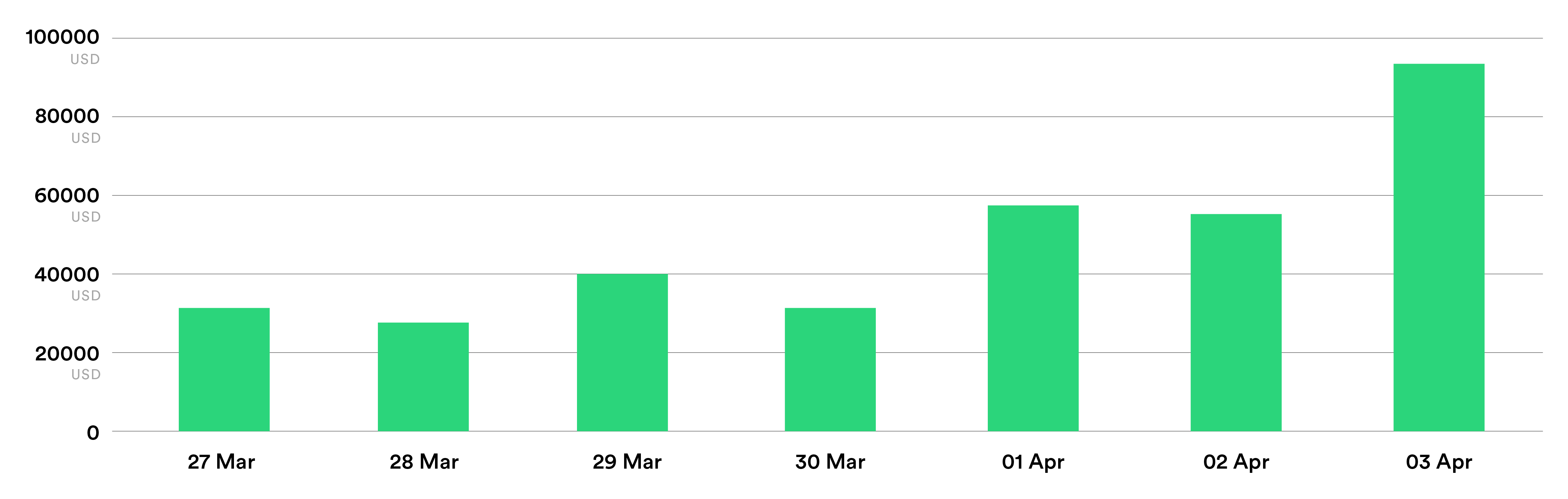
Figure 17: Revenue earned by Chainlink nodes on a single data feed (ETH-USD) during a representative week in March 2021. • Data access: While oracles may obtain many forms of data from open APIs, certain forms of data or certain high-quality sources may be available only on a subscription basis or through contractual agreements. Privileged access to certain data sources can play a role in creating a stable revenue stream. • DON participation: With the advent of DONs, communities of nodes will come together to provide particular services. We expect that many DONs will include operators on a selective basis, establishing participation in reputable DONs as a privileged market position that helps ensure a consistent source of revenue. • Cross-platform activity: Some node operators may have well-established presences and performance track records in other contexts, e.g., as PoS validators or data providers in non-blockchain contexts. Their performance in these other systems (when data on it is available in a trustworthy form) can inform evaluation of their performance history. Similarly, faulty behavior in the Chainlink network can jeopardize revenue in these other systems by driving away users, i.e., FFO can extend across platforms. 9.6.2 Speculative FFO Node operators participate in the Chainlink network not just to generate revenue from operations, but to create and position themselves to take advantage of new opportunities to run jobs. In other words, expenditure by oracle nodes in the network is also a positive statement about the future of DeFi and other smart-contract application domains as well as emerging non-blockchain applications of oracle networks. Node operators today earn the fees available on existing Chainlink networks and simultaneously These are loosely analogous to fake reviews on internet sites, except that the problem is easier in the oracle setting because we have a definitive record of whether the goods, i.e., reports, were ordered and delivered—as opposed to, e.g., physical goods ordered in online shops. Put another way, in the oracle setting, performance can be validated, even if customer veracity can’t.
build a reputation, performance history, and operational expertise that will position them advantageously to earn fees available in future networks (contingent, of course, on honest behavior). The nodes operating in the Chainlink ecosystem today will in this sense have an advantage over newcomers in earning the fees as additional Chainlink services become available. This advantage applies to new operators, as well as technology companies with established reputations; for example, T-Systems, a traditional technology provider (subsidiary of Deutsche Telekom), and Kraken, a large centralized exchange, have established early presences in the Chainlink ecosystem [28, 143]. Such participation by oracle nodes in future opportunities may be regarded itself as a kind of speculative FFO, and thus constitutes a form of stake in the Chainlink network. 9.6.3 External Reputation The IIF as we have described it can operate in a network with strictly pseudonymous operators, i.e., without disclosure of the people or real-world entities involved. One potentially important factor for user selection of providers, however, is external reputation. By external reputation, we mean the perception of trustworthiness attaching to real-world identities, rather than pseudonyms. Reputational risk attaching to real-world identities can be viewed as a form of implicit incentive. We view reputation through the lens of the IIF, i.e., in a cryptoeconomic sense, as a means of establishing cross-platform activity that may be incorporated into FFO estimates. The benefit of using external reputation as a factor in estimates of FFO, as opposed to pseudonymous linkage, is that external reputation links performance not just to an operator’s existing activities, but also to future ones. If, for instance, a bad reputation attaches to an individual person, it can taint that person’s future enterprises. Put another way, external reputation can capture a broader swath of FFO than pseudonymous performance records, as the impact of malfeasance attaching to a person or established company is harder to escape than that associated with a pseudonymous operation. Chainlink is compatible with decentralized identity technologies (Section 4.3) that can provide support for the use of external reputation in the IIF. Such technologies can validate and thereby help ensure the veracity of operators’ asserted real-world identities.19 9.6.4 Open IIF Analytics The IIF, as we have noted, aims to provide reliable open-source data and tools for implicit-incentive analytics. The goal is to enable providers within the community to develop analytics tailored to the risk-assessment needs of different parts of the Chainlink user base. 19Decentralized identity credentials can also, where desired, embellish pseudonyms with validated supplementary information. For example, a node operator could in principle use such credentials to prove that it is a Fortune 500 company, without revealing which one.
A considerable amount of historical data regarding nodes’ revenue and performance resides on chain in a high-trust, immutable form. Our goal, however, is to provide the most comprehensive possible data, including data on behaviors that are visible only off chain, such as Off-Chain Reporting (OCR) or DON activity. Such data can potentially be voluminous. The best way to store it and ensure its integrity, i.e., protect it from tampering, we believe, will be with the help of DONs, using techniques discussed in Section 3.3. Some incentives lend themselves to direct forms of measurement, such as staking deposits and basic FFO. Others, such as speculative FFO and reputation, are harder to measure in an objective manner, but we believe that supporting forms of data, including historical growth of the Chainlink ecosystem, social-media metrics of reputation, etc., can support IIF analytics models even for these harder-to-quantify elements. We can imagine that dedicated DONs arise specifically to monitor, validate, and record data relating to off-chain performance records of nodes, as well as other data used in the IIF, such as validated identity information. These DONs can provide uniform, high-trust IIF data for any analytics providers serving the Chainlink community. They will also provide a golden record that makes the claims of analytics providers independently verifiable by the community. 9.7 Putting It All Together: Node Operator Incentives Synthesizing our discussions above on explicit and implicit incentives for node operators provides a holistic view of the ways that node operators participate in and benefit from the Chainlink network. As a conceptual guide, we can express the total assets at stake by a given Chainlink node operator $S in a rough, stylized form as: \(S ≈\)D + \(F + \)FS + $R, where: • $D is the aggregate of all explicitly deposited stake across all networks in which the operator participates; • $F is the net present value of the aggregate of all FFO across all networks in which the operator participates; • $FS is the net present value of the speculative FFO of the operator; and • $R is the reputational equity of the operator outside the Chainlink ecosystem that might be jeopardized by identified misbehavior in its oracle nodes. While largely conceptual, this rough equality helpfully shows that there is a multiplicity of economic factors favoring high-reliability performance by Chainlink nodes. All of these factors other than $D are present in today’s Chainlink networks.
9.8 The Virtuous Cycle of Economic Security The combination of super-linear staking impact with representation of fee payments as future fee opportunity (FFO) in the IIF can lead to what we call the virtuous cycle of economic security in an oracle network. This can be seen as a kind of economy of scale. As the total amount secured by a particular network rises, the amount of additional stake it takes to add a fixed amount of economic security decreases as does the average per-user cost. It’s therefore cheaper, in terms of fees, for a user to join an already-existing network than to achieve the same increase in network economic security by creating a new network. Importantly, the addition of each new user lowers the cost of the service for all previous users of that network. Given a particular fee structure (e.g. a particular yield rate on the amount staked), if the total fees earned by a network increases, this incentivizes the flow of additional stake into the network to secure it at a higher rate. Specifically, if the total stake an individual node may hold in the system is capped, then when new fee payments enter the system, raising its FFO, the number of nodes n will increase. Thanks to the super-linear staking impact of our incentive system design, the economic security of the system will rise faster than n, e.g., as n2 in the mechanism we sketch in Section 9.4. As a result, the average cost for economic security—i.e., amount of stake contributing a dollar of economic security—will drop. The network can therefore charge its users lower fees. Assuming that demand for oracle services is elastic (see, e.g., [31] for a brief explanation), demand will rise, generating additional fees and FFO. We illustrate this point with the following example. Example 5. Since the economic security of an oracle network with our incentive scheme is \(dn2 for stake \)dn, the economic security contributed by a dollar of stake is n and thus the average cost per dollar of economic security—i.e, amount of stake contributing to a dollar of economic security—is 1/n. Consider a network in which the economic incentives consist entirely of FFO, capped at \(d ≤\)10K per node. Suppose the network has n = 3 nodes. Then the average cost per dollar of economic security is about $0.33. Suppose that the total FFO of the network rises above \(30K (e.g., to \)31K). Given the cap on per-node FFO, the network grows to (at least) n = 4. Now the average cost per dollar of economic security drops to about $0.25. We illustrate the full virtuous cycle of economic security in oracle networks schematically in Fig. 18. We emphasize that the virtuous cycle of economic security derives from the effect of users pooling their fees. It is their collective FFO that works in favor of larger network sizes and thus greater collective security. We also note that the virtuous cycle of economic security works in favor of DONs achieving financial sustainability. Once created, DONs that address user needs should grow to and beyond the point at which revenue from fees exceed operational costs for oracle nodes.
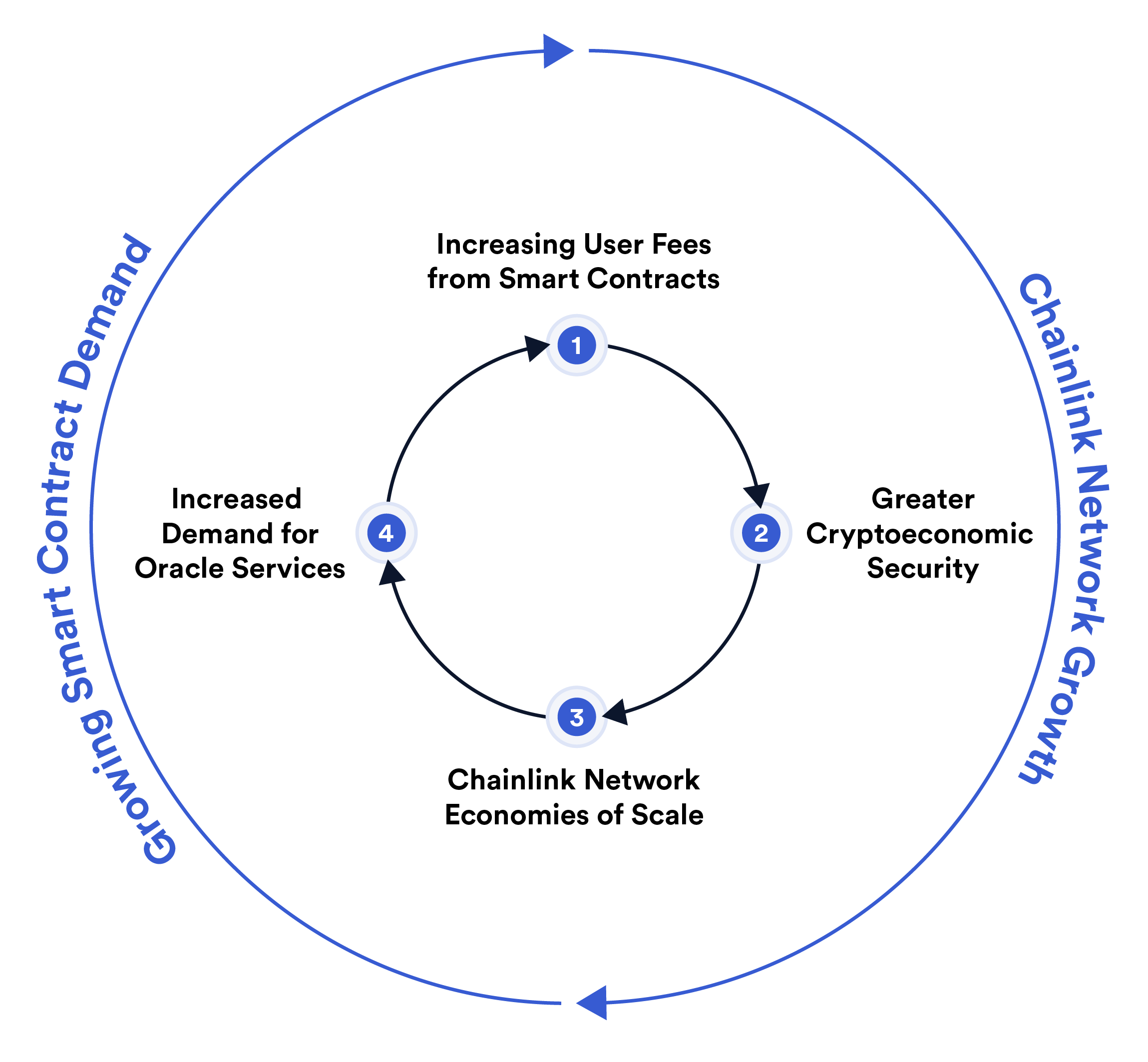
Figure 18: Schematic of the virtuous cycle of Chainlink staking. A rise in user fee payments to an oracle network 1⃝causes it to grow, leading to growth in its economic security 2⃝. This super-linear growth realizes economies of scale in Chainlink networks 3⃝. Specifically, it means a reduction in the average cost of economic security , i.e., the per-dollar economic security arising from fee payments or other sources of stake increases. Lower costs, passed along to users, stimulate increased demand for oracle services 4⃝. 9.9 Additional Factors Driving Network Growth As the Chainlink ecosystem continues to expand, we believe that its attractiveness to users and importance as infrastructure for the blockchain economy will accelerate. The value provided by oracle networks is super-linear, meaning that it grows faster
than the size of the networks themselves. This growth in value derives from both economies of scale—greater per-user cost efficiency as service volumes increase—and network effects—an increase of network utility as users adopt DONs more widely. As existing smart contracts continue to see more value secured and entirely new smart contract applications are made possible by more decentralized services, the total use of and aggregate fees paid to DONs should grow. Increasing pools of fees in turn translate into the means and incentive to create even more decentralized services, resulting in a virtuous cycle. This virtuous cycle solves a critical chicken-and-egg problem in the hybrid smart contract ecosystem: Innovative smart contract features often require decentralized services that don’t yet exist (e.g., new DeFi markets often require new data feeds) yet need sufficient economic demand to come into existence. The pooling of fees by various smart contracts for existing DONs will signal demand for additional decentralized services from a growing user base, giving rise to their creation by DONs and an ongoing enablement of new and varied hybrid smart contracts. In summary, we believe that the growth in network security driven by virtuous cycles in the Chainlink staking mechanism exemplifies larger patterns of growth that the Chainlink network can help bring about in an on-chain economy for decentralized services.
अर्थशास्त्र और क्रिप्टोइकोनॉमिक्स
विकेंद्रीकृत ट्रस्ट मॉडल के भीतर मजबूत सुरक्षा प्राप्त करने के लिए Chainlink नेटवर्क के लिए, यह आवश्यक है कि नोड्स सामूहिक रूप से सही व्यवहार प्रदर्शित करें, जिसका अर्थ है कि वे पालन करें अधिकांश समय बिल्कुल DON प्रोटोकॉल पर। इस अनुभाग में, हम दृष्टिकोणों पर चर्चा करते हैं आर्थिक प्रोत्साहनों, अर्थात् क्रिप्टोइकॉनॉमिक, के माध्यम से ऐसे व्यवहार को लागू करने में मदद करना प्रोत्साहन. ये प्रोत्साहन दो श्रेणियों में आते हैं: स्पष्ट और अंतर्निहित, साकार क्रमशः staking और भविष्य शुल्क अवसर (FFO) के माध्यम से। दांव लगाना: अन्य blockchain प्रणालियों की तरह, Chainlink में दांव लगाने में नेटवर्क प्रतिभागी, यानी, oracle नोड शामिल होते हैं, जो लिंक tokens के रूप में लॉक किए गए फंड को जमा करते हैं। ये फंड, जिसे हम हिस्सेदारी या स्पष्ट हिस्सेदारी भी कहते हैं, एक स्पष्ट प्रोत्साहन है। वे नोड विफलता या दुर्भावना पर जब्ती के अधीन हैं। blockchain संदर्भ में, इस प्रक्रिया को अक्सर स्लैशिंग कहा जाता है। हालाँकि, Chainlink में oracle नोड्स द्वारा स्टेकिंग, मूल रूप से staking से भिन्न है अनुमति रहित blockchains में validators द्वारा। सत्यापनकर्ता लेन-देन में गोल-मोल बातें करके या प्रतिकूल ढंग से आदेश देकर दुर्व्यवहार कर सकते हैं। ए में अंतर्निहित सर्वसम्मति प्रोटोकॉल 15चूंकि उपयोगकर्ता मेमपूल में लेनदेन को प्रतिस्थापित कर सकते हैं, इसलिए खनन किए गए और DON-प्रस्तुत किए गए लेनदेन के बीच सही पत्राचार सुनिश्चित करने के लिए देखभाल की आवश्यकता होती है।अनुमति रहित blockchain, हालांकि, validators को अमान्य ब्लॉक उत्पन्न करने से रोकने के लिए कठोर और तेज़ ब्लॉक-सत्यापन नियमों और क्रिप्टोग्राफ़िक प्राइमेटिव्स का उपयोग करता है। इसके विपरीत, प्रोग्रामेटिक सुरक्षा धोखाधड़ी वाले oracle नेटवर्क को उत्पन्न होने से नहीं रोक सकती अमान्य रिपोर्ट. इसका कारण दो प्रकार की प्रणालियों के बीच एक महत्वपूर्ण अंतर है: blockchains में लेनदेन सत्यापन आंतरिक स्थिरता का एक गुण है, जबकि शुद्धता blockchain पर oracle रिपोर्ट बाहरी, यानी, ओff-चेन डेटा की एक संपत्ति है। हमने Chainlink नेटवर्क आधारित के लिए एक प्रारंभिक staking तंत्र डिज़ाइन किया है oracle नोड्स के बीच एक इंटरैक्टिव प्रोटोकॉल पर जो बाहरी डेटा का उपयोग कर सकता है। यह तंत्र स्पष्ट पुरस्कारों का उपयोग करके सही व्यवहार के लिए वित्तीय प्रोत्साहन बनाता है जुर्माना (काटना)। चूंकि तंत्र आर्थिक है, इसे नोड को रोकने के लिए डिज़ाइन किया गया है एक विरोधी द्वारा भ्रष्टाचार जो नोड्स को भ्रष्ट करने के लिए वित्तीय संसाधनों का उपयोग करता है रिश्वतखोरी (ऐसा प्रतिद्वंद्वी बहुत सामान्य है, और इसका विस्तार, उदाहरण के लिए, सहयोग करने वाले नोड्स तक होता है उनके सामूहिक दुर्व्यवहार से मूल्य निकालें।) हमारे द्वारा डिज़ाइन किया गया Chainlink staking तंत्र कुछ शक्तिशाली और नवीन है विशेषताएं.16 ऐसी मुख्य विशेषता सुपर-लीनियर staking प्रभाव (विशेष रूप से, द्विघात) है। एक प्रतिद्वंद्वी के पास नोड्स द्वारा जमा की गई धनराशि से कहीं अधिक संसाधन होने चाहिए तंत्र को नष्ट करने का आदेश। हमारा staking तंत्र अतिरिक्त रूप से समान प्रणालियों में पहले की तुलना में अधिक मजबूत प्रतिद्वंद्वी के खिलाफ सुरक्षा प्रदान करता है, अर्थात् एक प्रतिद्वंद्वी जो नोड्स के भविष्य के व्यवहार पर रिश्वत कंडीशनिंग बना सकता है। इसके अतिरिक्त, हम चर्चा करते हैं कि कैसे DECO जैसे Chainlink उपकरण हमारे staking को मजबूत करने में मदद कर सकते हैं दोषपूर्ण नोड व्यवहार के मामले में सही निर्णय की सुविधा प्रदान करके तंत्र। भविष्य शुल्क अवसर (एफएफओ): दोनों PoW की अनुमति रहित blockchains और पीओएस विविधता-आज हम जिसे अंतर्निहित प्रोत्साहन कहते हैं, उस पर गंभीर रूप से निर्भर हैं। ये हैं ईमानदार व्यवहार के लिए आर्थिक प्रोत्साहन जो स्पष्ट पुरस्कारों से नहीं, बल्कि प्राप्त होते हैं मंच भागीदारी से ही. उदाहरण के लिए, Bitcoin खनिक समुदाय को आत्मविश्वास को कम करने के जोखिम से 51% हमले के खिलाफ प्रोत्साहित किया जाता है Bitcoin, इसके मूल्य को कम कर रहा है, और परिणामस्वरूप उनके सामूहिक मूल्य को नष्ट कर रहा है खनन अवसंरचना में पूंजी निवेश [150]। Chainlink नेटवर्क को एक समान अंतर्निहित प्रोत्साहन से लाभ होता है जिसका हम उल्लेख करते हैं भविष्य शुल्क अवसर (एफएफओ) के रूप में। मजबूत प्रदर्शन इतिहास वाले Oracle नोड्स या प्रतिष्ठा उपयोगकर्ताओं से शुल्क आकर्षित करती है। oracle नोड द्वारा दुर्व्यवहार भविष्य को खतरे में डालता है शुल्क भुगतान और इस प्रकार संभावित के संदर्भ में अवसर लागत के साथ नोड को दंडित किया जाता है नेटवर्क में भागीदारी के माध्यम से अर्जित राजस्व। स्पष्ट हिस्सेदारी के अनुरूप, एफएफओ को अंतर्निहित हिस्सेदारी के एक रूप के रूप में देखा जा सकता है, जो ईमानदार व्यवहार के लिए एक प्रोत्साहन है मंच पर विश्वास बनाए रखने के साझा लाभ से प्राप्त होता है नोड ऑपरेटरों का व्यवसाय निर्भर करता है, अर्थात, सकारात्मक प्रदर्शन और प्रतिष्ठा नेटवर्क. यह प्रोत्साहन Chainlink नेटवर्क में अंतर्निहित है लेकिन स्पष्ट रूप से व्यक्त नहीं किया गया है प्रोटोकॉल. Bitcoin में, ऊपर बताए अनुसार खनन कार्यों के मूल्य को बनाए रखना 16जिस staking तंत्र का हम यहां वर्णन कर रहे हैं उसका उद्देश्य वर्तमान में केवल सही रिपोर्ट की डिलीवरी लागू करना है oracle नेटवर्क द्वारा। हम उम्मीद करते हैं कि भविष्य में कई कार्यों का सही निष्पादन सुनिश्चित करने के लिए इसका विस्तार किया जाएगा अन्य कार्यात्मकताएँ DONs प्रदान करेंगी।इसी तरह इसे अंतर्निहित हिस्सेदारी के रूप में भी देखा जा सकता है। हम इस बात पर ज़ोर देते हैं कि FFO पहले से ही Chainlink में मौजूद है और नेटवर्क को सुरक्षित करने में मदद करता है आज. Chainlink के आगे के विकास में हमारा मुख्य योगदान एफएफओ जैसे अंतर्निहित प्रोत्साहनों के मूल्यांकन के लिए एक सैद्धांतिक, अनुभवजन्य रूप से संचालित दृष्टिकोण होगा। जिसे हम इम्प्लिसिट-इंसेंटिव फ्रेमवर्क (आईआईएफ) कहते हैं। जैसी मात्राओं का अनुमान लगाना नोड्स के भविष्य के शुल्क अवसर, आईआईएफ व्यापक पर लगातार आकर्षित होगा Chainlink नेटवर्क द्वारा एकत्रित प्रदर्शन और भुगतान डेटा। ऐसा अनुमान staking प्रणालियों के IIF-आधारित मानकीकरण को सक्षम करेगा जो नोड प्रोत्साहनों को प्रतिबिंबित करता है वर्तमान अनुमानी और/या स्थैतिक मॉडल की तुलना में अधिक सटीकता के साथ। संक्षेप में, सही oracle नोड के लिए दो मुख्य आर्थिक प्रोत्साहन विकासशील Chainlink नेटवर्क में व्यवहार होगा: • स्टेकिंग (जमा हिस्सेदारी) ओ स्पष्ट प्रोत्साहन • भविष्य शुल्क अवसर (एफएफओ) ओ निहित प्रोत्साहन प्रोत्साहन के ये दो रूप पूरक हैं। Oracle नोड्स एक साथ हो सकते हैं Chainlink staking प्रोटोकॉल में भाग लें, चल रही राजस्व स्ट्रीम का आनंद लें उपयोगकर्ता, और सामूहिक रूप से उनके निरंतर अच्छे व्यवहार से लाभान्वित होते हैं। इस प्रकार दोनों प्रोत्साहन oracle नेटवर्क द्वारा प्रदान की गई क्रिप्टोआर्थिक सुरक्षा में योगदान करें। इसके अतिरिक्त, दोनों प्रोत्साहन एक-दूसरे को सुदृढ़ कर सकते हैं और/या उनका आदान-प्रदान किया जा सकता है। उदाहरण के लिए, प्रदर्शन इतिहास और राजस्व स्ट्रीम के बिना एक नया oracle ऑपरेटर दांव लगा सकता है ईमानदार व्यवहार की गारंटी के रूप में बड़ी मात्रा में लिंक, जिससे उपयोगकर्ता आकर्षित होते हैं और फीस. इसके विपरीत, एक लंबे, अपेक्षाकृत दोष-मुक्त के साथ एक स्थापित oracle ऑपरेटर प्रदर्शन इतिहास एक बड़े उपयोगकर्ता आधार से पर्याप्त शुल्क ले सकता है और इस प्रकार भरोसा कर सकता है अंतर्निहित प्रोत्साहन के रूप में इसके एफएफओ पर अधिक जोर दिया गया। सामान्य तौर पर, जिस दृष्टिकोण पर हम यहां विचार कर रहे हैं उसका लक्ष्य oracle-नेटवर्क की एक निश्चित मात्रा है तर्कसंगत के लिए Chainlink में सबसे बड़ा संभव आर्थिक प्रोत्साहन बनाने के लिए संसाधन एजेंट- यानी, नोड्स अपनी वित्तीय उपयोगिता को अधिकतम करते हुए-ईमानदारी से व्यवहार करते हैं। दूसरा लगाओ वैसे, लक्ष्य किसी प्रतिद्वंद्वी पर हमला करने के लिए आवश्यक वित्तीय संसाधनों को अधिकतम करना है नेटवर्क सफलतापूर्वक. गणितीय रूप से अच्छी तरह से staking प्रोटोकॉल तैयार करके परिभाषित आर्थिक सुरक्षा और आईआईएफ का उपयोग करते हुए, हमारा लक्ष्य इसकी ताकत को मापना है Chainlink के प्रोत्साहन यथासंभव सटीक। भरोसेमंद अनुबंधों के निर्माता ऐसा करेंगे फिर मजबूत आत्मविश्वास के साथ यह निर्धारित करने में सक्षम हो कि क्या oracle नेटवर्क मिलता है क्रिप्टोइकोनॉमिक सुरक्षा के उनके आवश्यक स्तर। आर्थिक सुरक्षा का पुण्य चक्र: इस अनुभाग में हम जिन प्रोत्साहनों, staking और FFO पर चर्चा करते हैं, उनका सुरक्षा के सुदृढीकरण से परे प्रभाव पड़ता है DONs. वे जिसे हम आर्थिक सुरक्षा का एक अच्छा चक्र कहते हैं, उसे प्रेरित करने का वादा करते हैं। सुपर-लीनियर staking प्रभाव (और पैमाने की अन्य अर्थव्यवस्थाओं) के परिणामस्वरूप परिचालन कम होता है DON की सुरक्षा बढ़ने पर लागत बढ़ती है। कम लागत अतिरिक्त उपयोगकर्ताओं को DON की ओर आकर्षित करती है,शुल्क भुगतान को बढ़ावा देना। शुल्क भुगतान में वृद्धि से विकास को प्रोत्साहन मिलता रहता है नेटवर्क, जो पुण्य चक्र को कायम रखता है। हमारा मानना है कि आर्थिक सुरक्षा का पुण्य चक्र इसका एक उदाहरण मात्र है पैमाने की अर्थव्यवस्था और नेटवर्क प्रभाव आदि जिन पर हम इस खंड में बाद में चर्चा करेंगे। अनुभाग संगठन: स्टेकिंग के लिए उल्लेखनीय तकनीकी और वैचारिक चुनौतियाँ प्रस्तुत करता है हमने नवीन सुविधाओं के साथ एक तंत्र तैयार किया है। इसलिए स्टेकिंग होगी इस अनुभाग में हमारा मुख्य फोकस है। हम staking दृष्टिकोण का एक सिंहावलोकन देते हैं जिसे हम इस पेपर में धारा 9.1 में पेश करते हैं, इसके बाद धारा 9.2 से 9.5 में विस्तृत चर्चा करते हैं। हम आईएफएफ प्रस्तुत करते हैं धारा 9.6 में. हम धारा 9.7 में Chainlink नेटवर्क प्रोत्साहन का सारांश दृश्य प्रस्तुत करते हैं। धारा 9.8 में, हम आर्थिक सुरक्षा के पुण्य चक्र पर चर्चा करते हैं, हमारा प्रस्तावित staking दृष्टिकोण oracle नेटवर्क पर ला सकता है। अंत में, हम अन्य संभावनाओं का संक्षेप में वर्णन करते हैं धारा 9.9 में Chainlink नेटवर्क की वृद्धि को प्रभावित करता है। 9.1 स्टेकिंग अवलोकन staking तंत्र डिज़ाइन जिसे हम यहां पेश कर रहे हैं, जैसा कि ऊपर बताया गया है, इसमें oracle नोड्स के बीच एक इंटरैक्टिव प्रोटोकॉल शामिल है जो विसंगतियों के समाधान की अनुमति देता है। बाह्य डेटा की रिपोर्टिंग. स्टेकिंग का लक्ष्य तर्कसंगत oracle नोड्स से ईमानदार व्यवहार सुनिश्चित करना है। इसलिए हम staking प्रोटोकॉल पर हमला करने वाले एक प्रतिद्वंद्वी को एक के रूप में मॉडल कर सकते हैं रिश्वतखोर: प्रतिद्वंद्वी की रणनीति वित्तीय प्रोत्साहनों का उपयोग करके oracle नोड्स को भ्रष्ट करना है। सफलतापूर्वक छेड़छाड़ से विरोधी संभावित रूप से वित्तीय संसाधन प्राप्त कर सकता है oracle रिपोर्ट के साथ, उदाहरण के लिए, परिणामी लाभ को दूषित नोड्स के साथ साझा करने का प्रस्ताव। हम अपने staking तंत्र डिज़ाइन में एक साथ दो महत्वाकांक्षी लक्ष्य रखते हैं: 1. एक शक्तिशाली प्रतिद्वंद्वी का विरोध करना: staking तंत्र को सुरक्षा के लिए डिज़ाइन किया गया है oracle विरोधियों के व्यापक वर्ग के विरुद्ध नेटवर्क जो जटिल करने में सक्षम हैं, सशर्त रिश्वत देने की रणनीतियाँ, जिनमें संभावित रिश्वतखोरी भी शामिल है, जो रिश्वत प्रदान करती है oracle को जिनकी पहचान इस तथ्य के बाद निर्धारित की जाती है (उदाहरण के लिए, रिश्वत प्रदान करना oracles को उच्च-प्राथमिकता वाली चेतावनी के लिए यादृच्छिक रूप से चुना गया है)। जबकि अन्य oracle डिज़ाइन यथार्थवादी की पूर्ण क्षमताओं के बिना हमलों के एक संकीर्ण समूह पर विचार किया है विरोधी, जहां तक हमारी जानकारी है, हम प्रतिकूल तंत्र का परिचय देते हैं रिश्वत देने की रणनीतियों और शो के व्यापक सेट को स्पष्ट रूप से संबोधित करने वाला पहला लेख यहां दिया गया है इस मॉडल में प्रतिरोध. हमारा मॉडल मानता है कि हमलावर के अलावा नोड्स हैं आर्थिक रूप से तर्कसंगत (ईमानदार के विपरीत), और हम एक के अस्तित्व को मानते हैं सत्य का स्रोत जो सामान्य उपयोग के लिए बेहद महंगा है लेकिन उपलब्ध है असहमति के मामले में (नीचे चर्चा की गई है)। 2. सुपर-रैखिक staking प्रभाव प्राप्त करना: हमारा उद्देश्य यह सुनिश्चित करना है कि तर्कसंगत एजेंटों से बना एक oracle नेटवर्क रिपोर्ट करे सच तो यह है कि सुपर-लीनियर बजट वाले हमलावर की उपस्थिति में भीपूरे नेटवर्क द्वारा जमा की गई कुल हिस्सेदारी में। मौजूदा staking सिस्टम में, यदि प्रत्येक n नोड $d को दांव पर लगाता है, एक हमलावर एक विश्वसनीय रिश्वत जारी कर सकता है जो अनुरोध करता है कि नोड्स थोड़े से अधिक के भुगतान के बदले में बेईमानी से व्यवहार करते हैं \(d to each node, using a total budget of about \)dn. यह पहले से ही एक उच्च बार है हमलावर के पास संयुक्त जमा के क्रम पर एक तरल बजट होना चाहिए नेटवर्क के सभी हितधारक। हमारा लक्ष्य और भी मजबूत स्तर की आर्थिक सुरक्षा है इससे पहले से ही पर्याप्त बाधा है। हमारा लक्ष्य पहला staking सिस्टम डिज़ाइन करना है जो एन में बजट सुपर-लीनियर के साथ एक सामान्य हमलावर के लिए सुरक्षा प्राप्त कर सकता है। जबकि व्यावहारिक विचार कम प्रभाव प्राप्त कर सकते हैं, जैसा कि हम नीचे चर्चा करते हैं, हमारा प्रारंभिक डिज़ाइन एक प्रतिकूल बजट आवश्यकता से अधिक प्राप्त करता है $dn2/2, यानी, n में द्विघात स्केलिंग, रिश्वतखोरी को काफी हद तक अव्यवहारिक बना देती है जब नोड्स केवल मध्यम मात्रा में दांव लगाते हैं। इन दो लक्ष्यों तक पहुंचने के लिए प्रोत्साहन डिजाइन के एक अभिनव संयोजन की आवश्यकता है और क्रिप्टोग्राफी. मुख्य विचार: हमारा staking दृष्टिकोण एक विचार पर टिका है जिसे हम वॉचडॉग प्राथमिकता कहते हैं। Chainlink oracle नेटवर्क द्वारा तैयार की गई एक रिपोर्ट और एक भरोसेमंद अनुबंध को भेजी गई (उदाहरण के लिए, किसी परिसंपत्ति की कीमत पर) भाग लेने वाले नोड्स द्वारा योगदान की गई व्यक्तिगत रिपोर्टों से एकत्र किया जाता है (उदाहरण के लिए, माध्यिका लेकर)। आमतौर पर एक सेवा-स्तरीय समझौता (एसएलए) रिपोर्ट के लिए विचलन की स्वीकार्य सीमाएं निर्दिष्ट करता है, यानी, एक नोड की रिपोर्ट कितनी दूर तक हो सकती है समग्र रिपोर्ट से विचलन और कुल को कितनी दूर तक अनुमति दी जानी चाहिए सही माने जाने वाले वास्तविक मूल्य से विचलन। हमारे staking सिस्टम में, किसी दिए गए रिपोर्टिंग राउंड के लिए, प्रत्येक oracle नोड कार्य कर सकता है यदि निगरानीकर्ता को लगता है कि समग्र रिपोर्ट गलत है तो उसे अलर्ट जारी करना होगा। प्रत्येक में रिपोर्टिंग दौर में, प्रत्येक oracle नोड को एक सार्वजनिक प्राथमिकता दी जाती है जो निर्धारित करती है वह क्रम जिसमें उसका अलर्ट (यदि कोई हो) संसाधित किया जाएगा। हमारे तंत्र का लक्ष्य इनाम है एकाग्रता, जिसका अर्थ है कि अलर्ट बढ़ाने के लिए सर्वोच्च प्राथमिकता वाला निगरानीकर्ता कमाता है संपूर्ण पुरस्कार दोषपूर्ण नोड्स की जमा राशि जब्त करके प्राप्त किया जाता है। हमारे staking सिस्टम डिज़ाइन में दो स्तर शामिल हैं: पहला, डिफ़ॉल्ट स्तर, और दूसरा, बैकस्टॉप टियर. पहला स्तर स्वयं oracle नेटवर्क है, जो n नोड्स का एक सेट है। (सरलता के लिए, हम मानते हैं कि n विषम है।) यदि अधिकांश नोड्स गलत मानों की रिपोर्ट करते हैं, तो एक निगरानीकर्ता प्रथम स्तर को अलर्ट जारी करने के लिए दृढ़ता से प्रोत्साहित किया जाता है। यदि कोई चेतावनी जारी की जाती है, तो रिपोर्टिंग नेटवर्क के निर्णय को फिर दूसरे स्तर पर ले जाया जाता है - एक उच्च लागत, अधिकतम विश्वसनीयता प्रणाली जिसे नेटवर्क सेवा-स्तर समझौते में उपयोगकर्ता द्वारा निर्दिष्ट किया जा सकता है। यह एक ऐसी प्रणाली हो सकती है, जो उदाहरण के लिए, केवल मजबूत नोड्स से बनी है ऐतिहासिक विश्वसनीयता स्कोर, या वह जिसका परिमाण क्रम oracles से अधिक हो पहला स्तर. इसके अतिरिक्त, जैसा कि धारा 9.4.3 में चर्चा की गई है, डेको या टाउन कैरियर सेवा दे सकता है दूसरे स्तर पर कुशल और निर्णायक निर्णय सुनिश्चित करने में मदद करने के लिए शक्तिशाली उपकरण के रूप में। सरलता के लिए हम इस प्रकार मानते हैं कि यह दूसरी स्तरीय प्रणाली सही रिपोर्ट पर पहुंचती है मूल्य. हालाँकि सभी रिपोर्ट तैयार करने के लिए दूसरे स्तर पर निर्भर रहना आकर्षक लग सकता है, हमारे डिज़ाइन का लाभ यह है कि यह लगातार सुरक्षा गुणों को प्राप्त करता हैसामान्य स्थिति में, केवल परिचालन लागत का भुगतान करते हुए द्वितीय-स्तरीय प्रणाली प्रथम श्रेणी प्रणाली. वॉचडॉग प्राथमिकता के परिणामस्वरूप निम्नलिखित तरीके से सुपर-लीनियर staking प्रभाव पड़ता है: यदि प्रथम-स्तरीय oracle नेटवर्क गलत परिणाम और कई वॉचडॉग नोड्स आउटपुट करता है चेतावनी, staking प्रोत्साहन तंत्र सर्वोच्च प्राथमिकता वाले निगरानीकर्ता को पुरस्कृत करता है (बहुसंख्यक) दुर्व्यवहार करने वाले नोड्स की जमा राशि से $dn/2 से अधिक निकाला गया। द इस प्रकार कुल पुरस्कार इस एकल प्रहरी के हाथों में केंद्रित है, जो इसलिए वह न्यूनतम निर्धारित करता है जिसका एक प्रतिद्वंद्वी को संभावित निगरानीकर्ता को वादा करना चाहिए इसे सचेत न करने के लिए प्रोत्साहित करें। चूँकि हमारा तंत्र यह सुनिश्चित करता है कि प्रत्येक oracle को मिले यदि उच्च-प्राथमिकता वाले निगरानीकर्ताओं ने अपनी रिश्वत स्वीकार कर ली है तो निगरानीकर्ता के रूप में कार्य करने का मौका (और सतर्क न रहने का फैसला किया), इसलिए प्रतिद्वंद्वी को इससे अधिक की रिश्वत की पेशकश करनी होगी किसी भी अलर्ट को रोकने के लिए प्रत्येक नोड को $dn/2। चूँकि n नोड हैं, इसलिए एक सफल रिश्वत के लिए प्रतिद्वंद्वी का अपेक्षित बजट $dn2/2 से अधिक होता है, जो नेटवर्क में नोड्स की संख्या n में द्विघात है। 9.2 पृष्ठभूमि staking के प्रति हमारा दृष्टिकोण खेल सिद्धांत और तंत्र के क्षेत्र में अनुसंधान पर आधारित है डिज़ाइन (एमडी) (पाठ्यपुस्तक संदर्भ के लिए, [177] देखें)। गेम थ्योरी गणितीय है रणनीतिक बातचीत का औपचारिक अध्ययन। इस संदर्भ में, गेम इसका एक मॉडल है एक इंटरैक्शन, आमतौर पर वास्तविक दुनिया में, जो उपलब्ध कार्यों के सेट को कोडित करता है खेल में भाग लेने वाले, जिन्हें खिलाड़ी कहा जाता है। एक गेम प्राप्त भुगतान को भी निर्दिष्ट करता है व्यक्तिगत खिलाड़ियों द्वारा - पुरस्कार जो खिलाड़ी के चुने हुए कार्यों और पर निर्भर करते हैं अन्य खिलाड़ियों की हरकतें. शायद खेल में अध्ययन किए गए खेल का सबसे प्रसिद्ध उदाहरण सिद्धांत कैदियों की दुविधा [178] है। खेल सिद्धांतकारों का लक्ष्य आम तौर पर समझना होता है किसी दिए गए खेल में दर्शाया गया संतुलन या संतुलन (यदि कोई हो)। एक संतुलन है रणनीतियों का एक सेट (प्रत्येक खिलाड़ी के लिए एक) ताकि कोई भी खिलाड़ी उच्चतर प्राप्त न कर सके अपनी रणनीति से एकतरफा विचलन करके भुगतान करें। इस बीच, तंत्र डिजाइन, प्रोत्साहनों को डिजाइन करने का विज्ञान है किसी अंतःक्रिया (और उससे जुड़े खेल) के संतुलन में कुछ वांछनीय गुण होते हैं। एमडी को गेम थ्योरी के व्युत्क्रम के रूप में देखा जा सकता है: गेम में विहित प्रश्न सिद्धांत है, "प्रोत्साहन और मॉडल को देखते हुए, संतुलन क्या होगा?" एमडी में, इसके बजाय प्रश्न यह है, "वांछनीय संतुलन वाले खेल में क्या प्रोत्साहन मिलेगा?" एक तंत्र डिजाइनर का एक विशिष्ट लक्ष्य एक 'प्रोत्साहन संगत' तंत्र बनाना है, जिसका अर्थ है कि तंत्र में भाग लेने वाले (उदाहरण के लिए, नीलामी या अन्य जानकारी) एलिसिटेशन सिस्टम [228]) को किसी मामले पर सच्चाई रिपोर्ट करने के लिए प्रोत्साहित किया जाता है (उदाहरण के लिए, कैसे) वे किसी विशेष वस्तु को बहुत महत्व देते हैं)। विक्रे (दूसरी कीमत) नीलामी शायद है सर्वोत्तम ज्ञात प्रोत्साहन संगत तंत्र, जिसमें प्रतिभागी सीलबंद बोलियाँ प्रस्तुत करते हैं एक वस्तु के लिए और सबसे ऊंची बोली लगाने वाला वस्तु जीतता है लेकिन दूसरी सबसे ऊंची कीमत का भुगतान करता है [214]. क्रिप्टोइकोनॉमिक्स एमडी का एक डोमेन-विशिष्ट रूप है जो क्रिप्टोग्राफ़िक का लाभ उठाता है विकेंद्रीकृत प्रणालियों के भीतर वांछनीय संतुलन बनाने की तकनीकें। रिश्वतखोरी और मिलीभगत एमडी के पूरे क्षेत्र में महत्वपूर्ण चुनौतियाँ पैदा करती हैं। मिलीभगत की उपस्थिति में लगभग सभी तंत्र टूट जाते हैं, जिसे पार्श्व अनुबंध के रूप में परिभाषित किया जाता है-एक तंत्र में भाग लेने वाले पक्षों के बीच [125, 130]। रिश्वतखोरी, जिसमें एक बाहरी पक्ष खेल में नवीन प्रोत्साहन पेश करता है, एक और भी कठिन समस्या प्रस्तुत करता है मिलीभगत से क्या होता है; मिलीभगत को खेल के बीच रिश्वतखोरी के एक विशेष मामले के रूप में देखा जा सकता है प्रतिभागियों. ब्लॉकचेन सिस्टम को अक्सर मौद्रिक (क्रिप्टोक्यूरेंसी आधारित) भुगतान वाले गेम के रूप में अवधारणाबद्ध किया जा सकता है। एक सरल उदाहरण प्रूफ़-ऑफ़-वर्क खनन है: खनिकों के पास एक कार्य स्थान होता है जिसमें वे hashदर चुन सकते हैं जिसके साथ ब्लॉकों का खनन किया जाए। खनन का भुगतान एक गारंटीशुदा नकारात्मक इनाम (बिजली और उपकरण की लागत) और एक स्टोकेस्टिक है सकारात्मक इनाम (खनन सब्सिडी) जो अन्य सक्रिय खनिकों की संख्या पर निर्भर करता है [106, 172] और लेनदेन शुल्क। क्राउडसोर्स्ड oracles जैसे SchellingCoin [68] एक और उदाहरण हैं: एक्शन स्पेस संभावित रिपोर्टों का सेट है जिसे oracle भेज सकता है, जबकि भुगतान oracle तंत्र द्वारा निर्दिष्ट इनाम है, उदाहरण के लिए, भुगतान निर्भर हो सकता है oracle की रिपोर्ट अन्य रिपोर्टों के माध्यिका के कितने करीब है [26, 68, 119, 185]। ब्लॉकचेन गेम मिलीभगत और रिश्वतखोरी के हमलों के लिए पर्याप्त अवसर प्रदान करते हैं; वास्तव में, smart contracts ऐसे हमलों को भी सुविधाजनक बना सकते हैं [96, 165]। शायद सबसे प्रसिद्ध क्राउडसोर्स्ड oracles पर रिश्वतखोरी हमला पी-प्लस-एप्सिलॉन हमला [67] है। ये हमला शेलिंगकॉइन-जैसी तंत्र के संदर्भ में उत्पन्न होता है जिसमें खिलाड़ी बूलियनवैल्यूड रिपोर्ट (यानी, गलत या सच) जमा करते हैं और यदि वे इससे सहमत होते हैं तो उन्हें पी से पुरस्कृत किया जाता है। बहुमत समर्पण. पी-प्लस-एप्सिलॉन हमले में, हमलावर विश्वसनीय रूप से वादा करता है, उदाहरण के लिए, गलत वोट देने के लिए उपयोगकर्ताओं को $p + ϵ का भुगतान करें यदि और केवल तभी जब बहुमत का प्रस्तुतीकरण सत्य हो। परिणाम एक संतुलन है, जिसमें सभी खिलाड़ियों को झूठी रिपोर्ट करने के लिए प्रोत्साहित किया जाता है चाहे अन्य खिलाड़ी कुछ भी करें; परिणामस्वरूप, रिश्वत देने वाला नोड्स को प्रेरित कर सकता है वास्तव में रिश्वत का भुगतान किए बिना झूठी रिपोर्ट करने के लिए अपने वादे के अनुसार रिश्वत के माध्यम से (!)। हालाँकि, oracles के संदर्भ में अन्य रिश्वतखोर रणनीतियों की खोज - और विशेष रूप से oracles जो क्राउडसोर्स नहीं हैं - काफी कमजोर प्रतिकूलता तक सीमित हैं मॉडल. उदाहरण के लिए, पीओडब्ल्यू सेटिंग में, शोधकर्ताओं ने परिणाम-आकस्मिकता का अध्ययन किया है रिश्वत, यानी, रिश्वत तभी दी जाती है जब लक्ष्य संदेश को सफलतापूर्वक सेंसर किया जाता है और नहीं किसी व्यक्तिगत खनिक की कार्रवाई के बावजूद, एक ब्लॉक में दिखाई देता है [96,165]। मामले में हालाँकि, oracles में, पी-प्लस-एप्सिलॉन हमले के अलावा, हम केवल काम के बारे में जानते हैं रिश्वतखोरी का एक सख्ती से सीमित मॉडल जिसमें एक रिश्वत लेने वाला एक शर्त पर रिश्वत भेजता है व्यक्तिगत खिलाड़ी की कार्रवाई, परिणामी परिणाम पर नहीं। यहां हम सूचना-उत्प्रेरण तंत्र के डिज़ाइनों को रेखांकित करते हैं जो प्रोत्साहन बने रहते हैं एक मजबूत प्रतिकूल मॉडल में भी संगत, जैसा कि अगले उपधारा में वर्णित है। 9.3 मॉडलिंग धारणाएँ इस उपधारा में, हम बताते हैं कि हम खिलाड़ियों के व्यवहार और क्षमताओं का मॉडल कैसे बनाते हैं हमारा सिस्टम, विशेष रूप से प्रथम-स्तरीय oracle नोड्स, दूसरे-स्तरीय नोड्स (न्यायनिर्णयन) परत, और विरोधी।9.3.1 प्रथम-स्तरीय प्रोत्साहन मॉडल: तर्कसंगत अभिनेता कई blockchain प्रणालियाँ सुरक्षा के लिए कुछ ईमानदार लोगों की धारणा पर निर्भर करती हैं भाग लेने वाले नोड्स. यदि नोड्स प्रोटोकॉल का भी पालन करते हैं तो उन्हें ईमानदार माना जाता है जबकि ऐसा करना उनके वित्तीय हित में नहीं है। आमतौर पर कार्य-प्रमाण प्रणालियाँ ईमानदार होने के लिए hash शक्ति के बहुमत की आवश्यकता होती है, प्रूफ-ऑफ-स्टेक सिस्टम को ईमानदार होने के लिए आम तौर पर सभी भाग लेने वाली हिस्सेदारी के 2/3 या अधिक की आवश्यकता होती है, और यहां तक कि लेयर-2 सिस्टम की भी आवश्यकता होती है आर्बिट्रम [141] को कम से कम एक ईमानदार भागीदार की आवश्यकता है। हमारे staking तंत्र के लिए मॉडलिंग में, हम बहुत कमजोर धारणा बनाते हैं। (होना स्पष्ट, कमजोर धारणाओं का मतलब मजबूत सुरक्षा गुण हैं और इसलिए बेहतर हैं।) हम मानते हैं कि प्रतिद्वंद्वी ने कुछ (अल्पसंख्यक) को भ्रष्ट कर दिया है, यानी नियंत्रण कर लिया है। प्रथम-स्तरीय oracle नोड्स का अंश। हम शेष नोड्स को ईमानदार एजेंटों के रूप में नहीं मॉडल करते हैं, लेकिन तर्कसंगत अपेक्षित-उपयोगिता अधिकतमकर्ताओं के रूप में। ये नोड पूरी तरह से स्वार्थी वित्तीय प्रोत्साहनों के अनुसार कार्य करते हैं, ऐसे कार्यों का चयन करते हैं जिनके परिणामस्वरूप अपेक्षित वित्तीय परिणाम मिलते हैं लाभ. उदाहरण के लिए, यदि किसी नोड को मिलने वाले इनाम से अधिक रिश्वत की पेशकश की जाती है ईमानदार व्यवहार, यह रिश्वत स्वीकार करेगा. प्रतिकूल नोड्स पर ध्यान दें: ट्रस्ट मॉडलिंग के अनुसार सामान्य के लिए विकेन्द्रीकृत प्रणालियों में, हम मानते हैं कि सभी नोड तर्कसंगत हैं, यानी, अधिकतम करने की कोशिश कर रहे हैं शुद्ध राजस्व, किसी दुर्भावनापूर्ण प्रतिद्वंद्वी द्वारा नियंत्रित होने के बजाय। हालाँकि, हमारे दावे- विशेष रूप से सुपर-रैखिक या द्विघात staking प्रभाव - स्पर्शोन्मुख रूप से प्रदान किया गया कुछ सकारात्मक के लिए प्रतिकूल रूप से नियंत्रित नोड्स का सेट अधिकतम (1/2 −c)n है निरंतर सी. 9.3.2 द्वितीय-स्तरीय निर्णय मॉडल: अनुमान द्वारा शुद्धता याद रखें कि हमारे staking तंत्र की एक महत्वपूर्ण विशेषता सुरक्षा प्राप्त करने में मदद करती है तर्कसंगत नोड्स के विरुद्ध इसकी दूसरी स्तरीय प्रणाली है। हमारे प्रस्तावित staking तंत्र में, कोई भी oracle यह दर्शाता हुआ अलर्ट जारी कर सकता है उसका मानना है कि तंत्र का आउटपुट गलत है। एक अलर्ट के परिणामस्वरूप उच्च-भरोसा होता है द्वितीय-स्तरीय प्रणाली सक्रिय हो रही है और सही परिणाम बता रही है। इस प्रकार, एक प्रमुख मॉडलिंग हमारे दृष्टिकोण की आवश्यकता सही निर्णय लेने की है, अर्थात, सही रिपोर्टिंग द्वितीय श्रेणी प्रणाली. हमारा staking मॉडल एक दूसरी स्तरीय प्रणाली मानता है जो सत्य के एक अविनाशी, अधिकतम विश्वसनीय स्रोत के रूप में कार्य करता है। ऐसी प्रणाली महंगी और धीमी होने की संभावना है, और इसलिए विशिष्ट मामले के लिए उपयोग के लिए अनुपयुक्त। हालाँकि, संतुलन के मामले में, यानी, कब प्रथम-स्तरीय प्रणाली सही ढंग से कार्य करती है, द्वितीय-स्तरीय प्रणाली लागू नहीं की जाएगी। इसके बजाय, इसका अस्तित्व एक प्रदान करके संपूर्ण oracle प्रणाली की सुरक्षा को बढ़ावा देता है उच्च-आश्वासन बैकस्टॉप। उच्च-विश्वास, उच्च लागत वाली न्यायनिर्णयन परत का उपयोग अपील प्रक्रिया जैसा दिखता है अधिकांश न्यायिक प्रणालियों के केंद्र में। यह oracle के डिज़ाइन में भी पहले से ही आम है सिस्टम, उदाहरण के लिए, [119, 185]। हम दूसरे स्तर की प्राप्ति के दृष्टिकोण पर संक्षेप में चर्चा करते हैं धारा 9.4.3 में हमारे तंत्र में।हमारा staking प्रोटोकॉल oracle नोड्स द्वारा सही रिपोर्टिंग को लागू करने के लिए एक विश्वसनीय खतरे के रूप में दूसरी स्तरीय प्रणाली के अनुमानित सही निर्णय का उपयोग करता है। प्रोटोकॉल oracle नोड्स के कुछ या पूरे हिस्से को जब्त कर लेता है जो पहचानी गई रिपोर्ट उत्पन्न करते हैं द्वितीय स्तर की व्यवस्था गलत है। इस प्रकार Oracle नोड्स को दुर्व्यवहार करने से रोका जाता है परिणामी वित्तीय दंड से. यह दृष्टिकोण स्वाद में उसी के समान है जिसका उपयोग किया जाता है आशावादी rollups, उदाहरण के लिए, [141, 10]। 9.3.3 प्रतिकूल मॉडल हमारा staking तंत्र विरोधियों के एक व्यापक, अच्छी तरह से परिभाषित वर्ग के खिलाफ सुरक्षा प्राप्त करते हुए सच्ची जानकारी प्राप्त करने के लिए डिज़ाइन किया गया है। यह पूर्व कार्यों में सुधार करता है, जो या तो एक स्पष्ट प्रतिकूल मॉडल को छोड़ देते हैं या विरोधियों के संकीर्ण उप-वर्गों पर ध्यान केंद्रित करते हैं, उदाहरण के लिए, ऊपर चर्चा की गई पी-प्लस-एप्सिलॉन प्रतिद्वंद्वी। हमारा लक्ष्य staking डिज़ाइन करना है संभावित विरोधियों के पूर्ण स्पेक्ट्रम के विरुद्ध औपचारिक रूप से सिद्ध सुरक्षा वाला तंत्र व्यवहार में सामना करना पड़ेगा। हम अपने प्रतिद्वंद्वी को एक निश्चित (पैरामीटराइज़ करने योग्य) बजट के रूप में दर्शाते हैं, जिसे द्वारा दर्शाया गया है $बी. प्रतिद्वंद्वी प्रत्येक oracle के साथ व्यक्तिगत और गोपनीय रूप से संवाद कर सकता है नेटवर्क, और गुप्त रूप से किसी भी व्यक्ति को oracle रिश्वत के भुगतान की गारंटी दे सकता है तंत्र के सार्वजनिक रूप से अवलोकन योग्य परिणामों पर निर्भर। परिणाम निर्धारण रिश्वत में, उदाहरण के लिए, oracle द्वारा रिपोर्ट किया गया मूल्य, कोई भी सार्वजनिक संदेश शामिल हो सकता है किसी oracle द्वारा तंत्र को भेजा गया (उदाहरण के लिए, एक चेतावनी), अन्य द्वारा रिपोर्ट किए गए मान oracles, और तंत्र द्वारा मूल्य आउटपुट। कोई भी तंत्र असीमित क्षमताओं वाले हमलावर से सुरक्षा नहीं दे सकता। इसलिए हम कुछ व्यवहारों को अवास्तविक या दायरे से बाहर मानते हैं। हम अपना हमलावर मान लेते हैं मानक क्रिप्टोग्राफ़िक प्राइमेटिव को नहीं तोड़ सकता, और, जैसा कि ऊपर बताया गया है, एक निश्चित (यदि) है संभावित रूप से बड़ा) बजट $बी। हम आगे यह भी मानते हैं कि विरोधी नियंत्रण नहीं कर सकता oracle नेटवर्क में संचार, विशेष रूप से यह पर्याप्त देरी नहीं कर सकता प्रथम-स्तरीय और/या द्वितीय-स्तरीय नोड्स के बीच ट्रैफ़िक। (प्रतिद्वंद्वी इस तरह के संचार का निरीक्षण कर सकता है या नहीं यह विशेष तंत्र पर निर्भर करता है, जैसा कि हम नीचे समझाते हैं।) हालाँकि, अनौपचारिक रूप से, जैसा कि ऊपर बताया गया है, हम मानते हैं कि प्रतिद्वंद्वी: (1) भ्रष्ट हो सकता है oracle नोड्स का एक अंश ((1/2 −c)-कुछ स्थिरांक c के लिए अंश), यानी, पूर्ण नियंत्रण उन्हें, और (2) गारंटीकृत भुगतान आकस्मिकता के साथ, किसी भी वांछित नोड पर रिश्वत की पेशकश करें जैसा कि ऊपर वर्णित है, प्रतिद्वंद्वी द्वारा निर्दिष्ट परिणामों पर। हालाँकि हम शत्रु के पूर्ण होने का कोई औपचारिक मॉडल या संपूर्ण वर्गीकरण प्रदान नहीं करते हैं इस श्वेतपत्र में रिश्वत देने की क्षमताओं की सीमा के प्रकार के उदाहरण यहां दिए गए हैं रिश्वतखोर हमारे मॉडल में शामिल हैं। सरलता के लिए, हम मानते हैं कि oracles बूलियन उत्सर्जित करते हैं रिपोर्टें जिनका सही मान (w.l.o.g.) सत्य है, और अंतिम परिणाम की गणना इस प्रकार की जाती है उपभोक्ता smart contract द्वारा उपयोग की जाने वाली इन रिपोर्टों का एक समुच्चय। रिश्वतखोर का उद्देश्य यह है कि अंतिम परिणाम ग़लत हो, यानी ग़लत हो। • बिना शर्त रिश्वतखोर: रिश्वतखोर झूठी रिपोर्ट करने वाले किसी भी oracle को रिश्वत देता है। • संभाव्य रिश्वतखोर: रिश्वत देने वाला किसी भी oracle को कुछ संभाव्यता के साथ $b रिश्वत देता है। वह झूठी रिपोर्ट करता है।• false-outcome conditioned briber: Briber offers bribe $b to any oracle that reports false provided that the final outcome is false. • No-alert-conditioned briber: Briber offers bribe $b to any oracle that reports जब तक कोई चेतावनी नहीं दी जाती तब तक गलत है। • p-plus-epsilon Briber: Briber offers bribe $b to any oracle that reports false as long as the majority of oracles do not report false. • Prospective briber: Briber offers bribe $b in advance to whichever oracle is selected एक यादृच्छिक भूमिका के लिए और झूठी रिपोर्ट करता है। हमारे प्रस्तावित staking प्रोटोकॉल में, सभी nodes act as potential watchdogs, and we are able to show that randomization of watchdog priorities does not lend itself to prospective bribery. Many proofof-work, proof-of-stake, and permissioned systems are susceptible to prospective bribery, however, which shows the importance of considering it in our adversarial मॉडल बनाना और यह सुनिश्चित करना कि हमारे staking प्रोटोकॉल इसके प्रति लचीले हैं। परिशिष्ट ई देखें अधिक जानकारी के लिए. 9.3.4 कितनी क्रिप्टोइकोनॉमिक सुरक्षा पर्याप्त है? A rational adversary will only spend money to attack a system if it can obtain a profit अपने खर्च से भी बड़ा. Thus for our adversarial model and proposed staking mechanism, $B may be viewed as a measure of the potential profit an adversary is able to extract from relying smart contracts by corrupting an oracle network and causing it गलत रिपोर्ट या रिपोर्ट का सेट तैयार करना। यह तय करने में कि क्या एक oracle नेटवर्क है offers a sufficient degree of cryptoeconomic security for their purposes, a user should इस परिप्रेक्ष्य से नेटवर्क का आकलन करें। For plausible adversaries in practical settings, we expect that $B will generally be substantially smaller than the total assets in relying smart contracts. ज्यादातर मामलों में, यह is infeasible for an adversary to extract these assets in their totality. 9.4 स्टेकिंग तंत्र: स्केच यहां हम staking तंत्र के मुख्य विचार और सामान्य संरचना प्रस्तुत करते हैं फिलहाल विचार कर रहे हैं. For ease of presentation, we describe a simple but slow इस उपधारा में (मल्टी-राउंड) प्रोटोकॉल। हालाँकि, हम ध्यान दें कि यह योजना काफी है व्यावहारिक. तंत्र द्वारा प्रदान किए गए आर्थिक आश्वासनों, यानी, दोषपूर्ण नोड्स के खिलाफ दंड और परिणामी प्रोत्साहन को देखते हुए, कई उपयोगकर्ता इच्छुक हो सकते हैं रिपोर्ट को आशावादी ढंग से स्वीकार करें। In other words, such users may accept reports prior to द्वितीय स्तर द्वारा संभावित निर्णय। Users unwilling to accept reports optimistically can choose to wait until the protocol निष्पादन समाप्त हो जाता है, यानी, जब तक कि दूसरे स्तर पर कोई संभावित वृद्धि न हो जाए। यह, हालाँकि, रिपोर्ट के लिए पुष्टिकरण समय काफी हद तक धीमा हो सकता है। इसलिए हम संक्षेप में बताते हैंचित्र 15: चेतावनी के साथ staking योजना का योजनाबद्ध। इस उदाहरण में, 1⃝एक बहुमत नोड्स दूषित/भ्रष्ट हैं और सही के बजाय गलत मान ˜r उत्सर्जित करते हैं रिपोर्ट मूल्य आर. वॉचडॉग नोड 2⃝द्वितीय स्तरीय समिति को अलर्ट भेजता है, जो 3⃝सही रिपोर्ट मान r निर्धारित और उत्सर्जित करता है, जिसके परिणामस्वरूप नोड्स दूषित हो जाते हैं उनकी जमा राशि को जब्त करना - प्रत्येक $d को वॉचडॉग नोड 4⃝ के लिए। कुछ ऐसे अनुकूलनों की रूपरेखा तैयार करें जिनके परिणामस्वरूप यदि कुछ हद तक अधिक हो तो तेज़ (एकल-राउंड) परिणाम मिलता है धारा 9.5 में जटिल डिज़ाइन। याद रखें कि हमारे staking तंत्र के पहले स्तर में मूल oracle शामिल हैं नेटवर्क ही. जैसा कि ऊपर वर्णित है, हमारे तंत्र की मुख्य संरचना यह है कि प्रत्येक दौर में, प्रत्येक नोड कुछ प्राथमिकता के साथ "वॉचडॉग" के रूप में कार्य कर सकता है, और इस प्रकार इसमें क्षमता है यदि तंत्र सही आउटपुट के बजाय गलत आउटपुट ˜r पर पहुंचता है तो अलर्ट जारी करें एक आर. यह चेतावनी दूसरे स्तर के समाधान का कारण बनती है, जिसे हम सही मानते हैं रिपोर्ट. गलत रिपोर्ट वाले नोड्स को दंडित किया जाता है, इस अर्थ में कि उनके दांव हैं काट दिया गया और प्रहरी को दे दिया गया। यह बुनियादी संरचना oracle प्रणालियों में आम है, जैसे, उदाहरण के लिए, [119, 185]। हमारे डिज़ाइन में मुख्य नवीनता, जिसका ऊपर संक्षेप में उल्लेख किया गया है, वह यह है कि प्रत्येक नोड एक है संभावित निगरानीकर्ताओं के क्रम में एक विशिष्ट प्राथमिकता दी गई। यानी निगरानी रखने वाले प्राथमिकता क्रम में सचेत करने का अवसर दिया जाता है। याद रखें कि यदि किसी नोड में है अलर्ट जारी करना सर्वोच्च प्राथमिकता है, इसे प्रत्येक दुर्व्यवहार के लिए कटी हुई जमा राशि प्राप्त होती है नोड, कुल मिलाकर \(dn/2 = \)d × n/2 से अधिक, जैसा कि एक गलत रिपोर्ट से पता चलता है अधिकांश ख़राब नोड. नतीजतन, प्रतिद्वंद्वी को कम से कम यह इनाम देना होगा एक मनमाना नोड रिश्वत। इस प्रकार, अधिकांश नोड्स को रिश्वत देने के लिए, प्रतिद्वंद्वी को भुगतान करना होगा अधिकांश नोड्स के लिए बड़ी रिश्वत, अर्थात्, सख्ती से $dn2/2 से अधिक। हम योजनाबद्ध रूप से दिखाते हैं कि चित्र 15 में चेतावनी और निगरानी वृद्धि कैसे काम करती है।9.4.1 आगे तंत्र विवरण अब हम जिस रिश्वत-प्रतिरोधी प्रणाली का अधिक विस्तार से वर्णन करते हैं, वह एक सरल रेखाचित्र है हम जिस दो-स्तरीय निर्माण का निर्माण करना चाहते हैं। हमारा ज्यादातर ध्यान वर्णन करने पर रहेगा प्रथम-स्तरीय नेटवर्क (अब से केवल "नेटवर्क" जहां संदर्भ से स्पष्ट है) साथ में इसके प्रोत्साहन तंत्र और दूसरे स्तर तक बढ़ने की प्रक्रिया के साथ। n oracle नोड्स से बने Chainlink नेटवर्क पर विचार करें जो इसके लिए जिम्मेदार हैं नियमित रूप से (उदाहरण के लिए, एक मिनट में एक बार) बूलियन मान की रिपोर्ट करना (उदाहरण के लिए, चाहे बाज़ार बीटीसी का पूंजीकरण ईटीएच से अधिक है)। staking तंत्र के भाग के रूप में, नोड्स दो जमाएँ प्रदान करनी होंगी: असहमति की स्थिति में कटौती के अधीन एक जमा $d बहुमत और एक निगरानी जमा राशि $dw के साथ दोषपूर्ण होने की स्थिति में कटौती की जा सकती है वृद्धि. हम मानते हैं कि नोड्स अन्य नोड्स के सबमिशन की प्रतिलिपि नहीं बना सकते हैं, उदाहरण के लिए, जैसा कि धारा 5.3 में चर्चा की गई है, एक प्रतिबद्ध-प्रकटीकरण योजना के माध्यम से। प्रत्येक दौर में, पहले नोड्स उनकी रिपोर्ट के लिए प्रतिबद्ध हों, और एक बार सभी नोड्स प्रतिबद्ध हो जाएं (या टाइमआउट समाप्त हो जाए), नोड्स अपनी रिपोर्ट प्रकट करते हैं। प्रत्येक रिपोर्ट तैयार करने के लिए, प्रत्येक नोड को यादृच्छिक रूप से चुने गए 1 और n के बीच एक निगरानी प्राथमिकता दी जाती है, जिसमें 1 सर्वोच्च प्राथमिकता होती है। यह प्राथमिकता सक्षम बनाती है एक निगरानीकर्ता के हाथों में इनाम की एकाग्रता। सभी रिपोर्ट सार्वजनिक होने के बाद, एक चेतावनी चरण शुरू होता है। एन (सिंक्रोनस) राउंड के अनुक्रम पर, नोड के साथ प्राथमिकता I के पास राउंड I में सचेत करने का अवसर है। आइए नोड्स प्रकट होने के बाद तंत्र के संभावित परिणामों पर विचार करें उनकी रिपोर्ट. फिर से एक बाइनरी रिपोर्ट मानते हुए, मान लीजिए कि सही मान सत्य है और जो ग़लत है वह असत्य है। यह भी मान लें कि प्रथम-स्तरीय तंत्र आउटपुट देता है अंतिम रिपोर्ट आर के रूप में नोड्स द्वारा बहुमत मूल्य आउटपुट। तंत्र में तीन संभावित परिणाम हैं: • पूर्ण सहमति: सर्वोत्तम स्थिति में, नोड्स पूर्ण सहमति में हैं: सभी नोड्स उपलब्ध हैं और उन्होंने समान मूल्य r (या तो सत्य) की समय पर रिपोर्ट प्रदान की है या गलत)। इस मामले में, नेटवर्क को केवल भरोसेमंद अनुबंधों को आगे बढ़ाने की आवश्यकता है और प्रत्येक नोड को एक निश्चित प्रति-राउंड भुगतान $p से पुरस्कृत करें, जो बहुत छोटा है $d से. • आंशिक सहमति: यह संभव है कि कुछ नोड्स पूर्ण हों या इस बात पर असहमति हो कि कौन सा मान सही है, लेकिन अधिकांश नोड्स सत्य रिपोर्ट करते हैं और केवल एक अल्पसंख्यक रिपोर्ट झूठी. ये मामला भी सीधा है. बहुसंख्यक मूल्य (सही) की गणना की जाती है, जिसके परिणामस्वरूप एक सही रिपोर्ट आर आती है। सभी नोड्स जो रिपोर्ट किए गए हैं वे हैं $p से पुरस्कृत किया गया जबकि गलत रिपोर्ट करने वाले oracle में उनकी जमा राशि है मामूली कटौती की गई, उदाहरण के लिए, $10p की। • चेतावनी: ऐसी स्थिति में जब कोई निगरानीकर्ता मानता है कि नेटवर्क का आउटपुट गलत है, यह सार्वजनिक रूप से एक अलर्ट ट्रिगर करता है, जिससे तंत्र दूसरे स्तर के नेटवर्क तक बढ़ जाता है। तब दो संभावित परिणाम होंगे: - सही चेतावनी: यदि द्वितीय-स्तरीय नेटवर्क पुष्टि करता है कि आउटपुटचित्र 16: केंद्रित चेतावनी पुरस्कारों के माध्यम से रिश्वतखोर की लागत को बढ़ाना। एक रिश्वत प्रतिद्वंद्वी को प्रत्येक नोड को चेतावनी देकर प्राप्त होने वाले इनाम से अधिक रिश्वत देनी होगी (लाल पट्टी के रूप में दिखाया गया है)। यदि सचेत करने वाले पुरस्कार साझा किए जाएं तो यह पुरस्कार अपेक्षाकृत हो सकता है छोटा. संकेंद्रित चेतावनी पुरस्कार किसी भी एकल नोड द्वारा दिए जाने वाले पुरस्कार को बढ़ाते हैं प्राप्त करें (लंबी लाल पट्टी)। नतीजतन, एक व्यवहार्य रिश्वत के लिए प्रतिद्वंद्वी द्वारा कुल भुगतान (ग्रे क्षेत्र) साझा चेतावनी पुरस्कारों की तुलना में संकेंद्रित के साथ बहुत बड़ा है। प्रथम-स्तरीय नेटवर्क गलत था, अलर्ट करने वाले वॉचडॉग नोड को एक इनाम मिलता है इसमें सभी कटी हुई जमाराशियाँ शामिल हैं, और इस प्रकार $dn/2 से अधिक। - दोषपूर्ण चेतावनी: यदि द्वितीय-स्तरीय और प्रथम-स्तरीय oracles सहमत हैं, तो वृद्धि होगी दोषपूर्ण माना जाता है और चेतावनी देने वाला नोड अपनी $dw जमा राशि खो देता है। रिपोर्टों की आशावादी स्वीकृति के मामले में, वॉचडॉग अलर्ट का कारण नहीं बनता है भरोसेमंद अनुबंधों के निष्पादन में कोई भी परिवर्तन। प्रतीक्षा के लिए डिज़ाइन किए गए अनुबंधों के लिए द्वितीय स्तरीय समिति द्वारा संभावित मध्यस्थता, वॉचडॉग अलर्ट में देरी लेकिन अनुबंध निष्पादन पर रोक न लगाएं. अनुबंधों के लिए ए को नामित करना भी संभव है निर्णय की अवधि के लिए विफलता DON। 9.4.2 द्विघात दांव प्रभाव सख्त नोड प्राथमिकता के साथ संयुक्त, प्रत्येक नोड के लिए एक निगरानीकर्ता के रूप में कार्य करने की क्षमता संकेंद्रित पुरस्कार सुनिश्चित करना, तंत्र को द्विघात staking प्राप्त करने में सक्षम बनाता है धारा 9.3.3 में वर्णित प्रत्येक प्रकार के रिश्वत देने वाले हमलावर के लिए प्रभाव। याद रखें कि यह विशेष रूप से हमारी सेटिंग में इसका मतलब है कि, प्रत्येक जमा के साथ n नोड्स वाले नेटवर्क के लिए $d, एक सफल रिश्वतखोर (उपरोक्त किसी भी प्रकार का) का बजट इससे बड़ा होना चाहिए $dn2/2. सटीक होने के लिए, रिश्वत लेने वाले को कम से कम (n+1)/2 नोड्स को भ्रष्ट करना होगा, क्योंकि रिश्वत देने वाले को ऐसा करना ही होगा अधिकांश n नोड्स को भ्रष्ट करें (विषम n के लिए, धारणा के अनुसार)। इस प्रकार, एक निगरानीकर्ता खड़ा है $d(n + 1)/2 का इनाम अर्जित करें। परिणामस्वरूप रिश्वत देने वाले को यह राशि प्रत्येक को चुकानी होगीयह सुनिश्चित करने के लिए नोड कि कोई भी निगरानीकर्ता के रूप में कार्य न करे। हम औपचारिक रूप से यह दिखाने के लिए काम कर रहे हैं कि यदि रिश्वत देने वाले के पास अधिकतम $d(n2 + n)/2 का बजट होता है, तो उपखेल सही संतुलन होता है रिश्वतखोरों और oracles के बीच खेल का - दूसरे शब्दों में, संतुलन खेल के दौरान कोई भी बिंदु रिश्वत देने वाले के लिए नहीं है और न ही रिश्वत जारी करने के लिए है प्रत्येक oracle को अपने वास्तविक मूल्यों की ईमानदारी से रिपोर्ट करनी होगी। हमने ऊपर बताया है कि यह कैसे संभव है कि एक सफल रिश्वतखोर को इसकी आवश्यकता हो सकती है बजट नोड जमा के योग से काफी बड़ा है। इसे स्पष्ट करने के लिए सहज ज्ञान युक्त परिणाम, चित्र 16 ग्राफिक रूप से केंद्रित अलर्ट पुरस्कारों के प्रभाव को दर्शाता है। जैसा कि हम वहां देखते हैं, यदि निगरानीकर्ता को सतर्क करने के लिए इनाम - अर्थात् रिश्वत की जमा राशि झूठी रिपोर्टिंग करने वाले नोड्स) - सभी संभावित अलर्ट के बीच विभाजित किए गए, कुल राशि कोई भी व्यक्तिगत अलर्टिंग नोड उम्मीद कर सकता है कि वह अपेक्षाकृत छोटा होगा $डी. एक रिश्वत देने वाला, यह जानते हुए कि $d से अधिक का भुगतान असंभव है, इसका उपयोग कर सकता है प्रत्येक n नोड को थोड़ा अधिक रिश्वत देने के लिए एक गलत परिणाम वाली सशर्त रिश्वत $d + ϵ. प्रतिसहज ज्ञान से, चित्र 16 दिखाता है कि एक प्रणाली जो व्यापक रूप से पुरस्कार वितरित करती है नोड्स के बीच एक अलर्ट का संकेत देना उस नोड की तुलना में बहुत कमजोर है जो इनाम को केंद्रित करता है एक ही प्रहरी के हाथ. उदाहरण पैरामीटर: प्रत्येक n = 100 नोड्स वाले (प्रथम-स्तरीय) नेटवर्क पर विचार करें \(d = \)20K जमा करना। इस नेटवर्क में कुल $2 मिलियन जमा होंगे लेकिन होंगे \(100M = \)dn2/2 बजट वाले रिश्वतखोर से सुरक्षित रहें। की संख्या बढ़ रही है oracles निश्चित रूप से $d को बढ़ाने से अधिक प्रभावी है, और इसका नाटकीय प्रभाव हो सकता है: n = 300 नोड्स और जमा \(d = \)20K वाला नेटवर्क एक के विरुद्ध संरक्षित किया जाएगा $900 मिलियन तक के बजट वाला रिश्वतखोर। ध्यान दें कि staking प्रणाली कई मामलों में प्रतिनिधित्व करने वाले smart contract की सुरक्षा कर सकती है रिश्वतखोरी संरक्षण के प्रस्तावित स्तर से अधिक मूल्य। इसका कारण एक विरोधी है इन अनुबंधों पर हमला करने से कई मामलों में पूरा मूल्य नहीं निकाला जा सकता है। उदाहरण के लिए, ए Chainlink-संचालित अनुबंध, जिसका मूल्य $1B है, को केवल सुरक्षा की आवश्यकता हो सकती है 100 मिलियन डॉलर के संसाधन वाला रिश्वतखोर क्योंकि ऐसा विरोधी संभवतः लाभ कमा सकता है अनुबंध के मूल्य का केवल 10%। ध्यान दें: यह विचार व्यक्त किया गया है कि किसी नेटवर्क का मूल्य चतुष्कोणीय रूप से बढ़ सकता है प्रसिद्ध मेटकाफ का नियम [167, 235], जो बताता है कि एक नेटवर्क का मूल्य कनेक्टेड संस्थाओं की संख्या में चतुष्कोणीय वृद्धि होती है। हालाँकि, मेटकाफ़ का नियम, संभावित जोड़ीवार नेटवर्क कनेक्शनों की संख्या में वृद्धि से उत्पन्न होता है, जो हमारे प्रोत्साहन में अंतर्निहित द्विघात staking प्रभाव से भिन्न घटना है तंत्र. 9.4.3 द्वितीय स्तर का एहसास दो परिचालन विशेषताएं उच्च-विश्वसनीयता वाले दूसरे स्तर की प्राप्ति की सुविधा प्रदान करती हैं: (1) द्वितीय-स्तरीय निर्णय oracle नेटवर्क में एक दुर्लभ घटना होनी चाहिए और इसलिए हो सकती है प्रथम स्तर के सामान्य संचालन की तुलना में काफी अधिक महंगा होगा और (2) यह मानते हुएआशावादी रूप से स्वीकृत रिपोर्ट-या अनुबंध जिनके निष्पादन के लिए मध्यस्थता की प्रतीक्षा की जा सकती है- दूसरे स्तर को वास्तविक समय में निष्पादित करने की आवश्यकता नहीं है। इन सुविधाओं का परिणाम कई प्रकार का होता है विशेष DONs की आवश्यकताओं को पूरा करने के लिए दूसरे स्तर के लिए कॉन्फ़िगरेशन विकल्प। एक उदाहरण दृष्टिकोण के रूप में, एक दूसरी स्तरीय समिति में चयनित नोड्स शामिल हो सकते हैं DON (यानी, प्रथम श्रेणी) Chainlink में सबसे लंबे समय तक सेवा देने वाले और सबसे विश्वसनीय नोड्स से नेटवर्क. पर्याप्त प्रासंगिक परिचालन अनुभव के अलावा, ऑपरेटर ऐसे नोड्स में एफएफओ में काफी अंतर्निहित प्रोत्साहन होता है जो इच्छा को प्रेरित करता है यह सुनिश्चित करने के लिए कि Chainlink नेटवर्क अत्यधिक विश्वसनीय बना रहे। उन्होंने सार्वजनिक तौर पर भी उपलब्ध प्रदर्शन इतिहास जो उनकी विश्वसनीयता में पारदर्शिता प्रदान करते हैं। द्वितीय-स्तरीय नोड्स, यह ध्यान देने योग्य है, प्रथम-स्तरीय नेटवर्क में भागीदार होने की आवश्यकता नहीं है, और अनेक प्रथम-स्तरीय नेटवर्कों में दोषों का निर्णय कर सकता है। किसी दिए गए DON में नोड्स n′ के एक सेट को पूर्व-नामित और सार्वजनिक रूप से प्रतिबद्ध कर सकते हैं नोड्स उस DON के लिए दूसरी स्तरीय समिति का गठन करते हैं। इसके अतिरिक्त, DON नोड्स एक पैरामीटर k′ ≤n′ प्रकाशित करते हैं जो दूसरे स्तर के वोटों की संख्या निर्धारित करता है प्रथम-स्तरीय नोड को दंडित करने की आवश्यकता है। जब किसी दी गई रिपोर्ट के लिए अलर्ट उत्पन्न होता है, दूसरे स्तर के सदस्य प्रत्येक द्वारा प्रदान किए गए मूल्यों की शुद्धता पर मतदान करते हैं प्रथम-स्तरीय नोड्स का। कोई भी प्रथम-स्तरीय नोड जो k' नकारात्मक वोट प्राप्त करता है, उसे जब्त कर लिया जाता है वॉचडॉग नोड में जमा। निर्णय की दुर्लभता और विस्तारित समय निष्पादन के अवसर के कारण ऊपर बताया गया है, पहले स्तर के विपरीत, दूसरे स्तर के नोड्स: 1. न्यायनिर्णयन के संचालन के लिए अत्यधिक मुआवजा दिया जाए। 2. प्रथम श्रेणी द्वारा उपयोग किए गए विविध सेट से परे, अतिरिक्त डेटा स्रोतों का उपयोग करें। 3. मैन्युअल और/या विशेषज्ञ निरीक्षण और हस्तक्षेप पर भरोसा करें, उदाहरण के लिए, पहचानने के लिए और स्रोत डेटा में त्रुटियों का समाधान करें और एक ईमानदार नोड रिलेइंग के बीच अंतर करें दोषपूर्ण डेटा और एक दुर्व्यवहारपूर्ण नोड। हम इस बात पर जोर देते हैं कि द्वितीय श्रेणी के नोड्स के चयन और निर्णय को नियंत्रित करने वाली नीति के लिए हमने जो दृष्टिकोण वर्णित किया है, वह एक बड़े पैमाने के भीतर सिर्फ एक बिंदु का प्रतिनिधित्व करता है। दूसरे स्तर की संभावित प्राप्ति का डिज़ाइन स्थान। हमारा प्रोत्साहन तंत्र प्रदान करता है दूसरे स्तर को कैसे साकार किया जाता है, इसकी पूर्ण लचीलापन। व्यक्तिगत DONs इस प्रकार कर सकते हैं अपने दूसरे स्तरों के लिए नियम बनाएं और निर्धारित करें जो विशेष आवश्यकताओं को पूरा करते हों और भाग लेने वाले नोड्स और उपयोगकर्ताओं की अपेक्षाएं। निर्णय उपकरण के रूप में DECO और टाउन कैरियर: यह दूसरे स्तर के लिए आवश्यक है हमारे तंत्र में प्रतिकूल प्रथम-स्तरीय नोड्स के बीच अंतर करने में सक्षम होने के लिए जानबूझकर गलत रिपोर्टें और ईमानदार प्रथम-स्तरीय नोड्स अनजाने में तैयार करते हैं रिले डेटा जो स्रोत पर गलत है। तभी दूसरा स्तर लागू हो सकेगा धोखाधड़ी को हतोत्साहित करने के लिए कटौती करना, हमारे तंत्र का लक्ष्य है। डेको और टाउन कैरियर शक्तिशाली उपकरण हैं जो दूसरे स्तर के नोड्स को यह महत्वपूर्ण अंतर बनाने में सक्षम बना सकते हैं विश्वसनीय रूप से।कुछ मामलों में द्वितीय-स्तरीय नोड उपयोग किए गए डेटा स्रोत से सीधे पूछताछ करने में सक्षम हो सकते हैं यह जांचने के लिए कि क्या कोई गलत रिपोर्ट है, प्रथम-स्तरीय नोड द्वारा या एडीओ धारा 7.1 का उपयोग करें यह त्रुटिपूर्ण डेटा स्रोत के कारण हुआ। हालाँकि, अन्य मामलों में, दूसरे स्तर के नोड्स की कमी हो सकती है प्रथम-स्तरीय नोड के डेटा स्रोत तक सीधी पहुंच। ऐसे मामलों में, सही निर्णय होगा अव्यवहार्य प्रतीत होता है या व्यक्तिपरक निर्णय पर निर्भरता की आवश्यकता होती है। पिछला oracle विवाद प्रणालियों ने ऐसे समाधान के लिए मतदान के अकुशल, बढ़ते दौर पर भरोसा किया है चुनौतियाँ। हालाँकि, DECO या टाउन कैरियर का उपयोग करके, प्रथम स्तरीय नोड सही व्यवहार साबित कर सकता है दूसरे स्तर के नोड्स के लिए. (दोनों प्रणालियों पर विवरण के लिए धारा 3.6.2 देखें।) विशेष रूप से, यदि दूसरा स्तर नोड एक दोषपूर्ण रिपोर्ट मान आउटपुट के रूप में प्रथम स्तर नोड की पहचान करता है ˜r, प्रथम-स्तरीय नोड छेड़छाड़रोधी साक्ष्य उत्पन्न करने के लिए DECO या टाउन कैरियर का उपयोग कर सकता है द्वितीय-स्तरीय नोड्स कि यह (टीएलएस-सक्षम) स्रोत से ˜r को सही ढंग से रिले कर रहा है DON द्वारा आधिकारिक के रूप में मान्यता प्राप्त है। गंभीर रूप से, प्रथम-स्तरीय नोड यह कर सकता है डेटा स्रोत तक सीधी पहुंच की आवश्यकता वाले दूसरे-स्तरीय नोड्स के बिना।17 परिणामस्वरूप, किसी भी वांछित डेटा स्रोत के लिए Chainlink में सही निर्णय संभव है। 9.4.4 बीमा की गलत रिपोर्टिंग करना हमारे staking तंत्र द्वारा हासिल किया गया मजबूत रिश्वत प्रतिरोध मौलिक रूप से निर्भर करता है चेतावनी देने वालों को दी जाने वाली धनराशि में कटौती पर। मौद्रिक पुरस्कार के बिना, सचेतक ऐसा करेंगे रिश्वत अस्वीकार करने के लिए उनके पास कोई प्रत्यक्ष प्रोत्साहन नहीं है। हालाँकि, परिणामस्वरूप, निधियों में कटौती नहीं हुई है गलत रिपोर्ट से नुकसान उठाने वाले उपयोगकर्ताओं, उदाहरण के लिए, पैसे खोने वाले उपयोगकर्ताओं को मुआवजा देने के लिए उपलब्ध है जब गलत मूल्य डेटा smart contract पर रिले किया जाता है। धारणा के अनुसार, यदि रिपोर्टें स्वीकार कर ली जाती हैं तो गलत रिपोर्टें कोई समस्या पैदा नहीं करतीं संभावित निर्णय के बाद ही अनुबंध करें, यानी, दूसरे स्तर की कार्रवाई। जैसा कि समझाया गया है हालाँकि, सर्वोत्तम संभव प्रदर्शन प्राप्त करने के लिए, अनुबंधों पर भरोसा किया जा सकता है सही रिपोर्टिंग को लागू करने के तंत्र पर आशावादी रूप से, जिसका अर्थ है कि वे स्वीकार करते हैं संभावित द्वितीय-स्तरीय निर्णय से पहले रिपोर्ट। सचमुच, ऐसा आशावादी व्यवहार हमारे मॉडल में तर्कसंगत विरोधियों को मानना सुरक्षित है जिनका बजट इससे अधिक नहीं है staking तंत्र का प्रभाव। उपयोगकर्ता किसी तंत्र की विफलता की असंभव घटना के बारे में चिंतित हैं, जिसके परिणामस्वरूप, उदाहरण के लिए, अत्यधिक वित्तीय संसाधनों वाले विरोधी, ग़लत रिपोर्टिंग बीमा के रूप में आर्थिक सुरक्षा की एक अतिरिक्त परत नियोजित करना चाह सकते हैं। हम जानते हैं कई बीमाकर्ता पहले से ही इस तरह की स्मार्ट-अनुबंध-समर्थित पॉलिसियाँ पेश करने का इरादा रखते हैं निकट भविष्य में Chainlink-सुरक्षित प्रोटोकॉल के लिए, जिसमें DAOs जैसे नवीन तंत्र शामिल हैं, उदाहरण के लिए, [7]। Chainlink के लिए प्रदर्शन इतिहास का अस्तित्व नोड्स और नोड्स के बारे में अन्य डेटा जैसे कि उनकी हिस्सेदारी की मात्रा जोखिम के बीमांकिक आकलन के लिए एक असाधारण मजबूत आधार प्रदान करती है, जिससे मूल्य नीतियों को संभव बनाया जा सकता है। ऐसे तरीकों से जो पॉलिसीधारकों के लिए सस्ते हों फिर भी बीमाकर्ताओं के लिए टिकाऊ हों। 17टाउन कैरियर के साथ, प्रथम-स्तरीय नोड्स के लिए स्थानीय स्तर पर सत्यापन उत्पन्न करना अतिरिक्त रूप से संभव है उनके द्वारा आउटपुट की जाने वाली रिपोर्टों की शुद्धता की जांच करना और इन सत्यापनों को दूसरे स्तर के नोड्स को प्रदान करना आवश्यकतानुसार आधार।गलत रिपोर्टिंग बीमा के बुनियादी रूपों को भरोसेमंद और में लागू किया जा सकता है smart contracts का उपयोग करके कुशल तरीके से। एक सरल उदाहरण के रूप में, एक पैरामीट्रिक बीमा यदि हमारा प्रोत्साहन तंत्र है तो अनुबंध SCINs पॉलिसीधारकों को स्वचालित रूप से मुआवजा दे सकता है दूसरा स्तर पहले स्तर में उत्पन्न रिपोर्ट में एक त्रुटि की पहचान करता है। एक उपयोगकर्ता यू जो बीमा पॉलिसी खरीदना चाहता है, उदाहरण के लिए, लक्ष्य का निर्माता अनुबंध एससी, पॉलिसी राशि के लिए विकेन्द्रीकृत बीमाकर्ता को अनुरोध प्रस्तुत कर सकता है अनुबंध पर $M. यू को मंजूरी देने पर, बीमाकर्ता एक चालू (उदाहरण के लिए, मासिक) निर्धारित कर सकता है SCins में $P का प्रीमियम। जब तक यू प्रीमियम का भुगतान करती है, उसकी पॉलिसी सक्रिय रहती है। यदि SC में रिपोर्टिंग विफलता होती है, तो परिणाम एक जोड़ी (r1, r2) का उत्सर्जन होगा एससी के लिए परस्पर विरोधी रिपोर्टों की, जहां आर1 पर हमारे तंत्र में प्रथम स्तर द्वारा हस्ताक्षर किए गए हैं और r2, संबंधित संशोधित रिपोर्ट, दूसरे स्तर द्वारा हस्ताक्षरित है। यदि यू सुसज्जित है SCins के लिए ऐसी वैध जोड़ी (r1, r2), अनुबंध स्वचालित रूप से उसे $M का भुगतान करता है, बशर्ते उसका प्रीमियम भुगतान अद्यतन है। 9.5 सिंगल-राउंड वेरिएंट पिछले उपधारा में वर्णित प्रोटोकॉल के लिए आवश्यक है कि दूसरी स्तरीय समिति यह निर्धारित करने के लिए कई दौरों तक प्रतीक्षा करे कि क्या किसी निगरानीकर्ता ने अलर्ट जारी किया है। यह आवश्यकता आशावादी मामले में भी लागू रहती है, यानी, जब पहला स्तर कार्य कर रहा हो सही ढंग से. उन उपयोगकर्ताओं के लिए जो रिपोर्ट को आशावादी रूप से, यानी क्षमता से पहले स्वीकार करने के इच्छुक नहीं हैं निर्णय, उस दृष्टिकोण से जुड़ी देरी अव्यावहारिक होगी। इस कारण से, हम वैकल्पिक प्रोटोकॉल भी तलाश रहे हैं जिनके लिए केवल एक की आवश्यकता होती है गोल. इस दृष्टिकोण में, सभी oracle नोड्स गुप्त बिट्स सबमिट करते हैं जो यह दर्शाते हैं कि क्या है या नहीं वे एक चेतावनी जारी करना चाहते हैं. फिर दूसरी स्तरीय समिति इन मूल्यों की जाँच करती है प्राथमिकता क्रम. एक मोटा खाका प्रदान करने के लिए, ऐसी योजना में निम्नलिखित शामिल हो सकते हैं कदम: 1. वॉचडॉग बिट सबमिशन: प्रत्येक नोड ओआई सीक्रेट एक-बिट वॉचडॉग मान साझा करता है प्रत्येक रिपोर्ट के लिए दूसरे स्तर में नोड्स के बीच wi ∈{कोई चेतावनी, चेतावनी नहीं}। 2. अनाम युक्तियाँ: कोई भी oracle नोड द्वितीय श्रेणी समिति को उसी दौर में एक अनाम टिप α प्रस्तुत कर सकता है जिसमें वॉचडॉग बिट्स सबमिट किए जाते हैं। यह टिप α यह एक संदेश है जो दर्शाता है कि वर्तमान रिपोर्ट के लिए अलर्ट जारी कर दिया गया है। 3. वॉचडॉग बिट चेकिंग: दूसरी स्तरीय समिति ने oracle नोड्स के वॉचडॉग का खुलासा किया प्राथमिकता क्रम में बिट्स. ध्यान दें कि जब नोड्स अलर्ट नहीं करते हैं तो उन्हें कोई अलर्ट वॉचडॉग बिट्स नहीं भेजना चाहिए: अन्यथा, ट्रैफ़िक विश्लेषण से सभी नोड्स के बिट्स का पता चलता है। प्रोटोकॉल नो अलर्ट को प्रकट करता है सर्वोच्च प्राथमिकता वाले अलर्टिंग वॉचडॉग की तुलना में उच्च प्राथमिकता वाले नोड्स के वॉचडॉग बिट्स। ध्यान दें कि जो सामने आया है वह हमारे एन-राउंड प्रोटोकॉल के समान है। पुरस्कार भी उस योजना के समान ही वितरित किए जाते हैं, यानी, पहली पहचानी गई निगरानी संस्था गलत रिपोर्ट प्रस्तुत करने वाले नोड्स की कटी हुई जमा राशि प्राप्त करता है।अनाम युक्तियों का उपयोग दूसरी स्तरीय समिति को उन मामलों में गैर-संवादात्मक रहने में सक्षम बनाता है जहां कोई चेतावनी नहीं दी गई है, जिससे संचार जटिलता कम हो जाती है सामान्य मामले में. ध्यान दें कि अलर्ट जारी करने वाले किसी भी निगरानीकर्ता को गुमनाम टिप सबमिट करने के लिए आर्थिक प्रोत्साहन मिलता है: यदि कोई टिप सबमिट नहीं की जाती है, तो किसी को कोई इनाम नहीं दिया जाता है नोड. यह सुनिश्चित करने के लिए कि अज्ञात टिप α के प्रेषक ओआई की पहचान नहीं की जा सके नेटवर्क डेटा के आधार पर, अज्ञात व्यक्ति को अज्ञात टिप भेजी जा सकती है चैनल, उदाहरण के लिए, टोर के माध्यम से, या, अधिक व्यावहारिक रूप से, क्लाउड सेवा प्रदाता के माध्यम से प्रॉक्सी किया गया। को टिप को O से उत्पन्न होने के रूप में प्रमाणित करें, Oi रिंग हस्ताक्षर का उपयोग करके α पर हस्ताक्षर कर सकता है [39, 192]। वैकल्पिक रूप से, दुर्भावनापूर्ण oracle नोड द्वारा द्वितीय स्तरीय समिति के विरुद्ध सेवा से अस्वीकृत हमलों को रोकने के लिए, α एक अज्ञात क्रेडेंशियल हो सकता है प्रतिसंहरणीय गुमनामी [73]। यह प्रोटोकॉल, व्यावहारिक रूप से प्राप्त करने योग्य होते हुए भी, इसमें कुछ हद तक हेवीवेट इंजीनियरिंग है आवश्यकताएँ (जिन्हें हम कम करने के तरीके तलाश रहे हैं)। उदाहरण के लिए, प्रथम-स्तरीय नोड्स, दूसरे स्तर के नोड्स के साथ सीधे संवाद करना चाहिए, जिसके लिए एक निर्देशिका के रखरखाव की आवश्यकता होती है। अनाम चैनलों और रिंग हस्ताक्षरों की आवश्यकता इंजीनियरिंग में जुड़ जाती है योजना की जटिलता. अंत में, एक विशेष विश्वास आवश्यकता पर संक्षेप में चर्चा की गई है नीचे नोट में. इसलिए हम उन सरल योजनाओं की भी खोज कर रहे हैं जो अभी भी सफल हैं सुपर-रैखिक staking प्रभाव, लेकिन शायद द्विघात से कम, उदाहरण के लिए, जिसमें रिश्वत देने वाले को कम से कम $n लॉग एन के संसाधनों की आवश्यकता होती है। कुछ योजनाओं के अंतर्गत विचार में प्रहरी के रूप में कार्य करने के लिए नोड्स के एक सख्त उपसमूह का यादृच्छिक चयन शामिल है, ऐसी स्थिति में संभावित रिश्वतखोरी एक विशेष रूप से शक्तिशाली हमला बन जाती है। टिप्पणी: इस सिंगल-राउंड staking तंत्र की सुरक्षा के लिए अप्राप्य की आवश्यकता होती है oracle और द्वितीय-स्तरीय नोड्स के बीच चैनल - जबरदस्ती प्रतिरोधी प्रणालियों में एक मानक आवश्यकता, उदाहरण के लिए, मतदान [82, 138], और व्यवहार में एक उचित। इसके अतिरिक्त, हालांकि, एक नोड ओआई जो रिश्वत देने वाले के साथ सहयोग करना चाहता है, निर्माण कर सकता है इसका रहस्य इस तरह से साझा किया जाता है कि रिश्वत देने वाले को यह पता चले कि उसने किसी विशेष चीज़ को एन्कोड किया है मूल्य. उदाहरण के लिए, यदि ओई को नहीं पता कि रिश्वत देने वाला कौन से नोड को नियंत्रित करता है, तो ओई को पता है सभी समिति सदस्यों को 0-मूल्य वाले शेयर जमा करें। इसके बाद रिश्वत लेने वाला ओई का सत्यापन कर सकता है संभाव्य रूप से अनुपालन. किसी भी एकल-राउंड प्रोटोकॉल में इस समस्या से बचने के लिए, हम आवश्यकता है कि ओई को कम से कम एक ईमानदार द्वितीय-स्तरीय नोड की पहचान पता हो। एक इंटरैक्टिव प्रोटोकॉल के साथ जिसमें प्रत्येक द्वितीय-स्तरीय नोड एक यादृच्छिककरण जोड़ता है शेयरों के कारक के रूप में, रिश्वत लेने वाला सबसे अच्छा काम यह कर सकता है कि किसी यादृच्छिक के ओआई द्वारा चयन को लागू किया जाए निगरानी बिट. 9.6 अंतर्निहित-प्रोत्साहन ढांचा (आईआईएफ) एफएफओ Chainlink नेटवर्क में सही व्यवहार के लिए निहित प्रोत्साहन का एक रूप है। यह स्पष्ट हिस्सेदारी, यानी जमा जैसे कार्य, इसमें आर्थिक सुरक्षा लागू करने में मदद करते हैं नेटवर्क. दूसरे शब्दों में, एफएफओ को (प्रभावी) जमा के हिस्से के रूप में शामिल किया जाना चाहिए नेटवर्क में एक नोड का $d.सवाल यह है: हम एफएफओ और अंतर्निहित प्रोत्साहन के अन्य रूपों को कैसे मापते हैं Chainlink नेटवर्क के भीतर? इम्प्लिसिट-इंसेंटिव फ्रेमवर्क (IIF) का एक सेट है सिद्धांत और तकनीकें जिन्हें हम इस उद्देश्य के लिए विकसित करने की योजना बना रहे हैं। ब्लॉकचेन सिस्टम अभूतपूर्व पारदर्शिता के कई रूप और नोड के उच्च-विश्वसनीय रिकॉर्ड प्रदान करते हैं उनके द्वारा बनाया गया प्रदर्शन हमारे दृष्टिकोण के लिए एक स्प्रिंगबोर्ड है कि आईआईएफ कैसे काम करेगा। यहां हम आईआईएफ के प्रमुख तत्वों पर संक्षिप्त विचार प्रस्तुत कर रहे हैं। आईआईएफ में स्वयं कारकों का एक समूह शामिल होगा जिन्हें हम मूल्यांकन में महत्वपूर्ण मानते हैं एनालिटिक्स एल्गोरिदम द्वारा उपभोग के लिए उच्च आश्वासन फॉर्म में प्रासंगिक डेटा प्रकाशित करने के तंत्र के साथ-साथ अंतर्निहित प्रोत्साहन। विभिन्न Chainlink उपयोगकर्ता हो सकते हैं आईआईएफ का उपयोग विभिन्न तरीकों से करना चाहते हैं, उदाहरण के लिए, विभिन्न कारकों को अलग-अलग महत्व देना। हम उम्मीद करते हैं कि समुदाय में एनालिटिक्स सेवाएँ उभरेंगी जो उपयोगकर्ताओं को आईआईएफ लागू करने में मदद करेंगी उनकी व्यक्तिगत जोखिम-मूल्यांकन प्राथमिकताओं के अनुसार, और हमारा लक्ष्य सुविधा प्रदान करना है उच्च-आश्वासन और समय पर सहायक डेटा तक उनकी पहुंच सुनिश्चित करके ऐसी सेवाएं, जैसा कि हम नीचे चर्चा करते हैं (धारा 9.6.4)। 9.6.1 भविष्य शुल्क का अवसर नोड्स Chainlink पारिस्थितिकी तंत्र में भाग लेते हैं ताकि नेटवर्क द्वारा इस पेपर में वर्णित विभिन्न सेवाओं में से किसी के लिए भुगतान की जाने वाली फीस का हिस्सा अर्जित किया जा सके। साधारण डेटा उन्नत सेवाओं जैसे विकेंद्रीकृत पहचान, निष्पक्ष अनुक्रमण, को फ़ीड करता है और गोपनीयता-संरक्षण DeFi। Chainlink नेटवर्क समर्थन नोड ऑपरेटरों की लागत में शुल्क, उदाहरण के लिए, सर्वर चलाना, आवश्यक डेटा लाइसेंस प्राप्त करना और रखरखाव उच्च अपटाइम सुनिश्चित करने के लिए एक वैश्विक कर्मचारी। एफएफओ सेवा शुल्क, खर्चों के शुद्ध को दर्शाता है, यदि कोई नोड दोषपूर्ण व्यवहार प्रदर्शित करता है तो उसे भविष्य में लाभ होगा या हानि होगी। एफएफओ हिस्सेदारी का एक रूप है जो नेटवर्क को सुरक्षित रखने में मदद करता है। एफएफओ की एक सहायक विशेषता यह तथ्य है कि ऑन-चेन डेटा (ओ-चेन द्वारा पूरक)। डेटा) एफएफओ की गणना को सक्षम करते हुए, नोड के इतिहास का एक उच्च-विश्वसनीय रिकॉर्ड स्थापित करता है पारदर्शी, अनुभवजन्य तरीके से। एफएफओ का एक सरल, प्रथम-क्रम माप औसत शुद्ध राजस्व से प्राप्त किया जा सकता है समय की अवधि में नोड (यानी, सकल राजस्व घटाकर परिचालन व्यय)। एफएफओ हो सकता है फिर गणना इस प्रकार की जाएगी, उदाहरण के लिए, संचयी भविष्य के शुद्ध राजस्व का शुद्ध वर्तमान मूल्य [114], दूसरे शब्दों में, भविष्य की सभी कमाई का समय-छूट मूल्य। हालाँकि, नोड राजस्व अस्थिर हो सकता है, जैसा कि उदाहरण के लिए चित्र 17 में दिखाया गया है। इससे भी महत्वपूर्ण बात यह है कि नोड राजस्व स्थिर वितरण का पालन नहीं कर सकता है समय के साथ. नतीजतन, एफएफओ का आकलन करने में हम जिन अन्य कारकों का पता लगाने की योजना बना रहे हैं उनमें शामिल हैं: • प्रदर्शन इतिहास: एक ऑपरेटर का प्रदर्शन इतिहास-जिसमें उसकी रिपोर्ट की शुद्धता और समयबद्धता, साथ ही उसका अप टाइम भी शामिल है-एक उद्देश्य प्रदान करता है उपयोगकर्ताओं के लिए इसकी विश्वसनीयता का मूल्यांकन करने के लिए कसौटी। प्रदर्शन इतिहास इस प्रकार होगा उपयोगकर्ताओं के oracle नोड्स के चयन में एक महत्वपूर्ण कारक प्रदान करें (या, आगमन के साथ)। DONs का, उनका चयन DONs)। एक मजबूत प्रदर्शन इतिहास की संभावना है उच्च चल रहे राजस्व के साथ सहसंबद्ध।18 18एक महत्वपूर्ण शोध प्रश्न जिसका हम समाधान करना चाहते हैं वह है झूठी सेवा मात्रा का पता लगाना।चित्र 17: एकल डेटा फ़ीड (ETH-USD) पर Chainlink नोड्स द्वारा अर्जित राजस्व मार्च 2021 में एक प्रतिनिधि सप्ताह। • डेटा एक्सेस: जबकि oracle खुले एपीआई से कई प्रकार के डेटा प्राप्त कर सकते हैं, डेटा के कुछ प्रकार या कुछ उच्च-गुणवत्ता वाले स्रोत केवल a पर उपलब्ध हो सकते हैं सदस्यता के आधार पर या संविदात्मक समझौतों के माध्यम से। निश्चित तक विशेषाधिकार प्राप्त पहुंच डेटा स्रोत एक स्थिर राजस्व धारा बनाने में भूमिका निभा सकते हैं। • DON भागीदारी: DONs के आगमन के साथ, नोड्स के समुदाय आएंगे विशेष सेवाएँ प्रदान करने के लिए एक साथ। हम उम्मीद करते हैं कि कई DONs शामिल होंगे चुनिंदा आधार पर ऑपरेटर, प्रतिष्ठित DONs में भागीदारी स्थापित करना विशेषाधिकार प्राप्त बाज़ार स्थिति जो राजस्व का एक सतत स्रोत सुनिश्चित करने में मदद करती है। • क्रॉस-प्लेटफ़ॉर्म गतिविधि: कुछ नोड ऑपरेटरों के पास अन्य संदर्भों में अच्छी तरह से स्थापित उपस्थिति और प्रदर्शन ट्रैक रिकॉर्ड हो सकते हैं, उदाहरण के लिए, PoS validators या गैर-blockchain संदर्भों में डेटा प्रदाता। इन अन्य प्रणालियों में उनका प्रदर्शन (जब उस पर डेटा भरोसेमंद रूप में उपलब्ध हो) मूल्यांकन को सूचित कर सकता है उनके प्रदर्शन के इतिहास का. इसी प्रकार, Chainlink नेटवर्क में दोषपूर्ण व्यवहार उपयोगकर्ताओं, यानी, एफएफओ को दूर करके इन अन्य प्रणालियों में राजस्व को खतरे में डाल सकता है सभी प्लेटफार्मों पर विस्तार किया जा सकता है। 9.6.2 सट्टा एफएफओ नोड ऑपरेटर केवल राजस्व उत्पन्न करने के लिए Chainlink नेटवर्क में भाग नहीं लेते हैं संचालन, लेकिन नौकरियों को चलाने के लिए नए अवसरों का लाभ उठाने के लिए खुद को बनाना और स्थापित करना। दूसरे शब्दों में, नेटवर्क में oracle नोड्स द्वारा व्यय भी होता है DeFi और अन्य स्मार्ट-कॉन्ट्रैक्ट एप्लिकेशन के भविष्य के बारे में एक सकारात्मक बयान डोमेन के साथ-साथ oracle नेटवर्क के उभरते गैर-blockchain अनुप्रयोग। नोड ऑपरेटर आज मौजूदा Chainlink नेटवर्क पर और साथ ही उपलब्ध शुल्क अर्जित करते हैं ये इंटरनेट साइटों पर नकली समीक्षाओं के समान ही हैं, सिवाय इसके कि समस्या आसान है oracle सेटिंग क्योंकि हमारे पास इस बात का निश्चित रिकॉर्ड है कि क्या सामान, यानी रिपोर्ट, ऑर्डर किया गया था और वितरित—इसके विपरीत, उदाहरण के लिए, ऑनलाइन दुकानों में ऑर्डर किए गए भौतिक सामान। दूसरे तरीके से कहें तो oracle में सेटिंग, प्रदर्शन को मान्य किया जा सकता है, भले ही ग्राहक की सत्यता को नहीं।एक प्रतिष्ठा, प्रदर्शन इतिहास और परिचालन विशेषज्ञता का निर्माण करें जो स्थिति बनाएगी भविष्य के नेटवर्क में उपलब्ध शुल्क अर्जित करने के लिए उन्हें लाभप्रद रूप से (आकस्मिक, निश्चित रूप से, ईमानदार व्यवहार पर) आज Chainlink पारिस्थितिकी तंत्र में सक्रिय नोड्स इसमें शामिल होंगे अतिरिक्त Chainlink के रूप में शुल्क अर्जित करने में नए लोगों की तुलना में सेंस को लाभ होता है सेवाएँ उपलब्ध हो जाती हैं। यह लाभ नए ऑपरेटरों के साथ-साथ स्थापित प्रतिष्ठा वाली प्रौद्योगिकी कंपनियों पर भी लागू होता है; उदाहरण के लिए, टी-सिस्टम्स, एक पारंपरिक प्रौद्योगिकी प्रदाता (डॉयचे टेलीकॉम की सहायक कंपनी), और क्रैकन, एक बड़ा केंद्रीकृत एक्सचेंज ने Chainlink पारिस्थितिकी तंत्र [28, 143] में प्रारंभिक उपस्थिति स्थापित की है। भविष्य के अवसरों में oracle नोड्स द्वारा ऐसी भागीदारी को स्वयं माना जा सकता है एक प्रकार के सट्टा एफएफओ के रूप में, और इस प्रकार Chainlink में हिस्सेदारी का एक रूप बनता है नेटवर्क. 9.6.3 बाह्य प्रतिष्ठा जैसा कि हमने वर्णित किया है, आईआईएफ पूरी तरह से छद्म नाम के साथ एक नेटवर्क में काम कर सकता है ऑपरेटरों, यानी, इसमें शामिल लोगों या वास्तविक दुनिया की संस्थाओं का खुलासा किए बिना। हालाँकि, प्रदाताओं के उपयोगकर्ता चयन के लिए एक संभावित महत्वपूर्ण कारक बाहरी है प्रतिष्ठा. बाहरी प्रतिष्ठा से हमारा तात्पर्य छद्म नामों के बजाय वास्तविक दुनिया की पहचान से जुड़ी भरोसेमंदता की धारणा से है। प्रतिष्ठा संबंधी जोखिम जुड़ा हुआ है वास्तविक दुनिया की पहचान को अंतर्निहित प्रोत्साहन के रूप में देखा जा सकता है। हम प्रतिष्ठा देखते हैं आईआईएफ के लेंस के माध्यम से, यानी, क्रिप्टोइकोनॉमिक अर्थ में, स्थापित करने के साधन के रूप में क्रॉस-प्लेटफ़ॉर्म गतिविधि जिसे एफएफओ अनुमानों में शामिल किया जा सकता है। एफएफओ के अनुमान में एक कारक के रूप में बाहरी प्रतिष्ठा का उपयोग करने का लाभ, इसके विपरीत छद्म नाम से जुड़ाव का मतलब यह है कि बाहरी प्रतिष्ठा प्रदर्शन को सिर्फ एक से नहीं जोड़ती है ऑपरेटर की मौजूदा गतिविधियाँ, लेकिन भविष्य की गतिविधियाँ भी। उदाहरण के लिए, यदि प्रतिष्ठा ख़राब है किसी एक व्यक्ति से जुड़ा हुआ, यह उस व्यक्ति के भविष्य के उद्यमों को खराब कर सकता है। दूसरे शब्दों में कहें तो, बाहरी प्रतिष्ठा छद्मनाम की तुलना में एफएफओ के व्यापक हिस्से पर कब्जा कर सकती है प्रदर्शन रिकॉर्ड, किसी व्यक्ति या स्थापित पर होने वाले कदाचार के प्रभाव के रूप में किसी छद्मनाम वाले ऑपरेशन से जुड़ी कंपनी से बच निकलना अधिक कठिन है। Chainlink विकेंद्रीकृत पहचान प्रौद्योगिकियों (धारा 4.3) के साथ संगत है आईआईएफ में बाहरी प्रतिष्ठा के उपयोग के लिए सहायता प्रदान कर सकता है। ऐसी प्रौद्योगिकियां मान्य किया जा सकता है और इस प्रकार ऑपरेटरों के दावे वाली वास्तविक दुनिया की सत्यता सुनिश्चित करने में मदद मिल सकती है पहचान.19 9.6.4 आईआईएफ एनालिटिक्स खोलें जैसा कि हमने नोट किया है, आईआईएफ का लक्ष्य विश्वसनीय ओपन-सोर्स डेटा और उपकरण प्रदान करना है अंतर्निहित-प्रोत्साहन विश्लेषण। लक्ष्य समुदाय के भीतर प्रदाताओं को सक्षम बनाना है के विभिन्न भागों की जोखिम-मूल्यांकन आवश्यकताओं के अनुरूप विश्लेषण विकसित करना Chainlink उपयोगकर्ता आधार. 19विकेंद्रीकृत पहचान प्रमाण-पत्र, जहां चाहें, मान्य शब्दों के साथ छद्म नामों को भी अलंकृत कर सकते हैं पूरक जानकारी. उदाहरण के लिए, एक नोड ऑपरेटर सैद्धांतिक रूप से ऐसे क्रेडेंशियल्स का उपयोग कर सकता है साबित करें कि यह फॉर्च्यून 500 कंपनी है, बिना यह बताए कि कौन सी कंपनी है।नोड्स के राजस्व और प्रदर्शन के संबंध में काफी मात्रा में ऐतिहासिक डेटा उच्च-भरोसेमंद, अपरिवर्तनीय रूप में श्रृंखला पर रहता है। हालाँकि, हमारा लक्ष्य प्रदान करना है सबसे व्यापक संभावित डेटा, जिसमें उन व्यवहारों पर डेटा भी शामिल है जो केवल ओff पर दिखाई देते हैं श्रृंखला, जैसे Off-चेन रिपोर्टिंग (OCR) या DON गतिविधि। ऐसा डेटा संभावित रूप से हो सकता है विशाल हो. इसे संग्रहीत करने और इसकी अखंडता सुनिश्चित करने का सबसे अच्छा तरीका है, यानी, इसकी सुरक्षा करना हमारा मानना है कि छेड़छाड़, चर्चा की गई तकनीकों का उपयोग करके DONs की मदद से की जाएगी धारा 3.3 में. कुछ प्रोत्साहन स्वयं को माप के प्रत्यक्ष रूपों के लिए उधार देते हैं, जैसे staking जमा और बुनियादी एफएफओ। अन्य, जैसे कि सट्टा एफएफओ और प्रतिष्ठा, कठिन हैं वस्तुनिष्ठ तरीके से मापें, लेकिन हमारा मानना है कि डेटा के सहायक रूप भी शामिल हैं Chainlink पारिस्थितिकी तंत्र का ऐतिहासिक विकास, प्रतिष्ठा के सोशल-मीडिया मेट्रिक्स, आदि, इन कठिन-से-परिमाणित तत्वों के लिए भी IIF एनालिटिक्स मॉडल का समर्थन कर सकता है। हम कल्पना कर सकते हैं कि समर्पित DON विशेष रूप से निगरानी, सत्यापन और नोड्स के ओ-चेन प्रदर्शन रिकॉर्ड से संबंधित डेटा रिकॉर्ड करें, साथ ही अन्य डेटा भी IIF में उपयोग किया जाता है, जैसे मान्य पहचान जानकारी। ये DONChainlink समुदाय की सेवा करने वाले किसी भी विश्लेषण प्रदाता के लिए एक समान, उच्च-विश्वसनीय IIF डेटा प्रदान कर सकते हैं। वे एक सुनहरा रिकॉर्ड भी प्रदान करेंगे जो विश्लेषण प्रदाताओं के दावों को सच बनाता है समुदाय द्वारा स्वतंत्र रूप से सत्यापन योग्य। 9.7 यह सब एक साथ रखना: नोड ऑपरेटर प्रोत्साहन नोड ऑपरेटरों के लिए स्पष्ट और अंतर्निहित प्रोत्साहनों पर ऊपर हमारी चर्चाओं का संश्लेषण उन तरीकों का एक समग्र दृष्टिकोण प्रदान करता है जिनमें नोड ऑपरेटर भाग लेते हैं और लाभान्वित होते हैं Chainlink नेटवर्क. एक वैचारिक मार्गदर्शक के रूप में, हम किसी दिए गए Chainlink द्वारा दांव पर लगी कुल संपत्ति को व्यक्त कर सकते हैं नोड ऑपरेटर $S एक मोटे, शैलीबद्ध रूप में: \(S ≈\)D + \(F + \)FS + $R, कहाँ: • $D सभी नेटवर्कों में स्पष्ट रूप से जमा की गई हिस्सेदारी का योग है ऑपरेटर भाग लेता है; • $F सभी नेटवर्कों में सभी FFO के कुल योग का शुद्ध वर्तमान मूल्य है जिसमें ऑपरेटर भाग लेता है; • $FS ऑपरेटर के सट्टा एफएफओ का शुद्ध वर्तमान मूल्य है; और • $R Chainlink पारिस्थितिकी तंत्र के बाहर ऑपरेटर की प्रतिष्ठित इक्विटी है यह इसके oracle नोड्स में पहचाने गए दुर्व्यवहार से ख़तरे में पड़ सकता है। मोटे तौर पर वैचारिक होते हुए भी, यह मोटा समानता सहायक रूप से दिखाती है कि Chainlink नोड्स द्वारा उच्च-विश्वसनीयता प्रदर्शन के पक्ष में आर्थिक कारकों की बहुलता है। $D के अलावा ये सभी कारक आज के Chainlink नेटवर्क में मौजूद हैं।9.8 आर्थिक सुरक्षा का उत्तम चक्र शुल्क भुगतान के प्रतिनिधित्व के साथ सुपर-लीनियर staking प्रभाव का संयोजन क्योंकि आईआईएफ में भविष्य शुल्क अवसर (एफएफओ) उस ओर ले जा सकता है जिसे हम पुण्य चक्र कहते हैं oracle नेटवर्क में आर्थिक सुरक्षा। इसे एक प्रकार की अर्थव्यवस्था के रूप में देखा जा सकता है पैमाने का. जैसे-जैसे किसी विशेष नेटवर्क द्वारा सुरक्षित की गई कुल राशि बढ़ती है, की राशि आर्थिक सुरक्षा की एक निश्चित राशि जोड़ने के लिए लगने वाली अतिरिक्त हिस्सेदारी घट जाती है प्रति उपयोगकर्ता औसत लागत. इसलिए शुल्क के मामले में किसी उपयोगकर्ता के लिए इसमें शामिल होना सस्ता है नेटवर्क आर्थिक में समान वृद्धि हासिल करने की तुलना में पहले से मौजूद नेटवर्क एक नया नेटवर्क बनाकर सुरक्षा। महत्वपूर्ण बात यह है कि प्रत्येक नए उपयोगकर्ता का जुड़ना कम हो जाता है उस नेटवर्क के सभी पिछले उपयोगकर्ताओं के लिए सेवा की लागत। एक विशेष शुल्क संरचना को देखते हुए (उदाहरण के लिए दांव पर लगी राशि पर एक विशेष उपज दर), यदि किसी नेटवर्क द्वारा अर्जित कुल शुल्क बढ़ता है, तो यह अतिरिक्त प्रवाह को प्रोत्साहित करता है इसे उच्च दर पर सुरक्षित करने के लिए नेटवर्क में हिस्सेदारी करें। विशेष रूप से, यदि कुल हिस्सेदारी सिस्टम में एक व्यक्तिगत नोड को कैप किया जा सकता है, फिर जब नया शुल्क भुगतान किया जाता है सिस्टम में प्रवेश करें, इसके एफएफओ को बढ़ाकर, नोड्स एन की संख्या बढ़ जाएगी। को धन्यवाद हमारे प्रोत्साहन प्रणाली डिज़ाइन का सुपर-रैखिक staking प्रभाव, की आर्थिक सुरक्षा सिस्टम n की तुलना में तेजी से ऊपर उठेगा, उदाहरण के लिए, तंत्र में n2 के रूप में हम धारा 9.4 में स्केच करते हैं। परिणामस्वरूप, आर्थिक सुरक्षा के लिए औसत लागत - यानी, योगदान देने वाली हिस्सेदारी की राशि आर्थिक सुरक्षा का एक डॉलर-गिरा जाएगा। इसलिए नेटवर्क अपने उपयोगकर्ताओं से शुल्क ले सकता है कम फीस. यह मानते हुए कि oracle सेवाओं की मांग लोचदार है (देखें, उदाहरण के लिए, संक्षेप में [31] स्पष्टीकरण), मांग बढ़ेगी, अतिरिक्त शुल्क और एफएफओ उत्पन्न होगा। हम इस बिंदु को निम्नलिखित उदाहरण से स्पष्ट करते हैं। उदाहरण 5. चूंकि हमारे प्रोत्साहन से oracle नेटवर्क की आर्थिक सुरक्षा होती है योजना \(dn2 for stake \)dn है, आर्थिक सुरक्षा में एक डॉलर की हिस्सेदारी का योगदान है n है और इस प्रकार आर्थिक सुरक्षा की प्रति डॉलर औसत लागत - यानी, हिस्सेदारी की राशि एक डॉलर की आर्थिक सुरक्षा में योगदान-1/एन है। एक ऐसे नेटवर्क पर विचार करें जिसमें आर्थिक प्रोत्साहन पूरी तरह से एफएफओ तक सीमित हो \(d ≤\)10K प्रति नोड पर। मान लीजिए कि नेटवर्क में n = 3 नोड हैं। फिर औसत लागत प्रति डॉलर आर्थिक सुरक्षा लगभग $0.33 है। मान लीजिए कि नेटवर्क का कुल FFO \(30K (e.g., to \)31K) से ऊपर बढ़ जाता है। दिया गया प्रति-नोड एफएफओ पर सीमा, नेटवर्क बढ़कर (कम से कम) एन = 4 हो जाता है। अब औसत लागत प्रति डॉलर आर्थिक सुरक्षा गिरकर लगभग $0.25 हो जाती है। हम चित्र 18 में योजनाबद्ध रूप से oracle नेटवर्क में आर्थिक सुरक्षा के पूर्ण चक्र को चित्रित करते हैं। हम इस बात पर जोर देते हैं कि आर्थिक सुरक्षा का पुण्य चक्र प्रभाव से उत्पन्न होता है उपयोगकर्ताओं द्वारा अपनी फीस एकत्रित करना। यह उनका सामूहिक एफएफओ है जो बड़े लोगों के पक्ष में काम करता है नेटवर्क का आकार और इस प्रकार अधिक सामूहिक सुरक्षा। हम यह भी ध्यान दें कि पुण्य चक्र आर्थिक सुरक्षा वित्तीय स्थिरता प्राप्त करने के लिए DONs के पक्ष में काम करती है। एक बार बनाया गया, DON जो उपयोगकर्ता की जरूरतों को उस बिंदु तक और उससे आगे बढ़ाना चाहिए शुल्क से प्राप्त राजस्व oracle नोड्स के लिए परिचालन लागत से अधिक है।
चित्र 18: Chainlink staking के पुण्य चक्र का रेखाचित्र। उपयोगकर्ता शुल्क में वृद्धि oracle नेटवर्क को भुगतान 1⃝इसके बढ़ने का कारण बनता है, जिससे इसकी आर्थिक वृद्धि होती है सुरक्षा 2⃝. यह सुपर-रैखिक विकास Chainlink नेटवर्क में पैमाने की अर्थव्यवस्थाओं का एहसास कराता है 3⃝. विशेष रूप से, इसका मतलब आर्थिक सुरक्षा की औसत लागत में कमी है, अर्थात, शुल्क भुगतान या हिस्सेदारी के अन्य स्रोतों से उत्पन्न होने वाली प्रति-डॉलर आर्थिक सुरक्षा बढ़ जाता है. कम लागत, उपयोगकर्ताओं तक पहुंचाई गई, oracle की बढ़ी हुई मांग को प्रेरित करती है सेवाएँ 4⃝. 9.9 नेटवर्क विकास को चलाने वाले अतिरिक्त कारक चूँकि Chainlink पारिस्थितिकी तंत्र का विस्तार जारी है, हम मानते हैं कि इसका आकर्षण उपयोगकर्ताओं के लिए और blockchain अर्थव्यवस्था के लिए बुनियादी ढांचे के रूप में महत्व में तेजी आएगी। oracle नेटवर्क द्वारा प्रदान किया गया मान सुपर-लीनियर है, जिसका अर्थ है कि यह तेजी से बढ़ता हैस्वयं नेटवर्क के आकार की तुलना में। मूल्य में यह वृद्धि दोनों से उत्पन्न होती है पैमाने की मितव्ययता—सेवा की मात्रा बढ़ने पर प्रति-उपयोगकर्ता लागत दक्षता में वृद्धि—और नेटवर्क प्रभाव—जैसे-जैसे उपयोगकर्ता DON को अधिक व्यापक रूप से अपनाते हैं, नेटवर्क उपयोगिता में वृद्धि होती है। चूंकि मौजूदा smart contract को अधिक मूल्य सुरक्षित और पूरी तरह से नया दिखना जारी है smart contract अनुप्रयोग कुल मिलाकर अधिक विकेन्द्रीकृत सेवाओं द्वारा संभव बनाये गये हैं DONs का उपयोग और भुगतान की जाने वाली कुल फीस बढ़नी चाहिए। में फीस का पूल बढ़ रहा है इसे और भी अधिक विकेन्द्रीकृत सेवाएँ बनाने के साधन और प्रोत्साहन में बदलें, जिसके परिणामस्वरूप एक पुण्य चक्र होता है। यह पुण्य चक्र एक महत्वपूर्ण मुर्गी और अंडे का समाधान करता है हाइब्रिड smart contract पारिस्थितिकी तंत्र में समस्या: नवीन smart contract विशेषताएं अक्सर विकेंद्रीकृत सेवाओं की आवश्यकता होती है जो अभी तक मौजूद नहीं हैं (उदाहरण के लिए, नए DeFi बाज़ार अक्सर नए डेटा फ़ीड की आवश्यकता है) फिर भी अस्तित्व में आने के लिए पर्याप्त आर्थिक मांग की आवश्यकता है। मौजूदा DON के लिए विभिन्न smart contract द्वारा फीस की पूलिंग मांग का संकेत देगी बढ़ते उपयोगकर्ता आधार से अतिरिक्त विकेन्द्रीकृत सेवाएँ, जिससे उनके निर्माण को बढ़ावा मिला DONs द्वारा और नए और विविध हाइब्रिड smart contracts का चालू सक्षमता। संक्षेप में, हमारा मानना है कि नेटवर्क सुरक्षा में वृद्धि सद्गुणों से प्रेरित है Chainlink staking तंत्र में चक्र विकास के बड़े पैटर्न का उदाहरण देते हैं Chainlink नेटवर्क विकेंद्रीकृत के लिए ऑन-चेन अर्थव्यवस्था लाने में मदद कर सकता है सेवाएँ।
Conclusion
Conclusion
In this paper, we have set forth a vision for Chainlink’s evolution. The main theme in this vision is oracle networks’ ability to provide a much broader range of service for smart contracts than mere data delivery. Using DONs as a foundation for the decentralized services of the future, Chainlink will aim to provide performant, confidentialityenhanced oracle functionality. Its oracle networks will offer strong trust minimization through a combination of principled cryptoeconomic mechanisms such as staking and carefully conceived guard rails and service-level enforcement on relying main chains. DONs will also help layer-2 systems enforce flexible, fair ordering policies on transactions, as well as reduced gas costs for mempool-routed transactions. Taken together, these capabilities all drive in the direction of secure and richly functional hybrid smart contracts. The flexibility of DONs will enhance existing Chainlink services and give rise to many additional smart contract features and applications. Among these are seamless connection to a wide variety of off-chain systems, decentralized identity creation from existing data, priority channels to help ensure timely delivery of infrastructure-critical transactions, and confidentiality-preserving DeFi instruments. The vision we’ve set forth here is ambitious. In the short term, we seek to empower hybrid contracts to accomplish goals beyond the reach of smart contracts today, while in the long term we aim to realize a decentralized metalayer. Happily we can draw on new tools and ideas—ranging from consensus algorithms to zero-knowledge proof systems—that the community is developing as the fruit of rapidly evolving research.
Similarly, we expect to prioritize implementation of the ideas in this paper in response to the needs of Chainlink’s community of users. We look forward to the next stage in our quest to empower smart contracts through universal connectivity and establish decentralized technologies as the backbone of the world’s next generation of financial and legal systems. Acknowledgements Thanks to Julian Alterini and Shawn Lee for rendering the figures in this paper.
निष्कर्ष
इस पेपर में, हमने Chainlink के विकास के लिए एक दृष्टिकोण प्रस्तुत किया है। मुख्य विषय इस दृष्टिकोण में oracle नेटवर्क की सेवा की व्यापक रेंज प्रदान करने की क्षमता है मात्र डेटा डिलीवरी की तुलना में smart contracts। भविष्य की विकेंद्रीकृत सेवाओं के लिए आधार के रूप में DON का उपयोग करते हुए, Chainlink का लक्ष्य निष्पादन योग्य, गोपनीयता-संवर्धित oracle कार्यक्षमता प्रदान करना होगा। इसके oracle नेटवर्क मजबूत विश्वास न्यूनीकरण की पेशकश करेंगे staking और जैसे सैद्धांतिक क्रिप्टोइकोनॉमिक तंत्र के संयोजन के माध्यम से मुख्य श्रृंखलाओं पर निर्भर गार्ड रेल और सेवा-स्तरीय प्रवर्तन की सावधानीपूर्वक कल्पना की गई। DONs लेयर-2 सिस्टम को लेनदेन पर लचीली, निष्पक्ष आदेश नीतियों को लागू करने में मदद करेगा, साथ ही मेमपूल-रूटेड लेनदेन के लिए गैस लागत को कम करेगा। एक साथ लिया, ये सभी क्षमताएं सुरक्षित और समृद्ध रूप से कार्यात्मक हाइब्रिड स्मार्ट की दिशा में आगे बढ़ती हैं अनुबंध. DON की लचीलापन मौजूदा Chainlink सेवाओं को बढ़ाएगी और इसे बढ़ावा देगी कई अतिरिक्त smart contract सुविधाएँ और अनुप्रयोग। इनमें सीमलेस हैं विभिन्न प्रकार की ओ-चेन प्रणालियों से संबंध, विकेन्द्रीकृत पहचान निर्माण बुनियादी ढांचे-महत्वपूर्ण की समय पर डिलीवरी सुनिश्चित करने में मदद करने के लिए मौजूदा डेटा, प्राथमिकता चैनल लेनदेन, और गोपनीयता-संरक्षण DeFi उपकरण। हमने यहां जो दृष्टिकोण प्रस्तुत किया है वह महत्वाकांक्षी है। अल्पावधि में, हम सशक्त बनाना चाहते हैं आज, smart contracts की पहुंच से परे लक्ष्यों को पूरा करने के लिए हाइब्रिड अनुबंध दीर्घावधि में हमारा लक्ष्य विकेन्द्रीकृत धातु परत को साकार करना है। ख़ुशी से हम चित्र बना सकते हैं नए उपकरणों और विचारों पर - सर्वसम्मति एल्गोरिदम से लेकर शून्य-ज्ञान प्रमाण तक प्रणालियाँ—कि समुदाय तेजी से विकसित हो रहे अनुसंधान के फल के रूप में विकसित हो रहा है।
इसी तरह, हम प्रतिक्रिया में इस पेपर में विचारों के कार्यान्वयन को प्राथमिकता देने की उम्मीद करते हैं Chainlink के उपयोगकर्ताओं के समुदाय की आवश्यकताओं के लिए। हम अगले चरण की प्रतीक्षा कर रहे हैं सार्वभौमिक कनेक्टिविटी और स्थापना के माध्यम से smart contract को सशक्त बनाने की हमारी खोज में विकेंद्रीकृत प्रौद्योगिकियाँ दुनिया की अगली पीढ़ी की वित्तीय व्यवस्था की रीढ़ हैं और कानूनी प्रणालियाँ। आभार इस पेपर में आंकड़े प्रस्तुत करने के लिए जूलियन अल्टेरिनी और शॉन ली को धन्यवाद।