Solana : Une nouvelle architecture pour une blockchain haute performance
Abstract
Este documento presenta una nueva arquitectura para una blockchain de alto rendimiento. Solana implementa un novedoso mecanismo de cronometraje llamado Proof of History (PoH) -- una prueba para verificar el orden y el paso del tiempo entre eventos. PoH se utiliza para codificar el paso del tiempo de manera trustless en un ledger, creando un registro historico que demuestra que un evento ocurrio en un momento especifico en el tiempo.
La innovacion clave es que PoH permite que los nodos de la red establezcan un orden temporal de eventos sin necesidad de comunicarse entre si. Al utilizar una funcion de retardo verificable implementada como una cadena secuencial de hashes, el sistema genera un reloj criptografico que proporciona una forma de verificar el paso del tiempo entre eventos. Esto permite que la red procese miles de transacciones por segundo manteniendo la descentralizacion y la seguridad.
PoH esta integrado con un mecanismo de consenso Proof of Stake (PoS). La combinacion permite una arquitectura blockchain altamente optimizada donde los validadores pueden verificar transacciones en paralelo y alcanzar consenso de manera eficiente. El sistema esta disenado para escalar con la Ley de Moore, aprovechando los aumentos en el rendimiento del hardware para mejorar el throughput sin sacrificar las garantias de seguridad de una red descentralizada.
Abstract
Cet article presente une nouvelle architecture pour une blockchain haute performance. Solana implemente un mecanisme innovant de chronometrage appele Proof of History (PoH) -- une preuve permettant de verifier l'ordre et le passage du temps entre les evenements. PoH est utilise pour encoder le passage du temps de maniere trustless dans un ledger, creant un enregistrement historique qui prouve qu'un evenement s'est produit a un moment precis dans le temps.
L'innovation cle est que PoH permet aux noeuds du reseau d'etablir un ordre temporel des evenements sans avoir besoin de communiquer entre eux. En utilisant une fonction de delai verifiable implementee sous forme de chaine sequentielle de hashes, le systeme genere une horloge cryptographique qui fournit un moyen de verifier le passage du temps entre les evenements. Cela permet au reseau de traiter des milliers de transactions par seconde tout en maintenant la decentralisation et la securite.
PoH est integre a un mecanisme de consensus Proof of Stake (PoS). Cette combinaison permet une architecture blockchain hautement optimisee ou les validateurs peuvent verifier les transactions en parallele et atteindre un consensus de maniere efficace. Le systeme est concu pour evoluer avec la loi de Moore, tirant parti des ameliorations des performances materielles pour augmenter le throughput sans sacrifier les garanties de securite d'un reseau decentralise.
Introduction
El desafio fundamental en los sistemas blockchain es lograr un alto rendimiento de transacciones mientras se mantiene la descentralizacion y la seguridad. Las implementaciones actuales de blockchain estan limitadas por sus mecanismos de consenso, que requieren una comunicacion extensa entre nodos para acordar el tiempo y el ordenamiento de eventos. Esta sobrecarga de coordinacion crea un cuello de botella que impide que las blockchains existentes escalen para satisfacer las demandas de aplicaciones a escala global.
El problema central es el tiempo. En sistemas distribuidos, los nodos no pueden depender de relojes externos porque no pueden confiar en que las marcas de tiempo de otros nodos sean precisas. Los protocolos de consenso blockchain tradicionales resuelven esto haciendo que los nodos se comuniquen extensamente para acordar el estado actual y el orden de las transacciones. Esta sobrecarga de comunicacion limita fundamentalmente el rendimiento, ya que la red solo puede procesar transacciones tan rapido como los nodos pueden alcanzar consenso sobre su ordenamiento.
Solana introduce Proof of History como solucion a este problema de sincronizacion. PoH proporciona una forma criptografica de demostrar que ha pasado una cierta cantidad de tiempo entre eventos sin depender de marcas de tiempo de actores potencialmente maliciosos. Al crear un registro historico verificable, PoH permite que los nodos procesen transacciones de forma independiente mientras pueden demostrar el orden en que ocurrieron los eventos. Este avance permite que la red paralelice el procesamiento de transacciones y aumente dramaticamente el rendimiento.
La idea clave es que si podemos crear una fuente de tiempo sin confianza, podemos eliminar el cuello de botella de coordinacion del consenso. Con PoH proporcionando un reloj criptografico, los validadores pueden procesar transacciones en paralelo y solo necesitan comunicarse para finalizar el ordenamiento canonico. Este cambio arquitectonico permite a Solana alcanzar niveles de rendimiento que antes se consideraban imposibles en una blockchain descentralizada.
Introduction
Le defi fondamental des systemes blockchain est d'atteindre un debit de transactions eleve tout en maintenant la decentralisation et la securite. Les implementations blockchain actuelles sont limitees par leurs mecanismes de consensus, qui necessitent une communication extensive entre les noeuds pour s'accorder sur le temps et l'ordonnancement des evenements. Cette surcharge de coordination cree un goulot d'etranglement qui empeche les blockchains existantes de passer a l'echelle pour repondre aux demandes des applications a l'echelle mondiale.
Le probleme fondamental est le temps. Dans les systemes distribues, les noeuds ne peuvent pas se fier aux horloges externes car ils ne peuvent pas faire confiance aux horodatages des autres noeuds. Les protocoles de consensus blockchain traditionnels resolvent ce probleme en faisant communiquer extensivement les noeuds pour s'accorder sur l'etat actuel et l'ordre des transactions. Cette surcharge de communication limite fondamentalement le debit, car le reseau ne peut traiter les transactions qu'a la vitesse a laquelle les noeuds peuvent atteindre un consensus sur leur ordonnancement.
Solana introduit Proof of History comme solution a ce probleme de synchronisation. PoH fournit un moyen cryptographique de prouver qu'une certaine quantite de temps s'est ecoulee entre les evenements sans dependre d'horodatages d'acteurs potentiellement malveillants. En creant un enregistrement historique verifiable, PoH permet aux noeuds de traiter les transactions de maniere independante tout en pouvant prouver l'ordre dans lequel les evenements se sont produits. Cette percee permet au reseau de paralleliser le traitement des transactions et d'augmenter considerablement le debit.
L'idee cle est que si nous pouvons creer une source de temps sans confiance, nous pouvons supprimer le goulot d'etranglement de coordination du consensus. Avec PoH fournissant une horloge cryptographique, les validateurs peuvent traiter les transactions en parallele et n'ont besoin de communiquer que pour finaliser l'ordonnancement canonique. Ce changement architectural permet a Solana d'atteindre des niveaux de performance qui etaient auparavant consideres comme impossibles dans une blockchain decentralisee.
Outline
Este documento describe la arquitectura tecnica de Solana, centrándose en como Proof of History permite la operacion blockchain de alto rendimiento. El documento primero explica el mecanismo PoH en si — como una cadena de hash secuencial crea un ordenamiento temporal verificable de eventos. Detallamos las propiedades criptograficas que hacen seguro a PoH y demostramos como los validadores pueden verificar eficientemente la secuencia PoH.
Luego el documento explora como PoH se integra con el consenso Proof of Stake. Describimos Tower BFT, un algoritmo PoS disenado especificamente para aprovechar las propiedades temporales de PoH. La integracion permite a los validadores votar sobre el estado del libro mayor en marcas de tiempo PoH especificas, creando un mecanismo de consenso que es rapido y seguro. Tambien explicamos las condiciones de penalizacion que previenen el comportamiento malicioso.
A continuacion, presentamos el diseno de red de Solana y los protocolos de propagacion de datos. El protocolo Gulf Stream permite el reenvio de transacciones sin necesidad de un mempool, permitiendo a los clientes enviar transacciones directamente a los proximos lideres. Describimos como funciona la rotacion de lideres y como la red mantiene un alto rendimiento incluso cuando cambia el liderazgo.
Finalmente, discutimos la arquitectura del sistema incluyendo la Transaction Processing Unit (TPU), el runtime paralelo Sealevel y Proof of Replication para la verificacion del almacenamiento de datos. Las proyecciones de rendimiento demuestran que Solana puede procesar mas de 700,000 transacciones por segundo en una red gigabit estandar, con un rendimiento que escala a medida que mejora el hardware.
Outline
Ce document decrit l'architecture technique de Solana, en se concentrant sur la facon dont Proof of History permet le fonctionnement blockchain haute performance. Le document explique d'abord le mecanisme PoH lui-meme — comment une chaine de hachage sequentielle cree un ordonnancement temporel verifiable des evenements. Nous detaillons les proprietes cryptographiques qui rendent PoH securise et demontrons comment les validateurs peuvent verifier efficacement la sequence PoH.
Le document explore ensuite comment PoH s'integre avec le consensus Proof of Stake. Nous decrivons Tower BFT, un algorithme PoS specifiquement concu pour exploiter les proprietes temporelles de PoH. L'integration permet aux validateurs de voter sur l'etat du registre a des horodatages PoH specifiques, creant un mecanisme de consensus a la fois rapide et securise. Nous expliquons egalement les conditions de penalite qui empechent les comportements malveillants.
Ensuite, nous presentons la conception du reseau Solana et les protocoles de propagation des donnees. Le protocole Gulf Stream permet le transfert de transactions sans avoir besoin d'un mempool, permettant aux clients d'envoyer des transactions directement aux prochains leaders. Nous decrivons comment fonctionne la rotation des leaders et comment le reseau maintient un haut debit meme lorsque le leadership change.
Enfin, nous discutons de l'architecture du systeme, y compris la Transaction Processing Unit (TPU), le runtime parallele Sealevel et Proof of Replication pour la verification du stockage des donnees. Les projections de performance demontrent que Solana peut traiter plus de 700 000 transactions par seconde sur un reseau gigabit standard, avec un debit qui evolue a mesure que le materiel s'ameliore.
Network Design
El diseno de red de Solana se centra en un sistema de lideres rotativos donde los validadores se turnan para producir bloques. El lider es responsable de secuenciar las transacciones entrantes en el flujo PoH y publicar los bloques resultantes en la red. Los lideres se seleccionan mediante un algoritmo ponderado por participacion, y el calendario de rotacion se conoce de antemano, lo que permite a la red optimizar el reenvio de transacciones.
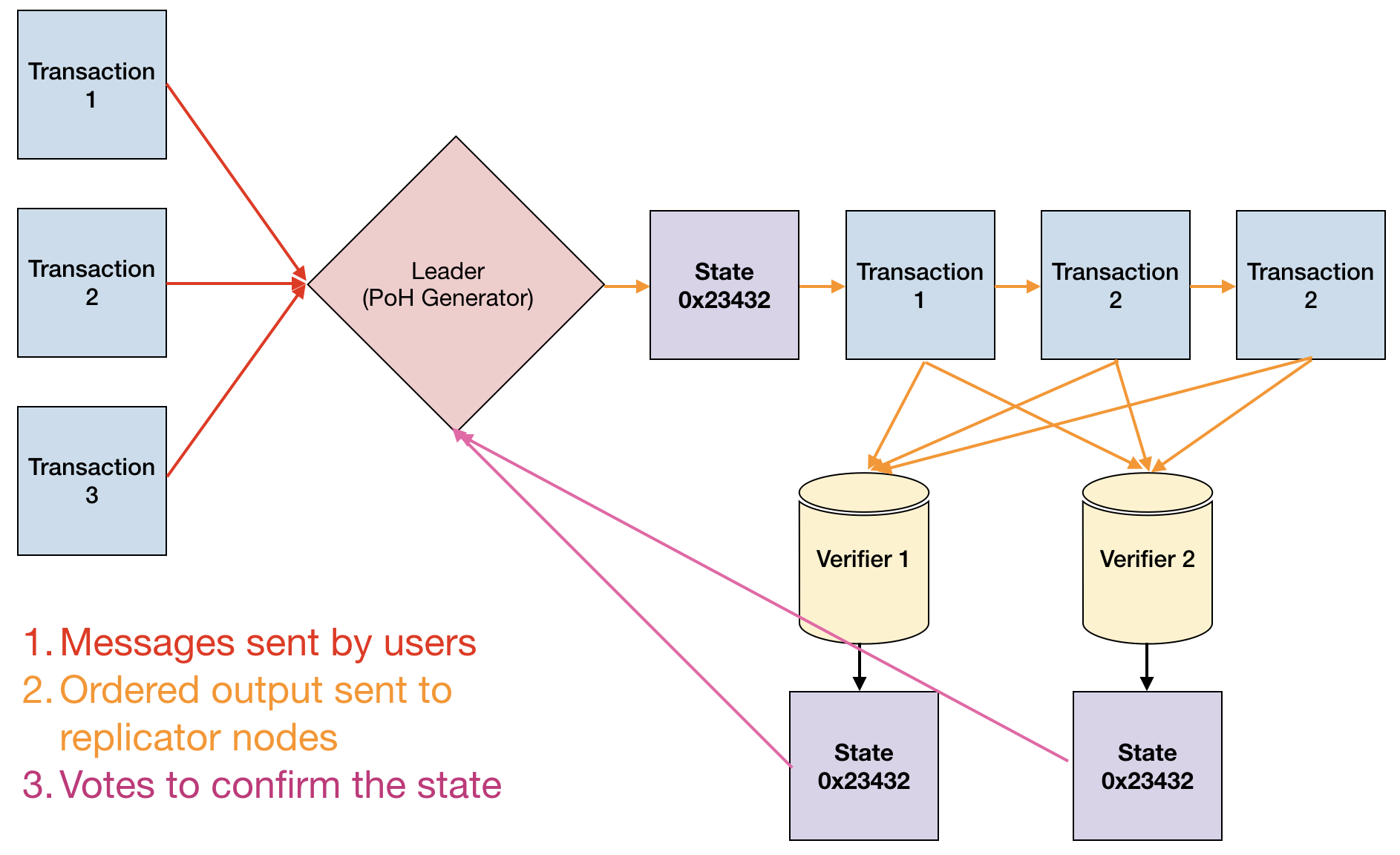
El protocolo Gulf Stream elimina la necesidad de un mempool tradicional al permitir que los clientes reenvien transacciones directamente a los proximos lideres. Cuando un cliente envia una transaccion, se reenvia al lider esperado segun el calendario de rotacion. Si el lider actual no puede procesar la transaccion, la reenvia al siguiente lider esperado. Este diseno reduce la latencia de confirmacion y permite a los validadores ejecutar transacciones por adelantado, optimizando aun mas el rendimiento.
La propagacion de transacciones utiliza un enfoque multicapa. Los clientes envian transacciones a los validadores, quienes las reenvian al lider actual o proximo. El lider secuencia las transacciones en el flujo PoH, creando un ordenamiento total. Una vez secuenciadas, el lider transmite el flujo PoH y los datos de transaccion a los validadores, quienes verifican la secuencia PoH y ejecutan las transacciones en paralelo.
El diseno de red tambien incluye un protocolo de propagacion de bloques Turbine que divide los bloques en paquetes mas pequenos y los distribuye a traves de la red en una estructura de arbol. Este enfoque minimiza los requisitos de ancho de banda para validadores individuales mientras asegura una rapida propagacion de bloques. Combinado con la capacidad de PoH para verificar el ordenamiento de transacciones, esta arquitectura permite a Solana lograr un alto rendimiento sin sacrificar la descentralizacion.
Network Design
La conception du reseau Solana est centree sur un systeme de leaders rotatifs ou les validateurs produisent des blocs a tour de role. Le leader est responsable de sequencer les transactions entrantes dans le flux PoH et de publier les blocs resultants sur le reseau. Les leaders sont selectionnes par un algorithme pondere par la mise, et le calendrier de rotation est connu a l'avance, permettant au reseau d'optimiser le transfert des transactions.
Le protocole Gulf Stream elimine le besoin d'un mempool traditionnel en permettant aux clients de transmettre les transactions directement aux prochains leaders. Lorsqu'un client soumet une transaction, elle est transmise au leader attendu selon le calendrier de rotation. Si le leader actuel ne peut pas traiter la transaction, elle est transmise au prochain leader attendu. Cette conception reduit la latence de confirmation et permet aux validateurs d'executer les transactions a l'avance, optimisant davantage le debit.
La propagation des transactions utilise une approche multicouche. Les clients envoient les transactions aux validateurs, qui les transmettent au leader actuel ou prochain. Le leader sequence les transactions dans le flux PoH, creant un ordonnancement total. Une fois sequencees, le leader transmet le flux PoH et les donnees de transaction aux validateurs, qui verifient la sequence PoH et executent les transactions en parallele.
La conception du reseau inclut egalement un protocole de propagation de blocs Turbine qui decoupe les blocs en paquets plus petits et les distribue a travers le reseau dans une structure arborescente. Cette approche minimise les exigences de bande passante pour les validateurs individuels tout en assurant une propagation rapide des blocs. Combinee avec la capacite de PoH a verifier l'ordonnancement des transactions, cette architecture permet a Solana d'atteindre un haut debit sans sacrifier la decentralisation.
Proof of History
Proof of History es una funcion de retardo verificable implementada como una cadena de hash secuencial usando SHA-256. El generador PoH calcula continuamente hashes SHA-256, usando cada salida como entrada para el siguiente hash. Esto crea una cadena secuencial donde cada hash solo puede calcularse despues del anterior, estableciendo un ordenamiento temporal verificable. El requisito computacional para generar cada hash impone un retardo de tiempo minimo entre eventos.
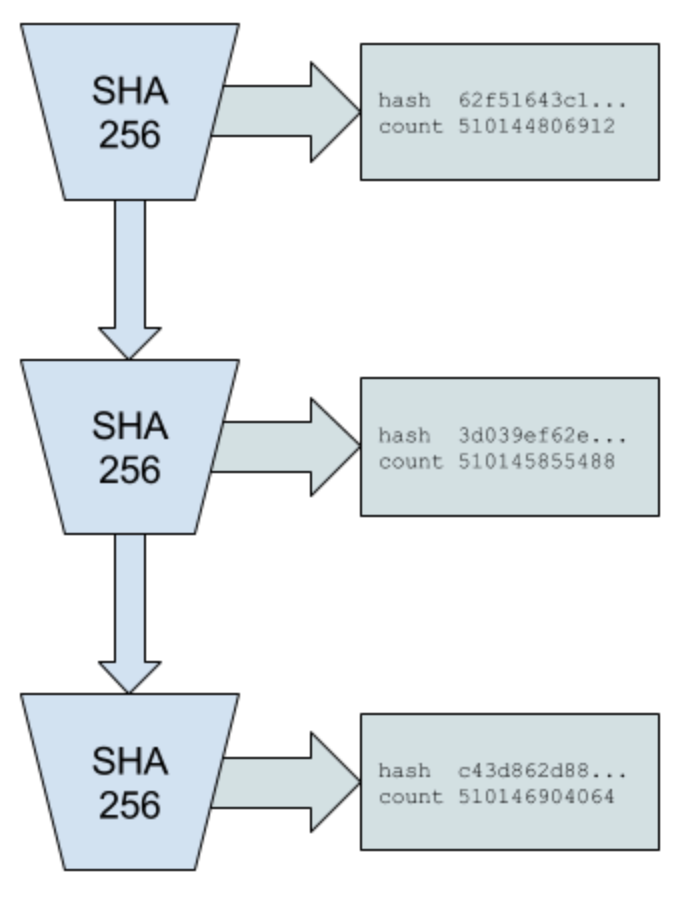
La propiedad clave de PoH es que es barato de verificar pero costoso de producir. Un verificador puede comprobar toda la secuencia de hash en paralelo dividiéndola en segmentos y verificando cada segmento de forma independiente, luego comprobando que los segmentos se conectan correctamente. Sin embargo, la generacion debe ser secuencial — no hay forma de predecir la salida de la cadena de hash sin calcular realmente cada paso intermedio. Esta asimetria entre generacion y verificacion es lo que hace practico a PoH.
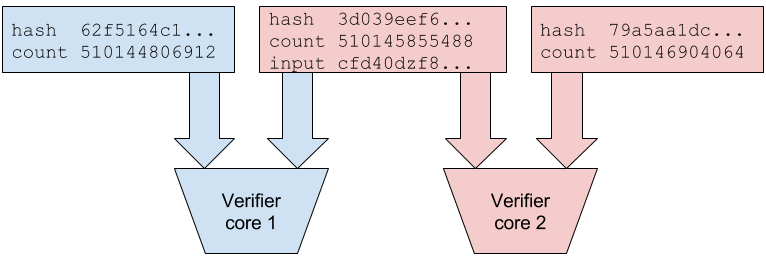
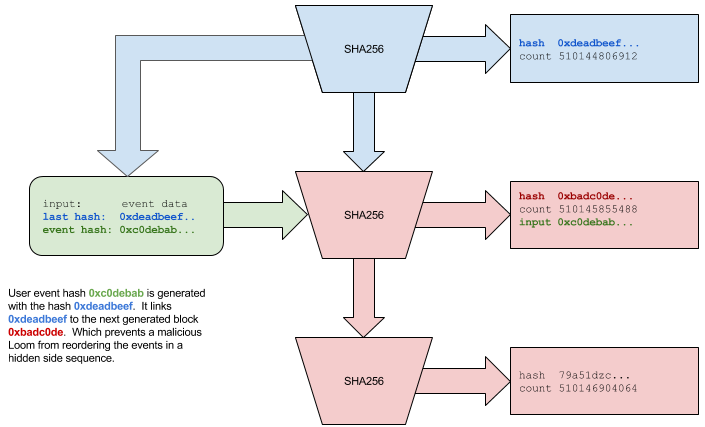
Los eventos externos y los datos de transaccion se insertan en la secuencia PoH mezclándolos en la cadena de hash. Cuando llega una transaccion, su hash se combina con el estado PoH actual, creando un registro que demuestra que la transaccion existio en ese punto de la secuencia. El generador PoH registra periodicamente puntos de control, publicando el valor hash actual junto con el conteo de hashes calculados desde el ultimo punto de control. Estos puntos de control permiten a los validadores verificar eficientemente la secuencia PoH sin recalcular cada hash.
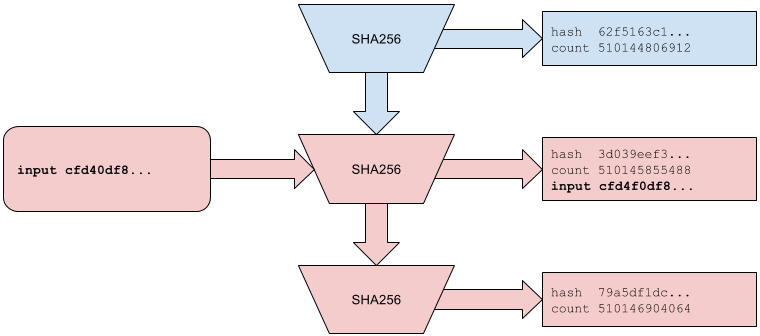
La secuencia PoH sirve como un reloj criptografico para toda la red. Debido a que la cadena de hash es secuencial y verificable, cualquier nodo puede demostrar que ha pasado una cierta cantidad de tiempo entre dos eventos simplemente mostrando los hashes que se calcularon durante ese intervalo. Esto elimina la necesidad de que los nodos confien en marcas de tiempo externas o se coordinen entre si para establecer un ordenamiento temporal, eliminando un cuello de botella fundamental en el consenso blockchain tradicional.
Proof of History
Proof of History est une fonction de delai verifiable implementee sous forme de chaine de hachage sequentielle utilisant SHA-256. Le generateur PoH calcule continuellement des hachages SHA-256, utilisant chaque sortie comme entree pour le hachage suivant. Cela cree une chaine sequentielle ou chaque hachage ne peut etre calcule qu'apres le precedent, etablissant un ordonnancement temporel verifiable. L'exigence computationnelle pour generer chaque hachage impose un delai temporel minimum entre les evenements.
La propriete cle de PoH est qu'il est peu couteux a verifier mais couteux a produire. Un verificateur peut verifier l'ensemble de la sequence de hachage en parallele en la divisant en segments et en verifiant chaque segment independamment, puis en verifiant que les segments se connectent correctement. Cependant, la generation doit etre sequentielle — il n'y a aucun moyen de predire la sortie de la chaine de hachage sans calculer effectivement chaque etape intermediaire. Cette asymetrie entre generation et verification est ce qui rend PoH pratique.
Les evenements externes et les donnees de transaction sont inseres dans la sequence PoH en les melangeant dans la chaine de hachage. Lorsqu'une transaction arrive, son hachage est combine avec l'etat PoH actuel, creant un enregistrement qui prouve que la transaction existait a ce point de la sequence. Le generateur PoH enregistre periodiquement des points de controle, publiant la valeur de hachage actuelle ainsi que le nombre de hachages calcules depuis le dernier point de controle. Ces points de controle permettent aux validateurs de verifier efficacement la sequence PoH sans recalculer chaque hachage.
La sequence PoH sert d'horloge cryptographique pour l'ensemble du reseau. Parce que la chaine de hachage est sequentielle et verifiable, n'importe quel noeud peut prouver qu'une certaine quantite de temps s'est ecoulee entre deux evenements simplement en montrant les hachages qui ont ete calcules pendant cet intervalle. Cela elimine le besoin pour les noeuds de faire confiance aux horodatages externes ou de se coordonner entre eux pour etablir l'ordonnancement temporel, supprimant un goulot d'etranglement fondamental dans le consensus blockchain traditionnel.
Proof of History Sequence
La secuencia de Proof of History es una cadena continua de hashes SHA-256 donde cada hash depende de la salida anterior. La secuencia comienza con un valor semilla inicial, que se hashea para producir la primera salida. Esta salida se convierte en la entrada para el siguiente hash, y el proceso se repite indefinidamente. El generador tambien mantiene un contador que rastrea el numero total de hashes calculados, que sirve como la "marca de tiempo" PoH para eventos en el libro mayor.
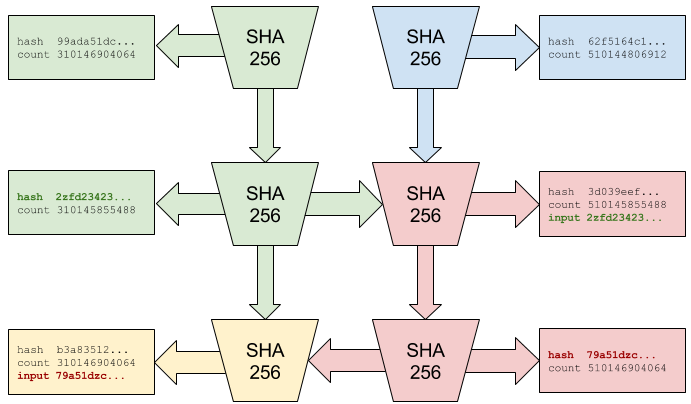
Cuando se necesita insertar datos en la secuencia (como hashes de transacciones o firmas de validadores), se combinan con el estado hash actual usando una funcion de mezcla determinista. Por ejemplo, si el estado hash actual es hash_n y queremos insertar datos D, calculamos hash_{n+1} = SHA256(hash_n || D), donde || denota concatenacion. El punto de insercion se registra junto con el valor del contador, demostrando que los datos D existian en ese punto especifico de la secuencia.
La verificacion de la secuencia PoH puede paralelizarse dividiendo la cadena en segmentos. Por ejemplo, un validador podria recibir puntos de control PoH cada 10,000 hashes. Para verificar la secuencia entre puntos de control, el validador puede dividir los 10,000 hashes en 100 segmentos de 100 hashes cada uno, verificar cada segmento independientemente en paralelo, y luego verificar que los segmentos se conectan correctamente. Esto permite que la verificacion escale horizontalmente con el numero de nucleos de CPU disponibles.
La secuencia tambien soporta pruebas eficientes de que dos eventos ocurrieron en un orden especifico. Dadas dos inserciones de datos en valores de contador n y m donde n m, cualquiera puede verificar que el evento en n ocurrio antes del evento en m comprobando la cadena de hash entre esos puntos. Esta propiedad permite a Solana crear un registro historico verificable de todos los eventos en la red sin requerir que los nodos esten en linea continuamente o confien en fuentes de tiempo externas.
Proof of History Sequence
La sequence Proof of History est une chaine continue de hachages SHA-256 ou chaque hachage depend de la sortie precedente. La sequence commence avec une valeur de graine initiale, qui est hachee pour produire la premiere sortie. Cette sortie devient l'entree pour le hachage suivant, et le processus se repete indefiniment. Le generateur maintient egalement un compteur qui suit le nombre total de hachages calcules, qui sert d'«horodatage» PoH pour les evenements dans le registre.
Lorsque des donnees doivent etre inserees dans la sequence (comme des hachages de transactions ou des signatures de validateurs), elles sont combinees avec l'etat de hachage actuel en utilisant une fonction de melange deterministe. Par exemple, si l'etat de hachage actuel est hash_n et que nous voulons inserer les donnees D, nous calculons hash_{n+1} = SHA256(hash_n || D), ou || denote la concatenation. Le point d'insertion est enregistre avec la valeur du compteur, prouvant que les donnees D existaient a ce point specifique de la sequence.
La verification de la sequence PoH peut etre parallelisee en divisant la chaine en segments. Par exemple, un validateur pourrait recevoir des points de controle PoH tous les 10 000 hachages. Pour verifier la sequence entre les points de controle, le validateur peut diviser les 10 000 hachages en 100 segments de 100 hachages chacun, verifier chaque segment independamment en parallele, puis verifier que les segments se connectent correctement. Cela permet a la verification de s'adapter horizontalement avec le nombre de coeurs CPU disponibles.
La sequence prend egalement en charge des preuves efficaces que deux evenements se sont produits dans un ordre specifique. Etant donne deux insertions de donnees aux valeurs de compteur n et m ou n m, n'importe qui peut verifier que l'evenement a n s'est produit avant l'evenement a m en verifiant la chaine de hachage entre ces points. Cette propriete permet a Solana de creer un enregistrement historique verifiable de tous les evenements du reseau sans exiger que les noeuds soient en ligne en permanence ou fassent confiance a des sources de temps externes.
Timestamp
Proof of History funciona como un reloj descentralizado que asigna marcas de tiempo a eventos sin depender del tiempo de reloj de pared. Cada hash PoH representa un "tick" discreto del reloj criptografico, y el valor del contador sirve como la marca de tiempo. Debido a que la cadena de hash es secuencial y verificable, estas marcas de tiempo son sin confianza — cualquier observador puede verificar que una marca de tiempo es legitima comprobando la cadena de hash.
En Solana, cada validador puede generar su propia secuencia PoH cuando actua como lider. Cuando los validadores rotan el liderazgo, sincronizan sus secuencias PoH usando el ultimo punto de control confirmado del lider anterior. Esto asegura la continuidad del registro temporal incluso cuando diferentes validadores se turnan para producir bloques. La red establece una linea temporal canonica al alcanzar consenso sobre que secuencias PoH aceptar como parte del libro mayor oficial.
El sistema maneja la deriva del reloj y la varianza en el rendimiento del hardware a traves de una combinacion de rotacion de lideres y consenso. Si un lider malicioso o defectuoso intenta generar marcas de tiempo PoH a una tasa incorrecta (demasiado rapida o demasiado lenta), los validadores pueden detectar esto comparando la tasa de ticks PoH con sus propios generadores PoH locales. Las desviaciones significativas de la tasa esperada indican un problema, y los validadores pueden rechazar bloques de lideres cuyas secuencias PoH divergen demasiado de la mediana de la red.
Este mecanismo de marcas de tiempo resuelve uno de los problemas fundamentales en sistemas distribuidos: establecer una nocion comun de tiempo sin una autoridad central de confianza. Al usar PoH como un reloj descentralizado, Solana permite que los validadores procesen transacciones en paralelo mientras mantienen un ordenamiento globalmente consistente. Las marcas de tiempo tambien proporcionan una base para caracteristicas basadas en tiempo como la expiracion de transacciones, operaciones programadas y medicion de rendimiento.
Timestamp
Proof of History fonctionne comme une horloge decentralisee qui attribue des horodatages aux evenements sans dependre du temps reel. Chaque hachage PoH represente un «tick» discret de l'horloge cryptographique, et la valeur du compteur sert d'horodatage. Parce que la chaine de hachage est sequentielle et verifiable, ces horodatages sont sans confiance — n'importe quel observateur peut verifier qu'un horodatage est legitime en verifiant la chaine de hachage.
Dans Solana, chaque validateur peut generer sa propre sequence PoH lorsqu'il agit en tant que leader. Lorsque les validateurs effectuent la rotation du leadership, ils synchronisent leurs sequences PoH en utilisant le dernier point de controle confirme du leader precedent. Cela assure la continuite de l'enregistrement temporel meme lorsque differents validateurs produisent des blocs a tour de role. Le reseau etablit une chronologie canonique en atteignant un consensus sur les sequences PoH a accepter comme partie du registre officiel.
Le systeme gere la derive de l'horloge et la variance des performances materielles grace a une combinaison de rotation des leaders et de consensus. Si un leader malveillant ou defaillant tente de generer des horodatages PoH a un rythme incorrect (trop rapide ou trop lent), les validateurs peuvent le detecter en comparant le taux de ticks PoH avec leurs propres generateurs PoH locaux. Des ecarts significatifs par rapport au taux attendu indiquent un probleme, et les validateurs peuvent rejeter les blocs des leaders dont les sequences PoH divergent trop de la mediane du reseau.
Ce mecanisme d'horodatage resout l'un des problemes fondamentaux des systemes distribues : etablir une notion commune du temps sans autorite centrale de confiance. En utilisant PoH comme horloge decentralisee, Solana permet aux validateurs de traiter les transactions en parallele tout en maintenant un ordonnancement globalement coherent. Les horodatages fournissent egalement une base pour des fonctionnalites basees sur le temps comme l'expiration des transactions, les operations programmees et la mesure des performances.
Proof of Stake Consensus
El mecanismo de consenso de Solana, llamado Tower BFT, es un algoritmo Proof of Stake disenado especificamente para aprovechar las propiedades temporales de Proof of History. Los validadores apuestan tokens SOL para participar en el consenso y ganar recompensas por validar correctamente los bloques. El sistema de votacion ponderado por participacion asegura que los validadores con mas interes economico en la red tengan proporcionalmente mas influencia sobre las decisiones de consenso.
La innovacion central en Tower BFT es el uso de periodos de bloqueo que aumentan exponencialmente con cada voto consecutivo. Cuando un validador vota sobre un hash PoH, se compromete con esa bifurcacion del libro mayor durante un cierto numero de ticks PoH. Si votan en el siguiente bloque de esa bifurcacion, el periodo de bloqueo se duplica. Esto crea un fuerte incentivo economico para que los validadores continuen votando en la misma bifurcacion, ya que cambiar de bifurcacion requeriria esperar a que expiren los bloqueos anteriores.
Especificamente, si un validador vota en un bloque en la marca de tiempo PoH t, no puede votar en una bifurcacion conflictiva hasta que hayan pasado 2^n ticks, donde n es el numero de votos consecutivos que ha realizado en la bifurcacion actual. Este mecanismo de bloqueo exponencial hace que el sistema sea seguro contra ataques de largo alcance mientras permite una finalidad rapida. Una vez que una supermayoria de participacion ha votado en un bloque con suficiente profundidad, ese bloque esta efectivamente finalizado.
Las condiciones de penalizacion imponen un comportamiento honesto. Si un validador vota en dos bifurcaciones conflictivas durante un periodo en el que deberia estar bloqueado, es penalizado — sus tokens apostados son parcialmente destruidos y es removido del conjunto de validadores. Esto hace economicamente irracional intentar la equivocacion u otro comportamiento bizantino. La combinacion de las marcas de tiempo verificables de PoH y los bloqueos exponenciales de Tower BFT crea un mecanismo de consenso que es rapido y seguro, logrando finalidad en segundos mientras mantiene las garantias de seguridad de los sistemas BFT tradicionales.
Proof of Stake Consensus
Le mecanisme de consensus de Solana, appele Tower BFT, est un algorithme Proof of Stake specifiquement concu pour exploiter les proprietes temporelles de Proof of History. Les validateurs mettent en jeu des jetons SOL pour participer au consensus et gagner des recompenses pour la validation correcte des blocs. Le systeme de vote pondere par la mise garantit que les validateurs ayant un interet economique plus important dans le reseau ont une influence proportionnellement plus grande sur les decisions de consensus.
L'innovation centrale de Tower BFT est l'utilisation de periodes de verrouillage qui augmentent de maniere exponentielle a chaque vote consecutif. Lorsqu'un validateur vote sur un hachage PoH, il s'engage sur cette branche du registre pour un certain nombre de ticks PoH. S'il vote sur le bloc suivant de cette branche, la periode de verrouillage double. Cela cree une forte incitation economique pour les validateurs a continuer de voter sur la meme branche, car changer de branche necessiterait d'attendre l'expiration des verrouillages precedents.
Specifiquement, si un validateur vote sur un bloc a l'horodatage PoH t, il ne peut pas voter sur une branche conflictuelle tant que 2^n ticks ne se sont pas ecoules, ou n est le nombre de votes consecutifs effectues sur la branche actuelle. Ce mecanisme de verrouillage exponentiel rend le systeme securise contre les attaques a longue portee tout en permettant une finalite rapide. Une fois qu'une supermajority de la mise a vote sur un bloc avec une profondeur suffisante, ce bloc est effectivement finalise.
Les conditions de penalite imposent un comportement honnete. Si un validateur vote sur deux branches conflictuelles pendant une periode ou il devrait etre verrouille, il est penalise — ses jetons mis en jeu sont partiellement detruits et il est retire de l'ensemble des validateurs. Cela rend economiquement irrationnel de tenter l'equivocation ou tout autre comportement byzantin. La combinaison des horodatages verifiables de PoH et des verrouillages exponentiels de Tower BFT cree un mecanisme de consensus rapide et securise, atteignant la finalite en quelques secondes tout en maintenant les garanties de securite des systemes BFT traditionnels.
Streaming Proof of Replication
Proof of Replication (PoRep) es un mecanismo que permite a los validadores demostrar que estan almacenando los datos del libro mayor sin revelar los datos mismos ni requerir una computacion intensiva. Solana implementa una version de streaming de PoRep donde los validadores demuestran continuamente que estan replicando el estado de la blockchain. Esto es esencial para la seguridad de la red, ya que asegura que los datos del libro mayor esten distribuidos adecuadamente entre los validadores y no concentrados en unas pocas ubicaciones.
El mecanismo PoRep funciona haciendo que los validadores cifren segmentos del libro mayor usando encriptacion en modo CBC (Cipher Block Chaining) con una clave especifica del validador derivada de su identidad. El proceso de encriptacion es tal que cada bloque cifrado depende del bloque anterior, creando una cadena que es unica para cada validador. Esto evita que los validadores simplemente copien datos cifrados entre si — cada validador debe almacenar y procesar los datos originales del libro mayor para generar su version cifrada unica.
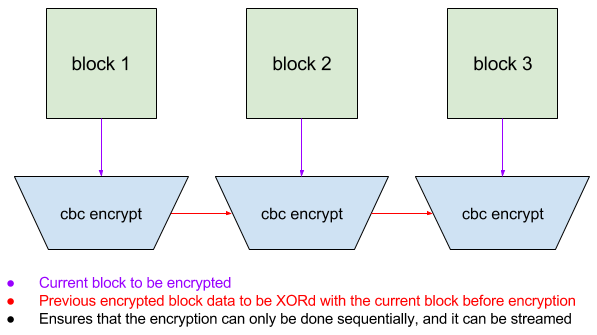
Periodicamente, la red emite desafios a los validadores solicitando que proporcionen bloques cifrados especificos. Debido a que la encriptacion esta encadenada, el validador debe haber almacenado todos los bloques anteriores para generar la respuesta correcta. El validador envia su bloque cifrado junto con una prueba de Merkle que muestra su posicion en su libro mayor cifrado. La red puede verificar esta prueba rapidamente sin necesidad de descifrar o re-cifrar los datos.
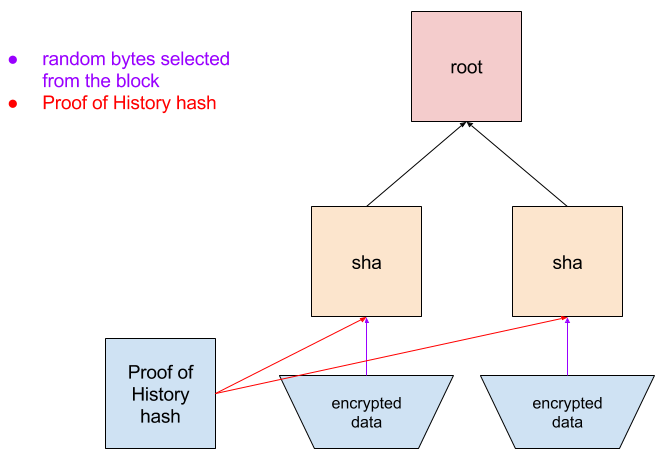
Este enfoque de streaming para PoRep tiene una baja sobrecarga comparado con los sistemas tradicionales de prueba de almacenamiento. Los validadores pueden cifrar datos a medida que llegan y responder a los desafios con una latencia minima. El sistema tambien permite la recuperacion en caso de perdida de datos — si un validador pierde parte del libro mayor, puede volver a descargarlo de otros validadores y re-cifrarlo. La combinacion de PoRep con marcas de tiempo PoH crea un sistema de responsabilidad completo donde la red puede verificar tanto cuando se crearon los datos como que estan almacenados correctamente en toda la red de validadores.
Streaming Proof of Replication
Proof of Replication (PoRep) est un mecanisme qui permet aux validateurs de prouver qu'ils stockent les donnees du registre sans reveler les donnees elles-memes ni necessiter de calculs intensifs. Solana implemente une version en streaming de PoRep ou les validateurs demontrent continuellement qu'ils repliquent l'etat de la blockchain. Ceci est essentiel pour la securite du reseau, car cela garantit que les donnees du registre sont correctement distribuees entre les validateurs et non concentrees en quelques emplacements.
Le mecanisme PoRep fonctionne en faisant chiffrer par les validateurs des segments du registre en utilisant le chiffrement en mode CBC (Cipher Block Chaining) avec une cle specifique au validateur derivee de son identite. Le processus de chiffrement est tel que chaque bloc chiffre depend du bloc precedent, creant une chaine unique a chaque validateur. Cela empeche les validateurs de simplement copier les donnees chiffrees les uns des autres — chaque validateur doit stocker et traiter les donnees originales du registre pour generer sa version chiffree unique.
Periodiquement, le reseau emet des defis aux validateurs leur demandant de fournir des blocs chiffres specifiques. Parce que le chiffrement est enchaine, le validateur doit avoir stocke tous les blocs precedents pour generer la reponse correcte. Le validateur soumet son bloc chiffre accompagne d'une preuve de Merkle montrant sa position dans son registre chiffre. Le reseau peut verifier cette preuve rapidement sans avoir besoin de dechiffrer ou rechiffrer les donnees.
Cette approche en streaming de PoRep a une faible surcharge comparee aux systemes traditionnels de preuve de stockage. Les validateurs peuvent chiffrer les donnees a mesure qu'elles arrivent et repondre aux defis avec une latence minimale. Le systeme permet egalement la recuperation en cas de perte de donnees — si un validateur perd une partie du registre, il peut le retelecharger aupres d'autres validateurs et le rechiffrer. La combinaison de PoRep avec les horodatages PoH cree un systeme de responsabilite complet ou le reseau peut verifier a la fois quand les donnees ont ete creees et qu'elles sont correctement stockees a travers le reseau de validateurs.
System Architecture
La arquitectura del sistema de Solana esta disenada como un pipeline donde diferentes etapas del procesamiento de transacciones ocurren en paralelo. La Transaction Processing Unit (TPU) es el componente central responsable de manejar las transacciones entrantes. La TPU consta de varias etapas: fetch (recoleccion de transacciones), verificacion de firmas, banking (ejecucion de transacciones) y write (escritura en almacenamiento). Cada etapa opera en paralelo sobre diferentes transacciones, similar al pipeline de una CPU.
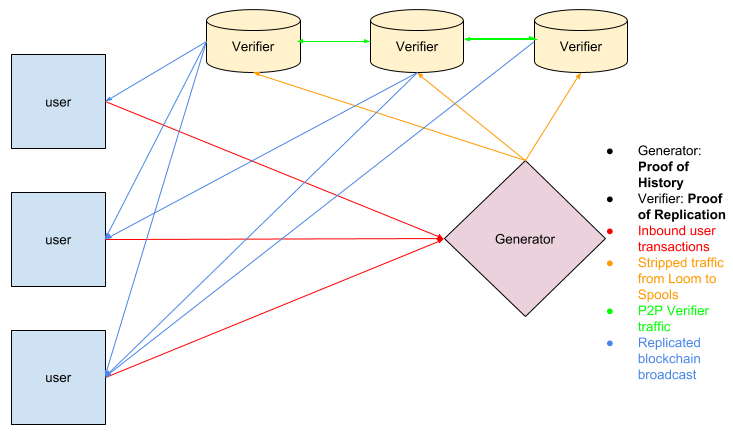
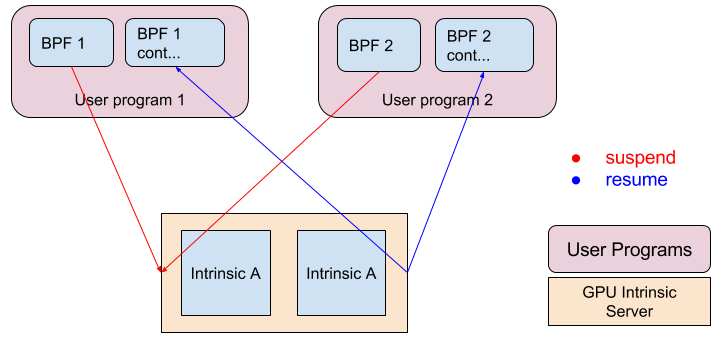
La verificacion de firmas se acelera usando GPUs, que son altamente eficientes en las operaciones de criptografia de curva eliptica necesarias para verificar firmas de transacciones. Al descargar esta tarea computacionalmente intensiva a las GPUs, Solana puede verificar firmas a tasas que exceden 900,000 por segundo en hardware comercial. Esta verificacion de firmas en paralelo evita que la validacion criptografica se convierta en un cuello de botella incluso a tasas de transaccion muy altas.
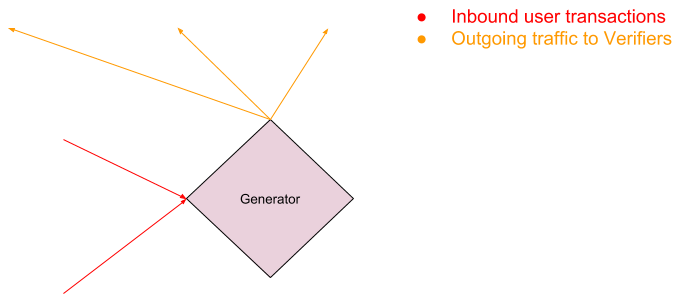
El runtime Sealevel es el motor de ejecucion de contratos inteligentes en paralelo de Solana. A diferencia de las blockchains tradicionales que ejecutan transacciones secuencialmente, Sealevel analiza las transacciones para identificar que cuentas acceden y ejecuta transacciones no conflictivas en paralelo a traves de multiples nucleos de CPU. Las transacciones que acceden a las mismas cuentas se ejecutan secuencialmente para mantener la consistencia, pero las transacciones que acceden a diferentes cuentas pueden ejecutarse simultaneamente. Este paralelismo es posible porque PoH establece un ordenamiento global — los validadores pueden ejecutar transacciones en cualquier orden siempre que las apliquen al estado en la secuencia especificada por PoH.
La arquitectura tambien incluye componentes optimizados para la propagacion y almacenamiento de bloques. El protocolo de propagacion de bloques Turbine usa codificacion de borrado para dividir bloques en paquetes mas pequenos que se distribuyen a traves de la red en una estructura de arbol, minimizando los requisitos de ancho de banda. La red de Archivers proporciona almacenamiento descentralizado para datos historicos del libro mayor, usando PoRep para asegurar la disponibilidad de datos. Juntos, estos componentes crean un sistema que puede procesar cientos de miles de transacciones por segundo mientras mantiene las propiedades de descentralizacion y seguridad de una blockchain.
System Architecture
L'architecture systeme de Solana est concue comme un pipeline ou differentes etapes du traitement des transactions se deroulent en parallele. La Transaction Processing Unit (TPU) est le composant central responsable du traitement des transactions entrantes. La TPU comprend plusieurs etapes : fetch (collecte des transactions), verification des signatures, banking (execution des transactions) et write (ecriture dans le stockage). Chaque etape opere en parallele sur differentes transactions, similaire au pipeline d'un CPU.
La verification des signatures est acceleree a l'aide de GPUs, qui sont tres efficaces pour les operations de cryptographie sur courbes elliptiques necessaires a la verification des signatures de transactions. En deleguant cette tache computationnellement intensive aux GPUs, Solana peut verifier les signatures a des taux depassant 900 000 par seconde sur du materiel standard. Cette verification parallele des signatures empeche la validation cryptographique de devenir un goulot d'etranglement meme a des taux de transactions tres eleves.
Le runtime Sealevel est le moteur d'execution parallele des contrats intelligents de Solana. Contrairement aux blockchains traditionnelles qui executent les transactions sequentiellement, Sealevel analyse les transactions pour identifier quels comptes elles accedent et execute les transactions non conflictuelles en parallele sur plusieurs coeurs CPU. Les transactions accedant aux memes comptes sont executees sequentiellement pour maintenir la coherence, mais les transactions accedant a des comptes differents peuvent s'executer simultanement. Ce parallelisme est possible parce que PoH etablit un ordonnancement global — les validateurs peuvent executer les transactions dans n'importe quel ordre tant qu'ils les appliquent a l'etat dans la sequence specifiee par PoH.
L'architecture inclut egalement des composants optimises pour la propagation et le stockage des blocs. Le protocole de propagation de blocs Turbine utilise le codage a effacement pour decouper les blocs en paquets plus petits distribues a travers le reseau dans une structure arborescente, minimisant les exigences de bande passante. Le reseau d'Archivers fournit un stockage decentralise pour les donnees historiques du registre, utilisant PoRep pour assurer la disponibilite des donnees. Ensemble, ces composants creent un systeme capable de traiter des centaines de milliers de transactions par seconde tout en maintenant les proprietes de decentralisation et de securite d'une blockchain.
Performance
La arquitectura de Solana esta disenada para alcanzar niveles de rendimiento que escalan con las mejoras de hardware, siguiendo la Ley de Moore. En una conexion de red estandar de 1 gigabit, el rendimiento maximo teorico es aproximadamente 710,000 transacciones por segundo, asumiendo 176 bytes por transaccion (incluyendo firmas y metadatos). Este calculo se basa en el ancho de banda de red como el cuello de botella principal, con los cuellos de botella computacionales eliminados a traves de la paralelizacion.
La verificacion de firmas, a menudo un factor limitante en el rendimiento de blockchain, se acelera usando paralelizacion GPU. Una sola GPU puede verificar mas de 900,000 firmas ed25519 por segundo, lo que excede el limite de rendimiento de la red. Esto significa que la verificacion de firmas no restringe el rendimiento del sistema — el cuello de botella se desplaza al ancho de banda de red y la ejecucion de transacciones. Para transacciones simples que solo transfieren valor sin logica compleja de contratos inteligentes, la etapa de banking puede procesar transacciones a tasas que igualan la tasa de entrada de la red.
El generador PoH funciona en un nucleo de CPU dedicado, produciendo aproximadamente 4,000 hashes por milisegundo en un procesador de 4GHz. A esta tasa, la secuencia PoH proporciona marcas de tiempo con una granularidad de 0.25 microsegundos, lo cual es suficiente para ordenar millones de transacciones por segundo. La naturaleza secuencial de la generacion PoH significa que este componente no puede paralelizarse, pero el rendimiento es lo suficientemente alto como para no limitar el rendimiento general del sistema.
A medida que el hardware mejora, el rendimiento de Solana escala en consecuencia. Redes mas rapidas, GPUs mas potentes y CPUs mejoradas contribuyen a tasas de transaccion mas altas. El sistema esta disenado para aprovechar estas mejoras sin requerir cambios de protocolo. Este enfoque de escalabilidad contrasta con blockchains que estan fundamentalmente limitadas por mecanismos de consenso secuenciales, permitiendo a Solana alcanzar niveles de rendimiento previamente considerados imposibles en un sistema descentralizado mientras mantiene garantias de seguridad y descentralizacion.
Performance
L'architecture de Solana est concue pour atteindre des niveaux de performance qui evoluent avec les ameliorations materielles, suivant la loi de Moore. Sur une connexion reseau gigabit standard, le debit theorique maximal est d'environ 710 000 transactions par seconde, en supposant 176 octets par transaction (signatures et metadonnees incluses). Ce calcul est base sur la bande passante reseau comme goulot d'etranglement principal, les goulots d'etranglement computationnels etant elimines par la parallelisation.
La verification des signatures, souvent un facteur limitant dans les performances blockchain, est acceleree par la parallelisation GPU. Un seul GPU peut verifier plus de 900 000 signatures ed25519 par seconde, ce qui depasse la limite de debit du reseau. Cela signifie que la verification des signatures ne contraint pas les performances du systeme — le goulot d'etranglement se deplace vers la bande passante reseau et l'execution des transactions. Pour les transactions simples qui ne font que transferer de la valeur sans logique complexe de contrats intelligents, l'etape de banking peut traiter les transactions a des taux correspondant au taux d'entree du reseau.
Le generateur PoH fonctionne sur un coeur CPU dedie, produisant environ 4 000 hachages par milliseconde sur un processeur a 4 GHz. A ce rythme, la sequence PoH fournit des horodatages avec une granularite de 0,25 microseconde, ce qui est suffisant pour ordonner des millions de transactions par seconde. La nature sequentielle de la generation PoH signifie que ce composant ne peut pas etre parallelise, mais le debit est suffisamment eleve pour ne pas limiter les performances globales du systeme.
A mesure que le materiel s'ameliore, le debit de Solana evolue en consequence. Des reseaux plus rapides, des GPUs plus puissants et des CPUs ameliores contribuent tous a des taux de transactions plus eleves. Le systeme est concu pour tirer parti de ces ameliorations sans necessiter de modifications du protocole. Cette approche d'evolutivite contraste avec les blockchains fondamentalement limitees par des mecanismes de consensus sequentiels, permettant a Solana d'atteindre des niveaux de performance precedemment consideres comme impossibles dans un systeme decentralise tout en maintenant les garanties de securite et de decentralisation.
Conclusion
Proof of History representa un avance fundamental en la arquitectura blockchain al resolver el problema de sincronizacion que ha limitado la escalabilidad de los libros mayores distribuidos. Al crear un reloj criptografico verificable, PoH permite a los validadores establecer un ordenamiento temporal de eventos sin la extensa sobrecarga de comunicacion requerida por los mecanismos de consenso tradicionales. Esta innovacion elimina un cuello de botella critico y permite que el procesamiento de transacciones se paralelice a traves de la red.
La integracion de PoH con componentes de sistema optimizados — verificacion de firmas acelerada por GPU, ejecucion de transacciones en paralelo a traves de Sealevel y protocolos de propagacion de bloques eficientes — crea una blockchain que puede procesar cientos de miles de transacciones por segundo en hardware comercial. Mas importante aun, la arquitectura esta disenada para escalar con las mejoras de hardware, lo que significa que el rendimiento continuara aumentando a medida que los procesadores se vuelvan mas rapidos y las redes mas capaces.
El diseno de Solana demuestra que el alto rendimiento y la descentralizacion no son mutuamente excluyentes. Al aprovechar PoH como base para el consenso y la coordinacion del sistema, la red alcanza niveles de rendimiento comparables a bases de datos centralizadas mientras mantiene las propiedades de seguridad y resistencia a la censura de una blockchain descentralizada. El mecanismo de consenso Tower BFT ponderado por participacion asegura que la red permanezca segura contra actores bizantinos mientras logra una finalidad rapida.
La implementacion de esta arquitectura proporciona un camino practico hacia adelante para que la tecnologia blockchain escale a la adopcion global. Las aplicaciones que requieren un alto rendimiento de transacciones — como intercambios descentralizados, plataformas de juegos y sistemas financieros — ahora pueden construirse sobre una infraestructura verdaderamente descentralizada sin comprometer el rendimiento. Proof of History abre la puerta a una nueva generacion de aplicaciones blockchain que anteriormente eran inviables debido a las limitaciones de escalabilidad.
Conclusion
Proof of History represente une percee fondamentale dans l'architecture blockchain en resolvant le probleme de synchronisation qui a limite l'evolutivite des registres distribues. En creant une horloge cryptographique verifiable, PoH permet aux validateurs d'etablir un ordonnancement temporel des evenements sans la surcharge de communication extensive requise par les mecanismes de consensus traditionnels. Cette innovation supprime un goulot d'etranglement critique et permet au traitement des transactions d'etre parallelise a travers le reseau.
L'integration de PoH avec des composants systeme optimises — verification des signatures acceleree par GPU, execution parallele des transactions via Sealevel et protocoles efficaces de propagation des blocs — cree une blockchain capable de traiter des centaines de milliers de transactions par seconde sur du materiel standard. Plus important encore, l'architecture est concue pour evoluer avec les ameliorations materielles, ce qui signifie que les performances continueront d'augmenter a mesure que les processeurs deviendront plus rapides et les reseaux plus performants.
La conception de Solana demontre que haute performance et decentralisation ne sont pas mutuellement exclusives. En tirant parti de PoH comme fondation pour le consensus et la coordination du systeme, le reseau atteint des niveaux de debit comparables aux bases de donnees centralisees tout en maintenant les proprietes de securite et de resistance a la censure d'une blockchain decentralisee. Le mecanisme de consensus Tower BFT pondere par la mise garantit que le reseau reste securise contre les acteurs byzantins tout en atteignant une finalite rapide.
L'implementation de cette architecture fournit un chemin pratique pour que la technologie blockchain evolue vers une adoption mondiale. Les applications necessitant un haut debit de transactions — comme les echanges decentralises, les plateformes de jeux et les systemes financiers — peuvent desormais etre construites sur une infrastructure veritablement decentralisee sans compromettre les performances. Proof of History ouvre la porte a une nouvelle generation d'applications blockchain qui etaient auparavant irrealisables en raison des contraintes d'evolutivite.