 Ethereum
State Transition System
Context
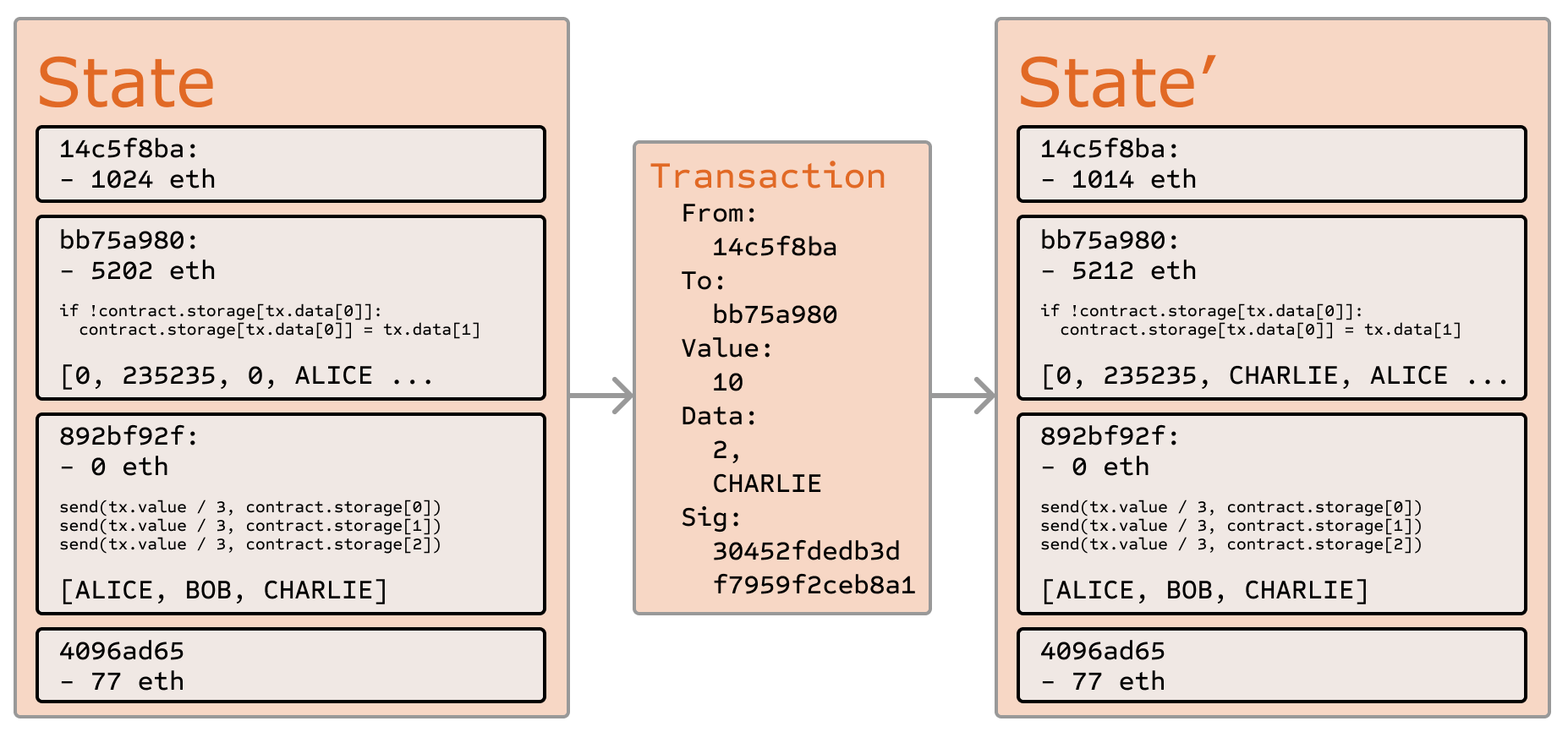
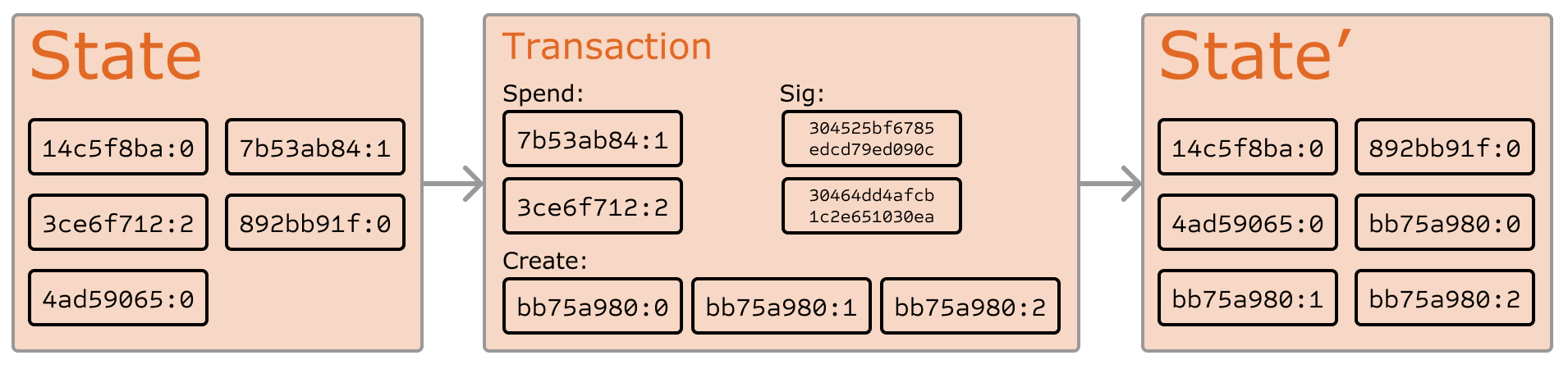
This figure appears in the 'Bitcoin as a State Transition System' section, which introduces the conceptual model underlying Bitcoin's ledger. The section explains that the blockchain can be formally described as a function APPLY(S, TX) -> S' that maps a current state and a transaction to a new state, using examples like APPLY({ Alice: $50, Bob: $50 }, 'send $20 from Alice to Bob') = { Alice: $30, Bob: $70 }. The UTXO model is the concrete instantiation of this abstraction, where each unspent output represents an ownership claim secured by a cryptographic public key.
What This Figure Shows
The diagram illustrates how a blockchain state — represented as the full set of unspent transaction outputs (UTXOs) — is transformed by applying a transaction. Each transaction consumes one or more existing UTXOs as inputs (validated via digital signatures) and produces one or more new UTXOs as outputs, resulting in a new state S'. The function is deterministic: given the same state and transaction, every node reaches the same result. Invalid transitions — such as spending a non-existent UTXO or spending more than the inputs contain — are rejected, returning an ERROR rather than a new state. This formalism unifies payment logic, security guarantees, and double-spend prevention under a single mathematical model. The diagram makes visible that ownership changes are discrete, atomic state transitions rather than mutable balance updates.
Significance
Framing the blockchain as a state transition system is the conceptual foundation for Ethereum's generalization: rather than restricting state to coin balances, Ethereum extends it to arbitrary contract storage and computation. This diagram establishes the vocabulary — state, transition function, inputs, outputs — used throughout the whitepaper to build toward a Turing-complete programmable blockchain.