 Ethereum
Supply Growth Rate
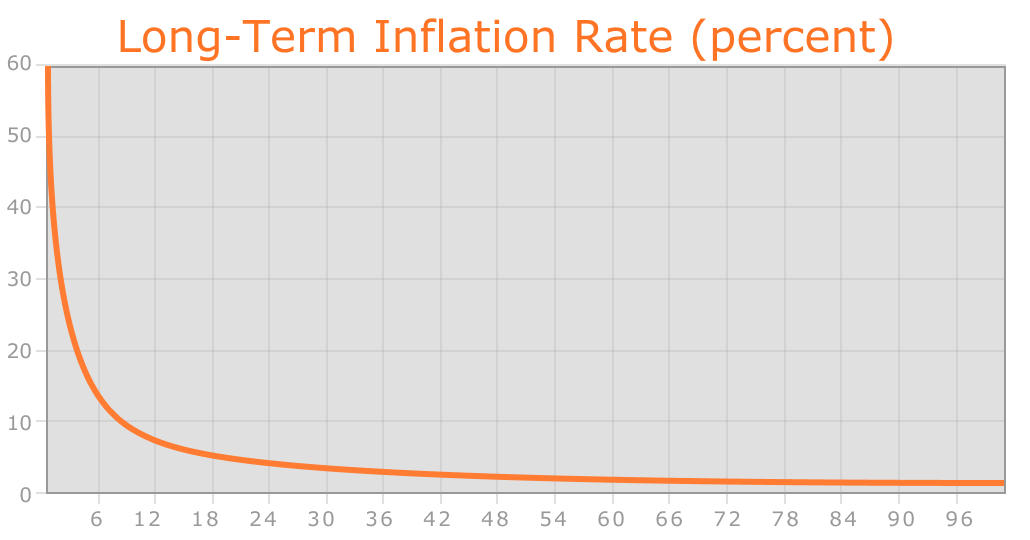
Context
This figure appears in the 'Miscellanea and Concerns' section, which addresses open questions and long-term design considerations for Ethereum, including scalability, mining centralization, and monetary policy. The section notes that Ethereum uses a linear issuance model — a fixed number of new ETH minted per block — in contrast to Bitcoin's geometrically decreasing issuance schedule with periodic halvings. This design choice has significant implications for long-term supply growth and inflation rates.
What This Figure Shows
The diagram compares Ethereum's supply growth trajectory against Bitcoin's, illustrating that linear issuance produces a continuously declining percentage growth rate over time (since a fixed absolute issuance divided by an ever-growing total supply yields a diminishing rate), while Bitcoin's halving schedule produces a step-function decrease in absolute issuance. In the early years, Ethereum's linear issuance results in a higher inflation rate than Bitcoin's, but as the total supply grows, the annual percentage rate asymptotically approaches zero. The diagram makes the mathematical intuition visual: linear supply growth means percentage inflation decreases monotonically, giving Ethereum predictable and diminishing dilution without the supply shock discontinuities of halvings.
Significance
This comparison is significant because it reflects Ethereum's deliberate choice to avoid the economic disruptions associated with block reward halvings. Linear issuance provides a more predictable reward schedule for miners, reducing the risk of hash rate crashes around halving events. The diagram also foreshadows Ethereum's eventual transition to proof-of-stake, where issuance economics change fundamentally — but the whitepaper's analysis here establishes the baseline inflationary model against which later changes are measured.