 Ethereum
Simplified Payment Verification
Context
This figure appears in the 'Merkle Trees' section, which explains how Bitcoin organizes transaction data in blocks using a binary hash tree structure. The section motivates Merkle trees as a tool for enabling lightweight verification: rather than downloading all transactions in a block, a client needs only the block header (containing the Merkle root) and a logarithmic-size branch proof to verify that a specific transaction is included. Ethereum adopts and extends this structure for transactions, state, and receipts.
What This Figure Shows
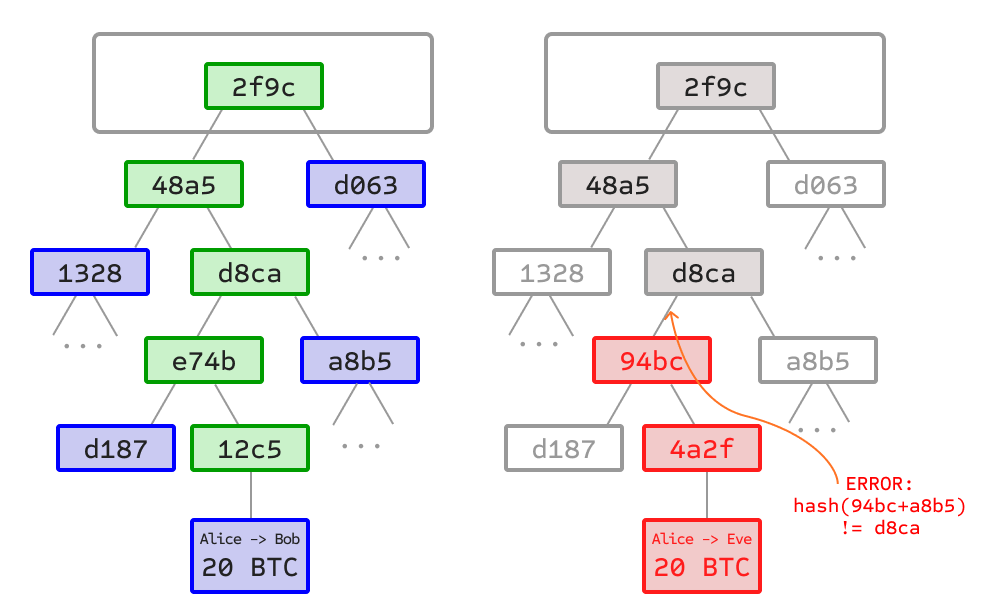
The diagram illustrates Simplified Payment Verification (SPV), where a lightweight client verifies transaction inclusion without downloading the full block. The Merkle tree is built bottom-up: leaf nodes are hashes of individual transactions, and each interior node is the hash of its two children, recursively up to the Merkle root stored in the block header. To prove a transaction is in the block, a full node provides the Merkle branch — the sibling hashes along the path from the transaction leaf to the root — and the light client recomputes the root hash using only those O(log n) hashes. If the computed root matches the one in the trusted block header, the proof is valid. The block header chain itself is verified through proof-of-work, so the light client ultimately trusts the heaviest chain of headers without processing transactions.
Significance
SPV is the mechanism that makes it practical to use Bitcoin on resource-constrained devices without trusting a centralized server. Ethereum generalizes the same Merkle proof technique across three separate Patricia tries — for state, transactions, and receipts — enabling light clients to prove not just transaction inclusion but also account balances, contract storage values, and execution receipts. This diagram is thus the conceptual precursor to Ethereum's more sophisticated light-client protocol.