
ビットコイン:ピアツーピア電子キャッシュシステム
Abstract
Une version purement pair-a-pair de monnaie electronique permettrait d'envoyer des paiements en ligne directement d'une partie a une autre sans passer par une institution financiere. Les signatures numeriques fournissent une partie de la solution, mais les principaux avantages sont perdus si un tiers de confiance est toujours necessaire pour empecher la double depense. Nous proposons une solution au probleme de la double depense en utilisant un reseau pair-a-pair. Le reseau horodate les transactions en les hachant dans une chaine continue de proof-of-work basee sur le hachage, formant un enregistrement qui ne peut etre modifie sans refaire le proof-of-work. La chaine la plus longue sert non seulement de preuve de la sequence des evenements observes, mais aussi de preuve qu'elle provient du plus grand pool de puissance CPU. Tant qu'une majorite de la puissance CPU est controlee par des noeuds qui ne cooperent pas pour attaquer le reseau, ils genereront la chaine la plus longue et devanceront les attaquants. Le reseau lui-meme necessite une structure minimale. Les messages sont diffuses au mieux, et les noeuds peuvent quitter et rejoindre le reseau a volonte, acceptant la chaine de proof-of-work la plus longue comme preuve de ce qui s'est passe pendant leur absence.
Abstract
純粋なpeer-to-peerの電子キャッシュにより、金融機関を介さずに一方の当事者からもう一方へ直接オンライン決済を行うことが可能になる。デジタル署名はその解決策の一部を提供するが、二重支払いを防ぐために信頼できる第三者が依然として必要であれば、主な利点は失われてしまう。我々はpeer-to-peerネットワークを用いた二重支払い問題への解決策を提案する。このネットワークは、トランザクションをhashベースのproof-of-workの連鎖にhash化することでタイムスタンプを付与し、proof-of-workをやり直さない限り変更できない記録を形成する。最長のチェーンは、目撃されたイベントの順序の証明としてのみならず、それが最大のCPUパワーのプールから生まれたことの証明としても機能する。CPUパワーの過半数がネットワークへの攻撃に協力していないノードによって制御されている限り、それらのノードが最長のチェーンを生成し、攻撃者を凌駕する。ネットワーク自体は最小限の構造しか必要としない。メッセージはベストエフォートで配信され、ノードは自由にネットワークから離脱・再参加でき、不在中に何が起こったかの証明として最長のproof-of-workチェーンを受け入れる。
Introduction
Le commerce sur Internet en est venu a reposer presque exclusivement sur des institutions financieres servant de tiers de confiance pour traiter les paiements electroniques. Bien que le systeme fonctionne assez bien pour la plupart des transactions, il souffre encore des faiblesses inherentes au modele base sur la confiance. Les transactions completement irreversibles ne sont pas vraiment possibles, puisque les institutions financieres ne peuvent eviter de medier les litiges. Le cout de la mediation augmente les couts de transaction, limitant la taille minimale pratique des transactions et eliminant la possibilite de petites transactions occasionnelles, et il y a un cout plus large dans la perte de la capacite a effectuer des paiements irreversibles pour des services irreversibles. Avec la possibilite d'inversion, le besoin de confiance se repand. Les commercants doivent se mefier de leurs clients, les harcelant pour obtenir plus d'informations qu'ils n'en auraient autrement besoin. Un certain pourcentage de fraude est accepte comme inevitable. Ces couts et incertitudes de paiement peuvent etre evites en personne en utilisant de la monnaie physique, mais aucun mecanisme n'existe pour effectuer des paiements sur un canal de communication sans un tiers de confiance.
Ce qui est necessaire est un systeme de paiement electronique base sur la preuve cryptographique plutot que sur la confiance, permettant a deux parties consentantes de transiger directement l'une avec l'autre sans besoin d'un tiers de confiance. Les transactions qu'il est informatiquement impraticable d'inverser protegeraient les vendeurs contre la fraude, et des mecanismes d'entiercement routiniers pourraient etre facilement mis en oeuvre pour proteger les acheteurs. Dans cet article, nous proposons une solution au probleme de la double depense en utilisant un serveur d'horodatage distribue pair-a-pair pour generer une preuve informatique de l'ordre chronologique des transactions. Le systeme est securise tant que les noeuds honnetes controlent collectivement plus de puissance CPU que tout groupe cooperant de noeuds attaquants.
Introduction
インターネット上の商取引は、電子決済を処理する信頼できる第三者として機能する金融機関にほぼ全面的に依存するようになった。このシステムはほとんどのトランザクションに対して十分に機能しているが、信頼ベースモデルに固有の弱点を依然として抱えている。金融機関は紛争の仲裁を避けることができないため、完全に不可逆なトランザクションは実質的に不可能である。仲裁コストはトランザクションコストを増大させ、実用的な最小トランザクションサイズを制限し、小規模なカジュアルトランザクションの可能性を断つ。さらに、不可逆なサービスに対して不可逆な支払いができないことによる、より広範なコストも存在する。取消しの可能性がある限り、信頼の必要性が広がる。商人は顧客を警戒し、本来不要な情報まで求めなければならない。一定割合の詐欺は不可避として受け入れられている。これらのコストと支払いの不確実性は、物理的な通貨を使用すれば対面で回避できるが、信頼できる当事者なしに通信チャネルを通じて支払いを行うメカニズムは存在しない。
必要とされているのは、信頼ではなく暗号学的証明に基づく電子決済システムであり、信頼できる第三者を必要とせずに任意の二者が直接取引できるようにするものである。計算上取消しが実質的に不可能なトランザクションは売り手を詐欺から保護し、日常的なエスクローメカニズムで買い手を容易に保護できる。本論文では、peer-to-peer分散タイムスタンプサーバーを用いてトランザクションの時系列順序の計算的証明を生成することで、二重支払い問題への解決策を提案する。このシステムは、正直なノードが協力する攻撃者ノードの集団よりも多くのCPUパワーを集合的に制御している限り安全である。
Transactions
Nous definissons une piece electronique comme une chaine de signatures numeriques. Chaque proprietaire transfere la piece au suivant en signant numeriquement un hash de la transaction precedente et la cle publique du proprietaire suivant, et en ajoutant ceux-ci a la fin de la piece. Un beneficiaire peut verifier les signatures pour verifier la chaine de propriete.
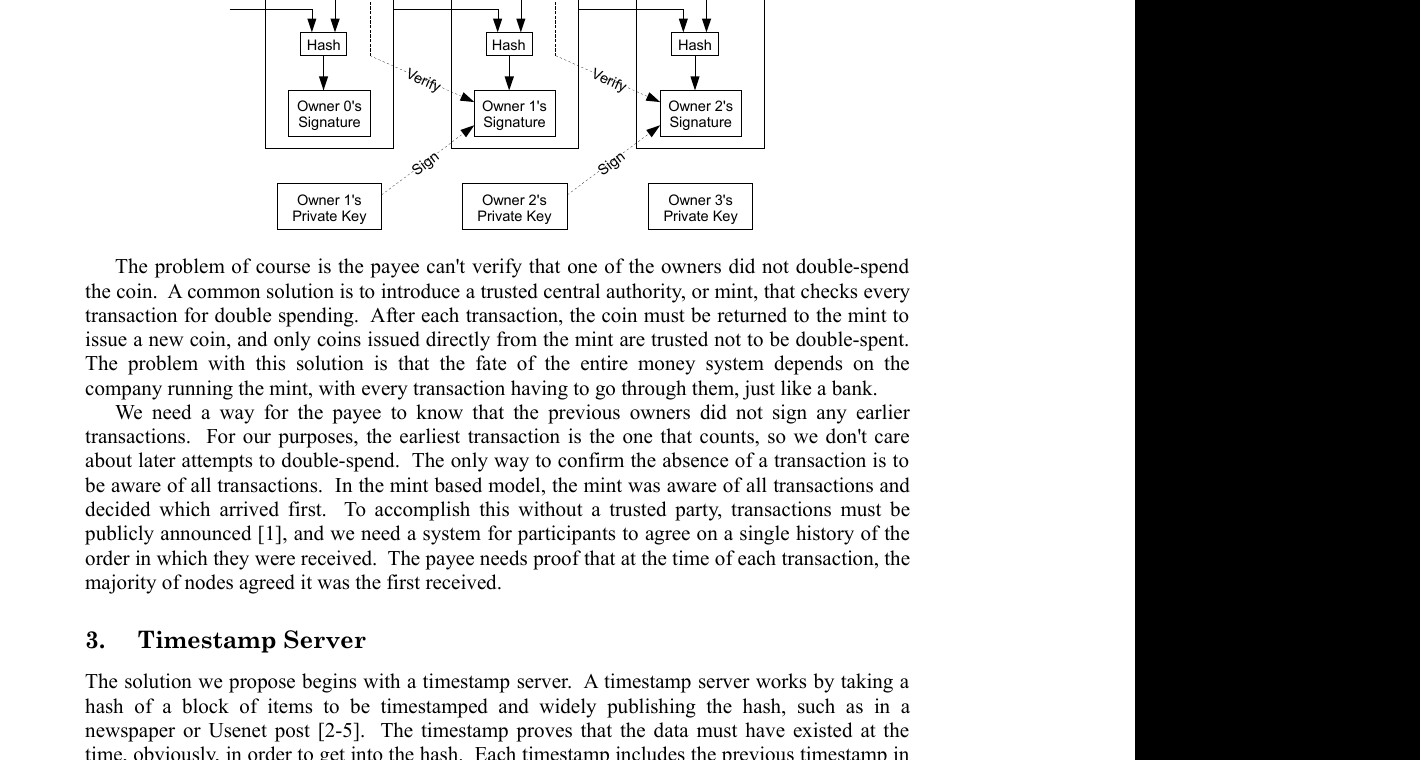
Le probleme bien sur est que le beneficiaire ne peut pas verifier qu'un des proprietaires n'a pas double-depense la piece. Une solution courante est d'introduire une autorite centrale de confiance, ou un atelier monetaire, qui verifie chaque transaction pour la double depense. Apres chaque transaction, la piece doit etre retournee a l'atelier monetaire pour emettre une nouvelle piece, et seules les pieces emises directement par l'atelier monetaire sont considerees comme non double-depensees. Le probleme avec cette solution est que le destin de l'ensemble du systeme monetaire depend de l'entreprise qui gere l'atelier monetaire, chaque transaction devant passer par eux, tout comme une banque.
Nous avons besoin d'un moyen pour le beneficiaire de savoir que les proprietaires precedents n'ont pas signe de transactions anterieures. Pour nos besoins, la transaction la plus ancienne est celle qui compte, donc nous ne nous soucions pas des tentatives ulterieures de double depense. La seule facon de confirmer l'absence d'une transaction est d'etre au courant de toutes les transactions. Dans le modele base sur l'atelier monetaire, l'atelier monetaire etait au courant de toutes les transactions et decidait laquelle etait arrivee en premier. Pour accomplir cela sans un tiers de confiance, les transactions doivent etre publiquement annoncees [^1], et nous avons besoin d'un systeme pour que les participants s'accordent sur un historique unique de l'ordre dans lequel elles ont ete recues. Le beneficiaire a besoin de la preuve qu'au moment de chaque transaction, la majorite des noeuds a convenu qu'elle etait la premiere recue.
Transactions
我々は電子コインをデジタル署名のチェーンとして定義する。各所有者は、前のトランザクションのhashと次の所有者の公開鍵にデジタル署名し、これらをコインの末尾に追加することで、次の所有者にコインを転送する。受取人は署名を検証することで所有権のチェーンを検証できる。
もちろん問題は、受取人が所有者の一人がコインを二重支払いしていないことを検証できないことである。一般的な解決策は、すべてのトランザクションの二重支払いをチェックする信頼できる中央機関、つまり造幣局を導入することである。各トランザクションの後、コインは新しいコインを発行するために造幣局に返却されなければならず、造幣局から直接発行されたコインのみが二重支払いされていないと信頼される。この解決策の問題は、銀行と同様に、すべてのトランザクションがそこを経由しなければならず、貨幣システム全体の運命が造幣局を運営する企業に依存することである。
我々は、受取人が以前の所有者がそれ以前のトランザクションに署名していないことを知る方法を必要とする。我々の目的においては、最も早いトランザクションが有効であり、それ以降の二重支払いの試みは問題としない。トランザクションが存在しないことを確認する唯一の方法は、すべてのトランザクションを認識することである。造幣局ベースのモデルでは、造幣局がすべてのトランザクションを認識し、どれが最初に到着したかを決定していた。信頼できる当事者なしにこれを達成するためには、トランザクションは公開で通知されなければならず[^1]、参加者がトランザクションの受信順序の単一の履歴に合意するシステムが必要である。受取人は、各トランザクションの時点で、ノードの過半数がそれを最初に受信したものとして合意したことの証明を必要とする。
Timestamp Server
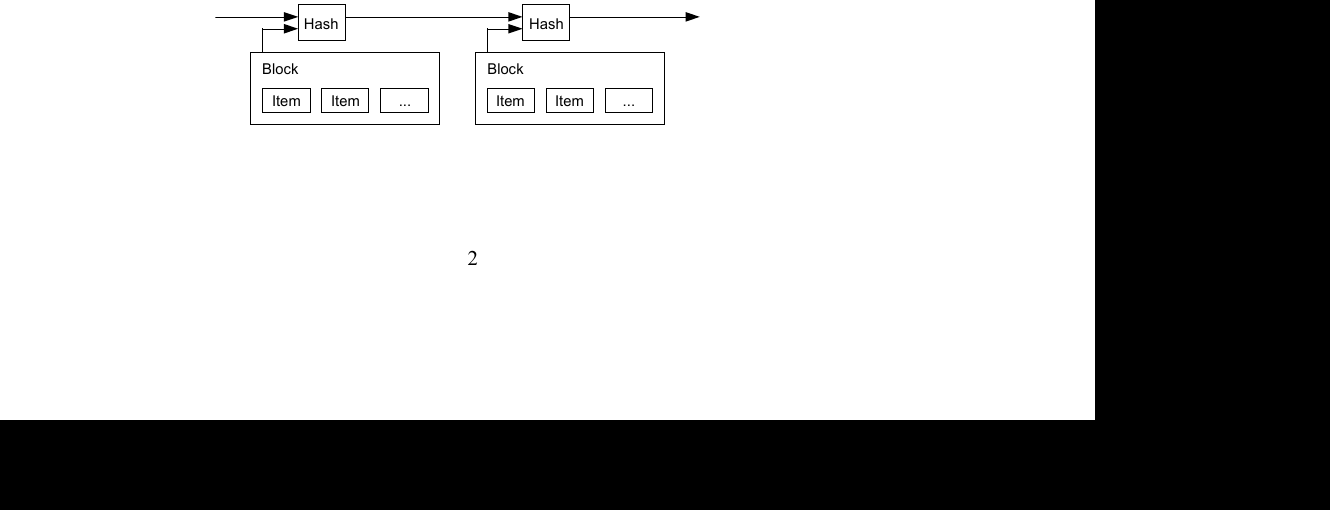
La solution que nous proposons commence par un serveur d'horodatage. Un serveur d'horodatage fonctionne en prenant un hash d'un bloc d'elements a horodater et en publiant largement le hash, comme dans un journal ou un message Usenet [^2] [^3] [^4] [^5]. L'horodatage prouve que les donnees devaient exister a ce moment-la, evidemment, pour etre incluses dans le hash. Chaque horodatage inclut l'horodatage precedent dans son hash, formant une chaine, chaque horodatage supplementaire renforcant les precedents.
Proof-of-Work
Pour implementer un serveur d'horodatage distribue sur une base pair-a-pair, nous devrons utiliser un systeme de proof-of-work similaire au Hashcash d'Adam Back [^6], plutot que des journaux ou des messages Usenet. Le proof-of-work consiste a rechercher une valeur qui, lorsqu'elle est hachee, par exemple avec SHA-256, le hash commence par un certain nombre de bits zero. Le travail moyen requis est exponentiel par rapport au nombre de bits zero requis et peut etre verifie en executant un seul hash.
Pour notre reseau d'horodatage, nous implementons le proof-of-work en incrementant un nonce dans le bloc jusqu'a ce qu'une valeur soit trouvee qui donne au hash du bloc les bits zero requis. Une fois que l'effort CPU a ete depense pour satisfaire le proof-of-work, le bloc ne peut pas etre modifie sans refaire le travail. Comme les blocs ulterieurs sont chaines apres lui, le travail pour modifier le bloc inclurait de refaire tous les blocs apres lui.
Le proof-of-work resout egalement le probleme de la determination de la representation dans la prise de decision majoritaire. Si la majorite etait basee sur une-adresse-IP-un-vote, elle pourrait etre corrompue par quiconque capable d'allouer de nombreuses adresses IP. Le proof-of-work est essentiellement un-CPU-un-vote. La decision majoritaire est representee par la chaine la plus longue, qui a le plus grand effort de proof-of-work investi. Si une majorite de la puissance CPU est controlee par des noeuds honnetes, la chaine honnete croitra le plus rapidement et devancera toutes les chaines concurrentes. Pour modifier un bloc passe, un attaquant devrait refaire le proof-of-work du bloc et de tous les blocs apres lui, puis rattraper et depasser le travail des noeuds honnetes. Nous montrerons plus tard que la probabilite qu'un attaquant plus lent rattrape diminue exponentiellement a mesure que des blocs subsequents sont ajoutes.
Pour compenser la vitesse croissante du materiel et l'interet variable pour l'exploitation des noeuds au fil du temps, la difficulte du proof-of-work est determinee par une moyenne mobile visant un nombre moyen de blocs par heure. S'ils sont generes trop rapidement, la difficulte augmente.
Proof-of-Work
peer-to-peerベースで分散タイムスタンプサーバーを実装するには、新聞やUsenetの投稿ではなく、Adam BackのHashcash [^6]に類似したproof-of-workシステムを使用する必要がある。proof-of-workは、hash化した際に(例えばSHA-256で)hashが一定数のゼロビットで始まる値を探索することを含む。必要な平均作業量はゼロビット数に対して指数関数的であり、単一のhashを実行することで検証できる。
我々のタイムスタンプネットワークでは、ブロック内のnonceをインクリメントし、ブロックのhashに必要なゼロビットを与える値が見つかるまで繰り返すことでproof-of-workを実装する。proof-of-workを満たすためにCPUの労力が費やされると、その作業をやり直さない限りブロックを変更することはできない。後続のブロックがその後にチェーンされるため、ブロックを変更するための作業にはそれ以降のすべてのブロックをやり直すことが含まれる。
proof-of-workは、多数決における代表性の決定問題も解決する。もし多数決が1つのIPアドレスにつき1票に基づいていたならば、多数のIPを割り当てられる者によって覆される可能性がある。proof-of-workは本質的に1つのCPUにつき1票である。多数決は最長のチェーン、すなわち最大のproof-of-work労力が投入されたチェーンによって表される。CPUパワーの過半数が正直なノードによって制御されていれば、正直なチェーンが最も速く成長し、競合するいかなるチェーンも凌駕する。過去のブロックを改変するには、攻撃者はそのブロックとそれ以降のすべてのブロックのproof-of-workをやり直し、さらに正直なノードの作業に追いつき追い越さなければならない。遅い攻撃者が追いつく確率は、後続のブロックが追加されるにつれて指数関数的に減少することを後に示す。
ハードウェア速度の向上と、時間の経過に伴うノード運用への関心の変動を補うため、proof-of-workの難易度は1時間あたりの平均ブロック数を目標とする移動平均によって決定される。生成速度が速すぎる場合、難易度は上昇する。
Network
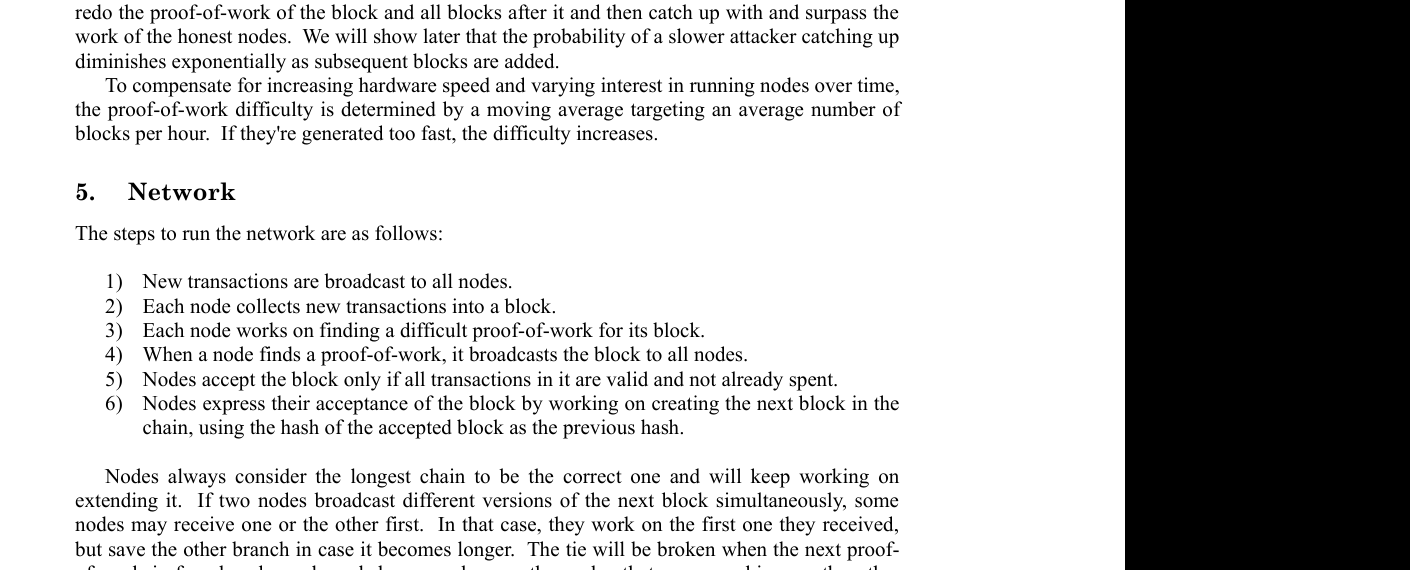
Les etapes pour faire fonctionner le reseau sont les suivantes :
- Les nouvelles transactions sont diffusees a tous les noeuds.
- Chaque noeud collecte les nouvelles transactions dans un bloc.
- Chaque noeud travaille a trouver un proof-of-work difficile pour son bloc.
- Lorsqu'un noeud trouve un proof-of-work, il diffuse le bloc a tous les noeuds.
- Les noeuds acceptent le bloc uniquement si toutes les transactions qu'il contient sont valides et n'ont pas deja ete depensees.
- Les noeuds expriment leur acceptation du bloc en travaillant a la creation du bloc suivant dans la chaine, en utilisant le hash du bloc accepte comme hash precedent.
Les noeuds considerent toujours la chaine la plus longue comme etant la correcte et continueront a travailler a son extension. Si deux noeuds diffusent des versions differentes du bloc suivant simultanement, certains noeuds peuvent recevoir l'une ou l'autre en premier. Dans ce cas, ils travaillent sur la premiere qu'ils ont recue, mais conservent l'autre branche au cas ou elle deviendrait plus longue. L'egalite sera brisee lorsque le prochain proof-of-work sera trouve et qu'une branche deviendra plus longue ; les noeuds qui travaillaient sur l'autre branche basculeront alors sur la plus longue.
Les diffusions de nouvelles transactions n'ont pas necessairement besoin d'atteindre tous les noeuds. Tant qu'elles atteignent de nombreux noeuds, elles seront integrees dans un bloc sous peu. Les diffusions de blocs sont egalement tolerantes aux messages perdus. Si un noeud ne recoit pas un bloc, il le demandera lorsqu'il recevra le bloc suivant et realisera qu'il en a manque un.
Network
ネットワークを運用する手順は以下の通りである:
- 新しいトランザクションがすべてのノードにブロードキャストされる。
- 各ノードが新しいトランザクションをブロックに収集する。
- 各ノードがそのブロックに対する困難なproof-of-workの発見に取り組む。
- ノードがproof-of-workを発見すると、そのブロックをすべてのノードにブロードキャストする。
- ノードは、ブロック内のすべてのトランザクションが有効であり、まだ使用されていない場合にのみ、そのブロックを承認する。
- ノードは、承認されたブロックのhashを前のhashとして使用し、チェーンの次のブロックの作成に取り組むことで、そのブロックの承認を表明する。
ノードは常に最長のチェーンを正しいものとみなし、その延長に取り組み続ける。2つのノードが異なるバージョンの次のブロックを同時にブロードキャストした場合、一部のノードはどちらか一方を先に受信する可能性がある。その場合、ノードは最初に受信した方に取り組むが、もう一方のブランチがより長くなった場合に備えて保存しておく。次のproof-of-workが発見され、一方のブランチがより長くなった時点で決着がつき、もう一方のブランチで作業していたノードはより長い方に切り替える。
新しいトランザクションのブロードキャストは、必ずしもすべてのノードに到達する必要はない。多くのノードに到達すれば、やがてブロックに取り込まれる。ブロックのブロードキャストもメッセージの欠落に対して寛容である。ノードがブロックを受信しなかった場合、次のブロックを受信した際に欠落に気づき、そのブロックを要求する。
Incentive
Par convention, la premiere transaction d'un bloc est une transaction speciale qui cree une nouvelle piece appartenant au createur du bloc. Cela ajoute une incitation pour les noeuds a soutenir le reseau et fournit un moyen de distribuer initialement les pieces en circulation, puisqu'il n'y a pas d'autorite centrale pour les emettre. L'ajout regulier d'une quantite constante de nouvelles pieces est analogue aux mineurs d'or qui depensent des ressources pour ajouter de l'or en circulation. Dans notre cas, ce sont le temps CPU et l'electricite qui sont depenses.
L'incitation peut aussi etre financee par les frais de transaction. Si la valeur de sortie d'une transaction est inferieure a sa valeur d'entree, la difference est un frais de transaction qui s'ajoute a la valeur d'incitation du bloc contenant la transaction. Une fois qu'un nombre predetermine de pieces est entre en circulation, l'incitation peut passer entierement aux frais de transaction et etre completement exempte d'inflation.
L'incitation peut aider a encourager les noeuds a rester honnetes. Si un attaquant cupide est capable de rassembler plus de puissance CPU que tous les noeuds honnetes, il devrait choisir entre l'utiliser pour escroquer les gens en volant ses paiements, ou l'utiliser pour generer de nouvelles pieces. Il devrait trouver plus profitable de jouer selon les regles, des regles qui le favorisent avec plus de nouvelles pieces que tous les autres combines, plutot que de saper le systeme et la validite de sa propre richesse.
Incentive
慣例により、ブロック内の最初のトランザクションは、ブロックの作成者が所有する新しいコインを生成する特別なトランザクションである。これはノードがネットワークを支援するインセンティブを追加し、発行する中央機関が存在しないため、コインを流通させる初期分配の方法を提供する。一定量の新しいコインの着実な追加は、金鉱夫が資源を費やして金を流通に追加することに類似している。我々の場合、費やされるのはCPU時間と電力である。
インセンティブはトランザクション手数料でも賄うことができる。トランザクションの出力値がその入力値よりも小さい場合、差額はそのトランザクションを含むブロックのインセンティブ値に加算されるトランザクション手数料となる。所定の数のコインが流通に入った後、インセンティブは完全にトランザクション手数料に移行し、完全にインフレーションフリーとなることができる。
インセンティブはノードが正直であり続けることを促す助けとなりうる。貪欲な攻撃者がすべての正直なノードよりも多くのCPUパワーを集めることができた場合、その力を使って自身の支払いを取り戻す詐欺を行うか、新しいコインの生成に使用するかを選択しなければならない。ルールに従って行動する方がより収益性が高いと判断するはずであり、そのようなルールは他の全員を合わせたよりも多くの新しいコインを彼に有利に与えるのであって、システムと自身の富の正当性を損なうよりもましである。
Reclaiming Disk Space
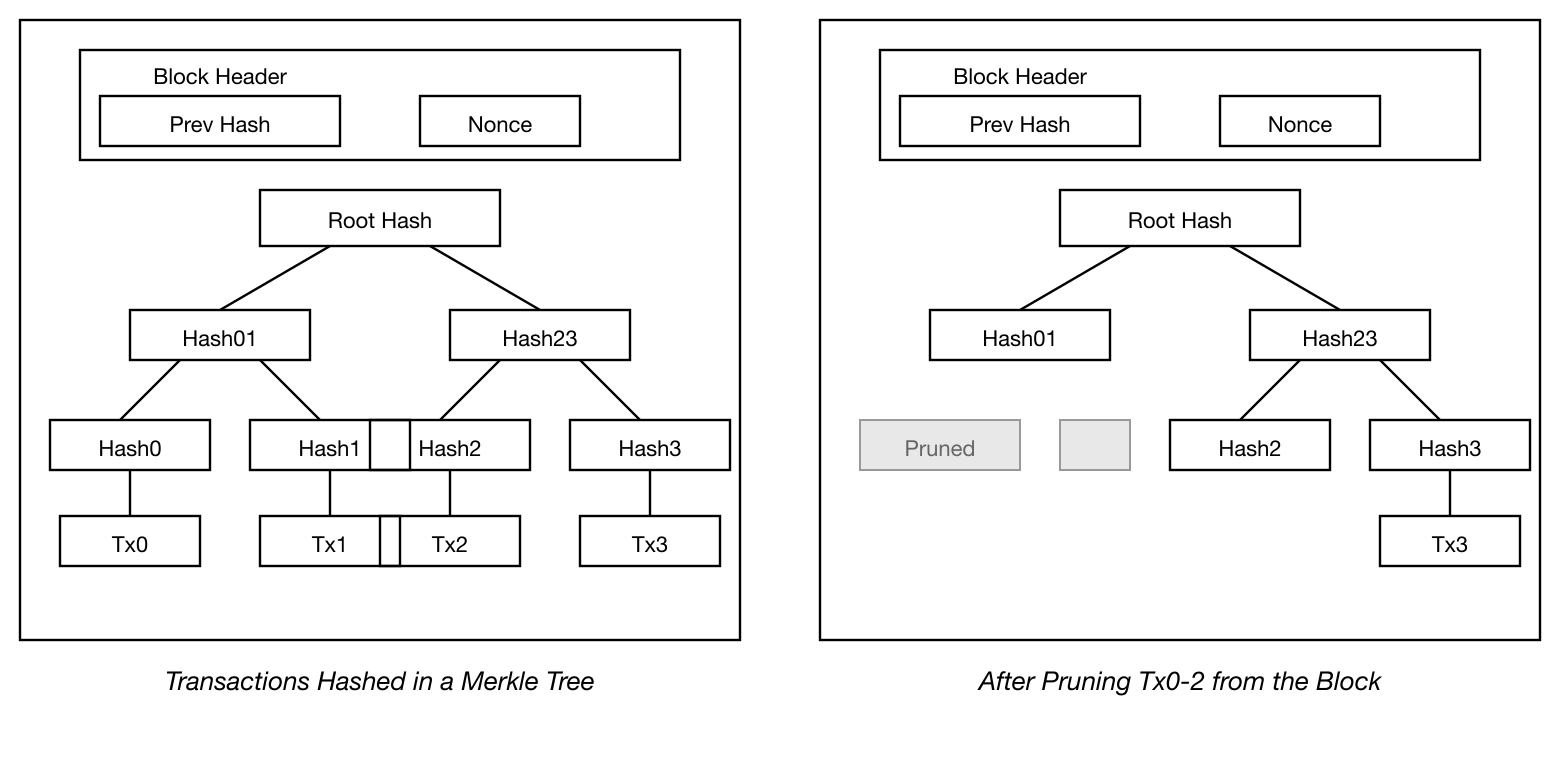
Une fois que la derniere transaction d'une piece est enfouie sous suffisamment de blocs, les transactions depensees avant elle peuvent etre supprimees pour economiser de l'espace disque. Pour faciliter cela sans casser le hash du bloc, les transactions sont hachees dans un Merkle Tree [^7] [^2] [^5], avec seule la racine incluse dans le hash du bloc. Les anciens blocs peuvent alors etre compactes en elaguant les branches de l'arbre. Les hash interieurs n'ont pas besoin d'etre stockes.
Un en-tete de bloc sans transactions ferait environ 80 octets. Si nous supposons que les blocs sont generes toutes les 10 minutes, 80 octets * 6 * 24 * 365 = 4,2 Mo par an. Avec des systemes informatiques generalement vendus avec 2 Go de RAM en 2008, et la loi de Moore prevoyant une croissance actuelle de 1,2 Go par an, le stockage ne devrait pas etre un probleme meme si les en-tetes de blocs doivent etre conserves en memoire.
Reclaiming Disk Space
コイン内の最新のトランザクションが十分な数のブロックの下に埋まれば、それ以前の使用済みトランザクションはディスクスペースを節約するために破棄できる。ブロックのhashを壊さずにこれを実現するため、トランザクションはMerkle Tree [^7] [^2] [^5]にhash化され、ルートのみがブロックのhashに含まれる。古いブロックはツリーの枝を切り落とすことでコンパクトにできる。内部のhashは保存する必要がない。
トランザクションを含まないブロックヘッダーは約80バイトとなる。ブロックが10分ごとに生成されると仮定すると、80バイト * 6 * 24 * 365 = 年間4.2MBとなる。2008年時点でコンピュータシステムが一般的に2GBのRAMを搭載して販売されており、ムーアの法則が年間1.2GBの現在の成長を予測していることを考えると、ブロックヘッダーをメモリに保持しなければならないとしてもストレージは問題とはならない。
Simplified Payment Verification
Il est possible de verifier les paiements sans faire fonctionner un noeud reseau complet. Un utilisateur n'a besoin que de conserver une copie des en-tetes de blocs de la plus longue chaine de proof-of-work, qu'il peut obtenir en interrogeant les noeuds du reseau jusqu'a ce qu'il soit convaincu d'avoir la chaine la plus longue, et d'obtenir la branche Merkle reliant la transaction au bloc dans lequel elle est horodatee. Il ne peut pas verifier la transaction par lui-meme, mais en la reliant a un endroit dans la chaine, il peut voir qu'un noeud du reseau l'a acceptee, et les blocs ajoutes apres confirment davantage que le reseau l'a acceptee.
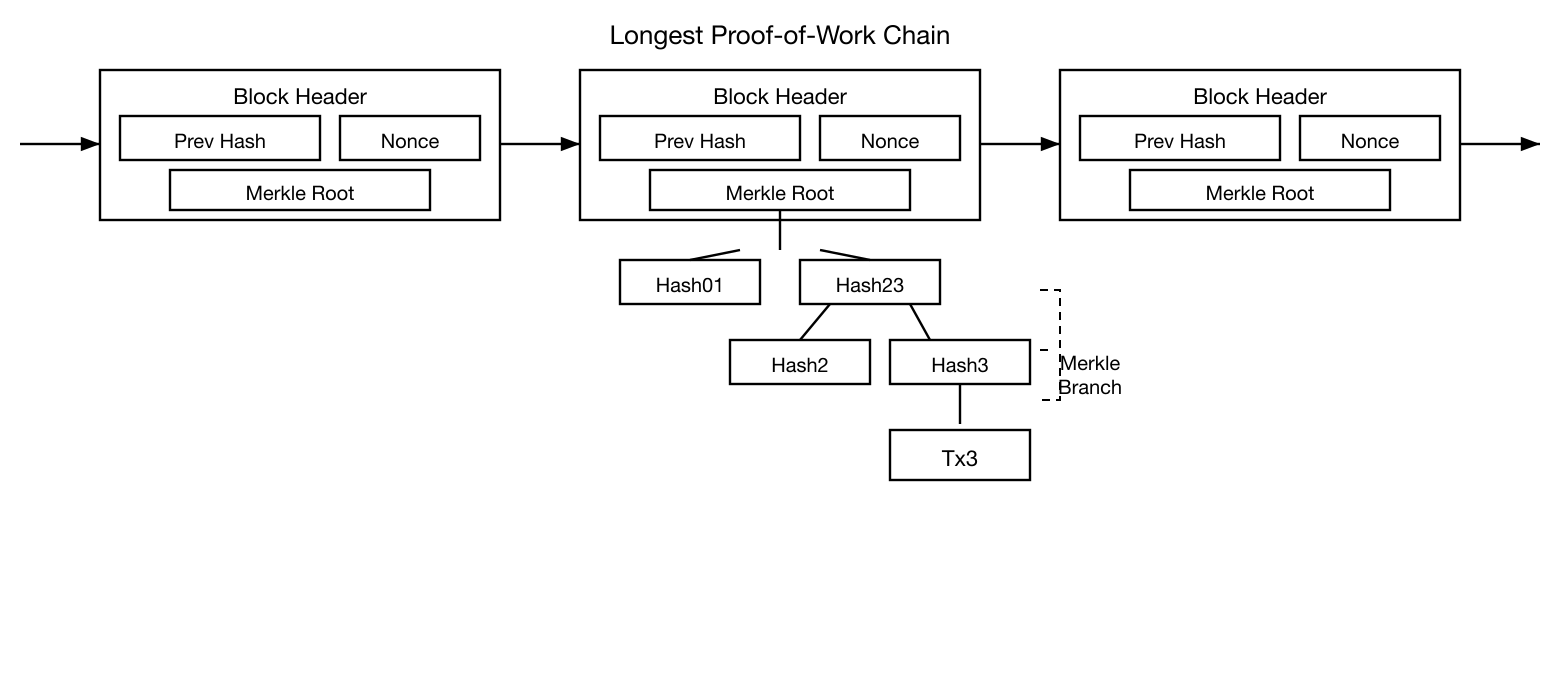
En tant que telle, la verification est fiable tant que les noeuds honnetes controlent le reseau, mais est plus vulnerable si le reseau est domine par un attaquant. Bien que les noeuds du reseau puissent verifier les transactions par eux-memes, la methode simplifiee peut etre trompee par les transactions fabriquees d'un attaquant tant que l'attaquant peut continuer a dominer le reseau. Une strategie pour se proteger contre cela serait d'accepter les alertes des noeuds du reseau lorsqu'ils detectent un bloc invalide, incitant le logiciel de l'utilisateur a telecharger le bloc complet et les transactions signalees pour confirmer l'incoherence. Les entreprises qui recoivent des paiements frequents voudront probablement toujours faire fonctionner leurs propres noeuds pour une securite plus independante et une verification plus rapide.
Simplified Payment Verification
完全なネットワークノードを稼働させずに支払いを検証することが可能である。ユーザーは最長のproof-of-workチェーンのブロックヘッダーのコピーのみを保持すればよく、最長のチェーンを持っていると確信するまでネットワークノードに問い合わせることで取得でき、トランザクションをそれがタイムスタンプされたブロックにリンクするMerkleブランチを取得できる。ユーザー自身がトランザクションを確認することはできないが、チェーン内の場所にリンクすることで、ネットワークノードがそれを承認したことを確認でき、その後に追加されたブロックがネットワークがそれを承認したことをさらに裏付ける。
そのため、正直なノードがネットワークを制御している限り検証は信頼できるが、ネットワークが攻撃者に圧倒された場合はより脆弱になる。ネットワークノードはトランザクションを自ら検証できるが、この簡易的な方法は、攻撃者がネットワークを圧倒し続けられる限り、攻撃者が捏造したトランザクションに欺かれる可能性がある。これに対する防御戦略の一つは、ネットワークノードが無効なブロックを検出した際にアラートを受け入れ、ユーザーのソフトウェアに完全なブロックとアラートされたトランザクションをダウンロードさせ、不整合を確認することである。頻繁に支払いを受ける企業は、より独立したセキュリティと迅速な検証のために、おそらく自社のノードを運用することを望むだろう。
Combining and Splitting Value
Bien qu'il soit possible de gerer les pieces individuellement, il serait peu pratique de faire une transaction separee pour chaque centime dans un transfert. Pour permettre de diviser et combiner la valeur, les transactions contiennent des entrees et des sorties multiples. Normalement, il y aura soit une seule entree provenant d'une transaction precedente plus importante, soit plusieurs entrees combinant des montants plus petits, et au plus deux sorties : une pour le paiement, et une restituant la monnaie, le cas echeant, a l'expediteur.
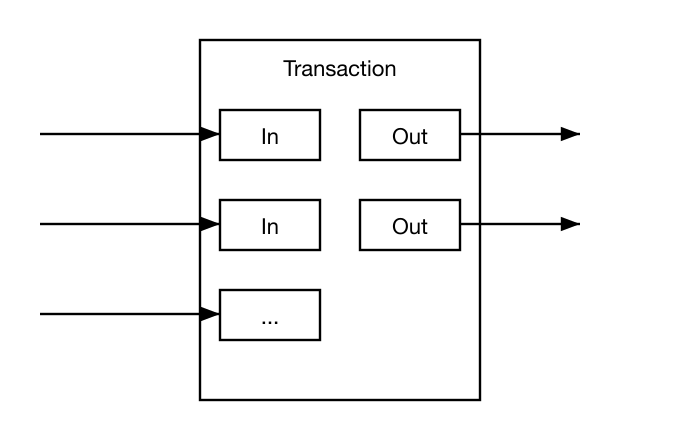
Il convient de noter que l'eventail, ou une transaction depend de plusieurs transactions, et ces transactions dependent de beaucoup d'autres, n'est pas un probleme ici. Il n'y a jamais besoin d'extraire une copie autonome complete de l'historique d'une transaction.
Combining and Splitting Value
コインを個別に扱うことは可能であるが、送金の1セントごとに別々のトランザクションを作成するのは扱いにくい。価値の分割と結合を可能にするため、トランザクションには複数の入力と出力が含まれる。通常、より大きな前のトランザクションからの単一の入力か、より小さな金額を結合する複数の入力があり、出力は最大で2つ:支払い用の1つと、もしあればお釣りを送信者に返す1つである。
あるトランザクションが複数のトランザクションに依存し、それらのトランザクションがさらに多くのトランザクションに依存するファンアウトは、ここでは問題にならないことに注意すべきである。トランザクションの完全な独立したコピーを抽出する必要は決してない。
Privacy
Le modele bancaire traditionnel atteint un niveau de confidentialite en limitant l'acces a l'information aux parties concernees et au tiers de confiance. La necessite d'annoncer toutes les transactions publiquement exclut cette methode, mais la confidentialite peut toujours etre maintenue en rompant le flux d'informations a un autre endroit : en gardant les cles publiques anonymes. Le public peut voir que quelqu'un envoie un montant a quelqu'un d'autre, mais sans information reliant la transaction a quiconque. Ceci est similaire au niveau d'information publie par les bourses, ou le moment et la taille des transactions individuelles, le "ruban", sont rendus publics, mais sans dire qui etaient les parties.
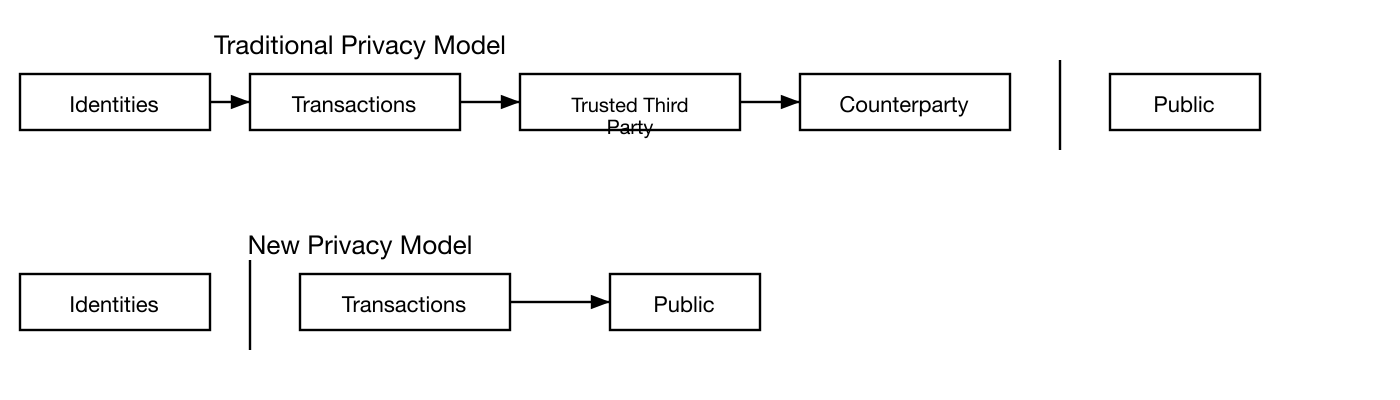
Comme pare-feu supplementaire, une nouvelle paire de cles devrait etre utilisee pour chaque transaction afin de les empecher d'etre liees a un proprietaire commun. Un certain lien est toujours inevitable avec les transactions a entrees multiples, qui revelent necessairement que leurs entrees appartenaient au meme proprietaire. Le risque est que si le proprietaire d'une cle est revele, le lien pourrait reveler d'autres transactions qui appartenaient au meme proprietaire.
Privacy
従来の銀行モデルは、関係当事者と信頼できる第三者に情報へのアクセスを制限することで一定レベルのプライバシーを実現している。すべてのトランザクションを公開で通知する必要性はこの方法を不可能にするが、別の場所で情報の流れを断ち切ることでプライバシーを維持することは可能である:公開鍵を匿名に保つことによってである。誰かが他の誰かに金額を送金していることは公開で見ることができるが、そのトランザクションを個人に結びつける情報はない。これは、証券取引所が公開する情報レベルに類似しており、個々の取引の時間と規模、すなわち「ティッカーテープ」は公開されるが、当事者が誰であるかは明かされない。
追加のファイアウォールとして、各トランザクションに新しいキーペアを使用し、共通の所有者にリンクされることを防ぐべきである。複数入力のトランザクションでは、一部のリンクは依然として不可避であり、それらの入力が同一の所有者のものであったことが必然的に明らかになる。リスクは、鍵の所有者が明らかになった場合、リンクによって同一の所有者に属する他のトランザクションが明らかになる可能性があることである。
Calculations
Nous considerons le scenario d'un attaquant essayant de generer une chaine alternative plus rapidement que la chaine honnete. Meme si cela est accompli, cela n'ouvre pas le systeme a des modifications arbitraires, comme creer de la valeur a partir de rien ou prendre de l'argent qui n'a jamais appartenu a l'attaquant. Les noeuds n'accepteront pas une transaction invalide comme paiement, et les noeuds honnetes n'accepteront jamais un bloc les contenant. Un attaquant ne peut qu'essayer de modifier une de ses propres transactions pour recuperer l'argent qu'il a recemment depense.
La course entre la chaine honnete et la chaine d'un attaquant peut etre caracterisee comme une marche aleatoire binomiale. L'evenement de succes est l'extension de la chaine honnete d'un bloc, augmentant son avance de +1, et l'evenement d'echec est l'extension de la chaine de l'attaquant d'un bloc, reduisant l'ecart de -1.
La probabilite qu'un attaquant rattrape a partir d'un deficit donne est analogue au probleme de la ruine du joueur. Supposons qu'un joueur avec un credit illimite commence avec un deficit et joue potentiellement un nombre infini d'essais pour tenter d'atteindre l'equilibre. Nous pouvons calculer la probabilite qu'il atteigne un jour l'equilibre, ou qu'un attaquant rattrape un jour la chaine honnete, comme suit [^8] :
p = probability an honest node finds the next block
q = probability the attacker finds the next block
q = probability the attacker will ever catch up from z blocks behind
``````

\[
qz =
\begin{cases}
1 & \text{if } p \leq q \\
\left(\frac{q}{p}\right) z & \text{if } p > q
\end{cases}
\]

Etant donne notre hypothese que p  q, la probabilite diminue exponentiellement a mesure que le nombre de blocs que l'attaquant doit rattraper augmente. Avec les chances contre lui, s'il ne fait pas une poussee chanceuse en avant tot, ses chances deviennent infiniment petites a mesure qu'il prend du retard.

Nous considerons maintenant combien de temps le destinataire d'une nouvelle transaction doit attendre avant d'etre suffisamment certain que l'expediteur ne peut pas modifier la transaction. Nous supposons que l'expediteur est un attaquant qui veut faire croire au destinataire qu'il l'a paye pendant un certain temps, puis basculer pour se rembourser lui-meme apres un certain temps. Le destinataire sera alerte quand cela se produira, mais l'expediteur espere qu'il sera trop tard.

Le destinataire genere une nouvelle paire de cles et donne la cle publique a l'expediteur peu avant la signature. Cela empeche l'expediteur de preparer une chaine de blocs a l'avance en y travaillant continuellement jusqu'a ce qu'il ait la chance d'etre suffisamment en avance, puis d'executer la transaction a ce moment-la. Une fois la transaction envoyee, l'expediteur malhonnete commence a travailler en secret sur une chaine parallele contenant une version alternative de sa transaction.

Le destinataire attend que la transaction ait ete ajoutee a un bloc et que z blocs aient ete lies apres. Il ne connait pas la quantite exacte de progres que l'attaquant a fait, mais en supposant que les blocs honnetes ont pris le temps moyen attendu par bloc, le progres potentiel de l'attaquant sera une distribution de Poisson avec la valeur attendue :

\[
\lambda = z\frac{q}{p}
\]

Pour obtenir la probabilite que l'attaquant puisse encore rattraper maintenant, nous multiplions la densite de Poisson pour chaque quantite de progres qu'il aurait pu faire par la probabilite qu'il puisse rattraper a partir de ce point :

\[
\sum_{k=0}^{\infty} \frac{\lambda^k e^{-\lambda}}{k!} \cdot \left\{
\begin{array}{cl}
\left(\frac{q}{p}\right)^{(z-k)} & \text{if } k \leq z \\
1 & \text{if } k > z
\end{array}
\right.
\]

Rearrangement pour eviter de sommer la queue infinie de la distribution...

\[
1 - \sum_{k=0}^{z} \frac{\lambda^k e^{-\lambda}}{k!} \left(1-\left(\frac{q}{p}\right)^{(z-k)}\right)
\]

Conversion en code C...

```c
#include math.h

double AttackerSuccessProbability(double q, int z)
{
    double p = 1.0 - q;
    double lambda = z * (q / p);
    double sum = 1.0;
    int i, k;
    for (k = 0; k = z; k++)
    {
        double poisson = exp(-lambda);
        for (i = 1; i = k; i++)
            poisson *= lambda / i;
        sum -= poisson * (1 - pow(q / p, z - k));
    }
    return sum;
}
En executant quelques resultats, nous pouvons voir la probabilite diminuer exponentiellement avec z.
q=0.1
z=0 P=1.0000000
z=1 P=0.2045873
z=2 P=0.0509779
z=3 P=0.0131722
z=4 P=0.0034552
z=5 P=0.0009137
z=6 P=0.0002428
z=7 P=0.0000647
z=8 P=0.0000173
z=9 P=0.0000046
z=10 P=0.0000012

q=0.3
z=0 P=1.0000000
z=5 P=0.1773523
z=10 P=0.0416605
z=15 P=0.0101008
z=20 P=0.0024804
z=25 P=0.0006132
z=30 P=0.0001522
z=35 P=0.0000379
z=40 P=0.0000095
z=45 P=0.0000024
z=50 P=0.0000006
Resolution pour P inferieur a 0,1%...
P  0.001
q=0.10 z=5
q=0.15 z=8
q=0.20 z=11
q=0.25 z=15
q=0.30 z=24
q=0.35 z=41
q=0.40 z=89
q=0.45 z=340
Calculations
攻撃者が正直なチェーンよりも速く代替チェーンを生成しようとするシナリオを考える。これが達成されたとしても、無から価値を創造したり、攻撃者に属さない金銭を奪うなど、システムが恣意的な変更に開かれるわけではない。ノードは無効なトランザクションを支払いとして受け入れず、正直なノードはそれを含むブロックを決して受け入れない。攻撃者は、自分自身のトランザクションの1つを変更して最近使った金銭を取り戻すことしか試みることができない。
正直なチェーンと攻撃者のチェーンの競争は二項ランダムウォークとして特徴づけることができる。成功事象は正直なチェーンが1ブロック延長されリードが+1増加すること、失敗事象は攻撃者のチェーンが1ブロック延長され差が-1縮小することである。
攻撃者が所定の不足分から追いつく確率は、ギャンブラーの破産問題に類似している。無限の信用を持つギャンブラーが不足分から出発し、損益分岐点に達しようと無限の試行を行うと仮定する。損益分岐点に達する確率、つまり攻撃者が正直なチェーンに追いつく確率は以下のように計算できる[^8]:
p = probability an honest node finds the next block
q = probability the attacker finds the next block
q = probability the attacker will ever catch up from z blocks behind
``````

\[
qz =
\begin{cases}
1 & \text{if } p \leq q \\
\left(\frac{q}{p}\right) z & \text{if } p > q
\end{cases}
\]

p  qという我々の仮定の下では、攻撃者が追いつかなければならないブロック数が増加するにつれて確率は指数関数的に低下する。不利な状況において、早い段階で幸運にも前進できなければ、遅れるにつれてその可能性は極めて小さくなる。

次に、新しいトランザクションの受取人が、送信者がトランザクションを変更できないと十分に確信するまでにどのくらい待つ必要があるかを考える。送信者は、受取人にしばらくの間支払ったと信じさせた後、一定時間の経過後に自分自身への支払いに切り替えたい攻撃者であると仮定する。受信者はそれが起こった時にアラートを受けるが、送信者はそれが手遅れであることを望んでいる。

受信者は新しいキーペアを生成し、署名の直前に送信者に公開鍵を渡す。これにより、送信者が十分先行できるほどの幸運を得るまで継続的にブロックのチェーンを事前に準備し、そのタイミングでトランザクションを実行することを防ぐ。トランザクションが送信されると、不正な送信者は自分のトランザクションの代替バージョンを含む並行チェーンを秘密裏に作成する作業を開始する。

受取人はトランザクションがブロックに追加され、その後にzブロックがリンクされるまで待つ。攻撃者が正確にどの程度進んでいるかは分からないが、正直なブロックがブロックあたりの平均予想時間を要したと仮定すると、攻撃者の潜在的な進捗は期待値が次のPoisson分布となる:

\[
\lambda = z\frac{q}{p}
\]

攻撃者が今なお追いつける確率を求めるために、攻撃者が到達しうる各進捗量のPoisson密度に、その地点から追いつける確率を乗じる:

\[
\sum_{k=0}^{\infty} \frac{\lambda^k e^{-\lambda}}{k!} \cdot \left\{
\begin{array}{cl}
\left(\frac{q}{p}\right)^{(z-k)} & \text{if } k \leq z \\
1 & \text{if } k > z
\end{array}
\right.
\]

分布の無限の裾を合計することを避けるために整理すると...

\[
1 - \sum_{k=0}^{z} \frac{\lambda^k e^{-\lambda}}{k!} \left(1-\left(\frac{q}{p}\right)^{(z-k)}\right)
\]

C言語コードに変換すると...

```c
#include math.h

double AttackerSuccessProbability(double q, int z)
{
    double p = 1.0 - q;
    double lambda = z * (q / p);
    double sum = 1.0;
    int i, k;
    for (k = 0; k = z; k++)
    {
        double poisson = exp(-lambda);
        for (i = 1; i = k; i++)
            poisson *= lambda / i;
        sum -= poisson * (1 - pow(q / p, z - k));
    }
    return sum;
}
いくつかの結果を実行すると、確率がzに対して指数関数的に低下することが分かる。
q=0.1
z=0 P=1.0000000
z=1 P=0.2045873
z=2 P=0.0509779
z=3 P=0.0131722
z=4 P=0.0034552
z=5 P=0.0009137
z=6 P=0.0002428
z=7 P=0.0000647
z=8 P=0.0000173
z=9 P=0.0000046
z=10 P=0.0000012

q=0.3
z=0 P=1.0000000
z=5 P=0.1773523
z=10 P=0.0416605
z=15 P=0.0101008
z=20 P=0.0024804
z=25 P=0.0006132
z=30 P=0.0001522
z=35 P=0.0000379
z=40 P=0.0000095
z=45 P=0.0000024
z=50 P=0.0000006
Pが0.1%未満となるzを求めると...
P  0.001
q=0.10 z=5
q=0.15 z=8
q=0.20 z=11
q=0.25 z=15
q=0.30 z=24
q=0.35 z=41
q=0.40 z=89
q=0.45 z=340
Conclusion
Nous avons propose un systeme pour les transactions electroniques sans reposer sur la confiance. Nous avons commence avec le cadre habituel de pieces faites de signatures numeriques, qui fournit un controle fort de la propriete, mais est incomplet sans un moyen de prevenir la double depense. Pour resoudre cela, nous avons propose un reseau pair-a-pair utilisant le proof-of-work pour enregistrer un historique public des transactions qui devient rapidement informatiquement impraticable a modifier pour un attaquant si les noeuds honnetes controlent une majorite de la puissance CPU. Le reseau est robuste dans sa simplicite non structuree. Les noeuds travaillent tous en meme temps avec peu de coordination. Ils n'ont pas besoin d'etre identifies, puisque les messages ne sont pas achemines vers un endroit particulier et n'ont besoin d'etre delivres qu'au mieux. Les noeuds peuvent quitter et rejoindre le reseau a volonte, acceptant la chaine de proof-of-work comme preuve de ce qui s'est passe pendant leur absence. Ils votent avec leur puissance CPU, exprimant leur acceptation des blocs valides en travaillant a les etendre et rejetant les blocs invalides en refusant de travailler dessus. Toutes les regles et incitations necessaires peuvent etre appliquees avec ce mecanisme de consensus.
Conclusion
我々は信頼に依存しない電子取引のシステムを提案した。デジタル署名から作られるコインの通常のフレームワークから出発した。これは所有権の強力な管理を提供するが、二重支払いを防ぐ方法がなければ不完全である。これを解決するために、proof-of-workを用いてトランザクションの公開履歴を記録するpeer-to-peerネットワークを提案した。正直なノードがCPUパワーの過半数を制御していれば、攻撃者がそれを変更することは計算上急速に非現実的となる。ネットワークはその非構造的な単純さにおいて頑健である。ノードはほとんど協調なしに一斉に作業する。メッセージは特定の場所にルーティングされるのではなくベストエフォートで配信されるだけでよいため、ノードは識別される必要がない。ノードは自由にネットワークから離脱・再参加でき、不在中に何が起こったかの証明としてproof-of-workチェーンを受け入れる。ノードはCPUパワーで投票し、有効なブロックの延長に取り組むことでその承認を表明し、無効なブロックに対しては作業を拒否することで拒絶する。必要なルールとインセンティブはすべてこの合意メカニズムによって施行できる。
References
-
H. Massias, X.S. Avila, and J.-J. Quisquater, "Design of a secure timestamping service with minimal trust requirements," In 20th Symposium on Information Theory in the Benelux, May 1999.
-
S. Haber, W.S. Stornetta, "How to time-stamp a digital document," In Journal of Cryptology, vol 3, no 2, pages 99-111, 1991.
-
D. Bayer, S. Haber, W.S. Stornetta, "Improving the efficiency and reliability of digital time-stamping," In Sequences II: Methods in Communication, Security and Computer Science, pages 329-334, 1993.
-
S. Haber, W.S. Stornetta, "Secure names for bit-strings," In Proceedings of the 4th ACM Conference on Computer and Communications Security, pages 28-35, April 1997.
-
A. Back, "Hashcash - a denial of service counter-measure," http://www.hashcash.org/papers/hashcash.pdf, 2002.
-
R.C. Merkle, "Protocols for public key cryptosystems," In Proc. 1980 Symposium on Security and Privacy, IEEE Computer Society, pages 122-133, April 1980.
-
W. Feller, "An introduction to probability theory and its applications," 1957.
References
-
H. Massias, X.S. Avila, and J.-J. Quisquater, "Design of a secure timestamping service with minimal trust requirements," In 20th Symposium on Information Theory in the Benelux, May 1999.
-
S. Haber, W.S. Stornetta, "How to time-stamp a digital document," In Journal of Cryptology, vol 3, no 2, pages 99-111, 1991.
-
D. Bayer, S. Haber, W.S. Stornetta, "Improving the efficiency and reliability of digital time-stamping," In Sequences II: Methods in Communication, Security and Computer Science, pages 329-334, 1993.
-
S. Haber, W.S. Stornetta, "Secure names for bit-strings," In Proceedings of the 4th ACM Conference on Computer and Communications Security, pages 28-35, April 1997.
-
A. Back, "Hashcash - a denial of service counter-measure," http://www.hashcash.org/papers/hashcash.pdf, 2002.
-
R.C. Merkle, "Protocols for public key cryptosystems," In Proc. 1980 Symposium on Security and Privacy, IEEE Computer Society, pages 122-133, April 1980.
-
W. Feller, "An introduction to probability theory and its applications," 1957.