 XRP
XRP
Вероятность сбоя консенсуса
Context
This figure appears in the Formal Analysis section of the XRP Ledger consensus paper, which provides mathematical proofs of RPCA's safety and liveness properties. The section applies probabilistic modeling to characterize conditions under which the algorithm can fail to reach consensus.
What This Figure Shows
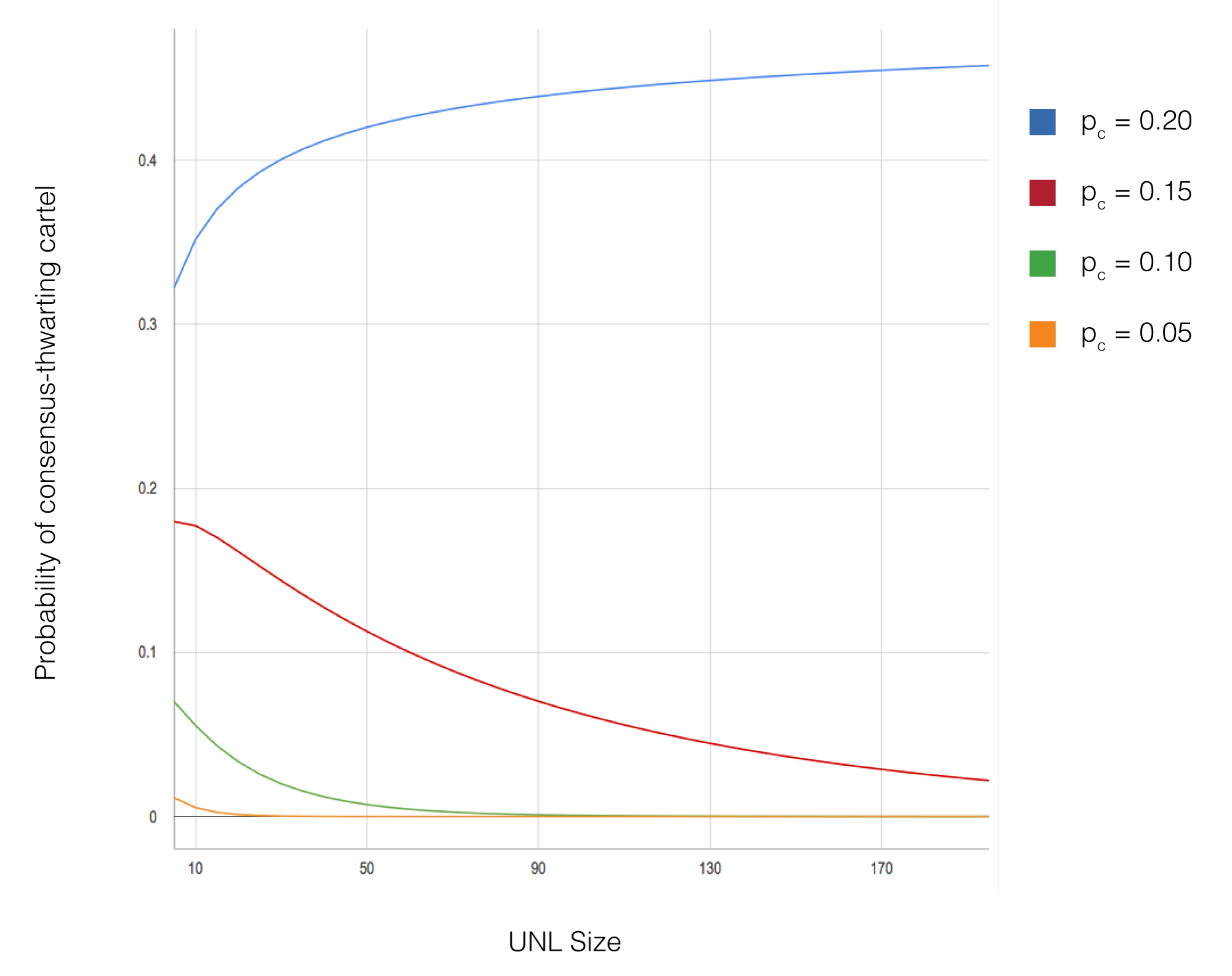
The diagram plots consensus failure probability against UNL size, with separate curves for different levels of UNL overlap. Consensus failure probability decreases rapidly — approaching zero — as either UNL size or overlap increases. At very small UNL sizes or low overlap, fork probability remains non-negligible because a small number of Byzantine validators can represent a large fraction of any node's trusted set. As UNL size grows and overlap increases, the network becomes robust to a larger absolute number of Byzantine validators while failure probability collapses toward zero. The curves make quantitatively precise the qualitative claim that UNLs must be large enough and overlapping enough to prevent Byzantine validators from misleading disjoint groups of honest nodes.
Significance
This probability curve is the mathematical foundation of the XRP Ledger's safety guarantee. It translates the abstract requirement of 'sufficient UNL overlap' into concrete engineering parameters: operators can read off the required UNL size and overlap percentage for a target failure probability. The formal result also establishes the theoretical upper bound on Byzantine tolerance within RPCA, analogous to the one-third threshold in classical BFT protocols.