Solana:高性能区块链的新架构

Solana: A new architecture for a high performance blockchain

โดย Anatoly Yakovenko · 2017

โหมดเดี่ยว PDF solana.com

Abstract

This paper presents a new blockchain architecture based on Proof of History (PoH) — a proof for verifying order and passage of time between events. PoH is used to encode trustless passage of time into a ledger, creating a historical record that proves that an event occurred at a specific moment in time. When used alongside a Proof of Stake consensus algorithm, PoH can reduce messaging overhead in a Byzantine Fault Tolerant replicated state machine, resulting in sub-second finality times.

The key innovation is the construction of a verifiable delay function implemented as a sequential pre-image resistant hash chain. The PoH sequence continuously runs and outputs a cryptographic proof that some amount of time has elapsed between two events. Data can be inserted into the sequence by appending it to the state that is hashed, thereby creating a timestamp that guarantees the data existed before the next hash was generated. This mechanism establishes a globally available, non-interactive source of time that all participants can verify independently.

By providing a trusted clock before consensus, PoH dramatically reduces the communication complexity of agreement. Validators can verify the relative ordering of events and the passage of time between them without communicating with each other. This allows the system to choose a leader, have that leader sequence user messages, and have validators process those messages in the order dictated by the PoH sequence, all without the traditional overhead of two-phase commit or synchronous coordination. The result is a blockchain capable of processing hundreds of thousands of transactions per second on a standard gigabit network while preserving the decentralization and security guarantees expected of a permissionless system.

The architecture integrates PoH with a Tower BFT consensus mechanism, a data plane optimized for streaming (Turbine), a mempool-less transaction forwarding protocol (Gulf Stream), a parallel smart contract runtime (Sealevel), and a Proof of Replication scheme for distributed storage verification. Together these components form a system whose throughput scales naturally with improvements in hardware — faster processors generate more PoH hashes per second, faster GPUs verify more signatures, and higher-bandwidth networks carry more transaction data — allowing performance to track Moore's Law without protocol changes.

Abstract

本文提出了一种高性能区块链的新架构。Solana实现了一种名为Proof of History(PoH)的新型计时机制——一种用于验证事件之间顺序和时间流逝的证明。PoH用于将无需信任的时间流逝编码到账本中,创建一个历史记录,证明某个事件发生在特定的时间点。

关键创新在于PoH允许网络中的节点在无需相互通信的情况下建立事件的时间顺序。通过使用以顺序哈希链实现的可验证延迟函数,系统生成了一个加密时钟,提供了一种验证事件之间时间流逝的方法。这使得网络能够在保持去中心化和安全性的同时每秒处理数千笔交易

PoH与Proof of Stake(PoS)共识机制集成。这种组合使得高度优化的区块链架构成为可能,验证者可以并行验证交易并高效地达成共识。该系统被设计为随摩尔定律扩展,利用硬件性能的提升来改善吞吐量,而不牺牲去中心化网络的安全保障。

Introduction

Blockchains are an implementation of fault tolerant replicated state machines. Currently available public blockchains do not rely on time, or make a weak assumption about the participants' abilities to keep time. Each node in the network typically maintains its own local clock without any guarantee that it is consistent with any other node in the network. The lack of a trusted source of time means that when a message timestamp is used to accept or reject a message, there is no guarantee that every other participant in the network will make the exact same choice. This limitation forces blockchain protocols into complex coordination patterns where nodes must exchange messages to agree on ordering.

The key observation driving Solana's design is that if a reliable source of time is available — a clock that all participants can verify without trusting each other — many of the fundamental scaling limitations of existing blockchains can be removed. In traditional consensus systems like PBFT or Tendermint, every validator must communicate with every other validator to agree on the order of transactions. This produces O(n^2) message complexity, which limits the practical network size and throughput. If ordering is established before consensus begins, validators only need to confirm that they have seen the same sequence, dramatically reducing the communication required.

Proof of History provides exactly this: a cryptographic clock that produces a verifiable record of time passage. PoH is implemented as a sequential computation — a SHA-256 hash chain where each output is used as the input for the next hash. Because SHA-256 is a pre-image resistant function, the only way to produce the output for a given position in the chain is to compute every intermediate hash from the starting point. This means the chain cannot be parallelized or shortcut, and the number of hashes between two events represents a provable lower bound on the real time that has elapsed between them.

The PoH generator runs continuously, producing hashes as fast as the hardware allows. When an event occurs (such as a transaction arriving), its data is mixed into the hash chain by including it as part of the next hash input. The resulting hash and the current counter value form a timestamp for that event. Any verifier can check that the event was incorporated at that specific position in the chain by recomputing the hashes from a known checkpoint. Because SHA-256 is cheap to verify in parallel but expensive to generate sequentially, a single PoH generator can timestamp events at the rate of a single core, while thousands of verifier cores can confirm those timestamps simultaneously.

This paper describes a new blockchain design that leverages PoH as a global clock, enabling a pipeline of optimizations: leader-based block production with predetermined schedules, streaming block propagation, GPU-accelerated signature verification, and parallel transaction execution. The net effect is a system that pushes the bottleneck from consensus messaging to raw hardware throughput — specifically, the bandwidth of the network connection and the speed of the PoH generator's CPU core.

Introduction

链">区块链系统面临的根本挑战是在保持去中心化和安全性的同时实现高交易吞吐量。当前的区块链实现受限于其共识机制,这些机制需要节点之间进行大量通信来就时间和事件排序达成一致。这种协调开销创建了瓶颈,阻止现有区块链扩展以满足全球规模应用的需求。

核心问题是时间。在分布式系统中,节点不能依赖外部时钟,因为它们无法信任其他节点的时间戳是准确的。传统的区块链共识协议通过让节点进行大量通信来就当前状态和交易顺序达成一致来解决这个问题。这种通信开销从根本上限制了吞吐量,因为网络只能以节点就排序达成共识的速度来处理交易。

Solana引入Proof of History作为这个时间问题的解决方案。PoH提供了一种加密方法来证明事件之间已经过了一定的时间,而无需依赖来自潜在恶意行为者的时间戳。通过创建可验证的历史记录,PoH使节点能够独立处理交易,同时仍然能够证明事件发生的顺序。这一突破使网络能够并行化交易处理并大幅提高吞吐量。

关键洞察是,如果我们能创建一个无需信任的时间源,就可以从共识中消除协调瓶颈。通过PoH提供加密时钟,验证者可以并行处理交易,只需在确定规范排序时进行通信。这种架构转变使Solana能够实现之前在去中心化区块链中被认为不可能的性能水平。

Outline

The remainder of this paper is organized as follows. We first describe the Proof of History mechanism in detail, explaining its construction from sequential SHA-256 hashing and the properties that make it suitable as a verifiable delay function. We then describe how data is inserted into the PoH sequence and how the resulting timestamps can be verified efficiently.

Next, we present the network design of Solana, including the leader rotation mechanism, the data plane used for block-propagation/" class="glossary-link" data-slug="block-propagation" title="block propagation">block propagation, and the transaction forwarding protocol that eliminates the need for a traditional mempool. We explain how the predetermined leader schedule, made possible by PoH's trusted clock, enables clients to send transactions directly to the upcoming leader, reducing confirmation latency.

We then describe how Proof of History integrates with a Proof of Stake consensus algorithm. The consensus mechanism, bft/" class="glossary-link" data-slug="tower-bft" title="Tower BFT">Tower BFT, uses PoH as a cryptographic clock to implement time-based lockouts that grow exponentially with each consecutive vote. This design produces a system where the cost of reverting a confirmed block increases exponentially over time, providing practical finality within seconds.

The paper proceeds to describe Streaming Proof of Replication, a mechanism for validators to prove they are storing a copy of the ledger state. This component addresses data availability — the requirement that enough copies of the blockchain data exist across the network for any participant to reconstruct the full state.

Finally, we present the system architecture as an integrated pipeline. The Transaction Processing Unit (TPU) fetches transactions, verifies signatures on the GPU, executes transactions in parallel using the Sealevel runtime, and writes the results to the ledger. We present performance projections based on the computational limits of current hardware and demonstrate that the system can process over 710,000 transactions per second on a standard gigabit network, with this throughput scaling as hardware improves over time.

Throughout the paper, we compare our approach against existing designs where relevant. Traditional blockchains process transactions sequentially and reach consensus through all-to-all communication. Solana replaces these serial bottlenecks with a pipelined, parallelized architecture where the PoH sequence serves as the coordinating mechanism, allowing each component to operate at its maximum hardware-limited throughput.

Outline

本文描述了Solana的技术架构,重点介绍Proof of History如何实现高性能链">区块链运行。文档首先解释PoH机制本身——顺序哈希链如何创建可验证的事件时间排序。我们详细说明使PoH安全的加密属性,并演示验证者如何高效地验证PoH序列。

然后,本文探讨PoH如何与Proof of Stake共识集成。我们描述Tower BFT,这是一种专门设计用于利用PoH时间属性的PoS算法。该集成允许验证者在特定的PoH时间戳上对账本状态进行投票,创建一个既快速又安全的共识机制。我们还解释了防止恶意行为的惩罚条件。

接下来,我们介绍Solana的网络设计和数据传播协议。Gulf Stream协议实现了无需内存池交易转发,允许客户端直接向即将到来的领导者发送交易。我们描述领导者轮换如何工作以及网络如何在领导权更替时保持高吞吐量。

最后,我们讨论系统架构,包括Transaction Processing Unit(TPU)、Sealevel并行运行时和用于数据存储验证的Proof of Replication。性能预测表明,Solana可以在标准千兆网络上每秒处理超过700,000笔交易,并且吞吐量会随硬件改进而扩展。

Network Design

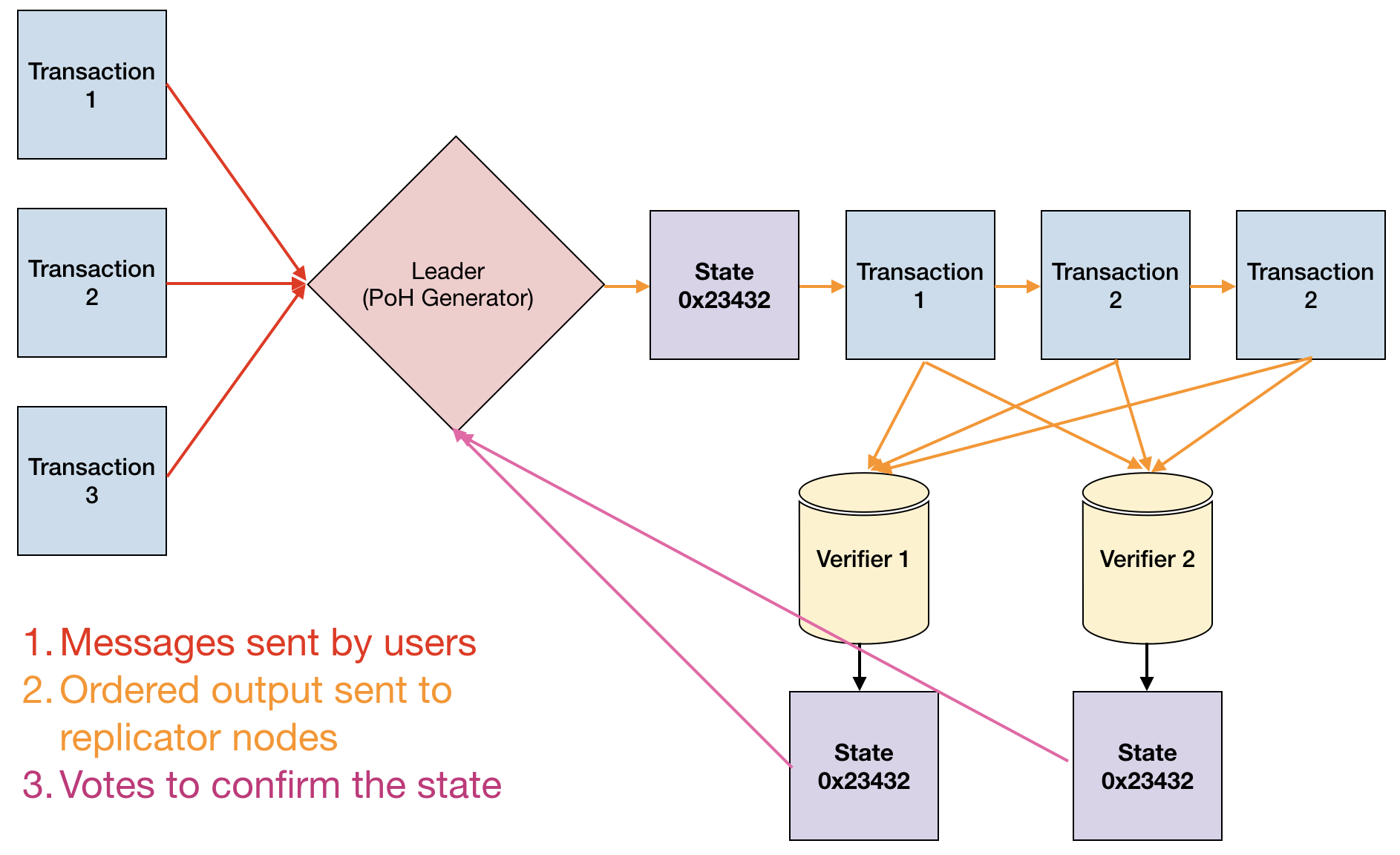
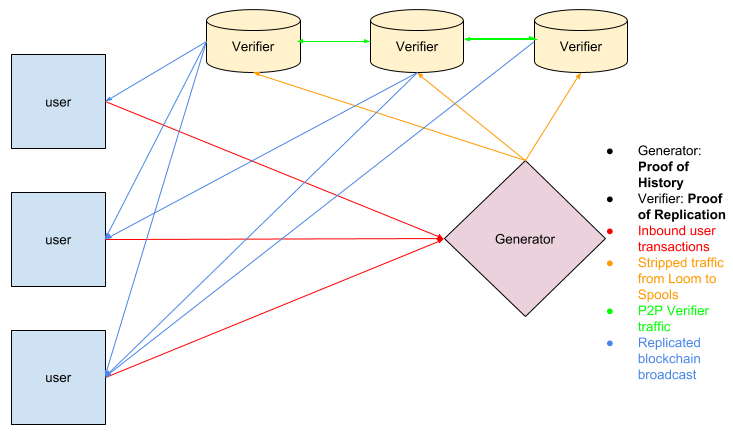
Solana's network operates on a rotating leader model where a single validator at a time is designated as the leader, responsible for producing the PoH sequence and ordering transactions into blocks. Validators are assigned leader slots according to a stake-weighted schedule that is derived deterministically from the PoH sequence itself. Because every validator can independently compute the same leader schedule from the same PoH state, the rotation is globally consistent without requiring any coordination messages.

Solana network design showing transaction flow through the leader validator to the rest of the network

A leader slot lasts for a fixed number of PoH ticks (currently configured at 800ms worth of hashes). During its slot, the leader ingests transactions from clients, orders them into the PoH stream, and produces a block that is streamed to the rest of the network. At the end of its slot, the next leader in the schedule takes over, continuing the PoH sequence from where the previous leader stopped. If a leader fails to produce a block during its slot — due to a crash, network partition, or malicious behavior — the slot is skipped and the next leader begins its rotation, with the gap in the PoH sequence serving as a verifiable record that time passed but no block was produced.

The data plane uses a protocol called Turbine, which is designed to maximize the use of network bandwidth while minimizing the data each individual validator must transmit. When a leader produces a block, it does not broadcast the entire block to every validator. Instead, the block is broken into small packets called shreds using Reed-Solomon erasure coding. The leader sends each shred to a different validator in a tree structure called a fanout tree. Each validator that receives a shred retransmits it to a fixed number of downstream validators in the tree, and those validators retransmit to their downstream neighbors, and so on. This creates a propagation pattern similar to BitTorrent, where the network's aggregate bandwidth is used to distribute the block rather than requiring the leader to have enough bandwidth to serve every validator directly.

Erasure coding is critical to Turbine's design. The leader encodes each block into data shreds and recovery shreds such that any sufficiently large subset of the total shreds is enough to reconstruct the full block. Even if some shreds are lost due to network failures or if some validators in the fanout tree fail to retransmit, the remaining validators can still recover the complete block from the shreds they did receive. This provides resilience against both random packet loss and targeted adversarial behavior.

Gulf Stream is Solana's transaction forwarding protocol, which eliminates the traditional mempool used by most blockchain networks. In a conventional blockchain, transactions are broadcast to the entire network and stored in each node's mempool until they are included in a block. This approach wastes bandwidth, as every transaction is transmitted to every node regardless of whether that node will process it. Gulf Stream instead forwards transactions directly to the expected leader. Because the leader schedule is known in advance (derived from the PoH state), clients and validators can determine which validator will be the leader for upcoming slots and forward transactions accordingly.

When a client submits a transaction, it includes a recent blockhash (a reference to a recent PoH checkpoint) that serves as a transaction lifetime marker. The transaction is valid only for a limited number of slots after the referenced blockhash. If the transaction is not processed within that window, it expires and the client must resubmit it with a more recent blockhash. This expiration mechanism prevents stale transactions from accumulating and allows validators to prune unprocessed transactions efficiently, keeping memory usage bounded without maintaining a global mempool.

The combination of known leader schedules, direct transaction forwarding, and transaction expiration means that by the time a validator becomes the leader, it already has most of the transactions it needs to build its block. There is no need to wait for mempool synchronization or to gossip unconfirmed transactions across the network. This design reduces confirmation latency because transactions arrive at the leader before it begins its slot, and it reduces network bandwidth consumption because transactions are forwarded along targeted paths rather than broadcast to all validators.

Network Design

Solana的网络设计以轮换领导者系统为中心,验证者轮流产生区。领导者负责将传入的交易排序到PoH流中,并将产生的区块发布到网络。领导者通过权益加权算法选出,轮换时间表提前已知,使网络能够优化交易转发。

Solana network design showing transaction flow through the leader validator to the rest of the network

Gulf Stream协议通过使客户端能够直接将交易转发给即将到来的领导者,消除了对传统内存池的需求。当客户端提交交易时,它会根据轮换时间表转发给预期的领导者。如果当前领导者无法处理该交易,则将其转发给下一个预期领导者。这种设计减少了确认延迟,并允许验证者提前执行交易,进一步优化吞吐量。

交易传播使用多层方法。客户端将交易发送给验证者,验证者将其转发给当前或即将到来的领导者。领导者将交易排序到PoH流中,创建总排序。排序完成后,领导者将PoH流和交易数据传输给验证者,验证者验证PoH序列并并行执行交易。

网络设计还包括Turbine区块传播协议,该协议将区块分解为更小的数据包,并以树形结构在网络中分发。这种方法在确保快速区块传播的同时最小化了单个验证者的带宽需求。结合PoH验证交易排序的能力,这种架构使Solana能够在不牺牲去中心化的情况下实现高吞吐量。

Proof of History

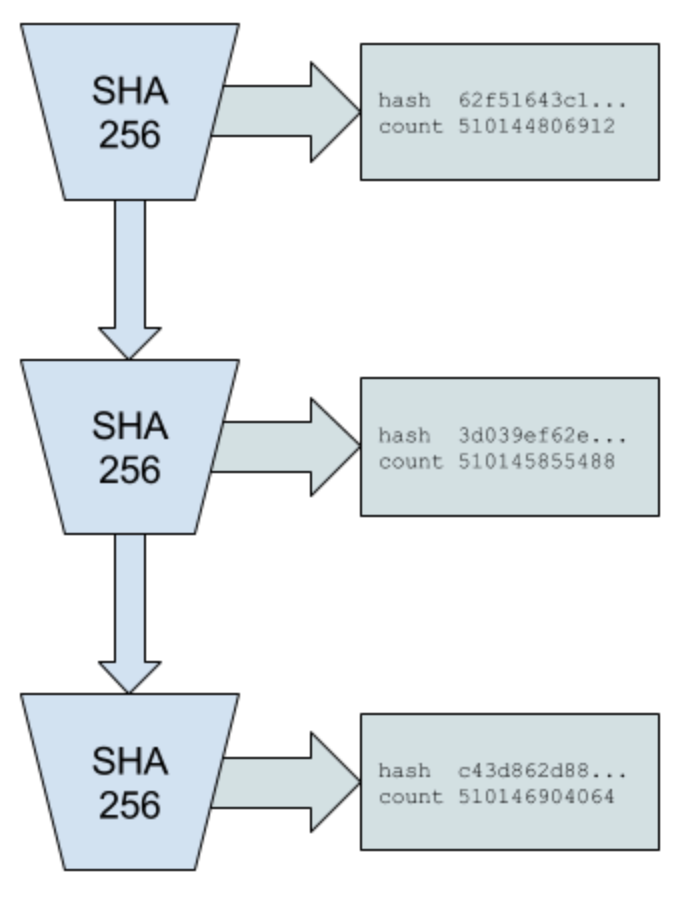
Proof of History is a sequence of computations that provides a cryptographic way to verify the passage of time between two events. It uses a sequential pre-image resistant hash function — specifically SHA-256 — that is run continuously, with the previous output used as the next input. Periodically, the current count and hash output are recorded, and each recorded sample can be verified by an external computer in the time it takes to evaluate the hash function from the starting state to the recorded sample.

The construction is straightforward. Starting from some initial hash value hash_0, the PoH generator computes:

hash_1 = SHA256(hash_0)
hash_2 = SHA256(hash_1)
hash_3 = SHA256(hash_2)
...
hash_n = SHA256(hash_{n-1})

Proof of History sequence showing sequential SHA-256 hash outputs with counter values

Each hash in the sequence can only be computed after the previous one. Because SHA-256 is pre-image resistant, there is no known way to find hash_n without computing all intermediate hashes hash_1 through hash_{n-1}. This property means the sequence acts as a verifiable delay function (VDF): producing n hashes requires sequential work proportional to n, and no amount of parallel hardware can accelerate the computation. The elapsed wall-clock time to generate n hashes on a given processor provides a lower bound on the real time that passed during generation.

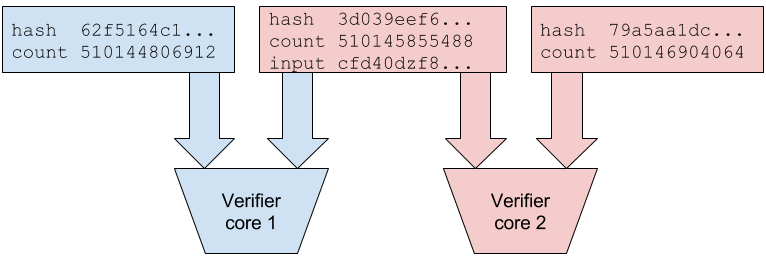
The critical asymmetry exploited by PoH is between generation and verification. While the hash chain must be generated sequentially on a single core, it can be verified in parallel by splitting it into segments. If a verifier receives the sequence along with checkpoints (hash value and counter pairs), it can divide the work among multiple cores. For example, given checkpoints at positions 0, 1000, 2000, and 3000, four cores can simultaneously verify the segments [0,1000], [1000,2000], [2000,3000] by each recomputing 1000 hashes and checking that the endpoint matches. This means verification is approximately c times faster than generation, where c is the number of cores available to the verifier.

Generation (sequential, single core):

  hash_0 → hash_1 → hash_2 → ... → hash_999 → hash_1000 → ... → hash_2000

Verification (parallel, multi-core):

  Core 1: hash_0    → ... → hash_999  ✓ matches checkpoint
  Core 2: hash_1000 → ... → hash_1999 ✓ matches checkpoint
  Core 3: hash_2000 → ... → hash_2999 ✓ matches checkpoint

Proof of History verification using multiple CPU cores to check hash chain segments in parallel

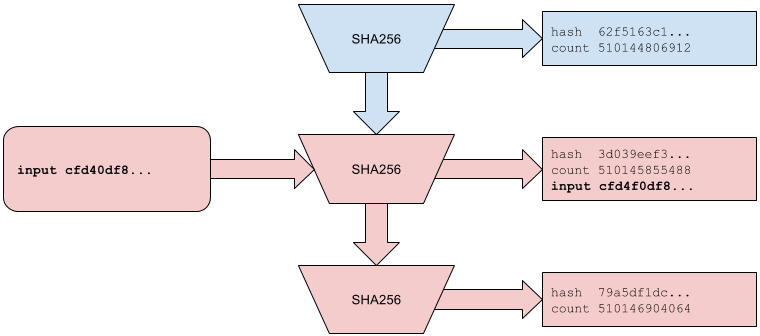
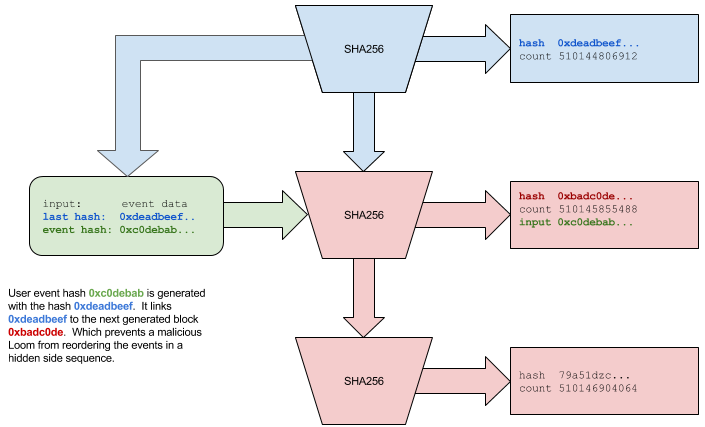
Inserting external data into the Proof of History hash sequence to create a verifiable timestamp

Proof of History input with a back reference ensuring consistency and causal ordering of events

Data can be inserted into the PoH sequence to create timestamps. When external data — such as a transaction hash, a photograph of a newspaper front page, or any arbitrary bytes — needs to be timestamped, it is appended to the current hash state and included in the next hash computation. For example, if the current state is hash_n and external data D arrives, the generator computes hash_{n+1} = SHA256(hash_n || SHA256(D)), where || denotes concatenation. The PoH record then includes the entry (n+1, D, hash_{n+1}), proving that data D existed before hash_{n+1} was computed and after hash_n was computed. The data insertion is irreversible: removing or altering D would change hash_{n+1} and every subsequent hash in the chain.

This data insertion mechanism provides a total ordering of events. If event A is inserted at position n and event B is inserted at position m where n m, then the hash chain proves that A was recorded before B. The number of hashes between positions n and m provides a lower bound on the time that elapsed between the two events. This ordering is non-interactive — any observer who has access to the hash chain can independently verify the ordering without communicating with the generator or any other observer.

The security of PoH rests on the pre-image resistance of SHA-256. An attacker who wants to forge a PoH sequence — inserting a different event at a given position while maintaining a valid hash chain — would need to recompute the entire chain from the point of forgery. Because the generator is running continuously at the maximum speed of a single core, the attacker's forged chain would always be behind the legitimate chain. To catch up, the attacker would need hardware that is faster than the generator's hardware on a single-core sequential SHA-256 computation, which is bounded by the laws of physics and the current state of semiconductor technology. This makes PoH manipulation economically and physically impractical for any reasonably provisioned generator.

Proof of History

Proof of History是一种使用SHA-256实现的顺序哈希链形式的可验证延迟函数。PoH生成器持续计算SHA-256哈希,使用每个输出作为下一个哈希的输入。这创建了一个顺序链,其中每个哈希只能在前一个哈希计算完成后才能计算,从而建立可验证的时间排序。生成每个哈希的计算要求强制了事件之间的最小时间延迟。

Proof of History sequence showing sequential SHA-256 hash outputs with counter values

PoH的关键属性是验证成本低但生成成本高。验证者可以通过将哈希序列分成段,独立并行检查每个段,然后验证各段正确连接来检查整个哈希序列。然而,生成必须是顺序的——不实际计算每个中间步骤就无法预测哈希链的输出。生成和验证之间的这种不对称性使PoH变得实用。

Proof of History verification using multiple CPU cores to check hash chain segments in parallel

外部事件和交易数据通过混合到哈希链中插入PoH序列。当交易到达时,其哈希与当前PoH状态结合,创建一条记录证明该交易在序列的该点存在。PoH生成器定期记录检查点,发布当前哈希值以及自上次检查点以来计算的哈希数量。这些检查点使验证者能够高效地验证PoH序列,而无需重新计算每个哈希。

Inserting external data into the Proof of History hash sequence to create a verifiable timestamp

PoH序列作为整个网络的加密时钟。因为哈希链是顺序的且可验证的,任何节点都可以通过展示在该时间间隔内计算的哈希来证明两个事件之间经过了一定的时间。这消除了节点信任外部时间戳或相互协调以建立时间排序的需要,消除了传统区块链共识中的根本瓶颈。

Proof of History input with a back reference ensuring consistency and causal ordering of events

Proof of History Sequence

The Proof of History sequence is a continuous stream of hash computations that serves as the backbone of Solana's temporal ordering system. The sequence begins with an arbitrary seed value and proceeds indefinitely, with the generator computing SHA-256 hashes as fast as the underlying hardware allows. Alongside the hash values, the generator maintains a monotonically increasing counter that records the total number of hashes computed since the sequence began. This counter serves as the canonical "clock tick" for the network.

The PoH output is recorded as a series of entries, each containing the counter value, the hash output, and optionally any data that was mixed into the hash at that position. Not every hash is recorded — the generator may output entries at regular intervals (for example, every 800,000 hashes), producing checkpoints that divide the sequence into verifiable segments. Between checkpoints, the generator may also produce entries at irregular intervals whenever data is inserted into the sequence. The complete sequence of entries forms the PoH log, which serves as a verifiable timeline for all events on the network.

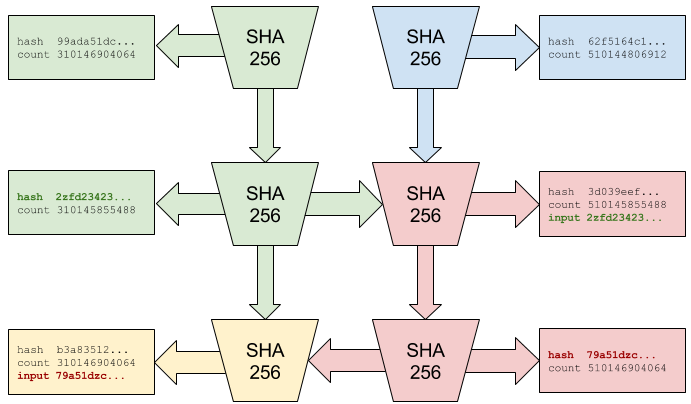
Two Proof of History generators synchronizing by inserting each other's output state for horizontal scaling

Multiple data items can be inserted at the same PoH index by hashing them together before mixing into the state. For example, if transactions Tx_1 and Tx_2 arrive simultaneously, the generator computes hash_{n+1} = SHA256(hash_n || SHA256(Tx_1) || SHA256(Tx_2)). The ordering within a single PoH index is determined by the generator (the leader), while the ordering between different PoH indices is determined by the hash chain. This two-level ordering scheme provides both fine-grained (intra-tick) and coarse-grained (inter-tick) temporal resolution.

Verification of the PoH sequence proceeds in two phases. In the first phase, a verifier checks the structural integrity of the hash chain by recomputing hashes between checkpoints and confirming that the computed output matches the recorded checkpoint value. This can be parallelized across multiple cores, with each core independently verifying one segment. In the second phase, the verifier checks that data insertions are correct by confirming that the hash at each insertion point correctly incorporates the declared data. Both phases can run simultaneously on different cores, making verification significantly faster than generation.

The PoH sequence also supports light proofs. A node that wants to prove that a specific event occurred at a specific position in the PoH sequence need not transmit the entire hash chain. Instead, it can provide the event data, the PoH hash at the insertion point, the hashes at the surrounding checkpoints, and a compact proof that the checkpoints are part of the canonical PoH sequence (confirmed by validator votes). The verifier can then check the segment containing the insertion point and confirm the event's position without processing the full sequence.

A critical design consideration is the speed of the PoH generator. The generator should use the fastest available single-core hardware for SHA-256 computation, because the rate of hash production determines the "tick rate" of the cryptographic clock. If an adversary has access to significantly faster hardware, they could generate an alternative PoH sequence faster than the legitimate generator, potentially creating a forged timeline. In practice, the fastest SHA-256 hardware available is commodity ASIC or high-end CPU hardware, and the difference in single-core performance between the fastest and second-fastest hardware is small — typically within a factor of two. This means an attacker's forged sequence would still fall behind the legitimate sequence as long as the legitimate generator starts first and the attacker cannot sustain twice the single-core hash rate indefinitely.

The PoH sequence naturally handles the passage of time during periods of inactivity. When no transactions are being submitted, the generator continues to compute hashes, producing "empty ticks" that advance the clock without recording any events. These empty ticks prove that time passed even when no activity occurred, which is important for features like transaction expiration and for distinguishing between a leader that produced an empty slot (because no transactions arrived) and a leader that failed to produce any output at all.

Proof of History Sequence

Proof of History序列是一个连续的SHA-256哈希链,其中每个哈希依赖于前一个输出。序列从初始种子值开始,该值被哈希以产生第一个输出。此输出成为下一个哈希的输入,过程无限重复。生成器还维护一个计数器,跟踪计算的哈希总数,作为账本中事件的PoH"时间戳"。

Two Proof of History generators synchronizing by inserting each other's output state for horizontal scaling

当需要将数据插入序列时(如交易哈希或验证者签名),使用确定性混合函数将其与当前哈希状态结合。例如,如果当前哈希状态是hash_n,我们想插入数据D,则计算hash_{n+1} = SHA256(hash_n || D),其中||表示连接。插入点与计数器值一起记录,证明数据D在序列的该特定点存在。

PoH序列的验证可以通过将链分成段来并行化。例如,验证者可能每10,000个哈希接收一次PoH检查点。要验证检查点之间的序列,验证者可以将10,000个哈希分成100个段,每段100个哈希,独立并行验证每个段,然后验证各段正确连接。这允许验证随可用CPU核心数水平扩展。

序列还支持高效证明两个事件以特定顺序发生。给定在计数器值nm(其中n m)处的两个数据插入,任何人都可以通过检查这些点之间的哈希链来验证n处的事件发生在m处的事件之前。此属性使Solana能够创建网络中所有事件的可验证历史记录,而无需节点持续在线或信任外部时间源。

Timestamp

Each hash and counter published by the PoH generator represents a unique timestamp. This timestamp is a proof that the data was created before the hash was generated. The PoH sequence can be used to embed wall-clock time estimates that validators collectively agree upon, creating a bridge between the cryptographic clock and human-readable time.

The mechanism works as follows. Each PoH tick represents a cryptographic timestamp — a position in the hash chain that can be verified but that does not directly correspond to a wall-clock time. To establish a mapping between PoH ticks and real-world time, validators periodically submit signed observations of their local wall-clock time along with the current PoH tick count. These observations are recorded in the PoH stream. After collecting observations from a sufficient number of validators, the network can compute a bounded estimate of the real-world time at each PoH tick by taking the stake-weighted median of the reported times.

Validator Timestamp Observations:

PoH Tick 500000:
  Validator A (10% stake): 2017-11-15T12:00:00.000Z
  Validator B (15% stake): 2017-11-15T12:00:00.012Z
  Validator C (20% stake): 2017-11-15T12:00:00.005Z
  Validator D (5% stake):  2017-11-15T12:00:00.008Z

Stake-weighted median → 2017-11-15T12:00:00.006Z
Bound: ±20ms (based on PoH tick rate and observation spread)

The bound on the wall-clock estimate depends on two factors: the variance in network propagation delays (which affects when different validators observe the same PoH tick) and the granularity of the PoH clock (which depends on the hash rate of the generator). On a 4GHz processor computing approximately 4 million SHA-256 hashes per second, the PoH clock has a resolution of approximately 0.25 microseconds per tick. Network propagation delays are typically on the order of tens to hundreds of milliseconds, so the bound on wall-clock estimates is dominated by network latency rather than PoH resolution.

This timestamp mechanism is important for several protocol features. Transaction expiration relies on timestamps to determine when a transaction's referenced blockhash has become too old. Stake lockup periods use timestamps to determine when staked tokens can be withdrawn. Oracle integrations use timestamps to verify the freshness of external data feeds. And any on-chain program that needs to implement time-dependent logic — such as scheduled payments, time-locked contracts, or rate limiting — can use the PoH-derived timestamps as a trusted time source.

A critical security property of PoH timestamps is that they cannot be manipulated by a single malicious leader. A leader could attempt to assign incorrect wall-clock times to PoH ticks, but because the wall-clock estimates are computed from the stake-weighted median of multiple validators' observations, a single malicious validator (even one with significant stake) cannot significantly skew the median. To shift the median by more than the normal observation variance, an attacker would need to control a majority of the stake, which would compromise the security of the consensus mechanism itself and is therefore outside the threat model.

The PoH clock also provides a mechanism for detecting leaders that are running at an abnormal rate. If a leader is generating PoH hashes significantly faster or slower than expected (relative to the observed wall-clock rate of previous leaders), validators can detect this discrepancy and reject blocks from that leader. This prevents attacks where a malicious leader attempts to compress or extend time by manipulating the rate of PoH generation. The expected PoH rate is calibrated based on the observed performance of the network's hardware, and validators maintain a running estimate of the normal rate to detect anomalies.

Timestamp

Proof of History作为去中心化时钟运行,在不依赖墙钟时间的情况下为事件分配时间戳。每个PoH哈希代表加密时钟的一个离散"滴答",计数器值作为时间戳。因为哈希链是顺序的且可验证的,这些时间戳是无需信任的——任何观察者都可以通过检查哈希链来验证时间戳的合法性。

在Solana中,每个验证者在充当领导者时可以生成自己的PoH序列。当验证者轮换领导权时,他们使用前一个领导者的最后确认检查点来同步其PoH序列。这确保了即使不同的验证者轮流产生区块,时间记录的连续性也得到保持。网络通过就接受哪些PoH序列作为官方账本的一部分达成共识来建立规范时间线。

系统通过领导者轮换和共识的组合来处理时钟漂移和硬件性能差异。如果恶意或故障的领导者试图以不正确的速率(过快或过慢)生成PoH时间戳,验证者可以通过将PoH滴答率与自己的本地PoH生成器进行比较来检测这一点。与预期速率的显著偏差表明存在问题,验证者可以拒绝PoH序列偏离网络中位数太远的领导者的区块。

这种时间戳机制解决了分布式系统中的一个基本问题:在没有受信任的中央机构的情况下建立共同的时间概念。通过使用PoH作为去中心化时钟,Solana使验证者能够在保持全局一致排序的同时并行处理交易。时间戳还为基于时间的功能提供了基础,如交易过期、定时操作和性能测量。

Proof of Stake Consensus

Solana uses a Proof of Stake consensus mechanism called bft/" class="glossary-link" data-slug="tower-bft" title="Tower BFT">Tower BFT that is specifically designed to leverage the temporal guarantees provided by Proof of History. In Tower BFT, validators stake SOL tokens as collateral and vote on the validity of blocks produced by leaders. Validators earn rewards proportional to their stake for correctly participating in consensus, and they risk having their stake slashed if they violate the protocol rules. The stake-weighted voting ensures that the consensus decision reflects the economic interests of the network's stakeholders.

The fundamental innovation in Tower BFT is the use of PoH as a clock for implementing exponentially increasing lockout periods. When a validator votes on a block at a specific PoH slot, it commits to that fork of the ledger. Each consecutive vote on the same fork doubles the lockout period before the validator can switch to an alternative fork. Specifically, if a validator has made n consecutive votes on a particular fork, the lockout period before the oldest of those votes expires is 2^n PoH slots. This exponential growth means that after a modest number of consecutive votes (for example, 32), the lockout period becomes astronomically long — over 4 billion slots, which at typical slot times would take decades to expire.

Tower BFT Exponential Lockout:

Vote #  Lockout (slots)   Cumulative commitment
─────────────────────────────────────────────────
1       2                 Low — can switch forks quickly
2       4
3       8
4       16
5       32
...
12      4,096             Minutes of lockout
...
20      1,048,576         Hours of lockout
...
32      4,294,967,296     Effectively permanent (decades)

This lockout mechanism creates a natural finality gradient. A block that has received votes from validators representing a supermajority of stake, where those validators have many consecutive votes on the fork containing that block, is effectively finalized. Reverting such a block would require those validators to wait for their lockouts to expire — a period that grows exponentially and quickly becomes impractical. In practice, blocks achieve effective finality within seconds, as validators rapidly accumulate consecutive votes on the canonical fork.

The integration with PoH is what makes this lockout scheme practical. In traditional BFT systems, lockout periods would need to be measured in wall-clock time, which requires nodes to trust each other's clocks or engage in complex time-synchronization protocols. With PoH, lockout periods are measured in PoH slots — a verifiable, tamper-proof unit of time. Every validator can independently verify whether a given lockout has expired by checking the PoH sequence, without trusting any other node's clock. This eliminates the ambiguity that would otherwise make time-based lockouts vulnerable to manipulation.

Slashing is the mechanism by which validators are penalized for violating protocol rules. The primary slashable offense is equivocation: voting on two conflicting forks during a period when the validator should be locked out on one fork. If a validator votes on fork A and then votes on a conflicting fork B before their lockout on A expires, any observer who possesses both votes can construct a slashing proof. This proof demonstrates that the validator violated its lockout commitment, and the network can automatically destroy a portion of the validator's staked tokens as punishment. The economic cost of slashing makes equivocation irrational for any validator whose stake exceeds the potential profit from the attack.

Leader selection in Tower BFT is determined by the PoH sequence and the current stake distribution. The leader schedule is computed deterministically from a recent snapshot of the stake distribution and a seed derived from the PoH state. This computation is performed independently by every validator, and because both inputs (stake distribution and PoH state) are part of the consensus state, all honest validators arrive at the same leader schedule. The schedule is computed for upcoming epochs (periods of several hundred thousand slots), giving the network advance notice of which validator will lead each slot. This predictability enables the Gulf Stream transaction forwarding protocol and allows validators to prepare for their leadership slots in advance.

Validators that are not currently serving as leader participate in consensus by voting on blocks produced by the current leader. When a validator receives a block, it verifies the PoH sequence, executes the transactions in the block, and if everything is valid, casts a vote for that block by signing the block's hash along with the PoH slot number. These votes are themselves transactions that are submitted to the leader of the current slot for inclusion in the PoH stream. Once a block has received votes representing more than two-thirds of the total stake, it is considered confirmed and all validators can advance their local view of the finalized state.

Proof of Stake Consensus

Solana的共识机制称为Tower BFT,是一种专门设计用于利用Proof of History时间属性的Proof of Stake算法。验证者质押SOL代币参与共识,并因正确验证区而获得奖励。权益加权投票系统确保在网络中拥有更多经济利益的验证者在共识决策中拥有相应更大的影响力。

Tower BFT的核心创新是使用随每次连续投票呈指数增长的锁定期。当验证者对PoH哈希投票时,他们承诺在一定数量的PoH滴答内留在账本的该分叉上。如果他们对该分叉的下一个区块投票,锁定期翻倍。这为验证者继续在同一分叉上投票创造了强烈的经济激励,因为切换分叉需要等待早期锁定期到期。

具体来说,如果验证者在PoH时间戳t处对区块投票,则在2^n个滴答过去之前不能对冲突的分叉投票,其中n是他们在当前分叉上进行的连续投票次数。这种指数锁定机制使系统在允许快速最终性的同时抵御远程攻击。一旦绝对多数的权益在足够深度上对区块投票,该区块就被有效地最终确定。

惩罚条件强制执行诚实行为。如果验证者在应该被锁定的期间对两个冲突的分叉投票,他们将被惩罚——质押的代币被部分销毁,并从验证者集合中移除。这使得尝试模棱两可或其他拜占庭行为在经济上不合理。PoH的可验证时间戳与Tower BFT的指数锁定的结合创造了一个既快速又安全的共识机制,在保持传统BFT系统安全保障的同时,在几秒内实现最终性。

Streaming Proof of Replication

Proof of Replication (PoRep) addresses the data availability problem in blockchain systems: ensuring that sufficient copies of the ledger data exist across the network so that any participant can reconstruct the complete state. In many blockchain designs, there is no verifiable mechanism to ensure that validators are actually storing the data they claim to store. A validator might discard historical data after processing it, relying on other validators to maintain copies. If enough validators adopt this strategy, the network's data redundancy degrades and the ledger may become unrecoverable.

Solana implements a streaming version of PoRep that allows validators to continuously prove they are storing and replicating ledger segments. The approach is based on encrypting the ledger data with a validator-specific key and then proving that the encrypted data exists and is stored correctly. Because each validator's encrypted copy is unique (due to the validator-specific key), a validator cannot fake their storage proof by copying another validator's encrypted data.

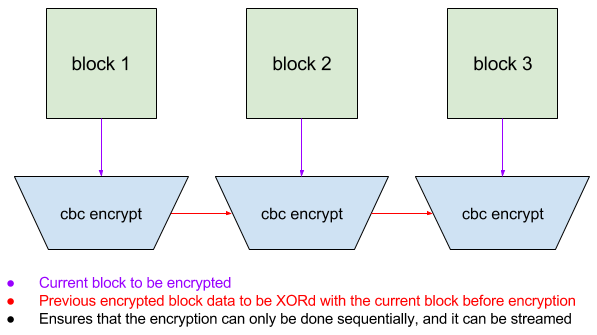
The encryption process uses CBC (Cipher Block Chaining) mode, where each encrypted block depends on the plaintext of the current block and the ciphertext of the previous block. This chaining property is essential: to produce the encrypted version of block n, the validator must possess both the plaintext of block n and the ciphertext of block n-1. This means the validator cannot compute arbitrary encrypted blocks without having processed all preceding blocks, ensuring that the encrypted ledger is a faithful replica of the original data.

Sequential CBC encryption diagram showing chained block cipher used in Solana Proof of Replication

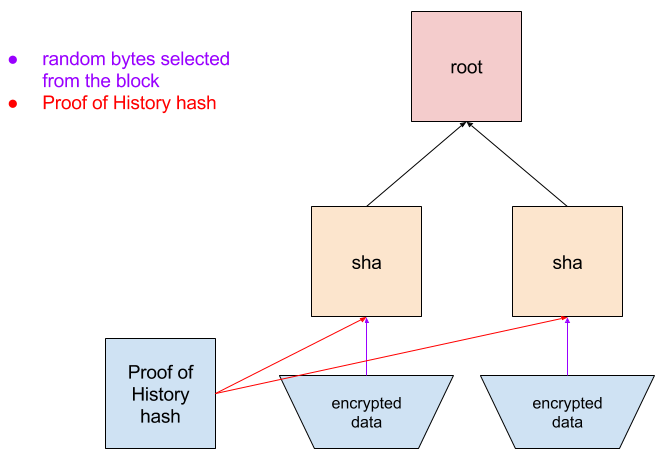
Fast Proof of Replication using Merkle hash tree for verifiable storage challenges

The validator-specific encryption key is derived from the validator's identity (their public key) and a PoH-derived seed that changes periodically. This periodic key rotation ensures that validators must re-encrypt their stored data at regular intervals, preventing them from performing the encryption once and then discarding the plaintext. The PoH seed for key derivation is chosen such that the encryption key for a given period cannot be known until that period begins, preventing validators from pre-computing encrypted data.

Storage challenges are issued through the PoH sequence. The network periodically selects random positions in the encrypted ledger and requests validators to provide the encrypted block at that position along with a Merkle proof demonstrating its position in the validator's encrypted ledger tree. Because the challenge positions are derived from the PoH state (which cannot be predicted in advance), validators cannot selectively store only the blocks that they expect to be challenged on. They must store the complete encrypted ledger to respond correctly to arbitrary challenges.

The verification of challenge responses is efficient. A verifier needs only the validator's public key, the PoH-derived encryption seed, the challenged position, and the Merkle root of the validator's encrypted ledger (which is published on-chain). The verifier computes the expected encryption key, checks that the provided encrypted block is consistent with the claimed plaintext at that position using CBC decryption, and verifies the Merkle proof against the published root. This entire verification can be done without accessing the validator's full encrypted ledger.

The streaming aspect of Solana's PoRep means that the encryption and proof generation happen continuously as new blocks are produced, rather than in discrete rounds. As the leader produces new blocks, validators encrypt them into their local PoRep store immediately. Challenge responses can be generated at any time by looking up the requested position in the local encrypted ledger and constructing a Merkle proof. This continuous operation ensures that proof of replication is always current and does not introduce latency spikes from periodic proof generation.

The combination of PoRep with PoH creates a complete accountability framework for data storage. PoH provides verifiable timestamps that record when data was created, and PoRep provides verifiable proofs that the data is being stored and replicated across the network. Together, they ensure that the blockchain's historical data remains available and intact, even if individual validators leave the network or attempt to discard data to reduce their storage costs.

Streaming Proof of Replication

Proof of Replication(PoRep)是一种允许验证者证明他们正在存储账本数据而无需揭示数据本身或需要密集计算的机制。Solana实现了PoRep的流式版本,验证者持续证明他们正在复制链">区块链状态。这对网络安全至关重要,因为它确保账本数据在验证者之间适当分布,而不是集中在少数位置。

PoRep机制通过让验证者使用从其身份派生的验证者特定密钥,以CBC(Cipher Block Chaining)模式加密账本段来工作。加密过程使每个加密块依赖于前一个块,创建一个对每个验证者唯一的链。这防止验证者简单地从彼此复制加密数据——每个验证者必须存储和处理原始账本数据才能生成其唯一的加密版本。

Sequential CBC encryption diagram showing chained block cipher used in Solana Proof of Replication

网络定期向验证者发出挑战,要求他们提供特定的加密块。因为加密是链式的,验证者必须存储所有前面的块才能生成正确的响应。验证者提交其加密块以及显示其在加密账本中位置的Merkle证明。网络可以快速验证此证明,而无需解密或重新加密数据。

Fast Proof of Replication using Merkle hash tree for verifiable storage challenges

这种流式PoRep方法与传统的存储证明系统相比开销较低。验证者可以在数据到达时进行加密,并以最小延迟响应挑战。系统还支持数据丢失时的恢复——如果验证者丢失了部分账本,可以从其他验证者重新下载并重新加密。PoRep与PoH时间戳的结合创建了一个完整的问责系统,网络可以验证数据的创建时间以及它在验证者网络中被正确存储。

System Architecture

Solana's system architecture is organized as a multi-stage pipeline, analogous to the instruction pipeline in a modern CPU. Each stage of the pipeline performs a specific function, and multiple stages operate concurrently on different batches of transactions. This pipelining ensures that the hardware is utilized continuously — while one batch of transactions is being executed, the next batch is having its signatures verified, and the batch after that is being fetched from the network. The result is a system that achieves throughput limited by the slowest pipeline stage rather than the sum of all stage latencies.

Solana system architecture showing the Transaction Processing Unit pipeline from fetch to write

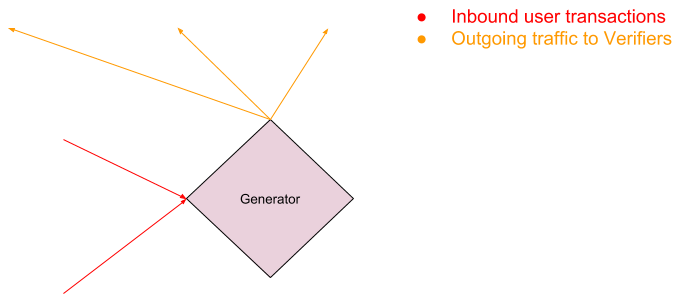
The Transaction Processing Unit (TPU) is the core component of the pipeline. It consists of four stages that process transactions sequentially within each stage but concurrently across stages:

Solana PoH generator network throughput limits showing bandwidth and processing constraints

The Fetch stage receives transaction packets from the network. Transactions arrive via UDP, and the fetch stage groups them into batches for the next pipeline stage. UDP is used instead of TCP because the overhead of TCP connection management and congestion control is unnecessary when transactions are small, independently verifiable, and can be safely dropped and retried. The fetch stage also performs basic structural validation, discarding malformed packets before they consume resources in later stages.

The SigVerify stage performs cryptographic signature verification on each transaction. Solana uses Ed25519 signatures, and this stage offloads the verification to GPUs using CUDA. A single modern GPU can verify over 900,000 Ed25519 signatures per second by executing thousands of verification operations in parallel across its CUDA cores. This is the key to removing signature verification as a bottleneck — while a single CPU core might verify only a few thousand signatures per second, a commodity GPU can handle nearly a million. The GPU receives a batch of transactions, verifies all signatures in parallel, and returns the results indicating which transactions have valid signatures.

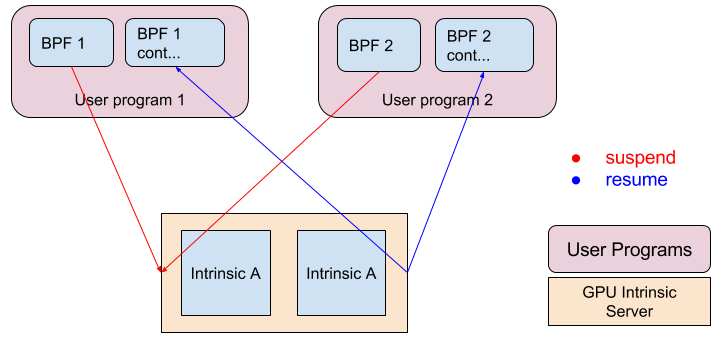
The Banking stage is where transactions are actually executed against the current state of the ledger. This stage uses Sealevel, Solana's parallel smart contract runtime. Sealevel analyzes each transaction to determine which accounts it reads from and writes to. Transactions that access disjoint sets of accounts can be executed in parallel across multiple CPU cores, because they cannot interfere with each other. Transactions that access overlapping accounts are serialized to prevent race conditions.

Executing user-supplied BPF programs in Solana Sealevel runtime with shared intrinsic calls

This account-level parallelism is possible because Solana programs (smart contracts) must declare upfront which accounts they will access. The runtime uses this declaration to build a dependency graph and schedule non-conflicting transactions across available CPU cores. Programs are executed in a sandboxed BPF (Berkeley Packet Filter) virtual machine, which provides memory safety and deterministic execution. The BPF runtime also enforces compute budgets to prevent any single transaction from consuming excessive resources.

The Write stage commits the executed transactions to the ledger and integrates them into the PoH sequence. The leader's PoH generator incorporates the transaction results into the hash chain, producing a PoH entry that timestamps the batch of executed transactions. The entry, along with the transaction data and execution results, is then transmitted to other validators via the Turbine protocol and written to local persistent storage.

The Cloudbreak state storage system is designed to support the parallelism required by the rest of the pipeline. Traditional blockchain state storage uses a single key-value store (such as LevelDB or RocksDB) that serializes all read and write operations. Cloudbreak uses memory-mapped files and a concurrent data structure that allows multiple threads to read and write different accounts simultaneously. Accounts are stored in separate memory regions, so accessing one account does not block access to another. This architecture ensures that the state storage layer does not become a bottleneck even when thousands of transactions are being executed in parallel.

The overall system architecture also includes the Archiver network, which provides long-term decentralized storage for historical ledger data. Active validators need only maintain the recent state and a sliding window of recent blocks. Older blocks are offloaded to Archiver nodes, which prove they are storing the data using the Proof of Replication mechanism described earlier. This separation of concerns allows validators to operate with bounded storage requirements while ensuring that the full history of the ledger remains available to any participant who needs it.

System Architecture

Solana的系统架构被设计为流水线,交易处理的不同阶段并行进行。Transaction Processing Unit(TPU)是负责处理传入交易的核心组件。TPU由几个阶段组成:fetch(收集交易)、签名验证、banking(交易执行)和write(提交到存储)。每个阶段对不同的交易并行操作,类似于CPU流水线。

Solana system architecture showing the Transaction Processing Unit pipeline from fetch to write

签名验证使用GPU加速,GPU在验证交易签名所需的椭圆曲线加密操作方面效率很高。通过将这个计算密集型任务卸载到GPU,Solana可以在商用硬件上以每秒超过900,000次的速率验证签名。这种并行签名验证防止了即使在非常高的交易速率下加密验证成为瓶颈。

Solana PoH generator network throughput limits showing bandwidth and processing constraints

Sealevel运行时是Solana的并行智能合约执行引擎。与顺序执行交易的传统链">区块链不同,Sealevel分析交易以识别它们访问哪些账户,并在多个CPU核心上并行执行不冲突的交易。访问相同账户的交易为保持一致性而顺序执行,但访问不同账户的交易可以同时运行。这种并行性之所以可能,是因为PoH建立了全局排序——验证者可以按任何顺序执行交易,只要按PoH指定的序列将其应用于状态

Executing user-supplied BPF programs in Solana Sealevel runtime with shared intrinsic calls

架构还包括用于区块传播和存储的优化组件。Turbine区块传播协议使用纠删码将区块分解为更小的数据包,并以树形结构在网络中分发,最小化带宽需求。Archivers网络使用PoRep确保数据可用性,为历史账本数据提供去中心化存储。这些组件共同创建了一个系统,能够在保持区块链去中心化和安全属性的同时每秒处理数十万笔交易。

Performance

The theoretical throughput of the Solana architecture is determined by three potential bottlenecks: network bandwidth, signature verification rate, and transaction execution rate. The system is designed so that improvements in any of these dimensions directly increase throughput, with the overall rate limited by whichever bottleneck is currently the tightest.

On a standard 1 gigabit per second (Gbps) network connection, the maximum data throughput is approximately 125 megabytes per second. A typical Solana transaction is 250 bytes including the signature, account addresses, instruction data, and metadata. At 250 bytes per transaction, a 1 Gbps connection can carry approximately 500,000 transactions per second. With 10 Gbps networking (increasingly available in data centers), this number rises to approximately 5 million transactions per second. The Turbine block-propagation/" class="glossary-link" data-slug="block-propagation" title="block propagation">block propagation protocol ensures that the network's aggregate bandwidth is utilized efficiently, so the bottleneck is the leader's outbound bandwidth rather than the total network capacity.

Throughput Projections by Network Bandwidth:

Network    Bandwidth     Tx Size    Max Throughput
──────────────────────────────────────────────────
1 Gbps     125 MB/s      250 B      500,000 TPS
10 Gbps    1.25 GB/s     250 B      5,000,000 TPS
40 Gbps    5 GB/s        250 B      20,000,000 TPS

Signature verification, often the computational bottleneck in blockchain systems, is addressed through GPU parallelization. A single NVIDIA GTX 1080 Ti GPU can verify approximately 900,000 Ed25519 signatures per second. Higher-end GPUs and future hardware generations will increase this rate further. Because signature verification is embarrassingly parallel (each signature is independent), the verification rate scales linearly with the number of GPU cores. With multiple GPUs, a single node can verify millions of signatures per second, ensuring that cryptographic validation does not constrain the system.

The PoH generator runs on a dedicated CPU core, producing approximately 4 million SHA-256 hashes per second on a 4 GHz processor. This provides a clock resolution of 0.25 microseconds per tick, which is more than sufficient for ordering millions of transactions per second. The sequential nature of PoH generation means this component cannot be parallelized, but the hash rate is high enough that the PoH generator is not a bottleneck. As CPU clock speeds increase and SHA-256 instruction sets improve (Intel SHA Extensions, ARM Cryptography Extensions), the PoH tick rate will increase accordingly.

Transaction execution throughput depends on the complexity of the transactions and the degree of parallelism achievable. For simple value transfers that access only two accounts (sender and receiver), the execution rate is very high because most transfers involve different accounts and can be executed in parallel. For smart contract interactions that access shared state, parallelism is reduced and execution becomes the bottleneck. The Sealevel runtime is designed to maximize parallelism by executing non-conflicting transactions on different CPU cores, and modern server hardware with 32 or more cores provides substantial parallel execution capacity.

Pipeline Stage Throughput (approximate, current hardware):

Stage              Hardware         Throughput
─────────────────────────────────────────────────
Fetch              1 Gbps NIC       500,000 TPS
SigVerify          1x GTX 1080 Ti   900,000 SPS
Banking/Execute    32-core CPU      ~400,000 TPS (simple transfers)
PoH Generator      4 GHz core       4,000,000 hashes/sec
Write/Storage      NVMe SSD         ~1,000,000 IOPS

A critical property of Solana's performance model is that it scales with Moore's Law. As hardware improves across all dimensions — faster CPUs, more powerful GPUs, higher-bandwidth networks, faster storage — the system's throughput increases proportionally without requiring any changes to the protocol. This is a deliberate design choice that distinguishes Solana from blockchains whose throughput is limited by protocol-level constraints (such as fixed block sizes or fixed block intervals) that require governance decisions and hard forks to change. In Solana, the protocol automatically takes advantage of whatever hardware is available, meaning that the performance ceiling rises continuously as technology advances.

Latency is another critical performance dimension. The end-to-end latency from transaction submission to confirmation depends on several factors: network propagation time to the leader, the leader's slot length (currently approximately 400ms), the time for the block to propagate to validators via Turbine, and the time for validators to vote and reach confirmation (typically 1-2 additional slots). In total, a transaction submitted to the current leader can be confirmed in approximately 400ms to 800ms under normal conditions. This latency is orders of magnitude lower than proof-of-work blockchains (which require minutes) and comparable to or faster than most proof-of-stake systems.

Performance

Solana的架构旨在实现随硬件改进而扩展的性能水平,遵循摩尔定律。在标准1千兆网络连接上,理论最大吞吐量约为每秒710,000笔交易,假设每笔交易176字节(包括签名和元数据)。此计算基于网络带宽作为主要瓶颈,计算瓶颈已通过并行化消除。

签名验证通常是链">区块链性能的限制因素,通过GPU并行化加速。单个GPU每秒可以验证超过900,000个ed25519签名,超过网络吞吐量限制。这意味着签名验证不会限制系统性能——瓶颈转移到网络带宽和交易执行。对于只转移价值而不涉及复杂智能合约逻辑的简单交易,banking阶段可以以匹配网络输入速率的速率处理交易。

PoH生成器在专用CPU核心上运行,在4GHz处理器上每毫秒产生约4,000个哈希。在此速率下,PoH序列提供0.25微秒粒度的时间戳,足以每秒排序数百万笔交易。PoH生成的顺序性质意味着此组件不能并行化,但吞吐量足够高,不会限制整体系统性能。

随着硬件改进,Solana的吞吐量相应扩展。更快的网络、更强大的GPU和改进的CPU都有助于更高的交易速率。系统被设计为无需协议更改即可利用这些改进。这种可扩展性方法与受顺序共识机制根本限制的区块链形成对比,使Solana能够在保持安全性和去中心化保障的同时,实现之前在去中心化系统中被认为不可能的性能水平。

Conclusion

This paper has presented a new blockchain architecture built on Proof of History, a mechanism for creating a verifiable, trustless record of time passage using sequential SHA-256 hashing. By establishing a cryptographic clock before consensus, PoH removes the coordination bottleneck that limits the throughput of existing blockchain systems. Validators no longer need to communicate extensively to agree on the ordering of events — the PoH sequence provides a canonical timeline that all participants can verify independently.

The key insight underlying Solana's design is that time is the missing primitive in distributed systems. Traditional consensus protocols must solve two problems simultaneously: agreeing on what happened and agreeing on when it happened. By separating these concerns — using PoH to establish when and consensus to confirm what — the system reduces the complexity of consensus from a coordination-intensive process to a simple confirmation step. This separation enables a pipeline architecture where block production, propagation, signature verification, and transaction execution all happen concurrently, maximizing hardware utilization.

The integration of PoH with the other components of the architecture produces a system with several distinctive properties. bft/" class="glossary-link" data-slug="tower-bft" title="Tower BFT">Tower BFT provides fast finality through exponentially increasing lockouts anchored to verifiable PoH timestamps. Gulf Stream eliminates the mempool by leveraging the predictable leader-schedule/" class="glossary-link" data-slug="leader-schedule" title="leader schedule">leader schedule that PoH enables. Turbine uses erasure coding and tree-structured propagation to distribute blocks efficiently. Sealevel executes non-conflicting transactions in parallel across multiple CPU cores. And Streaming Proof of Replication ensures that the ledger data is properly stored and replicated across the network.

The performance characteristics of this architecture are fundamentally different from those of previous blockchain designs. Instead of being limited by protocol-level constraints — fixed block sizes, fixed block intervals, sequential execution — Solana's throughput is limited only by the hardware available to validators. On current commodity hardware, the system can process hundreds of thousands of transactions per second with sub-second confirmation times. As hardware continues to improve following Moore's Law, these numbers will increase without requiring protocol changes or governance decisions.

The implications for blockchain adoption are significant. Many applications that require high throughput and low latency — decentralized exchanges, payment systems, gaming platforms, social networks, and Internet-of-Things data processing — have been unable to build on existing blockchain infrastructure due to performance limitations. Solana's architecture demonstrates that it is possible to build a blockchain that achieves performance levels comparable to centralized systems while maintaining the decentralization, security, and censorship resistance that make blockchains valuable. Proof of History provides the foundation for a new generation of decentralized applications that can operate at the scale demanded by global adoption.

Conclusion

Proof of History通过解决限制分布式账本可扩展性的时间问题,代表了链">区块链架构的根本性突破。通过创建可验证的加密时钟,PoH使验证者能够在不需要传统共识机制所需的大量通信开销的情况下建立事件的时间排序。这项创新消除了关键瓶颈,允许交易处理在网络中并行化。

PoH与优化的系统组件的集成——GPU加速签名验证、通过Sealevel的并行交易执行和高效的区块传播协议——创建了一个能够在商用硬件上每秒处理数十万笔交易的区块链。更重要的是,该架构被设计为随硬件改进而扩展,这意味着随着处理器变得更快、网络变得更强大,性能将持续提高。

Solana的设计证明了高性能和去中心化并非相互排斥。通过利用PoH作为共识和系统协调的基础,网络在保持去中心化区块链的安全性和抗审查属性的同时,实现了与中心化数据库相当的吞吐量水平。权益加权Tower BFT共识机制确保网络在实现快速最终性的同时抵御拜占庭行为者。

该架构的实现为区块链技术扩展到全球采用提供了实际路径。需要高交易吞吐量的应用——如去中心化交易所、游戏平台和金融系统——现在可以在不牺牲性能的情况下构建在真正去中心化的基础设施上。Proof of History为之前因可扩展性限制而不可行的新一代区块链应用打开了大门。