Ripple协议共识算法

The Ripple Protocol Consensus Algorithm

Tác giả David Schwartz, Noah Youngs and Arthur Britto · 2014

Abstract

While several consensus algorithms exist for the Byzantine Generals Problem, specifically as it pertains to distributed payment systems, many suffer from high latency induced by the requirement that all nodes within the network communicate synchronously. In this work, we present a novel consensus algorithm that circumvents this requirement by utilizing collectively-trusted subnetworks within the larger network. We show that the "trust" required of these subnetworks is in fact minimal and can be further reduced with principled selection of the member nodes.

The Ripple Protocol Consensus Algorithm (RPCA) is applied every few seconds by all nodes in the network, in order to maintain the correctness and agreement of the network. Once consensus is reached, the current ledger is considered "closed" and becomes the last-closed ledger. Assuming that the consensus algorithm is successful, and there are no forks in the network, the last-closed ledger maintained by all nodes in the network will be identical.

This algorithm achieves consensus with remarkably low latency — typically 3 to 5 seconds per ledger close — while maintaining provable safety guarantees against Byzantine failures. Unlike proof-of-work systems that require massive computational expenditure and suffer from probabilistic finality that may take an hour to become practically irreversible, RPCA provides deterministic finality: once a ledger is closed, it will not be reversed. This property makes the protocol suitable for real-time financial settlement, where counterparties need certainty that a payment has been completed before proceeding with dependent operations.

The key insight is that consensus does not require global trust. Each node in the network maintains a Unique Node List (UNL) — a set of other nodes that it trusts not to collude in an attempt to defraud the network. As long as these UNLs have sufficient pairwise overlap and the fraction of Byzantine nodes within any UNL remains below a critical threshold, the network as a whole will reach agreement on a single consistent ledger. This localized trust model allows the network to scale without requiring every participant to trust every other participant, while still providing the safety guarantees necessary for a global payment system.

Abstract

虽然存在多种针对Byzantine Generals Problem的共识算法,特别是与分布式支付系统相关的算法,但其中许多都因网络中所有节点需要同步通信的要求而导致高延迟问题。在本研究中,我们提出了一种新颖的共识算法,通过利用更大网络内的集体信任子网络来规避这一要求。我们证明,防止Sybil攻击所需的"信任"实际上不是全局性的,而是网络中每个节点的局部性的。

Ripple协议共识算法(RPCA)由所有节点每隔几秒应用一次,以维护网络的正确性和一致性。一旦达成共识,当前账本被视为"关闭",成为最后关闭的账本(last-closed ledger)。该算法的独特之处在于,它在维持对Byzantine故障的强大保障的同时实现了低延迟共识,使其适用于实时金融结算系统。

Introduction

The nature of payment systems in the modern world is changing rapidly. Digital currencies and online payment networks have emerged as alternatives to traditional banking infrastructure, promising lower transaction costs, faster settlement times, and broader financial inclusion. However, these systems face a fundamental challenge: how to process payments correctly, quickly, and securely in a network where participants may not trust each other and where some participants may behave maliciously.

The Bitcoin protocol, introduced by Nakamoto in 2008, demonstrated that a distributed payment system could operate without a trusted central authority by using a proof-of-work consensus mechanism. In Bitcoin, nodes compete to solve computationally expensive cryptographic puzzles, and the winner proposes the next block of transactions. While this approach elegantly solves the double-spending problem, it introduces significant practical limitations. The energy consumption of Bitcoin mining is enormous — estimated at the time of writing at over $150 million per year — and the confirmation latency for transactions is measured in minutes to hours rather than seconds. For a high-value transaction, the recommended practice is to wait for six block confirmations, which takes approximately one hour on average. These limitations make proof-of-work consensus unsuitable for many real-world payment applications.

The core problem is that proof-of-work conflates two distinct concerns: Sybil resistance (preventing an attacker from gaining disproportionate influence by creating many identities) and consensus (agreeing on the state of the ledger). By tying both concerns to computational expenditure, proof-of-work achieves security at the cost of efficiency. The Ripple protocol decouples these concerns by using a different mechanism for Sybil resistance — the node-list/" class="glossary-link" data-slug="unique-node-list" title="Unique Node List">Unique Node List — and a separate iterative voting protocol for consensus. This decoupling allows the consensus algorithm to be both fast and efficient, as it does not need to perform any computationally expensive work.

In this paper, we present the Ripple Protocol Consensus Algorithm and provide formal analysis of its correctness and convergence properties. We define the conditions under which the algorithm guarantees safety (no two honest nodes will accept conflicting ledgers) and liveness (the network will continue to make progress). We then analyze the requirements on UNL overlap and Byzantine node thresholds that are sufficient to maintain these guarantees. Finally, we present simulation results that validate the theoretical analysis and demonstrate the algorithm's performance under a variety of network conditions and adversarial scenarios.

The remainder of the paper is organized as follows. Section 2 provides formal definitions of the key concepts used throughout the paper. Section 3 surveys existing consensus algorithms and their limitations. Section 4 presents the RPCA algorithm in detail. Section 5 provides a formal analysis of convergence. Section 6 discusses the properties and selection of Unique Node Lists. Section 7 describes the simulation framework and results. Section 8 discusses the implications and trade-offs of the design, and Section 9 concludes.

Introduction

分布式支付系统必须实现共识算法,以便在存在故障或恶意行为者的情况下及时正确地处理支付。比特币通过工作量证明(proof-of-work)来达成共识,这要求所有节点消耗计算资源来解决密码学难题。虽然这种方法提供了强大的安全保障,但它存在显著的缺点,包括高能耗、低交易吞吐量以及对于高价值交易可能延长至一小时或更长时间的确认延迟。

Ripple协议共识算法提供了一种不需要工作量证明的分布式共识新方法。取而代之的是,网络中的节点通过在几秒内达成共识的投票过程来集体同意交易集合。这种共识机制专门为全球支付网络的需求而设计,在这些网络中,低延迟和高吞吐量对于实际部署至关重要。

RPCA的关键创新在于它不要求网络中的所有节点彼此达成一致。相反,每个节点维护一个唯一节点列表(Unique Node List, UNL),其中包含它信任不会串通的其他节点。只要节点选择的UNL具有足够的重叠,且故障节点低于阈值百分比,网络就会达成共识。这种方法在以秒而非分钟或小时来衡量共识延迟的同时,提供了支付系统所需的安全保障。

Definition of Consensus

We begin with formal definitions of the terms and concepts used throughout this paper. These definitions establish the precise framework within which we analyze the correctness and performance of the consensus-algorithm/" class="glossary-link" data-slug="ripple-protocol-consensus-algorithm" title="Ripple Protocol Consensus Algorithm">Ripple Protocol Consensus Algorithm.

Server. A server is any entity running the Ripple server software that participates in the consensus process. Each server maintains a copy of the ledger and communicates with other servers to reach agreement on new transactions. Servers may be operated by financial institutions, businesses, or individuals. A server may be correct (following the protocol faithfully) or Byzantine (behaving arbitrarily, possibly maliciously).

Ledger. The ledger is the complete record of all account balances and other state in the Ripple network. The ledger is organized as a set of account objects, each containing a balance denominated in one or more currencies, along with metadata such as trust lines, offers, and other protocol-level state. At any point in time, the ledger represents the authoritative state of the network.

Last-Closed Ledger. The last-closed ledger (LCL) is the most recent ledger that has been agreed upon by the consensus process. All servers that have successfully completed the most recent consensus round will have an identical LCL. The LCL serves as the base state from which the next round of consensus builds — new transactions are applied to the LCL to produce the next candidate ledger.

Open Ledger. The open ledger is the current working copy of the ledger that a server uses to process incoming transactions before the next consensus round begins. Each server maintains its own open ledger, which includes the LCL state plus any new transactions that the server has received but that have not yet been included in a closed ledger. Open ledgers may differ between servers because they have received different sets of transactions.

node-list/" class="glossary-link" data-slug="unique-node-list" title="Unique Node List">Unique Node List (UNL). The UNL of a server s is a set of other servers that s trusts not to collude in an attempt to defraud the network. The UNL is not a statement of complete trust — a server does not trust its UNL members to be correct in all circumstances. Rather, the UNL represents the set of servers that a node believes will not collectively conspire to produce fraudulent consensus results. The critical requirement is that a server's UNL should not contain a sufficient fraction of Byzantine nodes to subvert the consensus process.

Proposer Set. During each consensus round, a server's proposer set is the subset of its UNL from which it receives proposals. Due to network partitions, latency, or server failures, a server may not receive proposals from all members of its UNL in every round. The proposer set for a given round is therefore the intersection of the UNL and the set of servers from which proposals were actually received.

Consensus. Consensus in RPCA is the state in which all correct servers in the network agree on the same set of transactions to apply to the LCL, producing an identical new closed ledger. A consensus algorithm must provide two fundamental guarantees:

  1. Safety (Agreement): No two correct servers close different ledgers. If server s_1 closes ledger L and server s_2 closes ledger L' in the same consensus round, and both s_1 and s_2 are correct, then L = L'.

  2. Liveness (Termination): The consensus process completes in bounded time. Every correct server eventually closes a new ledger, ensuring the network makes forward progress.

Validation. After a server computes its closed ledger for a consensus round, it signs the ledger hash and broadcasts it as a validation message. A server that receives validations from a supermajority of its UNL for the same ledger hash can be confident that the network has reached consensus on that ledger. Validation messages serve as confirmation that the consensus round completed successfully across the network.

Transaction Set. A transaction set is a collection of transactions proposed for inclusion in the next closed ledger. During consensus, servers iteratively refine their proposed transaction sets, adding transactions that receive sufficient support and removing those that do not. The final agreed-upon transaction set is applied to the LCL to produce the new closed ledger.

Definition of Consensus

在分布式系统中,共识是指即使存在故障或恶意参与者,节点网络也能就共享状态达成一致的过程。共识算法必须满足三个基本属性:正确性(没有两个正确的节点做出不同的决定)、一致性(所有正确的节点达成相同的决定)和终止性(所有正确的节点最终都会做出决定)。这些属性确保分布式系统表现得如同一个单一的、可靠的节点。

达成共识的挑战源于分布式系统固有的不可靠性。节点可能崩溃,消息可能延迟或丢失,Byzantine节点可能任意或恶意地行为。Lamport、Shostak和Pease形式化的Byzantine Generals Problem捕捉了这一挑战:当一部分进程可能存在故障且通信不可靠时,一组进程如何能够达成一致?

分布式计算的经典结果确立了共识算法所能达到的基本限制。FLP不可能性结果表明,如果即使一个节点可能失败,在异步系统中没有确定性算法可以保证达成共识。因此,实用的共识算法必须在安全性(永远不会达成错误的共识)和活性(始终保持进展)之间做出权衡。比特币的工作量证明优先考虑安全性而非活性,而RPCA通过在有限时间内完成共识轮次,同时在现实的故障假设下维持强大的安全性保障,从而实现了更适合支付系统的平衡。

Existing Consensus Algorithms

Several consensus algorithms have been proposed to solve the Byzantine Generals Problem in distributed systems. We review the most relevant approaches and discuss their limitations in the context of distributed payment systems, motivating the design of RPCA.

Practical Byzantine Fault Tolerance (PBFT). The PBFT algorithm, introduced by Castro and Liskov in 1999, demonstrated that Byzantine fault tolerance could be achieved with practical performance. PBFT tolerates up to f Byzantine faults in a network of 3f + 1 nodes, meaning the system remains correct as long as fewer than one-third of the nodes are faulty. The algorithm operates in a series of views, each with a designated primary that proposes an ordering of client requests. If the primary is faulty, the remaining nodes can execute a view change to elect a new primary.

PBFT achieves consensus through a three-phase protocol: pre-prepare, prepare, and commit. In each phase, nodes exchange authenticated messages with all other nodes, resulting in O(n^2) message complexity per consensus round, where n is the total number of nodes. This quadratic communication overhead makes PBFT impractical for large networks. A network of 1,000 nodes would require approximately 1,000,000 messages per consensus round, creating a communication bottleneck that limits both throughput and latency. Furthermore, all nodes must participate in every consensus round, meaning the system cannot tolerate large numbers of offline nodes without risking liveness failures.

Paxos and Raft. The Paxos family of algorithms, developed by Lamport, provides consensus in asynchronous systems with crash failures. Paxos and its more understandable variant Raft use a leader-based approach where a single designated proposer coordinates agreement. These algorithms can tolerate the failure of up to f nodes in a system of 2f + 1 nodes, but they assume crash failures rather than Byzantine failures. A crashed node simply stops responding, whereas a Byzantine node may send conflicting messages, forge signatures, or otherwise behave maliciously. Because Paxos and Raft do not handle Byzantine behavior, they are unsuitable for open, permissionless networks where adversarial participants are expected.

Proof-of-Work (Bitcoin). Bitcoin's Nakamoto consensus uses proof-of-work to achieve Byzantine fault tolerance in a permissionless setting. Miners expend computational resources to solve SHA-256 hash puzzles, and the first miner to find a valid solution proposes the next block. The difficulty of the puzzle is adjusted dynamically so that the network produces one block approximately every 10 minutes. Security derives from the assumption that no single entity controls more than 50% of the network's computational power.

While proof-of-work operates in a fully permissionless environment and handles an arbitrary number of Byzantine nodes (subject to the majority hash rate assumption), its practical limitations for payment systems are severe:

  • Latency. A single confirmation takes approximately 10 minutes. For high-value transactions, the recommended practice of waiting for 6 confirmations yields a latency of approximately 60 minutes. This makes point-of-sale and real-time settlement applications impractical.

  • Energy consumption. The computational work performed by miners is deliberately wasteful — it exists solely to make the puzzle difficult. At the time of writing, the Bitcoin network's annual energy consumption was estimated to exceed $150 million, a cost ultimately borne by users of the system through transaction fees and inflation.

  • Throughput. Bitcoin's block size limit and 10-minute block interval restrict throughput to approximately 7 transactions per second. Increasing either parameter requires a hard fork and raises concerns about centralization, as larger blocks favor miners with more bandwidth and storage.

  • Probabilistic finality. Even after multiple confirmations, a proof-of-work transaction is never absolutely final — there is always a nonzero (though exponentially decreasing) probability that a longer competing chain could emerge and reverse the transaction. This probabilistic finality model is poorly suited to financial applications that require definitive settlement.

Federated Byzantine Agreement (FBA). The Stellar Consensus Protocol, proposed by Mazieres, introduces a model where nodes choose their own "quorum slices" — sets of nodes that they consider sufficient for agreement. FBA shares some conceptual similarities with RPCA's Unique Node Lists, but the two approaches differ in their consensus mechanisms and formal guarantees.

RPCA addresses the limitations of these existing approaches by combining the low latency of voting-based protocols with a trust model that does not require global agreement on the set of validators. By replacing global trust with local trust (the UNL), RPCA achieves Sybil resistance without proof-of-work, while the iterative voting mechanism with increasing thresholds provides both safety and liveness with consensus latency measured in seconds rather than minutes.

Existing Consensus Algorithms

已经有多种共识算法被提出来解决分布式系统中的Byzantine Generals Problem。由Castro和Liskov引入的Practical Byzantine Fault Tolerance(PBFT)算法可以在3f+1个节点的系统中容忍最多f个Byzantine故障。PBFT通过所有节点之间的多轮消息交换来达成共识,通信复杂度为O(n^2),其中n为节点数量。虽然PBFT提供了强大的安全性保障和小型网络中相对较低的延迟,但由于二次通信开销,它无法良好地扩展到大型网络。

由Lamport开发的Paxos及其变体在异步系统中提供共识,但假设的是崩溃故障而非Byzantine故障。Paxos通过一系列轮次达成共识,其中提议者建议值,接受者进行投票。虽然Paxos可以容忍任意消息延迟和进程崩溃,但处理Byzantine故障需要精心的工程设计,并且在某些场景中可能发生活锁(livelock)。

比特币的工作量证明共识算法采取了根本不同的方法,使Byzantine攻击在经济上不可行。节点竞争解决密码学难题,获胜者提议下一个交易。虽然这种方法可以扩展到任意网络规模并处理Byzantine故障,但它有严重的缺点:大量的能源消耗(比特币网络估计每年超过1.5亿美元)、长确认延迟(高价值交易通常为40-60分钟)以及有限的吞吐量(大约每秒7笔交易)。这些限制使得工作量证明不适合许多需要快速结算和高交易量的支付系统应用。

Ripple Protocol Consensus Algorithm

The consensus-algorithm/" class="glossary-link" data-slug="ripple-protocol-consensus-algorithm" title="Ripple Protocol Consensus Algorithm">Ripple Protocol Consensus Algorithm (RPCA) proceeds in rounds. Each round begins when a server determines that enough time has passed since the last ledger close (typically 3-5 seconds) or when it has accumulated a sufficient number of new transactions. The algorithm produces a new closed ledger by having all correct servers agree on a common set of transactions to apply to the last-closed ledger.

The algorithm proceeds through the following steps:

Step 1: Initial Proposal. Each server takes all valid transactions it has seen prior to the beginning of the consensus round — those in its open ledger that have not yet been included in a closed ledger — and forms them into an initial proposal. The server signs this proposal and broadcasts it to all servers in its UNL. The initial proposal represents the server's starting position: the set of transactions it believes should be included in the next ledger.

Step 2: Iterative Voting. Upon receiving proposals from other servers in its UNL, each server computes the overlap between the received proposals and its own proposal. A transaction is retained in the server's updated proposal if it appears in at least a threshold percentage of the proposals received from UNL members. This threshold starts at 50% in the first round, meaning a transaction must appear in proposals from at least half of the responding UNL members to survive.

The server then broadcasts its updated proposal and waits for responses. This process repeats through multiple rounds, with the threshold increasing at each round. A typical threshold progression is:

Round 1:  50% threshold  — transaction must appear in ≥50% of UNL proposals
Round 2:  60% threshold  — transaction must appear in ≥60% of UNL proposals
Round 3:  70% threshold  — transaction must appear in ≥70% of UNL proposals
Round 4:  80% threshold  — transaction must appear in ≥80% of UNL proposals (final)

The increasing thresholds serve as a filter that progressively removes contentious transactions — those that do not have broad support — while retaining transactions that are widely agreed upon. Transactions that were initially included by some servers but not others will be pruned in successive rounds as the threshold increases, until only transactions with near-universal support remain.

Step 3: Ledger Close. When a transaction achieves the final supermajority threshold of 80% support across a server's UNL, it is included in the server's final transaction set for this consensus round. The server applies all transactions in the final set to the last-closed ledger, computes the resulting ledger state, and cryptographically hashes the new ledger. This hash is signed by the server and broadcast as a validation message to all other servers in the network.

Step 4: Validation. Each server collects validation messages from its UNL members. If a supermajority (typically 80%) of a server's UNL sends validation messages containing the same ledger hash, the server accepts that ledger as the new last-closed ledger. If the server's own computed ledger hash matches the supermajority hash, the consensus round is complete. If the server's ledger hash differs from the supermajority, it means the server's local state diverged during consensus. In this case, the server fetches the correct ledger from its peers, updates its local state, and resynchronizes.

RPCA Consensus Flow:

Server A ──┐     ┌── Round 1 (50%) ──┐     ┌── Round 2 (60%) ──┐
Server B ──┼──►  │  Exchange         │ ──► │  Exchange         │ ──►
Server C ──┤     │  proposals        │     │  proposals        │
Server D ──┘     │  Filter by 50%    │     │  Filter by 60%    │
                 └───────────────────┘     └───────────────────┘
                          │
    ┌── Round 3 (70%) ──┐     ┌── Round 4 (80%) ──┐     ┌── Validation ──┐
──► │  Exchange         │ ──► │  Final round       │ ──► │  Sign ledger   │
    │  proposals        │     │  Apply surviving   │     │  hash, collect │
    │  Filter by 70%    │     │  txns to LCL       │     │  validations   │
    └───────────────────┘     └────────────────────┘     └────────────────┘

Transactions that fail to achieve the 80% supermajority in any consensus round are not discarded permanently. They remain as candidate transactions for subsequent consensus rounds. A transaction may fail to achieve consensus in one round because it arrived too late to be included in enough proposals, because network latency prevented some UNL members from receiving it, or because it conflicted with other transactions. In subsequent rounds, these transactions will be re-proposed and may achieve consensus if the conditions that prevented their inclusion are resolved.

The algorithm handles conflicting transactions (such as two transactions that attempt to spend the same funds) by relying on the threshold mechanism. Only one of the conflicting transactions can achieve 80% support, because any server that includes one conflict in its proposal will exclude the other. The iterative rounds ensure that the network converges on a single resolution of any conflict, with the most widely observed transaction typically prevailing.

A critical property of RPCA is that it does not require all servers in the network to participate in every round. Servers that are offline or unreachable simply do not contribute proposals, and the consensus process proceeds with the remaining servers. As long as the active servers satisfy the UNL overlap and Byzantine threshold requirements, the algorithm will reach consensus correctly. This tolerance for partial participation makes the protocol robust against server failures and network partitions.

Ripple Protocol Consensus Algorithm

共识算法">Ripple协议共识算法(RPCA)从每个服务器收集所有尚未应用的有效交易作为候选交易开始。然后服务器遵循多轮协议,迭代地就当前账本应用的交易集达成一致。在每一轮中,服务器提出它们认为应该包含在下一个账本中的交易提案。

在每个共识轮次中,服务器将其提案传达给唯一节点列表(UNL)中的其他服务器。然后服务器计算哪些交易出现在阈值百分比以上的提案中。最初,该阈值设置为50%,意味着交易必须出现在服务器UNL中至少一半的提案中才能被考虑进入下一轮。随着共识通过连续轮次的推进,该阈值逐步提高(通常到60%、70%,最终到80%)。

当一笔交易在服务器的UNL中达到80%的绝对多数支持阈值时,它将被包含在该服务器最终共识轮次的提案中。网络中所有达到该阈值的交易被应用到账本上,账本随后被加密哈希和签名。这个新验证的账本成为最后关闭的账本,流程以下一组候选交易重新开始。

共识过程通常在5秒或更短时间内完成,大多数交易只需要一个共识轮次即可达到绝对多数阈值。在一轮中未达成共识的交易仍作为后续轮次的候选。这种设计确保网络持续推进,同时维持强大的安全性保障,因为没有任何交易可以在没有受信任验证者绝对多数支持的情况下被应用到账本上。

Formal Analysis of Convergence

The correctness of consensus-algorithm/" class="glossary-link" data-slug="ripple-protocol-consensus-algorithm" title="RPCA">RPCA depends on two conditions: the fraction of Byzantine nodes within each server's node-list/" class="glossary-link" data-slug="unique-node-list" title="UNL">UNL, and the degree of overlap between the UNLs of different servers. We provide formal analysis of the convergence properties and prove that under specified conditions, the algorithm guarantees both safety and liveness.

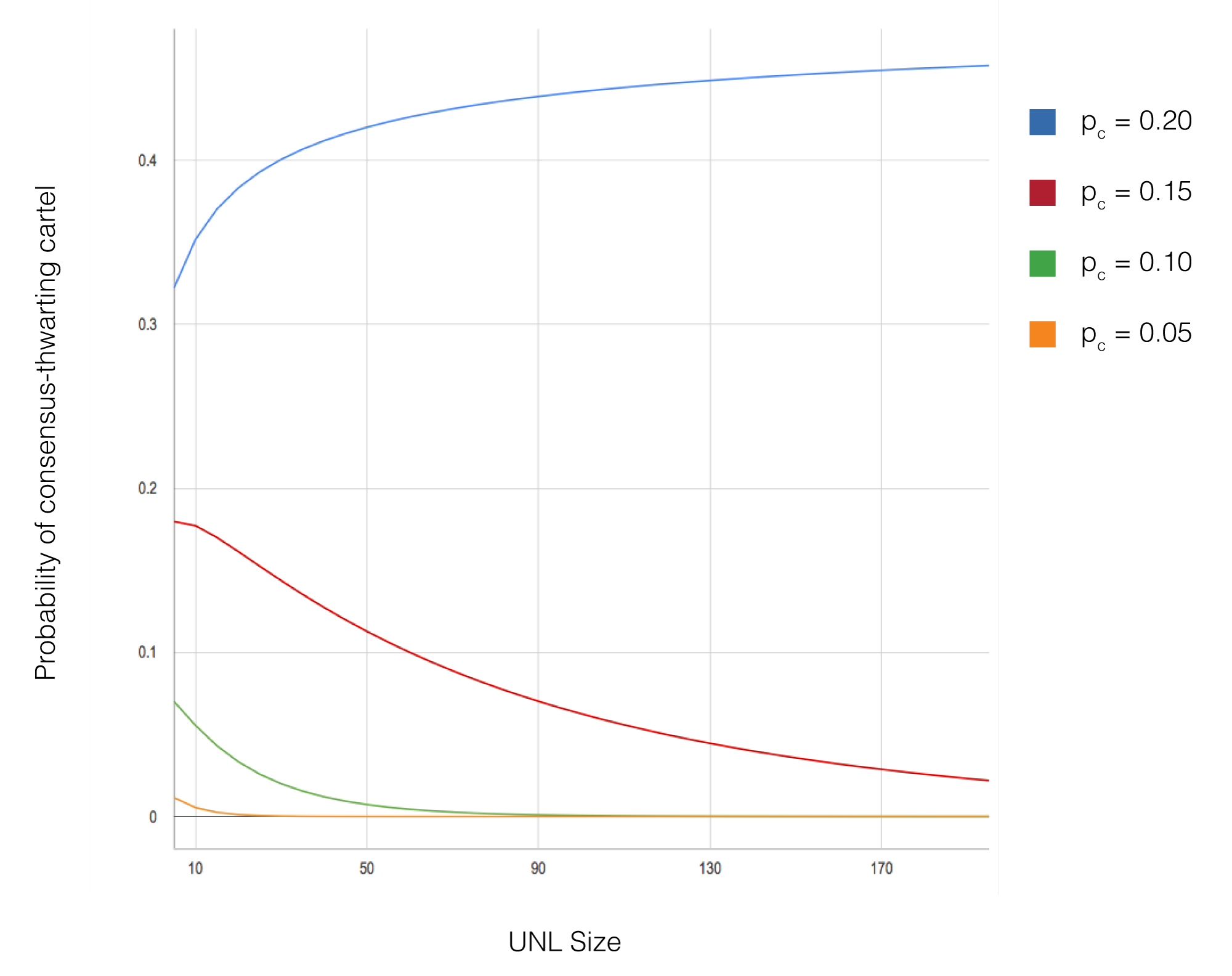
Probability of consensus failure versus UNL size chart showing security thresholds for the Ripple Protocol Consensus Algorithm

Theorem 1 (Safety). If for every pair of correct servers s_i and s_j in the network, the overlap between their UNLs satisfies:

\[\frac{|UNL_i \cap UNL_j|}{\max(|UNL_i|, |UNL_j|)} > \frac{1}{5}\]

and the fraction of Byzantine nodes in every UNL is less than 1/5, then no two correct servers will close different ledgers in the same consensus round.

Proof sketch. Suppose, for contradiction, that two correct servers s_i and s_j close different ledgers. This means there exists some transaction T that is in the final transaction set of s_i but not in the final transaction set of s_j (or vice versa). For T to be in s_i's final set, it must have received support from at least 80% of UNL_i. For T to not be in s_j's final set, it must have received support from fewer than 80% of UNL_j.

Let n_i = |UNL_i| and n_j = |UNL_j|. The number of nodes that support T in UNL_i is at least 0.8 * n_i. Among these supporting nodes, some are in the overlap UNL_i ∩ UNL_j. Because Byzantine nodes constitute less than 1/5 of each UNL, at least 0.8 * n_i - 0.2 * n_i = 0.6 * n_i correct nodes in UNL_i support T. The overlap condition ensures that a sufficient number of these correct supporting nodes are also in UNL_j, providing enough support for T in UNL_j to prevent it from being excluded.

Specifically, if the overlap |UNL_i ∩ UNL_j| exceeds 1/5 of the larger UNL, then the correct nodes in the overlap that support T will constitute enough of UNL_j's responses to keep T above the threshold. The combination of the overlap requirement and the Byzantine node bound makes it impossible for T to simultaneously achieve 80% support in one UNL and fall below 80% in another, proving that both servers must produce the same final transaction set and therefore the same closed ledger.

Theorem 2 (Liveness). Under the same conditions as Theorem 1, and assuming that network messages are delivered within a bounded time, every correct server will close a new ledger within a bounded number of consensus rounds.

Proof sketch. Liveness follows from the deterministic progression of the consensus rounds. Each round has a fixed duration, and the threshold progression (50% to 80%) is predetermined. A transaction that has support from a supermajority of correct nodes will survive all threshold rounds because the correct nodes will consistently include it in their proposals. A transaction that does not have supermajority support will be filtered out by the increasing thresholds. In either case, the set of transactions stabilizes within a bounded number of rounds, and all correct servers arrive at the same decision. The bounded message delivery assumption ensures that proposals reach their destinations within each round's time window.

Corollary (Fork-freeness). Under the conditions of Theorem 1, the Ripple network will not fork. A fork would require two disjoint subsets of the network to close different ledgers simultaneously, but the UNL overlap condition ensures that no such disjoint partitioning of the network can occur while maintaining 80% support within each partition.

The 1/5 threshold for both the overlap condition and the Byzantine node fraction is derived from the interplay between the 80% supermajority requirement and the need for correct nodes to have decisive influence. With 80% required for inclusion and at most 20% Byzantine nodes, the correct nodes control at least 60% of each UNL, which is enough to ensure that their collective decision is reflected in the final outcome. The 20% overlap requirement ensures that the correct majorities in different UNLs are sufficiently connected to prevent divergence.

It is worth noting that these bounds are conservative. In practice, the network typically operates with much higher UNL overlap and much lower Byzantine fault rates, providing safety margins well beyond the theoretical minimums. The formal analysis establishes worst-case guarantees, while the practical behavior of the network is significantly more robust than the worst case would suggest.

The convergence rate of the algorithm depends on the number of rounds and the initial agreement level. Simulations show that when the majority of UNL members begin with the same proposal (the common case in a well-connected network), consensus is typically achieved in a single round of threshold progression (4 sub-rounds), completing in approximately 3-5 seconds. When proposals diverge more significantly (for example, after a network partition heals), additional rounds may be needed, but convergence is still guaranteed within a bounded number of rounds.

Formal Analysis of Convergence

RPCA的正确性关键取决于网络中不同节点选择的UNL之间的重叠。令UNL_i表示节点i的唯一节点列表,UNL_i ∩ UNL_j表示同时出现在UNL_i和UNL_j中的节点集合。为使网络维持共识,我们要求对于任意两个节点i和j,其UNL的交集相对于任一UNL的最大规模必须足够大。

Probability of consensus failure versus UNL size chart showing security thresholds for the Ripple Protocol Consensus Algorithm

具体而言,当对所有节点对i和j满足|UNL_i ∩ UNL_j| / max(|UNL_i|, |UNL_j|) 1/5时,协议保证安全性。该条件确保即使Byzantine节点试图使网络的不同部分达成不同的共识决定,受信任节点的重叠也能防止分叉。如果该条件成立且任何UNL中Byzantine节点少于1/5,则所有正确节点将达成相同的共识决定。

形式化证明通过证明如果两个节点可以达成不同的共识决定,则必定存在某笔交易T出现在一个节点的最终账本中但不在另一个节点的账本中来进行。要发生这种情况,T必须在第一个节点的UNL中获得80%的支持,但在第二个节点的UNL中获得不到80%的支持。然而,考虑到重叠要求和对Byzantine节点的约束,可以证明这种情况是不可能的:如果T在UNL_i中获得80%的支持,它必须在满足重叠条件的任何UNL_j中至少获得60%的支持,经过足够的共识轮次,这将收敛到80%或被两个节点都拒绝。

活性属性——共识最终会达成——来自于包含阈值通过共识轮次确定性地增加这一观察。即使在存在Byzantine节点和网络延迟的情况下,协议也确保由诚实节点绝对多数支持的交易最终会被包含,而缺乏此类支持的交易将被排除。共识的有限时间(通常5秒)为支付系统应用提供了实用的活性保障。

Unique Node Lists

The node-list/" class="glossary-link" data-slug="unique-node-list" title="Unique Node List">Unique Node List (UNL) is the mechanism by which consensus-algorithm/" class="glossary-link" data-slug="ripple-protocol-consensus-algorithm" title="RPCA">RPCA achieves Sybil resistance without proof-of-work. In a naive voting system where each node has equal influence, an attacker could create thousands of pseudonymous nodes (a Sybil attack) and overwhelm the honest nodes with fraudulent votes. The UNL prevents this by requiring each server to explicitly declare which other servers it considers trustworthy for consensus purposes. Creating additional identities provides no advantage unless existing servers voluntarily add those identities to their UNLs.

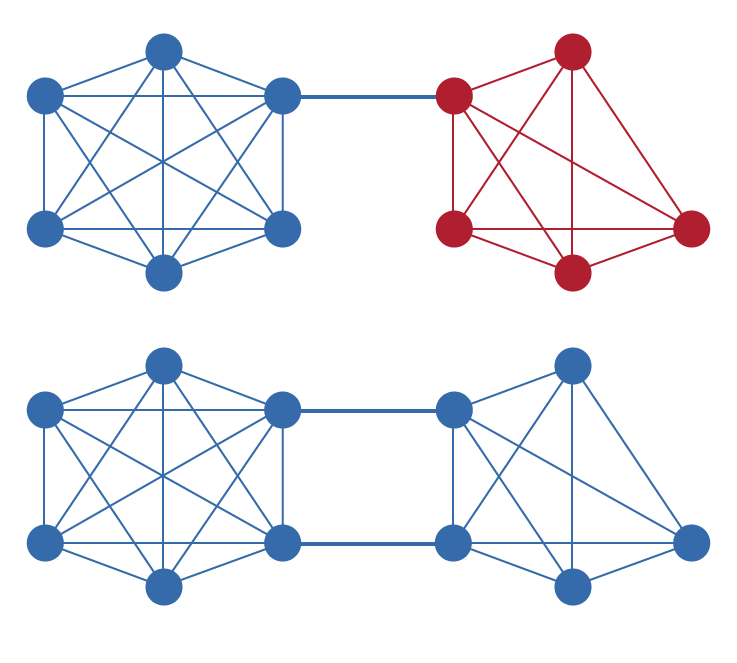
XRP Ledger network topology diagram showing two UNL node clusters with connectivity overlap

The trust implied by including a server in one's UNL is deliberately minimal. A server s that includes server t in its UNL is not asserting that t is always correct or that t will never fail. It is asserting only that t will not collude with other members of s's UNL to defraud the network. This is a much weaker assertion than full trust. For example, a server might include a validator operated by a major financial institution in its UNL not because it trusts that institution completely, but because it believes that institution will not conspire with the other validators in the UNL to commit fraud. The institution might occasionally have bugs or downtime, but these crash-type failures are handled by the consensus algorithm's tolerance for missing proposals.

The formal requirements for UNL selection are derived from the safety analysis. Two conditions must hold:

  1. Byzantine threshold: Fewer than 20% of the nodes in any server's UNL should be Byzantine. This means that when selecting UNL members, a server should choose nodes that it believes are operated by independent, trustworthy entities. Selecting nodes that are all operated by the same organization would violate this requirement if that organization behaved maliciously.

  2. Overlap requirement: For any two servers in the network, the overlap between their UNLs must exceed 20% of the larger UNL. This ensures that the local trust relationships form a sufficiently connected graph that consensus decisions propagate consistently across the network.

In practice, satisfying the overlap requirement is straightforward when the network provides a recommended default UNL. Ripple publishes a default UNL consisting of validators operated by a diverse set of entities — financial institutions, universities, blockchain companies, and other organizations. Servers that adopt this default UNL automatically satisfy the overlap condition with each other. Server operators who wish to customize their UNL may do so, but they should ensure that their custom list retains sufficient overlap with the UNLs of other servers they wish to reach consensus with.

The selection of UNL members can be guided by several heuristics:

Diversity. A well-constructed UNL should include validators operated by entities in different geographic regions, legal jurisdictions, and organizational types. This diversity reduces the probability that a common failure mode (such as a regional internet outage or a regulatory action in a specific jurisdiction) could simultaneously compromise a significant fraction of the UNL.

Independence. UNL members should be operated by independent entities that do not have incentives to collude. Validators operated by competing financial institutions, for example, are less likely to collude than validators operated by subsidiaries of the same parent company. The independence of UNL members directly affects the Byzantine fault tolerance of the system, as collusion between UNL members is the primary threat model.

Track record. Servers with a long history of correct behavior and high uptime are better candidates for UNL inclusion than newly created servers with no history. While past behavior does not guarantee future correctness, it provides a signal about the operator's competence and commitment to maintaining the validator.

Capacity. UNL members must have sufficient computational and network resources to participate reliably in the consensus process. A validator that frequently fails to deliver proposals on time due to resource constraints degrades the performance of the consensus algorithm for all servers that include it in their UNL.

The UNL mechanism also enables a natural path toward progressive decentralization. In the early stages of the network, the default UNL may be relatively concentrated among a small number of well-known validators. As the network matures and more independent operators demonstrate their reliability, the default UNL can be expanded to include a broader set of validators. Individual server operators can also customize their UNLs to reflect their own trust assessments, gradually diversifying the network's trust topology without requiring any protocol changes or coordinated upgrades.

A potential concern with the UNL model is that it could lead to a "trust hierarchy" where a small number of prominent validators are included in most UNLs, creating a de facto centralized system. To mitigate this risk, the protocol encourages diversity in UNL selection and provides tools for monitoring the network's trust topology. If the overlap between UNLs becomes too concentrated on a small set of validators, operators can be alerted to diversify their selections. The goal is a network where trust is distributed broadly enough that no single entity or small coalition can exert disproportionate influence over the consensus process.

Unique Node Lists

节点列表">唯一节点列表(UNL)是RPCA区别于其他共识算法的基本组件。Ripple网络中的每个节点维护一个UNL,包含它信任不会串通欺骗网络的其他节点。关键的是,这种信任是局部的而非全局的:不同的节点可以有不同的UNL,不需要全局统一的验证者集合。这种设计允许网络在保持去中心化的同时有机地扩展。

XRP Ledger network topology diagram showing two UNL node clusters with connectivity overlap

UNL作为一种无需工作量证明的Sybil攻击防御机制。在简单的投票系统中,攻击者可以创建许多假名节点以获得不成比例的影响力。通过要求每个节点明确选择它信任的其他节点,RPCA确保创建额外的身份不会带来任何优势,除非这些身份能够说服现有节点将其添加到UNL中。这将Sybil抵抗的问题从计算支出转移到了声誉和信任关系上。

为使网络正确运行,UNL必须按照形式化分析中所述选择具有足够重叠的列表。在实践中,这意味着虽然每个节点运营者在选择UNL方面拥有自主权,但必须确保其列表中包含网络其他部分也信任的验证者。Ripple提供了一个由多元化实体运营的验证者组成的默认UNL,但节点运营者可以根据自己的信任评估自由修改此列表。

UNL机制还提供了一条通向渐进式去中心化的自然路径。在网络的早期阶段,更集中的验证者集合可能更适合确保稳定性和可靠性。随着网络的成熟和更多多元化运营者证明其可信度,UNL可以演变为包含更广泛的验证者集合,在不损害安全属性的情况下增强网络的韧性和去中心化程度。

Simulation Code

To validate the theoretical analysis and evaluate the practical performance of consensus-algorithm/" class="glossary-link" data-slug="ripple-protocol-consensus-algorithm" title="RPCA">RPCA under realistic conditions, extensive simulations were conducted using a custom-built network simulator. The simulator models a network of servers, each maintaining their own node-list/" class="glossary-link" data-slug="unique-node-list" title="UNL">UNL and participating in the full RPCA protocol including proposal generation, iterative voting with increasing thresholds, ledger close, and validation. The simulation framework allows precise control over network topology, Byzantine behavior patterns, message latency distributions, and UNL configurations.

The simulation parameters were varied across the following dimensions:

Network size. Simulations were conducted with networks ranging from 10 to 1,000 nodes. Larger networks test the scalability of the algorithm, as the number of proposals each server must process increases with the size of its UNL (though not with the total network size, which is a key advantage of the UNL-based approach).

Byzantine node fraction. The percentage of Byzantine nodes was varied from 0% (fully correct network) to 20% (the theoretical maximum for guaranteed safety). Byzantine nodes were programmed to exhibit various adversarial behaviors including sending conflicting proposals to different servers, withholding proposals, sending proposals with deliberately different transaction sets, and attempting to fork the network by supporting different transactions in different proposals.

UNL size and overlap. UNL sizes ranged from 5 to 50 nodes, with overlap percentages ranging from 20% (the theoretical minimum) to 100% (fully overlapping UNLs). The relationship between UNL overlap and consensus success was a primary focus of the simulation study.

Network latency. Message delivery times were modeled using a log-normal distribution to simulate realistic network conditions, with mean latencies ranging from 10ms (data center environment) to 500ms (global internet with congestion). Some simulations also included random message drops to test the algorithm's robustness to packet loss.

The primary metrics tracked in the simulations were:

Simulation Metrics:

Metric                  Description
──────────────────────────────────────────────────────────────
Consensus latency       Time from round start to ledger close
Fork probability        Fraction of runs where servers closed
                        different ledgers
Transaction throughput  Number of transactions included per
                        consensus round
Agreement ratio         Fraction of servers closing the same
                        ledger in each round
Recovery time           Time to resynchronize after a network
                        partition heals

Safety results. In all configurations where the UNL overlap condition was satisfied (overlap 20% of the larger UNL) and Byzantine nodes comprised less than 20% of each UNL, no forks were observed across tens of thousands of simulation runs. This empirically confirms the theoretical safety guarantee of Theorem 1. When the overlap condition was violated — for example, by configuring two groups of servers with non-overlapping UNLs — forks occurred with high probability, confirming that the overlap condition is necessary as well as sufficient.

Latency results. Consensus latency remained consistently between 3 and 5 seconds across all tested network sizes, from 10 to 1,000 nodes. This is because each server only communicates with its UNL (not the entire network), so the per-round communication cost scales with UNL size rather than network size. With UNL sizes of 20-30 nodes (typical for production deployments), the communication overhead is modest even in large networks. Network latency was the primary factor affecting consensus time: simulations with 10ms mean latency completed consensus in approximately 2 seconds, while simulations with 500ms mean latency required approximately 6 seconds.

Byzantine resilience results. With up to 15% Byzantine nodes actively attempting to disrupt consensus, the network maintained correct consensus in all simulation runs as long as the UNL overlap condition was met. At 18-19% Byzantine nodes (near the theoretical threshold), occasional consensus delays were observed as the algorithm required additional rounds to filter out Byzantine proposals, but safety was never violated. Beyond 20%, the safety guarantee no longer holds and forks became possible, confirming the theoretical bounds.

Partition recovery. Simulations of network partitions showed that the algorithm recovers gracefully when a partition heals. During the partition, each partition may close ledgers independently (if it contains enough UNL members to reach consensus). When the partition heals, the servers that were in the minority partition detect that the majority reached a different consensus, fetch the correct ledger, and resynchronize. The recovery process typically completes within one or two consensus rounds after the partition heals.

The complete simulation code was made available for independent verification, allowing researchers and developers to reproduce the results, explore additional parameter configurations, and validate the algorithm's behavior under conditions not covered by the original simulation study.

Simulation Code

为验证RPCA的理论分析并评估其在各种条件下的性能,使用定制的仿真软件进行了大量模拟。仿真框架对节点网络进行建模,每个节点维护自己的UNL并参与共识协议。代码实现了完整的RPCA算法,包括交易提案、阈值递增的投票轮次和账本验证。

模拟中变化的关键参数包括网络规模(从10到1,000个节点)、Byzantine节点的百分比(从0%到20%)、UNL大小(通常在5到50个节点之间)和网络拓扑配置。对于每种参数配置,使用不同的随机种子进行了多次模拟运行,以确保结果的统计有效性。模拟跟踪了包括共识延迟、分叉概率和交易吞吐量在内的指标。

模拟结果证实了关于收敛和安全性的理论预测。在UNL重叠条件满足且Byzantine节点占每个UNL不到20%的所有配置中,网络成功达成共识且未出现分叉。共识延迟始终保持较低水平(通常在3-5秒的模拟时间内完成),与网络规模无关,证明了算法的可扩展性。即使有15%的Byzantine节点积极尝试破坏共识,只要满足UNL重叠要求,网络仍保持正确性。

额外的模拟探索了边缘情况和故障场景,包括网络分区、UNL组成的突然变化和Byzantine节点的协调攻击。这些模拟提供了关于协议鲁棒性的洞察,并为UNL选择和网络运营的推荐最佳实践提供了参考。完整的模拟代码已公开发布,以便进行独立验证和进一步研究。

Discussion

The design of consensus-algorithm/" class="glossary-link" data-slug="ripple-protocol-consensus-algorithm" title="RPCA">RPCA involves several deliberate trade-offs that distinguish it from other consensus algorithms. Understanding these trade-offs is essential for evaluating the algorithm's suitability for different applications and for identifying areas where future improvements may be possible.

Latency versus proof-of-work. Compared to Bitcoin's proof-of-work consensus, RPCA achieves consensus latency that is approximately three orders of magnitude lower — seconds instead of hours. This improvement comes from replacing computational proof with a voting mechanism that can complete in a small number of message rounds. The trade-off is that RPCA requires servers to maintain UNLs with sufficient overlap, whereas Bitcoin requires no pre-existing trust relationships. For payment system applications where low latency is essential and where participants have incentives to select diverse, reliable validators, this trade-off is strongly favorable toward RPCA.

Energy efficiency. RPCA requires negligible computational resources compared to proof-of-work. The consensus process involves only cryptographic signing, hash computation for ledger validation, and network communication — operations that can be performed on commodity hardware with minimal energy consumption. The elimination of mining means that the cost of operating the network is limited to the cost of running the servers themselves, which is a tiny fraction of the energy expenditure required by proof-of-work systems. This energy efficiency makes RPCA suitable for deployment at scale without the environmental concerns associated with proof-of-work mining.

Trust assumptions. The most significant difference between RPCA and proof-of-work is the trust model. Bitcoin's security relies solely on the assumption that no entity controls more than 50% of the network's hash rate — a purely economic assumption that requires no trust between participants. RPCA requires that servers choose UNLs with sufficient overlap and low Byzantine fractions — assumptions that involve trust in the competence and honesty of specific validator operators.

This difference in trust models has important implications. In a proof-of-work system, security degrades gracefully as an attacker approaches the 50% threshold, and the cost of attack is continuously quantifiable in terms of hardware and electricity. In RPCA, security depends on the correctness of node-list/" class="glossary-link" data-slug="unique-node-list" title="UNL">UNL selection, which is harder to quantify. If server operators make poor UNL choices — for example, by including validators controlled by a single malicious entity — the safety guarantees may not hold. Mitigating this risk requires careful UNL curation and network-level monitoring of the trust topology.

Throughput. RPCA's throughput is determined by the rate at which consensus rounds complete and the number of transactions that can be processed in each round. Because consensus rounds complete every 3-5 seconds and each round can include thousands of transactions, the practical throughput is on the order of 1,500 transactions per second — significantly higher than Bitcoin's approximately 7 transactions per second. The throughput can be further increased by optimizing the consensus round duration and increasing the transaction capacity per round, though this must be balanced against latency and network bandwidth requirements.

Network topology. The structure of the network's UNL graph — the graph where each server is a node and each UNL inclusion is a directed edge — significantly impacts the properties of the consensus system. A highly centralized topology where all servers include the same small set of validators maximizes safety (because overlap is maximized) but creates a single point of failure if those central validators become unavailable or are compromised. A highly decentralized topology with minimal overlap increases resilience to targeted attacks but may approach the safety boundaries, especially if Byzantine nodes are strategically placed to minimize effective overlap.

The optimal topology depends on the deployment scenario. For a network of financial institutions that already have established relationships and mutual accountability, a moderately concentrated topology with high overlap provides strong safety with acceptable centralization. For a more open network with diverse participants, a broader UNL topology with careful attention to overlap requirements provides better resilience against collusion.

Comparison with Federated Byzantine Agreement. The Stellar Consensus Protocol (SCP) takes a similar approach to RPCA in that nodes choose their own trust sets (called "quorum slices" in SCP). However, SCP uses a different consensus mechanism based on federated voting with ballots, whereas RPCA uses iterative threshold-based voting. SCP also defines a different set of safety conditions based on quorum intersection rather than UNL overlap. Both approaches demonstrate that local trust can replace global trust in consensus systems, but they achieve this through different mechanisms with different performance characteristics and failure modes.

Future directions. Several extensions to RPCA merit further research. Adaptive UNL selection algorithms could automatically adjust a server's UNL based on observed validator behavior, improving resilience without requiring manual intervention. Dynamic threshold adjustment could allow the consensus algorithm to adapt to varying network conditions, completing faster when agreement is easy and taking more time when it is difficult. And formal verification of the algorithm using machine-checked proofs could provide stronger assurance of correctness than the hand-written proofs presented in this paper.

Discussion

与比特币的工作量证明共识相比,RPCA为支付系统应用提供了几个显著优势。最值得注意的是,共识延迟从40-60分钟(高价值比特币交易通常建议的时间)减少到约5秒。这一改进使RPCA适用于需要近乎即时结算的销售点和其他应用。此外,RPCA与工作量证明相比所需的计算资源极少,消除了与比特币挖矿相关的大量能源消耗。

然而,这些优势伴随着不同的信任假设。比特币的安全性仅依赖于没有攻击者控制网络计算能力50%以上的假设,而RPCA要求节点选择具有足够重叠的UNL,并且Byzantine节点不超过这些UNL内的阈值。这将部分做出审慎信任决策的责任转移给了节点运营者。在实践中,对于参与机构拥有现有信任关系的许多支付系统用例,这种权衡是可以接受的。

网络拓扑和UNL选择策略显著影响共识系统的属性。所有节点在UNL中包含相同验证者的高度集中化拓扑最大化了安全性,但如果这些验证者不可用,可能会降低活性。相反,UNL重叠最小的高度去中心化拓扑可能改善活性,但如果重叠变得过于稀疏,则存在共识失败的风险。找到最佳平衡需要仔细考虑特定的部署场景和风险承受能力。

未来的研究可以探索在最大化去中心化的同时自动维护重叠要求的自适应UNL选择算法、节点根据观察到的验证者行为动态调整UNL的机制,以及可以容忍更高比例Byzantine节点的共识算法扩展。这些增强可以进一步提高RPCA在大规模分布式支付系统中的鲁棒性和适用性。

Conclusion

The consensus-algorithm/" class="glossary-link" data-slug="ripple-protocol-consensus-algorithm" title="Ripple Protocol Consensus Algorithm">Ripple Protocol Consensus Algorithm represents a significant advancement in distributed consensus for payment systems. By utilizing collectively-trusted subnetworks (Unique Node Lists) rather than requiring global agreement among all nodes or computationally expensive proof-of-work, RPCA achieves consensus in a matter of seconds while maintaining provable safety guarantees against Byzantine failures.

The formal analysis demonstrates that the algorithm's correctness depends on two quantifiable conditions: the overlap between UNLs must exceed 20% of the larger list for any pair of servers, and the fraction of Byzantine nodes in any UNL must remain below 20%. When these conditions are satisfied, the algorithm guarantees that all correct servers will close the same ledger (safety) and that consensus will complete in bounded time (liveness). These guarantees provide the deterministic finality required for financial settlement — unlike proof-of-work systems where finality is probabilistic and may require waiting for multiple confirmations.

The simulation results confirm the theoretical predictions across a wide range of network configurations. Consensus latency remains consistently low (3-5 seconds) regardless of network size, because the communication complexity of each server depends on its UNL size rather than the total number of servers. The algorithm maintains safety even with up to 19% Byzantine nodes actively attempting to disrupt consensus, providing a substantial safety margin under typical operating conditions where Byzantine behavior is rare.

The practical implications extend beyond the Ripple payment network. RPCA demonstrates that the traditional trade-off between consensus latency and Byzantine fault tolerance can be overcome through the principled use of local trust relationships. This insight may prove applicable to other distributed systems where participants have existing trust relationships and where low-latency agreement is critical: inter-bank settlement systems, supply chain management, securities clearing and settlement, and other financial infrastructure applications that require both speed and security.

The decoupling of Sybil resistance from consensus — using UNL-based trust for the former and iterative voting for the latter — opens a design space that has been largely unexplored in the distributed systems literature. This separation allows each concern to be optimized independently, yielding a system that is both more efficient and more flexible than systems that address both concerns with a single mechanism. As the network continues to evolve and incorporate additional validators from diverse operators, it provides a practical demonstration that local trust can serve as a foundation for global consensus.

Conclusion

共识算法">Ripple协议共识算法代表了支付系统分布式共识的重要进步。通过利用集体信任的子网络而非要求所有节点之间的全局一致,RPCA在维持对Byzantine故障的强大保障的同时,在几秒内达成共识。形式化分析表明,只要UNL以足够的重叠选择且Byzantine节点保持在阈值以下,网络将达成正确的共识而不会出现分叉。

本研究的实际意义超越了Ripple支付网络。RPCA表明,共识延迟与安全保障之间的传统权衡可以通过精心的协议设计和局部信任关系的使用来克服。这种方法可能适用于其他低延迟至关重要且参与者拥有现有信任关系的分布式系统,如银行间结算系统、供应链跟踪以及其他金融基础设施应用。

RPCA在生产系统中的部署验证了算法的性能特征和鲁棒性。Ripple网络以一致的3-5秒共识延迟处理每秒数千笔交易,证明了理论属性有效地转化为实际运营。随着网络继续演进并纳入来自多元化运营者的额外验证者,它提供了一个去中心化共识系统如何在规模上同时维持安全性和性能的实际案例。

References

Lamport, L., Shostak, R., and Pease, M. (1982). "The Byzantine Generals Problem." ACM Transactions on Programming Languages and Systems, 4(3):382-401. This seminal paper formalized the problem of reaching consensus in distributed systems with faulty components, establishing that agreement is possible if and only if fewer than one-third of the participants are faulty.

Castro, M., and Liskov, B. (1999). "Practical Byzantine Fault Tolerance." Proceedings of the Third Symposium on Operating Systems Design and Implementation (OSDI). Demonstrated that Byzantine fault tolerance could be achieved with practical performance through the PBFT algorithm, establishing the three-phase commit protocol (pre-prepare, prepare, commit) that tolerates f faults among 3f + 1 nodes with O(n^2) message complexity.

Nakamoto, S. (2008). "Bitcoin: A Peer-to-Peer Electronic Cash System." Introduced proof-of-work consensus as a solution to the double-spending problem in digital currency, enabling decentralized agreement without trusted parties. Established the longest-chain rule and demonstrated that probabilistic finality increases exponentially with the number of confirmations.

Lamport, L. (1998). "The Part-Time Parliament." ACM Transactions on Computer Systems, 16(2):133-169. Presented the Paxos algorithm for achieving consensus in asynchronous systems under crash failures. Paxos provides the theoretical foundation for many practical consensus implementations, though it does not handle Byzantine failures.

Fischer, M. J., Lynch, N. A., and Paterson, M. S. (1985). "Impossibility of Distributed Consensus with One Faulty Process." Journal of the ACM, 32(2):374-382. The FLP impossibility result proved that no deterministic algorithm can guarantee consensus in a fully asynchronous system if even a single process can fail, establishing fundamental limits on the achievable properties of consensus algorithms.

Dwork, C., Lynch, N., and Stockmeyer, L. (1988). "Consensus in the Presence of Partial Synchrony." Journal of the ACM, 35(2):288-323. Defined the partial synchrony model and showed that consensus is achievable under weaker timing assumptions than full synchrony, providing the theoretical basis for practical BFT protocols including PBFT.

Schwartz, D., Youngs, N., and Britto, A. (2014). "The Ripple Protocol Consensus Algorithm." Ripple Labs Inc. The present paper, describing RPCA and providing formal analysis of its safety and liveness properties under specified UNL overlap and Byzantine fault conditions.

Mazieres, D. (2015). "The Stellar Consensus Protocol: A Federated Model for Internet-level Consensus." Stellar Development Foundation. Introduced federated Byzantine agreement (FBA), where nodes choose their own quorum slices to define trust, sharing conceptual similarities with RPCA's UNL approach while using a different consensus mechanism based on federated voting with ballots.

References

Lamport, L., Shostak, R., and Pease, M. (1982). "The Byzantine Generals Problem." ACM Transactions on Programming Languages and Systems, 4(3):382-401. 这篇开创性论文形式化了在具有故障组件的分布式系统中达成共识的问题,并建立了Byzantine fault-tolerant系统的理论基础。

Castro, M., and Liskov, B. (1999). "Practical Byzantine Fault Tolerance." Proceedings of the Third Symposium on Operating Systems Design and Implementation (OSDI). 该研究引入了PBFT,表明Byzantine fault tolerance可以以实用的性能实现,尽管O(n^2)的通信复杂度限制了可扩展性。

Nakamoto, S. (2008). "Bitcoin: A Peer-to-Peer Electronic Cash System." 该白皮书引入了工作量证明共识作为数字货币中双重支付问题的解决方案,以高延迟和能源消耗为代价实现了无需可信方的去中心化共识。

Lamport, L. (1998). "The Part-Time Parliament." ACM Transactions on Computer Systems, 16(2):133-169. 该论文提出了Paxos算法,在崩溃故障下的异步系统中达成共识,影响了后续共识协议的设计。

Fischer, M. J., Lynch, N. A., and Paterson, M. S. (1985). "Impossibility of Distributed Consensus with One Faulty Process." Journal of the ACM, 32(2):374-382. FLP不可能性结果确立了异步系统中共识算法所能达到的基本限制,塑造了实用共识协议的设计空间。