
Thuật toán đồng thuận của giao thức Ripple
Abstract
While several consensus algorithms exist for the Byzantine Generals Problem, specifically as it pertains to distributed payment systems, many suffer from high latency induced by the requirement that all nodes within the network communicate synchronously. In this work, we present a novel consensus algorithm that circumvents this requirement by utilizing collectively-trusted subnetworks within the larger network. We show that the "trust" required of these subnetworks is in fact minimal and can be further reduced with principled selection of the member nodes.
The Ripple Protocol Consensus Algorithm (RPCA) is applied every few seconds by all nodes in the network, in order to maintain the correctness and agreement of the network. Once consensus is reached, the current ledger is considered "closed" and becomes the last-closed ledger. Assuming that the consensus algorithm is successful, and there are no forks in the network, the last-closed ledger maintained by all nodes in the network will be identical.
This algorithm achieves consensus with remarkably low latency — typically 3 to 5 seconds per ledger close — while maintaining provable safety guarantees against Byzantine failures. Unlike proof-of-work systems that require massive computational expenditure and suffer from probabilistic finality that may take an hour to become practically irreversible, RPCA provides deterministic finality: once a ledger is closed, it will not be reversed. This property makes the protocol suitable for real-time financial settlement, where counterparties need certainty that a payment has been completed before proceeding with dependent operations.
The key insight is that consensus does not require global trust. Each node in the network maintains a Unique Node List (UNL) — a set of other nodes that it trusts not to collude in an attempt to defraud the network. As long as these UNLs have sufficient pairwise overlap and the fraction of Byzantine nodes within any UNL remains below a critical threshold, the network as a whole will reach agreement on a single consistent ledger. This localized trust model allows the network to scale without requiring every participant to trust every other participant, while still providing the safety guarantees necessary for a global payment system.
Abstract
Mặc dù đã có nhiều thuật toán đồng thuận cho Bài toán các tướng Byzantine, đặc biệt trong bối cảnh hệ thống thanh toán phân tán, nhiều thuật toán vẫn gặp độ trễ cao do yêu cầu tất cả các nút trong mạng phải giao tiếp đồng bộ. Trong công trình này, chúng tôi trình bày một thuật toán đồng thuận mới vượt qua yêu cầu đó bằng cách tận dụng các mạng con được tin cậy tập thể bên trong mạng lớn hơn. Chúng tôi chỉ ra rằng "niềm tin" cần thiết để ngăn chặn tấn công Sybil thực chất không phải là toàn cục, mà là cục bộ theo từng nút trong mạng.
Thuật toán đồng thuận giao thức Ripple (RPCA) được áp dụng vài giây một lần bởi tất cả các nút để duy trì tính đúng đắn và sự nhất quán của mạng. Khi đạt đồng thuận, sổ cái hiện tại được coi là "đã đóng" và trở thành sổ cái đóng gần nhất. Thuật toán này khác biệt ở chỗ đạt đồng thuận với độ trễ thấp trong khi vẫn duy trì các bảo đảm mạnh trước lỗi Byzantine, phù hợp cho các hệ thống thanh toán tài chính thời gian thực.
Introduction
The nature of payment systems in the modern world is changing rapidly. Digital currencies and online payment networks have emerged as alternatives to traditional banking infrastructure, promising lower transaction costs, faster settlement times, and broader financial inclusion. However, these systems face a fundamental challenge: how to process payments correctly, quickly, and securely in a network where participants may not trust each other and where some participants may behave maliciously.
The Bitcoin protocol, introduced by Nakamoto in 2008, demonstrated that a distributed payment system could operate without a trusted central authority by using a proof-of-work consensus mechanism. In Bitcoin, nodes compete to solve computationally expensive cryptographic puzzles, and the winner proposes the next block of transactions. While this approach elegantly solves the double-spending problem, it introduces significant practical limitations. The energy consumption of Bitcoin mining is enormous — estimated at the time of writing at over $150 million per year — and the confirmation latency for transactions is measured in minutes to hours rather than seconds. For a high-value transaction, the recommended practice is to wait for six block confirmations, which takes approximately one hour on average. These limitations make proof-of-work consensus unsuitable for many real-world payment applications.
The core problem is that proof-of-work conflates two distinct concerns: Sybil resistance (preventing an attacker from gaining disproportionate influence by creating many identities) and consensus (agreeing on the state of the ledger). By tying both concerns to computational expenditure, proof-of-work achieves security at the cost of efficiency. The Ripple protocol decouples these concerns by using a different mechanism for Sybil resistance — the Unique Node List — and a separate iterative voting protocol for consensus. This decoupling allows the consensus algorithm to be both fast and efficient, as it does not need to perform any computationally expensive work.
In this paper, we present the Ripple Protocol Consensus Algorithm and provide formal analysis of its correctness and convergence properties. We define the conditions under which the algorithm guarantees safety (no two honest nodes will accept conflicting ledgers) and liveness (the network will continue to make progress). We then analyze the requirements on UNL overlap and Byzantine node thresholds that are sufficient to maintain these guarantees. Finally, we present simulation results that validate the theoretical analysis and demonstrate the algorithm's performance under a variety of network conditions and adversarial scenarios.
The remainder of the paper is organized as follows. Section 2 provides formal definitions of the key concepts used throughout the paper. Section 3 surveys existing consensus algorithms and their limitations. Section 4 presents the RPCA algorithm in detail. Section 5 provides a formal analysis of convergence. Section 6 discusses the properties and selection of Unique Node Lists. Section 7 describes the simulation framework and results. Section 8 discusses the implications and trade-offs of the design, and Section 9 concludes.
Introduction
Một hệ thống thanh toán phân tán phải triển khai thuật toán đồng thuận để xử lý thanh toán chính xác và kịp thời ngay cả khi có tác nhân lỗi hoặc độc hại. Bitcoin đạt đồng thuận bằng proof-of-work, yêu cầu tất cả các nút tiêu tốn tài nguyên tính toán để giải các bài toán mật mã. Dù cách tiếp cận này cung cấp bảo đảm bảo mật mạnh, nó có các hạn chế đáng kể như tiêu thụ năng lượng cao, thông lượng giao dịch thấp và độ trễ xác nhận dài, có thể kéo dài đến một giờ hoặc hơn với giao dịch giá trị cao.
Thuật toán đồng thuận giao thức Ripple đưa ra một cách tiếp cận mới cho đồng thuận phân tán mà không cần proof-of-work. Thay vào đó, các nút trong mạng cùng thống nhất trên các tập giao dịch thông qua cơ chế bỏ phiếu đạt đồng thuận chỉ trong vài giây. Cơ chế này được thiết kế riêng cho yêu cầu của một mạng thanh toán toàn cầu, nơi độ trễ thấp và thông lượng cao là điều kiện bắt buộc để triển khai thực tế.
Đổi mới cốt lõi của RPCA là không yêu cầu mọi nút trong mạng phải đồng ý trực tiếp với nhau. Thay vào đó, mỗi nút duy trì một Unique Node List (UNL) gồm các nút khác mà nó tin rằng sẽ không thông đồng. Miễn là các UNL do các nút chọn có độ chồng lấn đủ lớn và số nút lỗi thấp hơn một ngưỡng nhất định, mạng sẽ đạt đồng thuận. Cách làm này giữ được các bảo đảm bảo mật cần thiết cho hệ thống thanh toán đồng thời rút ngắn độ trễ đồng thuận xuống mức giây thay vì phút hoặc giờ.
Definition of Consensus
We begin with formal definitions of the terms and concepts used throughout this paper. These definitions establish the precise framework within which we analyze the correctness and performance of the Ripple Protocol Consensus Algorithm.
Server. A server is any entity running the Ripple server software that participates in the consensus process. Each server maintains a copy of the ledger and communicates with other servers to reach agreement on new transactions. Servers may be operated by financial institutions, businesses, or individuals. A server may be correct (following the protocol faithfully) or Byzantine (behaving arbitrarily, possibly maliciously).
Ledger. The ledger is the complete record of all account balances and other state in the Ripple network. The ledger is organized as a set of account objects, each containing a balance denominated in one or more currencies, along with metadata such as trust lines, offers, and other protocol-level state. At any point in time, the ledger represents the authoritative state of the network.
Last-Closed Ledger. The last-closed ledger (LCL) is the most recent ledger that has been agreed upon by the consensus process. All servers that have successfully completed the most recent consensus round will have an identical LCL. The LCL serves as the base state from which the next round of consensus builds — new transactions are applied to the LCL to produce the next candidate ledger.
Open Ledger. The open ledger is the current working copy of the ledger that a server uses to process incoming transactions before the next consensus round begins. Each server maintains its own open ledger, which includes the LCL state plus any new transactions that the server has received but that have not yet been included in a closed ledger. Open ledgers may differ between servers because they have received different sets of transactions.
Unique Node List (UNL). The UNL of a server s is a set of other servers that s trusts not to collude in an attempt to defraud the network. The UNL is not a statement of complete trust — a server does not trust its UNL members to be correct in all circumstances. Rather, the UNL represents the set of servers that a node believes will not collectively conspire to produce fraudulent consensus results. The critical requirement is that a server's UNL should not contain a sufficient fraction of Byzantine nodes to subvert the consensus process.
Proposer Set. During each consensus round, a server's proposer set is the subset of its UNL from which it receives proposals. Due to network partitions, latency, or server failures, a server may not receive proposals from all members of its UNL in every round. The proposer set for a given round is therefore the intersection of the UNL and the set of servers from which proposals were actually received.
Consensus. Consensus in RPCA is the state in which all correct servers in the network agree on the same set of transactions to apply to the LCL, producing an identical new closed ledger. A consensus algorithm must provide two fundamental guarantees:
-
Safety (Agreement): No two correct servers close different ledgers. If server
s_1closes ledgerLand servers_2closes ledgerL'in the same consensus round, and boths_1ands_2are correct, thenL = L'. -
Liveness (Termination): The consensus process completes in bounded time. Every correct server eventually closes a new ledger, ensuring the network makes forward progress.
Validation. After a server computes its closed ledger for a consensus round, it signs the ledger hash and broadcasts it as a validation message. A server that receives validations from a supermajority of its UNL for the same ledger hash can be confident that the network has reached consensus on that ledger. Validation messages serve as confirmation that the consensus round completed successfully across the network.
Transaction Set. A transaction set is a collection of transactions proposed for inclusion in the next closed ledger. During consensus, servers iteratively refine their proposed transaction sets, adding transactions that receive sufficient support and removing those that do not. The final agreed-upon transaction set is applied to the LCL to produce the new closed ledger.
Definition of Consensus
Trong hệ thống phân tán, đồng thuận là quá trình một mạng các nút đi đến thống nhất về một trạng thái chung, bất chấp sự hiện diện của các thành phần lỗi hoặc độc hại. Một thuật toán đồng thuận phải thỏa mãn ba thuộc tính nền tảng: tính đúng đắn (không có hai nút đúng đưa ra quyết định khác nhau), sự nhất trí (mọi nút đúng đều đi đến cùng một quyết định), và tính kết thúc (mọi nút đúng cuối cùng đều đưa ra quyết định). Các thuộc tính này bảo đảm hệ thống phân tán hành xử như thể nó là một nút duy nhất và đáng tin cậy.
Khó khăn của đồng thuận đến từ tính không đáng tin cậy vốn có của hệ thống phân tán. Nút có thể gặp sự cố, thông điệp có thể bị trễ hoặc thất lạc, và nút Byzantine có thể hành xử tùy ý hoặc độc hại. Bài toán các tướng Byzantine, được Lamport, Shostak và Pease hình thức hóa, mô tả đúng thách thức này: làm thế nào một nhóm tiến trình đạt được thống nhất khi một phần có thể bị lỗi và truyền thông không đáng tin cậy?
Các kết quả cổ điển trong tính toán phân tán đặt ra giới hạn nền tảng cho những gì thuật toán đồng thuận có thể đạt được. Kết quả bất khả thi FLP cho thấy không thuật toán tất định nào có thể bảo đảm đồng thuận trong hệ bất đồng bộ nếu chỉ một nút cũng có thể lỗi. Vì vậy, các thuật toán đồng thuận thực tế phải đánh đổi giữa an toàn (không bao giờ đạt đồng thuận sai) và tính sống (luôn tiếp tục tiến triển). Proof-of-work của Bitcoin ưu tiên an toàn hơn tính sống, trong khi RPCA đạt cân bằng phù hợp hơn cho hệ thống thanh toán bằng cách hoàn tất các vòng đồng thuận trong thời gian hữu hạn mà vẫn duy trì bảo đảm an toàn mạnh dưới các giả định lỗi thực tế.
Existing Consensus Algorithms
Several consensus algorithms have been proposed to solve the Byzantine Generals Problem in distributed systems. We review the most relevant approaches and discuss their limitations in the context of distributed payment systems, motivating the design of RPCA.
Practical Byzantine Fault Tolerance (PBFT). The PBFT algorithm, introduced by Castro and Liskov in 1999, demonstrated that Byzantine fault tolerance could be achieved with practical performance. PBFT tolerates up to f Byzantine faults in a network of 3f + 1 nodes, meaning the system remains correct as long as fewer than one-third of the nodes are faulty. The algorithm operates in a series of views, each with a designated primary that proposes an ordering of client requests. If the primary is faulty, the remaining nodes can execute a view change to elect a new primary.
PBFT achieves consensus through a three-phase protocol: pre-prepare, prepare, and commit. In each phase, nodes exchange authenticated messages with all other nodes, resulting in O(n^2) message complexity per consensus round, where n is the total number of nodes. This quadratic communication overhead makes PBFT impractical for large networks. A network of 1,000 nodes would require approximately 1,000,000 messages per consensus round, creating a communication bottleneck that limits both throughput and latency. Furthermore, all nodes must participate in every consensus round, meaning the system cannot tolerate large numbers of offline nodes without risking liveness failures.
Paxos and Raft. The Paxos family of algorithms, developed by Lamport, provides consensus in asynchronous systems with crash failures. Paxos and its more understandable variant Raft use a leader-based approach where a single designated proposer coordinates agreement. These algorithms can tolerate the failure of up to f nodes in a system of 2f + 1 nodes, but they assume crash failures rather than Byzantine failures. A crashed node simply stops responding, whereas a Byzantine node may send conflicting messages, forge signatures, or otherwise behave maliciously. Because Paxos and Raft do not handle Byzantine behavior, they are unsuitable for open, permissionless networks where adversarial participants are expected.
Proof-of-Work (Bitcoin). Bitcoin's Nakamoto consensus uses proof-of-work to achieve Byzantine fault tolerance in a permissionless setting. Miners expend computational resources to solve SHA-256 hash puzzles, and the first miner to find a valid solution proposes the next block. The difficulty of the puzzle is adjusted dynamically so that the network produces one block approximately every 10 minutes. Security derives from the assumption that no single entity controls more than 50% of the network's computational power.
While proof-of-work operates in a fully permissionless environment and handles an arbitrary number of Byzantine nodes (subject to the majority hash rate assumption), its practical limitations for payment systems are severe:
-
Latency. A single confirmation takes approximately 10 minutes. For high-value transactions, the recommended practice of waiting for 6 confirmations yields a latency of approximately 60 minutes. This makes point-of-sale and real-time settlement applications impractical.
-
Energy consumption. The computational work performed by miners is deliberately wasteful — it exists solely to make the puzzle difficult. At the time of writing, the Bitcoin network's annual energy consumption was estimated to exceed $150 million, a cost ultimately borne by users of the system through transaction fees and inflation.
-
Throughput. Bitcoin's block size limit and 10-minute block interval restrict throughput to approximately 7 transactions per second. Increasing either parameter requires a hard fork and raises concerns about centralization, as larger blocks favor miners with more bandwidth and storage.
-
Probabilistic finality. Even after multiple confirmations, a proof-of-work transaction is never absolutely final — there is always a nonzero (though exponentially decreasing) probability that a longer competing chain could emerge and reverse the transaction. This probabilistic finality model is poorly suited to financial applications that require definitive settlement.
Federated Byzantine Agreement (FBA). The Stellar Consensus Protocol, proposed by Mazieres, introduces a model where nodes choose their own "quorum slices" — sets of nodes that they consider sufficient for agreement. FBA shares some conceptual similarities with RPCA's Unique Node Lists, but the two approaches differ in their consensus mechanisms and formal guarantees.
RPCA addresses the limitations of these existing approaches by combining the low latency of voting-based protocols with a trust model that does not require global agreement on the set of validators. By replacing global trust with local trust (the UNL), RPCA achieves Sybil resistance without proof-of-work, while the iterative voting mechanism with increasing thresholds provides both safety and liveness with consensus latency measured in seconds rather than minutes.
Existing Consensus Algorithms
Nhiều thuật toán đồng thuận đã được đề xuất để giải Bài toán các tướng Byzantine trong hệ thống phân tán. Thuật toán Practical Byzantine Fault Tolerance (PBFT), do Castro và Liskov giới thiệu, có thể chịu tối đa f lỗi Byzantine trong hệ gồm 3f+1 nút. PBFT đạt đồng thuận qua nhiều vòng trao đổi thông điệp giữa tất cả các nút, với độ phức tạp truyền thông O(n^2), trong đó n là số nút. Dù PBFT có bảo đảm an toàn mạnh và độ trễ tương đối thấp với mạng nhỏ, nó không mở rộng tốt lên mạng lớn do chi phí truyền thông bậc hai.
Paxos và các biến thể của nó, do Lamport phát triển, đạt đồng thuận trong hệ bất đồng bộ nhưng giả định lỗi sập (crash) thay vì lỗi Byzantine. Paxos vận hành qua các vòng mà bên đề xuất đưa ra giá trị và bên chấp nhận bỏ phiếu. Dù có thể chịu trễ thông điệp tùy ý và lỗi sập tiến trình, Paxos cần thiết kế cẩn thận để xử lý lỗi Byzantine và có thể gặp livelock trong một số tình huống.
Thuật toán đồng thuận proof-of-work của Bitcoin theo một hướng tiếp cận khác về bản chất: làm cho tấn công Byzantine trở nên không khả thi về kinh tế. Các nút cạnh tranh giải bài toán mật mã, nút thắng sẽ đề xuất khối giao dịch tiếp theo. Cách làm này mở rộng được đến quy mô mạng tùy ý và xử lý được lỗi Byzantine, nhưng có nhược điểm nghiêm trọng: tiêu thụ năng lượng rất lớn (ước tính hơn 150 triệu USD mỗi năm cho mạng Bitcoin), độ trễ xác nhận dài (thường 40-60 phút cho giao dịch giá trị cao), và thông lượng hạn chế (khoảng 7 giao dịch mỗi giây). Các hạn chế này khiến proof-of-work không phù hợp với nhiều ứng dụng thanh toán cần quyết toán nhanh và khối lượng giao dịch cao.
Ripple Protocol Consensus Algorithm
The Ripple Protocol Consensus Algorithm (RPCA) proceeds in rounds. Each round begins when a server determines that enough time has passed since the last ledger close (typically 3-5 seconds) or when it has accumulated a sufficient number of new transactions. The algorithm produces a new closed ledger by having all correct servers agree on a common set of transactions to apply to the last-closed ledger.
The algorithm proceeds through the following steps:
Step 1: Initial Proposal. Each server takes all valid transactions it has seen prior to the beginning of the consensus round — those in its open ledger that have not yet been included in a closed ledger — and forms them into an initial proposal. The server signs this proposal and broadcasts it to all servers in its UNL. The initial proposal represents the server's starting position: the set of transactions it believes should be included in the next ledger.
Step 2: Iterative Voting. Upon receiving proposals from other servers in its UNL, each server computes the overlap between the received proposals and its own proposal. A transaction is retained in the server's updated proposal if it appears in at least a threshold percentage of the proposals received from UNL members. This threshold starts at 50% in the first round, meaning a transaction must appear in proposals from at least half of the responding UNL members to survive.
The server then broadcasts its updated proposal and waits for responses. This process repeats through multiple rounds, with the threshold increasing at each round. A typical threshold progression is:
Round 1:  50% threshold  — transaction must appear in ≥50% of UNL proposals
Round 2:  60% threshold  — transaction must appear in ≥60% of UNL proposals
Round 3:  70% threshold  — transaction must appear in ≥70% of UNL proposals
Round 4:  80% threshold  — transaction must appear in ≥80% of UNL proposals (final)
The increasing thresholds serve as a filter that progressively removes contentious transactions — those that do not have broad support — while retaining transactions that are widely agreed upon. Transactions that were initially included by some servers but not others will be pruned in successive rounds as the threshold increases, until only transactions with near-universal support remain.
Step 3: Ledger Close. When a transaction achieves the final supermajority threshold of 80% support across a server's UNL, it is included in the server's final transaction set for this consensus round. The server applies all transactions in the final set to the last-closed ledger, computes the resulting ledger state, and cryptographically hashes the new ledger. This hash is signed by the server and broadcast as a validation message to all other servers in the network.
Step 4: Validation. Each server collects validation messages from its UNL members. If a supermajority (typically 80%) of a server's UNL sends validation messages containing the same ledger hash, the server accepts that ledger as the new last-closed ledger. If the server's own computed ledger hash matches the supermajority hash, the consensus round is complete. If the server's ledger hash differs from the supermajority, it means the server's local state diverged during consensus. In this case, the server fetches the correct ledger from its peers, updates its local state, and resynchronizes.
RPCA Consensus Flow:

Server A ──┐     ┌── Round 1 (50%) ──┐     ┌── Round 2 (60%) ──┐
Server B ──┼──►  │  Exchange         │ ──► │  Exchange         │ ──►
Server C ──┤     │  proposals        │     │  proposals        │
Server D ──┘     │  Filter by 50%    │     │  Filter by 60%    │
                 └───────────────────┘     └───────────────────┘
                          │
    ┌── Round 3 (70%) ──┐     ┌── Round 4 (80%) ──┐     ┌── Validation ──┐
──► │  Exchange         │ ──► │  Final round       │ ──► │  Sign ledger   │
    │  proposals        │     │  Apply surviving   │     │  hash, collect │
    │  Filter by 70%    │     │  txns to LCL       │     │  validations   │
    └───────────────────┘     └────────────────────┘     └────────────────┘
Transactions that fail to achieve the 80% supermajority in any consensus round are not discarded permanently. They remain as candidate transactions for subsequent consensus rounds. A transaction may fail to achieve consensus in one round because it arrived too late to be included in enough proposals, because network latency prevented some UNL members from receiving it, or because it conflicted with other transactions. In subsequent rounds, these transactions will be re-proposed and may achieve consensus if the conditions that prevented their inclusion are resolved.
The algorithm handles conflicting transactions (such as two transactions that attempt to spend the same funds) by relying on the threshold mechanism. Only one of the conflicting transactions can achieve 80% support, because any server that includes one conflict in its proposal will exclude the other. The iterative rounds ensure that the network converges on a single resolution of any conflict, with the most widely observed transaction typically prevailing.
A critical property of RPCA is that it does not require all servers in the network to participate in every round. Servers that are offline or unreachable simply do not contribute proposals, and the consensus process proceeds with the remaining servers. As long as the active servers satisfy the UNL overlap and Byzantine threshold requirements, the algorithm will reach consensus correctly. This tolerance for partial participation makes the protocol robust against server failures and network partitions.
Ripple Protocol Consensus Algorithm
Thuật toán Đồng thuận Giao thức Ripple (RPCA) bắt đầu khi mỗi máy chủ lấy tất cả các giao dịch hợp lệ mà nó đã thấy nhưng chưa được áp dụng làm giao dịch ứng viên. Các máy chủ sau đó tuân theo một giao thức nhiều vòng, lặp dần để đạt đồng thuận về tập giao dịch sẽ áp dụng cho sổ cái hiện tại. Trong mỗi vòng, máy chủ đưa ra đề xuất gồm các giao dịch mà nó cho rằng nên được đưa vào sổ cái tiếp theo.
Trong mỗi vòng đồng thuận, máy chủ truyền đề xuất của mình đến các máy chủ khác trong Unique Node List (UNL) của nó. Sau đó, máy chủ tính giao dịch nào xuất hiện trong một tỷ lệ ngưỡng của các đề xuất. Ban đầu ngưỡng này là 50%, nghĩa là giao dịch phải xuất hiện trong đề xuất từ ít nhất một nửa UNL của máy chủ thì mới được xét ở vòng sau. Khi đồng thuận tiến qua các vòng liên tiếp, ngưỡng này tăng dần (thường lên 60%, 70% và cuối cùng 80%).
Khi một giao dịch đạt ngưỡng siêu đa số 80% ủng hộ trong UNL của máy chủ, giao dịch đó sẽ được đưa vào đề xuất của máy chủ cho vòng đồng thuận cuối. Tất cả các giao dịch đạt ngưỡng này trên toàn mạng được áp dụng vào sổ cái, sau đó sổ cái được băm và ký bằng mật mã. Sổ cái mới được xác thực này trở thành sổ cái đóng gần nhất, và quy trình bắt đầu lại với tập giao dịch ứng viên tiếp theo.
Quy trình đồng thuận thường hoàn tất trong 5 giây hoặc ít hơn, với phần lớn giao dịch chỉ cần một vòng đồng thuận để đạt ngưỡng siêu đa số. Giao dịch chưa đạt đồng thuận trong một vòng sẽ tiếp tục là ứng viên cho các vòng sau. Thiết kế này bảo đảm mạng liên tục tiến triển trong khi vẫn giữ an toàn mạnh, vì không giao dịch nào có thể được áp dụng vào sổ cái nếu không có sự ủng hộ siêu đa số từ các validator đáng tin cậy.
Formal Analysis of Convergence
The correctness of RPCA depends on two conditions: the fraction of Byzantine nodes within each server's UNL, and the degree of overlap between the UNLs of different servers. We provide formal analysis of the convergence properties and prove that under specified conditions, the algorithm guarantees both safety and liveness.
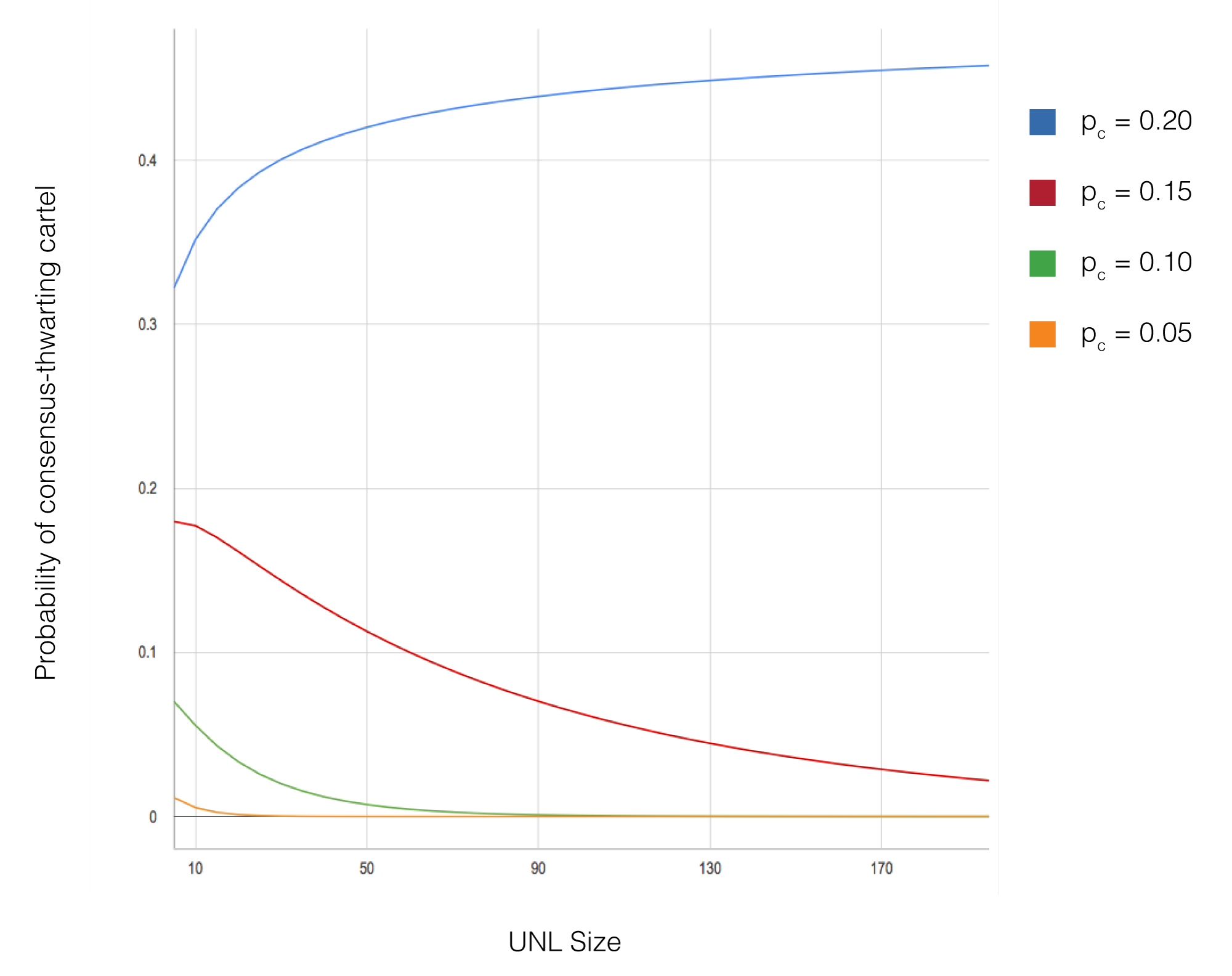
Theorem 1 (Safety). If for every pair of correct servers s_i and s_j in the network, the overlap between their UNLs satisfies:
\[\frac{|UNL_i \cap UNL_j|}{\max(|UNL_i|, |UNL_j|)} > \frac{1}{5}\]
and the fraction of Byzantine nodes in every UNL is less than 1/5, then no two correct servers will close different ledgers in the same consensus round.
Proof sketch. Suppose, for contradiction, that two correct servers s_i and s_j close different ledgers. This means there exists some transaction T that is in the final transaction set of s_i but not in the final transaction set of s_j (or vice versa). For T to be in s_i's final set, it must have received support from at least 80% of UNL_i. For T to not be in s_j's final set, it must have received support from fewer than 80% of UNL_j.
Let n_i = |UNL_i| and n_j = |UNL_j|. The number of nodes that support T in UNL_i is at least 0.8 * n_i. Among these supporting nodes, some are in the overlap UNL_i ∩ UNL_j. Because Byzantine nodes constitute less than 1/5 of each UNL, at least 0.8 * n_i - 0.2 * n_i = 0.6 * n_i correct nodes in UNL_i support T. The overlap condition ensures that a sufficient number of these correct supporting nodes are also in UNL_j, providing enough support for T in UNL_j to prevent it from being excluded.
Specifically, if the overlap |UNL_i ∩ UNL_j| exceeds 1/5 of the larger UNL, then the correct nodes in the overlap that support T will constitute enough of UNL_j's responses to keep T above the threshold. The combination of the overlap requirement and the Byzantine node bound makes it impossible for T to simultaneously achieve 80% support in one UNL and fall below 80% in another, proving that both servers must produce the same final transaction set and therefore the same closed ledger.
Theorem 2 (Liveness). Under the same conditions as Theorem 1, and assuming that network messages are delivered within a bounded time, every correct server will close a new ledger within a bounded number of consensus rounds.
Proof sketch. Liveness follows from the deterministic progression of the consensus rounds. Each round has a fixed duration, and the threshold progression (50% to 80%) is predetermined. A transaction that has support from a supermajority of correct nodes will survive all threshold rounds because the correct nodes will consistently include it in their proposals. A transaction that does not have supermajority support will be filtered out by the increasing thresholds. In either case, the set of transactions stabilizes within a bounded number of rounds, and all correct servers arrive at the same decision. The bounded message delivery assumption ensures that proposals reach their destinations within each round's time window.
Corollary (Fork-freeness). Under the conditions of Theorem 1, the Ripple network will not fork. A fork would require two disjoint subsets of the network to close different ledgers simultaneously, but the UNL overlap condition ensures that no such disjoint partitioning of the network can occur while maintaining 80% support within each partition.
The 1/5 threshold for both the overlap condition and the Byzantine node fraction is derived from the interplay between the 80% supermajority requirement and the need for correct nodes to have decisive influence. With 80% required for inclusion and at most 20% Byzantine nodes, the correct nodes control at least 60% of each UNL, which is enough to ensure that their collective decision is reflected in the final outcome. The 20% overlap requirement ensures that the correct majorities in different UNLs are sufficiently connected to prevent divergence.
It is worth noting that these bounds are conservative. In practice, the network typically operates with much higher UNL overlap and much lower Byzantine fault rates, providing safety margins well beyond the theoretical minimums. The formal analysis establishes worst-case guarantees, while the practical behavior of the network is significantly more robust than the worst case would suggest.
The convergence rate of the algorithm depends on the number of rounds and the initial agreement level. Simulations show that when the majority of UNL members begin with the same proposal (the common case in a well-connected network), consensus is typically achieved in a single round of threshold progression (4 sub-rounds), completing in approximately 3-5 seconds. When proposals diverge more significantly (for example, after a network partition heals), additional rounds may be needed, but convergence is still guaranteed within a bounded number of rounds.
Formal Analysis of Convergence
Tính đúng đắn của RPCA phụ thuộc quyết định vào độ chồng lấn giữa các UNL do các nút khác nhau chọn trong mạng. Gọi UNL_i là unique node list của nút i, và UNL_i ∩ UNL_j là tập các nút xuất hiện trong cả UNL_i và UNL_j. Để mạng duy trì đồng thuận, với mọi cặp nút i và j, giao của hai UNL phải đủ lớn so với kích thước lớn hơn giữa hai UNL đó.
Cụ thể, giao thức bảo đảm an toàn khi |UNL_i ∩ UNL_j| / max(|UNL_i|, |UNL_j|) 1/5 cho mọi cặp i, j. Điều kiện này bảo đảm rằng ngay cả khi các nút Byzantine cố làm các phần khác nhau của mạng đạt các quyết định đồng thuận khác nhau, phần chồng lấn các nút đáng tin vẫn ngăn được phân nhánh. Nếu điều kiện này đúng và số nút Byzantine trong bất kỳ UNL nào nhỏ hơn 1/5, thì mọi nút đúng sẽ đi đến cùng một quyết định đồng thuận.
Chứng minh hình thức cho thấy rằng nếu hai nút có thể đi đến hai quyết định đồng thuận khác nhau, phải tồn tại một giao dịch T xuất hiện trong sổ cái cuối của một nút nhưng không có trong nút kia. Để điều này xảy ra, T phải đạt 80% ủng hộ trong UNL của nút thứ nhất nhưng dưới 80% trong UNL của nút thứ hai. Tuy nhiên, với yêu cầu chồng lấn và ràng buộc tỷ lệ Byzantine, kịch bản này là bất khả: nếu T đạt 80% trong UNL_i, nó phải đạt ít nhất 60% trong bất kỳ UNL_j nào thỏa điều kiện chồng lấn; và với đủ số vòng đồng thuận, mức này sẽ hội tụ về 80% hoặc bị cả hai nút loại bỏ.
Thuộc tính tính sống, tức đồng thuận cuối cùng sẽ đạt được, đến từ việc ngưỡng đưa vào tăng một cách tất định qua các vòng đồng thuận. Ngay cả khi có nút Byzantine và độ trễ mạng, giao thức vẫn bảo đảm các giao dịch được siêu đa số nút trung thực ủng hộ cuối cùng sẽ được đưa vào, còn các giao dịch không có mức ủng hộ đó sẽ bị loại. Thời gian đồng thuận hữu hạn (thường khoảng 5 giây) mang lại bảo đảm tính sống thực tế phù hợp với các ứng dụng thanh toán.
Unique Node Lists
The Unique Node List (UNL) is the mechanism by which RPCA achieves Sybil resistance without proof-of-work. In a naive voting system where each node has equal influence, an attacker could create thousands of pseudonymous nodes (a Sybil attack) and overwhelm the honest nodes with fraudulent votes. The UNL prevents this by requiring each server to explicitly declare which other servers it considers trustworthy for consensus purposes. Creating additional identities provides no advantage unless existing servers voluntarily add those identities to their UNLs.
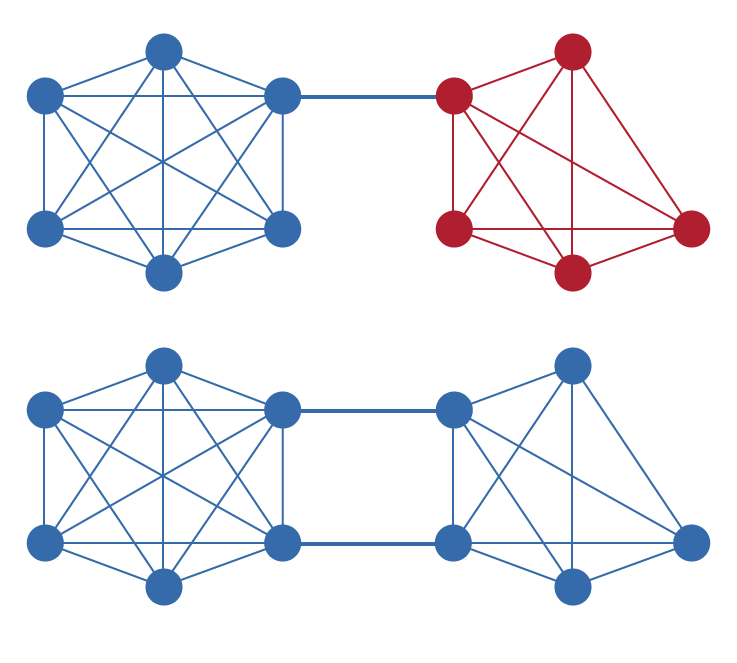
The trust implied by including a server in one's UNL is deliberately minimal. A server s that includes server t in its UNL is not asserting that t is always correct or that t will never fail. It is asserting only that t will not collude with other members of s's UNL to defraud the network. This is a much weaker assertion than full trust. For example, a server might include a validator operated by a major financial institution in its UNL not because it trusts that institution completely, but because it believes that institution will not conspire with the other validators in the UNL to commit fraud. The institution might occasionally have bugs or downtime, but these crash-type failures are handled by the consensus algorithm's tolerance for missing proposals.
The formal requirements for UNL selection are derived from the safety analysis. Two conditions must hold:
-
Byzantine threshold: Fewer than 20% of the nodes in any server's UNL should be Byzantine. This means that when selecting UNL members, a server should choose nodes that it believes are operated by independent, trustworthy entities. Selecting nodes that are all operated by the same organization would violate this requirement if that organization behaved maliciously.
-
Overlap requirement: For any two servers in the network, the overlap between their UNLs must exceed 20% of the larger UNL. This ensures that the local trust relationships form a sufficiently connected graph that consensus decisions propagate consistently across the network.
In practice, satisfying the overlap requirement is straightforward when the network provides a recommended default UNL. Ripple publishes a default UNL consisting of validators operated by a diverse set of entities — financial institutions, universities, blockchain companies, and other organizations. Servers that adopt this default UNL automatically satisfy the overlap condition with each other. Server operators who wish to customize their UNL may do so, but they should ensure that their custom list retains sufficient overlap with the UNLs of other servers they wish to reach consensus with.
The selection of UNL members can be guided by several heuristics:
Diversity. A well-constructed UNL should include validators operated by entities in different geographic regions, legal jurisdictions, and organizational types. This diversity reduces the probability that a common failure mode (such as a regional internet outage or a regulatory action in a specific jurisdiction) could simultaneously compromise a significant fraction of the UNL.
Independence. UNL members should be operated by independent entities that do not have incentives to collude. Validators operated by competing financial institutions, for example, are less likely to collude than validators operated by subsidiaries of the same parent company. The independence of UNL members directly affects the Byzantine fault tolerance of the system, as collusion between UNL members is the primary threat model.
Track record. Servers with a long history of correct behavior and high uptime are better candidates for UNL inclusion than newly created servers with no history. While past behavior does not guarantee future correctness, it provides a signal about the operator's competence and commitment to maintaining the validator.
Capacity. UNL members must have sufficient computational and network resources to participate reliably in the consensus process. A validator that frequently fails to deliver proposals on time due to resource constraints degrades the performance of the consensus algorithm for all servers that include it in their UNL.
The UNL mechanism also enables a natural path toward progressive decentralization. In the early stages of the network, the default UNL may be relatively concentrated among a small number of well-known validators. As the network matures and more independent operators demonstrate their reliability, the default UNL can be expanded to include a broader set of validators. Individual server operators can also customize their UNLs to reflect their own trust assessments, gradually diversifying the network's trust topology without requiring any protocol changes or coordinated upgrades.
A potential concern with the UNL model is that it could lead to a "trust hierarchy" where a small number of prominent validators are included in most UNLs, creating a de facto centralized system. To mitigate this risk, the protocol encourages diversity in UNL selection and provides tools for monitoring the network's trust topology. If the overlap between UNLs becomes too concentrated on a small set of validators, operators can be alerted to diversify their selections. The goal is a network where trust is distributed broadly enough that no single entity or small coalition can exert disproportionate influence over the consensus process.
Unique Node Lists
Unique Node List (UNL) là thành phần cốt lõi của RPCA, tạo nên điểm khác biệt với các thuật toán đồng thuận khác. Mỗi nút trong mạng Ripple duy trì một UNL gồm các nút khác mà nó tin rằng sẽ không thông đồng để gian lận mạng. Điểm then chốt là niềm tin này mang tính cục bộ, không phải toàn cục: các nút khác nhau có thể có UNL khác nhau, và không có yêu cầu phải tồn tại một tập validator thống nhất toàn mạng. Thiết kế này cho phép mạng mở rộng tự nhiên trong khi vẫn giữ tính phi tập trung.
UNL đóng vai trò cơ chế chống tấn công Sybil mà không cần proof-of-work. Trong hệ bỏ phiếu ngây thơ, kẻ tấn công có thể tạo nhiều danh tính giả để giành ảnh hưởng không cân xứng. Bằng cách buộc mỗi nút phải chỉ rõ nó tin nút nào, RPCA bảo đảm việc tạo thêm danh tính không mang lại lợi thế trừ khi các danh tính đó thuyết phục được các nút hiện có thêm chúng vào UNL. Nhờ đó, bài toán kháng Sybil được chuyển từ chi phí tính toán sang quan hệ uy tín và tin cậy.
Để mạng hoạt động đúng, UNL phải được chọn sao cho có độ chồng lấn đủ lớn như đã nêu trong phân tích hình thức. Trong thực tế, điều này có nghĩa là dù mỗi nhà vận hành nút có quyền tự chủ khi chọn UNL, họ vẫn cần bảo đảm danh sách của mình bao gồm các validator cũng được các phần khác của mạng tin cậy. Ripple cung cấp một UNL mặc định gồm các validator do nhiều thực thể vận hành, nhưng nhà vận hành có thể điều chỉnh danh sách này theo đánh giá tin cậy riêng.
Cơ chế UNL cũng tạo ra con đường tự nhiên hướng đến phi tập trung dần theo thời gian. Ở giai đoạn đầu của mạng, tập validator tập trung hơn có thể phù hợp để bảo đảm ổn định và độ tin cậy. Khi mạng trưởng thành và nhiều nhà vận hành đa dạng chứng minh được uy tín, UNL có thể tiến hóa để bao gồm tập validator rộng hơn, tăng khả năng chống chịu và mức độ phi tập trung mà không làm suy giảm các thuộc tính bảo mật.
Simulation Code
To validate the theoretical analysis and evaluate the practical performance of RPCA under realistic conditions, extensive simulations were conducted using a custom-built network simulator. The simulator models a network of servers, each maintaining their own UNL and participating in the full RPCA protocol including proposal generation, iterative voting with increasing thresholds, ledger close, and validation. The simulation framework allows precise control over network topology, Byzantine behavior patterns, message latency distributions, and UNL configurations.
The simulation parameters were varied across the following dimensions:
Network size. Simulations were conducted with networks ranging from 10 to 1,000 nodes. Larger networks test the scalability of the algorithm, as the number of proposals each server must process increases with the size of its UNL (though not with the total network size, which is a key advantage of the UNL-based approach).
Byzantine node fraction. The percentage of Byzantine nodes was varied from 0% (fully correct network) to 20% (the theoretical maximum for guaranteed safety). Byzantine nodes were programmed to exhibit various adversarial behaviors including sending conflicting proposals to different servers, withholding proposals, sending proposals with deliberately different transaction sets, and attempting to fork the network by supporting different transactions in different proposals.
UNL size and overlap. UNL sizes ranged from 5 to 50 nodes, with overlap percentages ranging from 20% (the theoretical minimum) to 100% (fully overlapping UNLs). The relationship between UNL overlap and consensus success was a primary focus of the simulation study.
Network latency. Message delivery times were modeled using a log-normal distribution to simulate realistic network conditions, with mean latencies ranging from 10ms (data center environment) to 500ms (global internet with congestion). Some simulations also included random message drops to test the algorithm's robustness to packet loss.
The primary metrics tracked in the simulations were:
Simulation Metrics:

Metric                  Description
──────────────────────────────────────────────────────────────
Consensus latency       Time from round start to ledger close
Fork probability        Fraction of runs where servers closed
                        different ledgers
Transaction throughput  Number of transactions included per
                        consensus round
Agreement ratio         Fraction of servers closing the same
                        ledger in each round
Recovery time           Time to resynchronize after a network
                        partition heals
Safety results. In all configurations where the UNL overlap condition was satisfied (overlap 20% of the larger UNL) and Byzantine nodes comprised less than 20% of each UNL, no forks were observed across tens of thousands of simulation runs. This empirically confirms the theoretical safety guarantee of Theorem 1. When the overlap condition was violated — for example, by configuring two groups of servers with non-overlapping UNLs — forks occurred with high probability, confirming that the overlap condition is necessary as well as sufficient.
Latency results. Consensus latency remained consistently between 3 and 5 seconds across all tested network sizes, from 10 to 1,000 nodes. This is because each server only communicates with its UNL (not the entire network), so the per-round communication cost scales with UNL size rather than network size. With UNL sizes of 20-30 nodes (typical for production deployments), the communication overhead is modest even in large networks. Network latency was the primary factor affecting consensus time: simulations with 10ms mean latency completed consensus in approximately 2 seconds, while simulations with 500ms mean latency required approximately 6 seconds.
Byzantine resilience results. With up to 15% Byzantine nodes actively attempting to disrupt consensus, the network maintained correct consensus in all simulation runs as long as the UNL overlap condition was met. At 18-19% Byzantine nodes (near the theoretical threshold), occasional consensus delays were observed as the algorithm required additional rounds to filter out Byzantine proposals, but safety was never violated. Beyond 20%, the safety guarantee no longer holds and forks became possible, confirming the theoretical bounds.
Partition recovery. Simulations of network partitions showed that the algorithm recovers gracefully when a partition heals. During the partition, each partition may close ledgers independently (if it contains enough UNL members to reach consensus). When the partition heals, the servers that were in the minority partition detect that the majority reached a different consensus, fetch the correct ledger, and resynchronize. The recovery process typically completes within one or two consensus rounds after the partition heals.
The complete simulation code was made available for independent verification, allowing researchers and developers to reproduce the results, explore additional parameter configurations, and validate the algorithm's behavior under conditions not covered by the original simulation study.
Simulation Code
Để kiểm chứng phân tích lý thuyết của RPCA và đánh giá hiệu năng dưới nhiều điều kiện, các mô phỏng quy mô lớn đã được thực hiện bằng phần mềm mô phỏng tùy biến. Khung mô phỏng mô hình hóa một mạng các nút, mỗi nút duy trì UNL riêng và tham gia giao thức đồng thuận. Mã nguồn triển khai đầy đủ thuật toán RPCA, bao gồm đề xuất giao dịch, các vòng bỏ phiếu với ngưỡng tăng dần và xác thực sổ cái.
Các tham số chính được thay đổi trong mô phỏng gồm kích thước mạng (từ 10 đến 1.000 nút), tỷ lệ nút Byzantine (từ 0% đến 20%), kích thước UNL (thường từ 5 đến 50 nút), và cấu hình topology mạng. Với mỗi cấu hình tham số, nhiều lần chạy mô phỏng được thực hiện với các random seed khác nhau để bảo đảm độ tin cậy thống kê của kết quả. Các mô phỏng theo dõi các chỉ số như độ trễ đồng thuận, xác suất phân nhánh, và thông lượng giao dịch.
Kết quả mô phỏng xác nhận các dự đoán lý thuyết về hội tụ và an toàn. Trong mọi cấu hình mà điều kiện chồng lấn UNL được thỏa và tỷ lệ Byzantine trong mỗi UNL dưới 20%, mạng đạt đồng thuận thành công mà không xảy ra phân nhánh. Độ trễ đồng thuận luôn thấp (thường hoàn tất trong 3-5 giây mô phỏng) bất kể kích thước mạng, cho thấy tính mở rộng của thuật toán. Ngay cả khi 15% nút Byzantine chủ động phá hoại đồng thuận, mạng vẫn giữ được tính đúng đắn miễn là điều kiện chồng lấn UNL được đáp ứng.
Các mô phỏng bổ sung cũng khảo sát các trường hợp biên và kịch bản lỗi, gồm phân vùng mạng, thay đổi đột ngột thành phần UNL, và tấn công phối hợp của các nút Byzantine. Các mô phỏng này cung cấp thêm hiểu biết về độ vững chắc của giao thức và định hình các thực hành tốt nhất được khuyến nghị cho lựa chọn UNL và vận hành mạng. Toàn bộ mã mô phỏng đã được công bố để cho phép kiểm chứng độc lập và nghiên cứu tiếp theo.
Discussion
The design of RPCA involves several deliberate trade-offs that distinguish it from other consensus algorithms. Understanding these trade-offs is essential for evaluating the algorithm's suitability for different applications and for identifying areas where future improvements may be possible.
Latency versus proof-of-work. Compared to Bitcoin's proof-of-work consensus, RPCA achieves consensus latency that is approximately three orders of magnitude lower — seconds instead of hours. This improvement comes from replacing computational proof with a voting mechanism that can complete in a small number of message rounds. The trade-off is that RPCA requires servers to maintain UNLs with sufficient overlap, whereas Bitcoin requires no pre-existing trust relationships. For payment system applications where low latency is essential and where participants have incentives to select diverse, reliable validators, this trade-off is strongly favorable toward RPCA.
Energy efficiency. RPCA requires negligible computational resources compared to proof-of-work. The consensus process involves only cryptographic signing, hash computation for ledger validation, and network communication — operations that can be performed on commodity hardware with minimal energy consumption. The elimination of mining means that the cost of operating the network is limited to the cost of running the servers themselves, which is a tiny fraction of the energy expenditure required by proof-of-work systems. This energy efficiency makes RPCA suitable for deployment at scale without the environmental concerns associated with proof-of-work mining.
Trust assumptions. The most significant difference between RPCA and proof-of-work is the trust model. Bitcoin's security relies solely on the assumption that no entity controls more than 50% of the network's hash rate — a purely economic assumption that requires no trust between participants. RPCA requires that servers choose UNLs with sufficient overlap and low Byzantine fractions — assumptions that involve trust in the competence and honesty of specific validator operators.
This difference in trust models has important implications. In a proof-of-work system, security degrades gracefully as an attacker approaches the 50% threshold, and the cost of attack is continuously quantifiable in terms of hardware and electricity. In RPCA, security depends on the correctness of UNL selection, which is harder to quantify. If server operators make poor UNL choices — for example, by including validators controlled by a single malicious entity — the safety guarantees may not hold. Mitigating this risk requires careful UNL curation and network-level monitoring of the trust topology.
Throughput. RPCA's throughput is determined by the rate at which consensus rounds complete and the number of transactions that can be processed in each round. Because consensus rounds complete every 3-5 seconds and each round can include thousands of transactions, the practical throughput is on the order of 1,500 transactions per second — significantly higher than Bitcoin's approximately 7 transactions per second. The throughput can be further increased by optimizing the consensus round duration and increasing the transaction capacity per round, though this must be balanced against latency and network bandwidth requirements.
Network topology. The structure of the network's UNL graph — the graph where each server is a node and each UNL inclusion is a directed edge — significantly impacts the properties of the consensus system. A highly centralized topology where all servers include the same small set of validators maximizes safety (because overlap is maximized) but creates a single point of failure if those central validators become unavailable or are compromised. A highly decentralized topology with minimal overlap increases resilience to targeted attacks but may approach the safety boundaries, especially if Byzantine nodes are strategically placed to minimize effective overlap.
The optimal topology depends on the deployment scenario. For a network of financial institutions that already have established relationships and mutual accountability, a moderately concentrated topology with high overlap provides strong safety with acceptable centralization. For a more open network with diverse participants, a broader UNL topology with careful attention to overlap requirements provides better resilience against collusion.
Comparison with Federated Byzantine Agreement. The Stellar Consensus Protocol (SCP) takes a similar approach to RPCA in that nodes choose their own trust sets (called "quorum slices" in SCP). However, SCP uses a different consensus mechanism based on federated voting with ballots, whereas RPCA uses iterative threshold-based voting. SCP also defines a different set of safety conditions based on quorum intersection rather than UNL overlap. Both approaches demonstrate that local trust can replace global trust in consensus systems, but they achieve this through different mechanisms with different performance characteristics and failure modes.
Future directions. Several extensions to RPCA merit further research. Adaptive UNL selection algorithms could automatically adjust a server's UNL based on observed validator behavior, improving resilience without requiring manual intervention. Dynamic threshold adjustment could allow the consensus algorithm to adapt to varying network conditions, completing faster when agreement is easy and taking more time when it is difficult. And formal verification of the algorithm using machine-checked proofs could provide stronger assurance of correctness than the hand-written proofs presented in this paper.
Discussion
So với đồng thuận proof-of-work của Bitcoin, RPCA mang lại nhiều lợi thế đáng kể cho các ứng dụng hệ thống thanh toán. Nổi bật nhất là độ trễ đồng thuận giảm từ 40-60 phút (thời gian thường được khuyến nghị cho giao dịch Bitcoin giá trị cao) xuống khoảng 5 giây. Cải thiện này khiến RPCA phù hợp cho điểm bán hàng và các ứng dụng đòi hỏi quyết toán gần như tức thời. Ngoài ra, RPCA yêu cầu tài nguyên tính toán tối thiểu so với proof-of-work, loại bỏ mức tiêu thụ năng lượng khổng lồ gắn với hoạt động đào Bitcoin.
Tuy nhiên, các lợi thế này đi kèm giả định tin cậy khác. Trong khi bảo mật của Bitcoin chỉ dựa trên giả định không có kẻ tấn công nào kiểm soát quá 50% năng lực tính toán toàn mạng, RPCA yêu cầu các nút chọn UNL có độ chồng lấn đủ lớn và số nút Byzantine không vượt ngưỡng trong các UNL đó. Điều này chuyển một phần trách nhiệm sang nhà vận hành nút trong việc đưa ra quyết định tin cậy thận trọng. Trong thực tế, đánh đổi này chấp nhận được trong nhiều bối cảnh thanh toán nơi các tổ chức tham gia vốn đã có quan hệ tin cậy.
Topology mạng và chiến lược chọn UNL ảnh hưởng mạnh đến đặc tính của hệ đồng thuận. Topology tập trung cao, nơi mọi nút cùng dùng chung validator trong UNL, tối đa hóa an toàn nhưng có thể làm giảm tính sống nếu các validator đó không khả dụng. Ngược lại, topology phi tập trung cao với độ chồng lấn UNL thấp có thể cải thiện tính sống nhưng làm tăng rủi ro thất bại đồng thuận nếu chồng lấn trở nên quá thưa. Việc tìm điểm cân bằng tối ưu đòi hỏi cân nhắc kỹ kịch bản triển khai cụ thể và mức chấp nhận rủi ro.
Các hướng nghiên cứu tương lai có thể gồm thuật toán chọn UNL thích nghi tự động duy trì điều kiện chồng lấn trong khi tối đa hóa phi tập trung, cơ chế để nút điều chỉnh UNL động theo hành vi validator quan sát được, và mở rộng thuật toán đồng thuận để chịu được tỷ lệ nút Byzantine cao hơn nữa. Những cải tiến này có thể tiếp tục nâng cao độ vững chắc và phạm vi ứng dụng của RPCA cho các hệ thống thanh toán phân tán quy mô lớn.
Conclusion
The Ripple Protocol Consensus Algorithm represents a significant advancement in distributed consensus for payment systems. By utilizing collectively-trusted subnetworks (Unique Node Lists) rather than requiring global agreement among all nodes or computationally expensive proof-of-work, RPCA achieves consensus in a matter of seconds while maintaining provable safety guarantees against Byzantine failures.
The formal analysis demonstrates that the algorithm's correctness depends on two quantifiable conditions: the overlap between UNLs must exceed 20% of the larger list for any pair of servers, and the fraction of Byzantine nodes in any UNL must remain below 20%. When these conditions are satisfied, the algorithm guarantees that all correct servers will close the same ledger (safety) and that consensus will complete in bounded time (liveness). These guarantees provide the deterministic finality required for financial settlement — unlike proof-of-work systems where finality is probabilistic and may require waiting for multiple confirmations.
The simulation results confirm the theoretical predictions across a wide range of network configurations. Consensus latency remains consistently low (3-5 seconds) regardless of network size, because the communication complexity of each server depends on its UNL size rather than the total number of servers. The algorithm maintains safety even with up to 19% Byzantine nodes actively attempting to disrupt consensus, providing a substantial safety margin under typical operating conditions where Byzantine behavior is rare.
The practical implications extend beyond the Ripple payment network. RPCA demonstrates that the traditional trade-off between consensus latency and Byzantine fault tolerance can be overcome through the principled use of local trust relationships. This insight may prove applicable to other distributed systems where participants have existing trust relationships and where low-latency agreement is critical: inter-bank settlement systems, supply chain management, securities clearing and settlement, and other financial infrastructure applications that require both speed and security.
The decoupling of Sybil resistance from consensus — using UNL-based trust for the former and iterative voting for the latter — opens a design space that has been largely unexplored in the distributed systems literature. This separation allows each concern to be optimized independently, yielding a system that is both more efficient and more flexible than systems that address both concerns with a single mechanism. As the network continues to evolve and incorporate additional validators from diverse operators, it provides a practical demonstration that local trust can serve as a foundation for global consensus.
Conclusion
Thuật toán Đồng thuận Giao thức Ripple là một bước tiến quan trọng của đồng thuận phân tán cho hệ thống thanh toán. Bằng cách sử dụng các mạng con được tin cậy tập thể thay vì yêu cầu đồng thuận toàn cục giữa mọi nút, RPCA đạt đồng thuận trong vài giây mà vẫn giữ bảo đảm mạnh trước lỗi Byzantine. Phân tích hình thức cho thấy rằng khi UNL được chọn với độ chồng lấn đủ lớn và tỷ lệ nút Byzantine nằm dưới ngưỡng, mạng sẽ đạt đồng thuận đúng mà không phân nhánh.
Ý nghĩa thực tiễn của công trình này vượt ra ngoài mạng thanh toán Ripple. RPCA cho thấy đánh đổi truyền thống giữa độ trễ đồng thuận và bảo đảm bảo mật có thể được vượt qua bằng thiết kế giao thức cẩn thận và việc khai thác quan hệ tin cậy cục bộ. Cách tiếp cận này có thể áp dụng cho các hệ phân tán khác nơi độ trễ thấp là yếu tố then chốt và các bên tham gia có quan hệ tin cậy sẵn có, như thanh toán liên ngân hàng, theo dõi chuỗi cung ứng, và các hạ tầng tài chính khác.
Việc triển khai RPCA trong môi trường sản xuất đã xác nhận đặc tính hiệu năng và độ vững chắc của thuật toán. Mạng Ripple xử lý hàng nghìn giao dịch mỗi giây với độ trễ đồng thuận ổn định 3-5 giây, chứng minh rằng các thuộc tính lý thuyết có thể chuyển hóa hiệu quả thành vận hành thực tế. Khi mạng tiếp tục phát triển và bổ sung thêm validator từ các nhà vận hành đa dạng, nó trở thành ví dụ thực tiễn về cách một hệ đồng thuận phi tập trung có thể duy trì đồng thời bảo mật và hiệu năng ở quy mô lớn.
References
Lamport, L., Shostak, R., and Pease, M. (1982). "The Byzantine Generals Problem." ACM Transactions on Programming Languages and Systems, 4(3):382-401. This seminal paper formalized the problem of reaching consensus in distributed systems with faulty components, establishing that agreement is possible if and only if fewer than one-third of the participants are faulty.
Castro, M., and Liskov, B. (1999). "Practical Byzantine Fault Tolerance." Proceedings of the Third Symposium on Operating Systems Design and Implementation (OSDI). Demonstrated that Byzantine fault tolerance could be achieved with practical performance through the PBFT algorithm, establishing the three-phase commit protocol (pre-prepare, prepare, commit) that tolerates f faults among 3f + 1 nodes with O(n^2) message complexity.
Nakamoto, S. (2008). "Bitcoin: A Peer-to-Peer Electronic Cash System." Introduced proof-of-work consensus as a solution to the double-spending problem in digital currency, enabling decentralized agreement without trusted parties. Established the longest-chain rule and demonstrated that probabilistic finality increases exponentially with the number of confirmations.
Lamport, L. (1998). "The Part-Time Parliament." ACM Transactions on Computer Systems, 16(2):133-169. Presented the Paxos algorithm for achieving consensus in asynchronous systems under crash failures. Paxos provides the theoretical foundation for many practical consensus implementations, though it does not handle Byzantine failures.
Fischer, M. J., Lynch, N. A., and Paterson, M. S. (1985). "Impossibility of Distributed Consensus with One Faulty Process." Journal of the ACM, 32(2):374-382. The FLP impossibility result proved that no deterministic algorithm can guarantee consensus in a fully asynchronous system if even a single process can fail, establishing fundamental limits on the achievable properties of consensus algorithms.
Dwork, C., Lynch, N., and Stockmeyer, L. (1988). "Consensus in the Presence of Partial Synchrony." Journal of the ACM, 35(2):288-323. Defined the partial synchrony model and showed that consensus is achievable under weaker timing assumptions than full synchrony, providing the theoretical basis for practical BFT protocols including PBFT.
Schwartz, D., Youngs, N., and Britto, A. (2014). "The Ripple Protocol Consensus Algorithm." Ripple Labs Inc. The present paper, describing RPCA and providing formal analysis of its safety and liveness properties under specified UNL overlap and Byzantine fault conditions.
Mazieres, D. (2015). "The Stellar Consensus Protocol: A Federated Model for Internet-level Consensus." Stellar Development Foundation. Introduced federated Byzantine agreement (FBA), where nodes choose their own quorum slices to define trust, sharing conceptual similarities with RPCA's UNL approach while using a different consensus mechanism based on federated voting with ballots.
References
Lamport, L., Shostak, R., và Pease, M. (1982). "The Byzantine Generals Problem." ACM Transactions on Programming Languages and Systems, 4(3):382-401. Công trình nền tảng này đã hình thức hóa bài toán đạt đồng thuận trong hệ phân tán có thành phần lỗi và đặt nền móng lý thuyết cho các hệ chịu lỗi Byzantine.
Castro, M., và Liskov, B. (1999). "Practical Byzantine Fault Tolerance." Proceedings of the Third Symposium on Operating Systems Design and Implementation (OSDI). Công trình này giới thiệu PBFT, cho thấy chịu lỗi Byzantine có thể đạt được với hiệu năng thực tiễn, dù độ phức tạp truyền thông O(n^2) giới hạn khả năng mở rộng.
Nakamoto, S. (2008). "Bitcoin: A Peer-to-Peer Electronic Cash System." Whitepaper này giới thiệu đồng thuận proof-of-work như lời giải cho bài toán chi tiêu kép trong tiền tệ số, cho phép đồng thuận phi tập trung không cần bên tin cậy nhưng đánh đổi bằng độ trễ cao và tiêu thụ năng lượng lớn.
Lamport, L. (1998). "The Part-Time Parliament." ACM Transactions on Computer Systems, 16(2):133-169. Bài báo này trình bày thuật toán Paxos, đạt đồng thuận trong hệ bất đồng bộ dưới lỗi sập và có ảnh hưởng lớn đến thiết kế các giao thức đồng thuận về sau.
Fischer, M. J., Lynch, N. A., và Paterson, M. S. (1985). "Impossibility of Distributed Consensus with One Faulty Process." Journal of the ACM, 32(2):374-382. Kết quả bất khả thi FLP thiết lập giới hạn cơ bản về những gì thuật toán đồng thuận có thể đạt trong hệ bất đồng bộ, qua đó định hình không gian thiết kế cho các giao thức đồng thuận thực tế.