 Avalanche
Comparaison des Protocoles de Consensus
Context
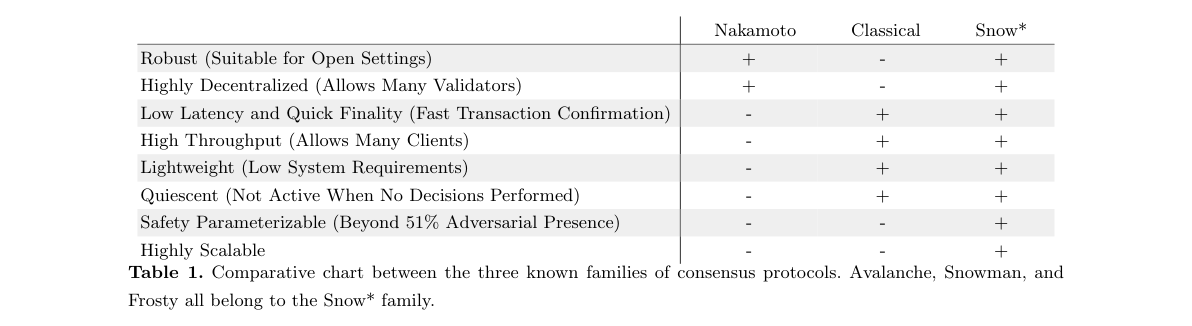
This table appears in Section 2 (The Engine) of the Avalanche whitepaper, immediately after the qualitative description of how the Snow* family of protocols operates through repeated random network sampling. It is the definitive comparative summary that situates Avalanche in the broader consensus landscape, contrasting it against the two dominant paradigms — classical BFT protocols and Nakamoto-style longest-chain protocols.
What This Figure Shows
The table organizes consensus protocol families into three columns (Classical, Nakamoto, and Snow*) and evaluates each across properties including safety guarantees, liveness, quorum requirements, communication complexity, finality speed, decentralization, and throughput. Classical protocols such as PBFT and HotStuff achieve strong safety and fast finality but require O(n²) all-to-all communication, making them impractical beyond a few hundred validators. Nakamoto protocols achieve open participation and robust liveness but suffer from probabilistic finality, high latency, and low throughput. The Snow* family achieves sub-second probabilistic finality, O(k log n) communication complexity via random sampling, throughput exceeding 5,000 TPS on a real 2,000-node AWS deployment, and full decentralization with no delegation to subcommittees.
Significance
This comparison table is the central argument of the Avalanche whitepaper's engineering thesis: that it is possible to simultaneously achieve the best properties of both classical and Nakamoto consensus without their respective drawbacks. By providing a concrete, multi-dimensional benchmark against established protocol families, the table gives developers and researchers an immediate basis for evaluating where Avalanche fits in the consensus design space.