
TRON-Whitepaper
การแนะนำ
1.1 วิสัยทัศน์
TRON เป็นโครงการที่มีความทะเยอทะยานที่อุทิศให้กับการสร้างอินเทอร์เน็ตที่มีการกระจายอำนาจอย่างแท้จริงและ
โครงสร้างพื้นฐาน TRON Protocol หนึ่งในระบบปฏิบัติการที่ใช้ blockchain ที่ใหญ่ที่สุดใน
world เสนอ blockchain การสนับสนุนสาธารณะสำหรับปริมาณงานสูง ความสามารถในการปรับขนาดสูง และความพร้อมใช้งานสูงสำหรับ
แอปพลิเคชันแบบกระจายอำนาจ (DApps) ทั้งหมดในระบบนิเวศ TRON การเข้าซื้อกิจการเดือนกรกฎาคม 2561 ของ
BitTorrent ยังตอกย้ำความเป็นผู้นำของ TRON ในการแสวงหาระบบนิเวศแบบกระจายอำนาจ
1.2 ความเป็นมา
การเปิดตัว Bitcoin ในปี 2009 ได้ปฏิวัติการรับรู้ของสังคมเกี่ยวกับการเงินแบบดั้งเดิม หลังเกิดภาวะเศรษฐกิจถดถอยครั้งใหญ่ (พ.ศ. 2550-2551) เป็นกองทุนป้องกันความเสี่ยงแบบรวมศูนย์และธนาคาร ทรุดตัวลงจากการเก็งกำไรในอนุพันธ์ทางการเงินที่ทึบแสง blockchain เทคโนโลยีให้ บัญชีแยกประเภทสากลที่โปร่งใสซึ่งใครก็ตามสามารถรวบรวมข้อมูลธุรกรรมได้ ที่ ธุรกรรมได้รับการรักษาความปลอดภัยแบบเข้ารหัสโดยใช้กลไกฉันทามติ Proof of Work (PoW) จึงป้องกันปัญหาการใช้จ่ายซ้ำซ้อน
ในช่วงปลายปี 2013 เอกสารไวท์เปเปอร์ Ethereum เสนอเครือข่ายที่ smart contracts และ Turing-complete Ethereum Virtual Machine (EVM) จะช่วยให้นักพัฒนาสามารถโต้ตอบกับ เครือข่ายผ่าน DApps อย่างไรก็ตาม เนื่องจากปริมาณธุรกรรมใน Bitcoin และ Ethereum พุ่งถึงจุดสูงสุดในปี 2017 เห็นได้ชัดจากเวลาการทำธุรกรรมที่ต่ำและค่าธรรมเนียมการทำธุรกรรมที่สูง cryptocurrencies เช่น Bitcoin และ Ethereum ในสถานะที่มีอยู่ไม่สามารถปรับขนาดได้อย่างกว้างขวาง การรับเลี้ยงบุตรบุญธรรม ดังนั้น TRON จึงถูกก่อตั้งขึ้นและจินตนาการว่าเป็นโซลูชันเชิงนวัตกรรมสำหรับการกดเหล่านี้ ความท้าทายด้านความสามารถในการขยายขนาด
1.3 ประวัติศาสตร์ TRON DAO ก่อตั้งขึ้นในเดือนกรกฎาคม 2017 ในสิงคโปร์ ในเดือนธันวาคม 2017 TRON มี เปิดตัวโปรโตคอลโอเพ่นซอร์ส Testnet, Blockchain Explorer และ Web Wallet ล้วนเป็นทั้งหมด เปิดตัวภายในเดือนมีนาคม 2018 TRON Mainnet เปิดตัวหลังจากนั้นไม่นานในเดือนพฤษภาคม 2018 ซึ่งถือเป็น การเปิดตัว Odyssey 2.0 ถือเป็นก้าวสำคัญทางเทคนิค ในเดือนมิถุนายน 2018 TRON ประกาศเอกราช ด้วยการสร้างบล็อก Genesis พร้อมกับการเข้าซื้อกิจการ BitTorrent ในเดือนกรกฎาคม 2561 ใน ตุลาคม 2018 TRON เปิดตัว TRON Virtual Machine (TVM) ซึ่งเป็นชุดเครื่องมือของนักพัฒนาที่สมบูรณ์ และระบบรองรับ 360 องศา แผนงาน TRON เกี่ยวข้องกับการรวมผู้ใช้ BitTorrent 100 ล้านคนเข้าด้วยกัน ด้วยเครือข่าย TRON ผ่าน Project Atlas ตลอดจนส่งเสริมชุมชนนักพัฒนาให้เปิดตัว DApps ใหม่ที่น่าตื่นเต้นบน TRON network1 1 V1.0 มีให้ที่ https://tron.network/static/doc/white_paper_v_1_0.pdf
1.4 คำศัพท์เฉพาะทาง
ที่อยู่/กระเป๋าเงิน ที่อยู่หรือกระเป๋าเงินที่ประกอบด้วยข้อมูลรับรองบัญชีบนเครือข่าย TRON ถูกสร้างขึ้นโดย คู่คีย์ซึ่งประกอบด้วยคีย์ส่วนตัวและคีย์สาธารณะ ซึ่งคีย์หลังได้รับมาจากคีย์แรก ผ่านอัลกอริธึม กุญแจสาธารณะมักจะใช้สำหรับการเข้ารหัสคีย์เซสชันและลายเซ็น การตรวจสอบและการเข้ารหัสข้อมูลที่สามารถถอดรหัสได้ด้วยคีย์ส่วนตัวที่เกี่ยวข้อง
เอบีไอ Application Binary Interface (ABI) เป็นส่วนต่อประสานระหว่างโมดูลโปรแกรมไบนารีสองโมดูล ปกติแล้ว หนึ่งในโมดูลเหล่านี้คือไลบรารีหรือสิ่งอำนวยความสะดวกของระบบปฏิบัติการ และอีกโมดูลหนึ่งคือส่วนเรียกใช้งานของผู้ใช้ โปรแกรม
เอพีไอ Application Programming Interface (API) ส่วนใหญ่จะใช้สำหรับการพัฒนาไคลเอนต์ผู้ใช้ ด้วยเอพีไอ สนับสนุน token แพลตฟอร์มการออกสามารถออกแบบโดยนักพัฒนาเองได้
สินทรัพย์ ในเอกสารของ TRON เนื้อหาจะเหมือนกับ token ซึ่งยังแสดงเป็น TRC-10 token
คะแนนแบนด์วิธ (BP) เพื่อให้เครือข่ายทำงานได้อย่างราบรื่น ธุรกรรมเครือข่าย TRON จะใช้ BP เป็นเชื้อเพลิง แต่ละบัญชี รับ 5,000 BP ฟรีทุกวัน และสามารถรับได้อีกมากโดยการแช่แข็ง TRX สำหรับ BP ทั้ง TRX และ TRC-10 token การโอนเป็นธุรกรรมปกติที่คิดต้นทุน BP การปรับใช้และการดำเนินการตามสัญญาอัจฉริยะ ธุรกรรมใช้ทั้ง BP และพลังงาน
บล็อก บล็อกประกอบด้วยบันทึกธุรกรรมดิจิทัล บล็อกที่สมบูรณ์ประกอบด้วยหมายเลขเวทย์มนตร์ ขนาดบล็อก ส่วนหัวของบล็อก ตัวนับธุรกรรม และข้อมูลธุรกรรม
รางวัลบล็อก รางวัลการผลิตบล็อกจะถูกส่งไปยังบัญชีย่อย (ที่อยู่/กระเป๋าเงิน) ตัวแทนซุปเปอร์ก็ได้ รับรางวัลจาก Tronscan หรือผ่าน API โดยตรง
ส่วนหัวของบล็อก ส่วนหัวของบล็อกเป็นส่วนหนึ่งของบล็อก TRON ส่วนหัวของบล็อกประกอบด้วย hash ของบล็อกก่อนหน้า ราก Merkle การประทับเวลา เวอร์ชัน และที่อยู่พยานกระเป๋าเงินเย็น กระเป๋าเงินเย็นหรือที่รู้จักกันในชื่อกระเป๋าเงินออฟไลน์ จะทำให้รหัสส่วนตัวถูกตัดการเชื่อมต่ออย่างสมบูรณ์ เครือข่าย โดยปกติแล้ว กระเป๋าเงินเย็นจะติดตั้งบนอุปกรณ์ "เย็น" (เช่น คอมพิวเตอร์หรือโทรศัพท์มือถือ อยู่ในสถานะออฟไลน์) เพื่อรับรองความปลอดภัยของรหัสส่วนตัว TRX
ดีแอป แอปพลิเคชันแบบกระจายอำนาจเป็นแอปที่ทำงานโดยไม่มีฝ่ายที่เชื่อถือได้จากส่วนกลาง ใบสมัคร ที่ช่วยให้มีปฏิสัมพันธ์/ข้อตกลง/การสื่อสารโดยตรงระหว่างผู้ใช้ปลายทางและ/หรือทรัพยากร โดยไม่มีคนกลาง
จีอาร์พีซี gRPC (gRPC Remote Procedure Calls) เป็นระบบการเรียกขั้นตอนระยะไกล (RPC) แบบโอเพ่นซอร์ส 2 พัฒนาครั้งแรกที่ Google ใช้ HTTP/2 สำหรับการขนส่ง โดยมี Protocol Buffers เป็นอินเทอร์เฟซ ภาษาคำอธิบาย และมีคุณสมบัติต่างๆ เช่น การรับรองความถูกต้อง การสตรีมและโฟลว์แบบสองทิศทาง การควบคุม การบล็อกหรือการไม่บล็อกการเชื่อมโยง และการยกเลิกและการหมดเวลา มันสร้าง ไคลเอนต์ข้ามแพลตฟอร์มและการเชื่อมโยงเซิร์ฟเวอร์สำหรับหลายภาษา สถานการณ์การใช้งานที่พบบ่อยที่สุด รวมถึงบริการเชื่อมต่อในสถาปัตยกรรมสไตล์ไมโครเซอร์วิสและการเชื่อมต่ออุปกรณ์มือถือ และ ไคลเอ็นต์เบราว์เซอร์ไปยังบริการแบ็กเอนด์
กระเป๋าเงินสุดฮอต กระเป๋าเงินร้อนหรือที่เรียกว่ากระเป๋าเงินออนไลน์ อนุญาตให้ใช้รหัสส่วนตัวของผู้ใช้ออนไลน์ได้ ดังนั้นจึงอาจเป็นเช่นนั้น อ่อนแอต่อช่องโหว่ที่อาจเกิดขึ้นหรือการสกัดกั้นโดยผู้ดำเนินการที่เป็นอันตราย
เจดีเค Java Development Kit คือ Java SDK ที่ใช้สำหรับแอปพลิเคชัน Java มันเป็นแกนหลักของ Java การพัฒนาประกอบด้วยสภาพแวดล้อมแอปพลิเคชัน Java (ไลบรารีคลาส JVM + Java) และ Java เครื่องมือ
KhaosDB TRON มี KhaosDB ในหน่วยความจำโหนดเต็มที่สามารถจัดเก็บเชนที่แยกใหม่ทั้งหมดที่สร้างขึ้น ภายในระยะเวลาที่กำหนดและสนับสนุนให้พยานเปลี่ยนจากห่วงโซ่ที่ใช้งานของตนเองได้อย่างรวดเร็ว เข้าสู่ห่วงโซ่หลักใหม่ ดู 2.2.2 การจัดเก็บสถานะสำหรับรายละเอียดเพิ่มเติม
ระดับDB เริ่มแรก LevelDB ถูกนำมาใช้โดยมีเป้าหมายหลักเพื่อให้เป็นไปตามข้อกำหนดของ R/W ที่รวดเร็วและรวดเร็ว การพัฒนา หลังจากเปิดตัว Mainnet แล้ว TRON ได้อัปเกรดฐานข้อมูลเป็นแบบที่ปรับแต่งเองทั้งหมด สิ่งหนึ่งที่สนองความต้องการของตัวเอง ดู 2.2.1 ที่เก็บข้อมูลบล็อคเชน สำหรับรายละเอียดเพิ่มเติม
รากเมิร์เคิล รากของ Merkle คือ hash ของ hashes ทั้งหมด ของธุรกรรมทั้งหมดที่รวมเป็นส่วนหนึ่งของบล็อกใน blockchain เครือข่าย ดู 3.1 หลักฐานการเดิมพันที่ได้รับมอบหมาย (DPoS) สำหรับรายละเอียดเพิ่มเติม 2 https://en.wikipedia.org/wiki/GRPC
เครือข่ายทดสอบสาธารณะ (Shasta) เวอร์ชันของเครือข่ายที่ทำงานในการกำหนดค่าโหนดเดียว นักพัฒนาสามารถเชื่อมต่อและทดสอบได้ คุณสมบัติโดยไม่ต้องกังวลกับการสูญเสียทางเศรษฐกิจ Testnet tokens ไม่มีค่าและใครๆ ก็สามารถทำได้ ขอเพิ่มเติมจาก faucet สาธารณะ
อาร์พีซี
3
ในการคำนวณแบบกระจาย การเรียกขั้นตอนระยะไกล (RPC) คือเมื่อโปรแกรมคอมพิวเตอร์ทำให้เกิด
ขั้นตอน (รูทีนย่อย) เพื่อดำเนินการในพื้นที่ที่อยู่อื่น (โดยทั่วไปบนคอมพิวเตอร์เครื่องอื่นที่เปิดอยู่
เครือข่ายที่ใช้ร่วมกัน) ซึ่งถูกเข้ารหัสราวกับว่าเป็นการเรียกโพรซีเดอร์ปกติ (ในเครื่อง) โดยไม่มี
โปรแกรมเมอร์เข้ารหัสรายละเอียดสำหรับการโต้ตอบระยะไกลอย่างชัดเจน
ความสามารถในการขยายขนาด ความสามารถในการปรับขนาดเป็นคุณลักษณะของโปรโตคอล TRON เป็นความสามารถของระบบ เครือข่าย หรือกระบวนการในการ รับมือกับปริมาณงานที่เพิ่มขึ้นหรือศักยภาพที่จะขยายเพื่อรองรับการเติบโตนั้น
อาทิตย์ SUN แทนที่ drop เป็นหน่วยที่เล็กที่สุดของ TRX 1 TRX = 1,000,000 อาทิตย์
ปริมาณงาน ปริมาณงานสูงเป็นคุณลักษณะของ TRON Mainnet มีหน่วยวัดเป็นธุรกรรมต่อวินาที (TPS) คือความสามารถในการทำธุรกรรมสูงสุดในหนึ่งวินาที
การประทับเวลา เวลาโดยประมาณของการผลิตบล็อกจะถูกบันทึกเป็นการประทับเวลา Unix ซึ่งเป็นจำนวน มิลลิวินาทีที่ผ่านไปตั้งแต่ 00:00:00 01 มกราคม 1970 UTC
ทีเคซี การกำหนดค่าโทเค็น
ทีอาร์ซี-10 มาตรฐานของ crypto token บนแพลตฟอร์ม TRON จำเป็นต้องปฏิบัติตามกฎและอินเทอร์เฟซบางอย่าง เมื่อถือข้อเสนอเหรียญเริ่มต้นใน TRON blockchain
TRX TRX ย่อมาจาก Tronix ซึ่งเป็นสกุลเงินดิจิทัลอย่างเป็นทางการของ TRON
3 https://en.wikipedia.org/wiki/Remote_procedure_call
Einführung
1.1 Vision
TRON ist ein ehrgeiziges Projekt, das sich der Einrichtung eines wirklich dezentralen Internets widmet
Infrastruktur. Das TRON-Protokoll, eines der größten blockchain-basierten Betriebssysteme in der Welt
Welt, bietet öffentliche blockchain Unterstützung für hohen Durchsatz, hohe Skalierbarkeit und hohe Verfügbarkeit für
alle dezentralen Anwendungen (DApps) im TRON-Ökosystem. Die Übernahme von. im Juli 2018
BitTorrent festigte die Führungsrolle von TRON bei der Verfolgung eines dezentralen Ökosystems weiter.
1.2 Hintergrund
Die Einführung von Bitcoin im Jahr 2009 revolutionierte die gesellschaftliche Wahrnehmung des traditionellen Finanzwesens System im Zuge der Großen Rezession (2007-2008). Als zentralisierte Hedgefonds und Banken brach aufgrund von Spekulationen mit undurchsichtigen Finanzderivaten zusammen, blockchain Technologie lieferte a transparentes Universalbuch, aus dem jeder Transaktionsinformationen abrufen kann. Die Transaktionen wurden mithilfe eines Proof of Work (PoW)-Konsensmechanismus kryptografisch gesichert, Dadurch werden Probleme mit doppelten Ausgaben verhindert.
Ende 2013 wurde im Whitepaper Ethereum ein Netzwerk vorgeschlagen, in dem smart contracts und a Turing-vollständige Ethereum Virtual Machine (EVM) würde es Entwicklern ermöglichen, mit der zu interagieren Netzwerk über DApps. Da jedoch die Transaktionsvolumina in Bitcoin und Ethereum im Jahr 2017 ihren Höhepunkt erreichten, Dies war an den geringen Transaktionsdurchlaufzeiten und hohen Transaktionsgebühren erkennbar Kryptowährungen wie Bitcoin und Ethereum waren in ihrem derzeitigen Zustand nicht für die weite Verbreitung skalierbar Adoption. Daher wurde TRON gegründet und als innovative Lösung für diese Pressungen konzipiert Skalierbarkeitsherausforderungen.
1.3 Geschichte Die TRON DAO wurde im Juli 2017 in Singapur gegründet. Im Dezember 2017 hatte TRON hat sein Open-Source-Protokoll eingeführt. Das waren Testnet, Blockchain Explorer und Web Wallet gestartet im März 2018. TRON Mainnet startete kurz darauf im Mai 2018 und markierte damit den Odyssey 2.0-Veröffentlichung als technischer Meilenstein. Im Juni 2018 erklärte TRON seine Unabhängigkeit mit der Schaffung des Genesis-Blocks, zusammen mit der Übernahme von BitTorrent im Juli 2018. In Im Oktober 2018 brachte TRON die TRON Virtual Machine (TVM) auf den Markt, ein komplettes Entwickler-Toolset. und 360-Support-System. Die TRON-Roadmap beinhaltet die Zusammenführung der 100 Millionen BitTorrent-Benutzer mit dem TRON-Netzwerk über Project Atlas sowie Förderung der Entwickler-Community beim Start aufregende neue DApps im Netzwerk TRON1. 1 V1.0 ist verfügbar unter https://tron.network/static/doc/white_paper_v_1_0.pdf
1.4 Terminologie
Adresse/Geldbörse Eine Adresse oder ein Wallet, bestehend aus Kontoanmeldeinformationen im Netzwerk TRON, wird von a generiert Schlüsselpaar, das aus einem privaten Schlüssel und einem öffentlichen Schlüssel besteht, wobei letzterer vom ersteren abgeleitet ist durch einen Algorithmus. Der öffentliche Schlüssel wird normalerweise für die Verschlüsselung des Sitzungsschlüssels und die Signatur verwendet Verifizierung und Verschlüsselung von Daten, die mit einem entsprechenden privaten Schlüssel entschlüsselt werden könnten.
ABI Eine Application Binary Interface (ABI) ist eine Schnittstelle zwischen zwei binären Programmmodulen; normalerweise Eines dieser Module ist eine Bibliothek oder eine Betriebssystemfunktion, das andere wird vom Benutzer ausgeführt Programm.
API Eine Anwendungsprogrammierschnittstelle (API) wird hauptsächlich für die Entwicklung von Benutzerclients verwendet. Mit API Unterstützung können token-Ausgabeplattformen auch von Entwicklern selbst entworfen werden.
Vermögenswert In den Dokumenten von TRON ist der Vermögenswert derselbe wie token, der auch als TRC-10 token bezeichnet wird.
Bandbreitenpunkte (BP) Um den reibungslosen Betrieb des Netzwerks zu gewährleisten, nutzen TRON Netzwerktransaktionen BP als Treibstoff. Jedes Konto erhält 5000 kostenlose tägliche BP und mehr können durch das Einfrieren von TRX für BP erhalten werden. Sowohl TRX als auch TRC-10 token Überweisungen sind normale Transaktionen, die BP kosten. Intelligente Vertragsbereitstellung und -ausführung Transaktionen verbrauchen sowohl BP als auch Energie.
Blockieren Blöcke enthalten die digitalen Aufzeichnungen von Transaktionen. Ein vollständiger Block besteht aus der magischen Zahl, Blockgröße, Blockheader, Transaktionszähler und Transaktionsdaten.
Belohnung blockieren Blockproduktionsprämien werden an ein Unterkonto (Adresse/Wallet) gesendet. Supervertreter können Fordern Sie ihre Prämien auf Tronscan oder direkt über die API an.
Block-Header Ein Blockheader ist Teil eines Blocks. TRON-Blockheader enthalten die hash des vorherigen Blocks Merkle-Wurzel, Zeitstempel, Version und Zeugenadresse.Kalte Geldbörse Cold Wallet, auch Offline-Wallet genannt, hält den privaten Schlüssel vollständig von anderen getrennt Netzwerk. Cold Wallets werden in der Regel auf „kalten“ Geräten (z. B. Computern oder Mobiltelefonen) installiert offline bleiben), um die Sicherheit des privaten TRX-Schlüssels zu gewährleisten.
DApp Eine dezentrale Anwendung ist eine App, die ohne eine zentral vertrauenswürdige Partei funktioniert. Eine Bewerbung Dies ermöglicht eine direkte Interaktion/Vereinbarung/Kommunikation zwischen Endbenutzern und/oder Ressourcen ohne Zwischenhändler.
gRPC gRPC (gRPC Remote Procedure Calls) ist ein Open-Source-RPC-System (Remote Procedure Call). 2 ursprünglich bei Google entwickelt. Es verwendet HTTP/2 für den Transport, Protokollpuffer als Schnittstelle Beschreibungssprache und bietet Funktionen wie Authentifizierung, bidirektionales Streaming und Fluss Kontrolle, blockierende oder nicht blockierende Bindungen sowie Abbruch und Zeitüberschreitungen. Es erzeugt plattformübergreifende Client- und Serverbindungen für viele Sprachen. Die häufigsten Nutzungsszenarien Dazu gehören die Verbindung von Diensten in einer Microservices-Architektur und die Verbindung mobiler Geräte Browser-Clients bis hin zu Backend-Diensten.
Heiße Geldbörse Hot Wallet, auch Online-Wallet genannt, ermöglicht die Online-Nutzung des privaten Schlüssels des Benutzers anfällig für potenzielle Schwachstellen oder das Abfangen durch böswillige Akteure.
JDK Java Development Kit ist das Java SDK, das für Java-Anwendungen verwendet wird. Es ist der Kern von Java Entwicklung, bestehend aus der Java-Anwendungsumgebung (JVM+Java-Klassenbibliothek) und Java Werkzeuge.
KhaosDB TRON verfügt über eine KhaosDB im Vollknotenspeicher, die alle generierten neu gegabelten Ketten speichern kann innerhalb eines bestimmten Zeitraums und unterstützt Zeugen beim schnellen Wechsel aus der eigenen aktiven Kette in eine neue Hauptkette. Weitere Einzelheiten finden Sie unter 2.2.2 Zustandsspeicherung.
LevelDB LevelDB wurde ursprünglich mit dem primären Ziel eingeführt, die Anforderungen an schnelles Lesen/Schreiben und schnelles Lesen zu erfüllen Entwicklung. Nach dem Start des Mainnets hat TRON seine Datenbank auf eine vollständig angepasste aktualisiert Man geht auf seine ganz eigenen Bedürfnisse ein. Weitere Einzelheiten finden Sie unter 2.2.1 Blockchain-Speicher.
Merkle-Wurzel Eine Merkle-Wurzel ist der hash aller hashes aller Transaktionen, die als Teil eines Blocks in einem blockchain enthalten sind. Netzwerk. Weitere Einzelheiten finden Sie unter 3.1 Delegierter Nachweis des Einsatzes (DPoS). 2 https://en.wikipedia.org/wiki/GRPC
Öffentliches Testnetz (Shasta) Eine Version des Netzwerks, die in einer Einzelknotenkonfiguration ausgeführt wird. Entwickler können sich verbinden und testen Funktionen, ohne sich Gedanken über den wirtschaftlichen Verlust machen zu müssen. Testnet tokens haben keinen Wert und jeder kann es tun Fordern Sie mehr über den öffentlichen Wasserhahn an.
RPC
3
Beim verteilten Rechnen liegt ein Remoteprozeduraufruf (RPC) vor, wenn ein Computerprogramm eine Aktion auslöst
Prozedur (Unterroutine), die in einem anderen Adressraum (üblicherweise auf einem anderen Computer) ausgeführt werden soll
ein gemeinsam genutztes Netzwerk), das so codiert ist, als wäre es ein normaler (lokaler) Prozeduraufruf, ohne das
Der Programmierer codiert explizit die Details für die Remote-Interaktion.
Skalierbarkeit Skalierbarkeit ist eine Funktion des TRON-Protokolls. Es ist die Fähigkeit eines Systems, Netzwerks oder Prozesses, dies zu tun ein wachsendes Arbeitsvolumen zu bewältigen oder sein Potenzial zu erweitern, um diesem Wachstum gerecht zu werden.
SONNE SUN ersetzte Drop als kleinste Einheit von TRX. 1 TRX = 1.000.000 SUN.
Durchsatz Hoher Durchsatz ist eine Funktion von TRON Mainnet. Es wird in Transaktionen pro Sekunde (TPS) gemessen. nämlich die maximale Transaktionskapazität in einer Sekunde.
Zeitstempel Der ungefähre Zeitpunkt der Blockproduktion wird als Unix-Zeitstempel aufgezeichnet, der die Anzahl angibt Millisekunden, die seit dem 1. Januar 1970, 00:00:00 UTC, vergangen sind.
TKC Token-Konfiguration.
TRC-10 Ein Krypto-Standard token auf der Plattform TRON. Bestimmte Regeln und Schnittstellen müssen beachtet werden bei einem Initial Coin Offering am TRON blockchain.
TRX TRX steht für Tronix, die offizielle Kryptowährung von TRON.
3 https://en.wikipedia.org/wiki/Remote_procedure_call
สถาปัตยกรรมระบบ
TRON ใช้สถาปัตยกรรม 3 เลเยอร์ซึ่งแบ่งออกเป็น Storage Layer, Core Layer และ Application Layer โปรโตคอล TRON เป็นไปตาม Google Protobuf ซึ่งสนับสนุนหลายภาษาอย่างแท้จริง ส่วนขยาย
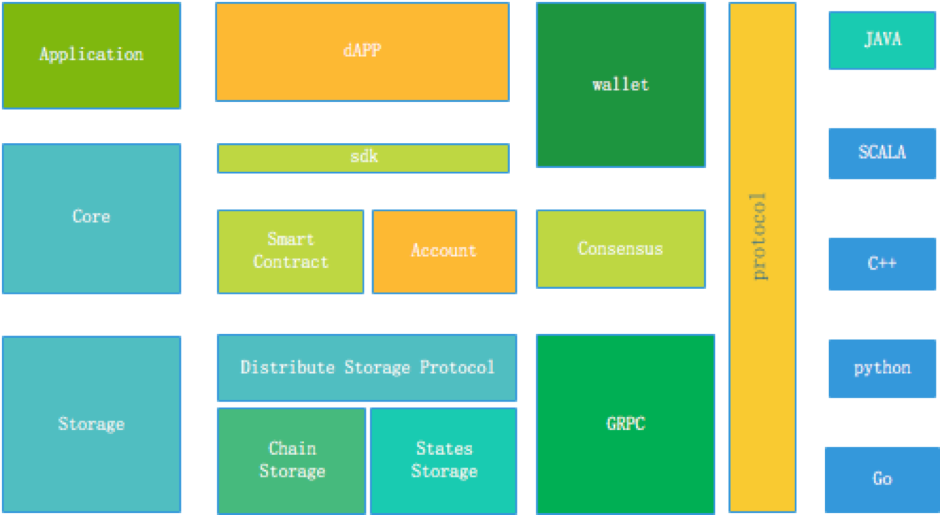
รูปที่ 1: TRON สถาปัตยกรรม 3 ชั้น
2.1 แกน
มีหลายโมดูลในเลเยอร์หลัก รวมถึง smart contracts การจัดการบัญชี และ ฉันทามติ เครื่องเสมือนแบบสแต็กถูกใช้งานบน TRON และคำสั่งที่ปรับให้เหมาะสม มีการใช้ชุด เพื่อสนับสนุนนักพัฒนา DApp ได้ดียิ่งขึ้น Solidity ได้รับเลือกให้เป็น smart contract 4 ตามมาด้วยการสนับสนุนภาษาขั้นสูงอื่นๆ ในอนาคต นอกจากนี้ ฉันทามติของ TRON กลไกจะขึ้นอยู่กับ Delegated Proof of Stake (DPoS) และมีการสร้างนวัตกรรมมากมายใน เพื่อให้เป็นไปตามข้อกำหนดเฉพาะของมัน 2.2 การจัดเก็บ
TRON ออกแบบโปรโตคอลการจัดเก็บข้อมูลแบบกระจายที่ไม่ซ้ำใคร ซึ่งประกอบด้วย Block Storage และ State ที่เก็บของ แนวคิดของฐานข้อมูลกราฟถูกนำมาใช้ในการออกแบบชั้นจัดเก็บข้อมูลเพื่อ ตอบสนองความต้องการการจัดเก็บข้อมูลที่หลากหลายในโลกแห่งความเป็นจริงได้ดีขึ้น 2.2.1 ที่เก็บข้อมูลบล็อคเชน
TRON blockchain พื้นที่เก็บข้อมูลเลือกใช้ LevelDB ซึ่งพัฒนาโดย Google และผ่านการพิสูจน์แล้ว ประสบความสำเร็จกับบริษัทและโครงการมากมาย มีประสิทธิภาพสูงและรองรับไบต์โดยพลการ อาร์เรย์เป็นทั้งคีย์และค่า รับเอกพจน์ ใส่และลบ ใส่และลบเป็นกลุ่ม สองทิศทาง ตัววนซ้ำและการบีบอัดอย่างง่ายโดยใช้อัลกอริธึม Snappy ที่รวดเร็วมาก 2.2.2 การจัดเก็บของรัฐ
TRON มี KhaosDB ในหน่วยความจำโหนดเต็มที่สามารถจัดเก็บโซ่ที่แยกใหม่ทั้งหมดที่สร้างขึ้น ภายในระยะเวลาที่กำหนดและสนับสนุนให้พยานเปลี่ยนจากห่วงโซ่ที่ใช้งานของตนเองได้อย่างรวดเร็ว เข้าสู่ห่วงโซ่หลักใหม่ นอกจากนี้ยังสามารถปกป้องที่เก็บข้อมูล blockchain โดยการทำให้มันมีเสถียรภาพมากขึ้นจากการเป็น ยุติอย่างผิดปกติในสภาวะระหว่างกลาง 2.3 การสมัคร
นักพัฒนาสามารถสร้าง DApps ที่หลากหลายและกระเป๋าเงินแบบกำหนดเองได้บน TRON ตั้งแต่ TRON เปิดใช้งาน smart contracts เพื่อปรับใช้และดำเนินการ โอกาสของแอปพลิเคชันยูทิลิตี้คือ ไม่จำกัด 4 เอกสารอย่างเป็นทางการของ Solidity: https://solidity.readthedocs.io/
2.4 พิธีสาร
TRON โปรโตคอลเป็นไปตาม Google Protocol Buffers ซึ่งเป็นภาษาที่เป็นกลาง แพลตฟอร์มที่เป็นกลาง 5 และวิธีที่ขยายได้ของซีเรียลไลซ์ข้อมูลที่มีโครงสร้างเพื่อใช้ในโปรโตคอลการสื่อสาร การจัดเก็บข้อมูล และอีกมากมาย 2.4.1 บัฟเฟอร์โปรโตคอล
Protocol Buffers (Protobuf) เป็นกลไกอัตโนมัติที่ยืดหยุ่น มีประสิทธิภาพ สำหรับการจัดโครงสร้างอนุกรม ข้อมูลคล้ายกับ JSON หรือ XML แต่มีขนาดเล็กกว่า เร็วกว่า และง่ายกว่ามาก
คำจำกัดความ Protobuf (.proto) สามารถใช้เพื่อสร้างโค้ดสำหรับ C++, Java, C#, Python, Ruby, ภาษา Golang และ Objective-C ผ่านตัวสร้างโค้ดอย่างเป็นทางการ บุคคลที่สามต่างๆ การใช้งานยังมีให้บริการในภาษาอื่นอีกมากมาย Protobuf ช่วยให้การพัฒนาง่ายขึ้น ลูกค้าโดยการรวมคำจำกัดความ API และเพิ่มประสิทธิภาพการถ่ายโอนข้อมูล ลูกค้าสามารถรับ API ได้ .proto จากที่เก็บโปรโตคอลของ TRON และบูรณาการผ่านโค้ดที่สร้างขึ้นโดยอัตโนมัติ ห้องสมุด
จากการเปรียบเทียบ Protocol Buffers มีขนาดเล็กกว่า 3 ถึง 10 เท่าและเร็วกว่า XML 20 ถึง 100 เท่า ด้วยไวยากรณ์ที่ไม่ชัดเจนน้อยกว่า Protobuf สร้างคลาสการเข้าถึงข้อมูลที่ใช้งานง่ายกว่า โดยทางโปรแกรม 2.4.2 HTTP
TRON โปรโตคอลให้ทางเลือก RESTful HTTP API แทน Protobuf API พวกเขาแบ่งปันเหมือนกัน อินเทอร์เฟซ แต่ HTTP API สามารถใช้งานได้ทันทีในไคลเอนต์จาวาสคริปต์ 2.5 TRON เครื่องเสมือน (TVM)
TVM เป็นเครื่องเสมือนทัวริงที่สมบูรณ์แบบน้ำหนักเบาที่พัฒนาขึ้นสำหรับระบบนิเวศของ TRON ที่
TVM เชื่อมโยงอย่างราบรื่นกับระบบนิเวศการพัฒนาที่มีอยู่เพื่อให้บริการผู้คนนับล้านทั่วโลก
นักพัฒนาซอฟต์แวร์ที่มีระบบ blockchain ที่สร้างขึ้นเองซึ่งมีประสิทธิภาพ สะดวก มีเสถียรภาพ ปลอดภัย และ
ปรับขนาดได้
2.6 การแลกเปลี่ยนแบบกระจายอำนาจ (DEX)
5 เอกสารอย่างเป็นทางการของ Google Protocol Buffers: https://developers.google.com/protocol-buffers/เครือข่าย TRON รองรับฟังก์ชันการแลกเปลี่ยนแบบกระจายอำนาจโดยกำเนิด การแลกเปลี่ยนแบบกระจายอำนาจ ประกอบด้วยคู่การซื้อขายหลายคู่ คู่การซื้อขาย (สัญลักษณ์ “การแลกเปลี่ยน”) คือตลาดแลกเปลี่ยน ระหว่าง TRC-10 tokens หรือระหว่าง TRC-10 token และ TRX บัญชีใดก็ได้สามารถสร้างการซื้อขายได้ จับคู่ระหว่าง tokens ใด ๆ แม้ว่าจะมีคู่เดียวกันอยู่แล้วบนเครือข่าย TRON ก็ตาม การค้าขายและ ความผันผวนของราคาของคู่การซื้อขายเป็นไปตามพิธีสาร Bancor เครือข่าย TRON กำหนดไว้เช่นนั้น 6 น้ำหนักของ token สองคู่ในคู่การซื้อขายทั้งหมดเท่ากัน ดังนั้นอัตราส่วนของยอดคงเหลือคือราคา ระหว่างพวกเขา ตัวอย่างเช่น พิจารณาคู่การซื้อขายที่มี tokens สองรายการ ได้แก่ ABC และ DEF เอบีซีก็มี ยอดคงเหลือ 10 ล้าน และ DEF มียอด 1 ล้าน เนื่องจากน้ำหนักเท่ากัน 10 ABC = 1 การป้องกัน ซึ่งหมายความว่าอัตราส่วนของ ABC ต่อ DEF คือ 10 ABC ต่อ DEF 2.7 การนำไปปฏิบัติ
รหัส TRON blockchain ถูกนำมาใช้ใน Java และเดิมทีเป็นทางแยกจาก EthereumJ
6 เว็บไซต์อย่างเป็นทางการของพิธีสาร Bancor: https://about.bancor.network/protocol/
Architektur
TRON verwendet eine dreischichtige Architektur, die in Speicherschicht, Kernschicht und Anwendungsschicht unterteilt ist. Das TRON-Protokoll folgt Google Protobuf, das von Natur aus Mehrsprachen unterstützt Erweiterung.
Abbildung 1: TRON 3-Schicht-Architektur
2.1 Kern
In der Kernschicht gibt es mehrere Module, darunter smart contracts, Kontoverwaltung und Konsens. Eine stapelbasierte virtuelle Maschine wird auf TRON und einer optimierten Anweisung implementiert Satz verwendet wird. Um DApp-Entwickler besser zu unterstützen, wurde Solidity als smart contract ausgewählt. 4 Sprache, gefolgt von der zukünftigen Unterstützung anderer fortgeschrittener Sprachen. Darüber hinaus der Konsens von TRON Der Mechanismus basiert auf dem Delegated Proof of Stake (DPoS) und viele Innovationen wurden vorgenommen um seinen individuellen Anforderungen gerecht zu werden. 2.2 Lagerung
TRON hat ein einzigartiges verteiltes Speicherprotokoll entwickelt, das aus Blockspeicher und Status besteht Lagerung. Der Begriff einer Graphdatenbank wurde in das Design der Speicherschicht eingeführt den Bedarf an diversifizierter Datenspeicherung in der realen Welt besser erfüllen. 2.2.1 Blockchain-Speicher
TRON blockchain Speicher entscheidet sich für die Verwendung von LevelDB, das von Google entwickelt und bewährt wurde erfolgreich bei vielen Unternehmen und Projekten. Es verfügt über eine hohe Leistung und unterstützt beliebige Bytes Arrays sowohl als Schlüssel als auch als Werte, singuläres Abrufen, Einfügen und Löschen, gestapeltes Einfügen und Löschen, bidirektional Iteratoren und einfache Komprimierung mit dem sehr schnellen Snappy-Algorithmus. 2.2.2 Zustandsspeicher
TRON verfügt über eine KhaosDB im Vollknotenspeicher, die alle neu generierten gegabelten Ketten speichern kann innerhalb eines bestimmten Zeitraums und unterstützt Zeugen beim schnellen Wechsel aus der eigenen aktiven Kette in eine neue Hauptkette. Es kann auch den Speicher blockchain schützen, indem es ihn stabiler macht endet abnormal in einem Zwischenzustand. 2.3 Anwendung
Entwickler können auf TRON eine Vielzahl von DApps und benutzerdefinierten Wallets erstellen. Seit TRON ermöglicht die Bereitstellung und Ausführung von smart contracts, die Möglichkeiten von Dienstprogrammanwendungen sind groß unbegrenzt. 4 Offizielle Solidity-Dokumentation: https://solidity.readthedocs.io/
2.4 Protokoll
Das TRON-Protokoll folgt Google Protocol Buffers, einem sprach- und plattformneutralen Protokoll. 5 und erweiterbare Möglichkeit zur Serialisierung strukturierter Daten zur Verwendung in Kommunikationsprotokollen, Datenspeicherung, und mehr. 2.4.1 Protokollpuffer
Protocol Buffers (Protobuf) ist ein flexibler, effizienter und automatisierter Mechanismus zur Serialisierung strukturierter Daten Daten, ähnlich wie JSON oder XML, aber viel kleiner, schneller und einfacher.
Protobuf-Definitionen (.proto) können zum Generieren von Code für C++, Java, C#, Python, Ruby, Golang- und Objective-C-Sprachen über die offiziellen Codegeneratoren. Diverse Drittanbieter Implementierungen sind auch für viele andere Sprachen verfügbar. Protobuf erleichtert die Entwicklung für Clients durch Vereinheitlichung der API-Definitionen und Optimierung der Datenübertragung. Kunden können die API nutzen .proto aus dem Protokoll-Repository von TRON herunterladen und über den automatisch generierten Code integrieren Bibliotheken.
Im Vergleich dazu ist Protocol Buffers 3 bis 10 Mal kleiner und 20 bis 100 Mal schneller als XML. mit weniger mehrdeutiger Syntax. Protobuf generiert Datenzugriffsklassen, die einfacher zu verwenden sind programmatisch. 2.4.2 HTTP
Das TRON-Protokoll bietet eine RESTful-HTTP-API-Alternative zur Protobuf-API. Sie teilen dasselbe Schnittstelle, aber die HTTP-API kann problemlos in Javascript-Clients verwendet werden. 2.5 TRON Virtuelle Maschine (TVM)
Der TVM ist eine leichte, vollständige virtuelle Turing-Maschine, die für das Ökosystem von TRON entwickelt wurde. Die
TVM verbindet sich nahtlos mit dem bestehenden Entwicklungsökosystem, um Millionen von Menschen auf der ganzen Welt bereitzustellen
Entwicklern ein maßgeschneidertes blockchain-System zur Verfügung, das effizient, bequem, stabil, sicher und effizient ist
skalierbar.
2.6 Dezentraler Austausch (DEX)
5 Offizielle Dokumentation zu Google Protocol Buffers: https://developers.google.com/protocol-buffers/Das Netzwerk TRON unterstützt nativ dezentrale Austauschfunktionen. Eine dezentrale Börse besteht aus mehreren Handelspaaren. Ein Handelspaar (Bezeichnung „Börse“) ist ein Börsenmarkt zwischen TRC-10 tokens oder zwischen einem TRC-10 token und TRX. Jedes Konto kann einen Handel erstellen Paar zwischen beliebigen tokens, auch wenn das gleiche Paar bereits im TRON-Netzwerk vorhanden ist. Handel und Preisschwankungen der Handelspaare folgen dem Bancor-Protokoll. Das Netzwerk TRON schreibt dies vor 6 Die Gewichte der beiden tokens in allen Handelspaaren sind gleich, daher ist das Verhältnis ihrer Salden der Preis zwischen ihnen. Betrachten Sie beispielsweise ein Handelspaar mit zwei tokens, ABC und DEF. ABC hat ein Saldo von 10 Millionen und DEF hat einen Saldo von 1 Million. Da ihre Gewichte gleich sind, ist 10 ABC = 1 DEF. Das bedeutet, dass das Verhältnis von ABC zu DEF 10 ABC pro DEF beträgt. 2.7 Umsetzung
Der Code TRON blockchain ist in Java implementiert und war ursprünglich ein Fork von EthereumJ.
6 Offizielle Website des Bancor-Protokolls: https://about.bancor.network/protocol/
ฉันทามติ
3.1 หลักฐานการเดิมพันที่ได้รับมอบหมาย (DPoS)
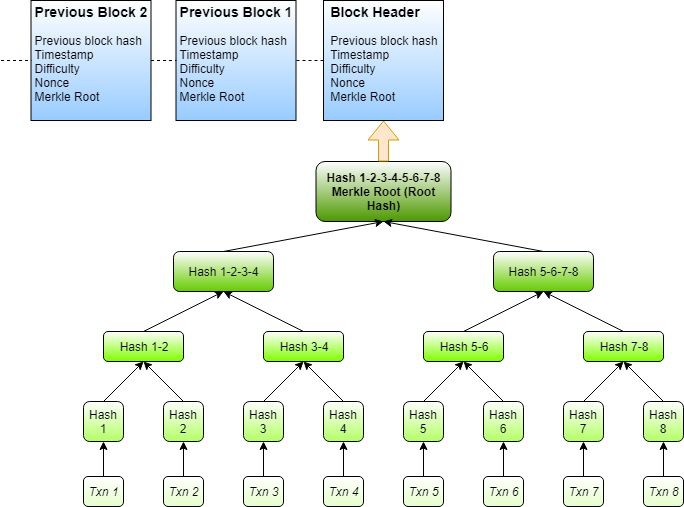
กลไกฉันทามติแรกสุดคือกลไกฉันทามติ Proof of Work (PoW) นี้ ปัจจุบันมีการใช้โปรโตคอลใน Bitcoin และ Ethereum ในระบบ PoW ธุรกรรม 7 8 การออกอากาศผ่านเครือข่ายจะถูกจัดกลุ่มเข้าด้วยกันเป็นบล็อกใหม่เพื่อยืนยันการขุด ที่ กระบวนการยืนยันเกี่ยวข้องกับธุรกรรม hashing โดยใช้อัลกอริธึมการเข้ารหัส hashing จนกระทั่ง ถึงราก Merkle แล้ว ทำให้เกิดต้นไม้ Merkle:
รูปที่ 2: ธุรกรรม 8 TRX ถูก hashed เข้าสู่ Merkle Root ราก Merkle นี้จะถูกรวมไว้ในส่วนหัวของบล็อกซึ่ง ถูกแนบไปกับบล็อกที่ยืนยันก่อนหน้านี้เพื่อสร้าง blockchain ช่วยให้สามารถติดตามได้ง่ายและโปร่งใส ธุรกรรม การประทับเวลา และข้อมูลอื่นๆ ที่เกี่ยวข้อง
7 Bitcoin เอกสารไวท์เปเปอร์: https://bitcoin.org/bitcoin.pdf 8 Ethereum เอกสารไวท์เปเปอร์: https://github.com/ethereum/wiki/wiki/White-Paper
อัลกอริธึมการเข้ารหัส hashing มีประโยชน์ในการป้องกันการโจมตีเครือข่ายเนื่องจากมี
คุณสมบัติหลายประการ:
9
●
ขนาดความยาวอินพุต/เอาต์พุต - อัลกอริธึมสามารถส่งผ่านอินพุตขนาดความยาวเท่าใดก็ได้ และ
ส่งออกค่า hash ที่มีความยาวคงที่
●
ประสิทธิภาพ - อัลกอริธึมค่อนข้างง่ายและรวดเร็วในการคำนวณ
●
ความต้านทานพรีอิมเมจ - สำหรับเอาท์พุตที่กำหนด z เป็นไปไม่ได้ที่จะหาอินพุต x เช่นนั้น
ชั่วโมง(x) = z กล่าวอีกนัยหนึ่ง hashing อัลกอริธึม h(x) เป็นฟังก์ชันทางเดียวซึ่งมีเพียงฟังก์ชันทางเดียวเท่านั้น
สามารถค้นหาเอาต์พุตได้โดยระบุอินพุต ย้อนกลับเป็นไปไม่ได้
●
ความต้านทานการชน - การคำนวณเป็นไปไม่ได้ที่จะหาคู่ใดๆ x1 ≠ x2 โดยที่ h(x1)
= ชม(x2). กล่าวอีกนัยหนึ่ง ความน่าจะเป็นในการค้นหาอินพุตที่แตกต่างกันสองรายการ hashing เหมือนกัน
เอาต์พุตต่ำมาก คุณสมบัตินี้ยังหมายถึงความต้านทานของพรีอิมเมจที่สองด้วย
●
ความต้านทานพรีอิมเมจที่สอง - เมื่อให้ x1 และด้วยเหตุนี้ h(x1) จึงเป็นไปไม่ได้โดยการคำนวณ
จงหา x2 ใดๆ ที่ทำให้ h(x1) = h(x2) แม้ว่าคุณสมบัตินี้จะคล้ายกับ 'ความต้านทานการชน' แต่
คุณสมบัติแตกต่างตรงที่บอกว่าผู้โจมตีที่ได้รับ x1 จะค้นหามันโดยการคำนวณ
เป็นไปไม่ได้ที่จะค้นหา x2 hashing ใด ๆ ไปยังเอาต์พุตเดียวกัน
●
กำหนด - แมปแต่ละอินพุตกับเอาต์พุตเดียวเท่านั้น
●
Avalanche effect - การเปลี่ยนแปลงเล็กน้อยในอินพุตส่งผลให้เอาต์พุตแตกต่างไปจากเดิมอย่างสิ้นเชิง
คุณสมบัติเหล่านี้ทำให้เครือข่ายสกุลเงินดิจิทัลมีมูลค่าที่แท้จริงโดยทำให้แน่ใจว่าการโจมตีจะไม่เกิดขึ้น ประนีประนอมเครือข่าย เมื่อนักขุดยืนยันบล็อก พวกเขาได้รับรางวัล tokens เป็นบล็อกในตัว แรงจูงใจในการเข้าร่วมเครือข่าย อย่างไรก็ตาม เนื่องจากมูลค่าตลาดของสกุลเงินดิจิทัลทั่วโลก เพิ่มขึ้นอย่างต่อเนื่อง นักขุดกลายเป็นศูนย์กลางและมุ่งเน้นไปที่ทรัพยากรคอมพิวเตอร์ของพวกเขา การกักตุน tokens เป็นทรัพย์สิน แทนที่จะสะสมไว้เพื่อวัตถุประสงค์ในการเข้าร่วมเครือข่าย นักขุดซีพียูหลีกทางให้ GPU ซึ่งทำให้ ASIC ทรงพลังกลับมา ในการศึกษาที่โดดเด่นเรื่องหนึ่งคือพลังทั้งหมด ปริมาณการใช้ Bitcoin การขุดคาดว่าจะสูงถึง 3 GW เทียบได้กับของไอร์แลนด์ 10 การใช้พลังงาน การศึกษาเดียวกันนี้คาดการณ์ว่าการใช้พลังงานทั้งหมดจะสูงถึง 8 GW ในเร็วๆ นี้ อนาคต
เพื่อแก้ไขปัญหาขยะพลังงาน กลไกฉันทามติ Proof of Stake (PoS) ได้รับการเสนอโดย เครือข่ายใหม่มากมาย ในเครือข่าย PoS ผู้ถือ token ล็อคยอดคงเหลือ token ของตนเพื่อให้กลายเป็นบล็อก validatorส. validators ผลัดกันเสนอและลงคะแนนในบล็อกถัดไป อย่างไรก็ตามปัญหา ด้วย PoS มาตรฐานคืออิทธิพลของ validator มีความสัมพันธ์โดยตรงกับจำนวน tokens ที่ถูกล็อค ส่งผลให้ฝ่ายต่างๆ กักตุนสกุลเงินหลักของเครือข่ายจำนวนมากจนเกินควร อิทธิพลในระบบนิเวศเครือข่าย
กลไกฉันทามติ TRON ใช้ระบบ Delegated Proof of Stake ที่เป็นนวัตกรรมใหม่ ซึ่ง 27
ผู้แทนระดับสูง (SR) ผลิตบล็อกสำหรับเครือข่าย ทุก 6 ชั่วโมง ผู้ถือบัญชี TRX
ผู้ระงับบัญชีของตนสามารถลงคะแนนให้ผู้สมัคร SR ที่เลือกได้ โดยมีผู้สมัคร 27 อันดับแรก
ถือว่า ส.ส. ผู้ลงคะแนนอาจเลือก SR ตามเกณฑ์ เช่น โครงการที่ได้รับการสนับสนุนจาก SR
9 PAAR, C., PELZL, J., ทำความเข้าใจการเข้ารหัส: หนังสือเรียนสำหรับนักเรียนและผู้ปฏิบัติงาน, 2010 ed.
สปริงเกอร์-แวร์ลัก เบอร์ลิน ไฮเดลเบิร์ก, 2010.
10 https://www.sciencedirect.com/science/article/pii/S2542435118301776เพิ่มการยอมรับ TRX และรางวัลจะแจกจ่ายให้กับผู้มีสิทธิเลือกตั้ง ซึ่งจะช่วยให้เกิดความเป็นประชาธิปไตยมากขึ้นและ
ระบบนิเวศกระจายอำนาจ บัญชีของ SR เป็นบัญชีปกติแต่เป็นการสะสมคะแนนเสียง
ทำให้พวกเขาสามารถสร้างบล็อกได้ ด้วยอัตราปริมาณงานต่ำที่ Bitcoin และ Ethereum เนื่องจาก
กลไกฉันทามติ PoW และปัญหาความสามารถในการปรับขนาด ระบบ DPoS ของ TRON นำเสนอนวัตกรรมใหม่
กลไกที่ส่งผลให้ปี 2000 TPS เปรียบเทียบกับ Bitcoin's 3 TPS และ Ethereum's 15 TPS
เครือข่ายโปรโตคอล TRON สร้างหนึ่งบล็อกทุกๆ สามวินาที โดยแต่ละบล็อกจะให้รางวัล 32 TRX ถึงตัวแทนระดับสูง จะมีการมอบ TRX รวม 336,384,000 TRX เป็นประจำทุกปีให้กับ SR 27 รายการ แต่ละครั้งที่ SR เสร็จสิ้นการผลิตบล็อก รางวัลจะถูกส่งไปยังบัญชีย่อยในบัญชีแยกประเภทขั้นสูง SR สามารถตรวจสอบได้ แต่ไม่สามารถใช้ TRX tokens เหล่านี้ได้โดยตรง การถอนเงินสามารถทำได้โดยแต่ละคน SR หนึ่งครั้งทุกๆ 24 ชั่วโมง โดยโอนรางวัลจากบัญชีย่อยไปยัง SR ที่ระบุ บัญชี
โหนดสามประเภทบนเครือข่าย TRON ได้แก่ Witness Node, Full Node และ Solidity Node โหนดพยานได้รับการจัดตั้งขึ้นโดย SR และมีหน้าที่หลักในการผลิตบล็อกและข้อเสนอ การสร้าง/การลงคะแนนเสียง โหนดแบบเต็มมี API และธุรกรรมและบล็อกการออกอากาศ การซิงค์โหนด Solidity บล็อกจากโหนดเต็มอื่นๆ และยังมี API ที่สามารถจัดทำดัชนีได้
Konsens
3.1 Delegierter Nachweis des Einsatzes (DPoS)
Der früheste Konsensmechanismus ist der Proof of Work (PoW)-Konsensmechanismus. Dies Das Protokoll ist derzeit in Bitcoin und Ethereum implementiert. In PoW-Systemen Transaktionen 7 8 Über das Netzwerk gesendete Daten werden zur Bestätigung durch den Miner in neu entstehende Blöcke gruppiert. Die Der Bestätigungsprozess umfasst das hashing von Transaktionen mithilfe kryptografischer hashing-Algorithmen, bis a Die Merkle-Wurzel wurde erreicht, wodurch ein Merkle-Baum erstellt wurde:
Abbildung 2: 8 TRX-Transaktionen werden im Merkle-Root hashed. Diese Merkle-Wurzel wird dann in den Block-Header eingefügt, der wird an die zuvor bestätigten Blöcke angehängt, um einen blockchain zu bilden. Dies ermöglicht eine einfache und transparente Nachverfolgung Transaktionen, Zeitstempel und andere verwandte Informationen.
7 Bitcoin Whitepaper: https://bitcoin.org/bitcoin.pdf 8 Ethereum Whitepaper: https://github.com/ethereum/wiki/wiki/White-Paper
Kryptografische Algorithmen sind bei der Verhinderung von Netzwerkangriffen nützlich, da sie Folgendes besitzen
mehrere Eigenschaften:
9
●
Größe der Eingabe-/Ausgabelänge – Der Algorithmus kann eine Eingabe beliebiger Länge und Größe übergeben
gibt einen Wert mit fester Länge hash aus.
●
Effizienz: Der Algorithmus ist relativ einfach und schnell zu berechnen.
●
Urbildwiderstand – Für einen gegebenen Ausgang z ist es unmöglich, einen solchen Eingang x zu finden
h(x) = z. Mit anderen Worten, der hashing-Algorithmus h(x) ist eine Einwegfunktion, in der nur die
Ausgabe kann gefunden werden, wenn eine Eingabe gegeben ist. Das Umgekehrte ist nicht möglich.
●
Kollisionswiderstand – Es ist rechnerisch nicht möglich, Paare x1 ≠ x2 zu finden, so dass h(x1)
= h(x2). Mit anderen Worten, die Wahrscheinlichkeit, zwei unterschiedliche Eingaben zu finden, die auf denselben Wert verweisen
Die Leistung ist extrem gering. Diese Eigenschaft impliziert auch einen Widerstand gegen das zweite Urbild.
●
Zweiter Urbildwiderstand: Bei gegebenem x1 und damit h(x1) ist dies rechnerisch nicht möglich
Finden Sie ein beliebiges x2 mit h(x1) = h(x2). Während diese Eigenschaft der Kollisionsbeständigkeit ähnelt, ist die
Die Eigenschaft unterscheidet sich darin, dass sie besagt, dass ein Angreifer mit einem bestimmten x1 es rechnerisch finden wird
Es ist unmöglich, x2 hashzu finden, die zum gleichen Ausgang führen.
●
Deterministisch – ordnet jede Eingabe einer und nur einer Ausgabe zu.
●
Avalanche-Effekt – eine kleine Änderung der Eingabe führt zu einer völlig anderen Ausgabe.
Diese Eigenschaften verleihen dem Kryptowährungsnetzwerk seinen inneren Wert, indem sie dafür sorgen, dass es nicht zu Angriffen kommt das Netzwerk gefährden. Wenn Miner einen Block bestätigen, erhalten sie als integrierte Belohnung tokens Anreiz zur Netzwerkbeteiligung. Allerdings als die globale Marktkapitalisierung der Kryptowährung Die Zahl der Miner nahm stetig zu, die Miner wurden zentralisiert und konzentrierten ihre Rechenressourcen darauf Horten von tokens als Vermögenswerte und nicht für Zwecke der Netzwerkbeteiligung. CPU-Miner gaben nach GPUs, die wiederum leistungsstarken ASICs Platz machten. In einer bemerkenswerten Studie wurde die Gesamtleistung ermittelt Der Verbrauch von Bitcoin Bergbau wurde auf bis zu 3 GW geschätzt, vergleichbar mit Irland 10 Stromverbrauch. Dieselbe Studie geht davon aus, dass der Gesamtstromverbrauch in naher Zukunft 8 GW erreichen wird Zukunft.
Um das Problem der Energieverschwendung zu lösen, wurde der Proof of Stake (PoS)-Konsensmechanismus vorgeschlagen viele neue Netzwerke. In PoS-Netzwerken sperren token-Inhaber ihre token-Guthaben, um sie zu blockieren validators. Die validators schlagen abwechselnd den nächsten Block vor und stimmen darüber ab. Allerdings ist das Problem Beim Standard-PoS korreliert der Einfluss von validator direkt mit der Anzahl der gesperrten tokens. Dies führt dazu, dass die Parteien große Mengen der Basiswährung des Netzwerks horten und unrechtmäßig handeln Einfluss auf das Netzwerk-Ökosystem.
Der Konsensmechanismus TRON verwendet ein innovatives Delegated Proof of Stake-System, bei dem 27
Super Representatives (SRs) produzieren Blöcke für das Netzwerk. Alle 6 Stunden, TRX-Kontoinhaber
Wer sein Konto einfriert, kann für eine Auswahl von SR-Kandidaten stimmen, darunter die besten 27 Kandidaten
gelten als die SRs. Wähler können SRs auf der Grundlage von Kriterien auswählen, beispielsweise von Projekten, die von SRs gesponsert werden
9 PAAR, C., PELZL, J., Understanding Cryptography: A Textbook for Students and Practitioners, Ausgabe 2010.
Springer-Verlag Berlin Heidelberg, 2010.
10 https://www.sciencedirect.com/science/article/pii/S2542435118301776Erhöhen Sie die TRX-Akzeptanz und die Verteilung der Belohnungen an die Wähler. Dies ermöglicht eine stärkere Demokratisierung und
dezentrales Ökosystem. Die Konten der SRs sind normale Konten, aber ihre Ansammlung von Stimmen
ermöglicht es ihnen, Blöcke zu produzieren. Aufgrund der geringen Durchsatzraten von Bitcoin und Ethereum
PoW-Konsensmechanismus und Skalierbarkeitsprobleme: Das DPoS-System von TRON bietet eine Innovation
Mechanismus führt zu 2000 TPS im Vergleich zu 3 TPS von Bitcoin und 15 TPS von Ethereum.
Das Protokollnetzwerk TRON generiert alle drei Sekunden einen Block, wobei jeder Block 32 vergibt TRX an Supervertreter. Insgesamt werden jährlich 336.384.000 TRX an die 27 SRs vergeben. Jedes Mal, wenn ein SR die Blockproduktion abschließt, werden Belohnungen an ein Unterkonto im Super-Ledger gesendet. SRs können diese TRX tokens prüfen, aber nicht direkt nutzen. Ein Widerruf kann von jedem vorgenommen werden SR einmal alle 24 Stunden, wobei die Prämien vom Unterkonto auf den angegebenen SR übertragen werden Konto.
Die drei Knotentypen im Netzwerk TRON sind Witness Node, Full Node und Solidity Node. Zeugenknoten werden von SRs eingerichtet und sind hauptsächlich für die Blockproduktion und -vorschläge verantwortlich Erstellung/Abstimmung. Vollständige Knoten stellen APIs bereit und übertragen Transaktionen und Blöcke. Solidity-Knoten werden synchronisiert Blöcke von anderen Full Nodes und stellen auch indizierbare APIs bereit.
บัญชี
4.1 ประเภท
บัญชีสามประเภทในเครือข่าย TRON คือบัญชีปกติ บัญชี token และ บัญชีสัญญา
1.
บัญชีปกติใช้สำหรับธุรกรรมมาตรฐาน
2.
บัญชีโทเค็นใช้สำหรับจัดเก็บ TRC-10 tokens
3.
บัญชีสัญญาคือ smart contract บัญชีที่สร้างขึ้นโดยบัญชีปกติและสามารถเป็นได้
กระตุ้นโดยบัญชีปกติเช่นกัน
4.2 การสร้าง
มีสามวิธีในการสร้างบัญชี TRON:
1. สร้างบัญชีใหม่ผ่าน API 2. โอน TRX ไปยังที่อยู่บัญชีใหม่ 3. โอน TRC-10 token ใด ๆ ไปยังที่อยู่บัญชีใหม่
คู่คีย์ออฟไลน์ที่ประกอบด้วยที่อยู่ (คีย์สาธารณะ) และคีย์ส่วนตัว และไม่ได้บันทึกโดย เครือข่าย TRON ก็สามารถสร้างได้เช่นกัน อัลกอริธึมการสร้างที่อยู่ผู้ใช้ประกอบด้วย สร้างคู่คีย์แล้วแยกคีย์สาธารณะ (อาร์เรย์ไบต์ 64 ไบต์แทน x, y พิกัด) แฮชคีย์สาธารณะโดยใช้ฟังก์ชัน SHA3-256 (โปรโตคอล SHA3 ที่นำมาใช้คือ KECCAK-256) และแยกผลลัพธ์ 20 ไบต์สุดท้าย เพิ่ม 41 ที่จุดเริ่มต้นของอาร์เรย์ไบต์ และตรวจสอบให้แน่ใจว่าความยาวที่อยู่เริ่มต้นคือ 21 ไบต์ แฮชที่อยู่สองครั้งโดยใช้ฟังก์ชัน SHA3-256 และใช้ 4 ไบต์แรกเป็นรหัสยืนยัน เพิ่มรหัสยืนยันที่ส่วนท้ายของอักษรย่อ ที่อยู่และรับที่อยู่ในรูปแบบ base58check ผ่านการเข้ารหัส base58 มีการเข้ารหัส ที่อยู่ Mainnet เริ่มต้นด้วย T และมีความยาว 34 ไบต์ 4.3 โครงสร้าง
บัญชีสามประเภทที่แตกต่างกัน ได้แก่ Normal, AssetIssue และ Contract บัญชีประกอบด้วย 7 พารามิเตอร์:
1.
account_name: ชื่อของบัญชีนี้ – เช่น บัญชีบิล.
2.
type : บัญชีนี้เป็นประเภทใด – เช่น 0 (ย่อมาจากประเภท 'ปกติ')
3.
balance: ยอดคงเหลือของบัญชีนี้ – เช่น 4213312.
Protobuf data structure:
message Account {
message Vote {
bytes vote_address = 1;
int64 vote_count = 2;
}
bytes accout_name = 1;
AccountType type = 2;
bytes address = 3;
int64 balance = 4;
repeated Vote votes = 5;
map<string, int64> asset = 6;
int64 latest_operation_time = 10;
}
enum AccountType {
Normal = 0;
AssetIssue = 1;
Contract = 2;
}
Konto
4.1 Typen
Die drei Arten von Konten im TRON-Netzwerk sind reguläre Konten, token-Konten und Vertragskonten.
1.
Für Standardtransaktionen werden reguläre Konten verwendet.
2.
Token-Konten werden zum Speichern von TRC-10 tokens verwendet.
3.
Vertragskonten sind smart contract Konten, die von regulären Konten erstellt wurden und können
wird auch durch reguläre Konten ausgelöst.
4.2 Schöpfung
Es gibt drei Möglichkeiten, ein TRON-Konto zu erstellen:
1. Erstellen Sie über die API ein neues Konto 2. Übertragen Sie TRX auf eine neue Kontoadresse 3. Übertragen Sie alle TRC-10 token in eine neue Kontoadresse
Ein Offline-Schlüsselpaar, das aus einer Adresse (öffentlicher Schlüssel) und einem privaten Schlüssel besteht und nicht von der Adresse aufgezeichnet wird TRON Netzwerk, kann ebenfalls generiert werden. Der Algorithmus zur Generierung der Benutzeradresse besteht aus Erzeugen eines Schlüsselpaars und anschließendes Extrahieren des öffentlichen Schlüssels (64-Byte-Byte-Array, das x, y darstellt). Koordinaten). Hashen Sie den öffentlichen Schlüssel mithilfe der SHA3-256-Funktion (das verwendete SHA3-Protokoll ist). KECCAK-256) und extrahieren Sie die letzten 20 Bytes des Ergebnisses. Fügen Sie 41 am Anfang des Byte-Arrays hinzu und stellen Sie sicher, dass die anfängliche Adresslänge 21 Byte beträgt. Hashen Sie die Adresse zweimal mit der SHA3-256-Funktion und nehmen Sie die ersten 4 Bytes als Bestätigungscode. Fügen Sie den Bestätigungscode am Ende der Initiale hinzu Adresse und erhalten Sie die Adresse im Base58-Check-Format durch Base58-Codierung. Eine verschlüsselte Die Mainnet-Adresse beginnt mit T und ist 34 Byte lang. 4.3 Struktur
Die drei verschiedenen Kontotypen sind Normal, AssetIssue und Contract. Ein Konto enthält 7 Parameter:
1.
Kontoname: der Name für dieses Konto – z.B. RechnungenKonto.
2.
Typ: Um welchen Typ handelt es sich bei diesem Konto – z.B. 0 (steht für Typ „Normal“).
3.
Saldo: Saldo dieses Kontos – z.B. 4213312.
Protobuf data structure:
message Account {
message Vote {
bytes vote_address = 1;
int64 vote_count = 2;
}
bytes accout_name = 1;
AccountType type = 2;
bytes address = 3;
int64 balance = 4;
repeated Vote votes = 5;
map<string, int64> asset = 6;
int64 latest_operation_time = 10;
}
enum AccountType {
Normal = 0;
AssetIssue = 1;
Contract = 2;
}
บล็อก
โดยทั่วไปบล็อกจะมีส่วนหัวของบล็อกและธุรกรรมหลายรายการ
Protobuf data structure:
message Block {
BlockHeader block_header = 1;
repeated Transaction transactions = 2;
}
5.1 ส่วนหัวของบล็อก
ส่วนหัวของบล็อกประกอบด้วย raw_data, witness_signature และ blockID
Protobuf data structure:
message BlockHeader {
message raw {
int64 timestamp = 1;
bytes txTrieRoot = 2;
bytes parentHash = 3;
uint64 number = 4;
uint64 version = 5;
bytes witness_address = 6;
}
bytes witness_signature = 2;
bytes blockID = 3;
}
5.1.1 ข้อมูลดิบ
ข้อมูลดิบจะแสดงเป็น raw_data ใน Protobuf ประกอบด้วยข้อมูลดิบของข้อความ ประกอบด้วย 6 พารามิเตอร์:
1. timestamp: การประทับเวลาของข้อความนี้ – เช่น 1543884429000. 2. txTrieRoot: รากของ Merkle Tree – เช่น 7แดคซา…3ed. 3. parentHash: hash ของบล็อกสุดท้าย – เช่น 7แดคซา…3ed. 4. number: ความสูงของบล็อก – เช่น 4638708. 5. เวอร์ชัน : สงวนไว้ – เช่น.ก. 5.
6. พยาน_ที่อยู่: ที่อยู่ของพยานที่อยู่ในบล็อกนี้ – เช่น 41928c...4d21. 5.1.2 ลายเซ็นพยาน
ลายเซ็นพยานแสดงเป็น witness_signature ใน Protobuf ซึ่งเป็นลายเซ็นสำหรับสิ่งนี้ ส่วนหัวบล็อกจากโหนดพยาน 5.1.3 รหัสบล็อก
Block ID จะแสดงเป็น blockID ใน Protobuf มันมีการระบุอะตอมของบล็อก บล็อก ID มี 2 พารามิเตอร์: 1. hash : hash ของบล็อก 2. number : hash และความสูงของบล็อก 5.2 การทำธุรกรรม 5.2.1 การลงนาม
TRON กระบวนการลงนามธุรกรรมของ __ เป็นไปตามอัลกอริธึมการเข้ารหัส ECDSA มาตรฐาน โดยมี
เส้นโค้งการเลือก SECP256K1 คีย์ส่วนตัวคือตัวเลขสุ่ม และคีย์สาธารณะคือจุดบน
เส้นโค้งรูปไข่ กระบวนการสร้างคีย์สาธารณะประกอบด้วยการสร้างตัวเลขสุ่มเป็น a ก่อน
คีย์ส่วนตัวแล้วคูณจุดฐานของเส้นโค้งรูปไข่ด้วยคีย์ส่วนตัวเพื่อให้ได้
กุญแจสาธารณะ เมื่อธุรกรรมเกิดขึ้น ข้อมูลดิบของธุรกรรมจะถูกแปลงเป็นรูปแบบไบต์ก่อน
ข้อมูลดิบจะผ่าน SHA-256 hashing รหัสส่วนตัวที่สอดคล้องกับสัญญา
ที่อยู่ จากนั้นลงนามผลลัพธ์ของ SHA256 hash จากนั้นผลลายเซ็นจะถูกเพิ่มลงใน
การทำธุรกรรม
5.2.2 โมเดลแบนด์วิธ
ธุรกรรมทั่วไปใช้เฉพาะจุดแบนด์วิธเท่านั้น แต่การดำเนินการ smart contract ใช้ทั้งสองจุด จุดพลังงานและแบนด์วิธ มีจุดแบนด์วิธให้เลือกสองประเภท ผู้ใช้สามารถรับได้ จุดแบนด์วิธจากการแช่แข็ง TRX ในขณะที่จุดแบนด์วิธฟรี 5,000 จุดก็มีให้บริการทุกวัน
เมื่อมีการออกอากาศธุรกรรม TRX มันจะถูกส่งและจัดเก็บในรูปแบบของอาร์เรย์ไบต์ เครือข่าย คะแนนแบนด์วิธที่ใช้โดยหนึ่งธุรกรรม = จำนวนไบต์ของธุรกรรม คูณด้วยอัตราคะแนนแบนด์วิธ ตัวอย่างเช่น หากความยาวอาร์เรย์ไบต์ของธุรกรรมคือ 200 จากนั้นธุรกรรมจะใช้จุดแบนด์วิธ 200 จุด อย่างไรก็ตาม หากการโอน TRX หรือ token ส่งผลให้ บัญชีเป้าหมายที่กำลังสร้าง จากนั้นใช้เฉพาะจุดแบนด์วิธที่ใช้ในการสร้างบัญชี จะถูกหักออก และคะแนนแบนด์วิธเพิ่มเติมจะไม่ถูกหักออก ในการสร้างบัญชี ในสถานการณ์สมมติ เครือข่ายจะใช้จุดแบนด์วิธที่ผู้ริเริ่มธุรกรรมได้รับก่อนจากการแช่แข็ง TRX หากจำนวนเงินนี้ไม่เพียงพอ เครือข่ายจะใช้ธุรกรรม TRX ของผู้ริเริ่ม
ในสถานการณ์การถ่ายโอน TRX มาตรฐานจากบัญชี TRX หนึ่งไปยังอีกบัญชีหนึ่ง เครือข่ายจะใช้ก่อน จุดแบนด์วิธที่ได้รับจากตัวเริ่มต้นธุรกรรมสำหรับการแช่แข็ง TRX ถ้านั่นไม่เพียงพอก็แล้วไป ใช้จากจุดแบนด์วิธฟรี 5,000 รายวัน หากยังไม่เพียงพอก็ต่อเครือข่าย ใช้ TRX ของตัวเริ่มต้นธุรกรรม จำนวนเงินจะคำนวณตามจำนวนไบต์ใน ธุรกรรมคูณด้วย 10 SUN ดังนั้น สำหรับผู้ถือ TRX ส่วนใหญ่ที่อาจไม่จำเป็นต้องหยุด TRX ของพวกเขาที่จะมีส่วนร่วมในการโหวต SR ขั้นตอนแรกจะถูกข้ามโดยอัตโนมัติ (ตั้งแต่ยอดคงเหลือ TRX แช่แข็ง = 0) และแบนด์วิดธ์ฟรี 5,000 ต่อวันขับเคลื่อนธุรกรรม
สำหรับการถ่ายโอน TRC-10 token เครือข่ายจะตรวจสอบก่อนว่าจุดแบนด์วิธว่างทั้งหมดของ ออกสินทรัพย์ token เพียงพอแล้ว ถ้าไม่เช่นนั้น จุดแบนด์วิธที่ได้จากการแช่แข็ง TRX จะเป็นดังนี้ บริโภค หากยังมีจุดแบนด์วิธไม่เพียงพอ จะใช้ TRX ของธุรกรรม ผู้ริเริ่ม
5.2.3 ค่าธรรมเนียม
โดยทั่วไปเครือข่าย TRON จะไม่เรียกเก็บค่าธรรมเนียมสำหรับธุรกรรมส่วนใหญ่ อย่างไรก็ตาม เนื่องจากระบบ ข้อจำกัดและความเป็นธรรม การใช้แบนด์วิธ และการทำธุรกรรมมีค่าธรรมเนียมบางอย่าง
ค่าธรรมเนียมจะแบ่งออกเป็นประเภทต่างๆ ดังต่อไปนี้: 1. ธุรกรรมปกติจะมีค่าใช้จ่ายจุดแบนด์วิธ ผู้ใช้สามารถใช้จุดแบนด์วิธรายวันฟรี (5,000) หรือตรึง TRX เพื่อรับเพิ่ม เมื่อจุดแบนด์วิธไม่เพียงพอ TRX ก็จะเป็นเช่นนั้น ใช้โดยตรงจากบัญชีผู้ส่ง TRX ที่ต้องการคือจำนวนไบต์ * 10 SUN 2. สัญญาอัจฉริยะมีค่าใช้จ่ายพลังงาน (ส่วนที่ 6) แต่ยังต้องมีจุดแบนด์วิธสำหรับ ธุรกรรมที่จะออกอากาศและยืนยัน ค่าใช้จ่ายแบนด์วิดท์จะเหมือนกับข้างต้น 3. ธุรกรรมการค้นหาทั้งหมดนั้นฟรี ไม่มีค่าใช้จ่ายด้านพลังงานหรือแบนด์วิธ
TRON เครือข่ายยังกำหนดชุดค่าธรรมเนียมคงที่สำหรับธุรกรรมต่อไปนี้: 1. การสร้างโหนดพยาน: 9999 TRX 2. การออก TRC-10 token: 1024 TRX 3. การสร้างบัญชีใหม่: 0.1 TRX 4. การสร้างคู่แลกเปลี่ยน: 1024 TRX 5.2.4 การทำธุรกรรมเป็นหลักฐานการเดิมพัน (TaPoS)
TRON ใช้ TaPoS เพื่อให้แน่ใจว่าธุรกรรมทั้งหมดจะยืนยัน blockchain หลักในขณะที่ดำเนินการ
ยากที่จะปลอมแปลงโซ่ปลอม ใน TaPoS เครือข่ายต้องการให้แต่ละธุรกรรมรวมส่วนหนึ่งของ
hash ของส่วนหัวของบล็อกล่าสุด ข้อกำหนดนี้ป้องกันไม่ให้ธุรกรรมถูกเล่นซ้ำ
ทางแยกไม่รวมบล็อกที่อ้างอิง และยังส่งสัญญาณไปยังเครือข่ายที่ผู้ใช้รายใดรายหนึ่งและของพวกเขาเงินเดิมพันอยู่บนทางแยกเฉพาะ กลไกฉันทามตินี้ปกป้องเครือข่ายจากการปฏิเสธ
บริการ 51% การขุดที่เห็นแก่ตัว และการโจมตีแบบใช้จ่ายสองเท่า
5.2.5 การยืนยันธุรกรรม
ธุรกรรมจะรวมอยู่ในบล็อกในอนาคตหลังจากออกอากาศไปยังเครือข่าย หลังจากครบ 19 บล็อคแล้ว ขุดบน TRON (รวมถึงบล็อกของตัวเอง) ธุรกรรมได้รับการยืนยันแล้ว แต่ละบล็อกผลิตโดย หนึ่งใน 27 สุดยอดผู้แทนราษฎรแบบพบกันหมด แต่ละบล็อกใช้เวลาประมาณ 3 วินาทีในการ ถูกขุดบน blockchain เวลาอาจแตกต่างกันเล็กน้อยสำหรับตัวแทนระดับสูงแต่ละคนเนื่องจากเครือข่าย เงื่อนไขและการกำหนดค่าเครื่อง โดยทั่วไปแล้วการทำธุรกรรมจะถือว่าได้รับการยืนยันโดยสมบูรณ์หลังจากนั้น ~1 นาที 5.2.6 โครงสร้าง
Transaction APIs consist of the following functions: message Transaction { message Contract { enum ContractType { AccountCreateContract = 0; // Create account/wallet TransferContract = 1; // Transfer TRX TransferAssetContract = 2; // Transfer TRC10 token VoteWitnessContract = 4; // Vote for Super Representative (SR) WitnessCreateContract = 5; // Create a new SR account AssetIssueContract = 6; // Create a new TRC10 token WitnessUpdateContract = 8; // Update SR information ParticipateAssetIssueContract = 9; // Purchase TRC10 token AccountUpdateContract = 10; // Update account/wallet information FreezeBalanceContract = 11; // Freeze TRX for bandwidth or energy UnfreezeBalanceContract = 12; // Unfreeze TRX WithdrawBalanceContract = 13; // Withdraw SR rewards, once per day UnfreezeAssetContract = 14; // Unfreeze TRC10 token UpdateAssetContract = 15; // Update a TRC10 token’s information ProposalCreateContract = 16; // Create a new network proposal by any SR ProposalApproveContract = 17; // SR votes yes for a network proposal ProposalDeleteContract = 18; // Delete a network proposal by owner CreateSmartContract = 30; // Deploy a new smart contract TriggerSmartContract = 31; // Call a function on a smart contract GetContract = 32; // Get an existing smart contract UpdateSettingContract = 33; // Update a smart contract’s parameters ExchangeCreateContract = 41; // Create a token trading pair on DEX ExchangeInjectContract = 42; // Inject funding into a trading pair
ExchangeWithdrawContract = 43; // Withdraw funding from a trading pair ExchangeTransactionContract = 44; // Perform token trading UpdateEnergyLimitContract = 45; // Update origin_energy_limit on a smart contract } } }
Block
Ein Block enthält typischerweise einen Blockheader und mehrere Transaktionen.
Protobuf data structure:
message Block {
BlockHeader block_header = 1;
repeated Transaction transactions = 2;
}
5.1 Blockkopf
Ein Blockheader enthält raw_data, witness_signature und blockID.
Protobuf data structure:
message BlockHeader {
message raw {
int64 timestamp = 1;
bytes txTrieRoot = 2;
bytes parentHash = 3;
uint64 number = 4;
uint64 version = 5;
bytes witness_address = 6;
}
bytes witness_signature = 2;
bytes blockID = 3;
}
5.1.1 Rohdaten
Rohdaten werden in Protobuf als raw_data bezeichnet. Es enthält die Rohdaten einer Nachricht, bestehend aus 6 Parameter:
1. Zeitstempel: Zeitstempel dieser Nachricht – z.B. 1543884429000. 2. txTrieRoot: die Wurzel des Merkle-Baums – z.B. 7dacsa…3ed. 3. parentHash: der hash des letzten Blocks – z.B. 7dacsa…3ed. 4. Zahl: die Blockhöhe – z.B. 4638708. 5. Version: reserviert – z.B. 5.
6. Zeugenadresse: die Adresse des in diesem Block enthaltenen Zeugen – z.B. 41928c...4d21. 5.1.2 Unterschrift des Zeugen
Die Zeugensignatur wird in Protobuf als witness_signature bezeichnet, was die Signatur dafür ist Blockheader vom Zeugenknoten. 5.1.3 Block-ID
Die Block-ID wird in Protobuf als blockID bezeichnet. Es enthält die atomare Identifikation eines Blocks. Ein Block ID enthält 2 Parameter: 1. hash: der hash des Blocks. 2. Nummer: hash und Höhe des Blocks. 5.2 Transaktion 5.2.1 Unterzeichnung
Der Transaktionssignierungsprozess von TRON folgt einem standardmäßigen kryptografischen ECDSA-Algorithmus mit a
SECP256K1-Auswahlkurve. Ein privater Schlüssel ist eine Zufallszahl und der öffentliche Schlüssel ist ein Punkt auf dem
elliptische Kurve. Der Prozess der Generierung eines öffentlichen Schlüssels besteht darin, zunächst eine Zufallszahl als eine zu generieren
privaten Schlüssel und dann Multiplikation des Basispunkts der elliptischen Kurve mit dem privaten Schlüssel, um den zu erhalten
öffentlicher Schlüssel. Wenn eine Transaktion stattfindet, werden die Rohdaten der Transaktion zunächst in das Byte-Format konvertiert.
Anschließend werden die Rohdaten SHA-256 hashing unterzogen. Der dem Vertrag entsprechende private Schlüssel
Die Adresse signiert dann das Ergebnis des SHA256 hash. Das Signaturergebnis wird dann dem hinzugefügt
Transaktion.
5.2.2 Bandbreitenmodell
Gewöhnliche Transaktionen verbrauchen nur Bandbreitenpunkte, smart contract-Vorgänge verbrauchen jedoch beide Energie- und Bandbreitenpunkte. Es stehen zwei Arten von Bandbreitenpunkten zur Verfügung. Benutzer können gewinnen Bandbreitenpunkte durch das Einfrieren von TRX, während täglich auch 5000 kostenlose Bandbreitenpunkte verfügbar sind.
Wenn eine TRX-Transaktion gesendet wird, wird sie in Form eines Byte-Arrays übertragen und gespeichert das Netzwerk. Von einer Transaktion verbrauchte Bandbreitenpunkte = Anzahl der Transaktionsbytes multipliziert mit der Bandbreitenpunktrate. Wenn beispielsweise die Byte-Array-Länge einer Transaktion 200 beträgt, dann verbraucht die Transaktion 200 Bandbreitenpunkte. Wenn jedoch eine TRX- oder token-Übertragung erfolgt das Zielkonto, das erstellt wird, dann nur die Bandbreitenpunkte, die zum Erstellen des Kontos verbraucht wurden abgezogen, zusätzliche Bandbreitenpunkte werden nicht abgezogen. Bei einer Kontoerstellung In diesem Szenario verbraucht das Netzwerk zunächst die Bandbreitenpunkte, die der Transaktionsinitiator gewonnen hatvom Einfrieren von TRX. Reicht dieser Betrag nicht aus, verbraucht das Netzwerk die Transaktion TRX des Initiators.
In Standard-TRX-Übertragungsszenarien von einem TRX-Konto zu einem anderen verbraucht das Netzwerk zuerst die Bandbreitenpunkte, die der Transaktionsinitiator für das Einfrieren von TRX gewonnen hat. Wenn das nicht ausreicht, dann verbraucht von den kostenlosen 5000 täglichen Bandbreitenpunkten. Wenn das immer noch nicht reicht, dann das Netzwerk verbraucht den TRX des Transaktionsinitiators. Die Menge wird anhand der Anzahl der Bytes berechnet die Transaktion multipliziert mit 10 SUN. Daher ist für die meisten TRX-Inhaber dies nicht unbedingt der Fall Wenn ihr TRX an der SR-Abstimmung teilnehmen möchte, wird der erste Schritt automatisch übersprungen (da TRX-Guthaben eingefroren = 0) und die tägliche freie Bandbreite von 5000 treibt die Transaktion an.
Bei TRC-10 token-Übertragungen überprüft das Netzwerk zunächst, ob die gesamten freien Bandbreitenpunkte des ausgestelltes token-Vermögenswert sind ausreichend. Wenn nicht, sind es die Bandbreitenpunkte, die durch das Einfrieren von TRX erhalten werden verbraucht. Wenn immer noch nicht genügend Bandbreitenpunkte vorhanden sind, wird der TRX der Transaktion verbraucht Initiator.
5.2.3 Gebühr
Das Netzwerk TRON erhebt jedoch systembedingt grundsätzlich keine Gebühren für die meisten Transaktionen Einschränkungen und Fairness, Bandbreitennutzung und Transaktionen erfordern bestimmte Gebühren.
Die Gebühren werden in die folgenden Kategorien unterteilt: 1. Normale Transaktionen kosten Bandbreitenpunkte. Benutzer können die kostenlosen täglichen Bandbreitenpunkte nutzen (5000) oder TRX einfrieren, um mehr zu erhalten. Wenn Bandbreitenpunkte nicht ausreichen, wird TRX ausreichen direkt vom sendenden Konto verwendet werden. Der benötigte TRX ist die Anzahl der Bytes * 10 SUN. 2. Intelligente Verträge kosten Energie (Abschnitt 6), benötigen dafür aber auch Bandbreitenpunkte Die Transaktion muss übertragen und bestätigt werden. Die Bandbreitenkosten sind die gleichen wie oben. 3. Alle Abfragetransaktionen sind kostenlos. Es kostet weder Energie noch Bandbreite.
Das Netzwerk TRON definiert außerdem eine Reihe fester Gebühren für die folgenden Transaktionen: 1. Erstellen eines Zeugenknotens: 9999 TRX 2. Ausgabe eines TRC-10 token: 1024 TRX 3. Erstellen eines neuen Kontos: 0,1 TRX 4. Erstellen eines Austauschpaares: 1024 TRX 5.2.4 Transaktion als Proof of Stake (TaPoS)
TRON verwendet TaPoS, um sicherzustellen, dass alle Transaktionen den Haupt-blockchain bestätigen, während sie ausgeführt werden
Es ist schwierig, gefälschte Ketten zu fälschen. In TaPoS verlangen die Netzwerke, dass jede Transaktion einen Teil davon umfasst
der hash eines aktuellen Blockheaders. Diese Anforderung verhindert, dass Transaktionen wiederholt werden
Forks enthalten nicht den referenzierten Block und signalisieren dem Netzwerk auch, dass ein bestimmter Benutzer und seinDer Einsatz liegt auf einer bestimmten Gabel. Dieser Konsensmechanismus schützt das Netzwerk vor Denial of
Service, 51 %, egoistisches Mining und Double-Spend-Angriffe.
5.2.5 Transaktionsbestätigung
Eine Transaktion wird in einen zukünftigen Block aufgenommen, nachdem sie an das Netzwerk gesendet wurde. Nach 19 Blöcken sind abgebaut auf TRON (einschließlich seines eigenen Blocks), die Transaktion wird bestätigt. Jeder Block wird von erzeugt einer der 27 besten Super-Repräsentanten im Round-Robin-Verfahren. Jeder Block dauert ca. 3 Sekunden auf dem blockchain abgebaut werden. Aufgrund des Netzwerks kann die Zeit für jeden Super-Repräsentanten leicht variieren Bedingungen und Maschinenkonfigurationen. Im Allgemeinen gilt eine Transaktion danach als vollständig bestätigt ~1 Minute. 5.2.6 Struktur
Transaction APIs consist of the following functions: message Transaction { message Contract { enum ContractType { AccountCreateContract = 0; // Create account/wallet TransferContract = 1; // Transfer TRX TransferAssetContract = 2; // Transfer TRC10 token VoteWitnessContract = 4; // Vote for Super Representative (SR) WitnessCreateContract = 5; // Create a new SR account AssetIssueContract = 6; // Create a new TRC10 token WitnessUpdateContract = 8; // Update SR information ParticipateAssetIssueContract = 9; // Purchase TRC10 token AccountUpdateContract = 10; // Update account/wallet information FreezeBalanceContract = 11; // Freeze TRX for bandwidth or energy UnfreezeBalanceContract = 12; // Unfreeze TRX WithdrawBalanceContract = 13; // Withdraw SR rewards, once per day UnfreezeAssetContract = 14; // Unfreeze TRC10 token UpdateAssetContract = 15; // Update a TRC10 token’s information ProposalCreateContract = 16; // Create a new network proposal by any SR ProposalApproveContract = 17; // SR votes yes for a network proposal ProposalDeleteContract = 18; // Delete a network proposal by owner CreateSmartContract = 30; // Deploy a new smart contract TriggerSmartContract = 31; // Call a function on a smart contract GetContract = 32; // Get an existing smart contract UpdateSettingContract = 33; // Update a smart contract’s parameters ExchangeCreateContract = 41; // Create a token trading pair on DEX ExchangeInjectContract = 42; // Inject funding into a trading pair
ExchangeWithdrawContract = 43; // Withdraw funding from a trading pair ExchangeTransactionContract = 44; // Perform token trading UpdateEnergyLimitContract = 45; // Update origin_energy_limit on a smart contract } } }
TRON เครื่องเสมือน
6.1 บทนำ
TRON Virtual Machine (TVM) เป็นเครื่องเสมือนทัวริงที่สมบูรณ์แบบน้ำหนักเบาที่พัฒนาขึ้นสำหรับ ระบบนิเวศของ TRON เป้าหมายคือการจัดหาระบบ blockchain ที่สร้างขึ้นเองซึ่งมีประสิทธิภาพ สะดวก มั่นคง ปลอดภัย และปรับขนาดได้
TVM เริ่มแรกแยกจาก EVM และสามารถเชื่อมต่อกับความแข็งแกร่งที่มีอยู่ smart contract ได้อย่างราบรื่น 11 ระบบนิเวศการพัฒนา ด้วยเหตุนี้ TVM จึงสนับสนุน DPoS ฉันทามติเพิ่มเติม
TVM ใช้แนวคิดเรื่องพลังงาน แตกต่างจากกลไกของแก๊สใน EVM การทำงานของ ธุรกรรมและ smart contracts บน TVM นั้นฟรี โดยไม่ต้องใช้ TRX ในทางเทคนิคแล้วสามารถเรียกใช้งานได้ ความสามารถในการคำนวณบน TVM ไม่ได้ถูกจำกัดด้วยจำนวนการถือครองทั้งหมด tokens 6.2 ขั้นตอนการทำงาน
คอมไพเลอร์จะแปล Solidity smart contract เป็น bytecode ที่สามารถอ่านและเรียกใช้งานได้บน ทีวีเอ็ม จากนั้น TVM จะประมวลผลข้อมูลผ่าน opcode ซึ่งเทียบเท่ากับการใช้งานลอจิก ของเครื่องสถานะจำกัดแบบสแต็ก สุดท้าย TVM เข้าถึงข้อมูล blockchain และเรียกใช้ อินเทอร์เฟซข้อมูลภายนอกผ่านเลเยอร์ Interoperation 11 EVM: Ethereum เครื่องเสมือน (https://github.com/ethereum/ethereumj)
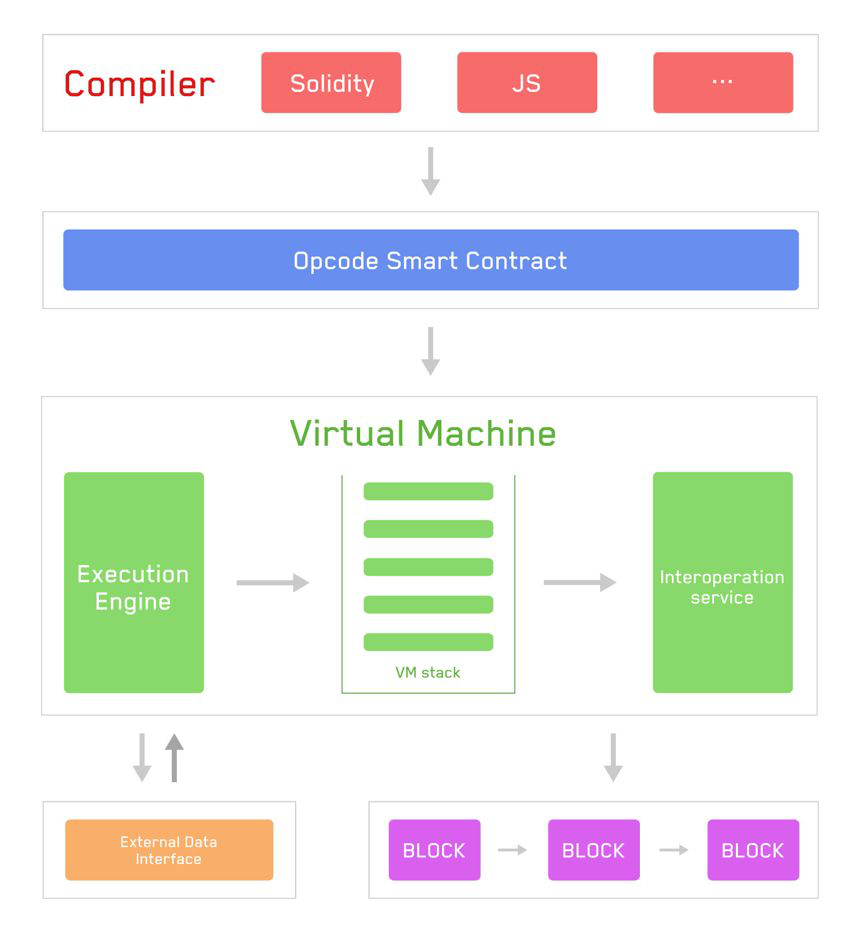
รูปที่ 3: ขั้นตอนการทำงานของ TVM
6.3 ประสิทธิภาพ 6.3.1 สถาปัตยกรรมน้ำหนักเบา
TVM ใช้สถาปัตยกรรมน้ำหนักเบาโดยมีจุดประสงค์เพื่อลดการใช้ทรัพยากรเพื่อรับประกัน ประสิทธิภาพของระบบ 6.3.2 แข็งแกร่ง
TRX ถ่ายโอนและ smart contract จุดแบนด์วิดธ์ค่าใช้จ่ายในการดำเนินการเท่านั้น แทนที่จะเป็น TRX ซึ่ง ยกเว้น TRON จากการถูกโจมตี ปริมาณการใช้แบนด์วิธสามารถคาดเดาได้และคงที่ตั้งแต่แต่ละรายการ ต้นทุนขั้นตอนการคำนวณได้รับการแก้ไขแล้ว 6.3.3 ความเข้ากันได้สูง
TVM เข้ากันได้กับ EVM และจะเข้ากันได้กับ VM หลักอื่นๆ ในอนาคต ด้วยเหตุนี้ smart contracts ทั้งหมดบน EVM จึงสามารถเรียกใช้งานได้บน TVM 6.3.4 ต้นทุนต่ำ
เนื่องจากการตั้งค่าแบนด์วิธของ TVM ต้นทุนการพัฒนาจึงลดลง และนักพัฒนาสามารถมุ่งเน้นไปที่ การพัฒนาตรรกะของรหัสสัญญา TVM ยังมีอินเทอร์เฟซแบบครบวงจรสำหรับสัญญาอีกด้วย การปรับใช้ การทริกเกอร์ และการดูเพื่อมอบความสะดวกสบายให้กับนักพัฒนา
TRON Virtuelle Maschine
6.1 Einführung
TRON Virtual Machine (TVM) ist eine leichte, vollständige Turing-virtuelle Maschine, die für entwickelt wurde Das Ökosystem von TRON. Sein Ziel ist es, ein maßgeschneidertes blockchain-System bereitzustellen, das effizient ist, bequem, stabil, sicher und skalierbar.
TVM wurde ursprünglich von EVM abgezweigt und kann nahtlos mit der bestehenden Solidität smart contract verbunden werden. 11 Entwicklungsökosystem. Auf dieser Grundlage unterstützt TVM zusätzlich den Konsens DPoS.
TVM verwendet das Konzept der Energie. Anders als beim Gasmechanismus auf EVM, Operationen von Transaktionen und smart contracts auf TVM sind kostenlos, es wird kein TRX verbraucht. Technisch ausführbar Die Rechenkapazität auf TVM ist nicht durch den Gesamtbestand von tokens eingeschränkt. 6.2 Arbeitsablauf
Der Compiler übersetzt zunächst den Solidity smart contract in lesbaren und ausführbaren Bytecode der TVM. Das TVM verarbeitet die Daten dann über den Opcode, was dem Betrieb der Logik entspricht eines stapelbasierten Finite-State-Automaten. Schließlich greift der TVM auf blockchain-Daten zu und ruft sie auf Externe Datenschnittstelle über die Interoperation-Schicht. 11 EVM: Ethereum Virtuelle Maschine (https://github.com/ethereum/ethereumj)
Abbildung 3: TVM-Workflow
6.3 Leistung 6.3.1 Leichtbauarchitektur
TVM übernimmt eine leichtgewichtige Architektur mit dem Ziel, einen reduzierten Ressourcenverbrauch zu gewährleisten Systemleistung. 6.3.2 Robust
TRX-Übertragungen und smart contract-Ausführung kosten nur Bandbreitenpunkte, anstelle von TRX, was befreit TRON von Angriffen. Der Bandbreitenverbrauch ist vorhersehbar und statisch Die Kosten für den Rechenschritt sind festgelegt. 6.3.3 Hohe Kompatibilität
TVM ist mit EVM kompatibel und wird in Zukunft mit weiteren Mainstream-VMs kompatibel sein. Dadurch sind alle smart contracts auf EVM auf TVM ausführbar. 6.3.4 Niedrige Kosten
Aufgrund der Bandbreiteneinrichtung von TVM werden die Entwicklungskosten reduziert und Entwickler können sich auf das konzentrieren logische Entwicklung ihres Vertragscodes. TVM bietet auch All-in-One-Schnittstellen für Verträge an Bereitstellung, Auslösung und Anzeige, um Entwicklern Komfort zu bieten.
สัญญาอัจฉริยะ
7.1 บทนำ
smart contract เป็นโปรโตคอลที่ตรวจสอบการเจรจาสัญญาแบบดิจิทัล พวกเขากำหนดกฎเกณฑ์และ บทลงโทษที่เกี่ยวข้องกับข้อตกลงและบังคับใช้ข้อผูกพันเหล่านั้นโดยอัตโนมัติ ผู้ฉลาด รหัสสัญญาอำนวยความสะดวก ตรวจสอบ และบังคับใช้การเจรจาหรือการปฏิบัติตามข้อตกลงหรือ การทำธุรกรรม จากมุมมองของ tokenization smart contracts ยังอำนวยความสะดวกในการให้เงินอัตโนมัติ การโอนระหว่างบุคคลที่เข้าร่วมควรเป็นไปตามเกณฑ์ที่กำหนด
TRON smart contracts เขียนด้วยภาษา Solidity เมื่อเขียนและทดสอบแล้วก็สามารถเป็นได้ คอมไพล์เป็น bytecode จากนั้นปรับใช้บนเครือข่าย TRON สำหรับ TRON Virtual Machine ครั้งหนึ่ง เมื่อปรับใช้แล้ว smart contracts สามารถสอบถามผ่านที่อยู่สัญญาได้ การสมัครสัญญา Binary Interface (ABI) แสดงฟังก์ชันการโทรของสัญญาและใช้สำหรับโต้ตอบกับ เครือข่าย 7.2 แบบจำลองพลังงาน
ขีดจำกัดพลังงานสูงสุดสำหรับการปรับใช้และทริกเกอร์ smart contract เป็นฟังก์ชันของหลายฟังก์ชัน ตัวแปร:
● พลังงานไดนามิกจากการแช่แข็ง 1 TRX คือ 50,000,000,000 (ขีดจำกัดพลังงานรวม) / (พลังงานทั้งหมด น้ำหนัก) ● ขีดจำกัดพลังงานคือขีดจำกัดพลังงานในบัญชีรายวันจากการแช่แข็ง TRX ● พลังงานในบัญชีรายวันที่เหลืออยู่จากการแช่แข็ง TRX จะถูกคำนวณเป็นขีดจำกัดพลังงาน - พลังงาน ใช้แล้ว ● ขีดจำกัดค่าธรรมเนียมใน TRX ถูกตั้งค่าไว้ใน smart contract ปรับใช้/ทริกเกอร์การโทร ● TRX ที่ใช้งานได้คงเหลืออยู่ในบัญชี ● พลังงานต่อ TRX หากซื้อโดยตรง (10 SUN = 1 พลังงาน) = 100,000 SR สามารถลงคะแนนได้ การปรับตัว
มีสองสถานการณ์การใช้งานในการคำนวณขีดจำกัดพลังงานสูงสุดสำหรับการปรับใช้และ
ทริกเกอร์ ตรรกะสามารถแสดงได้ดังนี้:
const R = Dynamic Energy Limit
const F = Daily account energy from freezing TRX
const E = Remaining daily account energy from freezing TRX
const L = Fee limit in TRX set in deploy/trigger call
const T = Remaining usable TRX in account
const C = Energy per TRX if purchased directly
// Calculate M, defined as maximum energy limit for deployment/trigger of smart contract if F > LR let M = min(E+TC, LR) else let M = E+TC 7.3 การปรับใช้
เมื่อคอมไพล์ TRON ความแข็งแกร่ง smart contract แล้ว TRON Virtual Machine จะอ่านคอมไพล์แล้ว ไบต์โค้ด bytecode ประกอบด้วยส่วนสำหรับการปรับใช้โค้ด รหัสสัญญา และ Auxdata Auxdata คือลายนิ้วมือเข้ารหัสของซอร์สโค้ด ซึ่งใช้สำหรับการตรวจสอบ การใช้งาน bytecode รันฟังก์ชัน Constructor และตั้งค่าตัวแปรหน่วยเก็บข้อมูลเริ่มต้น การใช้งาน รหัสยังคำนวณรหัสสัญญาและส่งกลับไปยัง TVM ABI เป็นไฟล์ JSON ที่ อธิบายฟังก์ชันของ TRON smart contract ไฟล์นี้กำหนดชื่อฟังก์ชัน ความสามารถในการชำระ ค่าส่งคืนฟังก์ชันและความไม่แน่นอนของสถานะ 7.4 ฟังก์ชั่นทริกเกอร์
เมื่อ TRON smart contracts ถูกปรับใช้ ฟังก์ชันของพวกมันจะถูกทริกเกอร์แยกกันผ่าน TronStudio หรือผ่านการเรียก API ฟังก์ชันการเปลี่ยนสถานะต้องใช้พลังงานในขณะที่ฟังก์ชันอ่านอย่างเดียว ดำเนินการโดยไม่มีพลังงาน 7.5 TRON ความแข็งแกร่ง
TRON Solidity มาจากภาษา Solidity ของ Ethereum TRON แก้ไขโครงการดั้งเดิมเป็น รองรับหน่วย TRX และ SUN (1 TRX = 1,000,000 SUN) ไวยากรณ์ภาษาที่เหลือคือ เข้ากันได้กับ Solidity ^0.4.24 ดังนั้น Tron Virtual Machine (TVM) จึงเข้ากันได้เกือบ 100% พร้อมคำแนะนำ EVM
Intelligenter Vertrag
7.1 Einführung
Ein smart contract ist ein Protokoll, das Vertragsverhandlungen digital überprüft. Sie definieren die Regeln und Strafen im Zusammenhang mit einer Vereinbarung zu verhängen und diese Verpflichtungen auch automatisch durchzusetzen. Der Schlaue Der Vertragskodex erleichtert, überprüft und erzwingt die Aushandlung oder Erfüllung einer Vereinbarung oder Transaktion. Aus Sicht der tokenisierung ermöglichen smart contracts auch automatische Mittel Übertragungen zwischen teilnehmenden Parteien, sofern bestimmte Kriterien erfüllt sind.
TRON smart contracts sind in der Solidity-Sprache geschrieben. Sobald sie geschrieben und getestet sind, können sie es sein In Bytecode kompiliert und dann im Netzwerk TRON für die virtuelle Maschine TRON bereitgestellt. Einmal Im Einsatz können smart contracts über ihre Vertragsadressen abgefragt werden. Der Vertragsantrag Binary Interface (ABI) zeigt die Aufruffunktionen des Vertrags an und wird für die Interaktion mit dem verwendet Netzwerk. 7.2 Energiemodell
Die maximale Energiegrenze für die Auslösung und Auslösung eines smart contract hängt von mehreren Faktoren ab Variablen:
● Die dynamische Energie aus dem Einfrieren von 1 TRX beträgt 50.000.000.000 (Gesamtenergielimit) / (Gesamtenergie). Gewicht) ● Das Energielimit ist das tägliche Energielimit des Kontos durch das Einfrieren von TRX ● Die verbleibende tägliche Kontoenergie aus dem Einfrieren von TRX wird als Energielimit – Energie berechnet Gebraucht ● Das Gebührenlimit in TRX wird in smart contract Deploy/Trigger Call festgelegt ● Verbleibender nutzbarer TRX im Konto ● Energie pro TRX bei direktem Kauf (10 SUN = 1 Energie) = 100.000, SRs können darüber abstimmen Anpassung
Es gibt zwei Verbrauchsszenarien zur Berechnung der maximalen Energiegrenze für den Einsatz und
Auslöser. Die Logik kann wie folgt ausgedrückt werden:
const R = Dynamic Energy Limit
const F = Daily account energy from freezing TRX
const E = Remaining daily account energy from freezing TRX
const L = Fee limit in TRX set in deploy/trigger call
const T = Remaining usable TRX in account
const C = Energy per TRX if purchased directly
// Calculate M, defined as maximum energy limit for deployment/trigger of smart contract if F > LR let M = min(E+TC, LR) else let M = E+TC 7.3 Bereitstellung
Wenn eine Solidität TRON smart contract kompiliert wird, liest die virtuelle Maschine TRON die kompilierte Datei Bytecode. Der Bytecode besteht aus einem Abschnitt für die Codebereitstellung, dem Vertragscode und den Auxdata. Bei den Auxdata handelt es sich um den kryptografischen Fingerabdruck des Quellcodes, der zur Verifizierung verwendet wird. Der Einsatz Bytecode führt die Konstruktorfunktion aus und richtet die anfänglichen Speichervariablen ein. Der Einsatz code berechnet auch den Vertragscode und gibt ihn an den TVM zurück. Die ABI ist eine JSON-Datei beschreibt die Funktionen eines TRON smart contract. Diese Datei definiert die Funktionsnamen, ihre Bezahlbarkeit, die Funktionsrückgabewerte und ihre Zustandsveränderlichkeit. 7.4 Triggerfunktion
Sobald die TRON smart contracts bereitgestellt sind, können ihre Funktionen einzeln entweder über ausgelöst werden TronStudio oder über API-Aufrufe. Zustandsverändernde Funktionen erfordern Energie, während schreibgeschützte Funktionen vorhanden sind ohne Energie ausführen. 7,5 TRON Solidität
TRON Solidity ist eine Abzweigung aus der Solidity-Sprache von Ethereum. TRON ändert das ursprüngliche Projekt in unterstützen TRX- und SUN-Einheiten (1 TRX = 1.000.000 SUN). Der Rest der Sprachsyntax ist kompatibel mit Solidity ^0.4.24. Somit ist die Tron Virtual Machine (TVM) nahezu 100 % kompatibel mit EVM Anweisungen.
โทเค็น
8.1 โทเค็น TRC-10
ในเครือข่าย TRON แต่ละบัญชีสามารถออก tokens ได้โดยมีค่าใช้จ่าย 1,024 TRX ในการออก tokens ผู้ออกต้องระบุชื่อ token, มูลค่ารวมทั้งหมด, อัตราแลกเปลี่ยนเป็น TRX, ระยะเวลาการหมุนเวียน คำอธิบาย เว็บไซต์ การใช้แบนด์วิธสูงสุดต่อบัญชี รวมทั้งหมด การใช้แบนด์วิธ และจำนวน token ที่ถูกแช่แข็ง token แต่ละฉบับสามารถกำหนดค่าได้เช่นกัน สูงสุดรายวันของแต่ละบัญชี token โอนคะแนนแบนด์วิธ สูงสุดรายวันของเครือข่ายทั้งหมด token โอนคะแนนแบนด์วิธ, การจัดหาทั้งหมด token, ระยะเวลาการล็อคเป็นวัน และจำนวนทั้งหมด ของ tokens ถูกล็อค 8.2 โทเค็น TRC-20
TRC-20 เป็นมาตรฐานทางเทคนิคที่ใช้สำหรับ smart contracts การใช้งาน tokens ที่สนับสนุนโดย TRON เครื่องเสมือน สามารถใช้งานร่วมกับ ERC-20 ได้อย่างสมบูรณ์
อินเทอร์เฟซมีดังนี้:
สัญญา TRC20อินเทอร์เฟซ {
ฟังก์ชัน totalSupply() ผลตอบแทนคงที่สาธารณะ (uint);
ฟังก์ชั่น balanceOf (ที่อยู่ token เจ้าของ) ผลตอบแทนสาธารณะคงที่ (uint
สมดุล);
ฟังก์ชัน เบี้ยเลี้ยง(ที่อยู่ tokenเจ้าของ ที่อยู่ผู้ใช้จ่าย) สาธารณะ ค่าคงที่
ผลตอบแทน (ไม่เหลือ);
ฟังก์ชั่น การถ่ายโอน (ที่อยู่ไปที่ uint tokens) ผลตอบแทนสาธารณะ (บูลสำเร็จ);
ฟังก์ชั่น อนุมัติ (ที่อยู่ผู้ใช้บริการ, uint tokens) ผลตอบแทนสาธารณะ (บูล
ความสำเร็จ);
ฟังก์ชั่น transferFrom (ที่อยู่จาก, ที่อยู่ถึง, uint tokens) สาธารณะ
ผลตอบแทน (ความสำเร็จของบูล);
เหตุการณ์ การโอน (ที่อยู่จัดทำดัชนีจาก, ที่อยู่จัดทำดัชนีถึง, uint tokens);
เหตุการณ์ การอนุมัติ (ที่อยู่จัดทำดัชนี token เจ้าของ ที่อยู่ผู้ใช้จ่ายที่จัดทำดัชนี uint
tokens); }
จากมุมมองของนักพัฒนา TRC-10 และ TRC-20 มีความแตกต่างหลายประการ บ้าง ความแตกต่างที่สำคัญคือ TRC-10 tokens สามารถเข้าถึงได้โดย API และ smart contracts ในขณะที่ TRC-20 tokens อนุญาตให้ปรับแต่งอินเทอร์เฟซได้ แต่สามารถเข้าถึงได้ภายใน smart contracts เท่านั้น
จากมุมมองของต้นทุน TRC-10 tokens มีค่าธรรมเนียมการทำธุรกรรมที่ต่ำกว่า 1,000 เท่า
TRC-20 แต่มีค่าใช้จ่ายแบนด์วิธสำหรับการโอนและการฝาก API การโอนและการฝากเงินในสมาร์ท
สัญญาสำหรับ TRC-10 tokens มีค่าใช้จ่ายทั้งแบนด์วิดท์และพลังงาน
8.3 เกินกว่านั้น
เนื่องจาก TRON ใช้เวอร์ชัน Solidity เดียวกันกับ Ethereum ดังนั้น token มาตรฐานเพิ่มเติมจึงพร้อมใช้งาน ย้ายไปยัง TRON แล้ว
Token
8.1 TRC-10-Token
Im TRON-Netzwerk kann jedes Konto tokens auf Kosten von 1024 TRX ausgeben. Um tokens auszugeben, Der Emittent muss einen token-Namen, die Gesamtkapitalisierung, den Wechselkurs zu TRX angeben. Verbreitungsdauer, Beschreibung, Website, maximaler Bandbreitenverbrauch pro Account, Gesamt Bandbreitenverbrauch und die Menge der eingefrorenen token. Jede token-Ausgabe kann auch konfiguriert werden die maximale tägliche token Übertragungsbandbreitenpunkte jedes Kontos, die maximale tägliche Bandbreite des gesamten Netzwerks token Übertragungsbandbreitenpunkte, Gesamtangebot token, Sperrdauer in Tagen und Gesamtbetrag von tokens gesperrt. 8.2 TRC-20-Token
TRC-20 ist ein technischer Standard, der für smart contracts verwendet wird, die von der unterstützte tokens implementieren TRON Virtuelle Maschine. Es ist vollständig kompatibel mit ERC-20.
Die Schnittstelle ist wie folgt:
Vertrag TRC20Interface {
Funktion totalSupply() public constant returns (uint);
Funktion balanceOf(Adresse tokenOwner) öffentliche Konstante gibt zurück (uint
Gleichgewicht);
Funktion Zulage(Adresse tokenEigentümer, Adressgeber) Öffentliche Konstante
gibt zurück (uint übrig);
Funktion Übertragung(Adresse an, uint tokens) öffentliche Rückgaben (Bool-Erfolg);
Funktion approve(address spender, uint tokens) public returns (bool
Erfolg);
Funktion transferFrom(Adresse von, Adresse an, uint tokens) public
return (bool success);
Ereignis Übertragung(Adresse indiziert von, Adresse indiziert nach, uint tokens);
Ereignis Genehmigung(Adresse indiziert tokenEigentümer, Adresse indizierter Spender, uint
tokens); }
Aus Entwicklersicht gibt es mehrere Unterschiede zwischen TRC-10 und TRC-20. Einige Einer der Hauptunterschiede besteht darin, dass TRC-10-tokens über APIs und smart contracts zugänglich sind TRC-20 tokens ermöglichen die Anpassung der Benutzeroberfläche, sind jedoch nur innerhalb von smart contracts zugänglich.
Aus Kostengründen haben TRC-10 tokens Transaktionsgebühren, die 1000-mal niedriger sind als
TRC-20, verursachen jedoch Bandbreitenkosten für API-Übertragungen und -Einzahlungen. Überweisungen und Einzahlungen in smart
Verträge für TRC-10 tokens kosten sowohl Bandbreite als auch Energie.
8.3 Darüber hinaus
Da TRON dieselbe Solidity-Version wie Ethereum verwendet, könnten problemlos weitere token-Standards implementiert werden portiert auf TRON.
ธรรมาภิบาล
9.1 ตัวแทนระดับสูง 9.1.1 ทั่วไป
ทุกบัญชีในเครือข่าย TRON สามารถสมัครและมีโอกาสที่จะเป็น Super ตัวแทน (แสดงเป็น SR) ทุกคนสามารถลงคะแนนให้ผู้สมัคร SR ได้ ผู้สมัคร 27 อันดับแรกด้วย ผู้โหวตมากที่สุดจะกลายเป็น SR ที่มีสิทธิ์และหน้าที่ในการสร้างบล็อก คะแนนเสียงคือ นับทุกๆ 6 ชั่วโมง และ SR จะเปลี่ยนตามไปด้วย
เพื่อป้องกันการโจมตีที่เป็นอันตราย การสมัครเป็น SR มีค่าใช้จ่าย เมื่อสมัคร 9999 TRX จะถูกเผาจากบัญชีของผู้สมัคร เมื่อสำเร็จแล้ว บัญชีดังกล่าวจะสามารถเข้าร่วม SR ได้ การเลือกตั้ง 9.1.2 การเลือกตั้ง
TRON ต้องใช้อำนาจ (แสดงเป็น TP) ในการลงคะแนนเสียง และจำนวน TP ขึ้นอยู่กับผู้ลงคะแนนเสียง สินทรัพย์ที่ถูกแช่แข็ง (TRX)
TP คำนวณด้วยวิธีต่อไปนี้:
ทีพี
1 TRX ถูกแช่แข็งเพื่อรับแบนด์วิธ
1
=
ทุกบัญชีในเครือข่าย TRON มีสิทธิ์ลงคะแนนให้ SR ของตนเอง
หลังจากการเปิดตัว (เลิกระงับ และใช้งานได้หลังจาก 3 วัน) ผู้ใช้จะไม่มีเนื้อหาที่ถูกแช่แข็งและสูญเสียทั้งหมด ทีพี ตามนั้น ส่งผลให้การลงคะแนนเสียงทั้งหมดเป็นโมฆะสำหรับการลงคะแนนเสียงที่กำลังดำเนินอยู่และรอบต่อไป เว้นแต่ TRX ถูกระงับการลงคะแนนเสียงอีกครั้ง
โปรดทราบว่าเครือข่าย TRON จะบันทึกเฉพาะการโหวตล่าสุดเท่านั้น ซึ่งหมายความว่าทุกการโหวตใหม่ จะลบล้างคะแนนเสียงก่อนหน้านี้ทั้งหมด 9.1.3 รางวัล ก. โหวตรางวัล
เรียกอีกอย่างว่ารางวัลผู้สมัคร ซึ่งผู้สมัคร 127 อันดับแรกจะอัปเดตทุกๆ รอบ (6
ชั่วโมง) จะแบ่ง 115,200 TRX เมื่อขุดได้ รางวัลจะแบ่งตามน้ำหนักคะแนนโหวต
ผู้สมัครแต่ละคนจะได้รับ ในแต่ละปี รางวัลรวมสำหรับผู้สมัครจะเท่ากับ 168,192,000 TRX
รางวัลโหวตรวมต่อรอบ
ทำไมต้อง 115,200 TRX ทุกรอบ?
15, 00 TRX
รางวัลคะแนนโหวตรวมต่อรอบ (VR/รอบ)
1
2
=
VR/รอบ = 16 T RX/บล็อก × 20 บล็อค/นาที × 60 นาที/ชม × 6 ชม./รอบ
หมายเหตุ: ค่านี้กำหนดโดย WITNESS_STANDBY_ALLOWANCE = 115,200 TRX ดูพารามิเตอร์เครือข่ายแบบไดนามิก
รางวัลคะแนนเสียงทั้งหมดต่อปี
ทำไมต้อง 168,192,000 TRX ทุกปี?
168, 192, 000 T RX = รางวัลคะแนนโหวตทั้งหมดต่อปี (V R/ปี)
V R/ปี = 115, 200 T RX/รอบ × 4 รอบ/วัน × 365 วัน/ปี
ข. รางวัลบล็อก
หรือที่เรียกว่า Super Representative Reward ซึ่งผู้เข้าชิง 27 อันดับแรก (SRs) ที่ได้รับเลือก
ทุกรอบ (6 ชั่วโมง) จะแบ่งประมาณ 230,400 TRX เมื่อขุดได้ รางวัลจะแบ่งเท่าๆ กัน
ระหว่าง 27 SR (ลบบล็อกรางวัลทั้งหมดที่พลาดเนื่องจากข้อผิดพลาดของเครือข่าย) รวมของ
336,384,000 TRX จะมอบให้ทุกปีแก่ 27 SR
รางวัลบล็อกทั้งหมดต่อรอบ
ทำไมต้อง 230,400 TRX ทุกรอบ?
230, 400 T RX = รางวัลบล็อคทั้งหมดต่อรอบ (BR/รอบ)
BR/รอบ = 32 T RX/bloc × 20 บล็อก/นาที × 60 นาที/ชม × 6 ชม./รอบ
หมายเหตุ: รางวัลบล็อกหน่วยถูกกำหนดโดย WITNESS_PAY_PER_BLOCK = 32 TRX ดูเครือข่ายแบบไดนามิก
พารามิเตอร์
รางวัลบล็อกทั้งหมดต่อปี
ทำไมต้อง 336,384,000 TRX ทุกปี?
336, 384, 000 T RX = รางวัลบล็อกทั้งหมดต่อปี (BR/ปี)
BR/ปี = 230, 400 T RX/รอบ × 4 รอบ/วัน × 365 วัน/ปี
1 มกราคม 2021
จะไม่มีอัตราเงินเฟ้อบนเครือข่าย TRON ก่อนวันที่ 1 มกราคม 2021 และ TRON DAO จะ
มอบรางวัลบล็อกและรางวัลผู้สมัครทั้งหมดก่อนวันที่ดังกล่าว
ค. การคำนวณรางวัล
การคำนวณรางวัล SR
รางวัลทั้งหมด
รางวัลการโหวต (VR)
รางวัลบล็อก (BR)
ที
=
+
ร
วี อาร์ ทั้งหมด
วี
=
×
คะแนนเสียงทั้งหมด
คะแนนโหวต ผู้สมัคร SR ที่ได้รับ
ร
บล็อกพลาด
2
บี
=
27
รวม BR -
× 3
หมายเหตุ: รางวัลจะคำนวณต่อ SR ต่อรอบ (6 ชั่วโมง)
อันดับที่ 28 ถึงอันดับที่ 127 การคำนวณรางวัลผู้สมัคร SR รางวัลทั้งหมด รางวัลการโหวต (VR) ที =
ร
วี อาร์ ทั้งหมด
วี
=
×
คะแนนเสียงทั้งหมด
คะแนนโหวต ผู้สมัคร SR ที่ได้รับ
หมายเหตุ: รางวัลจะคำนวณต่อผู้สมัคร SR ต่อรอบ (6 ชั่วโมง)
9.2 คณะกรรมการ
9.2.1 ทั่วไป
คณะกรรมการใช้เพื่อแก้ไขพารามิเตอร์เครือข่ายไดนามิก TRON เช่น การสร้างบล็อก
รางวัล ค่าธรรมเนียมการทำธุรกรรม ฯลฯ คณะกรรมการประกอบด้วย SR 27 รายการในรอบปัจจุบัน เอสอาร์แต่ละคน
มีสิทธิเสนอและลงคะแนนเสียงข้อเสนอได้ เมื่อข้อเสนอได้รับคะแนนเสียง 19 เสียงขึ้นไปก็คือ
ได้รับการอนุมัติและพารามิเตอร์เครือข่ายใหม่จะถูกนำไปใช้ในช่วงการบำรุงรักษาครั้งถัดไป (3 วัน)
9.2.2 พารามิเตอร์เครือข่ายแบบไดนามิก
0.
การบำรุงรักษา_TIME_INTERVAL
ก.
คำอธิบาย
แก้ไขช่วงเวลาการบำรุงรักษาเป็นมิลลิวินาที เรียกว่าช่วงเวลาการลงคะแนนเสียง SR ต่อ
รอบ
ข.
ตัวอย่าง
[6 * 3600 * 1,000] ms - ซึ่งก็คือ 6 ชั่วโมง
ค.
พิสัย
[3271,000, 2436001,000] มิลลิวินาที
1.
ACCOUNT_UPGRADE_COST
ก.
คำอธิบาย
ปรับเปลี่ยนค่าใช้จ่ายในการสมัครบัญชี SR
ข.
ตัวอย่าง
[9,999,000,000] SUN - ซึ่งก็คือ 9,999 TRX
ค.
พิสัย
[0,100 000 000 000 000 000] อาทิตย์
2.
CREATE_ACCOUNT_FEE
ก.
คำอธิบาย
แก้ไขค่าธรรมเนียมการสร้างบัญชีข.
ตัวอย่าง
[100,000] SUN - ซึ่งก็คือ 1 TRX
ค.
พิสัย
[0,100 000 000 000 000 000] อาทิตย์
3.
ธุรกรรม_ค่าธรรมเนียม
ก.
คำอธิบาย
แก้ไขจำนวนค่าธรรมเนียมที่ใช้เพื่อเพิ่มแบนด์วิธเพิ่มเติม
ข.
ตัวอย่าง
[10] อาทิตย์/ไบต์
ค.
พิสัย
[0,100 000 000 000 000 000] อาทิตย์/ไบต์
4.
ASSET_ISSUE_FEE
ก.
คำอธิบาย
ปรับเปลี่ยนค่าธรรมเนียมการออกสินทรัพย์
ข.
ตัวอย่าง
[1,024,000,000] SUN - ซึ่งก็คือ 1,024 TRX
ค.
พิสัย
[0,100 000 000 000 000 000] อาทิตย์
5.
WITNESS_PAY_PER_BLOCK
ก.
คำอธิบาย
แก้ไขรางวัลการสร้างบล็อก SR รู้จักกันในชื่อรางวัลบล็อกหน่วย
ข.
ตัวอย่าง
[32,000,000] อาทิตย์ - ซึ่งก็คือ 32 TRX
ค.
พิสัย
[0,100 000 000 000 000 000] อาทิตย์
6.
WITNESS_STANDBY_ALLOWANCE
ก.
คำอธิบาย
ปรับเปลี่ยนรางวัลที่มอบให้กับผู้สมัคร SR 127 อันดับแรก เรียกว่ารางวัลการโหวตทั้งหมด
ต่อรอบ
ข.
ตัวอย่าง
[115,200,000,000] SUN - ซึ่งก็คือ 115,200 TRX
ค.
พิสัย
[0,100 000 000 000 000 000] อาทิตย์
7.
CREATE_NEW_ACCOUNT_FEE_IN_SYSTEM_CONTRACT
ก.
คำอธิบาย
แก้ไขต้นทุนการสร้างบัญชี รวมพารามิเตอร์เครือข่ายไดนามิก #8 เพื่อรับ
ต้นทุนการสร้างบัญชีทั้งหมด:
REATE_NEW_ACCOUNT_FEE_IN_SY STEM_CONTRACT
REATE_NEW_ACCOUNT_BANDWIDTH_RATE
ค
× ซี
ข. ตัวอย่าง [0] อาทิตย์ ค. พิสัย [0,100 000 000 000 000 000] อาทิตย์ 8. CREATE_NEW_ACCOUNT_BANDWIDTH_RATE
ก.
คำอธิบาย
แก้ไขต้นทุนการสร้างบัญชี รวมพารามิเตอร์เครือข่ายแบบไดนามิก #7 เพื่อรับ
ต้นทุนการสร้างบัญชีทั้งหมด:
REATE_NEW_ACCOUNT_FEE_IN_SY STEM_CONTRACT
REATE_NEW_ACCOUNT_BANDWIDTH_RATE
ค
× ซี
ข. ตัวอย่าง [1]. ค. พิสัย [0,100,000,000,000,000,000] 9. ALLOW_CREATION_OF_CONTRACTS ก. คำอธิบาย เพื่อเปิด Tron Virtual Machine (TVM) ข. ตัวอย่าง จริง - ตั้งค่าให้เปิดใช้งานและมีผลตั้งแต่ 10/10/2018 23:47 UTC ค. พิสัย จริง/เท็จ 10. REMOVE_THE_POWER_OF_THE_GR ก. คำอธิบาย ลบคะแนนการกำเนิด GR เริ่มต้น ข. ตัวอย่าง จริง - มีผลเมื่อ 4/11/2561 08:46 UTC ค. พิสัย จริง/เท็จ - หมายเหตุ: ไม่สามารถตั้งค่ากลับเป็นเท็จจากจริงได้ 11. พลังงาน_ค่าธรรมเนียม ก. คำอธิบาย แก้ไขค่าธรรมเนียม 1 พลังงาน ข. ตัวอย่าง 20 อาทิตย์ ค. พิสัย [0,100 000 000 000 000 000] อาทิตย์ 12. EXCHANGE_CREATE_FEE ก. คำอธิบาย ปรับเปลี่ยนต้นทุนการสร้างคู่การซื้อขาย เรียกว่าต้นทุนในการสร้างคำสั่งซื้อขาย ข. ตัวอย่าง [1,024,000,000] SUN - ซึ่งก็คือ 1,024 TRX ค. พิสัย [0,100 000 000 000 000 000] อาทิตย์ 13. MAX_CPU_TIME_OF_ONE_TX ก. คำอธิบาย แก้ไขเวลาดำเนินการสูงสุดของหนึ่งธุรกรรม เรียกว่าขีดจำกัดการหมดเวลาของ หนึ่งธุรกรรม ข. ตัวอย่าง 50 มิลลิวินาที ค. พิสัย
[0, 1,000] มิลลิวินาที
14. ALLOW_UPDATE_ACCOUNT_NAME
ก.
คำอธิบาย
แก้ไขตัวเลือกเพื่อให้บัญชีอัปเดตชื่อบัญชีของตน
ข.
ตัวอย่าง
เท็จ - ซึ่งสามารถเสนอได้จาก java-tron Odyssey v3.2
ค.
พิสัย
จริง/เท็จ - หมายเหตุ: ไม่สามารถตั้งค่ากลับเป็นเท็จจากจริงได้
15. ALLOW_SAME_TOKEN_NAME
ก.
คำอธิบาย
แก้ไขการตรวจสอบความถูกต้องของการอนุญาตให้ token ที่แตกต่างกันมีชื่อซ้ำกัน
ข.
ตัวอย่าง
เท็จ - ซึ่งสามารถเสนอได้จาก java-tron Odyssey v3.2
ค.
พิสัย
จริง/เท็จ - หมายเหตุ: ไม่สามารถตั้งค่ากลับเป็นเท็จจากจริงได้
16. ALLOW_DELEGATE_RESOURCE
ก.
คำอธิบาย
แก้ไขการตรวจสอบความถูกต้องของการอนุญาตให้ออก token ด้วยชื่อที่ซ้ำกัน ดังนั้น
tokenID ของ token ซึ่งเป็นประเภทข้อมูลจำนวนเต็มยาว จะเป็นอะตอมเพียงชนิดเดียว
บัตรประจำตัวของ token
ข.
ตัวอย่าง
เท็จ - ซึ่งสามารถเสนอได้จาก java-tron Odyssey v3.2
ค.
พิสัย
จริง/เท็จ - หมายเหตุ: ไม่สามารถตั้งค่ากลับเป็นเท็จจากจริงได้
17. TOTAL_ENERGY_LIMIT
ก.
คำอธิบาย
แก้ไขขีดจำกัดพลังงานรวมของเครือข่ายทั้งหมด
ข.
ตัวอย่าง
[50,000,000,000,000,000] SUN - ซึ่งเท่ากับ 50,000,000,000 TRX
ค.
พิสัย
[0,100,000,000,000,000,000] อาทิตย์
18. ALLOW_TVM_TRANSFER_TRC10
ก.
คำอธิบาย
อนุญาตให้ถ่ายโอน TRC-10 token ภายใน smart contracts
ALLOW_UPDATE_ACCOUNT_NAME, ALLOW_SAME_TOKEN_NAME,
ข้อเสนอ ALLOW_DELEGATE_RESOURCE ทั้งหมดต้องได้รับการอนุมัติก่อนที่จะเสนอ
การเปลี่ยนแปลงพารามิเตอร์นี้
ข.
ตัวอย่าง
เท็จ - ซึ่งสามารถเสนอได้จาก java-tron Odyssey v3.2
ค.
พิสัย
จริง/เท็จ - หมายเหตุ: ไม่สามารถตั้งค่ากลับเป็นเท็จจากจริงได้9.2.3 สร้างข้อเสนอ
เฉพาะบัญชี SR เท่านั้นที่มีสิทธิ์เสนอการเปลี่ยนแปลงในพารามิเตอร์เครือข่ายแบบไดนามิก 9.2.4 การเสนอการลงคะแนนเสียง
เฉพาะสมาชิกคณะกรรมการ (SR) เท่านั้นที่สามารถลงคะแนนเสียงให้กับข้อเสนอและสมาชิกที่ไม่ลงคะแนนเสียงได้ทันเวลา จะถือว่าไม่เห็นด้วย ข้อเสนอมีผลใช้งานเป็นเวลา 3 วันหลังจากสร้างขึ้น โหวตก็ได้ สามารถเปลี่ยนแปลงหรือเรียกคืนได้ในช่วงหน้าต่างลงคะแนนเสียง 3 วัน เมื่อสิ้นสุดระยะเวลาข้อเสนอจะสิ้นสุดลง สำเร็จ (19+ โหวต) หรือล้มเหลว (และสิ้นสุด) 9.2.5 ยกเลิกข้อเสนอ
ผู้เสนอสามารถยกเลิกข้อเสนอก่อนที่จะมีผลใช้บังคับ 9.3 โครงสร้าง
SR เป็นพยานของบล็อกที่สร้างขึ้นใหม่ พยานประกอบด้วย 8 พารามิเตอร์:
1.
ที่อยู่: ที่อยู่ของพยานนี้ – เช่น 0xu82h…7237.
2.
voteCount: จำนวนคะแนนเสียงที่ได้รับจากพยานคนนี้ - เช่น 234234.
3.
pubKey: กุญแจสาธารณะสำหรับพยานนี้ – เช่น 0xu82h…7237.
4.
url: URL ของพยานรายนี้ – เช่น https://www.noonetrust.com.
5.
TotalProduced: จำนวนบล็อกที่พยานนี้สร้างขึ้น - เช่น 2434.
6.
TotalMissed: จำนวนบล็อกที่พยานรายนี้พลาด – เช่น 7.
7.
latestBlockNum: ความสูงล่าสุดของบล็อก – เช่น 4522.
8.
isjobs : ธงบูลีน
โครงสร้างข้อมูล Protobuf:
ข้อความ พยาน{
ที่อยู่ไบต์ = 1;
int64 โหวตนับ = 2;
ไบต์ pubKey = 3;
สตริง url = 4;
int64 ผลรวมที่ผลิต = 5;
int64 รวมพลาด = 6;
int64 ล่าสุดBlockNum = 7;
บูลคืองาน = 8;
}
- การพัฒนา DApp 10.1 API
เครือข่าย TRON มีเกตเวย์ HTTP API ให้เลือกมากกว่า 60+ รายการสำหรับการโต้ตอบกับ เครือข่ายผ่าน Full และ Solidity Nodes นอกจากนี้ TronWeb ยังเป็นไลบรารี JavaScript ที่ครอบคลุมอีกด้วย มีฟังก์ชัน API ที่ช่วยให้นักพัฒนาสามารถปรับใช้ smart contracts เปลี่ยน blockchain สถานะ, สอบถาม blockchain และข้อมูลสัญญา, ซื้อขาย DEX และอื่นๆ อีกมากมาย API เหล่านี้ เกตเวย์สามารถมุ่งตรงไปยังไพรเวทเน็ตเฉพาะที่, เทสเน็ต Shasta หรือ TRON เมนเน็ต
10.2 เครือข่าย
TRON มีทั้ง Shasta testnet และ Mainnet นักพัฒนาอาจเชื่อมต่อกับเครือข่ายโดย
การปรับใช้โหนด การโต้ตอบผ่าน TronStudio หรือใช้ API ผ่านบริการ TronGrid ตรอนกริด
บริการประกอบด้วยคลัสเตอร์โหนดที่สมดุลโหลดซึ่งโฮสต์บนเซิร์ฟเวอร์ AWS ทั่วโลก ในฐานะ DApp
การพัฒนาขยายขนาดและปริมาณการเรียก API เพิ่มขึ้น TronGrid ประสบความสำเร็จในการเพิ่มจำนวน
การรับส่งข้อมูล API
10.3 เครื่องมือ
TRON นำเสนอชุดเครื่องมือการพัฒนาที่ช่วยให้นักพัฒนาสามารถสร้าง DApps ที่เป็นนวัตกรรมใหม่ได้
TronBox เป็นเฟรมเวิร์กที่ช่วยให้นักพัฒนาสามารถทดสอบและปรับใช้ smart contracts ผ่านทาง TronWeb
เอพีไอ TronGrid เป็นบริการ API ที่สมดุลโหลดและโฮสต์ซึ่งช่วยให้นักพัฒนาสามารถเข้าถึง
TRON เครือข่ายโดยไม่ต้องรันโหนดของตนเอง TronGrid ให้การเข้าถึงทั้ง Shasta
testnet เช่นเดียวกับ TRON Mainnet TronStudio เป็นการพัฒนาแบบรวมที่ครอบคลุม
สภาพแวดล้อม (IDE) ที่ช่วยให้นักพัฒนาสามารถคอมไพล์ ปรับใช้ และดีบัก Solidity smart ของตนได้
สัญญา TronStudio มีโหนดเต็มภายในที่สร้างสภาพแวดล้อมท้องถิ่นส่วนตัวสำหรับ
smart contract การทดสอบก่อนการปรับใช้งาน ไลบรารี TronWeb API เชื่อมต่อนักพัฒนาเข้ากับ
เครือข่ายผ่านการเรียก HTTP API ที่หลากหลายซึ่งรวมอยู่ใน JavaScript
10.4 ทรัพยากร
TRON Developer Hub คือไซต์เอกสารประกอบ API ที่ครอบคลุมซึ่งปรับแต่งมาโดยเฉพาะ 12 นักพัฒนาที่ต้องการสร้างบนเครือข่าย TRON Developer Hub มอบระดับสูง ความเข้าใจแนวคิดของ TRON และแนะนำผู้ใช้ผ่านรายละเอียดการโต้ตอบกับ 12 ศูนย์กลางนักพัฒนา: https://developers.tron.network/
เครือข่าย คู่มือนี้จะแนะนำนักพัฒนาเกี่ยวกับการตั้งค่าโหนด การปรับใช้ และการโต้ตอบกับระบบอัจฉริยะ
สัญญา การโต้ตอบและการใช้งาน API การสร้าง DApps ตัวอย่าง และการใช้แต่ละอย่าง
เครื่องมือสำหรับนักพัฒนา นอกจากนี้ ช่องทางชุมชนนักพัฒนายังมีให้บริการผ่าน Discord
13
13 ความขัดแย้ง: https://discordapp.com/invite/GsRgsTD
- บทสรุป
TRON เป็นโซลูชัน blockchain ที่ปรับขนาดได้ ซึ่งได้ใช้วิธีการที่เป็นนวัตกรรมใหม่สำหรับการแก้ปัญหา ความท้าทายที่เครือข่าย blockchain เดิมต้องเผชิญ มีธุรกรรมมากกว่า 2 ล้านรายการต่อวัน ด้วยบัญชี TRX มากกว่า 700,000 บัญชี และมากกว่า 2,000 บัญชี TPS, TRON ได้เปิดใช้งานชุมชนใน การสร้างเครือข่ายกระจายอำนาจและเป็นประชาธิปไตย
Regierungsführung
9.1 Supervertreter 9.1.1 Allgemeines
Jeder Account im TRON-Netzwerk kann sich bewerben und hat die Möglichkeit, ein Super zu werden Vertreter (bezeichnet als SR). Jeder kann für SR-Kandidaten stimmen. Die 27 besten Kandidaten mit Die meisten Stimmen erhalten SRs mit dem Recht und der Pflicht, Blöcke zu generieren. Die Stimmen sind alle 6 Stunden gezählt und die SRs ändern sich entsprechend.
Um böswillige Angriffe zu verhindern, ist es mit Kosten verbunden, ein SR-Kandidat zu werden. Bei der Bewerbung 9999 TRX wird vom Konto des Antragstellers gelöscht. Bei Erfolg kann ein solches Konto dem SR beitreten Wahl. 9.1.2 Wahl
TRON Macht (bezeichnet als TP) ist zum Wählen erforderlich und die Höhe der TP hängt von der des Wählers ab eingefrorene Vermögenswerte (TRX).
TP wird auf folgende Weise berechnet:
TP
1 TRX eingefroren, um Bandbreite zu erhalten
1
=
Jedes Konto im Netzwerk TRON hat das Recht, für seine eigenen SRs zu stimmen.
Nach der Veröffentlichung (Entsperrung, verfügbar nach 3 Tagen) haben Benutzer keine eingefrorenen Assets mehr und verlieren alle TP entsprechend. Dadurch werden alle Stimmen für die laufende und zukünftige Abstimmungsrunde ungültig, es sei denn TRX ist erneut für die Abstimmung eingefroren.
Beachten Sie, dass das Netzwerk TRON nur die letzte Abstimmung aufzeichnet, also jede neue Abstimmung wird alle vorherigen Abstimmungen negieren. 9.1.3 Belohnung a. Abstimmungsbelohnung
Auch als Kandidatenbelohnung bekannt, die die 127 besten Kandidaten einmal pro Runde aktualisieren (6
Stunden) werden 115.200 TRX wie abgebauten teilen. Die Belohnung wird entsprechend der Stimmengewichtung aufgeteilt
Jeder Kandidat erhält. Jedes Jahr beträgt die Gesamtprämie für Kandidaten 168.192.000 TRX.
Gesamtstimmenbelohnung pro Runde
Warum 115.200 TRX jede Runde?
15.00 TRX
Gesamtstimmenbelohnung pro Runde (V R/Runde)
1
2
=
V R/Runde = 16 T RX/Block × 20 Blöcke/Minute × 60 Minuten/Std. × 6 Stunden/Runde
Hinweis: Dies wird durch WITNESS_STANDBY_ALLOWANCE = 115.200 TRX festgelegt. Siehe dynamische Netzwerkparameter.
Gesamtstimmenbelohnung pro Jahr
Warum 168.192.000 TRX jedes Jahr?
168.192.000 T RX = Gesamtstimmenbelohnung pro Jahr (V R/Jahr)
V R/Jahr = 115, 200 T RX/Runde × 4 Runden/Tag × 365 Tage/Jahr
b. Belohnung blockieren
Auch bekannt als Super Representative Reward, der den 27 besten Kandidaten (SRs) verliehen wird, die gewählt werden
In jeder Runde (6 Stunden) werden etwa 230.400 TRX abgebaut. Die Belohnung wird gleichmäßig aufgeteilt
zwischen den 27 SRs (abzüglich der gesamten aufgrund eines Netzwerkfehlers verpassten Belohnungsblöcke). Insgesamt
336.384.000 TRX werden jährlich an die 27 SRs vergeben.
Gesamtblockbelohnung pro Runde
Warum 230.400 TRX jede Runde?
230, 400 T RX = Gesamtblockbelohnung pro Runde (BR/Runde)
BR/Runde = 32 T RX/Block × 20 Blöcke/Minute × 60 Minuten/Std. × 6 Stunden/Runde
Hinweis: Die Einheitsblockbelohnung wird durch WITNESS_PAY_PER_BLOCK = 32 TRX festgelegt. Siehe dynamisches Netzwerk
Parameter.
Gesamtblockbelohnung pro Jahr
Warum jedes Jahr 336.384.000 TRX?
336.384.000 T RX = Gesamtblockbelohnung pro Jahr (BR/Jahr)
BR/Jahr = 230, 400 T RX/Runde × 4 Runden/Tag × 365 Tage/Jahr
1. Januar 2021
Vor dem 1. Januar 2021 wird es im Netzwerk TRON keine Inflation geben, im Netzwerk TRON DAO jedoch
Vergeben Sie alle Blockprämien und Kandidatenprämien vor diesem Datum.
C. Belohnungsberechnung
Berechnung der SR-Belohnung
totale Belohnung
Abstimmungsbelohnung (V R)
Blockbelohnung (BR)
t
=
+
R
Gesamt-V R
V
=
×
Gesamtstimmen
Stimmen, die der SR-Kandidat erhalten hat
R
Block verpasst
2
B
=
27
Gesamt-BR −
× 3
Hinweis: Die Belohnung wird pro SR pro Runde (6 Stunden) berechnet.
Berechnung der Belohnung für SR-Kandidaten von Rang 28 bis Rang 127 totale Belohnung Abstimmungsbelohnung (V R) t =
R
Gesamt-V R
V
=
×
Gesamtstimmen
Stimmen, die der SR-Kandidat erhalten hat
Hinweis: Die Belohnung wird pro SR-Kandidat und Runde (6 Stunden) berechnet.
9.2 Ausschuss
9.2.1 Allgemeines
Das Komitee wird zum Ändern dynamischer Netzwerkparameter TRON verwendet, beispielsweise zur Blockgenerierung
Belohnungen, Transaktionsgebühren usw. Das Komitee besteht aus den 27 SRs der aktuellen Runde. Jeder SR
hat das Recht, Vorschläge vorzulegen und darüber abzustimmen. Wenn ein Vorschlag 19 oder mehr Stimmen erhält, ist dies der Fall
genehmigt und die neuen Netzwerkparameter werden in der nächsten Wartungsperiode (3 Tage) angewendet.
9.2.2 Dynamische Netzwerkparameter
0.
MAINTENANCE_TIME_INTERVAL
a.
Beschreibung
Ändern Sie die Wartungsintervallzeit in ms. Bekannt als SR-Abstimmungsintervallzeit pro
rund.
B.
Beispiel
[6 * 3600 * 1000] ms – das sind 6 Stunden.
C.
Reichweite
[3 * 27* 1000, 24 * 3600 * 1000] ms
1.
ACCOUNT_UPGRADE_COST
a.
Beschreibung
Ändern Sie die Kosten für die Beantragung eines SR-Kontos.
B.
Beispiel
[9.999.000.000] SUN – das sind 9.999 TRX.
C.
Reichweite
[0,100 000 000 000 000 000] SONNE
2.
CREATE_ACCOUNT_FEE
a.
Beschreibung
Ändern Sie die Gebühr für die Kontoerstellung.B.
Beispiel
[100.000] SUN – das ist 1 TRX.
C.
Reichweite
[0,100 000 000 000 000 000] SONNE
3.
TRANSACTION_FEE
a.
Beschreibung
Ändern Sie die Höhe der Gebühr, um zusätzliche Bandbreite zu gewinnen.
B.
Beispiel
[10] SUN/Byte.
C.
Reichweite
[0,100 000 000 000 000 000] SUN/Byte
4.
ASSET_ISSUE_FEE
a.
Beschreibung
Ändern Sie die Gebühr für die Ausgabe von Vermögenswerten.
B.
Beispiel
[1024.000.000] SUN – das sind 1024 TRX.
C.
Reichweite
[0,100 000 000 000 000 000] SONNE
5.
WITNESS_PAY_PER_BLOCK
a.
Beschreibung
Ändern Sie die Belohnung für die SR-Blockgenerierung. Wird als Unit-Block-Belohnung bezeichnet.
B.
Beispiel
[32.000.000] SUN – das sind 32 TRX.
C.
Reichweite
[0,100 000 000 000 000 000] SONNE
6.
WITNESS_STANDBY_ALLOWANCE
a.
Beschreibung
Ändern Sie die Belohnungen für die 127 besten SR-Kandidaten. Wird als Gesamtstimmenbelohnung bezeichnet
pro Runde.
B.
Beispiel
[115.200.000.000] SUN – das sind 115.200 TRX.
C.
Reichweite
[0,100 000 000 000 000 000] SONNE
7.
CREATE_NEW_ACCOUNT_FEE_IN_SYSTEM_CONTRACT
a.
Beschreibung
Ändern Sie die Kosten für die Kontoerstellung. Kombinieren Sie die dynamischen Netzwerkparameter Nr. 8, um zu erhalten
Gesamtkosten für die Kontoerstellung:
REATE_NEW_ACCOUNT_FEE_IN_SY STEM_CONTRACT
REATE_NEW_ACCOUNT_BANDWIDTH_RATE
C
× C
b. Beispiel [0] SONNE. C. Reichweite [0,100 000 000 000 000 000] SONNE 8. CREATE_NEW_ACCOUNT_BANDWIDTH_RATE
a.
Beschreibung
Ändern Sie die Kosten für die Kontoerstellung. Kombinieren Sie die dynamischen Netzwerkparameter Nr. 7, um zu erhalten
Gesamtkosten für die Kontoerstellung:
REATE_NEW_ACCOUNT_FEE_IN_SY STEM_CONTRACT
REATE_NEW_ACCOUNT_BANDWIDTH_RATE
C
× C
b. Beispiel [1]. C. Reichweite [0.100.000.000.000.000.000] 9. ALLOW_CREATION_OF_CONTRACTS a. Beschreibung So aktivieren Sie Tron Virtual Machine (TVM). B. Beispiel True – aktiviert und wirksam seit dem 10.10.2018 23:47 UTC. C. Reichweite Richtig/Falsch 10. REMOVE_THE_POWER_OF_THE_GR a. Beschreibung Entfernen Sie die anfänglichen GR-Genesis-Stimmen b. Beispiel Stimmt – gültig am 04.11.2018 08:46 UTC. C. Reichweite Wahr/Falsch – Hinweis: Von „Wahr“ kann nicht auf „Falsch“ zurückgesetzt werden. 11. ENERGIEGEBÜHR a. Beschreibung Ändern Sie die Gebühr von 1 Energie. B. Beispiel 20 SO. C. Reichweite [0,100 000 000 000 000 000] SONNE 12. EXCHANGE_CREATE_FEE a. Beschreibung Ändern Sie die Kosten für die Erstellung von Handelspaaren. Bekannt als die Kosten für die Erstellung eines Handelsauftrags. B. Beispiel [1.024.000.000] SUN – das sind 1024 TRX. C. Reichweite [0,100 000 000 000 000 000] SONNE 13. MAX_CPU_TIME_OF_ONE_TX a. Beschreibung Ändern Sie die maximale Ausführungszeit einer Transaktion. Bekannt als das Timeout-Limit von eine Transaktion. B. Beispiel 50 ms. C. Reichweite
[0, 1000] ms
14. ALLOW_UPDATE_ACCOUNT_NAME
a.
Beschreibung
Ändern Sie die Option, damit ein Konto seinen Kontonamen aktualisieren kann.
B.
Beispiel
Falsch – was ab Java-Tron Odyssey v3.2 vorgeschlagen werden kann.
C.
Reichweite
Wahr/Falsch – Hinweis: Von „Wahr“ kann nicht auf „Falsch“ zurückgesetzt werden.
15. ALLOW_SAME_TOKEN_NAME
a.
Beschreibung
Ändern Sie die Validierung, um zuzulassen, dass verschiedene token einen doppelten Namen haben.
B.
Beispiel
Falsch – was ab Java-Tron Odyssey v3.2 vorgeschlagen werden kann.
C.
Reichweite
Wahr/Falsch – Hinweis: Von „Wahr“ kann nicht auf „Falsch“ zurückgesetzt werden.
16. ALLOW_DELEGATE_RESOURCE
a.
Beschreibung
Ändern Sie die Validierung, sodass token mit einem doppelten Namen ausgegeben werden darf
tokenID des token im Datentyp „Long Integer“ wäre die einzige atomare Variable
Identifizierung eines token.
B.
Beispiel
Falsch – was ab Java-Tron Odyssey v3.2 vorgeschlagen werden kann.
C.
Reichweite
Wahr/Falsch – Hinweis: Von „Wahr“ kann nicht auf „Falsch“ zurückgesetzt werden.
17. TOTAL_ENERGY_LIMIT
a.
Beschreibung
Ändern Sie den Gesamtenergiegrenzwert des gesamten Netzwerks.
B.
Beispiel
[50.000.000.000.000.000] SUN – das sind 50.000.000.000 TRX.
C.
Reichweite
[0.100.000.000.000.000.000] SONNE
18. ALLOW_TVM_TRANSFER_TRC10
a.
Beschreibung
TRC-10 token-Übertragung innerhalb von smart contracts zulassen.
ALLOW_UPDATE_ACCOUNT_NAME, ALLOW_SAME_TOKEN_NAME,
ALLOW_DELEGATE_RESOURCE-Vorschläge müssen alle genehmigt werden, bevor sie vorgeschlagen werden
diese Parameteränderung.
B.
Beispiel
Falsch – was ab Java-Tron Odyssey v3.2 vorgeschlagen werden kann.
C.
Reichweite
Wahr/Falsch – Hinweis: Von „Wahr“ kann nicht auf „Falsch“ zurückgesetzt werden.9.2.3 Angebot erstellen
Nur die SR-Konten haben das Recht, eine Änderung der dynamischen Netzwerkparameter vorzuschlagen. 9.2.4 Abstimmungsvorschlag
Nur Ausschussmitglieder (SRs) können für einen Vorschlag stimmen und das Mitglied, das nicht rechtzeitig abstimmt wird als Nichtübereinstimmung gewertet. Das Angebot ist nach seiner Erstellung drei Tage lang aktiv. Die Abstimmung kann können während des dreitägigen Abstimmungsfensters geändert oder abgerufen werden. Sobald die Frist abgelaufen ist, wird der Vorschlag eingereicht entweder erfolgreich (19+ Stimmen) oder scheitern (und enden). 9.2.5 Angebot stornieren
Der Antragsteller kann den Vorschlag vor Inkrafttreten stornieren. 9.3 Struktur
SRs sind die Zeugen neu generierter Blöcke. Ein Zeuge enthält 8 Parameter:
1.
Adresse: die Adresse dieses Zeugen – z.B. 0xu82h…7237.
2.
voteCount: Anzahl der erhaltenen Stimmen zu diesem Zeugen – z.B. 234234.
3.
pubKey: der öffentliche Schlüssel für diesen Zeugen – z.B. 0xu82h…7237.
4.
URL: die URL für diesen Zeugen – z.B. https://www.noonetrust.com.
5.
totalProduced: Die Anzahl der Blöcke, die dieser Zeuge erzeugt hat – z. B. 2434.
6.
totalMissed: Die Anzahl der Blöcke, die dieser Zeuge verpasst hat – z.B. 7.
7.
LatestBlockNum: die neueste Blockhöhe – z.B. 4522.
8.
isjobs: eine boolesche Flagge.
Protobuf-Datenstruktur:
Nachricht Zeuge{
Bytes Adresse = 1;
int64 voteCount = 2;
Bytes pubKey = 3;
string url = 4;
int64 totalProduced = 5;
int64 totalMissed = 6;
int64 LatestBlockNum = 7;
bool isJobs = 8;
}
- DApp-Entwicklung 10.1 APIs
Das TRON-Netzwerk bietet eine große Auswahl von über 60 HTTP-API-Gateways für die Interaktion mit dem Netzwerk über Full und Solidity Nodes. Darüber hinaus ist TronWeb eine umfassende JavaScript-Bibliothek Enthält API-Funktionen, die es Entwicklern ermöglichen, smart contracts bereitzustellen. Ändern Sie die blockchain Status, Abfrage von blockchain- und Vertragsinformationen, Handel am DEX und vieles mehr. Diese API Gateways können auf ein lokales Privatenet, das Shasta-Testnet oder das TRON Mainnet gerichtet sein.
10.2 Netzwerke
TRON verfügt sowohl über ein Shasta-Testnetz als auch über ein Mainnet. Entwickler können eine Verbindung zu den Netzwerken herstellen
Bereitstellung von Knoten, Interaktion über TronStudio oder Verwendung von APIs über den TronGrid-Dienst. Das TronGrid
Der Dienst besteht aus Knotenclustern mit Lastausgleich, die auf AWS-Servern weltweit gehostet werden. Als DApp
Die Entwicklung nimmt zu und das API-Aufrufvolumen nimmt zu. TronGrid bewältigt den Anstieg erfolgreich
API-Verkehr.
10.3 Werkzeuge
TRON bietet eine Reihe von Entwicklungstools, mit denen Entwickler innovative DApps erstellen können.
TronBox ist ein Framework, das es Entwicklern ermöglicht, smart contracts über TronWeb zu testen und bereitzustellen
API. TronGrid ist ein lastenausgleichender und gehosteter API-Dienst, der Entwicklern den Zugriff ermöglicht
TRON Netzwerk, ohne einen eigenen Knoten betreiben zu müssen. TronGrid bietet Zugriff auf beide Shasta
testnet sowie das TRON Mainnet. TronStudio ist eine umfassende integrierte Entwicklung
Umgebung (IDE), die es Entwicklern ermöglicht, ihre Solidity Smart zu kompilieren, bereitzustellen und zu debuggen
Verträge. TronStudio enthält einen internen Vollknoten, der eine private lokale Umgebung für erstellt
smart contract Tests vor der Bereitstellung. Die TronWeb API-Bibliothek verbindet Entwickler mit dem
Netzwerk über eine große Auswahl an in JavaScript verpackten HTTP-API-Aufrufen.
10.4 Ressourcen
Der TRON Developer Hub ist eine umfassende API-Dokumentationsseite, die darauf zugeschnitten ist 12 Entwickler, die auf dem Netzwerk TRON aufbauen möchten. Der Developer Hub bietet ein High-Level konzeptionelles Verständnis von TRON und führt Benutzer durch die Details der Interaktion mit dem 12 Entwickler-Hub: https://developers.tron.network/
Netzwerk. Die Leitfäden führen Entwickler durch die Knoteneinrichtung, Bereitstellung und Interaktion mit smart
Verträge, API-Interaktion und -Implementierung, Erstellen von Beispiel-DApps und Verwenden jeder dieser
Entwicklertools. Darüber hinaus sind Entwickler-Community-Kanäle über Discord verfügbar.
13
13 Discord: https://discordapp.com/invite/GsRgsTD
- Fazit
TRON ist eine skalierbare blockchain Lösung, die innovative Methoden zur Bewältigung eingesetzt hat Herausforderungen, mit denen alte blockchain-Netzwerke konfrontiert sind. Mit über 2 Millionen Transaktionen pro Tag, Mit über 700.000 TRX-Konten und mehr als 2.000 TPS hat TRON der Community geholfen Schaffung eines dezentralen und demokratisierten Netzwerks.